
Anarchist ‘cell’ seen behind deadly Thessaloniki arson attacks
Authorities investigating a seemingly coordinated string of arson attacks in Thessaloniki, northern Greece, that resulted in the death of one person and the injury of four, are reportedly focusing on a specific group of about 30 anarchists. They claim that members of that group – known for having previously occupied an empty city building and rooms at the Aristotle University, before being evicted from both – either carried out the attacks themselves or guided new recruits into taking action.
https://www.ekathimerini.com/politics/1308368/one-dead-four-hurt-in-arson-hits
Bill to integrate equal pay between men and women to be debated in Parliament’s plenary on Thursday
A draft law by the Ministry of Labour and Social Insurance on integrating into Greek law an EU directive for equal pay between men and women completed its second reading and will be discussed in the Greek Parliament’s plenary session on Thursday.
Suspended sentences for 57 convicted of EU farm subsidy fraud
An Athens court has sentenced 57 defendants from Crete to prison terms of one to three years – suspended for three years – over fraudulent EU farm subsidy claims, in a case involving allegedly false declarations of pasture and agricultural land. The sentences were suspended for three years. In addition, 28 of the defendants were fined between €500 and €8,000, while the court rejected all requests for mitigating circumstances. The defendants were found guilty of falsely declaring ownership or rental of land in the Kastoria region in northern Greece for the cultivation of olive and almond trees, despite being based in Crete. The case was brought by the Greek branch of the European Public Prosecutor’s Office (EPPO), which is investigating a wider series of alleged subsidy fraud schemes involving the former OPEKEPE payments agency.
Unemployment rate eased to 8.1% in May 2026, ELSTAT announces
The seasonally adjusted unemployment rate in May 2026 amounted to 8.1% compared to the upwards revised 8.7% in May 2025, and the downwards revised 9.1% in April 2026, according to the findings of the Labour Force Survey released by the independent Hellenic Statistical Authority (ELSTAT) on Wednesday.
https://www.amna.gr/en/article/1005419/Unemployment-rate-eased-to-81-in-May-2026–ELSTAT-announces
ATHEX: Local stocks defy European tendency
July started with a statement-session by Greek stocks that overcame the reserved attitude of traders in most other eurozone bourses and enjoyed notable gains, on increased turnover, too. A number of share packages that changed hands on improved prices and the positive course of the banks index contributed in the benchmark adding more than 20 points on Wednesday to get once again within striking distance from the landmark of 2,500 points.
https://www.ekathimerini.com/economy/1308366/athex-local-stocks-defy-european-tendency


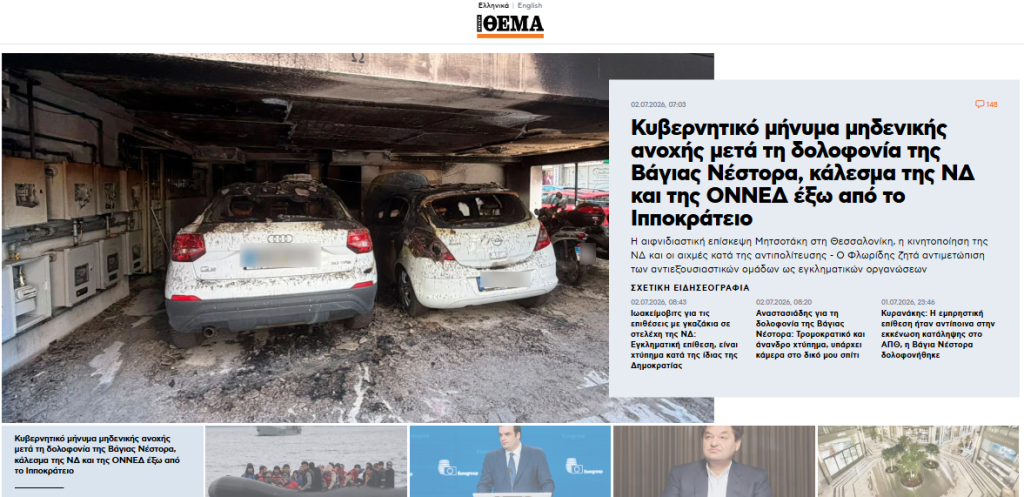
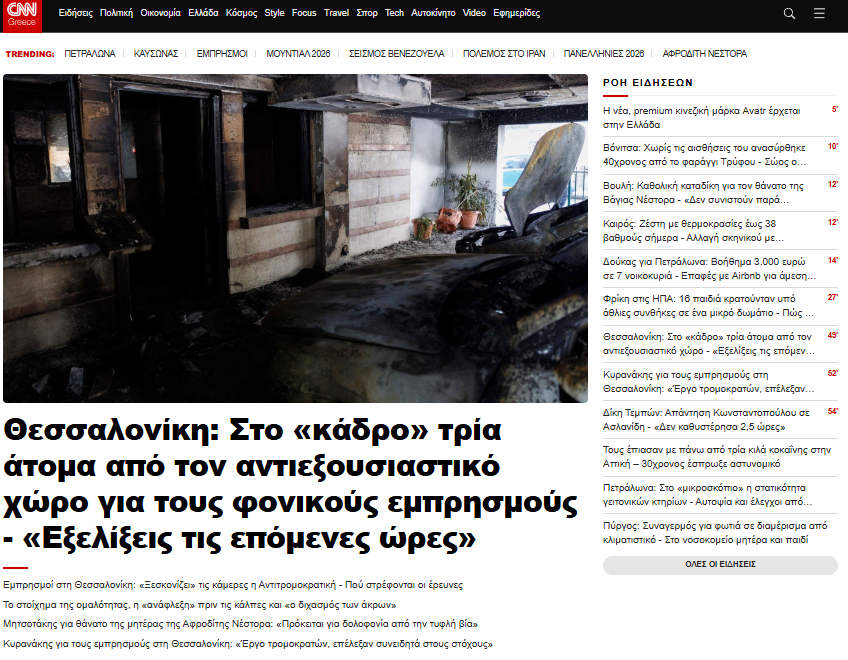

KATHIMERINI: The “cell” behind the lethal attack
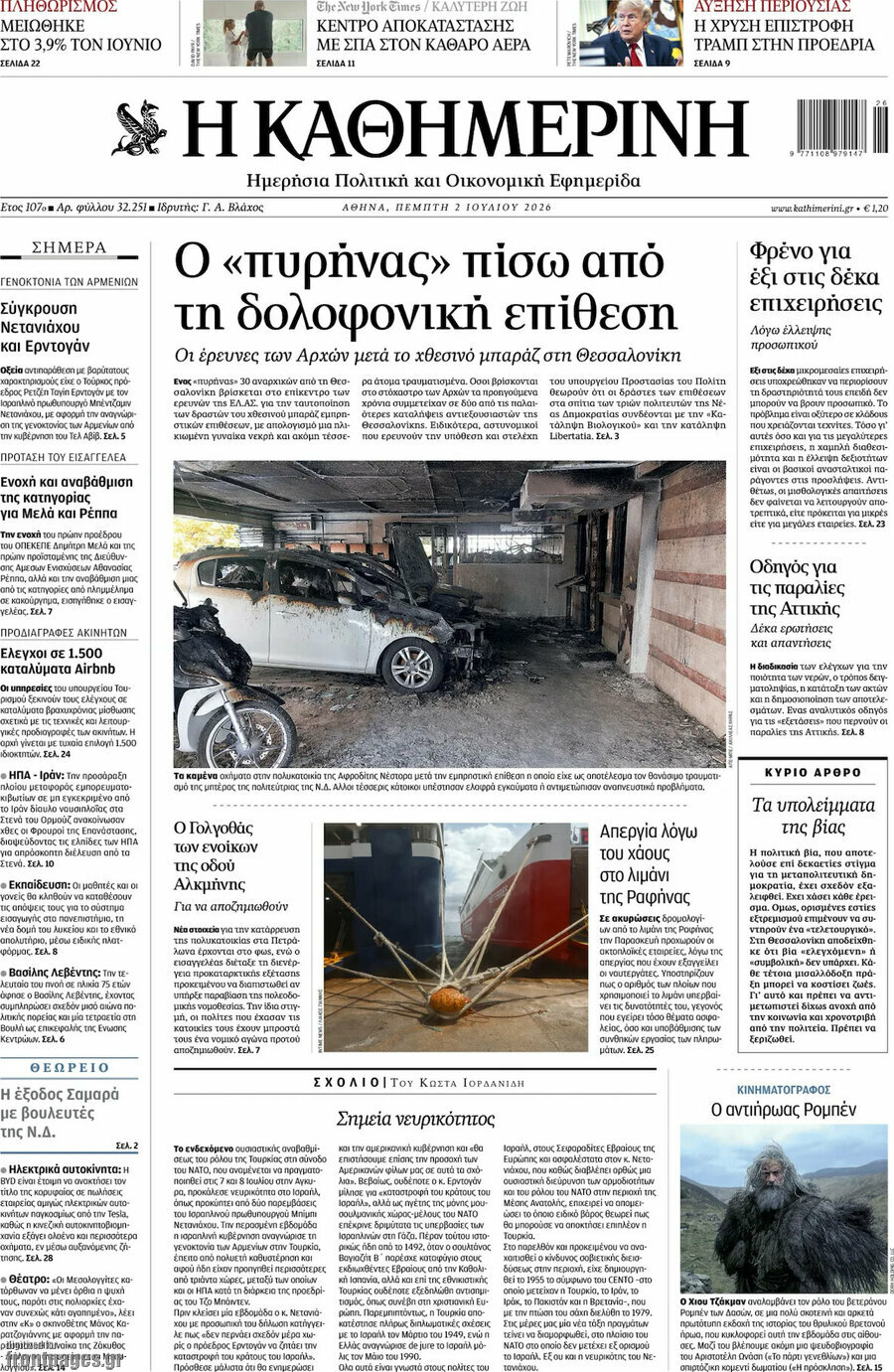
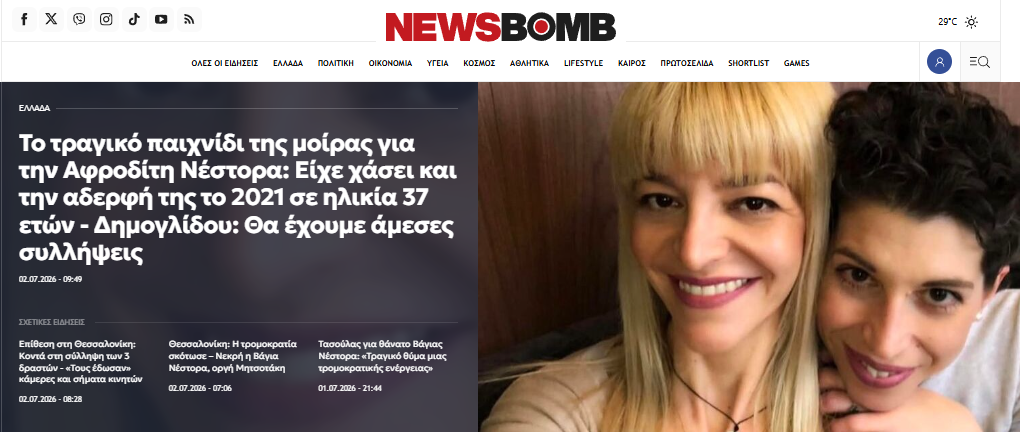
TA NEA: Dead at the altar of blind hate
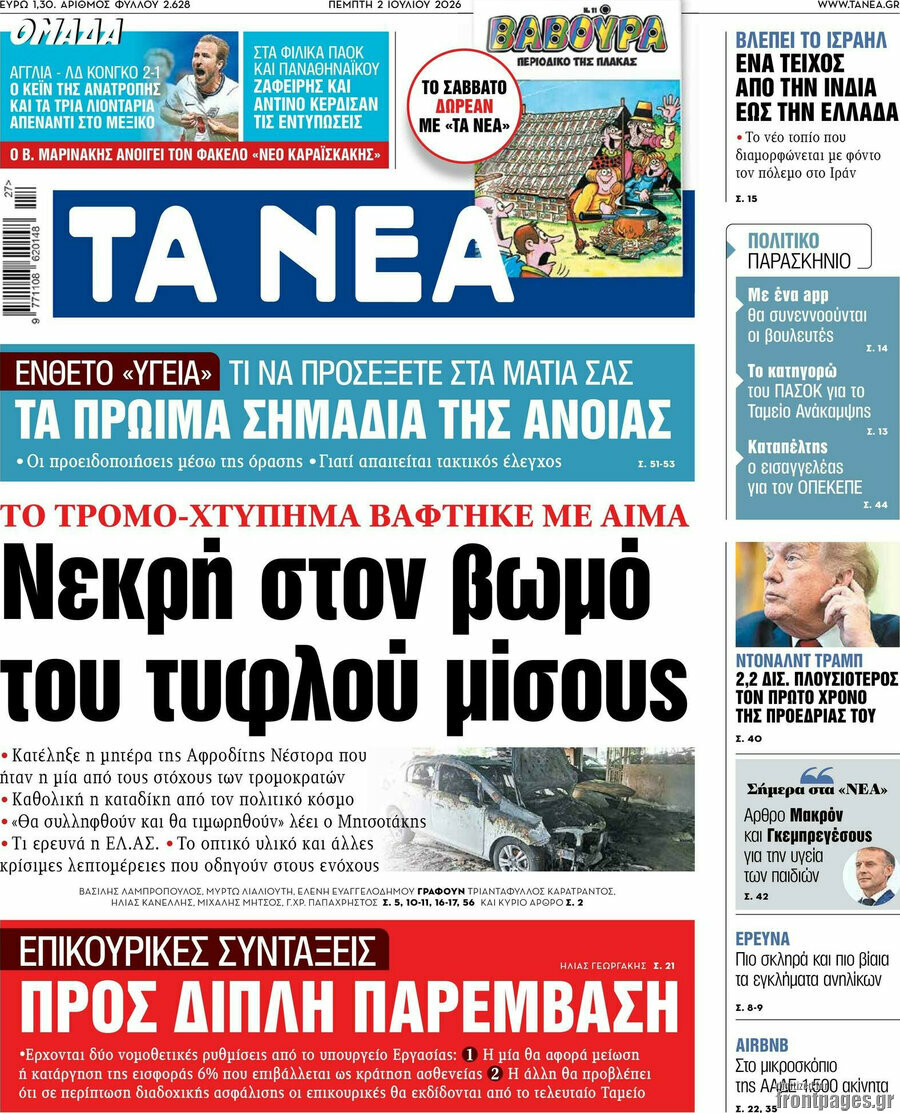
EFIMERIDA TON SYNTAKTON: The government is planning a party-controlled public administration
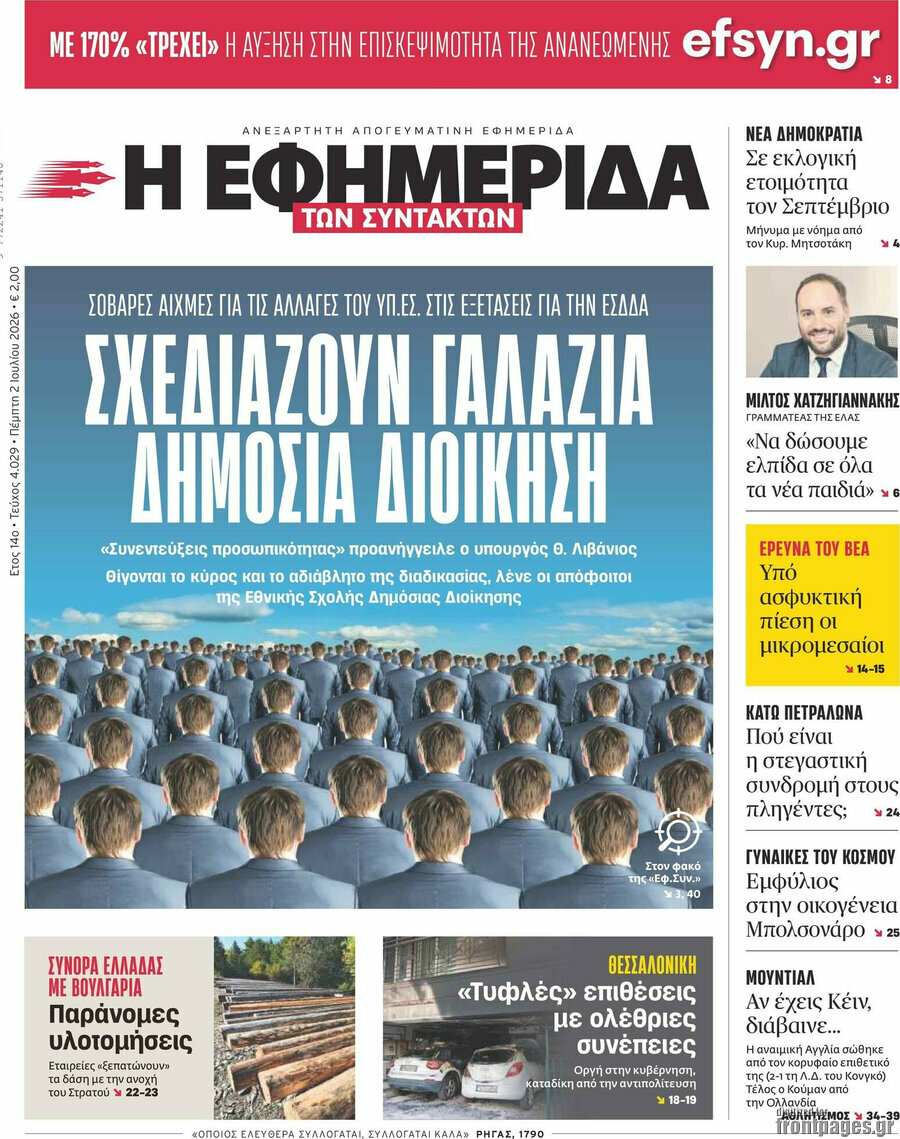
RIZOSPASTIS: Open discussion on simple folks’ housing organized by the Greek Communist Party
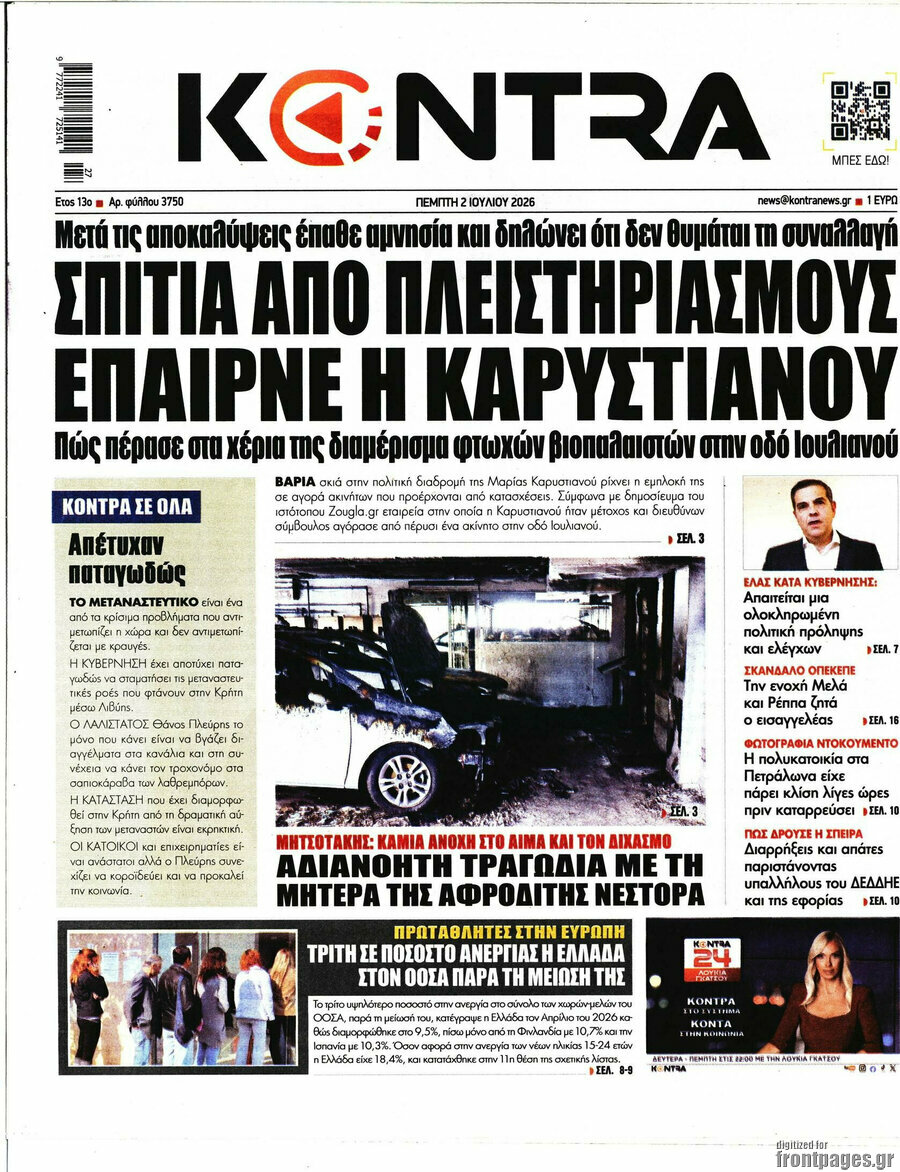
KONTRA NEWS: Karystianou was acquiring homes through auctions
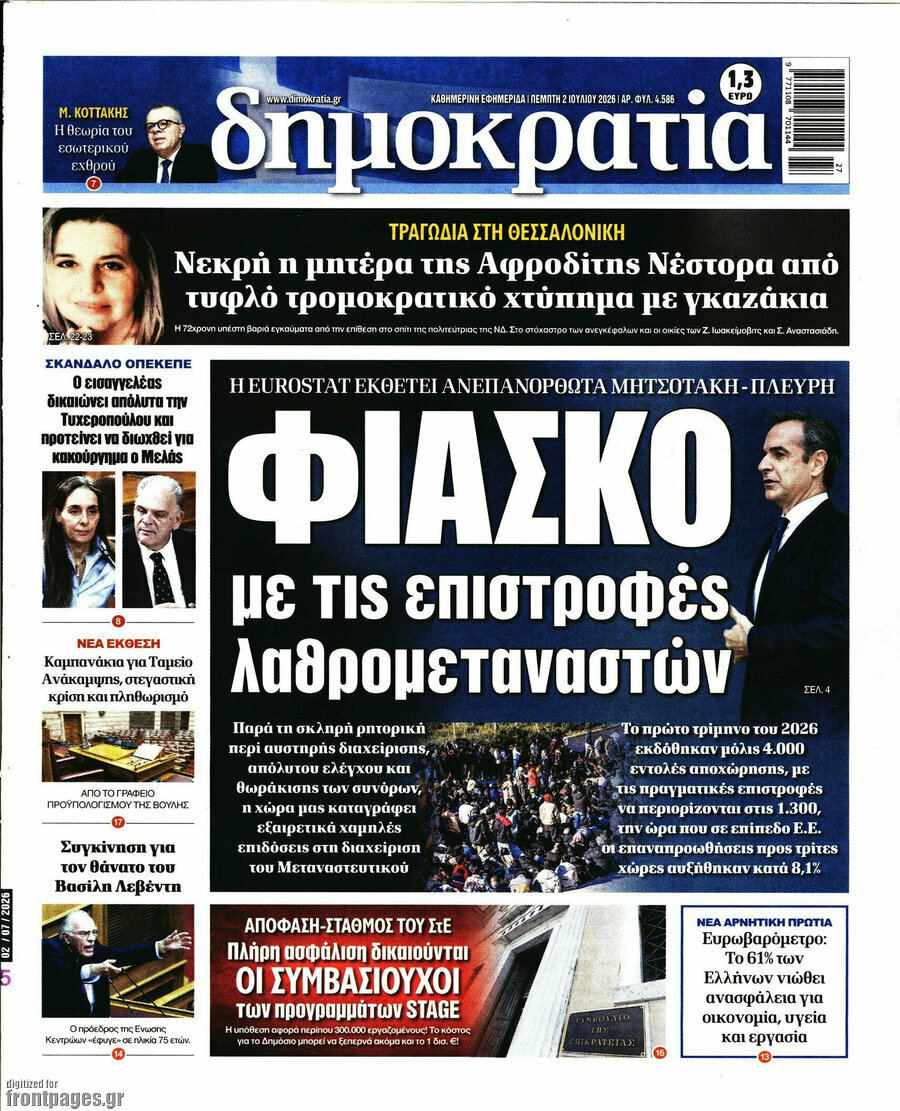
DIMOKRATIA: Fiasco regarding the return of illegal migrants
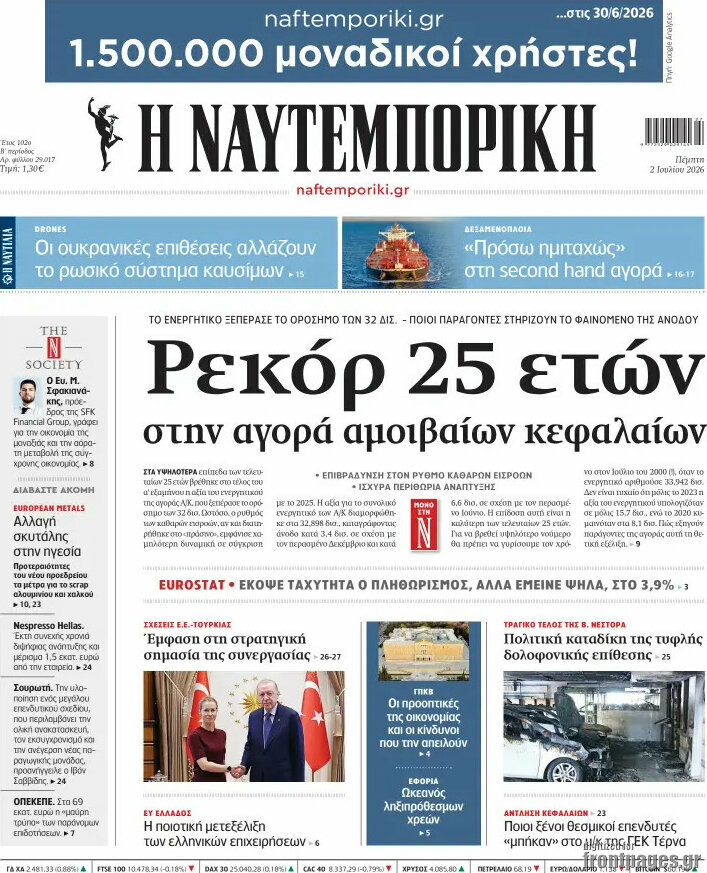
NAFTEMPORIKI: 25-year record in the mutual bonds market

DRIVING THE DAY
READY TO HOLD THE LINE ON RUSSIA: Day 1 of Ireland’s Council of the EU presidency removed any doubt about Dublin’s commitment to security. Ukraine dominated the presidency’s launch, with an unexpected appearance by Ukrainian President Volodymyr Zelenskyy, while sanctions against Moscow topped the Coreper agenda back in Brussels.
Sanctions packaged: Taoiseach Micheál Martin was on the front foot, promising Ireland would work to deprive Moscow of the revenues that are funding its war on Ukraine. “This includes reaching early agreement on the 21st sanctions package and looking ahead to a possible 22nd package,” he said.
The awkward bit: The sanctions push comes as Dublin faces uncomfortable questions on this very issue. The government has been under pressure after revelations that a Russian-owned alumina plant on the Shannon Estuary, in County Limerick, has continued exporting the raw material to Russia throughout the war.
Raging against the war machine: Martin insisted Ireland doesn’t want “material emanating from a plant in Ireland” that supports “the Russian war machine,” but stressed an investigation must conclude before any decisions are taken with the Commission.
Zelenskyy noticed: Without mentioning Ireland by name, the Ukrainian president appeared to reference the controversy. “Unfortunately, there are companies in Europe that are owned or effectively controlled by Russia and its sanctioned oligarchs. They keep supplying the aggressor with essential materials, even now.”
After Martin pointed to the ongoing investigation, Zelenskyy delivered a final nudge, saying he hoped the process would not take months.
How it unfolded: Zelenskyy made the surprise stop in Dublin before quickly leaving again, after intelligence warned of an imminent large-scale Russian attack. That offensive has now begun, the Guardian reports. The Ukrainian leader shared the stage with Martin and European Council President António Costa — but all eyes were on Zelenskyy.
His ask: Keep tightening the screws. Zelenskyy singled out Russia’s shadow fleet and “the many tools Putin still relies on to keep this war going.”
A simple argument: sanctions work. “When their economy is shrinking, we can see that immediately. Russia’s capability to perform massive attacks decreases, and all of that is reflected in the quantity of casualties in Ukraine,” he said.
The bottom line: Zelenskyy got the sanctions commitments he wanted. Now Ireland has to show it can match its rhetoric with its own record as the alumina controversy risks undercutting its message.
BIG AND BREAKING
BUDAPEST’S SPIES IN BRUSSELS: An alleged intelligence operation targeting EU officials run out of Hungary’s Brussels embassy ramped up in 2015, according to a Commission document obtained by POLITICO (for Pro subscribers). Olivér Várhelyi, today the European Commission’s health chief, became Hungary’s EU ambassador the same year.
PROBLEMS AT THE SOURCE: The EU diplomatic service is plagued by internal tensions, ebbing morale and bureaucratic turf war — but arguments over its structure and governance predate the body itself. Was the EEAS set up to fail?
ANKARA EYES VISAS: The EU is “working toward” visa liberalization with Turkey, an EU official said, following a high-profile trip to Ankara by the bloc’s chief diplomat Kaja Kallas and commissioners Magnus Brunner and Marta Kos.
PUTIN FEELS THE HEAT: Ukraine’s strikes are no longer just hurting Russia’s military — they’re starting to affect ordinary Russians at the fuel pump.
END OF THE BEGINNING: The outcome of France’s embezzlement case against National Rally leader Marine Le Pen will determine whether the far-right party’s Jordan Bardella becomes a presidential candidate. But this week’s police raids mean its judicial headaches are far from over.
RESET REDUX: Britain’s next prime minister is set to have a major summit to repair relations with the EU in the first few weeks after taking office, with a rescheduled bilateral meeting and five separate legislative packages on the agenda.
MEP FACES IMMUNITY VOTE: EU lawmakers are expected to vote today against lifting the immunity of the chair of the Parliament’s legal affairs committee, Renew Europe’s Ilhan Kyuchyuk, according to three people with knowledge of the matter. Kyuchyuk is under investigation by the European Public Prosecutor’s Office.
EUROPE WANTS SELF-RELIANCE
WHO YOU GONNA CALL? Most Europeans think their individual countries couldn’t fend off an attack — but few still think it’s acceptable to depend on help from countries outside of Europe, new polling shared exclusively with POLITICO shows.
Transatlantic doom: The figures paint a gloomy picture of Europeans’ sense of security at a time when the administration of U.S. President Donald Trump is pivoting away from the continent, Hanne Cokelaere reports. The insight comes ahead of a meeting of NATO members in Ankara next week.
Need to break free: The NATO summit is likely to add further momentum to EU countries’ push for military independence. Participants will be checked on their pledges to start spending 5 percent of their GDP on defense — a benchmark pushed by Trump.
The numbers: In a June survey, which pollster Public First carried out across 24 EU countries, 58 percent of respondents said their country wasn’t prepared to defend itself; just 27 percent said that it was. They were more positive — but far from enthusiastic — about Europe’s ability to defend itself, with 41 percent saying Europe is ready and 43 percent saying it isn’t.
 |
U.S. who? The most common position held by poll respondents was that it would be acceptable for their country to rely on Europe for military help — but not on countries further afield.
It’s not just defense: The EU’s traditional alliance with the U.S. is under pressure and fraying tensions have European citizens questioning everything from military dependency to trading ties under Trump.
Calling China: At a time when political and trade tensions strain the bloc’s relations with both the U.S. and China, its two largest trading partners, those surveyed tended to think China, not the U.S., would be Europe’s most important trading partner in 10 years’ time.
20-SECOND PLAYBOOK PRIMER
Imports of Russian gas into the bloc increased sharply between January and May this year, according to a new report by EU agency ACER, which convenes national energy regulators. But didn’t the EU ban gas from Russia? Yes, it did — in December 2025, in a bid to wean the bloc off Russian energy. Short-term contracts were phased out between April and June this year, with long-term contracts to be banned from January 2027. ACER says the most recent increase was likely the result of companies racing to stock up before the ban comes into effect.
TRANSATLANTIC THERAPY
MELONI LOYALISTS IN D.C.: A delegation of senior lawmakers from the European Conservatives and Reformists, a European Parliament grouping dominated by Italian Prime Minister Giorgia Meloni’s Brothers of Italy, arrived in Washington this week with one message: let’s stop the bickering.
Making amends: “We have to overcome the frictions between the president and our prime minister, for sure,” said Italian MEP Carlo Fidanza, who is leading the delegation alongside Poland’s Patryk Jaki. Meloni had a falling out with Trump over her refusal to allow U.S. forces to strike Iran from Italian bases.“Our mission here can contribute to explain some of these positions to our American friends,” Fidanza said.
The ECR delegation,whichincludes European Parliament Vice President Antonella Sberna and head of the Polish ECR delegation Adam Bielan, metU.S. Under Secretary of State for Public Diplomacy Sarah Rogers and Under Secretary of War for Policy Elbridge Colby. The delegation was also due to meet deputy national security adviser Andy Baker, according to a schedule seen by POLITICO, and Samuel Samson, the State Department official leading efforts to preserve “America’s Western civilizational heritage,” according to a person familiar with the matter.
Lost in a sea of woke: Americans see Europe as a “lost continent” because of “woke ideology,” weak migration policies and the “crazy” European Green Deal, Fidanza said. But that perception will change as ECR parties win elections across Europe in coming years and start to address those concerns, he said. An example of this is the migration policy that the EU had hardened — “following Meloni’s line.”
Troops: The priority of the Polish MEPs in the delegation will be to convince the Trump administration not to withdraw troops from Europe, as part of the review of the U.S. military presence on the continent. “We hope that Poland would not suffer from this reduction,” said Bielan, a lawmaker from the Law and Justice party.
6 MORE THINGS GETTING US TALKING
“SEND THEM BACK” FALLOUT: A delegation of NGOs including Amnesty International, Equinox Initiative for Racial Justice and PICUM will meet with the cabinet of Parliament President Roberta Metsola to ask for action over the “send them back!” chants of some right-wing MEPs when the Parliament adopted the return regulation on June 17.
GERMANY DEMANDS BUDGET HAIRCUT: Berlin wants to slash the EU’s proposed €2.1 trillion seven-year budget by about €400 billion, according to an internal government document seen by POLITICO. Brussels’ current proposal is “impossible” to accept in its current form, the document says.
Ireland’s message to the frugals: Asked at a press briefing what he’d say to the budget hawks, Ireland’s European Affairs Minister Thomas Byrne argued that “everybody sees the benefits of a strong European budget that delivers for people,” adding that every net contributor is also an EU funding recipient.
MEPS VS. FIFA: Forty-four EU lawmakers are urging FIFA President Gianni Infantino to reverse a decision to let Russian athletes compete at this year’s inaugural U-15 World Cup in Azerbaijan, according to a letter obtained by POLITICO.
Latest from the World Cup: Belgium pulled off the most dramatic comeback of the tournament so far last night, beating Senegal 3-2 with a penalty deep in extra time. Earlier, Brussels’ Matongé area was filled with drums and flags as fans packed into bars and barber shops to watch Congo narrowly lose to England. Read more in our World Cup blog.
EUROVISION GETS WEIRDER: Canada will join the Eurovision Song Contest in 2027, the European Broadcasting Union and the Canadian Broadcasting Corporation announced Wednesday, following in the footsteps of non-European participants Australia and Israel.