
Mitsotakis: Burning a woman is a “murderous act” rather than an intervention
Prime Minister Kyriakos Mitsotakis on Friday in an interview published by Liberal.gr. condemned a recent attack on a woman, describing it as a “murderous act” rather than an intervention.
“They burned a woman. This is not an ‘intervention’; it is a murderous act,” Mitsotakis said, calling for the unequivocal condemnation of such incidents in order to safeguard democratic principles, where differences are resolved through argument rather than violence. He added that political discourse has increasingly drifted toward rhetoric that can “arm the hands” of those who carry out violent acts, and said his government had confronted organised groups that had previously enjoyed political immunity from criticism.
Afroditi Nestora hospitalised in the Burns Unit at Papanikolaou Hospital
Aphrodite Nestora, has been transferred from Ippokrateio Hospital to Papanikolaou Hospital in Thessaloniki after suffering extensive first- and second-degree burns to her hands and legs following the arson attack at her home. Nestora is being treated in the Burns Unit of Papanikolaou Hospital. Doctors are prioritising care for the burns on her hands, and it has been reported that she is breathing without respiratory support. Her father, Panagiotis Nestoras, who is being treated in the Pulmonology Clinic of Ippokrateio for respiratory problems following the attack, is expected to be discharged on Friday. One of the apartment building residents, also hospitalised in the same clinic, is likewise expected to be discharged on Friday.
New poll projects ND ahead at 30.4%, ELAS at 17.1%
The governing conservative New Democracy party is projected to win just over 30% of the vote in the next elections, while left-wing former Prime Minister Alexis Tsipras’ new party has increased its lead over Socialist PASOK to consolidate its position at the head of the opposition, a new poll indicated Thursday. The Metron Analysis survey for Mega TV projected that Prime Minister Kyriakos Mitsotakis’ ND would secure 30.4%, 1.9 percentage points up from the company’s last poll published in June. Tsipras’ Greek Left Alliance, ELAS, also gained 1.9 percentage points to a projected 17.1%, while PASOK limped in third at 11.4%. Another fledgling party, rail safety activist Maria Karystianou’s Hope for Democracy, is projected to get 7.5% – down from 10.4% – and the Greek Communist Party follows at 6.2%. Four populist parties, two right-wing and two left-wing, are also projected to cross the 3% Parliamentary threshold. Tsipras’ former SYRIZA party is projected to get 1.4%.
https://www.ekathimerini.com/politics/1308478/new-poll-projects-nd-ahead-at-30-4-elas-at-17-1
Inflation fell to 3.9% in June
Inflation slowed in June, both in Greece and in the eurozone, mainly thanks to the decrease in fuel prices. However on a monthly basis Greece recorded an increase in food prices that was the largest in the eurozone, even though the profit ceiling was still in force last month. According to Eurostat estimates, the harmonized index of consumer prices increased in Greece in June compared to a year earlier by 3.9%, down from an annual increase of 4.9% in May. This is the fifth highest inflation in the eurozone, after Lithuania, Bulgaria, Croatia and Cyprus. In the euro are, the harmonized consumer price index increased in June by 2.8% annually, compared to an annual increase of 3.2% in May.
https://www.ekathimerini.com/economy/1308377/inflation-fell-to-3-9-in-june
ATHEX: Index covers losses from 200 months
Two hundred months is a long time: It is 17 years minus four months. This is the period whose bourse benchmark losses were fully covered for the first time on Thursday at Athinon Avenue, as another day of price growth had the main index return to over 2,500 points and to levels unseen since November 2009, or when the debt crisis started kicking in. The universal move upward recorded in this session, despite the small drop in turnover, pointed to a structural shift toward higher ground.
https://www.ekathimerini.com/economy/1308489/athex-index-covers-losses-from-200-months


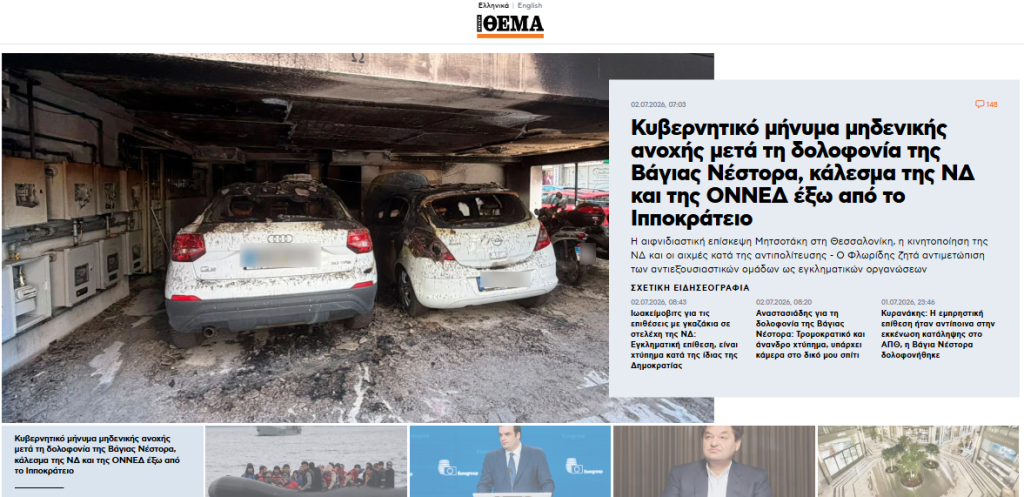
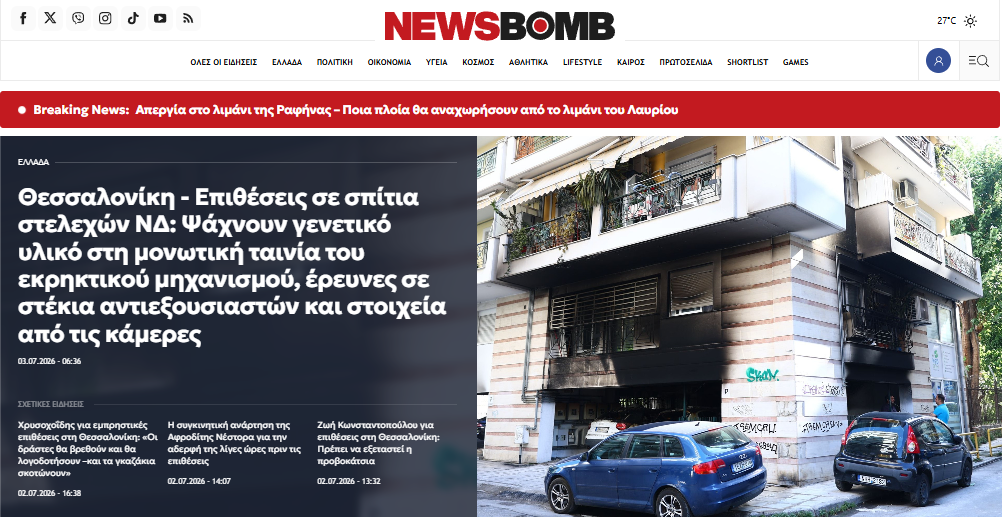
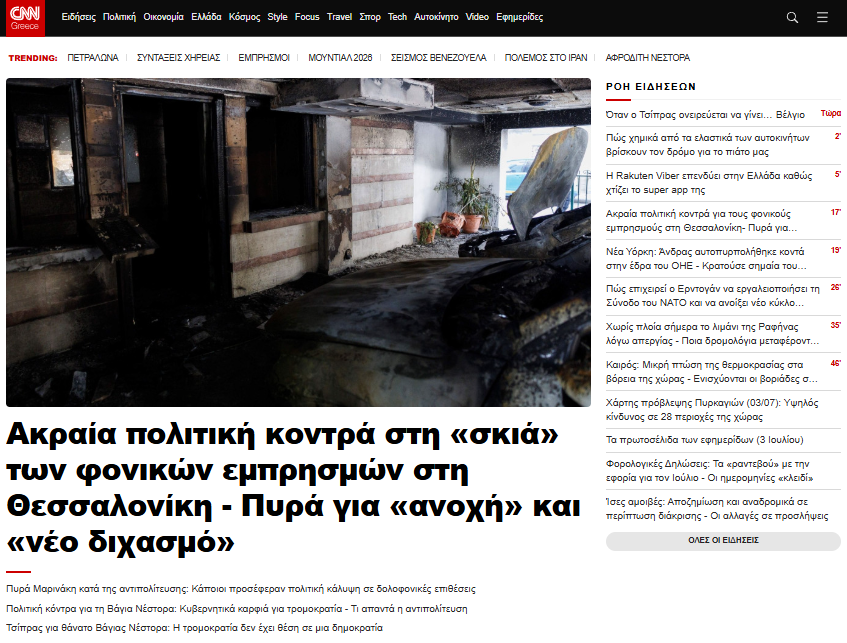

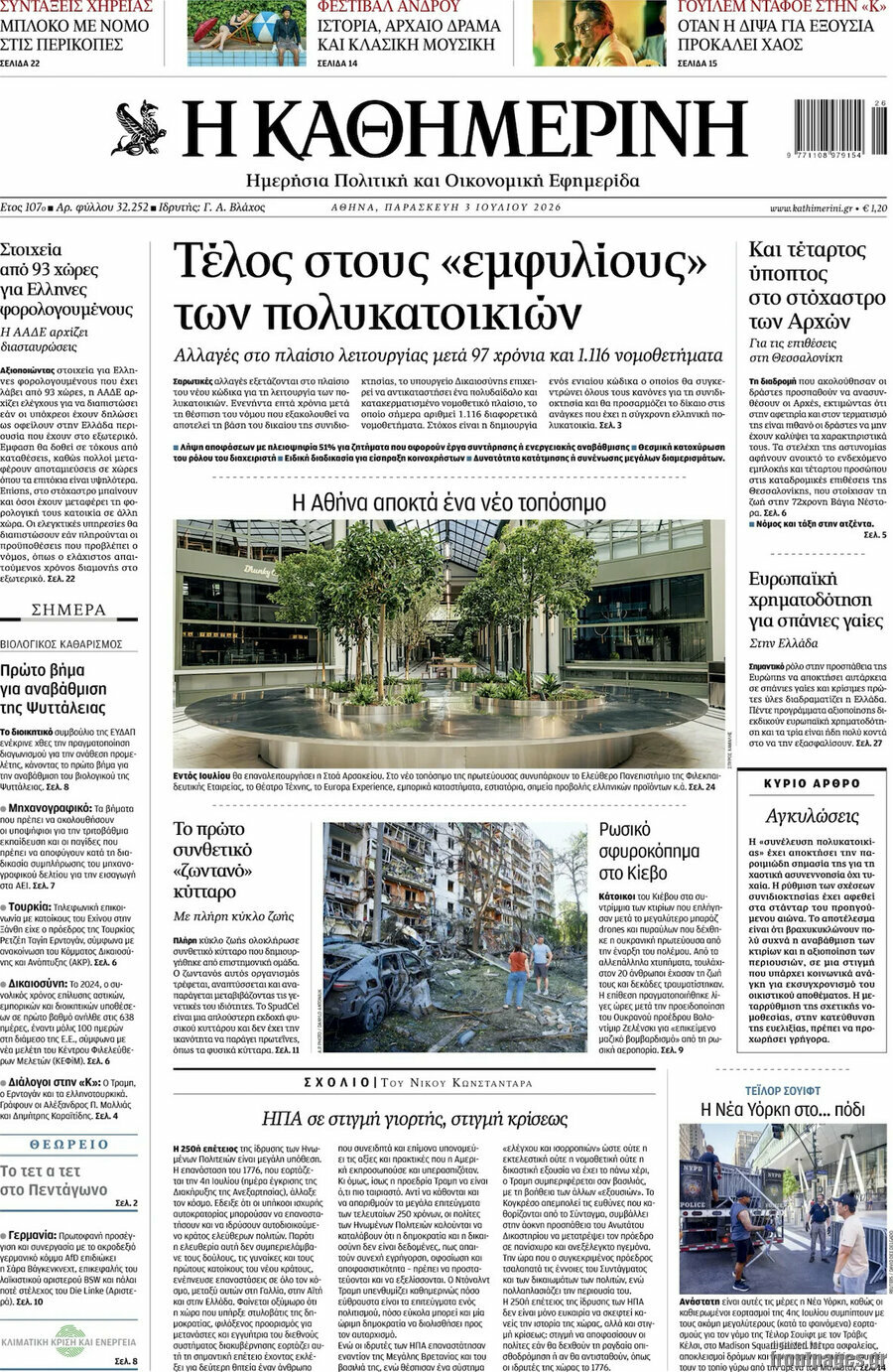
KATHIMERINI: No more “civil wars” in apartment buildings
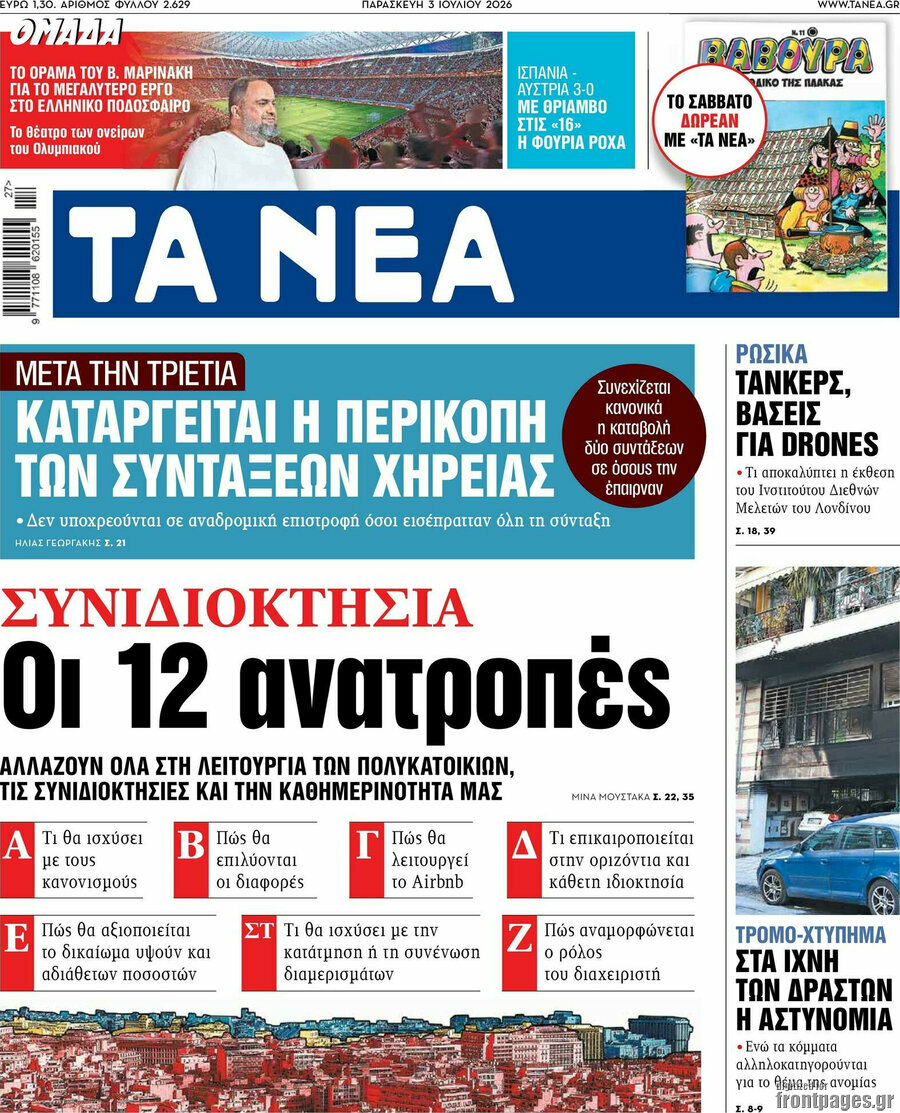
TA NEA: Co-ownership of real estate assets: 12 changes
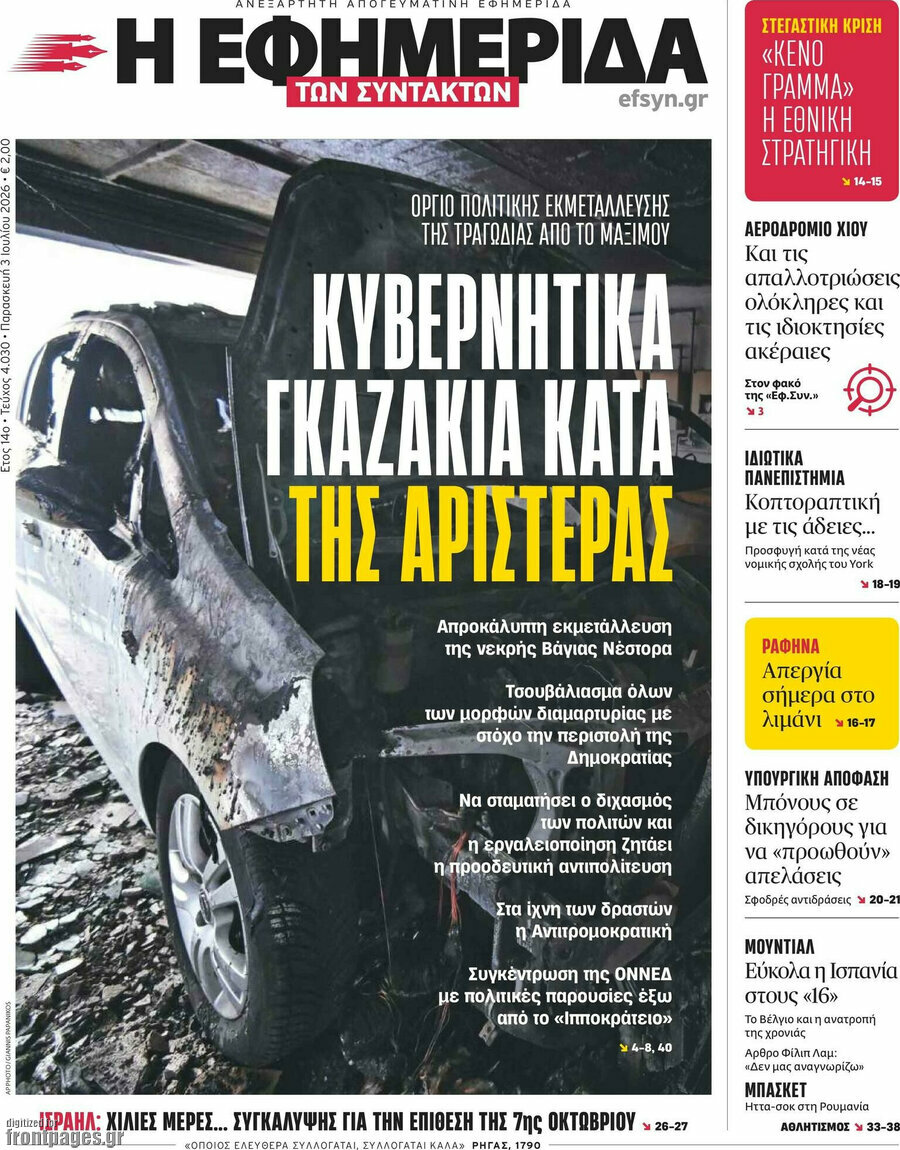
EFIMERIDA TON SYNTAKTON: Government instigates “inflammatory” tension with the Left
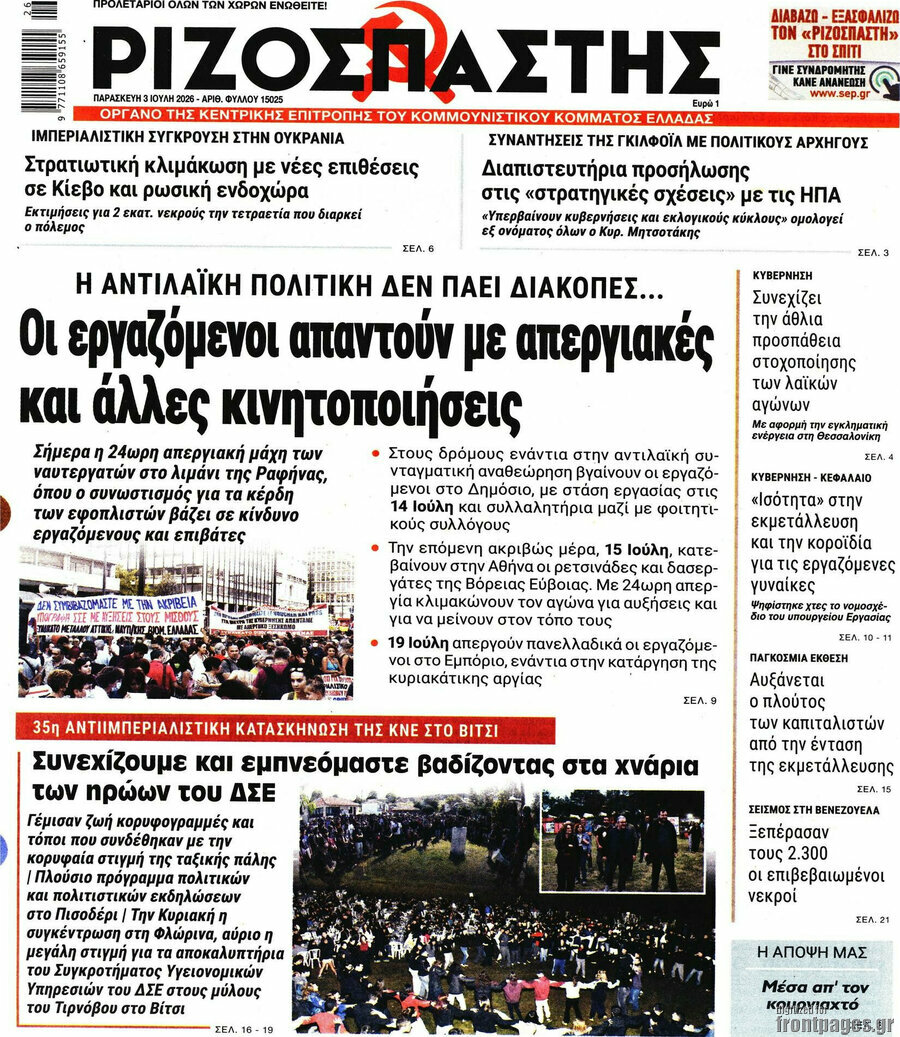
RIZOSPASTIS: Workers respond with strikes and more rallies
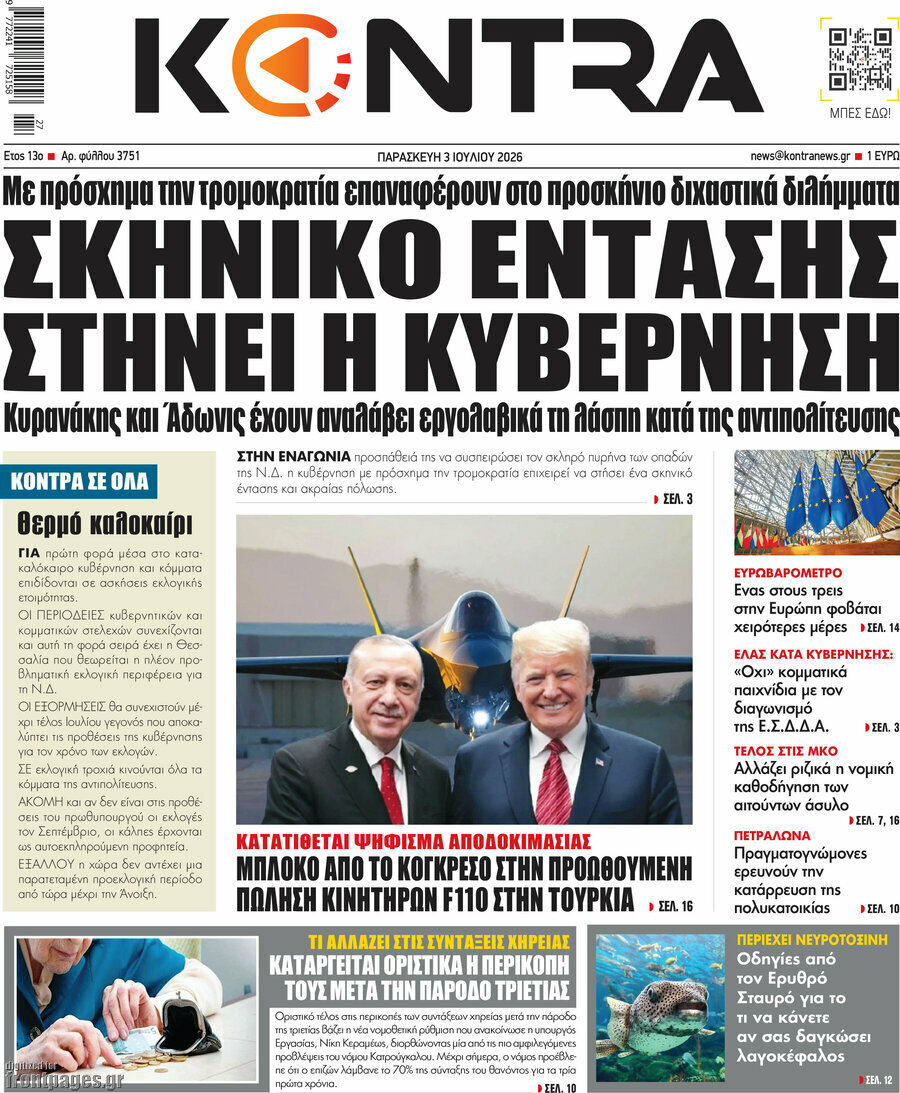
KONTRA NEWS: The government is setting up a tension scenery
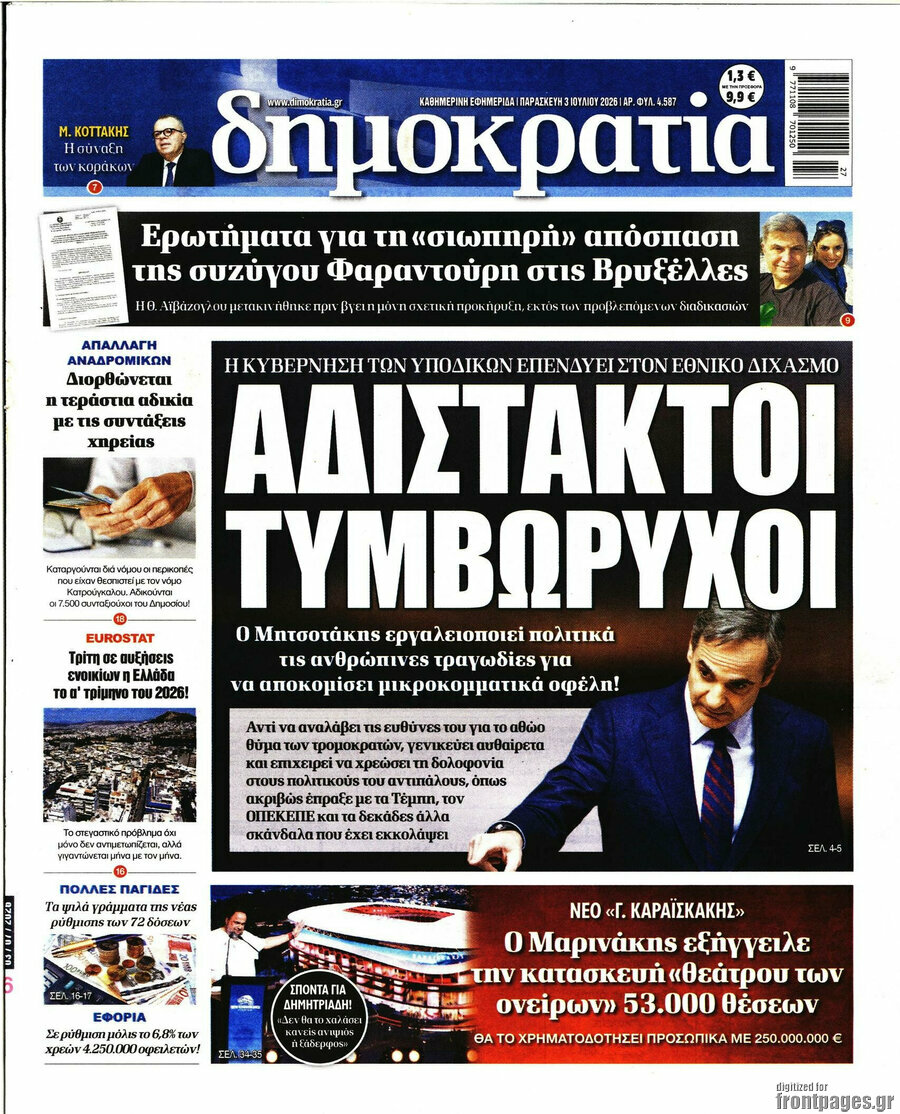
DIMOKRATIA: Mitsotakis is a ruthless tomb raider
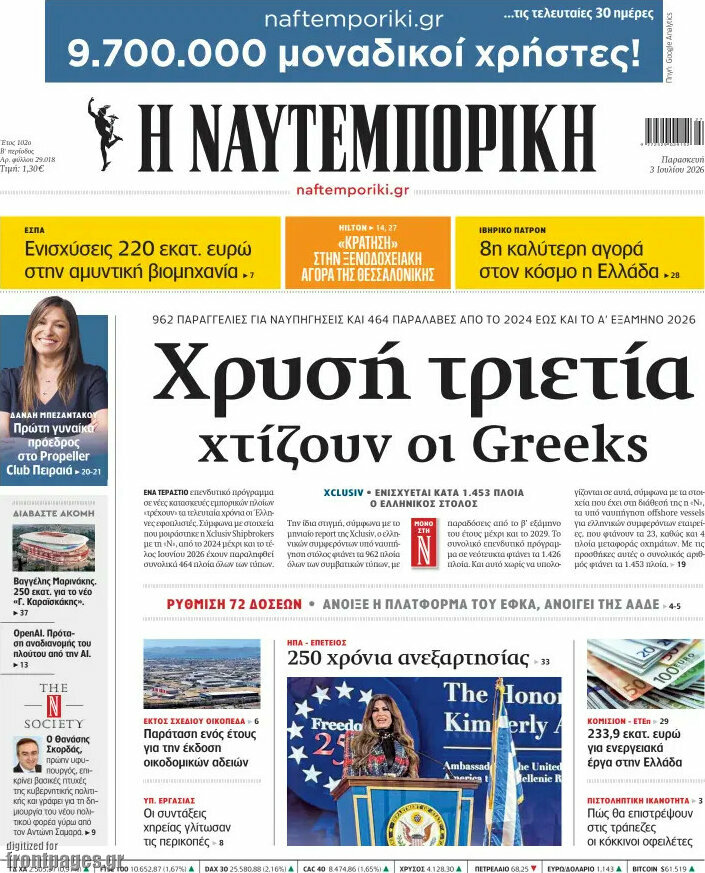
NAFTEMPORIKI: Greeks of shipping are building a golden three-year era

DRIVING THE DAY
DEFENSE SPENDING DRIVE: EU leaders are sitting down for talks on how quickly they can boost defense spending, amid growing threats from hostile powers and increasing uncertainty over President Donald Trump’s plans. But the clock is ticking to work out how to pay for it.
Frontline warning: German Chancellor Friedrich Merz will today meet the leaders of Estonia, Latvia and Lithuania to discuss European security and support for Ukraine, ahead of next week’s NATO summit in Ankara. All NATO countries apart from Spain have committed themselves to spending 5 percent of their GDP on defense by 2035 — but some want that to be done far sooner.
Not if, but when: “The question is no longer whether Europe should do more for its own security. The question is how quickly we can deliver. A stronger Europe means a stronger NATO,” Estonian Prime Minister Kristen Michal told Playbook ahead of the meeting.
A stitch in time: “Investing in deterrence today is far less expensive than paying for the consequences of aggression tomorrow. The message from Ankara must be clear: Europe is ready to take greater responsibility for its own security while keeping the transatlantic alliance strong,” Michal said.
It’s all about the money: Spending commitments will be on show next week, with NATO allies hoping to use the summit to repair relations with Trump. The friendship was strained after Europeans hesitated in joining U.S. attacks on Iran, with Washington announcing plans to withdraw troops and capabilities from Europe.
Hey, big spenders: Leaders will be trumpeting the extra €139 billion NATO members (excluding the U.S.) spent this year on defense. Their commitment is to shoulder the burden of defending the continent and — according to a person familiar with the planning who spoke to my colleague Victor Jack — announce “double digit” billions in new procurement deals.
Keep it snappy: There’s just one three-hour session planned, in a bid to keep Trump from getting bored, one NATO official told POLITICO. Although keeping the U.S. president engaged might not be a problem, if his overnight social media post lamenting the size of American NATO spending is anything to go by.
Canada’s middle-power posse: Reuters is reporting that Ottawa hopes to use next week’s summit to announce about 10 founding countries for a global defense bank, as part of Prime Minister Mark Carney’s call for an alliance of middle powers. So far, only Luxembourg has publicly joined the initiative.
Finding the money: Boosting European defense capabilities depends on new funding in the EU’s long-term budget, the MFF, which is at the center of a fierce battle between net payers and net recipients. “The money that is supposed to be dedicated to defense is much greater than in the previous MFF,” said one EU official of the draft plans. But “we need to find the means to do it, and we need new ‘own resources’ to pay for this,” the official said.
Problematic: The size of the spending and the new powers the EU wants to raise the money are still proving controversial for capitals.
Buckle up: The twin issues of protecting Europe and signing off on the MFF will dominate the agenda for the rest of the year. Officials told Playbook that October’s European Council will focus on the debate. The summit is expected to last for two days — a rare move for Council President António Costa, who has championed efficient one-day affairs that spare leaders, diplomats (and reporters) brutal back-to-back negotiations.
BIG AND BREAKING
TAKING ACTION: Top EU diplomat Kaja Kallas has proposed a new round of sanctions on Russia’s military industries, following the recent deadly attack on Ukraine that killed at least 27 people, according to recent reports.
BEIJING CRACKDOWN: The EU is setting a deadline of October to outline its response to unfair Chinese trade practices, trade chief Maroš Šefčovič has told ambassadors, with officials working through the summer on the proposals. More for subscribers in Morning Trade.
JUDGMENT DAY: French far-right leader Marine Le Pen is set to find out on Tuesday whether she’ll be able to stand as a candidate in next year’s presidential elections, after a long-running legal battle over an embezzlement complaint.
DASHBOARD
WHO CAN WE DEPEND ON? Europeans want to rely on themselves to defend their countries — but they want to see proof it’s possible, according to polling data shared with POLITICO.
 |
LIBERALS VS. VETO
NO BLOCKERS: The EU’s liberal party ALDE is calling on the bloc’s institutions to curtail the power of national governments to veto foreign policy. ALDE is calling for a “pooled veto,” under which only groups of five EU members, representing at least 5 percent of the bloc’s population, could block decisions.
The proposal follows the angst sparked by former Hungarian Prime Minister Viktor Orbán‘s hostility to the EU’s Ukraine policy. It’s also designed to allay concerns over veto powers, which may be slowing down EU enlargement, starting from the accession of Montenegro.
Vienna bash: The policy suggestion is part of a resolution, obtained by POLITICO, to be debated and voted on by hundreds of delegates gathering in Vienna today for ALDE’s annual congress. They include representatives from Dutch party D66, Estonia’s Reform Party and Romania’s USR.
Broad range of proposals: The parties — including 12 in government across the EU — will seek to agree on 17 resolutions, ranging from the economy to social media bans and Ukraine. We scooped them for you.
Tough times: The gathering comes at a difficult moment for Europe’s liberals, two years after the 2024 EU elections. As the European People’s Party increasingly relies on far-right votes and the Socialists & Democrats pull left, the liberals’ Renew Europe grouping — which is a broadly centrist and socially progressive — is witnessing its internal factions drifting further apart.
Migration: Those tensions were laid bare during the vote on the EU’s return regulation: 37 Renew MEPs were in favor of the measures; 21 against; and 12 abstained. These divisions are likely to resurface this weekend as delegates debate a migration resolution calling for trade sanctions against countries refusing to readmit deported nationals.
Belgian surprise: The clearest illustration of the widening gaps among Europe’s liberals is Belgium’s Georges-Louis Bouchez. The Reformist Movement leader recently suggested his party could one day join the EPP, arguing that Renew has become too cautious on the need for economic reform. Bouchez canceled his trip to Vienna two days before the congress.
We get it: “I understand that [Bouchez] is concerned about some economic positions,” said German MEP Svenja Hahn, ALDE’s president, who is set to be re-elected unopposed on Saturday. Hahn is among the liberals pushing for sweeping deregulation as part of the EU’s omnibus packages — although others in the party believe that goes too far. “We’d need a German Autobahn with no speed limit for the omnibuses to move forward significantly faster,” Hahn joked.
20-SECOND PLAYBOOK PRIMER
The European Parliament’s energy committee on Thursday discussed its position on elements of the EU’s plans to strengthen the bloc’s energy plan. But what is the European Grids Package? It’s a plan to modernize and expand Europe’s electricity infrastructure, in part because some 40 percent of distribution grids are over 40 years old. It includes common EU-wide grid planning, expanded cross-border infrastructure rules and faster procedures for granting permits. Talks among the main EU institutions on the package will take place later this year.
POSTCARD FROM IRELAND
COLLEGE DAZE: Day 2 of the College of Commissioners’ visit to Ireland to mark the start of the country’s rotating presidency was hosted at University College Cork. The institution has an impressive list of alumni, from Taoiseach Micheál Martin to actor Cillian Murphy (who attended but never graduated).
Circle of life: Commission Deputy Chief Spokesperson Olof Gill is an old boy of the college, telling Playbook’s Gerardo Fortuna on the ground that he was “delighted and proud” to be back on campus, having finished his degree during Ireland’s 2004 Council presidency. “It feels like coming full circle.”
On the menu: Commission President Ursula von der Leyen and her team last night feasted on Ballycotton Seafood, mushrooms and summer berries, with Roscommon chargrilled beef fillet and fondant with potatoes, and a light Jameson Irish Whiskey cream.
What’s on today: Expect thematic sessions between commissioners and Irish ministers, with competitiveness and security topping the agenda, alongside a plenary meeting between the Commission and government.
The unavoidable MFF: Martin made clear what would consume Ireland’s presidency: The budget negotiations ahead would be “very, very tough,” he warned. In his words: “Budget is reconciling the irreconcilable.” His target date is the special European Council on November 26, when leaders will try to bridge the gap between frugals, friends of cohesion and everyone in between.
5 MORE THINGS GETTING US TALKING
ROYAL ROMANCE RISKS ELECTORAL GUILLOTINE: Jordan Bardella’s romance with an Italian princess is clashing with his working class credentials, the French far-right leader’s allies fear.
NUCLEAR RETHINK: Lithuanian President Gitanas Nausėda says his countryis close to scrapping its historic prohibition on nuclear weapons, raising the prospect of hosting American warheads.
HOW TO DEAL WITH TRUMP: MAGA-friendly Greece should follow in Spain’s footsteps and burn its bridges with Washington, former left-wing Prime Minister Alexis Tsipras told POLITICO in an interview.
A BIG SPLASH: In this week’s Declassified column, Paul Dallison looks at the French far-right’s new enemy: a teenage boy armed with a water pistol.
TROUBLED WATERS: A shipyard in Denmark is racing to service Russia’s icebreaking gas tankers, which help fuel the Kremlin’s war in Ukraine, before a ban comes in at the end of the year.