
Mitsotakis upbeat on further drop in retail fuel prices
Prime Minister Kyriakos Mitsotakis told a Cabinet meeting Tuesday that fuel prices at petrol stations are expected to drop further amid the easing of tension between the US and Iran in the Persian Gulf. Mitsotakis said oil prices are now roughly back at pre-war levels. “Of course we all hope that these reduced oil prices are reflected in petrol prices at the pumps,” he said. “This is something that I am sure will happen in the next few days. Obviously state supervisory mechanisms will ensure that petrol and diesel prices follow crude oil prices, with the small delay always to be expected.”
https://www.ekathimerini.com/economy/1308205/mitsotakis-upbeat-on-further-drop-in-retail-fuel-prices
Poll: Cost of living voters’ top concern, new parties face cautious reception
High prices, low wages and pensions remain the issues of greatest concern to Greek voters, according to a MARC poll for ANT1, while two newly launched parties – Hope for Democracy, led by Tempe rail disaster campaigner Maria Karystianou, and former SYRIZA prime minister Alexis Tsipras’ ELAS – have yet to win broad public support, with voters expressing reservations about both.
Cabinet appoints new Supreme Court President and Chief Prosecutor
The Cabinet on Tuesday adopted the recommendations of Justice Minister George Floridis and appointed Panagiotis Lymperopoulos as the new President of Greece’s Supreme Court, and Evangelos Bakelas as the new Chief Prosecutor.
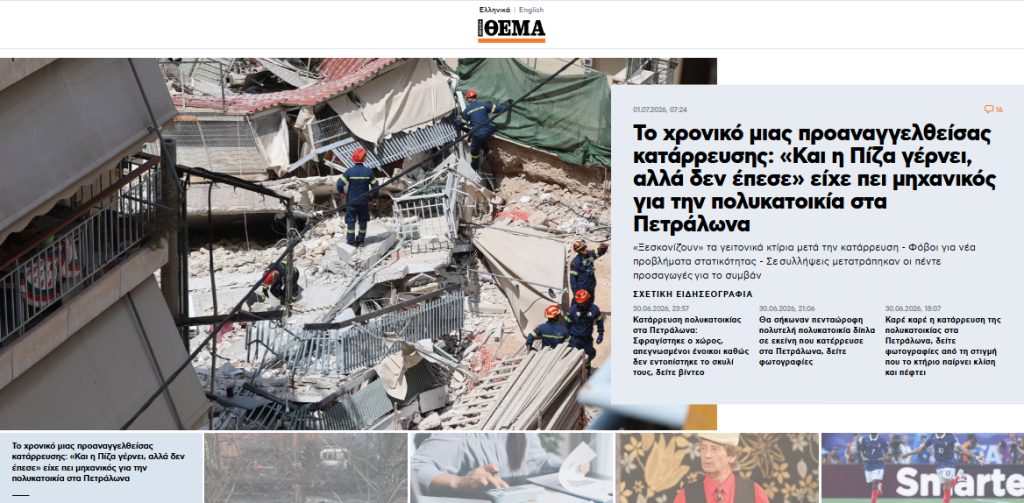
Apartment building collapses in central Athens; unconfirmed reports of one person trapped
A major search and rescue operation was underway on Tuesday afternoon, following the collapse of a four-storey residential building on Alkminis Street 22 in Petralona, central Athens. The four residents who were originally feared to be trapped under the rubble have since called in to confirm that they were not in the building when it fell, the Fire Department said.
ATHEX: Bourse has gained 16% so far in 2026
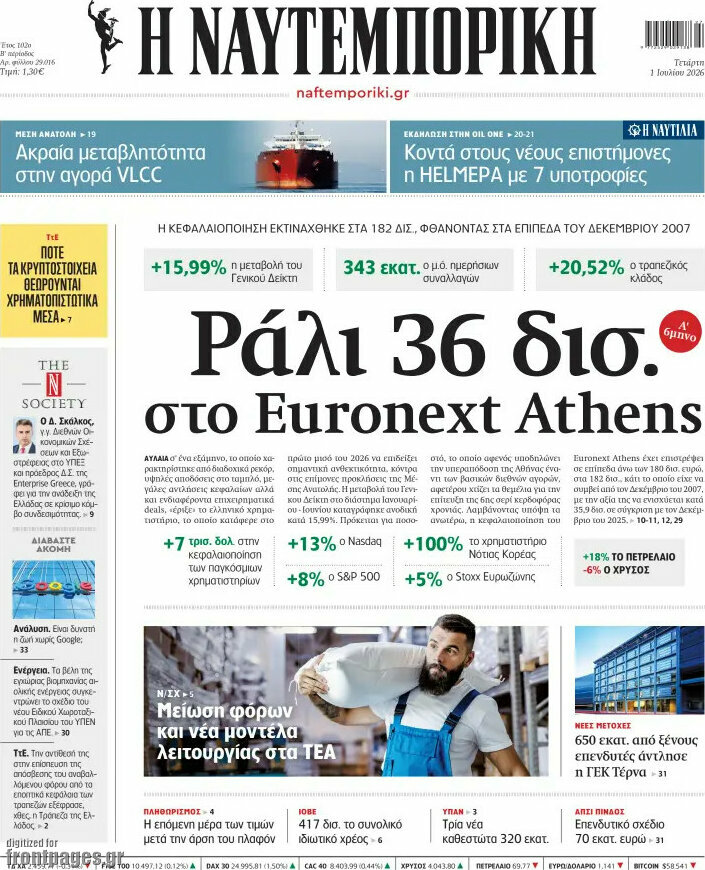
The last bourse session of June and the first half of the year offered less window-dressing than expected, as there was more stock-picking and less cashing in on gains, with the end result being determined by the outperformance of sellers at the closing auctions. In total, June proved to be the third consecutive month of growth for the benchmark, that recorded monthly gains of 3.67%. Since the start of the year the main index has climbed 15.99%.
https://www.ekathimerini.com/economy/1308265/athex-bourse-has-gained-16-so-far-in-2026



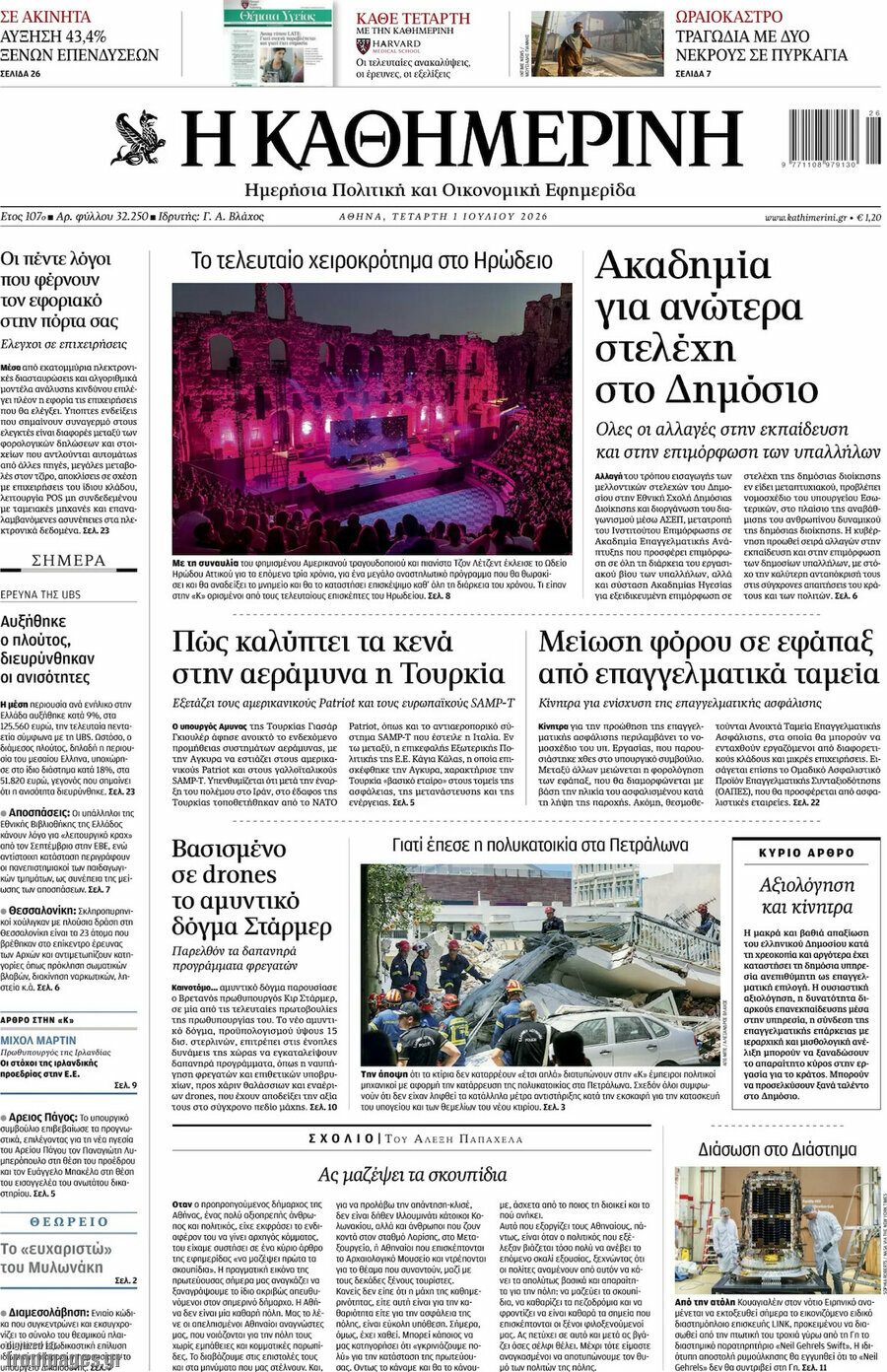
KATHIMERINI: Academy for high ranking civil employees
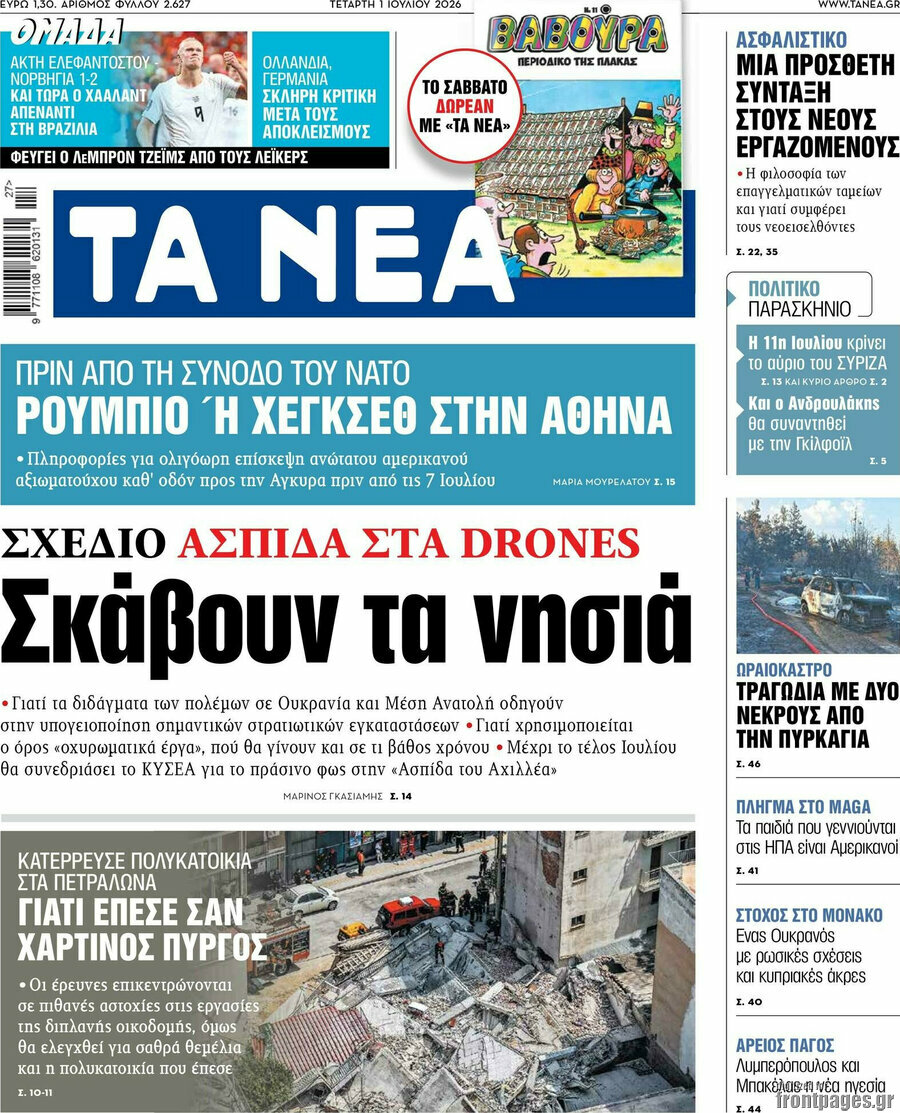
TA NEA: Military facilities on the islands are going underground
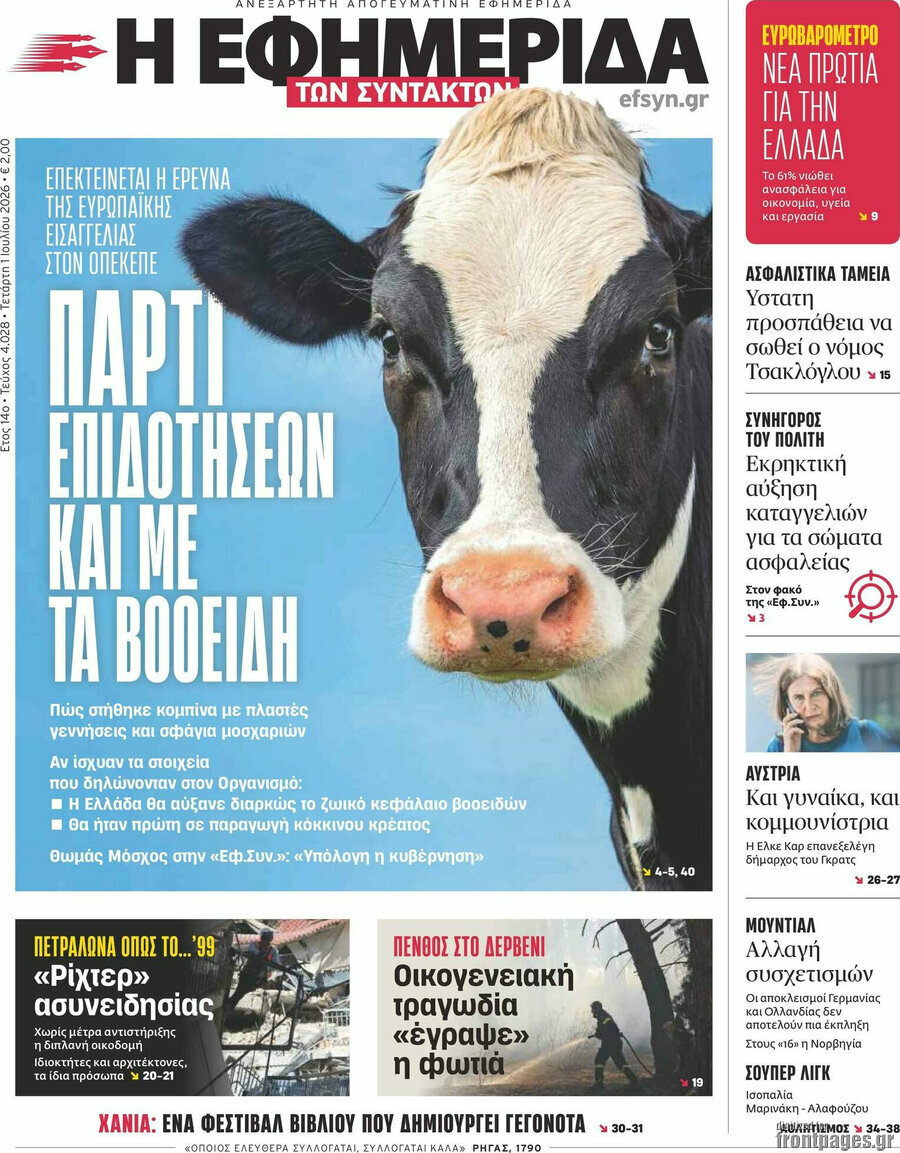
EFIMERIDA TON SYNTAKTON: Party regarding subsidies for cattle
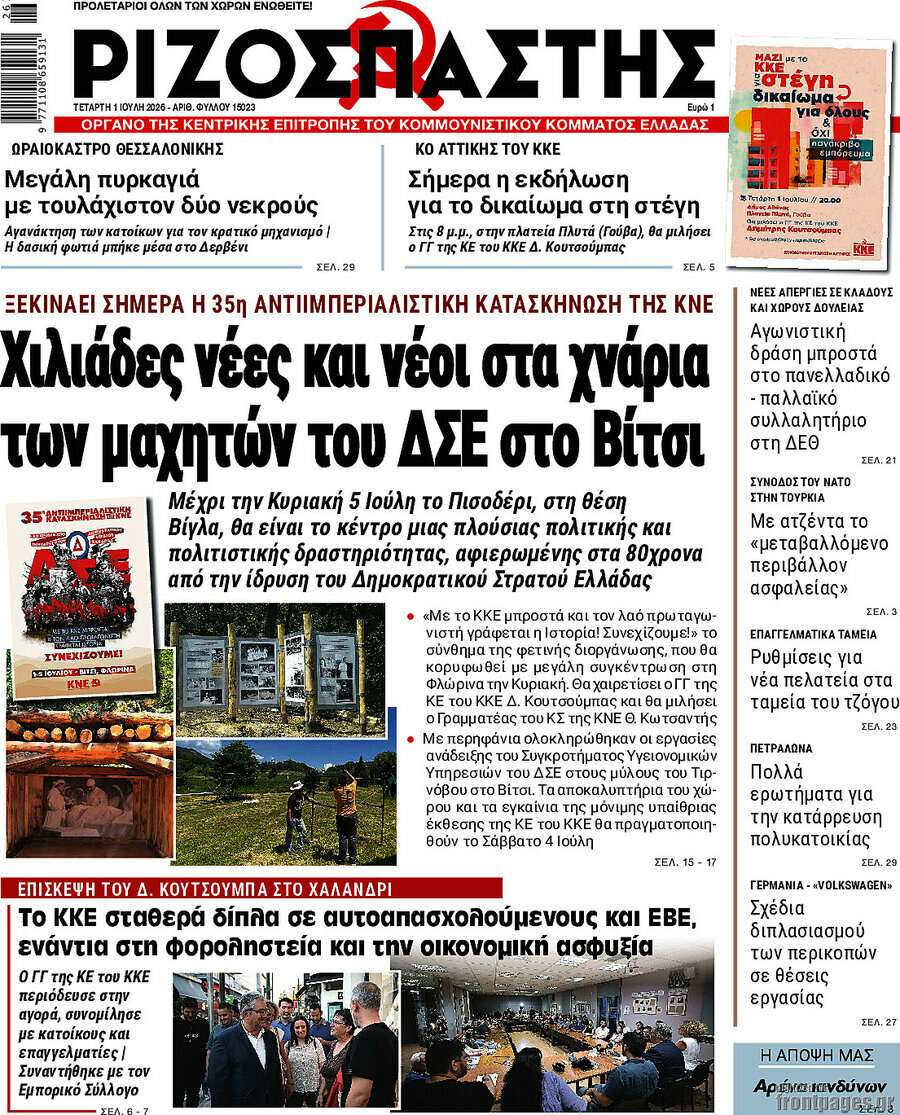
RIZOSPASTIS: Thousands of youngsters in the path of the civil war fighters at Vitsi
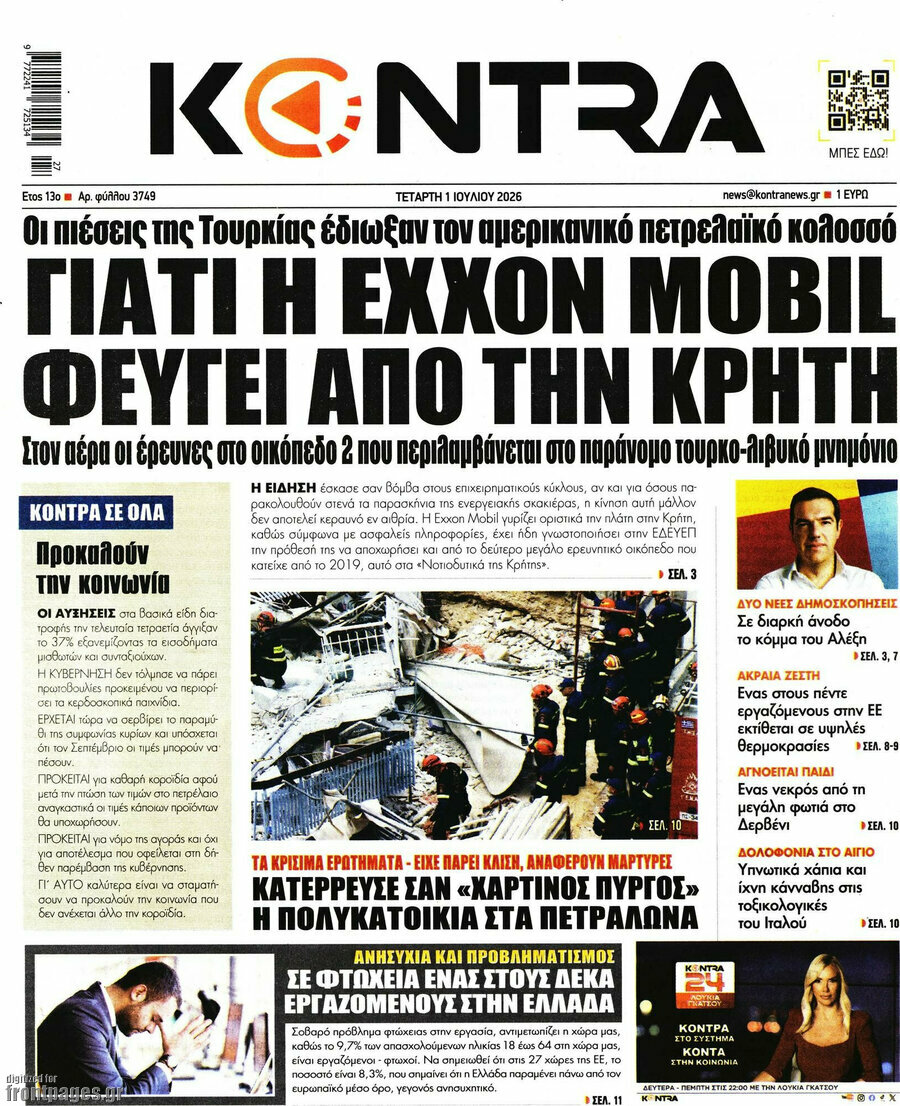
KONTRA NEWS: Why Exxon Mobil is leaving Crete
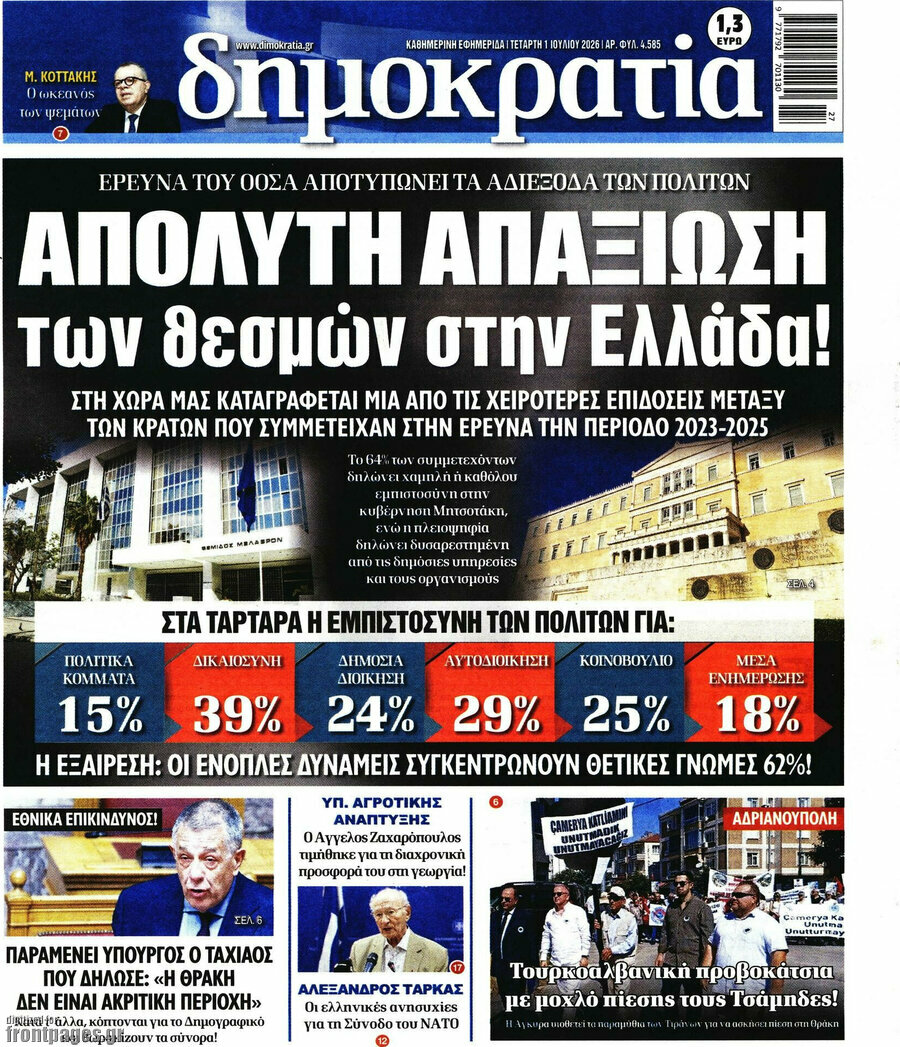
DIMOKRATIA: OECD: Total degradation of institutions in Greece
NAFTEMPORIKI: 36-billion-euro race in the Euronext Athens stock exchange

DRIVING THE DAY
TIME TO BE IRISH: No, it’s not St. Patrick’s Day, but Ireland takes over the rotating EU Council presidency from Cyprus today. And the expectation in Brussels is clear: broker some deals.
“It’s a generational moment for politicians, civil servants and for the country as a whole,” Ireland’s European Affairs Minister Thomas Byrne told POLITICO’s Chief EU Correspondent Zoya Sheftalovich.
Prepared for pain: The presidency will be dominated by negotiations on the EU’s next long-term budget — and Byrne said he knows what he’s signed up for. “It’s something we don’t stop thinking about or talking about,” he said. “Lots of people will be unhappy with a presidency when they prepare a negotiating box,” Byrne said. “We have to be ready for that.”
Showtime: The curtain goes up at Dublin Castle this afternoon at 2 p.m. local time. The script remains closely guarded, but a presidency official told me to expect speeches from Taoiseach Micheál Martin and European Council President António Costa, plus the obligatory flag-raising ceremony. We can also expect a blend of traditional and contemporary Irish music, and — this being the land of Yeats and Boland — plenty of poetry.
Passing the baton: Byrne praised the work of Marilena Raouna, saying the handover call with Cyprus’ deputy minister for European affairs had been “very, very useful.” Raouna had been “a great colleague and has done a great job,” he said. “If we can do the sort of work she’s been doing, I think we’ll certainly do OK.”
Not everyone’s been so impressed. One EU diplomat told me there are “higher expectations” for Ireland — whose presidency is expected to cost three times as much as that of Cyprus, mainly because of spending on security — and “more confidence that they will live up” to those expectations. The hope is for a smoother running of the Council machinery.
Lift the presidency’s game: Another diplomat was blunter, saying that, especially at Coreper, “Cyprus was lost and very dependent on the General Secretariat of the Council — to a point where we must collectively ask ourselves whether the rotating presidency is always such a good idea.”
Nicosia’s view: Cyprus’ Ambassador to the EU Christina Rafti paints a different picture. The presidency had been “an incredible journey, with a fair share of difficulties,” she told Playbook’s Gabriel Gavin. She points to maintaining EU backing for Ukraine and pushing through a string of legislative files as the presidency’s main achievements.
One last farewell: Rafti won’t be around Brussels much longer. Playbook can report the veteran diplomat will leave her post, handing over to her current deputy Giorgos Ioannides.
Back to brokering: Justice Commissioner Michael McGrath, the Irishman in the College, told Playbook that while “much has changed” in the 13 years since Ireland last held the presidency, one thing is the same: “Ireland’s dedication, drive and reputation as an honest broker.” That, he said, gives Dublin “a real opportunity to help steer the union through a period of significant negotiations.”
Not today, Ryanair: McGrath is already in Ireland but the rest of the College lands in Cork tomorrow for its special meeting. Unlike the journalists covering the presidency, however, commissioners won’t be flying cattle class. Spokesperson Balazs Ujvari told Playbook they will be on a chartered flight.
No flight of fancy: This is an “exceptional means of transport” used only when commercial flights are “incompatible with official agendas,” when “urgent political developments require rapid travel” or for security reasons, Ujvari said. “The above were all carefully considered” before opting for the special flight.
BIG AND BREAKING
PRESIDENCY BONANZA: It’s not just the MFF. Enlargement will also be high on Dublin’s to-do list, with Ireland hoping to keep momentum behind the EU’s next wave of expansion.
“QUITE A MESS”: Former EU foreign policy chief Josep Borrell has delivered his sharpest public criticism yet of the European Commission’s push into diplomacy and defense, in the latest in our series on the European External Action Service.
KYIV WANTS MORE: Ukraine says it’s regained the initiative on the battlefield. Now Defense Minister Mykhailo Fedorov tells POLITICO the West must deliver “the next level of aid” before Russia adapts.
FARM TO PITCHFORK: Defense, competitiveness and Ukraine are all fighting for cash in the next EU budget. CAP isn’t. The reason? Tractors still pack political punch.
PLENARY TEST 2.0: Roberta Metsola will today put forward a proposal to make July’s plenary follow the same format as June’s, when the chamber tried to make debates livelier and improve attendance.
€3 PARCEL TAX IN FORCE
TEMU TAX: From today, the EU is imposing a €3 customs charge on low-value parcels arriving from outside the bloc, ending the long-standing exemption for imports worth up to €150. It’s aimed primarily at the surge of cheap goods sold through Chinese platforms such as Temu, Shein and AliExpress.
How it works: The levy applies to individually shipped items, from clothes and electronics to toys and household goods. It’s imposed by goods category, not by parcel: so buying five T-shirts would incur one €3 fee, while buying one T-shirt and a watch — in the same parcel — would trigger two separate €3 charges. The seller or importer pays the fee during customs clearance, but this could ultimately be passed on to consumers.
Stopgap: Brussels says the charge is temporary until a broader customs overhaul — including a new EU Customs Authority and a central customs data platform — is in place.
Why now? The Commission argues Europe’s customs system is overwhelmed. More than 5.9 billion low-value parcels entered the EU in 2025, up from 4.6 billion in 2024, according to a senior EU official. These packages account for 97 percent of individual shipments but only 2 percent of the value of total EU imports.
Unsafe, unfair: Many cheap parcels contain unsafe products or are deliberately undervalued to avoid duties, the official said. European retailers argue they face unfair competition from sellers that sidestep many of the regulatory, environmental and compliance costs borne by businesses operating inside the single market.
Tough sell: Unlike popular measures such as free roaming or cheaper cross-border payments, the €3 levy makes online shopping more expensive. But Brussels argues it’s worth it to level the playing field.
About time: European Parliament lawmaker Anna Cavazzini told Playbook that scrapping the €150 exemption is “long overdue,” saying it directly targets the business models of Shein, Temu and others, and restores fair competition.
Changing business models: Cavazzini said the €3 fee makes individual shipments from third countries uneconomic, encouraging bulk imports that are easier for customs to inspect and more efficient to transport. Shein has already adapted by opening a warehouse in Poland to bring goods into the EU in bulk.
20-SECOND PLAYBOOK PRIMER
Today is the start of the Irish presidency of the Council of the EU, as mentioned above. How do these presidencies work? Each of the 27 EU countries holds the presidency for six months, on a rotational basis. The presiding country’s ministers and officials will chair meetings and decide which topics to focus on (although certain subjects must be addressed at certain times — in the Irish case, the MFF is high on the agenda). The presidency also seeks compromise among member countries and will represent the Council in negotiations with other EU institutions.
TALK TO PLAYBOOK: WhatsApp us on +32 491 050629 and listen from 7 a.m. to hear if we give you a shoutout.
BREAKING FROM US BIG TECH
EUROGROUP BOSS ON AN AI MISSION: Eurogroup President Kyriakos Pierrakakis wants the informal group of Eurozone finance ministers to sharpen its focus on technology and stop aping Silicon Valley. “I plan to propose to the Eurogroup that we will have a separate work stream on AI and on technological innovation and technological sovereignty,” he told my colleague Nektaria Stamouli in Athens, in an interview for POLI TICO pro.
So what? The Eurogroup has been dealing with sovereign debt crises, banking reforms and digital currencies since it was established in 1998.But as Europe grapples to assert its autonomy from American Big Tech, Pierrakakis wants finance ministers to be part of the discussion on AI and new technologies.
Elevator pitch: AI and technology are set to be key planks of the Eurogroup’s work plan outlining the key priority areas for the coming 12 months. The plan will be presented to eurozone ministers next autumn.
New directions: Pierrakakis wants to breathe new life into the Eurogroup, which critics say had become too predictable under his predecessor, Ireland’s Paschal Donohoe. “Europe does not need to copy Silicon Valley; it needs to stop exporting its best ideas and simply importing back their value,” Pierrakakis said.
Eurogroup look-ahead: During the next gathering of eurozone finance ministers next week, officials are set to discuss the consequences of new AI models for European banks, such as Anthropic’s Mythos, with Mistral CEO Arthur Mensch.
DASHBOARD
CITIZENS EMBRACE EU AMID GLOBAL GLOOM: With growing pessimism about the future of the world, more Europeans are seeing the appeal of the EU. According to new Eurobarometer data out today, 58 percent of people said they’re pessimistic about the future of the world. But the number of people saying their country had benefited from being a part of the bloc peaked at 74 percent. Citizens singled out defense and security, energy independence and competitiveness as the three areas the bloc should focus on to strengthen its position in the world.
 |
5 MORE THINGS GETTING US TALKING
TRUMP-FRIENDLY SPENDING: Europe’s rearmament drive is sustaining 195,000 U.S. defense jobs through $300 billion in arms orders, NATO Secretary-General Mark Rutte has told the FT, in a pitch to keep Donald Trump committed to the alliance.
EUCO, BUT MAKE IT AI: A cross-party group of MEPs wants António Costa to convene a special European Council dedicated to artificial intelligence. Pieter Haeck has the letter. (For Morning Tech subscribers.)
VW TESTS BRUSSELS: Volkswagen’s plan to cut up to 100,000 jobs and shut four factories in Germany is exactly the kind of industrial shock Brussels says it wants to prevent to save European industry. Now comes the hard part: agreeing how.
EU CASH RAIDS: Police on Tuesday conducted raids in France, Spain, Belgium, and Italy as part of an ongoing investigation by the EU public prosecutor into the misspending of 4 million in Parliament funds by former far-right Identity and Democracy group, Le Monde reports.
BUDGET BATTLE, GERMAN EDITION: The Committee of the Regions kicks off its two-day plenary today, with German Bundesrat President Andreas Bovenschulte taking the stage. Worth watching: Germany’s Länder are pushing a very different line on the EU’s long-term budget than Chancellor Friedrich Merz’s government.