
Mitsotakis, in Cyprus, says cable project proceeding as planned
Prime Minister Kyriakos Mitsotakis and Cypriot President Nikos Christodoulides stressed the importance of the project to link the two countries’ power grids by undersea cable, during talks in Nicosia Wednesday. Mitsotakis noted that preliminary seabed surveys for the Great Sea Interconnector, as the project is known, started last week and are proceeding as planned. Turkey had initially expressed objections to the survey work, arguing that it would include areas within its own maritime jurisdiction, without however taking action to disrupt it. “We insisted, and we still insist, on implementing this very important strategic project, overcoming whatever impediments we encountered on the way,” Mitsotakis said. The Cypriot government said the first €25 million installment for its participation was expected to be disbursed, addressing a point of friction between Athens and Nicosia. A joint statement pledged coordination on regional security, efforts to restart Cyprus reunification talks from where they broke off in 2017, and cooperation on artificial intelligence, civil protection and Greece’s 2027 EU Council presidency, as well.
Parliament go-ahead to SYRIZA proposal for NPL Investigative Committee
A proposal by the SYRIZA parliamentary group president and nine of its MPs to establish an Investigative Committee “to examine government decisions, the institutional and supervisory framework, securitisations and the management of non-performing loans (NPLs), state guarantees under the ‘Hercules’ programme, and their implications for the state, borrowers and the economy” was approved following a recorded roll-call vote, with 137 votes in favour and 157 MPs voting “present”. The Committee will have a three-month deadline to present its report, with a right to extension of the deadline.
PM Mitsotakis heading to Berlin for Ukraine talks
Prime Minister Kyriakos Mitsotakis is to travel to Berlin on Thursday, where he will attend a meeting of leaders in the Coalition of the Willing on Ukraine, hosted by German Chancellor Friedrich Merz, French President Emmanuel Macron and UK Prime Minister Andy Burnham.
https://www.amna.gr/en/article/1040313/PM-Mitsotakis-heading-to-Berlin-for-Ukraine-talks
Reduced primary surplus compared to last year
The state budget recorded a reduced primary surplus on a cash basis in the 10-month period from January to October, compared to the corresponding period last year. According to data released by the Bank of Greece on Wednesday, the primary surplus stood at €2.9 billion during this period, down from €11.1 billion last year. The central government cash balance recorded a deficit of €1.17 billion, compared to a surplus of €3.92 billion in the same period of 2025.
https://www.ekathimerini.com/economy/1321769/reduced-primary-surplus-compared-to-last-year
ATHEX: Stock sellers focused on credit sector
The Euronext Athens (ATHEX) general index closed at 2,584.51 points, shedding 2.02% from Tuesday’s 2,637.69 points. The large-cap FTSE-25 index contracted 2.21% to end at 6,621.91 points, though mid-caps only slipped 0.28%.
https://www.ekathimerini.com/economy/1321785/athex-stock-sellers-focused-on-credit-sector



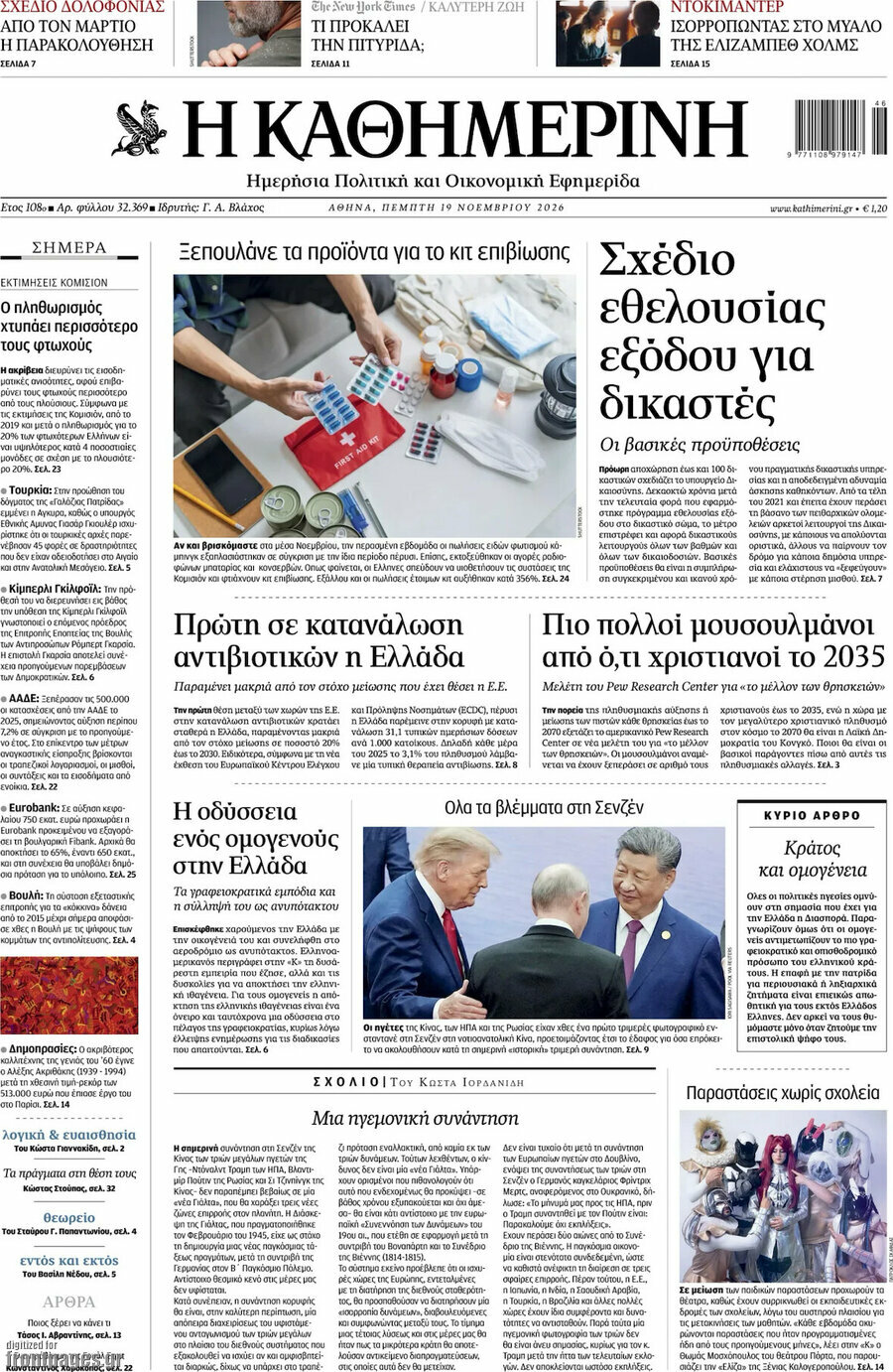
KATHIMERINI: Plan for voluntary exit of judges
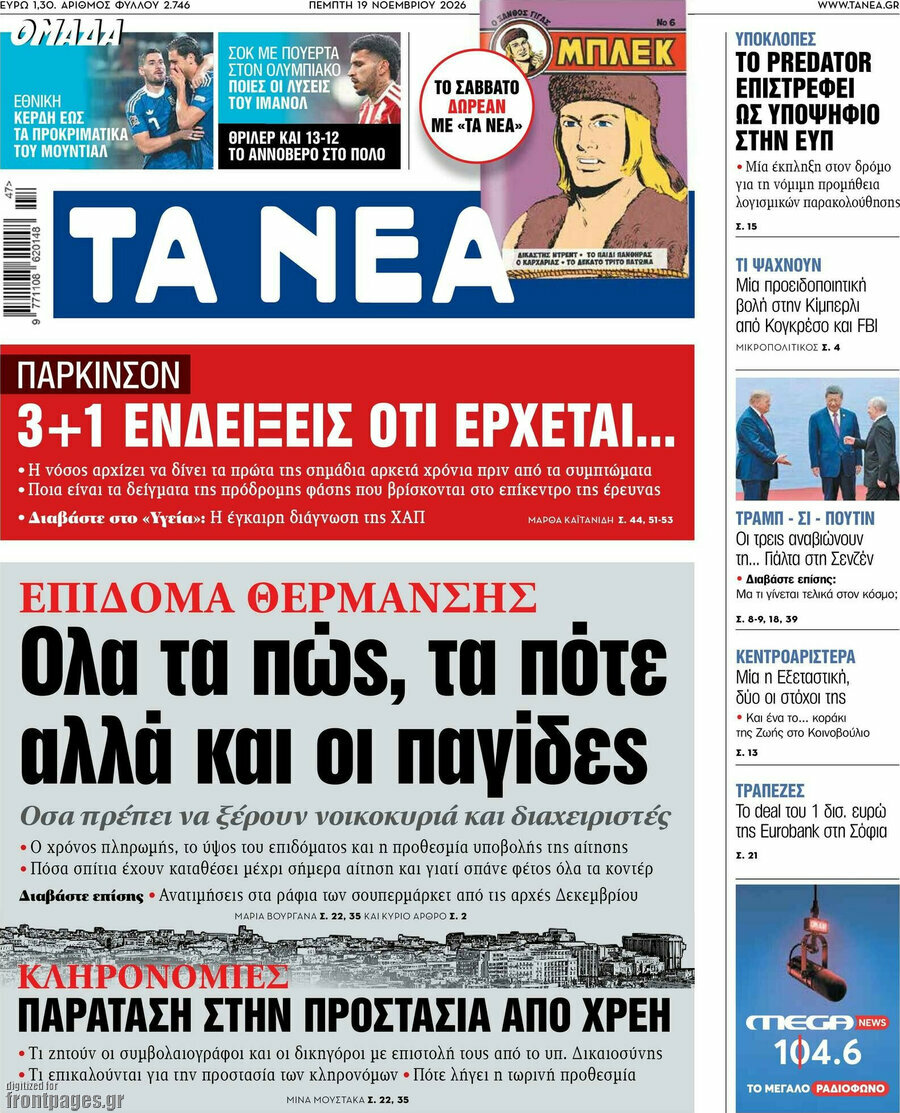
TA NEA: Heating allowance: guidebook and traps
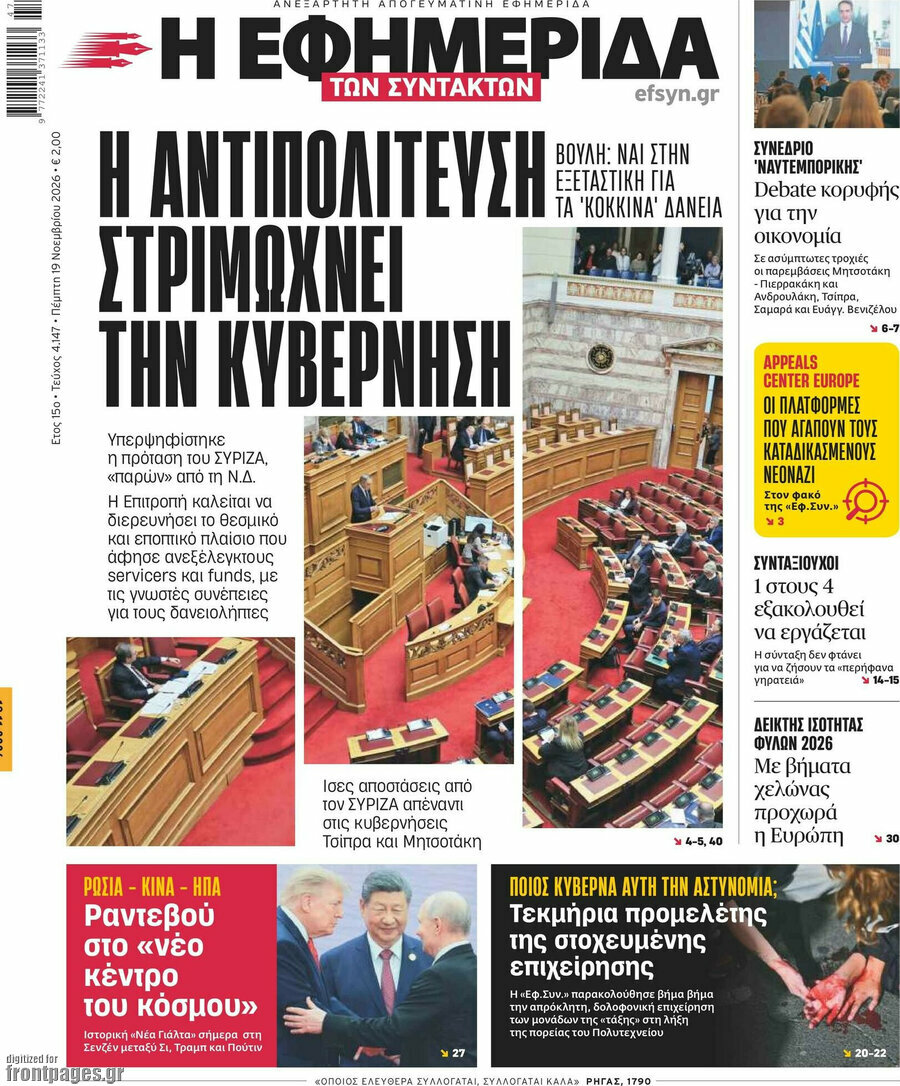
EFIMERIDA TON SYNTAKTON: The opposition backs the government into a corner
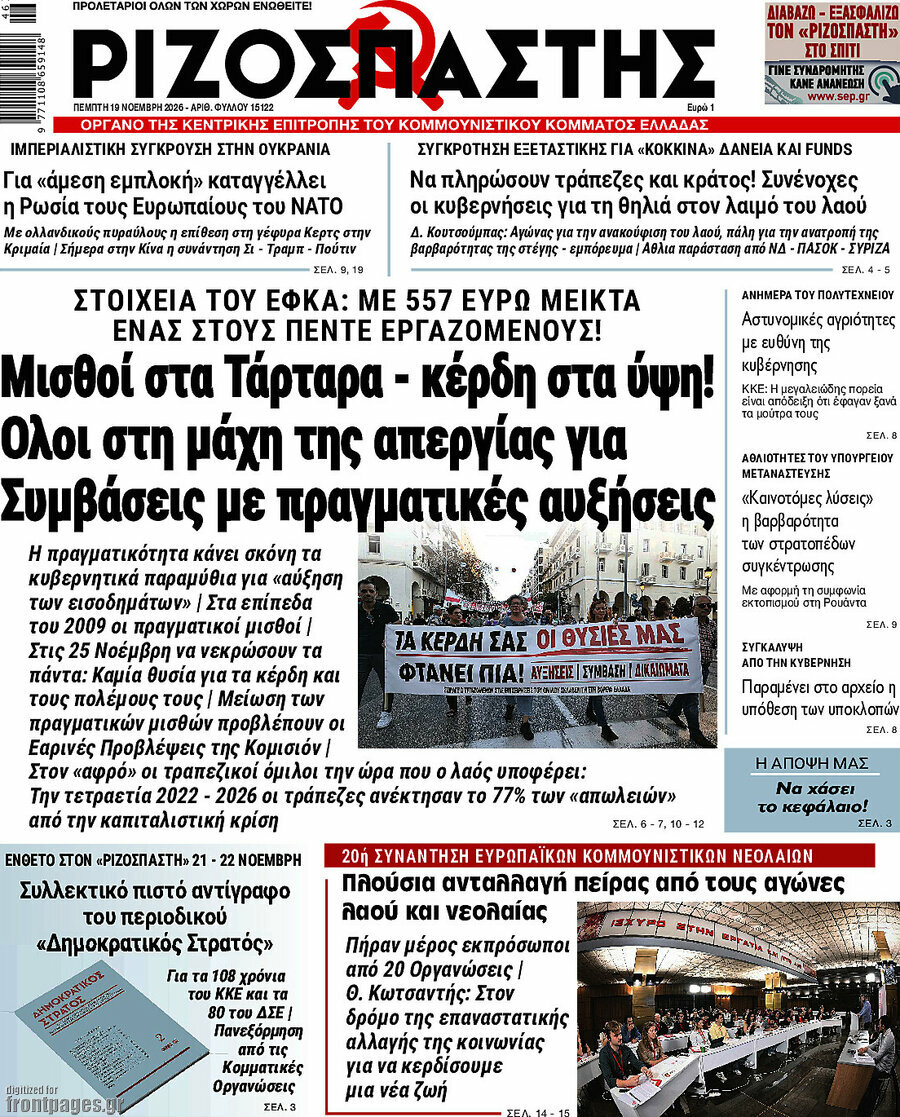
RIZOSPASTIS: Salaries plunge – Companies’ profits spike
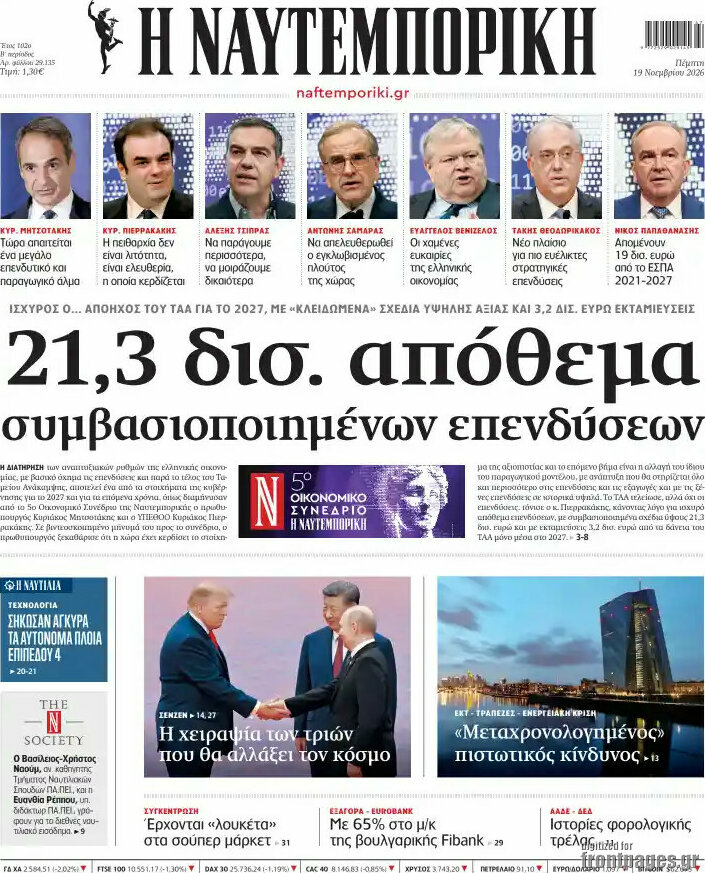
KONTRA NEWS: HORECA chains acting as “laundry” machines are being targeted by AADE
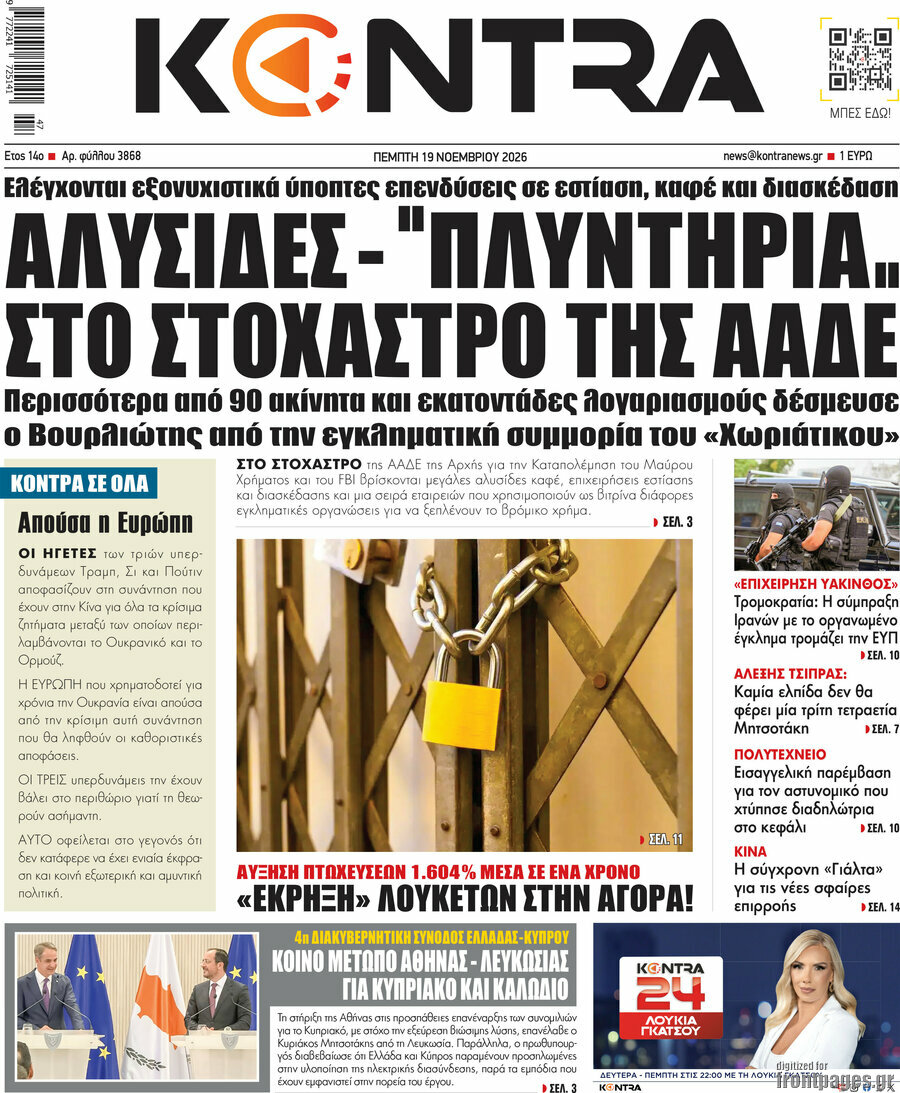
DIMOKRATIA: New fait accompli by the Turks regarding the Aegean Sea
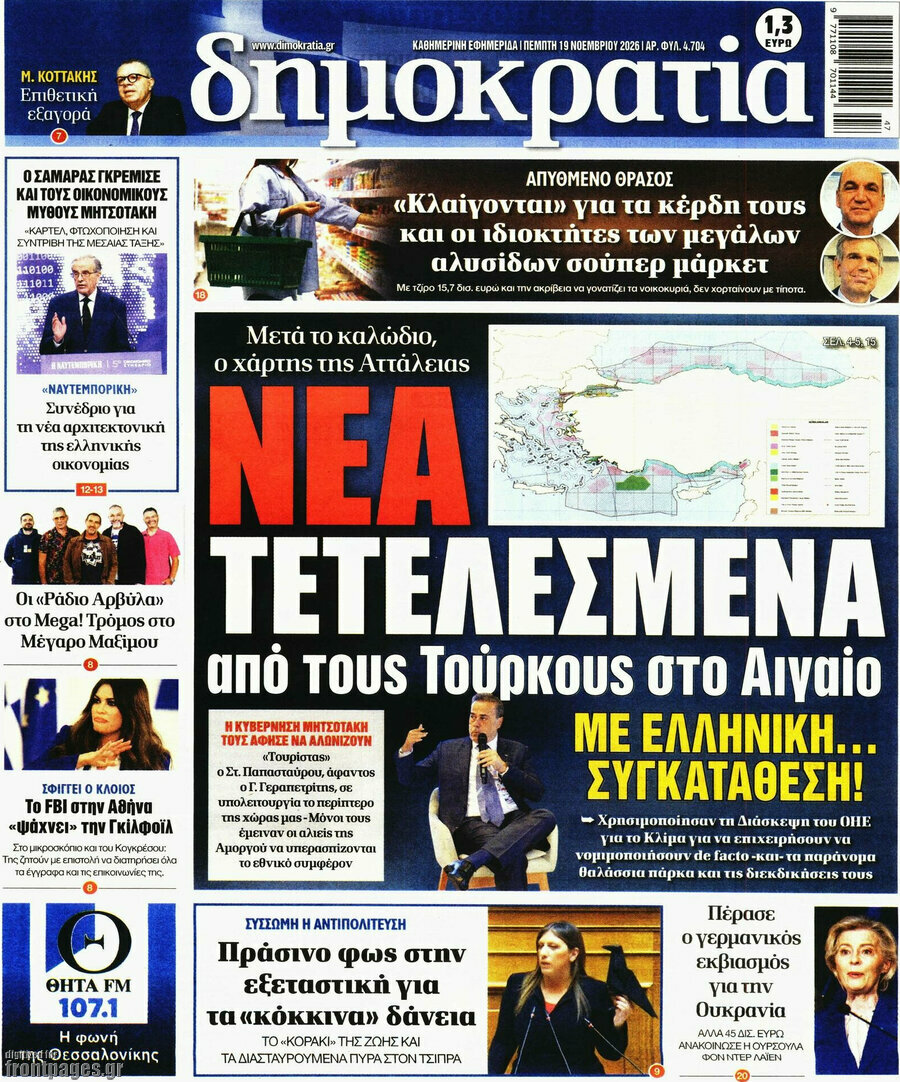
NAFTEMPORIKI: 21,3 bln reserve of contracted investments

DRIVING THE DAY
EXCLUSIVE — HUGE CYBERATTACK HITS THE EUROPEAN COMMISSION: The incident has potentially compromised swaths of personal data, left staff unable to input salary and leave information and prompted the most senior officials to discuss the crisis at their weekly meeting yesterday.
“The Commission believes it has contained most of the attack, but the full extent of any damage remains unclear,” an EU official, granted anonymity because of the sensitivity of the issue, told Playbook. “The systems may be coming back online. The answers are taking a little longer.”
Weapon of choice: The EU institutions’ cybersecurity watchdog, CERT-EU, detected earlier this month that international hackers used ARTEX, a publicly available AI-powered tool designed to identify vulnerabilities in IT systems. “Some actors misuse such tools and have targeted the Commission,” the EU official added. As a precaution, several applications were temporarily taken offline. Access to most has now been restored.
“The European Commission has taken the necessary steps in response to a detected cyber campaign,” Commission spokesperson Thomas Regnier told Playbook. “Individual systems were targeted and, in line with our standard practice, we have informed those concerned.”
Investigators are still trying to establish whether staff data was compromised, according to the first EU official. The official said the uncertainty explains the limited communication to staff — because the Commission doesn’t yet know whether, or to what extent, personal information was hacked.
Disruption has lasted over 10 days. Sysper, the Commission’s HR platform for payslips, leave requests and timesheets, and MyPMO, its medical reimbursement system, were restored earlier this week — though Sysper briefly crashed again yesterday. Translation services were also hit on Tuesday, prompting one particularly inconvenienced official to admit to “swearing a lot.”
All the way to the top: The Commission convened its highest-level internal crisis-management body, the Corporate Management Board, for an urgent meeting over these “ongoing cyber incidents” earlier this month, according to a leaked internal mail seen by Playbook. The digital services department ordered stepped-up security checks. And tech commissioner Henna Virkkunen briefed counterparts at yesterday’s College of Commissioners meeting on the immediate response, two officials said.
This is the latest in a series of high-profile global cyberattacks or outages in recent days, including disruptions affecting Microsoft, large U.S. banks and America’s National Security Agency, as well as a hack that targeted popular websites such as those of Air France, the BBC and Zoom.
But did you get paid? Playbook asked around, and the answer was largely yes. While salaries landed as usual, some officials couldn’t submit timesheets or request leave. Three officials also complained about the lack of communication. In a reply to an issue with Sysper seen by Playbook, IT cited a general issue affecting the system’s functionality — without mentioning a cyberattack. Thanks to Max Griera, Nicholas Vinocur, Sebastian Starcevic and Zoya Sheftalovich, who assisted me with this report.
BIG AND BREAKING
SPAIN’S ELECTORAL BATTLEGROUNDS: From Seville to Murcia and beyond, POLITICO crunched the results of every congressional election in Spain’s history to identify five places that could reveal where this month’s vote is heading.
DOWN TO THE WIRE: With just one day to go before Friday’s summit with the U.K., EU ambassadors failed to finalize a joint statement yesterday evening. Now they’ll need an extra round of talks to nail down the text and finish preparations.
In the meantime … this deep dive by my colleagues in London on Andy Burnham’s grand strategy on Europe is well worth a read.
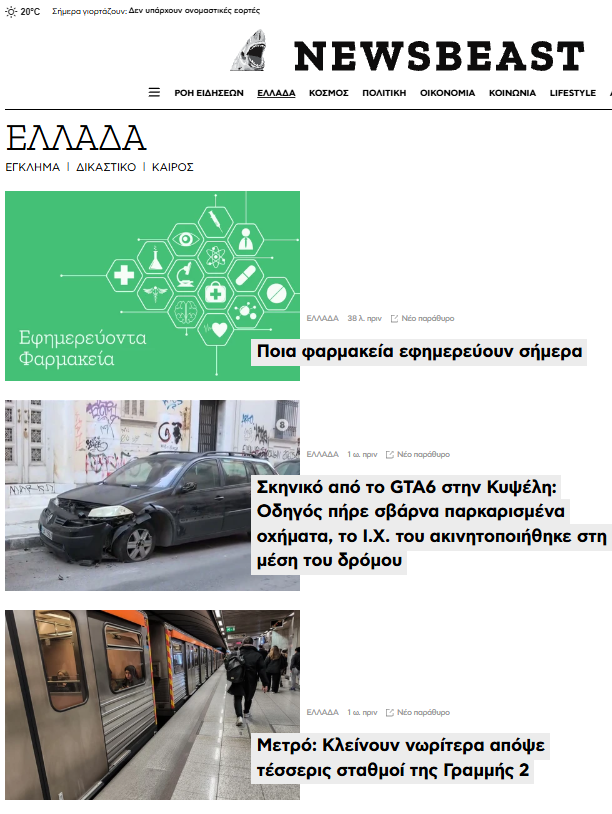
GAME ON: “Grand Theft Auto VI” launches today, 13 years after the last edition came out — but why should Eurocrats care? POLITICO’s Eliza Gkritsi has six reasons why even they should pay attention.
EPP MOVES TO SUSPEND VUČIĆ’S PARTY: The EPP leadership wants to suspend the associate membership of the Serbian Progressive Party, the political home of former President Aleksandar Vučić, giving it a year to break with Moscow and Beijing and improve democratic standards or face expulsion.
AFTER THE WHO ON UKRAINE COMES THE WHAT
EUROPE SEEKS SPECIFICS: We have an answer to the question “Who represents Europe in talks on Ukraine?” We don’t yet have answers to the questions “What will that look like?” and “Will it be effective?”
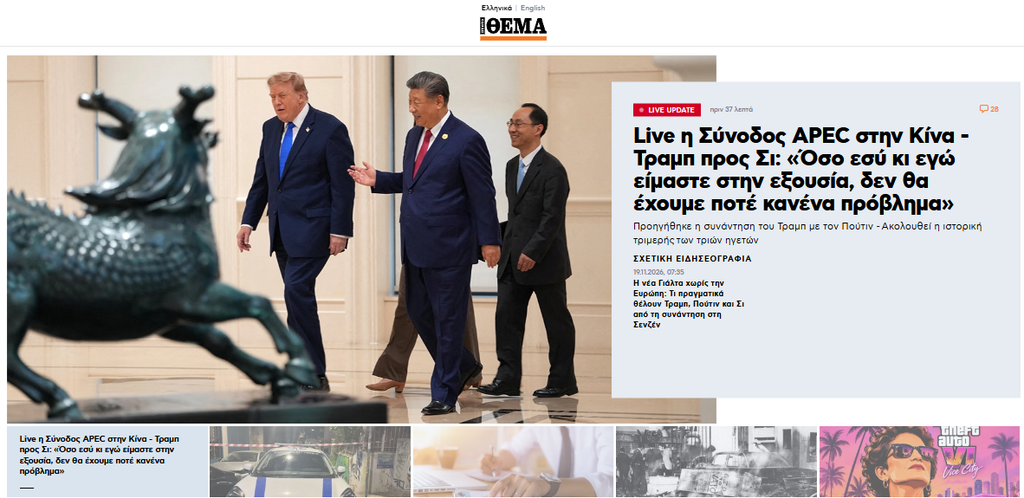
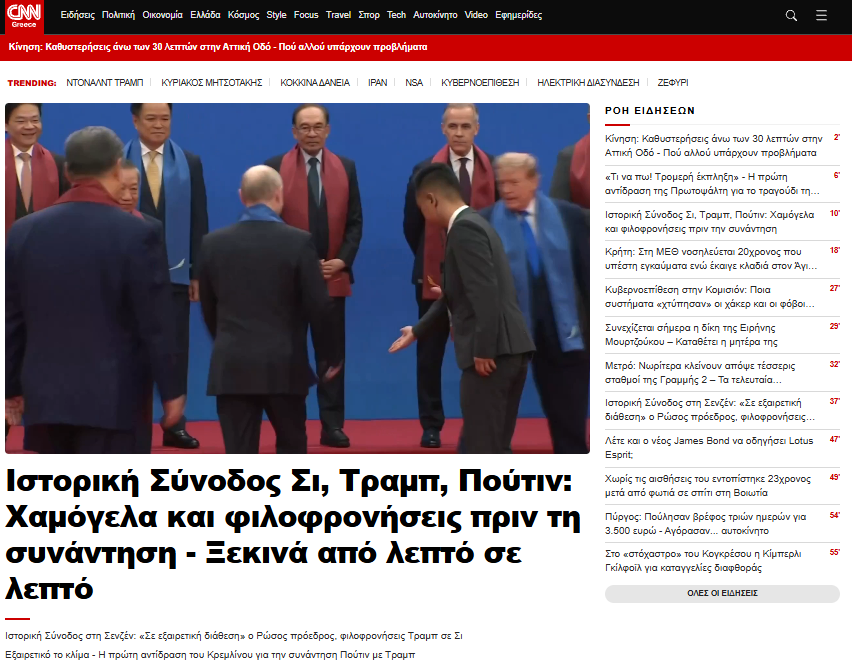
Double events: After the three-way talks between Donald Trump, Vladimir Putin and Xi Jinping — and as the Coalition of the Willing meets in Berlin today — Europe is trying to decide what its negotiators can and cannot offer if they get into a room with Russia.
The who: EU leaders last week settled on a team made up of officials from five major countries plus top officials from NATO, the European Commission and Council.
The what: But agreeing on which line the European team should take is proving divisive. Some countries, led by Austria, are advocating a looser approach involving the likes of limited or partial ceasefires to pave the way for a wider truce, or offering to set up an international forum to monitor any peace agreement, Nick and Zoya report.
Others disagree with that approach: “We have to agree on the ceasefire and, when the guns go silent, then we negotiate on the long-lasting peace,” Lithuanian Foreign Minister Kęstutis Budrys said.
Unwilling? Things are no more settled in the Coalition of the Willing, the alliance of more than 35 nations supporting Kyiv. As Tim Ross and Esther Webber write, Ukrainian President Volodymyr Zelenskyy will find himself among a motley assembly of countries, convened by two weak European leaders (Emmanuel Macron and Friedrich Merz) and a rookie without a mandate (Andy Burnham).
Budget protection: Merz, with an eye on the future, is pushing to make the EU’s long-term budget “Le Pen-proof.” Germany wants to lock into the MFF a durable funding scheme for Ukraine that will be difficult for potential opponents to veto, James Angelos and Gregorio Sorgi write.
20-SECOND PLAYBOOK PRIMER
On Friday, it’s the EU-U.K. summit in Brussels. Are such meetings new? Of course, the U.K. didn’t need a special summit when it was part of the EU. The first post-Brexit summit between the two sides was held in London in May 2025 (when Keir Starmer was prime minister) and focused on setting up a “new Strategic Partnership.” This year, new PM Andy Burnhamwants a wider reset of ties with the bloc — and has even opened the door to a British return to the EU.
LAWMAKERS RAISE CHINA CONCERNS
BRUSSELS FEELS A CHINA CHILL: European Parliament President Roberta Metsola contacted Chinese authorities after MEPs reported pressure from Beijing, her spokesperson Jüri Laas said.
Piling up: Seven MEPs told Max Griera and Carlo Martuscelli about what they described as intimidation inside Parliament offices as well as detention at the Chinese border and threatening letters, mostly concerning engagement with Taiwan.
“I have never encountered such behavior from foreign diplomats,” said Engin Eroglu, chair of Parliament’s delegation to China. The Chinese mission to the EU did not respond to a request for comment.
No grace period: The incidents come just over a year after Parliament and Beijing ended a four-year freeze in relations over China’s sanctions on lawmakers who criticized China’s human rights record.
Surprise visit: Patriots for Europe Vice Chair António Tânger Corrêa said a senior Chinese diplomat visited his office unannounced before a trip to Taiwan, warning that they “could not ensure” his safety. And lawmakers who attended a Taipei event received letters, seen by POLITICO, urging them to “refrain from any official exchange” with Taiwan.
Detained: Czech MEP Markéta Gregorová said she was held for 1.5 hours while entering China, had her passport confiscated and was forbidden from using her phone, in what she said could be a “deliberate intimidation tactic.” Gregorová demanded an explanation from Beijing and asked Metsola to bar Chinese representatives from Parliament if she doesn’t get one.
DASHBOARD
Morocco’s hopes of being included as a trusted partner in the Industrial Accelerator Act are vanishing quickly, leading Rabat to enact “Plan B” of cozying up to China to keep its car exports up, Jordyn Dahl reports.

7 MORE THINGS GETTING US TALKING
SG BEEFS UP: The Commission’s Secretariat-General, reporting directly to Ursula von der Leyen, is getting another boost: The new sanctions office announced yesterday, which will be housed in the powerful presidential service, will need 50 to 60 officials, a senior Commission official said. Some 40 to 45 officials already working on sanctions across other DGs will be moving there, the official added.
GOING ROUND IN CIRCLES: The EU’s Circular Economy Act is stuck on the Berlaymont’s 13th floor, officials tell Playbook and Fiona McNally. DG GROW and DG ENV have finished their work, but interservice consultation hasn’t started. It’s not clear whether that puts the Dec. 2 presentation at risk.
WHO KNEW POLITICS WAS HARD? Elon Musk, the world’s richest man, has admitted he feels “foolish” after spending more than $440 million backing the Republicans in the midterms, my stateside colleagues write.
GENDER BACKLASH: Russia and the Vatican have been accused of blocking references to gender at the COP31 conference in Turkey, Zia Weise reports.
FOREVER CHEMICALS, TEMPORARY EXEMPTIONS: The EU’s chemical safety watchdog wants sweeping temporary exemptions from the planned PFAS ban to protect key manufacturing sectors, according to a draft obtained by POLITICO.
PATENT MYSTERY: The Commission has been accused of withholding internal emails explaining why it scrapped a controversial patent proposal. MEPs suspect the U-turn may have followed a meeting between von der Leyen and U.S. Vice President JD Vance.
ROBERT PATTINSON’S EU CONNECTION: Becoming the next James Bond surely doesn’t top the time the British actor featured heavily in a Commission webinar on how to fight deepfakes.