
Egypt to UN calls Turkish-Libyan MoU ‘null and void’, rejects Libya’s maritime claims
Egypt rejected the so-called Memorandum of Understanding (MoU) between Türkiye and Libya on the delimitation of the maritime jurisdiction areas in the Mediterranean, calling the agreement “null and void” and having “no legal effect with respect to Egypt”. In a new note verbale to the UN secretary-general dated November 5 to a so-called Turkish-Libyan MoU signed on November 27, 2019 and ratified by Libya’s House of Representatives, (General Assembly A/81/479) in October, the Arab republic said, “Egypt rejects the Memorandum of Understanding between the Government of the Republic of Turkey and the Government of National Accord-State of Libya on Delimitation of the Maritime Jurisdiction Areas in the Mediterranean, signed on 27 November 2019, does not recognize it and considers it to be absolutely null and void and devoid of any legal effect, as previously stated in the notes verbales” of December 2019, April 2023, April 2024 and September 2025. Egypt added that the MoU and related actions “violate the principles of the international law of the sea, the relevant provisions of the 1982 United Nations Convention on the Law of the Sea and established practices regarding the delimitation of maritime boundaries.
Fragmented Parliament complicates gov’t strategy
A fragmented Parliament with as many as 11 parties could complicate the governing party’s path to an outright majority, despite its lead in voter preferences, a Pulse poll for Skai television suggests. New Democracy ranks first in voting intention and on key issues, including relations with Turkey and tackling high prices. Five additional parties could enter Parliament alongside six established groups: Maria Karystianou’s Hope for Democracy, Voice of Reason, the Alliance of Greeks party associated with Ilias Kasidiaris, SYRIZA and MeRA25. A party led by former prime minister Antonis Samaras may also have potential to enter, according to qualitative findings. Under current electoral law, a party would need 39.5% of the vote for an outright majority if 11 parties enter Parliament, the poll estimates. The threshold would fall to 38.5% with 10 parties, 37.5% with nine, 36.5% with eight and about 35% with seven. The findings present strategic dilemmas for the government. Polarizing the campaign around larger parties could weaken smaller rivals but risks escalating tensions.
https://www.ekathimerini.com/politics/1321665/fragmented-parliament-complicates-govt-strategy
Top prosecutor says ‘no legal basis’ to reopen wiretapping scandal case
Supreme Court Prosecutor Evangelos Bakelas has turned down a request by an active high-ranking officer in Greece’s intelligence service EYP to reopen a file on a major wiretapping scandal, arguing no new evidence has emerged to justify the move. The EYP officer, Yiannis Papadopoulos, has accused four business executives linked to the spyware developer Intellexa for espionage: Tal Dilian, the founder of Intellexa, his ex-wife and business partner Sara Hamou, Intellexa executive Felix Bitzios, and Yiannis Lavranos, who owned the Greek security firm that purchased Intellexa’s Predator spyware. Papadopoulos argued that his case is unlike that of other Predator victims, as due to his job and official duties he manages sensitive, highly classified information, whose leakage to third parties, and even private individuals, threatens national security and constitutes espionage.
Greece, North Macedonia foil plot by Iranian proxy to kill Israeli
Five people have been arrested in North Macedonia and Greece as part of a joint intelligence operation to crack down on a network of individuals preparing a terrorist attack or the assassination of an individual in Greece, allegedly acting on behalf of an Iranian national. A man from North Macedonia was arrested in Greece and extradited to his home country in connection with the plot, while four of his compatriots were arrested in Skopje, according to a press release by the neighboring county’s Agency for National Security (ANB). The agency did not reveal who was or may have been the target or targets in Greece. Sources indicated the target was an Israeli executive in a Greece-based company. Authorities seized weapons and ammunition, as well as handwritten notes and a map.
Stournaras: Incomes yet to return to precrisis levels
The Greek economy has moved beyond the acute phase of the crisis and its growth prospects are improving, according to Bank of Greece Governor Yannis Stournaras. Capital accumulation and productivity are now underpinning estimated potential growth. However, population aging is expected to limit the contribution of labor toward the end of the decade, while the income losses suffered during the crisis have yet to be fully recovered. Speaking at the Money and Banking Conference in Buenos Aires, Stournaras said that, at the height of the crisis, real GDP per capita had fallen by approximately 26% compared with precrisis levels, while household real disposable income had declined by around 36%. Both indicators remain below their precrisis levels.
https://www.ekathimerini.com/economy/1321668/stournaras-incomes-yet-to-return-to-precrisis-levels

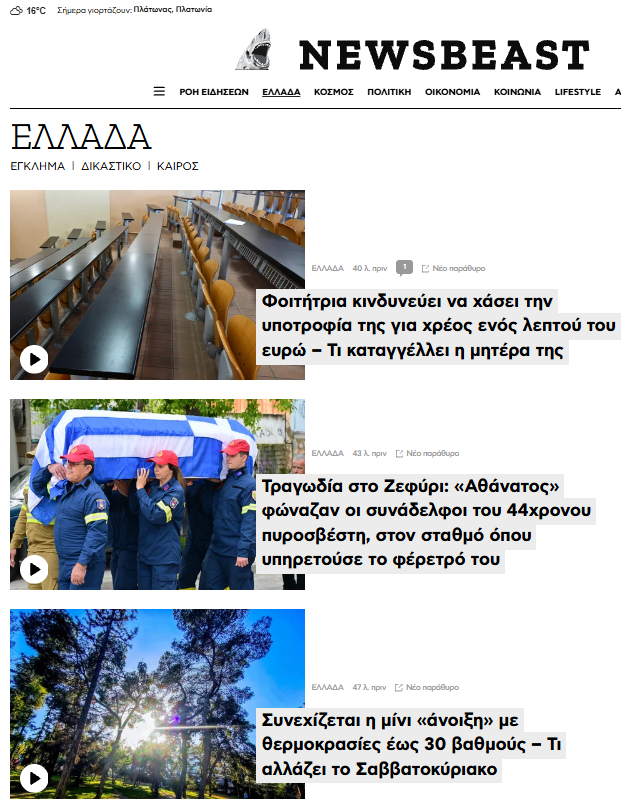

KATHIMERINI: Iran recruited criminals from Skopje
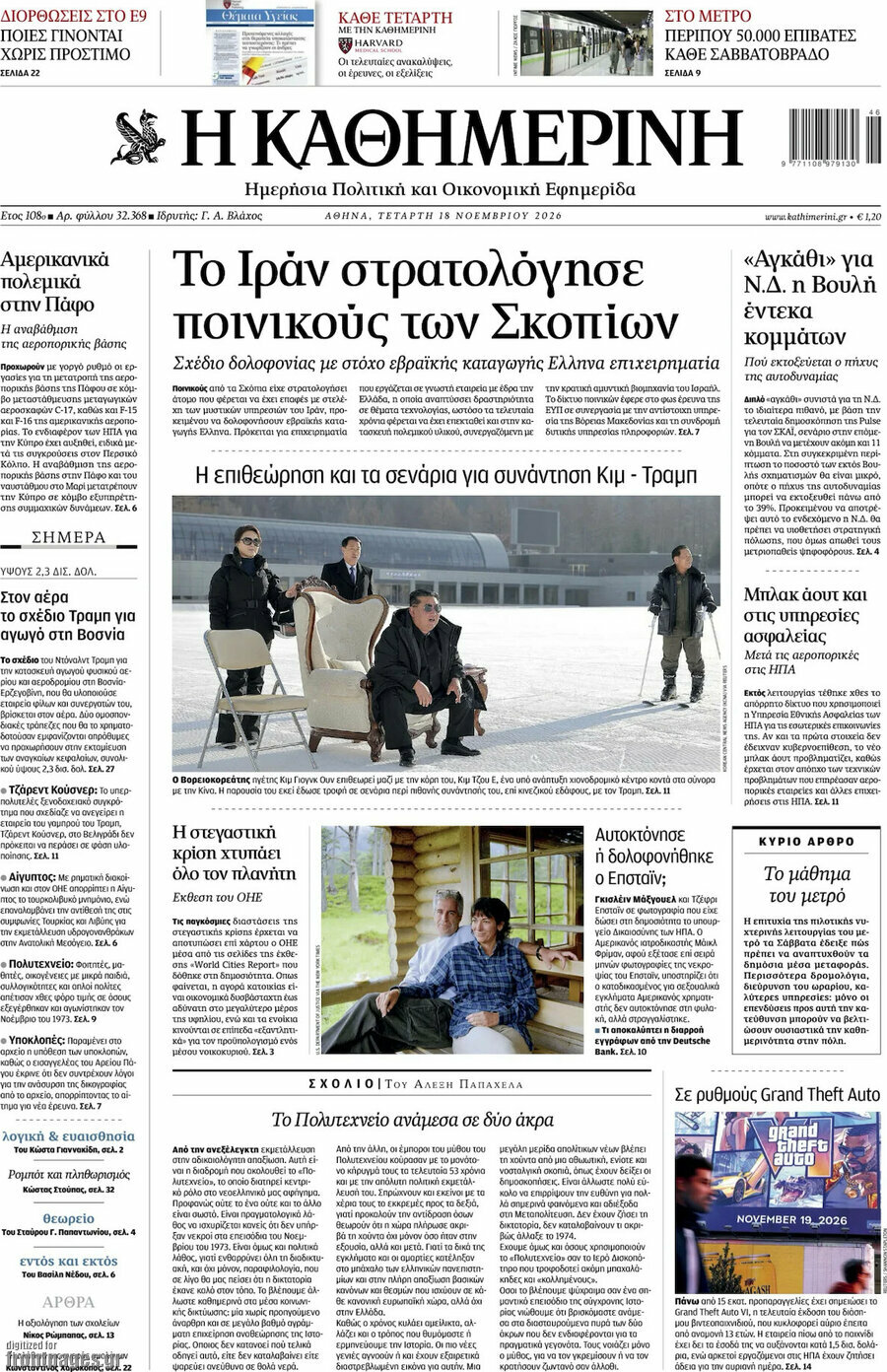
TA NEA: Civil Personnel Selection: exams change
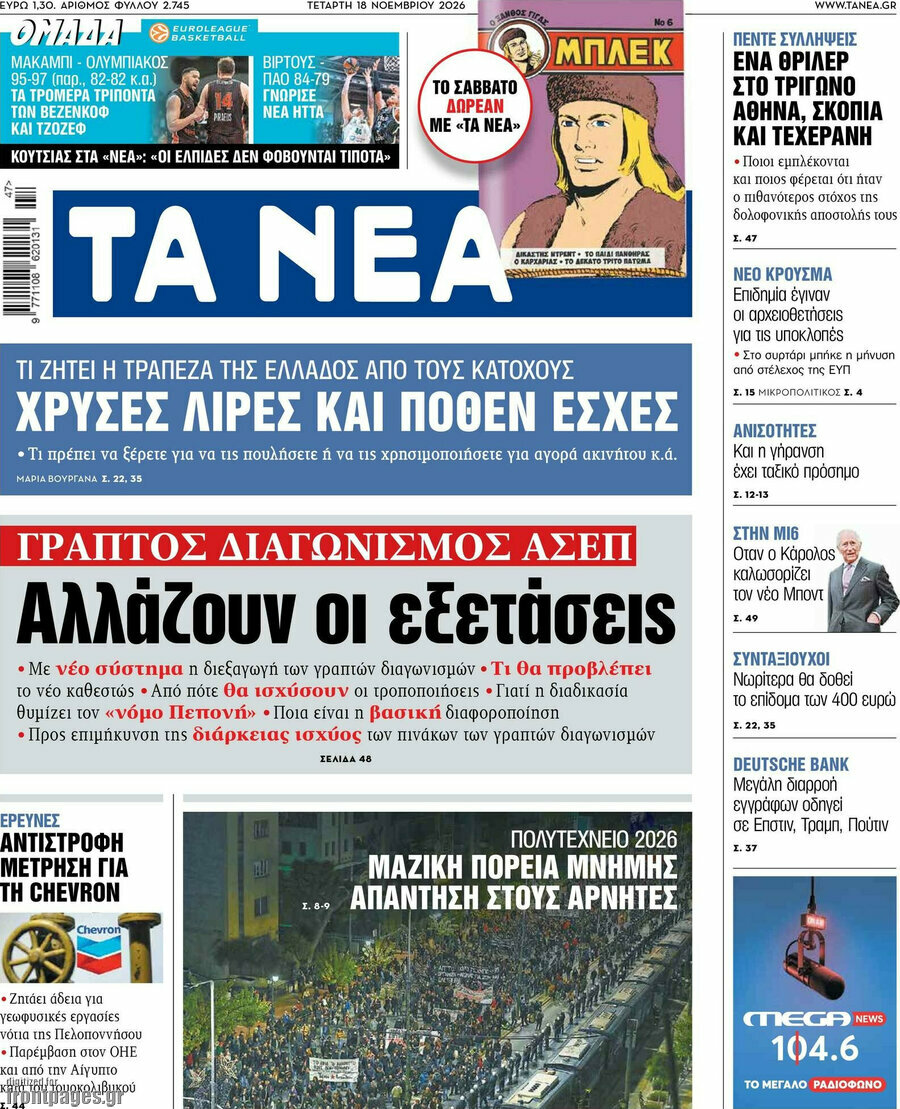
EFIMERIDA TON SYNTAKTON: Let’s march for our generation’s uprising!
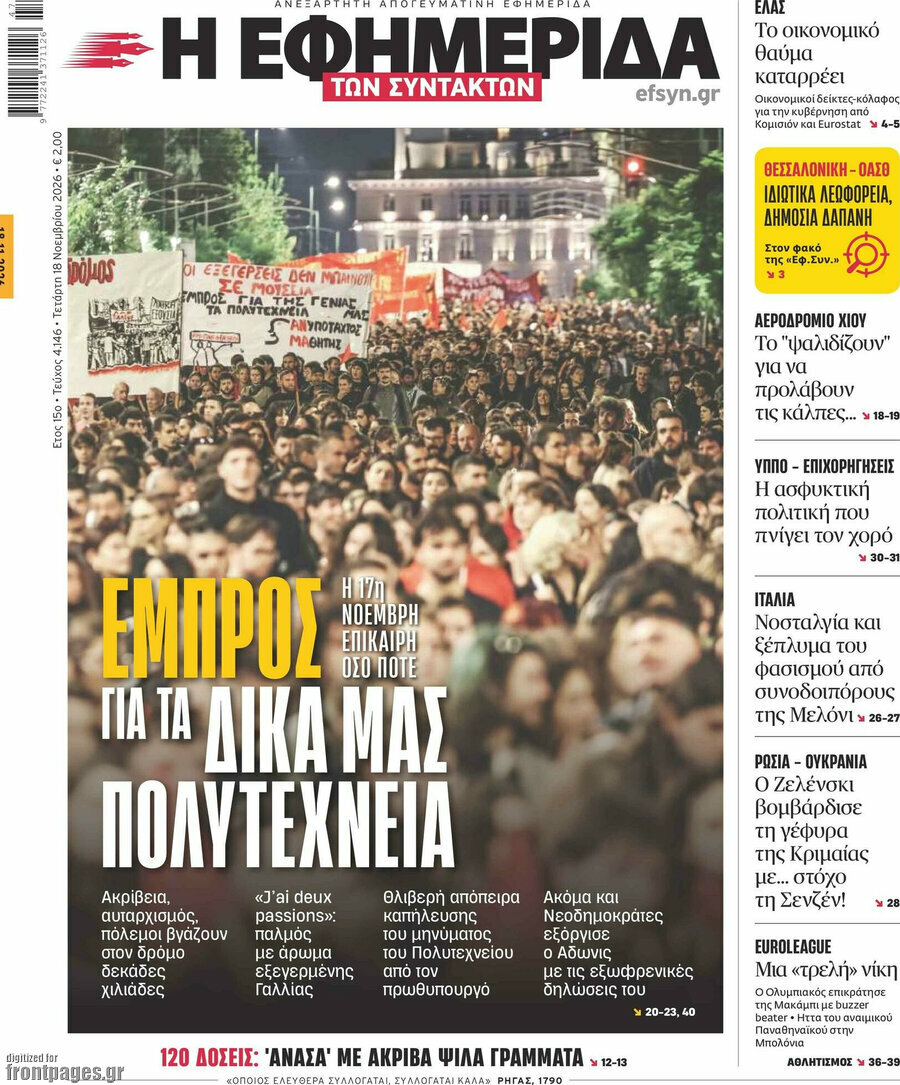
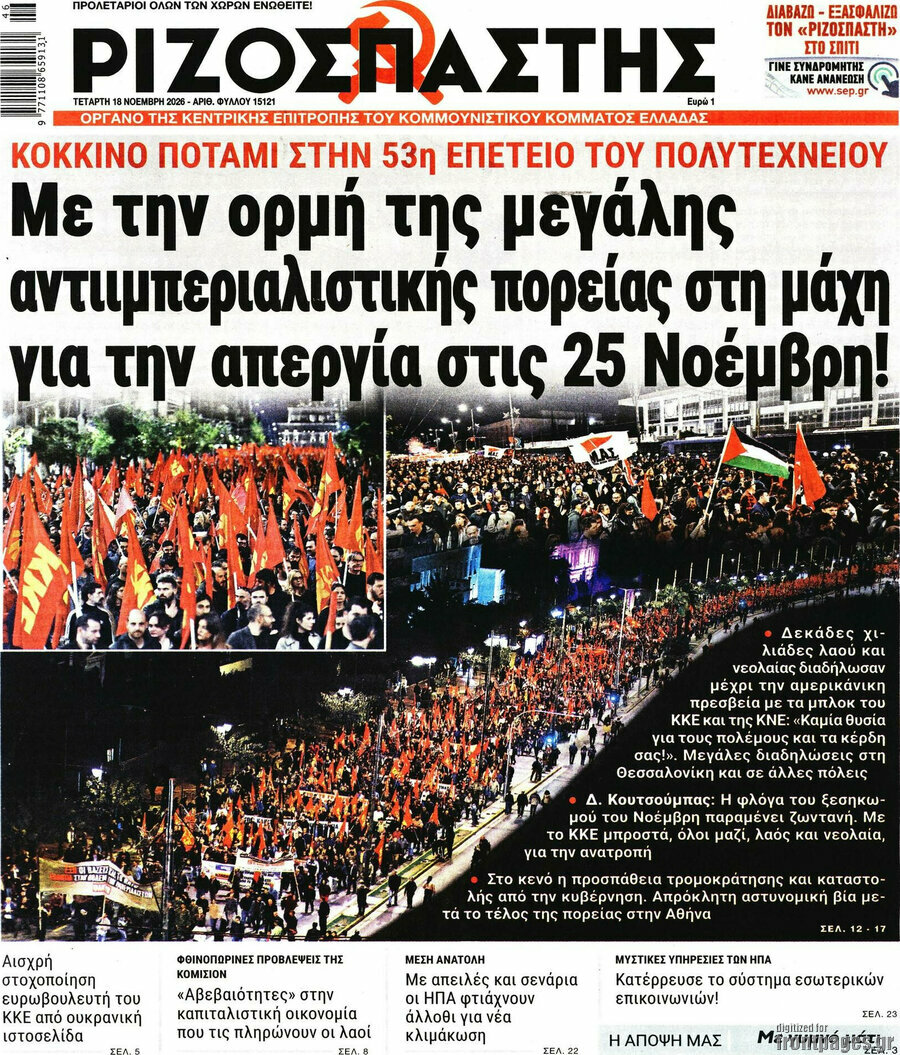
RIZOSPASTIS: “Red river” at the 53rd anniversary of the Polytechnic School uprising
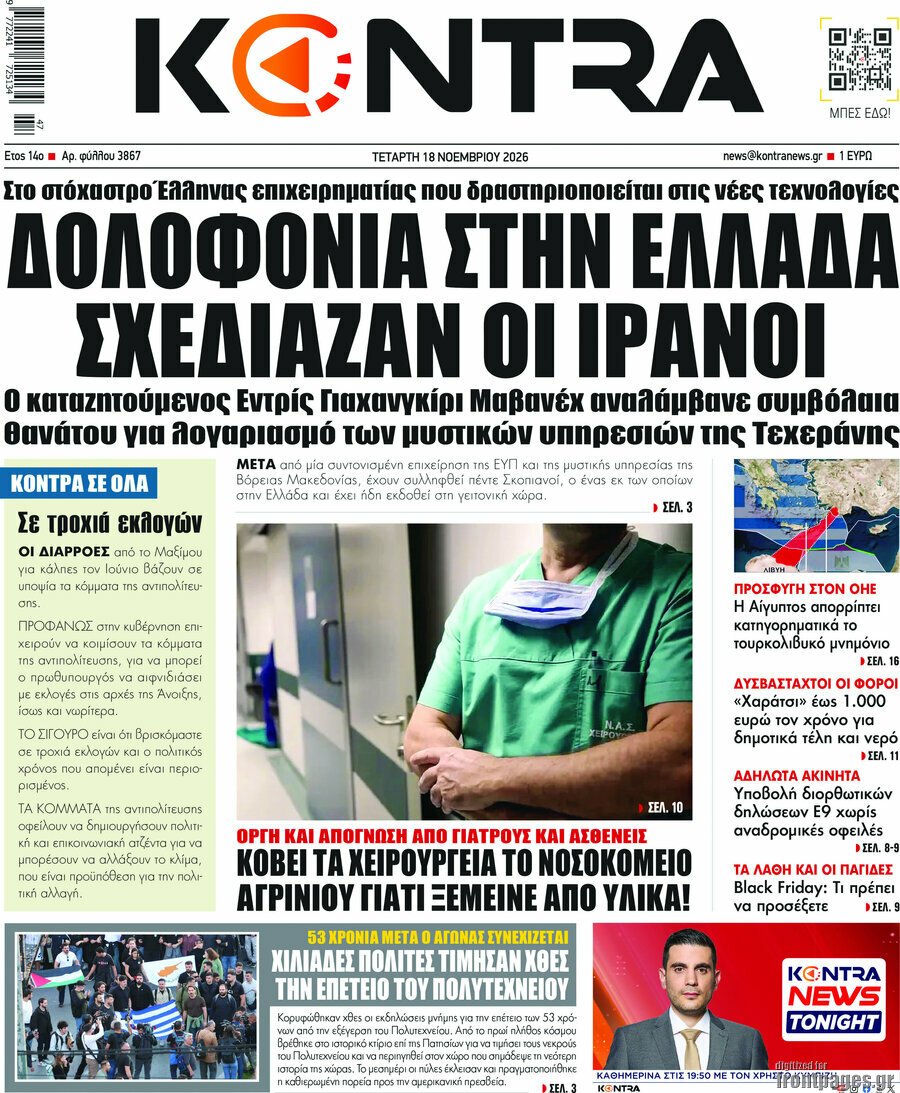
KONTRA NEWS: The Iranians were planning an assassination in Greece
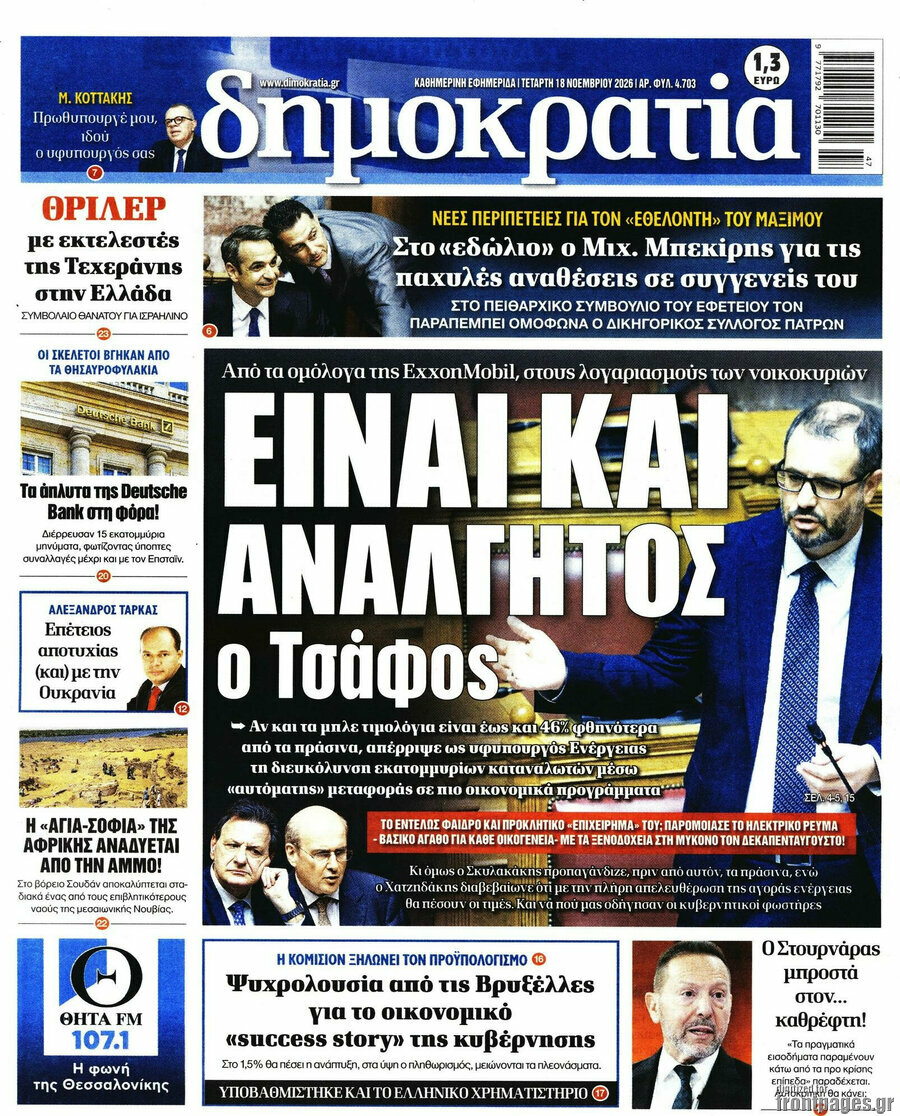
DIMOKRATIA: Energy consultant to PM Mitsotakis, Tsafos, is cold-hearted apart from everything else
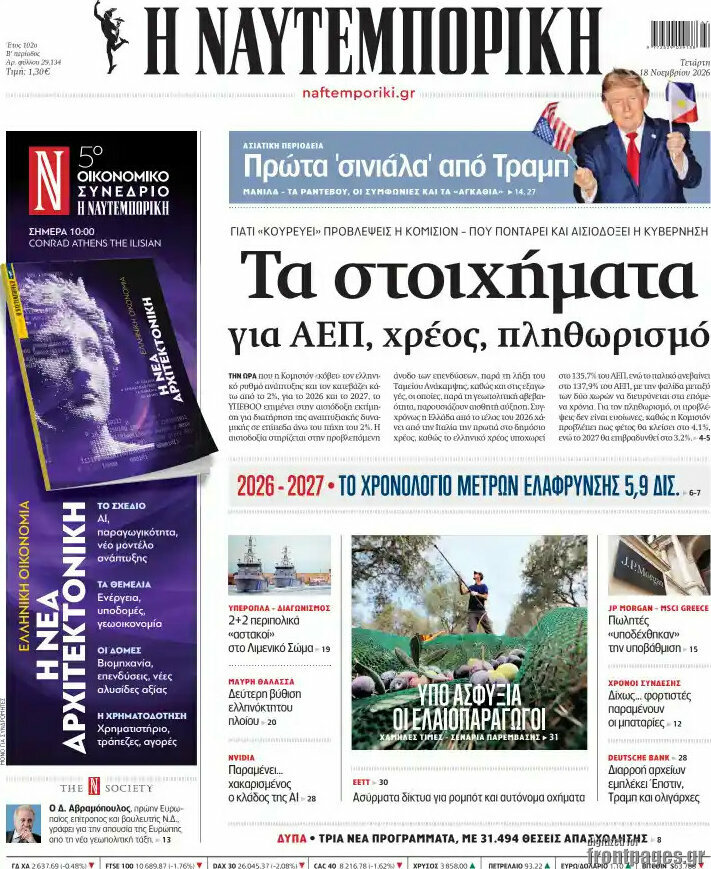
NAFTEMPORIKI: The bets regarding GDP, debt and inflation

DRIVING THE DAY
ŠUICA STEPS UP: The European Commission is taking a more prominent role in the EU’s Middle East diplomacy as Kaja Kallas’ direct channel to Israel remains frozen — illustrating a wider question over who gets to speak for the EU abroad, Zoya Sheftalovich and Nick Vinocur report.
This week, Commission President Ursula von der Leyen and Mediterranean Commissioner Dubravka Šuica are heading to Syria and Jordan, while Kallas hosts a Mediterranean security forum in Brussels.
Calendar scrape: Šuica has met Israeli Foreign Minister Gideon Sa’ar or spoken with him by phone at least four times this year, and in February she attended U.S. President Donald Trump’s Board of Peace for Gaza as an observer. Kallas has been iced out by Israel since June.
The rupture came after reports that Kallas compared Israel’s treatment of Palestinians to apartheid-era South Africa. Sa’ar said he would “sever all contact” with the EU’s top diplomat until she apologized. The decision to cut off contact “relates solely” to Kallas and Israel continues to engage with other EU officials, institutions and countries, a spokesperson for Sa’ar said.
Better days: Before that, the two were in frequent contact, sometimes exchanging WhatsApp messages multiple times a day, according to a person familiar with their communications who was granted anonymity to discuss the private exchanges. “It’s a problem if the Israelis don’t want to speak to her,” said one EU diplomat.
This tug-of-war over EU diplomacy helps to “undermine the EU as a credible global actor,” liberal EU lawmaker and chair of the European Parliament’s Development Committee Barry Andrews told Playbook.
Kallas is “open for dialogue and stands ready to engage with the next government of Israel,” a Commission spokesperson said. “She continues to be in touch with politicians from across the political spectrum.”
EU officials say Kallas and the European External Action Service are not being cut out of the region’s work, and that Kallas and Šuica work closely together. The Commission and the EEAS have overlapping roles across the region, with the Commission handling much of the EU’s aid and economic support and Kallas leading political and security work. The EU cannot dictate whom Israel chooses to speak with, one official said: “It’s a matter of personal preference.”
Zoom out: Yet Šuica taking the reins on communicating with Israel brings yet another arm of the EU’s foreign policy closer to von der Leyen. Leaders last week shut Kallas out of the negotiating team for future Ukraine peace talks, opting instead for national security advisers from five EU countries, plus the Commission and Council.
BIG AND BREAKING
GOING THROUGH THE MOTIONS: European diplomats and officials are skeptical that Vladimir Putin is serious about negotiating an end to the war in Ukraine, yet they’re sticking with the process being pushed by Washington — partly out of fear that Donald Trump could cut a deal with Putin and walk away if the talks collapse. Tim Ross and Nick Vinocur lay out the latest on the peace talks.
UKRAINE STANDOFF: Marine Le Pen and Volodymyr Zelenskyy say they want to meet, but can’t seem to agree on a venue. The French presidential front-runner has dismissed an invitation to visit Kyiv: “She doesn’t like the idea of going there for a photo op,” an adviser told my colleagues in Paris.
DEPORTATION DIVIDE: Commission Executive Vice President Teresa Ribera has criticized plans by five EU countries for a migration deportation hub in Rwanda, saying in a personal capacity that Europe shouldn’t emulate Trump or El Salvador’s Nayib Bukele. Migration Commissioner Magnus Brunner defended the EU taking a “fair and firm” stance on unauthorized migration, telling Playbook: “Our policy is delivering results” and that “return hubs are part of this European approach.”
ETHICS PUSH: The Irish Council presidency wants the European Parliament to approve an expert panel to advise the EU ethics body before its first meeting, according to a letter seen by Max Griera. The move puts pressure on Parliament President Roberta Metsola and group leaders as the right-wing majority pushes to kill the body, with a decision expected in the coming weeks.
MONTENEGRO HITS A SPEED BUMP
FRONT-RUNNER, WITH AN ASTERISK: The Commission is on an enlargement high and Montenegro is the star pupil. But the Council offers a less rosy picture.
The Berlaymont’s happy: The Commission touts Montenegro as the country closest to EU membership, with a turbocharged timetable to match: accession talks wrapped up by December and a treaty potentially ready by June 2027. “Montenegro is approaching the finish line,” Ursula von der Leyen said this week.
Cross the Schuman roundabout, though … and the finish line looks further away. At a Council working party meeting yesterday evening, EU countries agreed to provisionally close just one of three accession chapters that were supposed to be ready before a meeting between the EU and Montenegro on Thursday. Regional policy got the nod; transport and energy didn’t.
That’s a bump in the Commission’s fast-track timetable. To keep things moving, the Irish presidency is considering an extra conference in November, rather than leaving eight chapters — plus two handled separately — to December.
The main issue? Croatia. Zagreb has a list of unresolved issues with Podgorica. PM Andrej Plenković made his displeasure known at the last EU summit, getting a commitment to close all chapters by year’s end scrubbed from the conclusions.
“We sorted out … two out of eight prerequisites we asked for,” a Croatian government official told Playbook, adding that Zagreb is taking a constructive approach.
The European Parliament is nervous: With the Council visibly less enthusiastic, MEP Thomas Waitz, chair of Parliament’s delegation for Montenegro, warned that “bilateral disputes must not block” the country’s EU path.
That’s just the warm-up: Even if Montenegro gets through the chapter-closing obstacle course, there’s a bigger headache waiting: ratification. An accession treaty needs approval from every member state. “You need just one country [against] and everything can blow up,” an EU official told Playbook.
“It’s a bumpy road ahead,” an EU diplomat added. In France, ratification would require either a referendum or a three-fifths majority in both houses of parliament. And that’s before factoring in a potential Marine Le Pen presidency. “It’s beyond Le Pen: There might be issues in many member states,” the diplomat warned.
20-SECOND PLAYBOOK PRIMER
European Commission President Ursula von der Leyen has said the EU should have a tech sovereignty fund to reduce the bloc’s reliance on U.S. and Chinese technology … but what would such a fund do? The idea is to invest — “several hundred million euros,” according to the Commission’s tech chief Henna Virkkunen — in companies active in AI, quantum technology and chips. A full proposal is expected to be unveiled at the European Council next week.
THE PLACE NO ONE WANTS TO WORK
IT’S GETTING LONELY IN LUXEMBOURG: Brussels often gets a bad rep from EU staffers, but it could be worse. That’s according to officials at the EU’s Luxembourg-based institutions who say they simply can’t get people to move there, Mari Eccles writes in.
It “remains a challenge,” the Court of Justice of the EU’s registrar (that’s the chief administrator) Vittorio Di Bucci told MEPs. “Recruitment is not all that popular for Luxembourg.” Chief among the reasons for that is the cost of living, he said. Figures from Eurostat last year showed it’s the priciest EU country for food and drink.

The European Court of Auditors echoed the complaint. “Attracting and retaining qualified staff in Luxembourg remains difficult,” said Zacharias Kolias, the ECA secretary-general.
Falling apart: It probably doesn’t help that the ECA’s “aging” offices aren’t in a great state. “We face unexpected problems like serious water infiltration,” Kolias said, adding that the court was deciding whether to bulldoze the buildings.
The carrot: Di Bucci said the Court of Justice of the EU provides allowances for staff on lower salaries and has made outreach efforts “to try and convince people to come to Luxembourg.” But so far, he said, that doesn’t seem to be paying off.
They’re missing out: “Luxembourg stands out in ways few places can,” spokesperson for the Grand Duchy Yves Hoffmann told Mari, citing “world-class infrastructure, free public transport, European public schools, and a vibrant multilingual, multicultural scene.” He added: “Add in a family-friendly quality of life, and it’s no surprise that expat families consistently rank Luxembourg as one of the most livable places in the world.”
8 MORE THINGS GETTING US TALKING
OPEN FOR BIDS: Commission Executive Vice President Roxana Mînzatu will today announce that applications are open for the EU’s €5.36 billion Erasmus+ fund for education, training, youth and sport projects in 2027. Brits can now apply as an associated country per the terms of the deal struck earlier this year, but sports bodies that allow Russian athletes to compete under national symbols are ineligible.
HANDS OFF OUR CHIPS: The Netherlands is pushing back against American efforts to tighten semiconductor export controls on China, warning that Washington’s bid to dictate rules for Dutch firms such as ASML is unacceptable.
NEW PATRIOT: Slovenian MEP Branko Grims, expelled from the EPP in July for breaching its far-right firewall, has joined the Patriots for Europe, bringing the group to 86 MEPs — ahead of the ECR’s 84.
BREXIT’S BAD BOYS ARE BACK: Andy Burnham’s attempts to reignite the debate about the U.K.’s relationship with the EU have given a new lease of life to veteran Euroskeptic campaigners.
TOXIC TRADE-OFF: Danish Environment Minister Maria Reumert Gjerding wrote to MEPs last night urging them to reject parts of the EU’s Omnibus simplification package that could allow the use of chemicals that pose a risk to public health, according to a letter seen by Playbook.
SUPERBUG SURGE: Drug-resistant bloodstream infections caused by “Klebsiella pneumoniae” jumped 72% between 2019 and 2025, the EU’s disease agency has warned.
WATCHING THE WATCHDOGS: Ireland has appointed former Twitter lobbyist Sinéad McSweeney to the role of Online Safety Commissioner — a move that could reignite criticism of the country’s approach to regulating Big Tech, my colleagues on Morning Tech report (for subscribers).
KILL SWITCH: The European Commission is weighing whether a WTO-era trade rule can become its fast-response weapon against China while the “trade bazooka” remains unused, Camille Gijs writes