
Where parties will focus their campaigns
The three major political parties have different goals and strategies for the next national election. The ruling conservative New Democracy is, barring a shocking upset, certain of first place and while it will likely not attain a result allowing it to clinch a parliamentary majority – it would need at least 37% of the vote – it wants to attain at least 30%, with the hope it will attract more voters in an all but certain second election. The socialist PASOK and ELAS, or Greek Left Alliance, will fight it out for second place and a chance to present themselves as the only realistic alternative to New Democracy.
https://www.ekathimerini.com/politics/1308620/where-parties-will-focus-their-campaigns
Court sentences former OPEKEPE executives to five years, eight months in prison, pending appeal
The Three-Member Misdemeanour Court on Friday handed down sentences of five years and eight months each to Dimitris Melas, who was head of Greece’s agricultural subsidies payment agency, OPEKEPE, in 2021-2022, and the former director of Direct Payments and Technical Works Athanasia Reppa. The sentences are suspended pending appeal. The court had earlier delivered a guilty verdict on charges of breach of duty and of aiding and abetting a criminal. It also ruled that a third charge should be upgraded to a felony and referred to a Felony Court of Appeal.
Former MEP Stelios Kouloglou targeted by Pegasus while probing Europe’s Illegal surveillance scandal
New findings have added a troubling twist to Europe’s long-running spyware scandal, with digital forensic evidence indicating former member of the European Parliament that Greek journalist and Stelios Kouloglou was targeted by the Pegasus surveillance software while serving on the European Parliament’s inquiry into the misuse of spyware by EU member states.
Greek banks offer mortgage rates below eurozone average
Competition among Greek banks in the mortgage market has been pushing lending rates steadily lower lately, giving borrowers access to fixed-rate home loans priced below the euro zone average despite a housing affordability crisis that remains one of Europe’s most pressing social and economic challenges.
https://www.amna.gr/en/article/1006596/Greek-banks-offer-mortgage-rates-below-eurozone-average
ATHEX: Yet another 17-year high for bourse
The main index at Athinon Avenue registered yet another 17-year high on Friday, while the banks index returned to levels unseen since November 2015, as local stocks maintained their upward trajectory. The easing of the Middle East tension and the upcoming share capital increases and corporate bond issues by several listed companies bolster trader sentiment and help mainly the blue chips outperform as the summer proceeds.
https://www.ekathimerini.com/economy/1308624/athex-yet-another-17-year-high-for-bourse

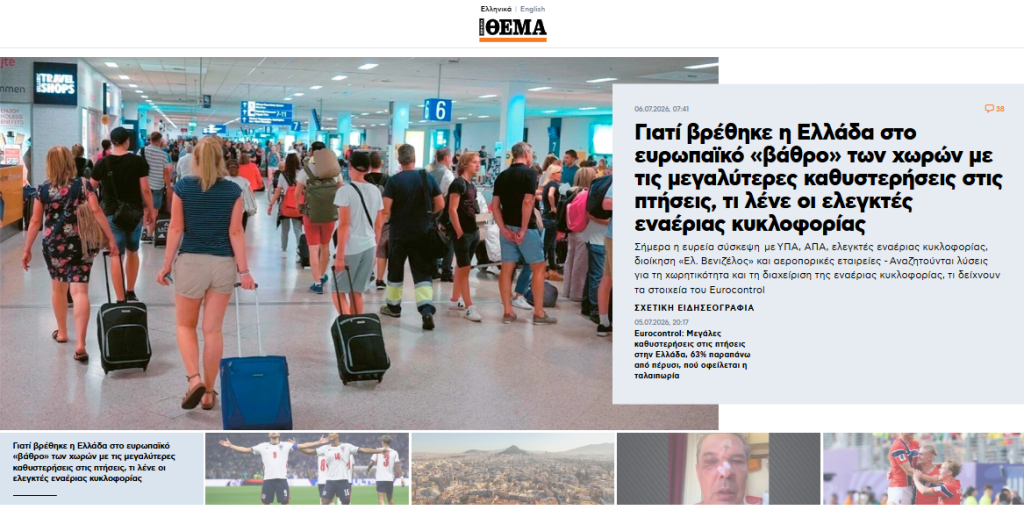
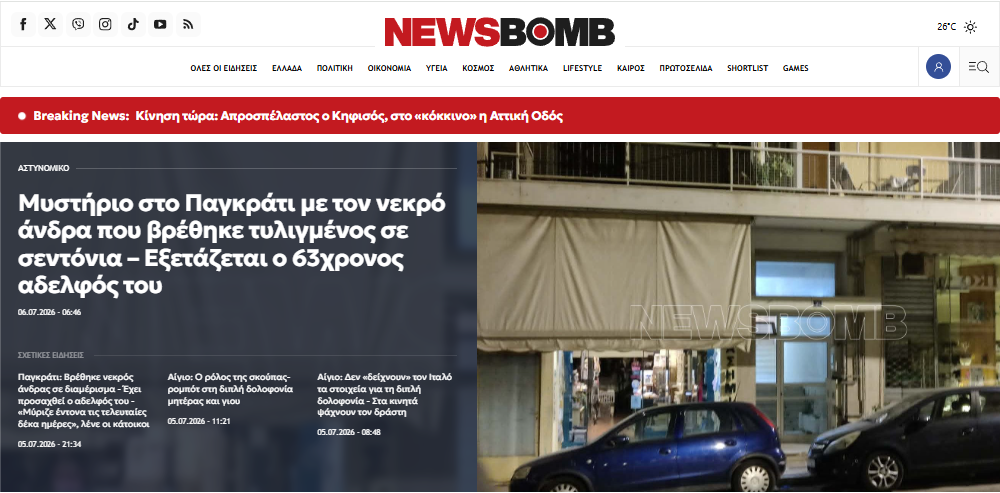
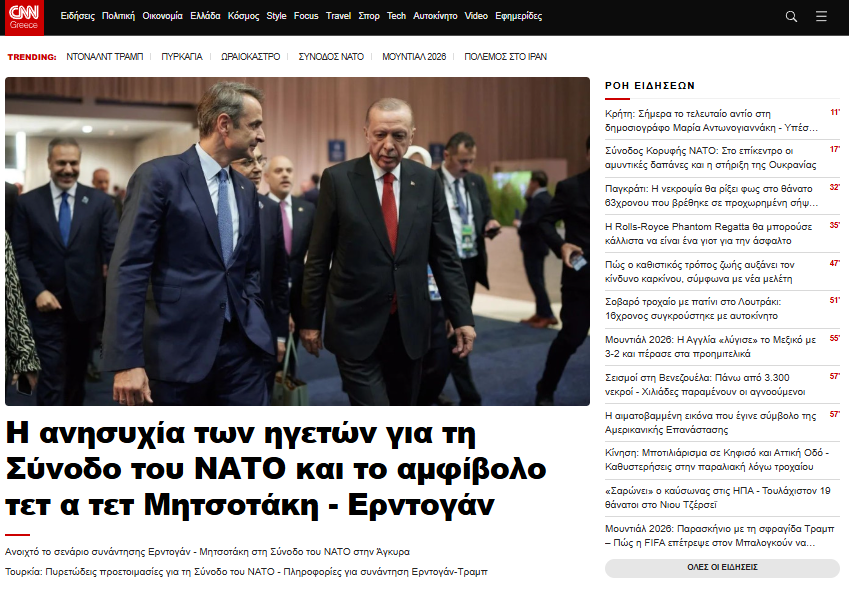

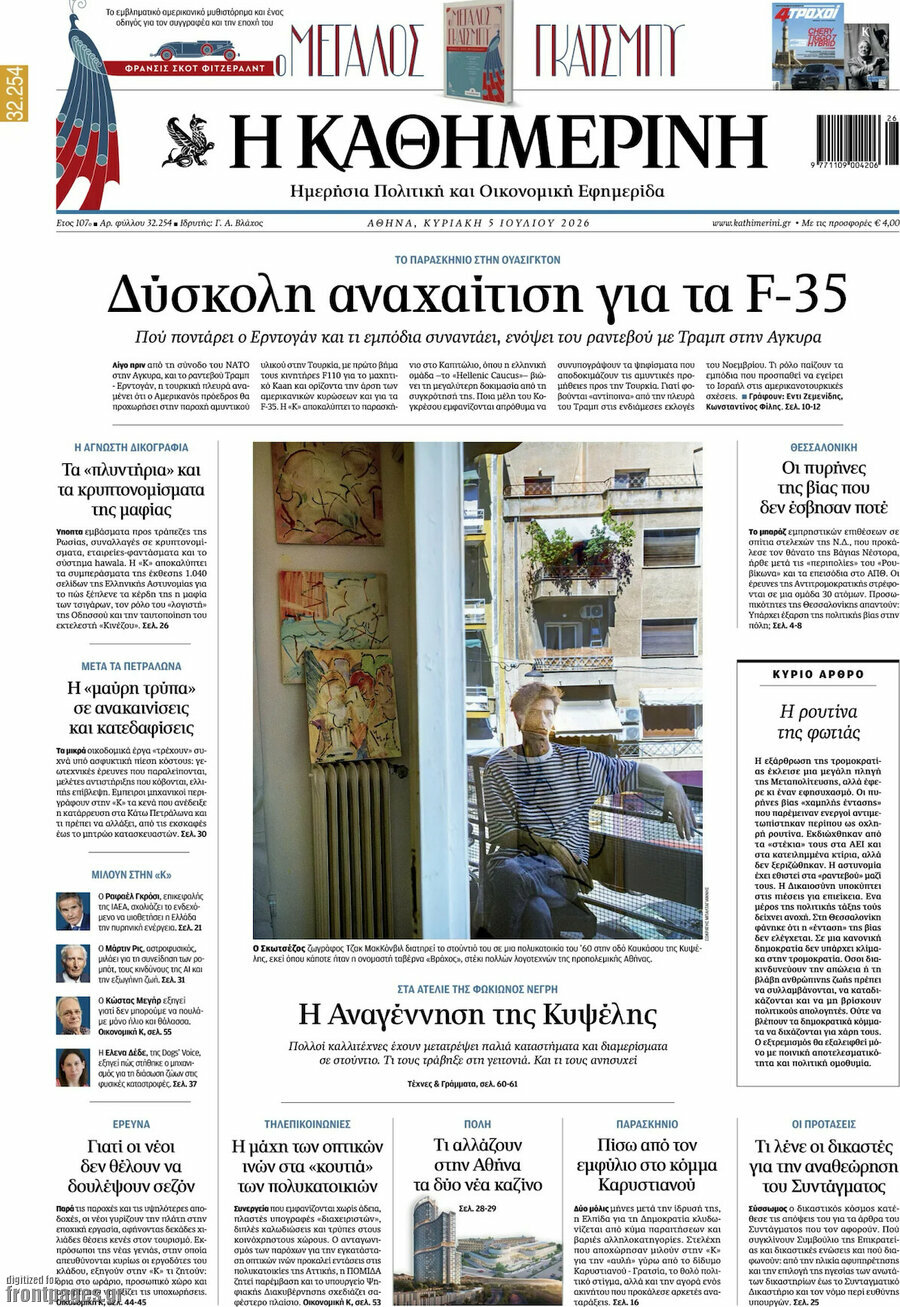
SUNDAY PAPERS
KATHIMERINI: Difficult congressional efforts to block the sale of F35s to Turkey
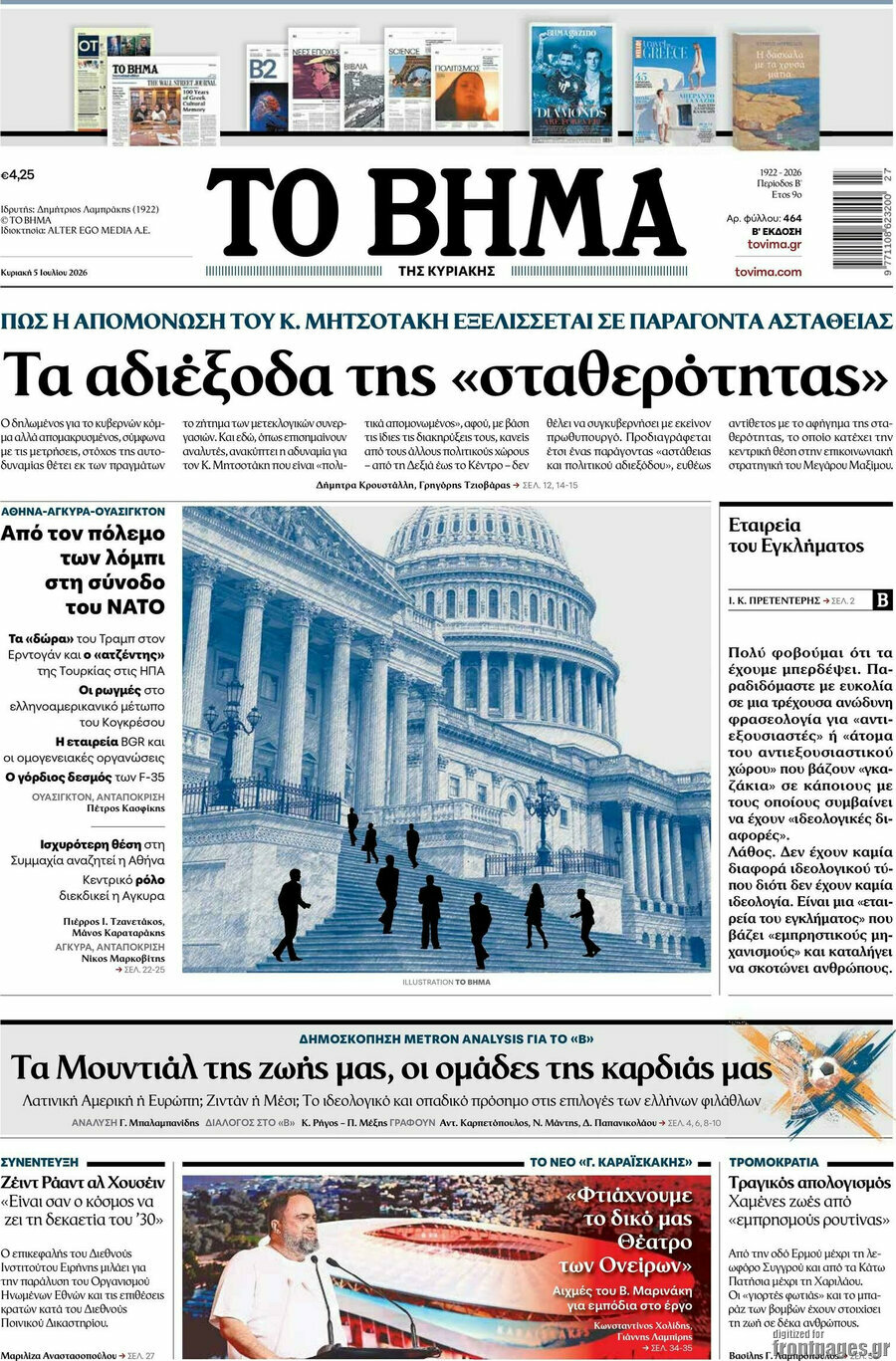
TO VIMA: The dead-ends of “stability”: Mitsotakis’ isolation evolved into an instability factor
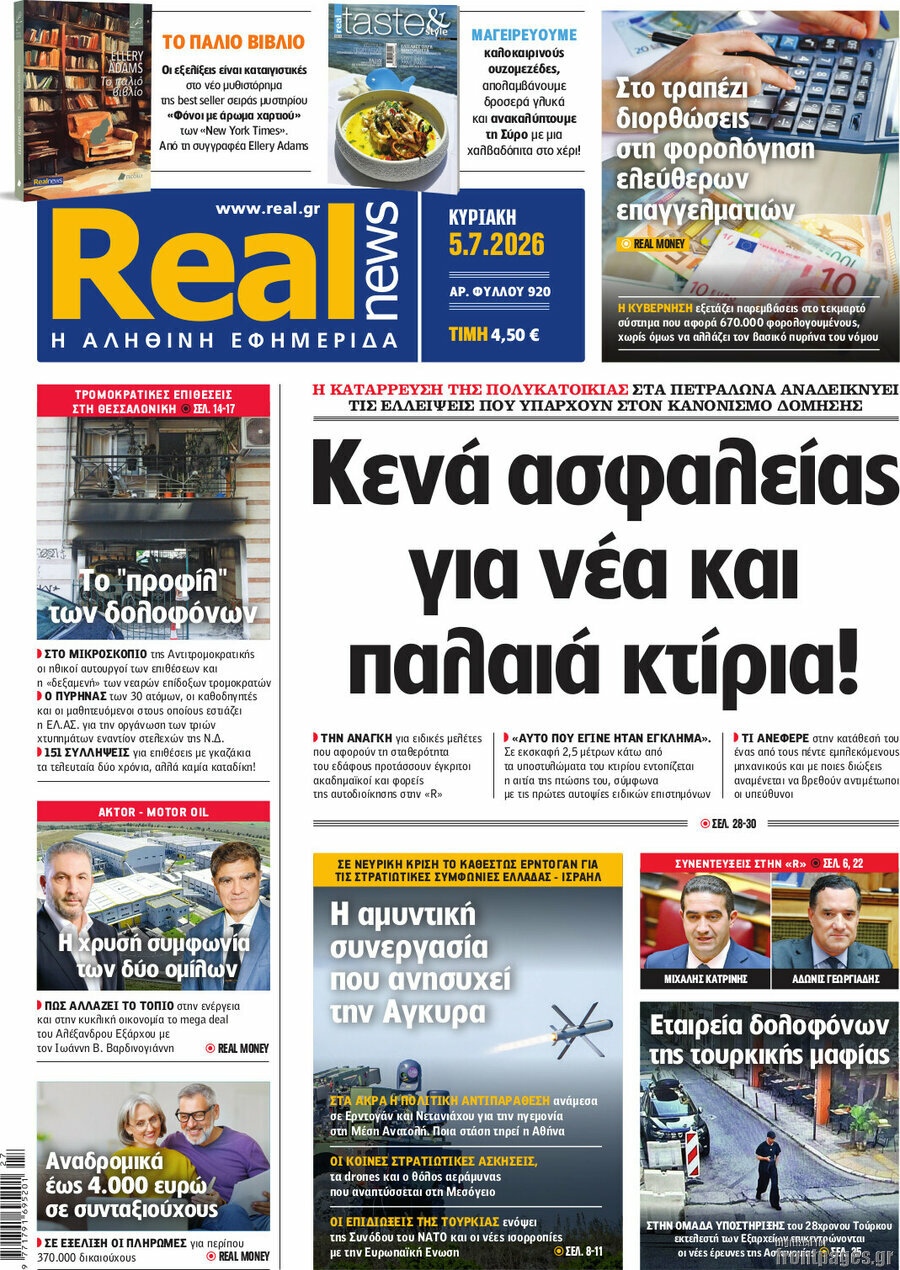
REAL NEWS: Security gaps in newer and older buildings
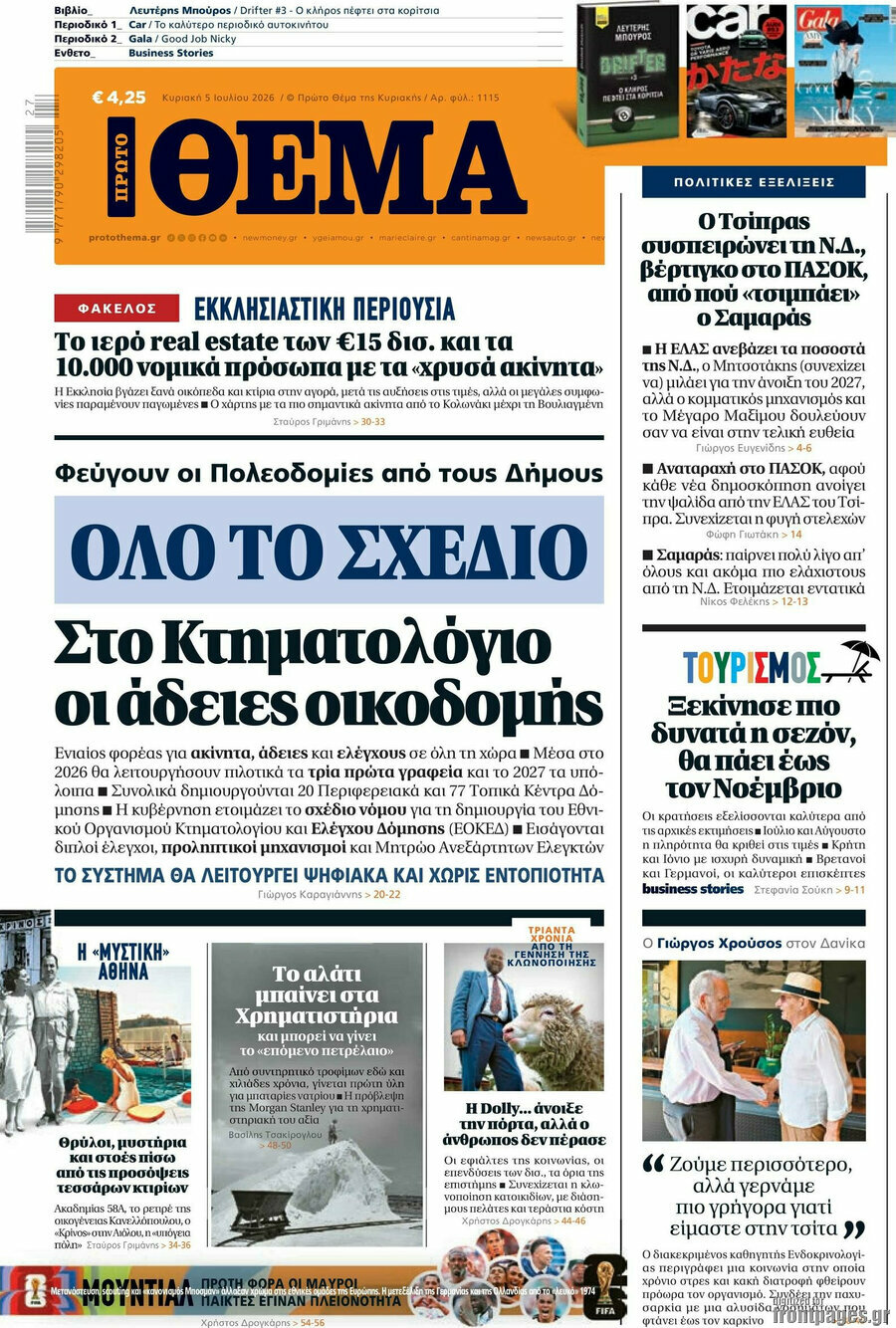
PROTO THEMA: Construction permits integrated in the cadastre
MONDAY PAPERS:
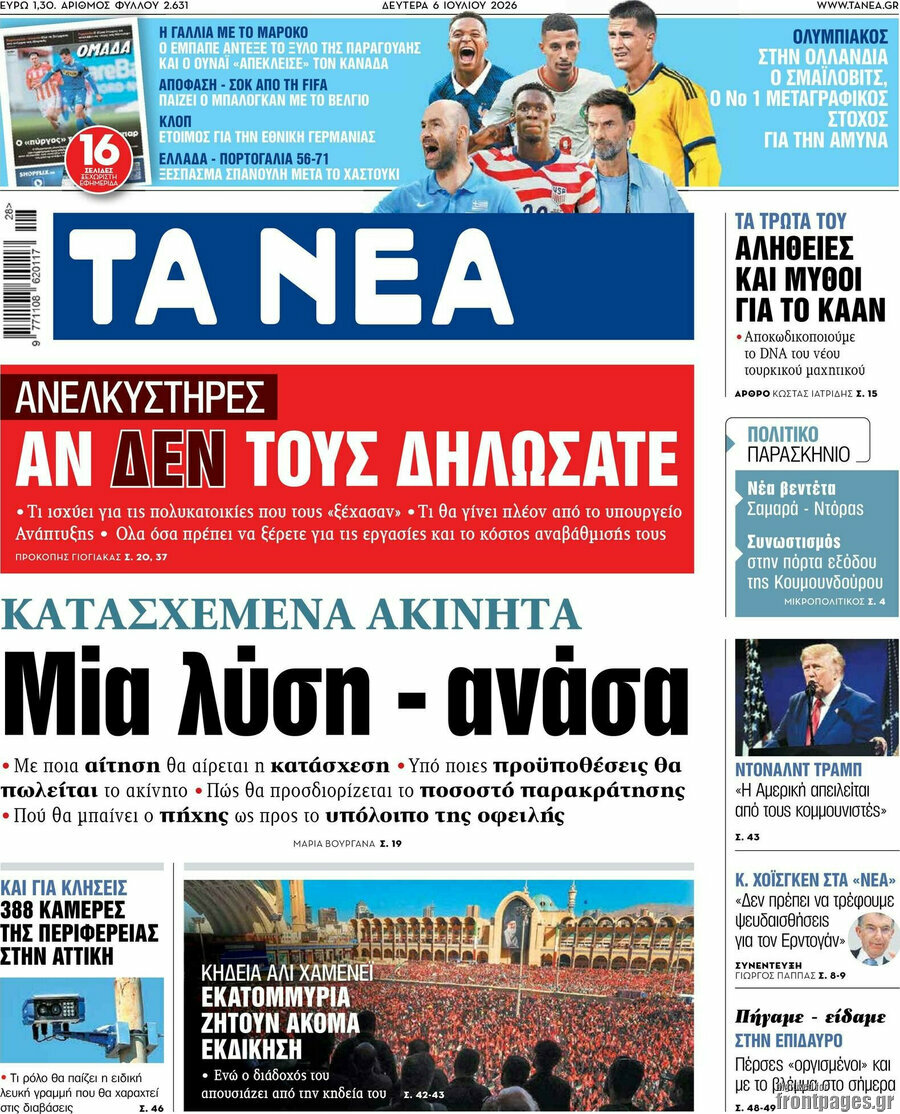
TA NEA: Confiscate real estate assets: A solution that provides breathing space
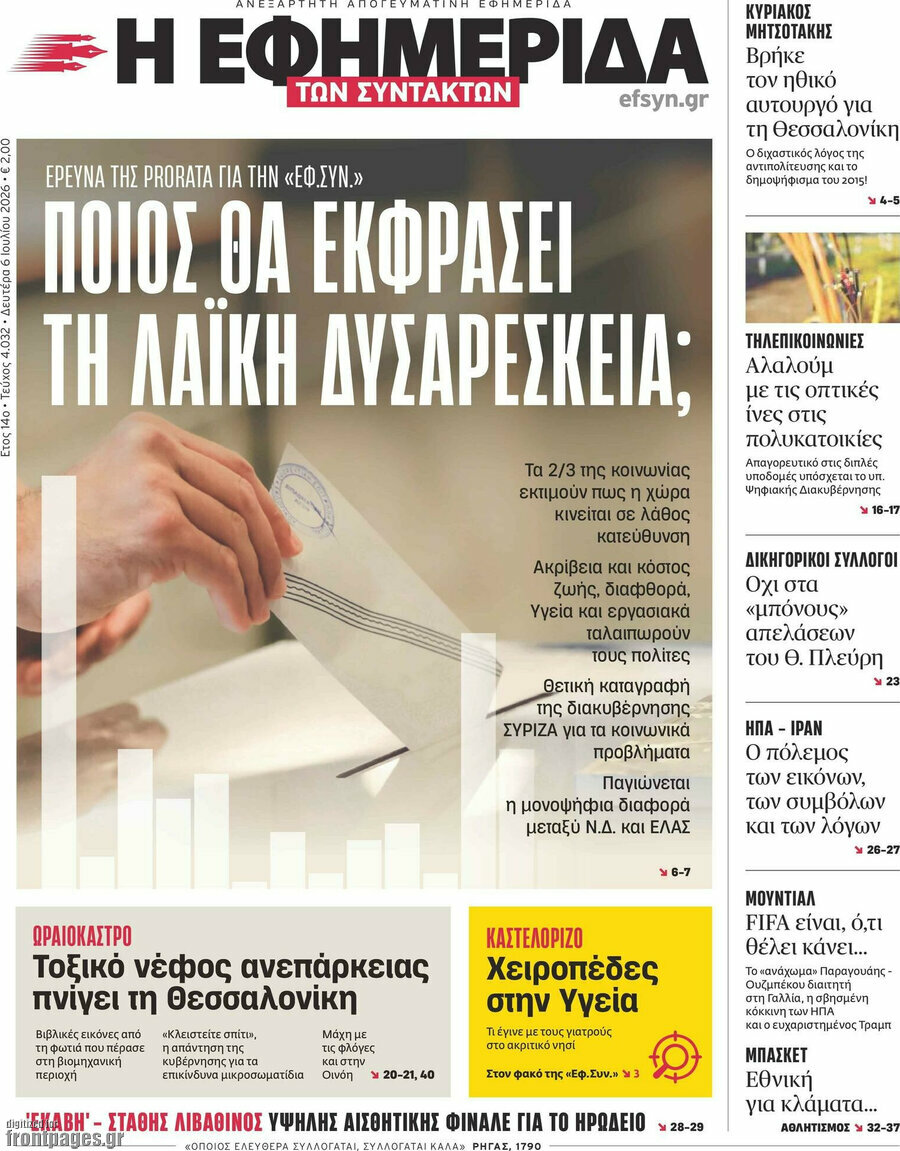
EFIMERIDA TON SYNTAKTON: Prorata Poll: Who is going to express the people’s discontent
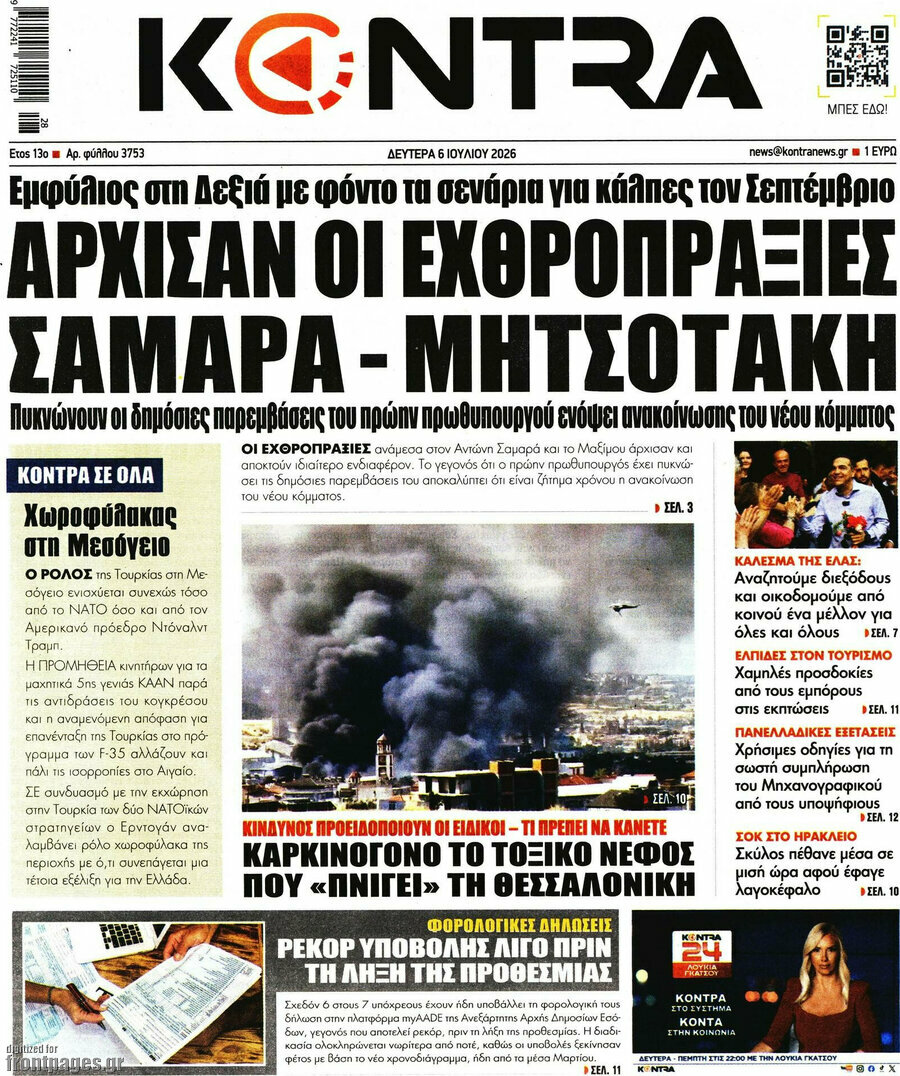
KONTRA NEWS: Hostilities between Samaras and Mitsotakis have begun
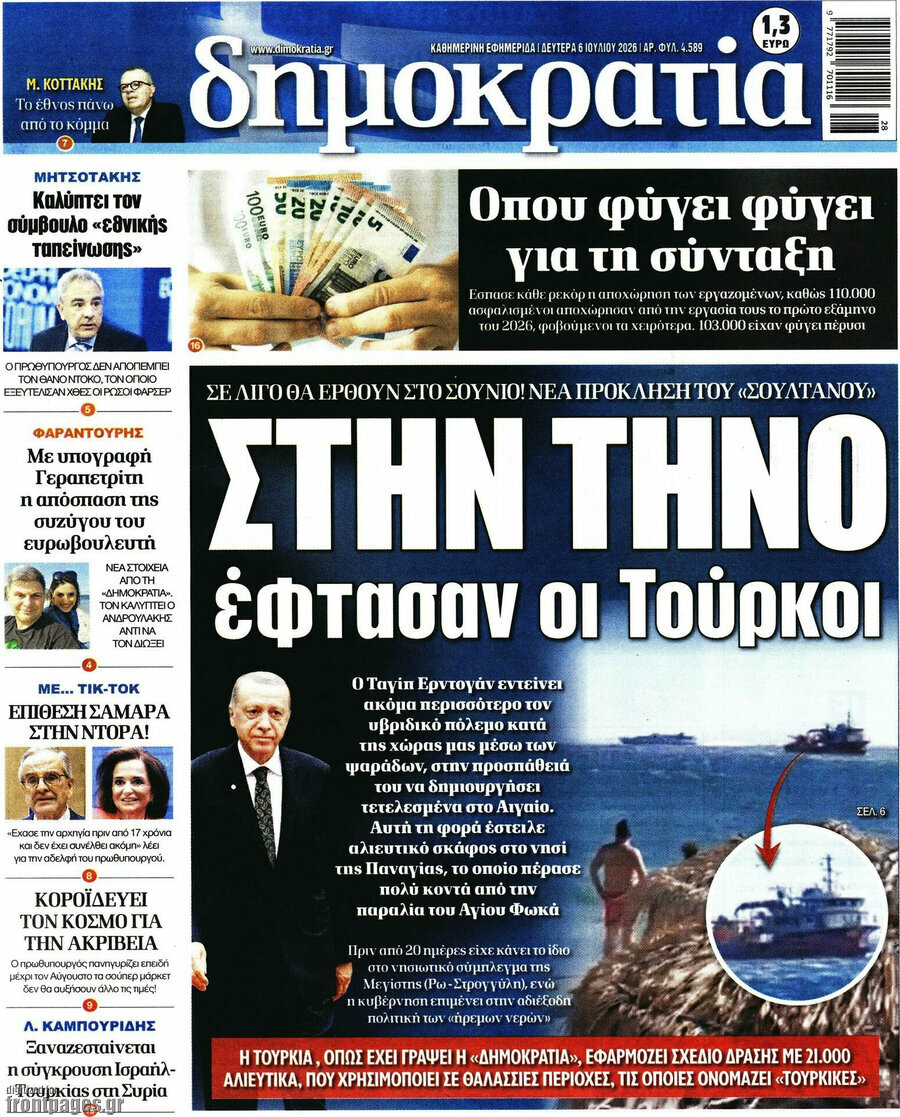
DIMOKRATIA: The Turks made it to Tinos
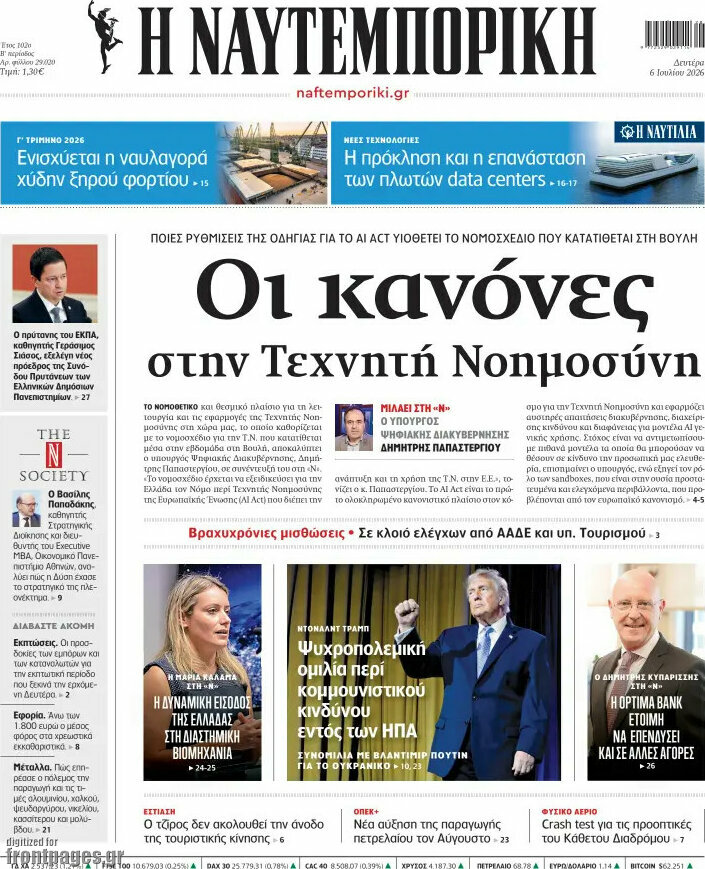
NAFTEMPORIKI: Rules for AI

DRIVING THE DAY
ANKARA SUMMIT TESTS RUTTE: NATO boss Mark Rutte is under pressure to pull off another diplomatic feat this week: keeping U.S. President Donald Trump from derailing a landmark NATO summit in Ankara, as allies try to convince him they’re paying their fair share.
Whatever it takes: Trump has continued to bash European NATO allies in the lead-up to the summit. But Rutte isn’t giving up. The secretary-general has pulled out all the stops to keep the president involved, including large visual aids and lavish praise. But the method has proven controversial among some Europeans.
Performance review: As we gear up for the summit, and Turkish officials reportedly clamp down on opposition campaigners, Playbook checked in with senior European lawmakers and officials to see what they thought of Rutte’s performance, after criticism of his “Daddy” comments and Trump’s recent clash with Italian PM Giorgia Meloni.
The verdict: Broadly upbeat — with some big caveats.
‘Doing the job’: “Europe’s interest is a united and coherent alliance at a time when our security environment is becoming much more demanding. And maintaining that unity among all allies is the secretary-general’s job,” said David McAllister, a German conservative MEP and chair of the European Parliament’s foreign affairs committee. “Mark Rutte is doing his job.”
Notes: The whatever-it-takes approach to Trump has to prove itself, said Mārtiņš Stakis, a Latvian Greens lawmaker on the Parliament’s Committee on Security and Defense. “If we think of the book that will be written in 10 years, Rutte will either look like a genius who held NATO together through the hardest moment in its history … or it will be something else.”
Toddler props: As for Rutte’s Trump method, Stakis said: “It looks like what we used in kindergarten: big pictures, giant letters.” A spokesperson for NATO did not immediately reply to a request for comment.
Dutch factor: Some Europeans have accused Rutte of kowtowing too blatantly to a U.S. president who has no hesitation in dumping on NATO allies. But a senior EU official who has worked with Rutte for years defended the former Dutch PM, saying it was his “lack of ego” that made him fit for the job: “You cannot keep Dutch coalitions together for as long as he did if you have too much pride,” said an official granted anonymity to comment. “That’s what NATO needs.”
The bottom line: Rutte has done his best to achieve success in Ankara. Allies are primed to show Trump how much they have increased defense spending. The main discussions will be short and sweet, Victor Jack reports. But, of course, things could still go wrong.
BIG AND BREAKING
FRANCE ON EDGE OVER LE PEN’S LEGAL FATE: The leader of France’s far-right National Rally Jordan Bardella will find out Tuesday whether he’ll be a presidential candidate next year, with a court ruling to decide Marine Le Pen’s eligibility to run.
POWER BEHIND THE SCENES: The Portuguese chief of staff to European Council President António Costa has become known as the EU’s “dealmaker-in-chief.” But reaching out to the Kremlin has exposed Pedro Lourtie to criticism from some capitals.
THE HAND OF GOD: U.S. striker Folarin Balogun had his one-match suspension lifted so he can play in the Americans’ last-16 game against Belgium on Tuesday morning, sparking outrage in Brussels. Reuters reports the decision followed a call from Trump to FIFA President Gianni Infantino. European football leaders are considering their next step.
Meanwhile … England beat World Cup co-host Mexico 3-2 overnight in what observers are describing as one of the best games in the 2026 tournament, CNN reports. Even Trump outed himself as a fan of England striker Harry Kane.
SUMMER HOLI-DELAY: The Commission has launched a new push in a bid to ensure its new biometric Entry/Exit System doesn’t leave non-EU citizens stranded in lines at the border as holiday season begins, according to a letter seen by Playbook’s Gabriel Gavin.
HATE SPEECH CLASH: EuropeanParliament President Roberta Metsola will today remind MEPs that they should all “feel safe,” following outrage over chants of “send them back” during a debate on the EU’s return regulations last month. Metsola is waiting for a report before making a decision on sanctions targeting the lawmakers behind the chants, the Parliament’s press service said.
Mounting pressure: “Real sanctions was my first ask … second ask was mandatory training for all vice presidents on hate speech,” Renew European MEP Abir Al-Sahlani told POLITICO, following a meeting with Metsola. Green MEP Saskia Bricmont warned the situation “can quickly get out of control if it’s not clearer [that] misbehavior is simply not allowed.”
INSIDE THE COMMISSION
EXCLUSIVE — COMMISSION REFORM PLANS: The European Commission is considering options to bolster its external-facing policy units, as part of an internal reform process. The proposal includes combining several units into one powerful department for external relations, according to three EU officials.
Foreign-policy push: The idea — one of several under review — would be to maximize the Commission’s external-policy reach, in keeping with the aims of a “large-scale review” being led by Budget Commissioner Piotr Serafin. If adopted, the proposal could add to concerns about a turf war between the Commission and the bloc’s diplomatic branch, the EEAS.
Look closer: A supercharged DG for external relations could include elements, in whole or in part, of DG TRADE or DG MENA, the department in charge of Middle East and North Africa policy. Other options under consideration include reorganizing DGs along geographic or thematic lines, per the officials who were granted anonymity to discuss confidential plans.
When to watch: Some of this thinking is due to be shared with Commission employees during an all-staff meeting on July 13, with commissioners to be briefed in subsequent weeks.
Asked about the plans, a Commission spokesperson wrote in an email: “This review is an important internal exercise for the institution. It is about making the organisation stronger, more agile and better equipped to service European citizens in a rapidly changing world.”
Stand back: Under President Ursula von der Leyen, the Commission has taken steps to bolster its foreign-policy credibility, leading to friction with the EEAS, which is headed by top EU diplomat Kaja Kallas. The reform options being considered show the Commission isn’t stepping away from foreign policy — quite the opposite.
EEAS not standing still: Kallas is also taking steps to strengthen the EEAS, having recently unveiled a new leadership structure, which includes former Dutch Defense Minister Kajsa Ollongren as secretary-general, replacing Belén Martínez Carbonell. Further reforms are expected to be unveiled after the summer.
The bottom line: The battle over who controls EU foreign policy is only getting started.
20-SECOND PLAYBOOK PRIMER
European Central Bank President Christine Lagarde said she could leave her post before the end of her term, in October 2027, to take part in France’s presidential election. That prompts the question: How is an ECB president chosen? Candidates are put forward by countries that use the euro. The Eurogroup (the body where finance and economy ministers of the eurozone meet) then picks a candidate and informs the European Council. The European Parliament and the ECB’s own governing council are consulted, with the Parliament’s Economic and Monetary Affairs Committee holding a hearing with the nominee. The European Council makes the final decision and there needs to be a reinforced qualified majority (at least 16 of the 21 eurozone countries representing 65 percent of the population). ECB president terms are eight years — non-renewable.
ROMANIA’S EU FUNDS AT RISK
CRISIS DEEPENS: Romania won’t have a new government before September, USR leader Dominic Fritz told Max Griera, as MPs go on holiday from this week: “The deadlock is real. It’s not a tactical position of the parties. It’s not political posturing.”
No go: Fritz said his liberal party, together with the center-right PNL, refuses to allow the Social Democratic Party (PSD) back into government, after it brought down the three-party centrist coalition in April, with the support of the far right.
The deadlock: Fritz wants a minority government made up of USR and PNL, which Socialists should support to “demonstrate that this is the direction they want to support and not the new majority that they formed with the far right.”
But the Socialists want a minority government led by their chief Sorin Grindeanu. A possible compromise, involving dividing the term in two, failed to take off as the parties disagreed over which side would start governing first.
Clearing the runway: “In two months, there’s enough time for any landing zone to make itself evident,” Fritz said.
EU funds in the balance: Around €5.1 billion worth of EU Covid-19 recovery funds are at risk, as Romania races to meet an end-of-August deadline for key remaining reforms, according to the USR policy department. It’s the fate of these funds that’s the most politically contentious. Still, Fritz said he was confident Parliament could pass the reforms in time, although he couldn’t “guarantee the political goodwill of the other parties.”
5 MORE THINGS GETTING US TALKING
PRESIDENT PRESSES MEPs: European Parliament President Roberta Metsola has taken the rare step of asking lawmakers to vote again after they rejected a proposed law allowing tech companies to scan their platforms for child sexual abuse content.
TURKEY READY FOR EUROPEAN DEFENSE EMBRACE: Turkey has a grim human rights record and strong ties with Russia and China. But Trump’s wavering commitment to European defense is prompting allies to reassess closer military cooperation with Ankara.
ITALY OPPOSES KIRILL SANCTIONS: Italy has joined Bulgaria in voicing concerns about plans to sanction Russia’s Orthodox Patriarch Kirill, according to three EU diplomats informed on the deliberations.
EMERALD ODYSSEY: The first informal meeting of Ireland’s EU Council presidency is an EPSCO Council gathering focused on social affairs and already has diplomats and EU officials grumbling that the venue is too remote. The meeting is being held in Ballina, roughly three hours and 40 minutes from Dublin by train. An Irish presidency official told Playbook the government had committed itself to holding at least 25 percent of its informal Council meetings outside Dublin.
WILDFIRE RESPONSE: Hundreds of firefighters battled wildfires in Portugal, Greece and Spain on Sunday, with Spain and Italy sending reinforcements to Portugal to help with a massive blaze that has been burning for more than three days, AP reports.