
Resignation signals gov’t reset effort
The government is seeking to close a turbulent chapter following the resignation on Saturday of Deputy Agriculture Minister Makarios Lazaridis. Officials judged that the political fallout from Lazaridis’ 2007 irregular appointment as a scientific adviser – despite lacking required qualifications – was compounding the damage from the ongoing OPEKEPE farm subsidy case, particularly due to his handling of the controversy. Senior lawmaker Dora Bakoyannis had urged him to resign, saying his continued presence burdened both himself and the government.
https://www.ekathimerini.com/politics/1301300/resignation-signals-govt-reset-effort
PASOK bets on fractured rivals’ collapse
PASOK leader Nikos Androulakis is pressing his call for snap elections at every opportunity, raising questions about whether the demand reflects genuine political strategy or campaign posturing. Party officials insist the call is sincere, arguing the government is in “full decline” and leading the country toward deeper deterioration. Yet polling data shows PASOK lacks the momentum needed to unseat the ruling New Democracy party. PASOK officials believe Prime Minister Kyriakos Mitsotakis is unlikely to call early elections while the war crisis continues. The opposition party sees opportunity in a fractured opposition landscape.
https://www.ekathimerini.com/politics/1301301/pasok-bets-on-fractured-rivals-collapse
The visit of Emmanuel Macron will seal the renewal of the Greek-French strategic cooperation agreement on security and defense
In a period of heightened geopolitical uncertainty, with Europe seeking a new direction both in strengthening its competitiveness and shaping a more cohesive defense policy complementary to NATO, the upcoming visit of French President Emmanuel Macron to Athens on April 24-25 carries particular significance, according to government sources. The visit is expected to seal the renewal of the Greek-French strategic partnership agreement on security and defense, while also opening the way for further cooperation in areas such as the economy, civil protection, and innovation.
Mytilene – Serious shortages in basic goods due to livestock farmers’ protest
For the sixth consecutive day, on Sunday 19 April, protesting livestock farmers on Lesvos are preventing trucks carrying mainly food and other perishable goods from disembarking at the ports of Mytilene from scheduled ferry routes and commercial cargo vessels. The ongoing disruption of supplies to the island for ten consecutive days (including the Easter holiday period) has fully destabilized the local market. Market sources report serious shortages of basic goods. Supermarket shelves are empty, there are supply issues with essential items such as flour for bread production, and fruits and vegetables are also in short supply, as local production is not sufficient to meet demand.
ATHEX: Benchmark reaches new two-month high
Developments in the Middle East conflict continued to favor the optimists, as the tension is easing and the Strait of Hormuz is one way or another about to reopen. This positive mood is starting to get reflected on stock prices, with the local bourse seeing its benchmark climb above the 2,300-point level, to a two-month high, at the end of the week. For the remainder of the month attention will now shift to the policy decisions of the Fed and the European Central Bank.
https://www.ekathimerini.com/economy/1301216/athex-benchmark-reaches-new-two-month-high




SUNDAY PAPERS
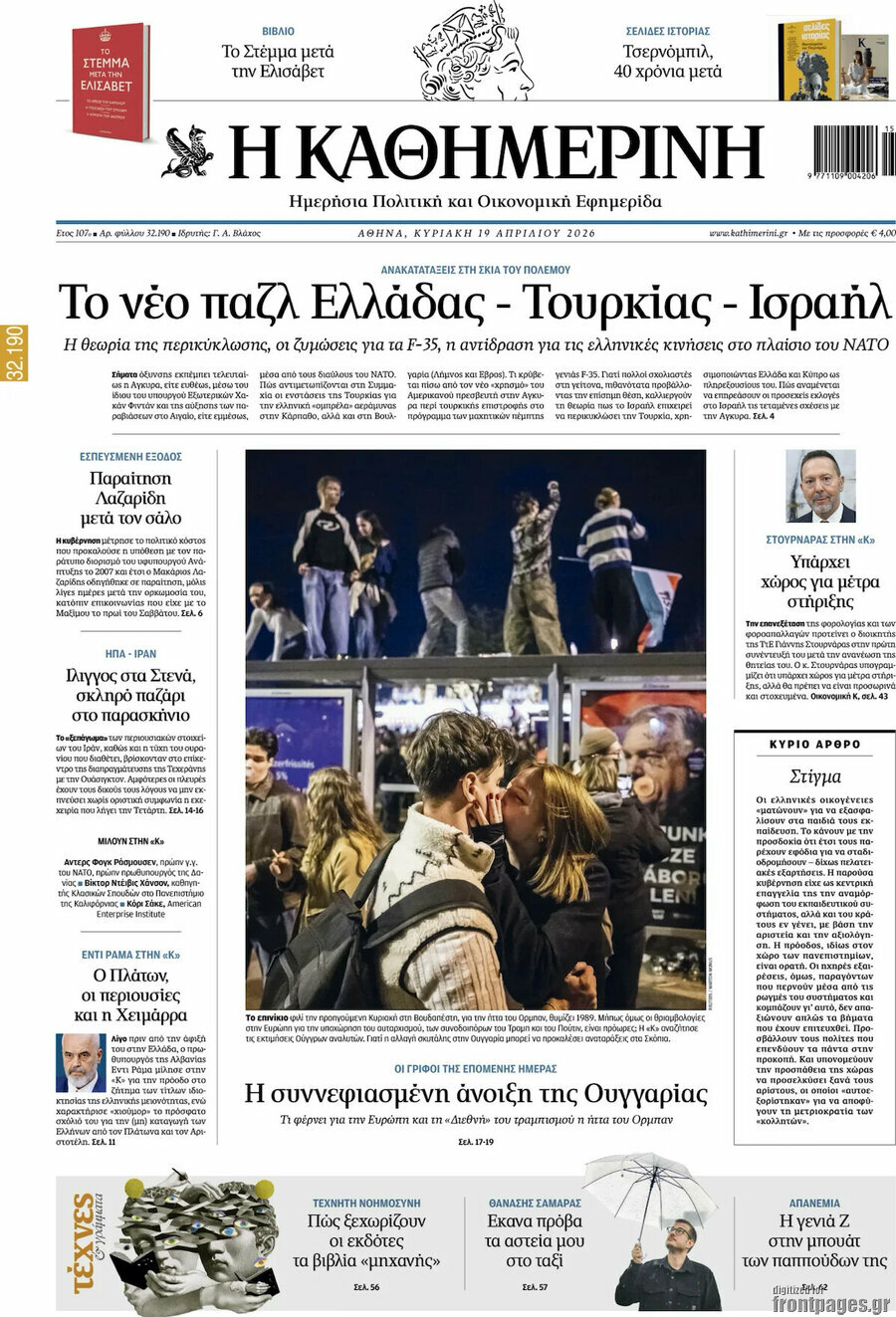
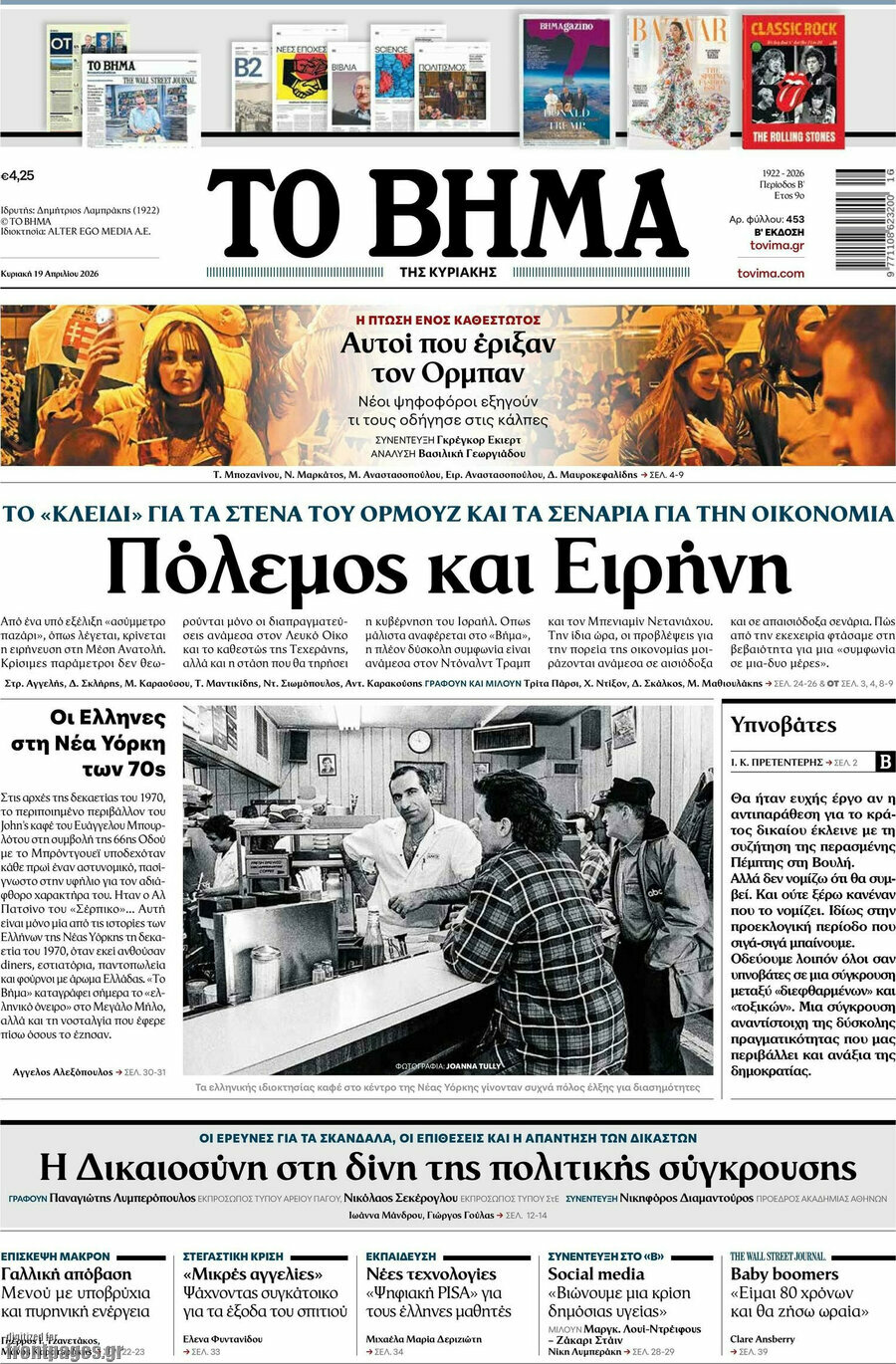
KATHIMERINI: The new Greece-Turkey-Israel puzzle
TO VIMA: War and Peace
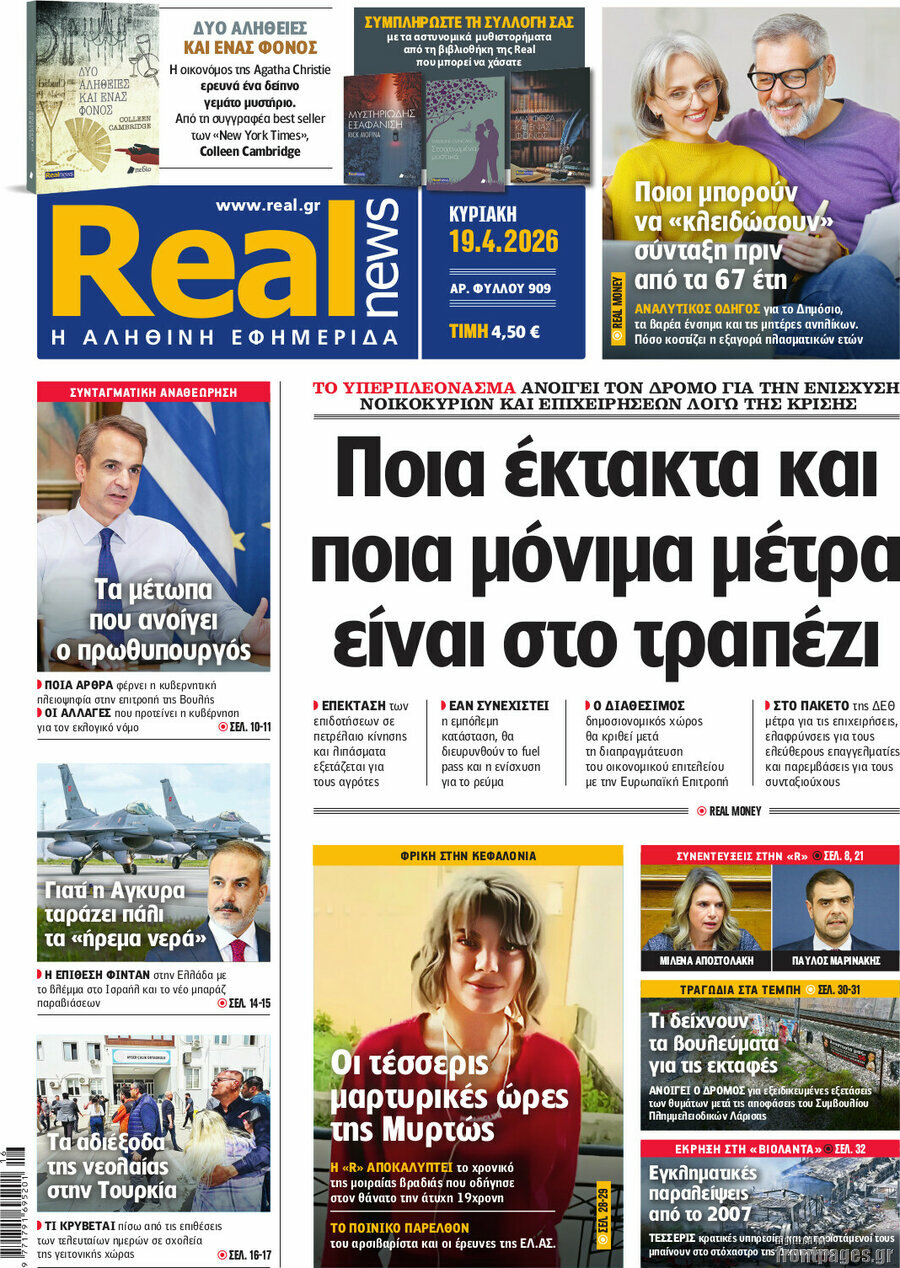
REAL NEWS: Which extraordinary and regular support measures are under discussion
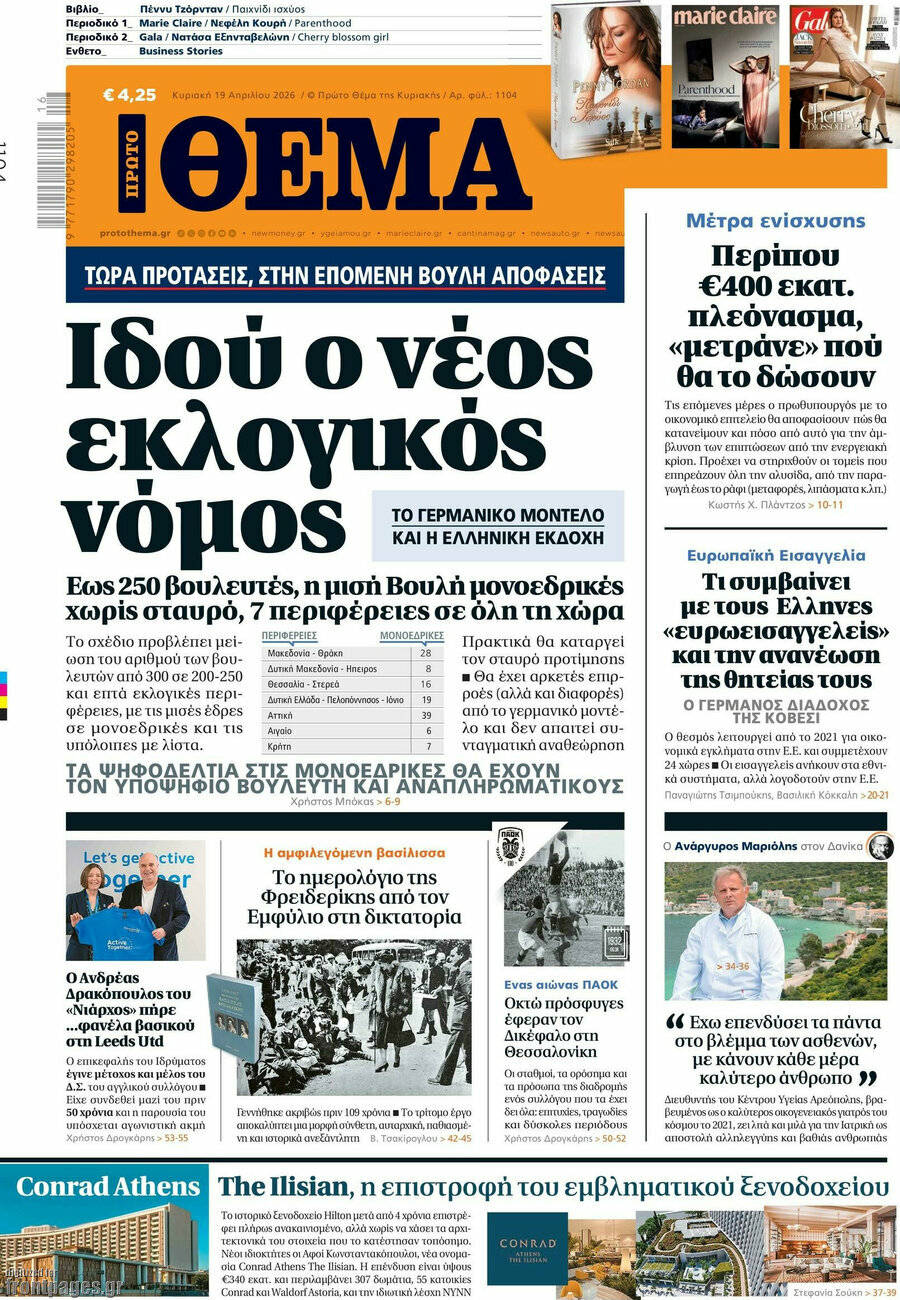
PROTO THEMA: Behold the new electoral law
MONDAY PAPERS:
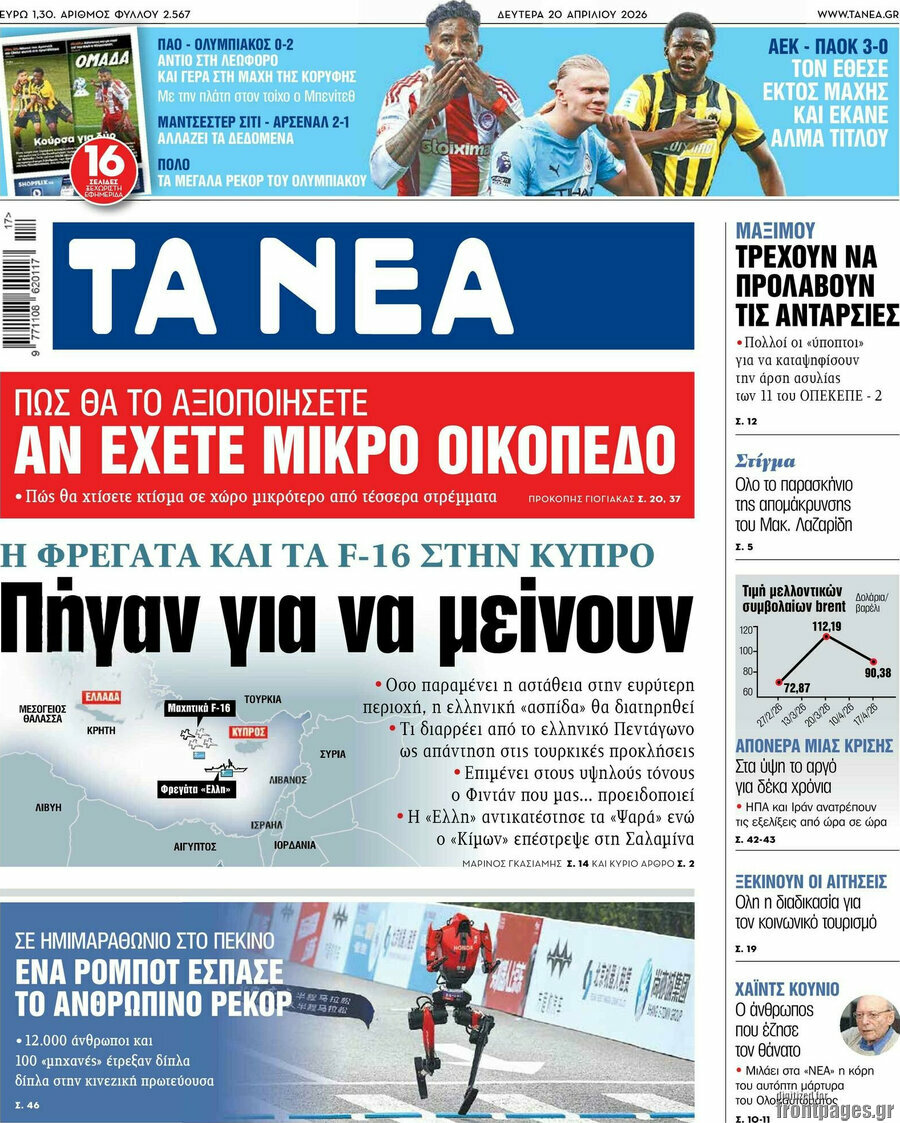
TA NEA: The Greek frigate and the F-16 jetfighters will remain in Cyprus
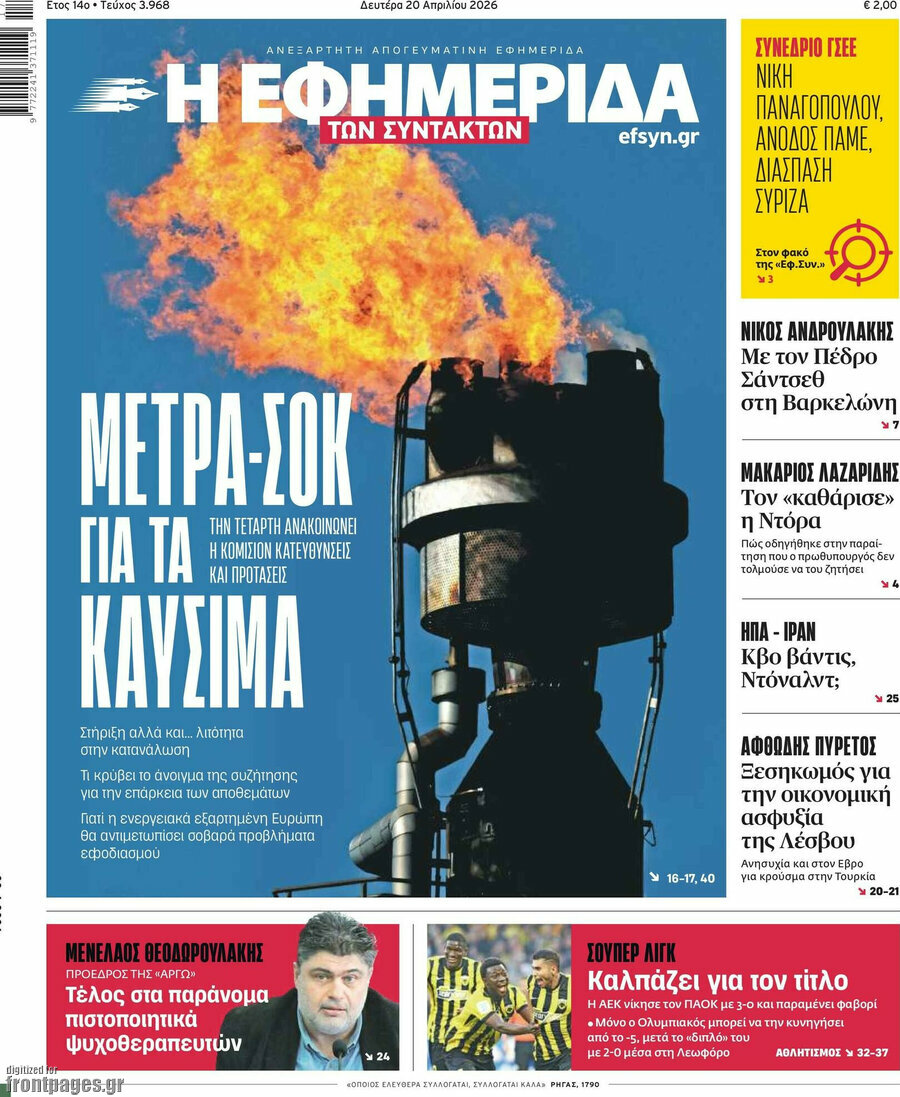
EFIMERIDA TON SYNTAKTON: Shocking measures about fuels
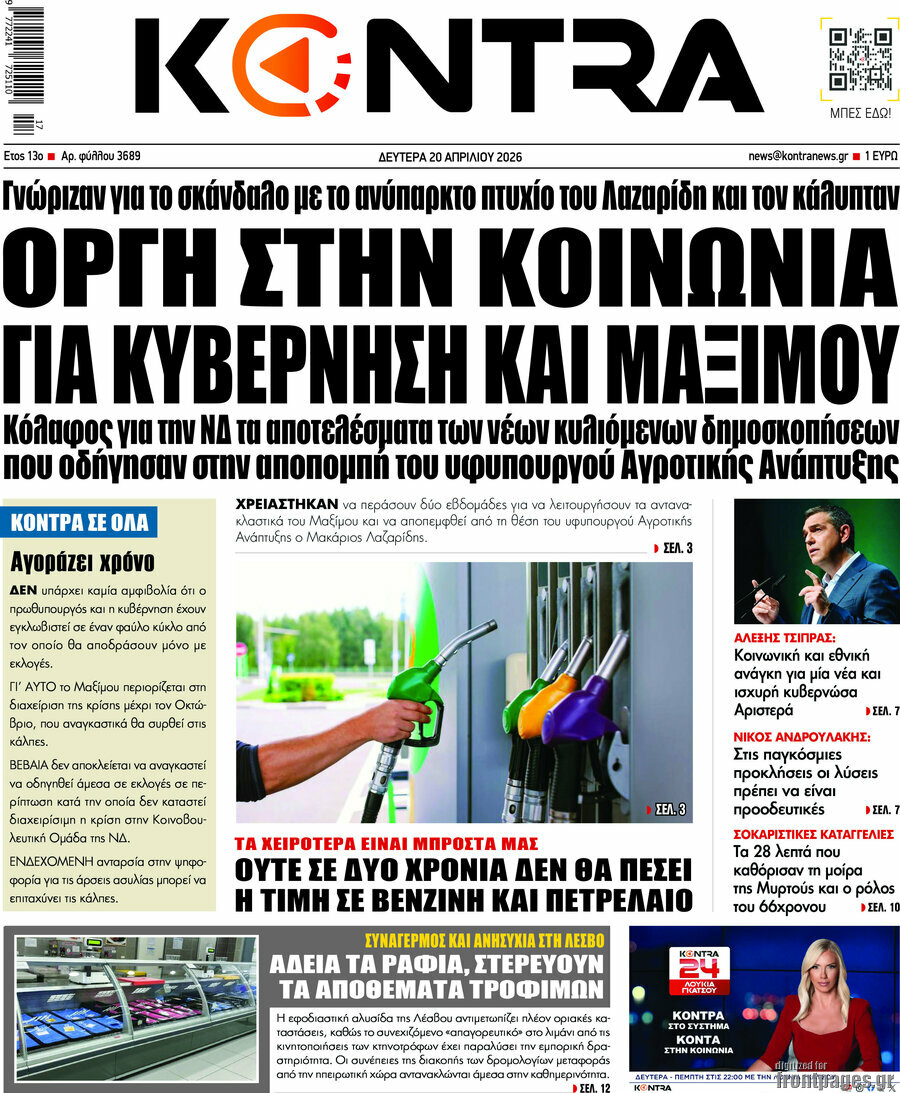
KONTRA NEWS: Society is enraged with the government and the PM’s office
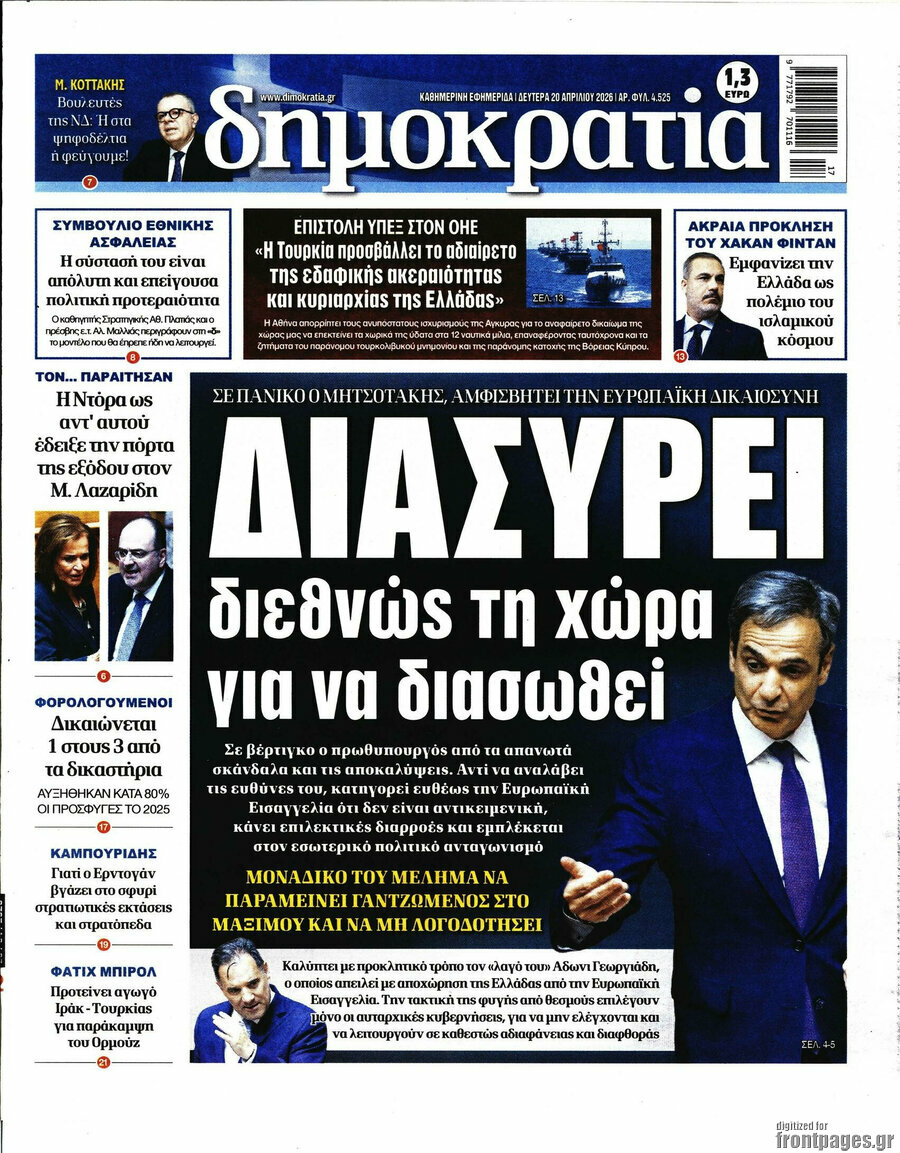
DIMOKRATIA: The PM is humiliating the country internationally in order to save himself
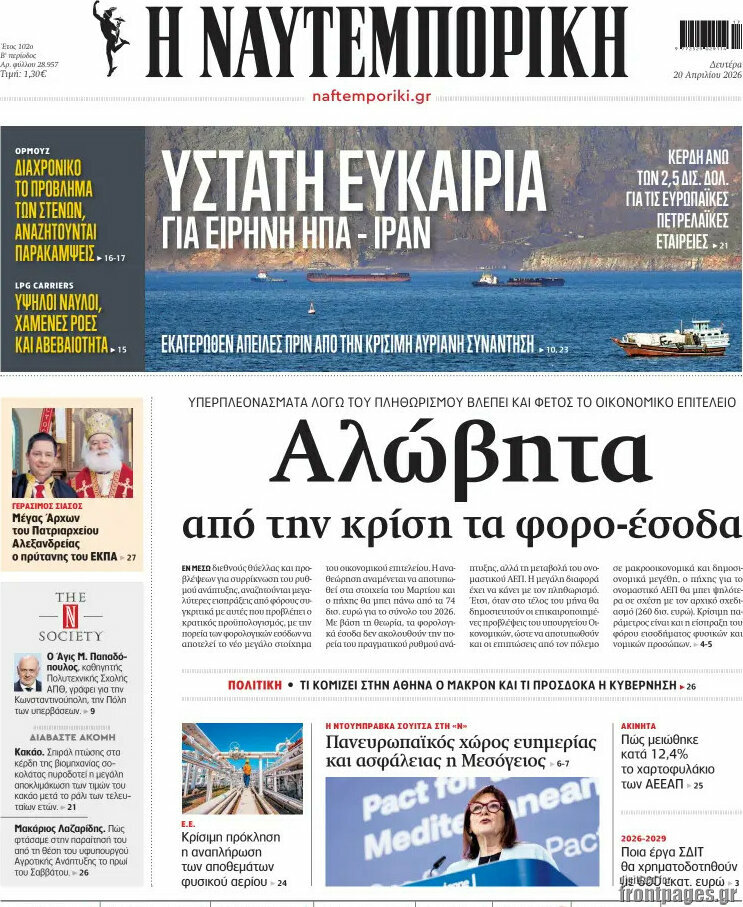
NAFTEMPORIKI: Tax-revenue remains unharmed from the war

DRIVING THE DAY
RIVAL PALESTINIAN INITIATIVES: Back-to-back events devoted to finding a two-state solution for Palestine will unfold in Brussels today, with the EU High Representative Kaja Kallas co-hosting a conference attended by Palestinian Prime Minister Mohammad Mustafa. The Global Alliance for the Implementation of a Two-State Solution meeting will rival Donald Trump’s Board of Peace.
The Trump administration has sidelined the Palestinian Authority in its peace initiative — cutting funding and banning its members from entering the U.S. But the EU is taking the opposite approach, rolling out the red carpet for Mustafa and continuing to support the cash-starved authority as a credible partner for the future of Gaza and the West Bank.
Who’s coming: The two events — the second being the “Ad Hoc Liaison Committee,” a donor conference — will bring together backers of a two-state solution from around the world, including Norwegian Foreign Minister Espen Barth Eide. Some 60 delegations will attend the meetings hosted by Kallas and Belgian Foreign Minister Maxime Prévot.
Peeking in: Even Nickolay Mladenov — official envoy of Trump’s Board of Peace and former Bulgarian minister — will be dropping by, echoing EU Commissioner Dubravka Šuica’s low-key attendance at Trump’s Board of Peace launch event in Washington in February.
Why Europe is doing it: Brussels is now the world’s top financial backer of the Palestinian Authority and has two active missions in the region — what an EU official describes as “skin in the game.” Today’s conferences show the EU flexing its diplomatic muscle to highlight a different vision for the region, ahead of Israeli elections due to happen later this year.
On the table: “With the Iran and Lebanon wars taking center stage, Gaza has fallen a bit off the radar. Hamas refuses to disarm, the international stabilization force hasn’t deployed yet and West Bank settler violence is rising,” the EU official told Playbook. “So, the outlook isn’t rosy.” Today’s gatherings are to put the two-state solution “back on the table” and support PA reforms, they added.
ISRAEL IN THE SPOTLIGHT: The gathering comes as Israel faces fresh scrutiny in the EU. Spanish Prime Minister Pedro Sánchez announced Sunday that his foreign minister will pitch suspending the EU-Israel Association Agreement at the Foreign Affairs Council in Luxembourg Tuesday. (Sánchez has a lot on his plate at the moment: Gerardo Fortuna has this write-up of the prime minister’s bid to lead global forces against the far right.)
Why suspend? European Commission President Ursula von der Leyen had come under pressure from EU states over Israel and in 2025 proposed a suspension of the trade pillar of the Association Agreement. That proposal never reached the requisite threshold of support, but it’s now coming up for review. And it’s happening at a time when Italy is hardening its tone against Israel and Hungarian Prime Minister Viktor Orbán, Israel’s biggest backer in Europe, is exiting stage left.
Speaking of … Orbán’s departure leaves Israel more exposed to potential sanctions in coming months, including measures targeting violence by West Bank settlers, for which Hungary was the sole holdout when the proposal was tabled earlier this year. “The mood has shifted” with regard to Israel, said one senior EU official told me.
IRAN LATEST: Trump said the U.S. will continue peace negotiations with Iranian representatives in Pakistan, despite both sides continuing to trade blows in the Strait of Hormuz. The U.S. last night seized an Iranian-flagged cargo ship that tried to get around its naval blockade, sending oil prices higher and prompting threats of retaliation from Tehran. An American delegation will travel to Islamabad Monday for another round of talks, Trump said — though Iranian state media reported that Tehran won’t send negotiators because of the blockade.
Backfire risk: Reuters is reporting that Washington’s European allies fear Trump’s push for a swift, headline-grabbing framework deal with Iran could entrench deeper problems — including the future of Iran’s nuclear program.
CYPRUS INFORMAL EUCO
AN EVER-CLOSER SECURITY UNION? EU leaders gathering this week in Cyprus will be briefed by Kallas on work to operationalize Article 42.7 of the Lisbon Treaty, under which EU countries must offer “aid and assistance” to one another in the event of a formal request from a member country.
Key detail: Article 42.7 is widely understood to be an EU-shaped panic button in the case of attack by an outside country. But the clause doesn’t lock in members to provide military assistance (unlike NATO’s Article 5) and contains language covering neutral nations such as Ireland and Austria.
Why now: The threats against EU states are more real than ever. For example, Cyprus chose not to activate Article 42.7, despite a British military base on the island being targeted by drones in March. But Nicosia is one of the capitals to voice interest in better understanding how the EU’s mutual assistance clause would work, per one of the diplomats.
The elephant in the room: NATO’s Article 5 mutual defense clause is designed to be the only security guarantee members will ever need. But following Trump’s threats to invade Greenland, EU countries are increasingly interested in hedging against the risk that the unpredictable president could block the activation of Article 5 if it’s requested by an EU member of NATO.
Getting serious: Following the informal Council meeting, Kaja Kallas will host a tabletop exercise with senior ambassadors in Brussels to game out how Article 42.7 would work in practice, your Playbook author and my defense colleague Jacopo Barigazzi reported Friday.
Tightrope: Based on a fictional scenario that is being kept under wraps, the exercise will be carefully calibrated so as not to suggest that the EU is looking to replace NATO. Instead, following a meeting between NATO Secretary-General Mark Rutte and von der Leyen last week, diplomats said the focus will be on making Article 42.7 complementary with NATO’s Article 5, amid a wider push to “Europeanize” the alliance.
Wider push: The exercise comes as Kallas compiles threat assessments from 27 governments to feed into the bloc’s first-ever Security Strategy, which von der Leyen is due to present this summer.
Step back: Europe has long styled itself as a soft power giant, or a “lifestyle superpower,” as one commissioner put it recently. But that soft image is being tested — and the EU is being forced to toughen up.
EU ENLARGEMENT
SCOOP — CASH ON HOLD: Enlargement Commissioner Marta Kos is set to announce at a European Parliament hearing on foreign affairs today that the EU will freeze a €1.5 billion pot of funds earmarked for Serbia over controversial judicial reforms Belgrade pushed through in January, as POLITICO scooped on April 10.
POLITICO’s Sebastian Starcevic has learned that Kos is expected to say Belgrade won’t be paid a cent in EU grants intended to help Serbia align itself with the bloc, at least until the Venice Commission, the Council of Europe’s legal advisory body, publishes its opinion on the Serbian reforms. That’s expected by the end of the month, an EU official told POLITICO.
Serbian climbdown: Serbia’s envoy to the EU told POLITICO earlier this month that Belgrade had vowed to accept the Venice Commission’s recommendations, which might include changing or repealing the legislation. That chimes with Kos’ plans to demand that Serbia “align its judicial laws with the Venice Commission’s recommendations.”
The EU’s patience with Serbia has worn thin in recent months, with a scathing report on the country’s enlargement progress last November warning of democratic backsliding and “an anti-EU narrative” in Belgrade. Serbia has pocketed more than €7 billion in funds and investments from the EU since 2000, but continues to court close ties with Russia.
IN OTHER NEWS
CHICKEN, EGG: Viktor Orbán suggested on X overnight that Ukraine was ready to restore oil deliveries via the damaged Druzhba pipeline as early as today, “provided that Hungary lifts its blockade of the €90 billion EU loan.” The outgoing Hungarian prime minister said the timing would have to be the other way around: “Once oil deliveries are restored, we will no longer stand in the way of approving the loan,” he said. Bloomberg quotes a European Commission spokesperson as confirming it has been in touch “with concerned parties.”
U.S. AMBASSADOR MEETS VIRKKUNEN: Andrew Puzder is meeting Executive Vice President for Tech Sovereignty Henna Virkkunen today, our Morning Tech colleagues write in to report. The U.S. ambassador has given several interviews to European media in the past few weeks criticizing the EU’s “overregulation” of tech and raising concerns about how it could affect the bloc’s chances of keeping up in the global AI race.
INFLUENCE WARNING: Two leading U.S. lawmakers have written to Meta and Google to demand they take steps against Russia’s latest “efforts to interfere in a vulnerable democracy’s elections” — this time in Armenia.
Calling tech bosses: Senators Jeanne Shaheen, the ranking member of the Committee on Foreign Relations, and Thom Tillis warned dozens of accounts and streaming channels are engaging in “coordinated inauthentic behavior,” in an apparent bid to influence the South Caucasus’ nation’s parliamentary vote on June 7, according to letters seen by Playbook’s Gabriel Gavin.
At the periphery: Armenia’s Prime Minister Nikol Pashinyan has sought to bring the country closer to the EU and will host leaders from across the bloc for the European Political Community summit there on May 4 — a landmark move for a former Soviet Republic that was once one of Moscow’s closest allies. But warning signs are growing that the Kremlin is working to tilt the balance in favor of the opposition, as it tried to do — unsuccessfully — in Moldova.
GIVE US ACCESS: The new head of the EU’s anti-fraud agency, Petr Klement, says OLAF is still struggling to get the access it needs to properly investigate institutional wrongdoing, Mari Eccles reports.
FATAL FLAW: My Westminster colleagues have a cracking read out this morning on the political limtiations that have brought British PM Keir Starmer potentially to the endgame of his premiership.