
Athens sees gains from Rubio visit
Greek officials gave a broadly positive assessment of US Secretary of State Marco Rubio’s visit, saying his public remarks and an interview with Kathimerini showed a strong understanding of Greek positions, regional dynamics and the sensitivities surrounding Greek-Turkish relations. Greek officials highlighted Rubio’s statement to Kathimerini that Washington considers a Greek-Turkish conflict unthinkable, as well as what they described as discreet support in principle for the Greece-Cyprus electricity interconnection project, the Great Sea Interconnector.
https://www.ekathimerini.com/politics/foreign-policy/1317617/athens-sees-gains-from-rubio-visit
Skouries mine a ‘vote of confidence’ in Greek economy, PM says
Greece can attract foreign investment with credibility, Prime Minister Kyriakos Mitsotakis said Thursday at the opening of a new mine by Eldorado Gold and the Canadian group’s Greek subsidiary Hellas Gold in Skouries, Halkidiki, northern Greece. Describing the project as a “vote of confidence” in the Greek economy, Mitsotakis said it reflects “a country that can attract foreign investors with credibility,” adding that Greece must maintain consistency and clear rules for investors.
BoG governor Stournaras: Greece aims to have Category A credit rating before 2030
Greece’s aim is to get a Category A investment-grade rating before 2030, Bank of Greece Governor Yannis Stournaras said on Thursday, in response to questions from the Athens-Macedonian News Agency (ANA-MPA). His comments came in the wake of the latest reduction in Greece’s public debt, following an early repayment of € 2.5 billion on October 1, while speaking on the sidelines of the To Vima conference entitled “Dialogues for Athens”.
ELSTAT: Trade deficit down 3.8% in Jan-Aug ’26 – up 3.6% in Aug
The total value of imports amounted to € 6,466.7 million in August 2026, in comparison with € 5,492.4 million in August 2025, recording an increase of 17.7%, according to the Hellenic Statistical Authority (ELSTAT) on Thursday. The deficit of the trade balance, in August 2026, amounted to € 2,205.6 million in comparison with € 2,128.7 million in August 2025, recording an increase of 3.6%. The corresponding value of deficit excluding oil products, in August 2026, recorded a decrease of € 135.2 million or 6.6% and the corresponding value excluding oil products and ships, in August 2026, recorded a decrease of € 84.0 million or 4.2%, in comparison with August 2025.
https://www.amna.gr/en/article/1029467/ELSTAT-Trade-deficit-down-38-in-Jan-Aug-26–up-36-in-Aug
ATHEX: Bourse sees its negative spiral go on
The Euronext Athens (ATHEX) general index closed Thursday at 2,568.05 points, shedding 2.06% from Wednesday’s 2,622.02 points. The large-cap FTSE-25 index contracted 2.16% to end at 6,577.49 points.
https://www.ekathimerini.com/economy/1317643/athex-bourse-sees-its-negative-spiral-go-on



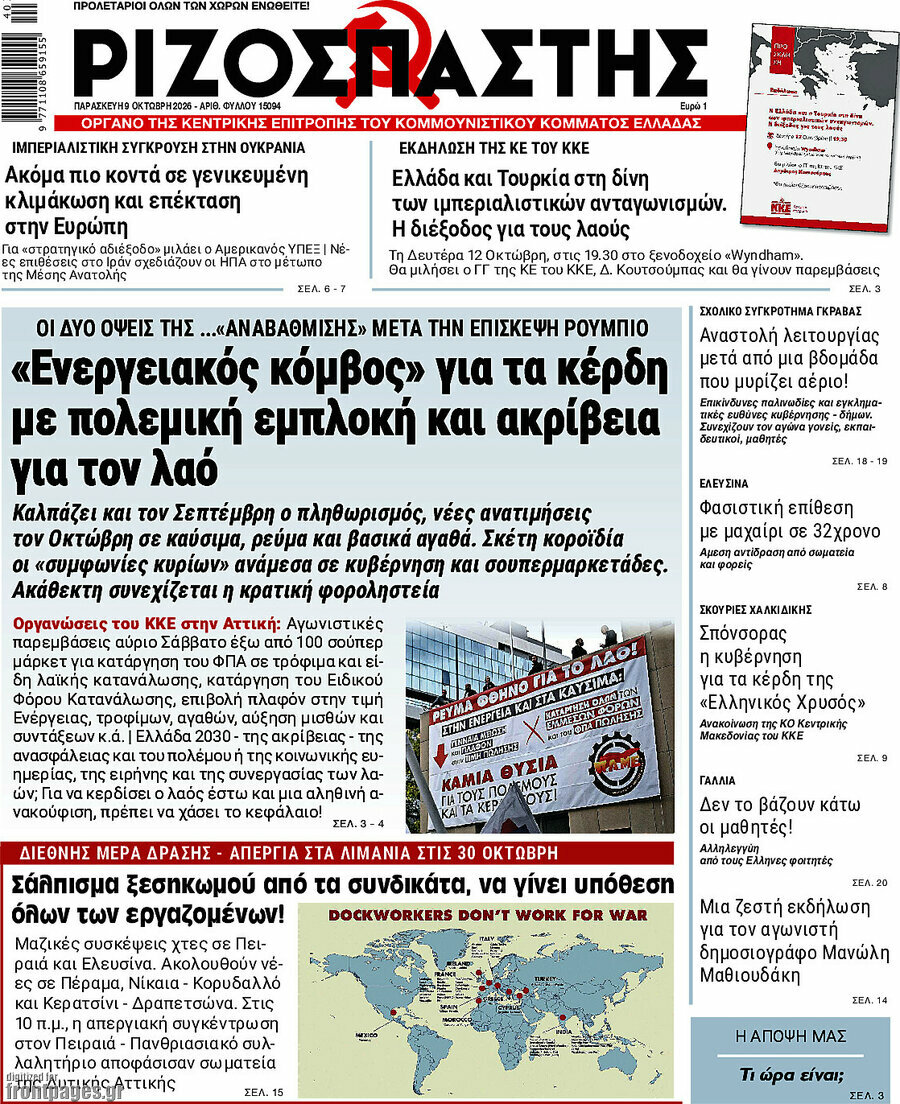
KATHIMERINI: EU Commission pressures Paris for austerity measures
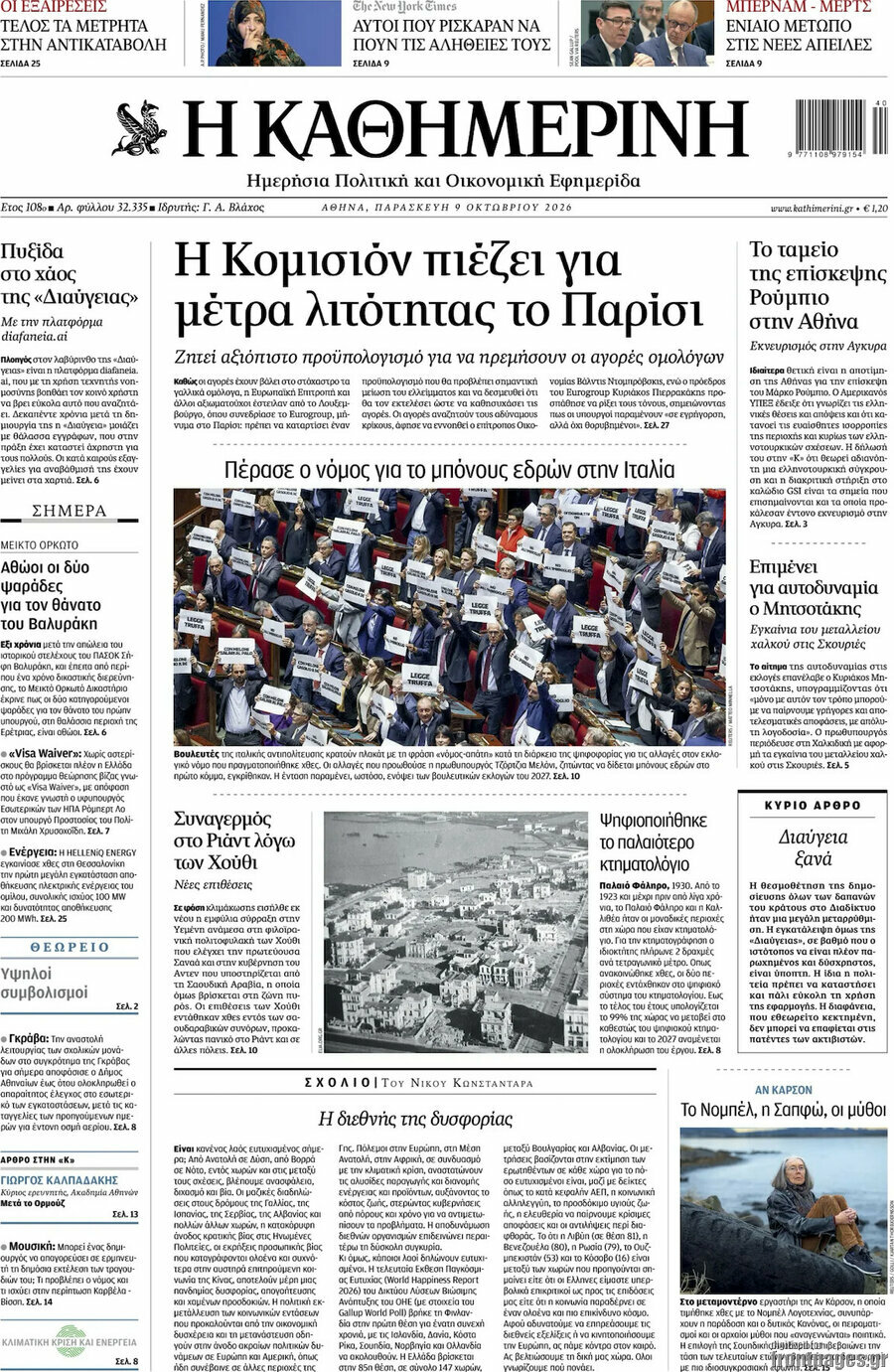
TA NEA: Courier services: no more cash
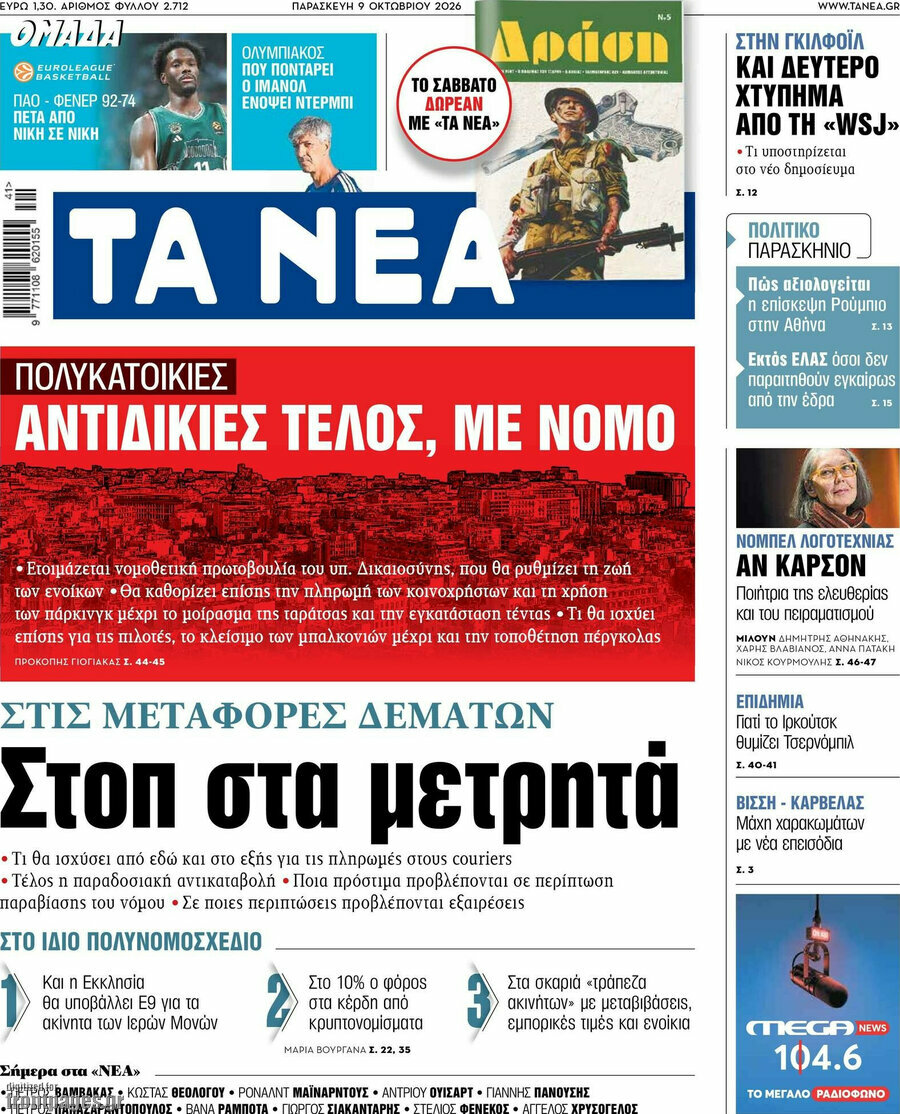
EFIMERIDA TON SYNTAKTON: 2,800 houses were lost in Attica to auctions
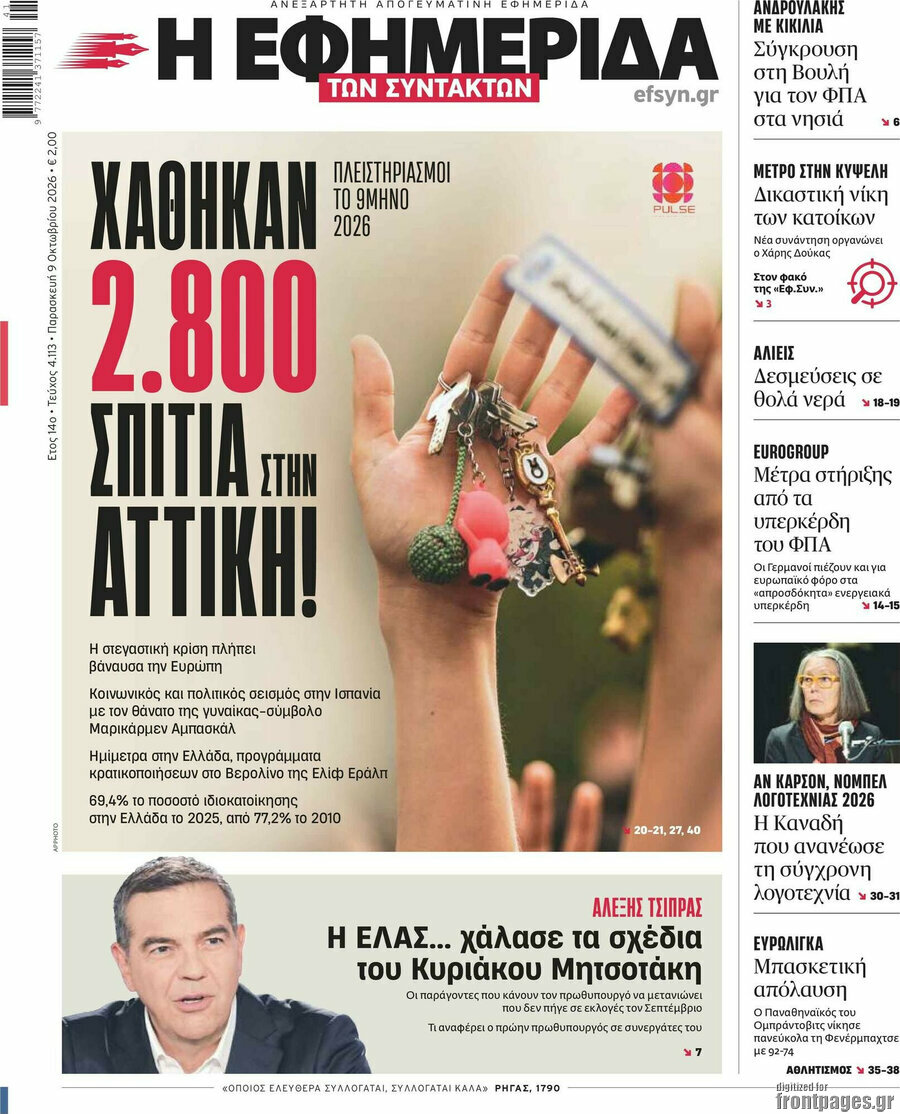
RIZOSPASTIS: Greece becomes energy hub benefiting business groups and gets involved in war plans, while simple folks suffer from price hikes
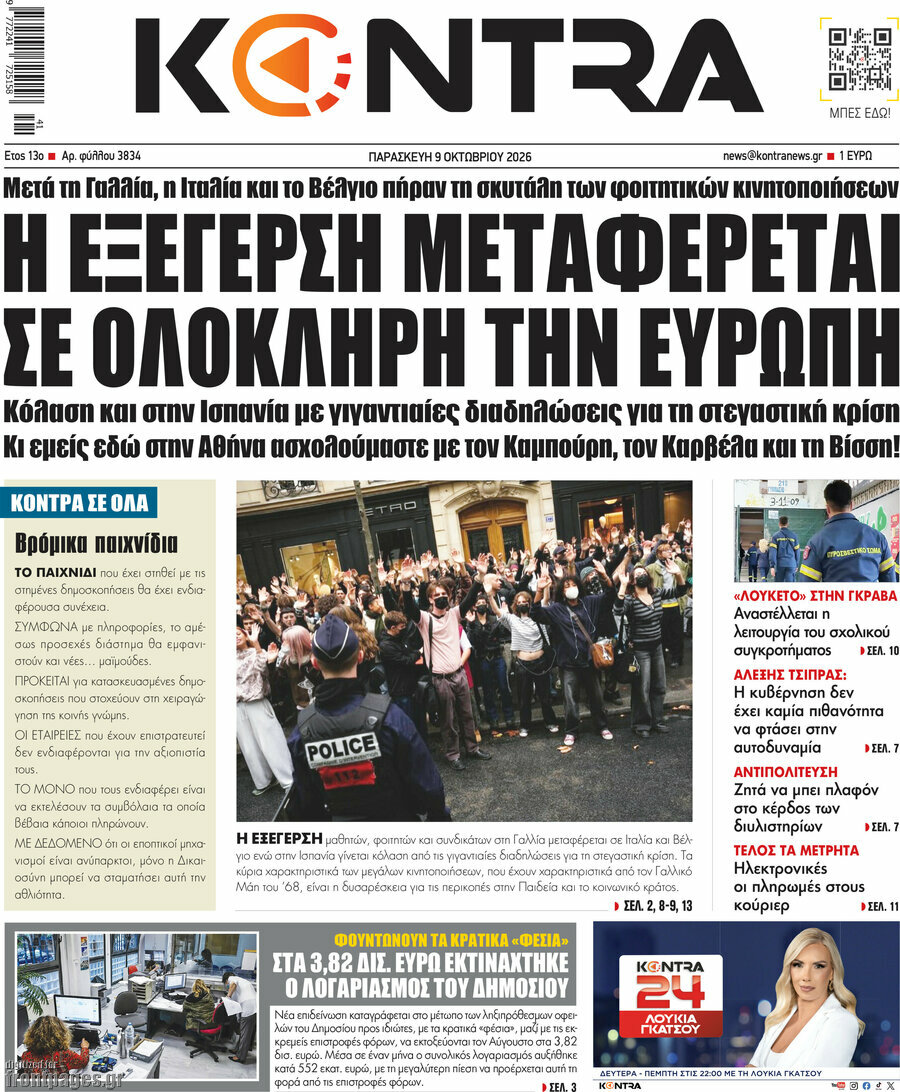
KONTRA NEWS: After France, the uprising was transferred in Italy and Belgium
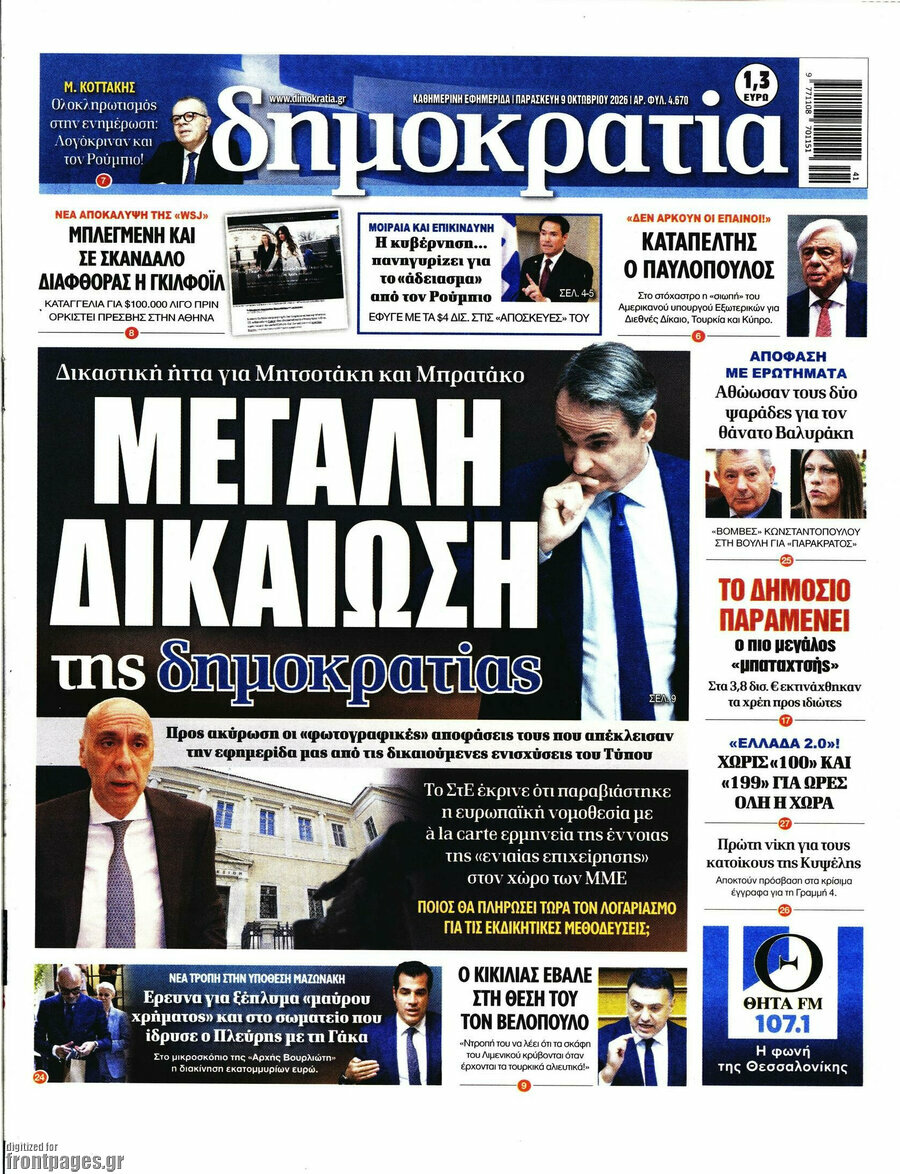
DIMOKRATIA: Newspaper “Dimokratia” vindicated in court for its exclusion from press subsidies
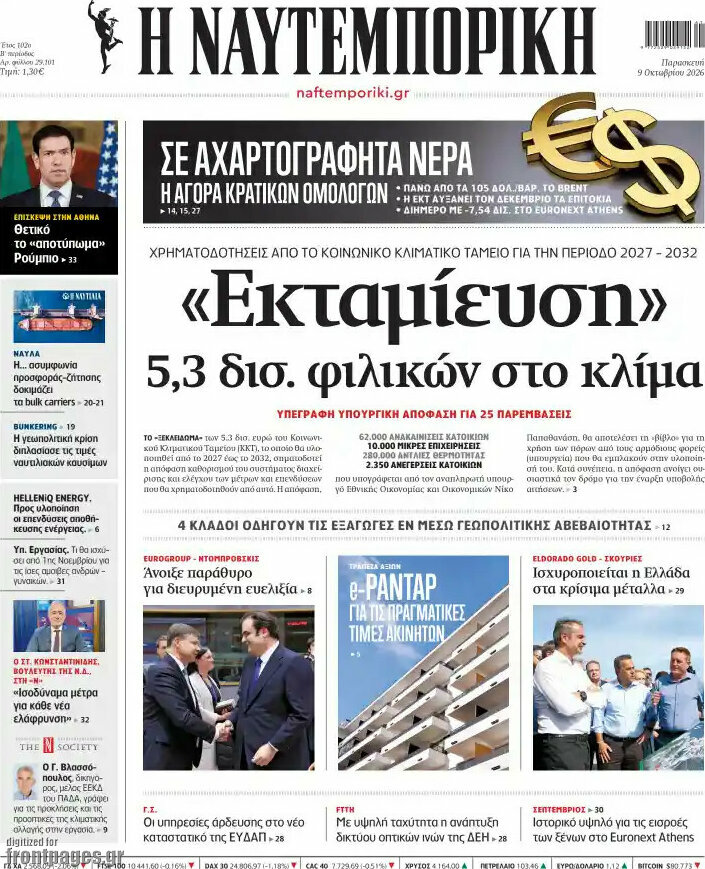
NAFTEMPORIKI: “Disbursement” of 5,3 environment-friendly billion

DRIVING THE DAY
EXCLUSIVE — PANDORA’S NEGOBOX: EU governments are bracing for the proposed size of the bloc’s next seven-year budget to be cut by €100 billion to €200 billion compared with the plan announced in June, according to a dozen European diplomats Gregorio Sorgi and I spoke to.
Starting gun: Ireland, in its role at the helm of the presidency of the Council of the EU, will unveil its negotiating document, or “negobox,” tomorrow morning (yes, a Saturday), which will set the scene for no-doubt fraught discussions between leaders at a two-day summit in Brussels next week.
“It starts with a one,” a diplomat said, tantalizing us with the number of billions to be reduced from the proposal.
In the weeds: Cuts will be light or non-existent to agriculture and regional spending, which account for almost half of the total budget, five diplomats told us. This would be a victory for 17 countries including Italy, Spain and Poland, which opposed cuts to these policies in a joint statement last week.
Firing line: Administration, the €118 billion earmarked for the EU’s institutions and staff, is the easiest target. However, larger reductions are expected from the Global Europe fund, the EU’s €200 billion pot of development aid and external relations cash, and the €410 billion European Competitiveness Fund to boost the bloc’s industrial capacity, the diplomats said.
“We are very concerned that Ireland would decide to smash funding for research and external action, which is a major issue for development, our economic interests and migration,” one diplomat said.
Your regular reminder of the fight: The bloc is split between so-called frugal countries including Germany, Austria and the Netherlands, which want several hundred billion euros slashed from the nearly €2 trillion proposal, and the “Friends of Cohesion,” a rival coalition of southern and eastern countries.
There has been “substantial progress” toward an agreement between EU member countries, Ireland’s European Affairs Minister Thomas Byrne told the European Parliament. But “we cannot satisfy everybody.” He added to Playbook the negobox was a “realistic basis” for more talks.
Any way you slice it: Stripping administration, Global Europe and competitiveness alone won’t satisfy the frugals, who want cuts across the board. They will be asking “where did they cut and did they cut enough?” said one diplomat.
How to pay for a smaller budget: The European Commission’s five proposed EU-wide taxes — known as “own resources” — are expected to make it into the negobox, the diplomats said. But Dublin might suggest tweaks to levies including a corporate tax, known as CORE, that’s particularly unpopular with European governments. The European Parliament’s proposed taxes will be left out entirely.
All of this points to a tense summit. Those talks’ chances of success “depend on the negobox,” said a diplomat. But: “Time is running out. The European Council has clearly been too slow so far,” Siegfried Mureșan, the European People’s Party’s budget negotiator, told me.
BIG AND BREAKING
LIKE A SPY MOVIE: Antoaneta Roussi has a must-click profile of the former head of Germany’s foreign intelligence service accused of profiting from state secrets.
PARTY EXIT: MEP Romana Jerković has stood down from her national party after POLITICO revealed her inner circle attended a taxpayer-funded European Parliament event in Strasbourg, Mari Eccles reports.
READY TO RULE: Alternative for Germany is softening its pledge to quit the euro — a sign that the party is seriously preparing to govern Germany, Johanna Treeck writes.
WINTER SNAP: The EU is facing a winter gas shortage that could leave the bloc scrambling to replace lost energy supplies equivalent to the power used by up to 12 million homes, reports Ben Munster.
EUROPE’S DEVELOPMENT RETREAT
DON’T PUT AID LAST: Cuts to EU development funding will leave a vacuum for Russia and China and result in more migration to Europe, Irish International Development Minister Neale Richmond told Playbook’s Zoya Sheftalovich.
“If you cut a country’s development budget, it will force people to go on the move,” he said ahead of today’s meeting of EU development ministers in Dublin. “If people don’t have access to good health care systems, if the infrastructure is crumbling around them, they will move.”
Well, that’s depressing: The get-together at Dublin Castle is the first gathering of EU development ministers in almost two years. Richmond said the “dispiriting” gap reflects the extent to which humanitarian aid has slipped down the global agenda.
“Globally, we’ve seen development cooperation drop by over 23% in the last year, not just due to cuts from the United States, but also from many EU member states,” he said, adding that Ireland and Spain were the only two to increase their development budgets.
Budget squeeze: Global Europe, the EU’s main cash pot for funding countries outside the bloc, is among the areas facing a budget squeeze in Ireland’s negobox. Any serious cuts there would be “crazy,” the Socialists and Democrats’ budget co-rapporteur Carla Tavares said.
RIP USAID: A diplomat from a country receiving EU funding — granted anonymity to avoid prejudicing future applications for the funds — compared the cuts to the Trump administration’s gutting of USAID and said they will open the door for Moscow and Beijing.
Filling the void: Richmond argued that giving aid is in Europe’s geostrategic interest. “The more the U.S. withdraws, the more that EU withdraws, that void is generally being filled by Russia,” he said, pointing to the Kremlin’s influence operations in Africa and efforts by China, Turkey and others to increase their footprint.
20-SECOND PLAYBOOK PRIMER
EU countries will meet on Sunday to try to agree on a negotiating position on the digital omnibus … but what is that? It’s a package of red-tape slashing measures for tech regulations that was proposed by the European Commission. The member countries hoped to have already found a common position so talks can start with the Commission and Parliament, but Germany is seeking tougher protections for trade secrets.
CRUEL CLICKBAIT
GONE PHISHING AT THE BERLAYMONT: European Commission officials have been notified of the launch of a shiny new cross-institution AI assistant. The catch? The launch isn’t actually a new super-helper to speed up policy work. It’s a gullibility test, Gerardo Fortuna reports.
The bait: Commission officials were prompted to click a link to activate their access to the new service, touted in an email obtained by Playbook, with a warning that failure to do so could result in losing access to key AI features.
Hook, line and sinker? The email — a routine phishing exercise to see whether officials click on suspicious links or report them — was sent by the Commission’s own IT department to test the computer literacy of the EU executive’s 30,000-strong workforce.
If it looks too good to be true …“In which world would we have one AI for all EU institutions?” said one official, granted anonymity to speak frankly on the institution’s technical competence. “When I saw it, I knew it had to be fake.”
Business as usual: Regular phishing exercises are conducted for all staff, Commission spokesperson Thomas Regnier told Playbook. The tests provide “practical experience in receiving, identifying and reporting phishing emails, thus preparing them to respond effectively to real attacks.”
4 MORE THINGS GETTING US TALKING
CRMA UPDATE: Two years after it was enacted, the EU’s Critical Raw Materials Act is not going to plan, Jakob Weizman reports.
BRUSSELS TRIES CHINESE AI: The EU’s cybersecurity agency and in-house research center have each begun experimenting with open AI models from China, three EU officials told Sam Clark.
“NOT GREAT, NOT TERRIBLE”: The Soviet Union’s record of covering up disasters like Chernobyl casts a shadow over Moscow’s assurances about the suspected plague outbreak in Siberia, Claudia Chiappa writes.
STEAMY TALES: In this week’s Declassified column, Paul Dallison looks at what happens when politicians turn to writing bad erotic fiction.