
Strength of US-Greece ties reaffirmed
US Secretary of State Marco Rubio’s visit to Athens reaffirmed the strength of relations between Greece and the United States, with officials highlighting cooperation on defense spending, energy, migration and regional security. In meetings with Foreign Minister George Gerapetritis and in public remarks, Rubio made clear that Washington views Greece as a partner with distinct characteristics compared to the rest of the European Union. The relationship was reinforced at the Maximos Mansion, where Rubio met Prime Minister Kyriakos Mitsotakis. “Our relations are at the highest level of all time,” Mitsotakis said, pointing to energy and connectivity as important factors in bilateral ties. Rubio replied: “We regard you as a strong partner and we continue to strengthen this relationship in a way that is mutually beneficial.”
https://www.ekathimerini.com/politics/foreign-policy/1317510/strength-of-us-greece-ties-reaffirmed
Greece buys $4 bln-worth of US missiles, bombs, aircraft upgrades
Greece has agreed to buy US weapons and military equipment worth $4 billion, during Secretary of State Marco Rubio’s visit to Athens.
Rubio: US and Greek interests overlap
America is ready to make behind-the-scenes ‘diplomatic efforts’ to prevent a possible crisis over the Great Sea Interconnector, US secretary of state told Kathimerini, in an interview. “To me, [a Greek-Turkish crisis] would be unimaginable. It wouldn’t be good for either Turkey or Greece, but it also wouldn’t be good for the United States. It is something we could never allow to happen” he stressed.
https://www.ekathimerini.com/politics/foreign-policy/1317517/us-and-greek-interests-overlap
Androulakis: PM turned housing deadlock into business for developers
Main opposition PASOK-Change for Movement (KINAL) leader Nikos Androulakis on Wednesday described as deplorable Prime Minister Kyriakos Mitsotakis’ proposal to provide incentives allowing buildings in the city to add one or two extra floors as a way of tackling the housing crisis. Speaking at the “ Dialogues on Athens: From Myth to the Modern City” conference organised by the newspaper ‘To Vima’, Androulakis sharply criticised what he called the “ bright idea” put forward by Mitsotakis at the same conference on Tuesday. “ The prime minister’s bright idea was to respond to the housing deadlock facing thousands of Greeks by turning it into a business opportunity for developers, which is why the only ones celebrating were the developers,” he said. “ The problem will become even worse under the prime minister’s proposal because Athens is already heavily built up in its central urban fabric,” he added. Androulakis also accused the prime minister of cynicism, noting that the Council of State had already rejected a similar measure under which additional square metres were offered as an incentive for the construction of more environmentally friendly homes.
ATHEX: Backward move for local stocks
The Euronext Athens (ATHEX) general index closed at 2,622.02 points, shedding 2.39% from Tuesday’s 2,686.20 points. The large-cap FTSE-25 index contracted 2.55% to end at 6,722.56 points.
https://www.ekathimerini.com/economy/1317522/athex-backward-move-for-local-stocks



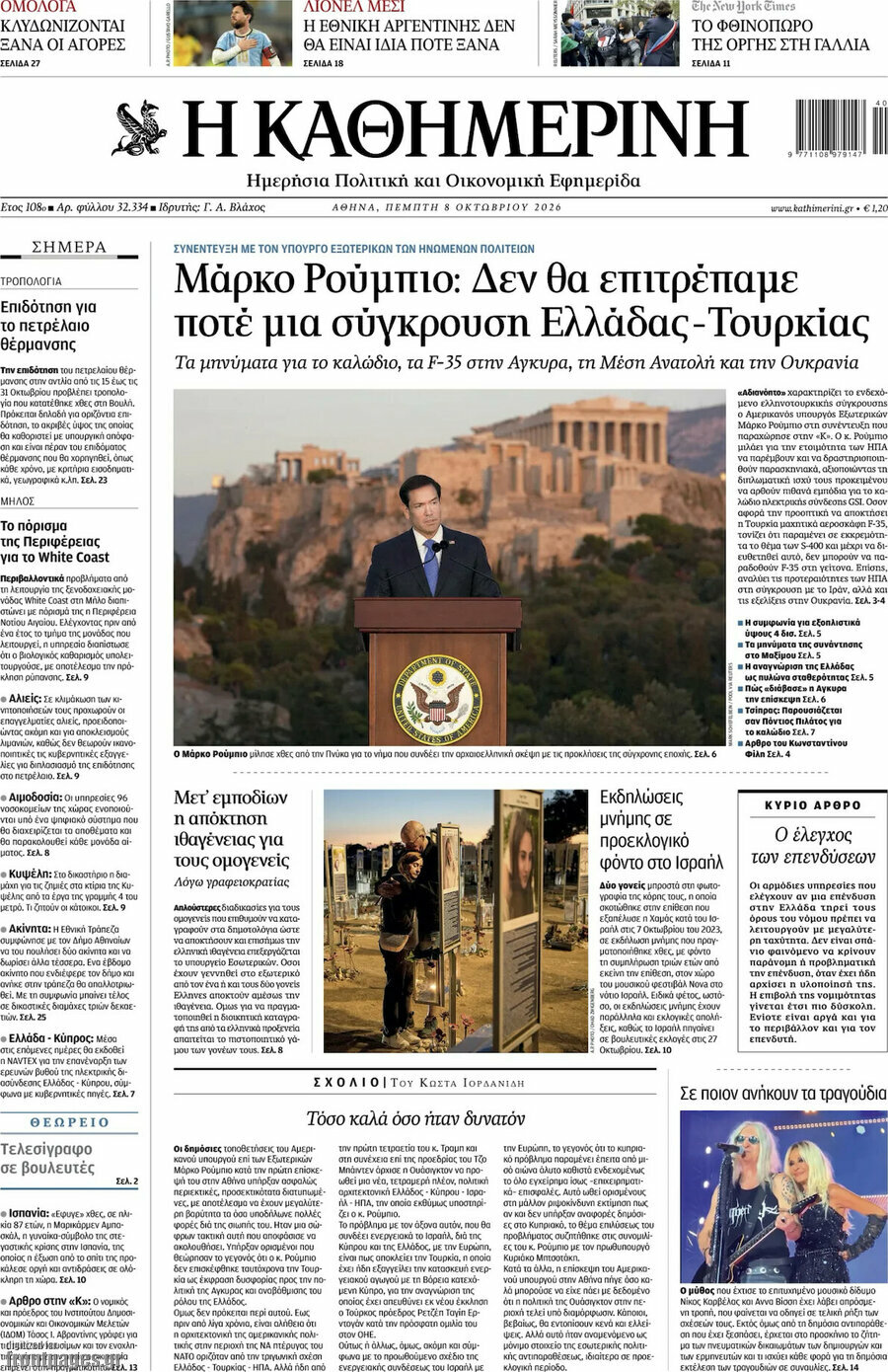
KATHIMERINI: Marco Rubio: We would not allow a clash between Greece and Turkey
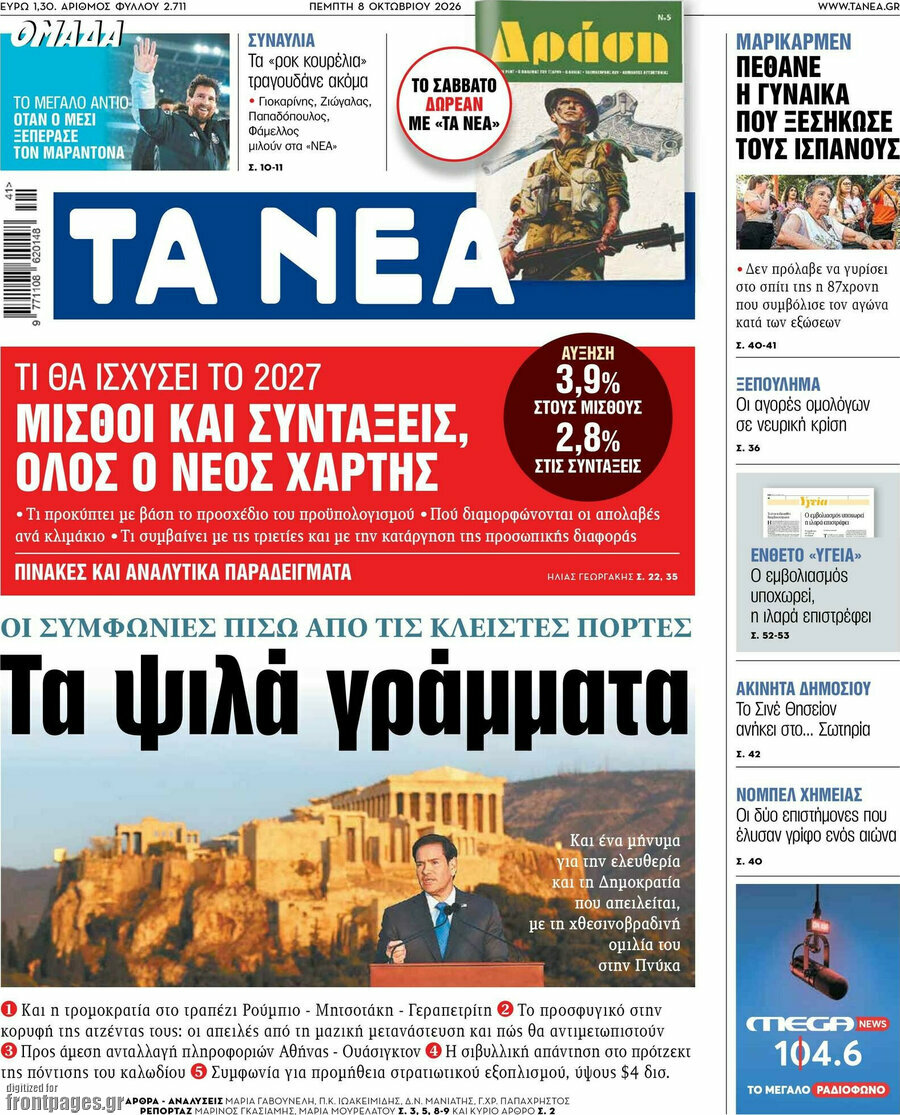
TA NEA: Agreements behind closed doors: The fine print
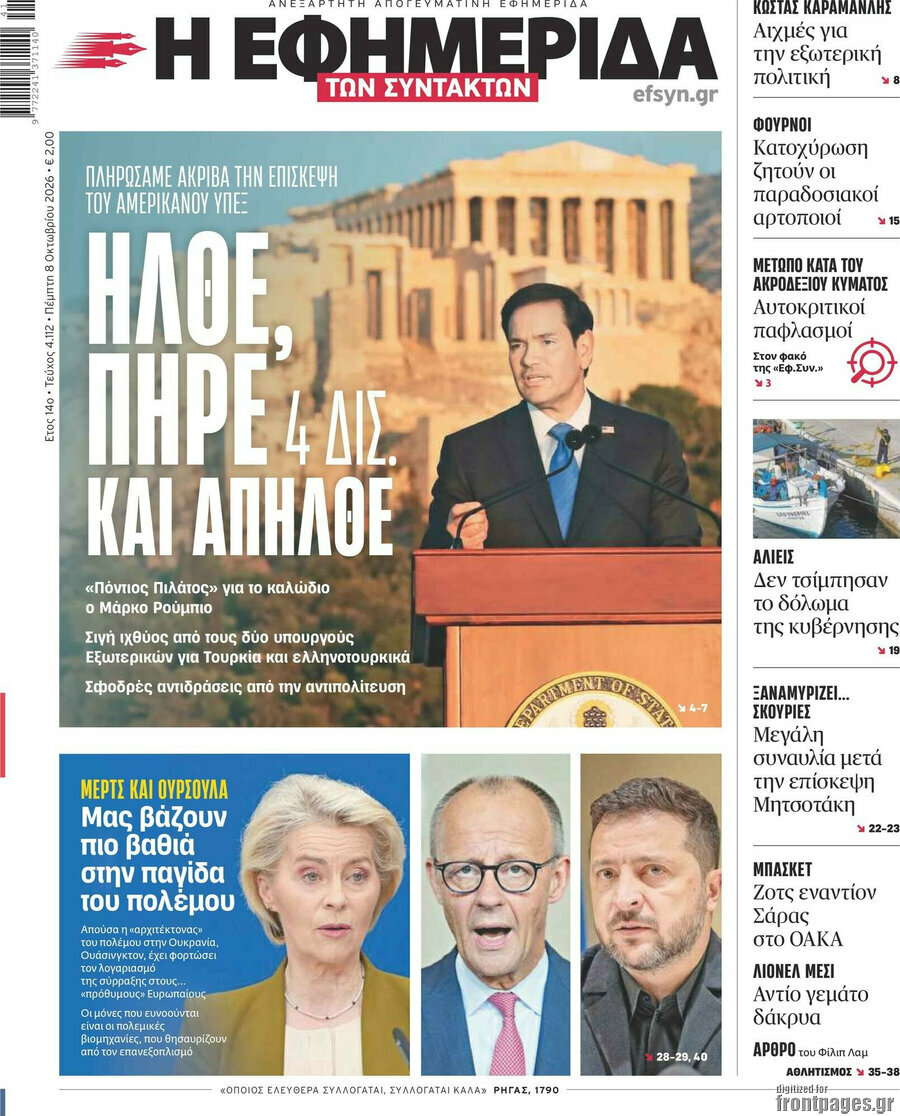
EFIMERIDA TON SYNTAKTON: Rubio in Athens: He came, he got 4 billion and he left
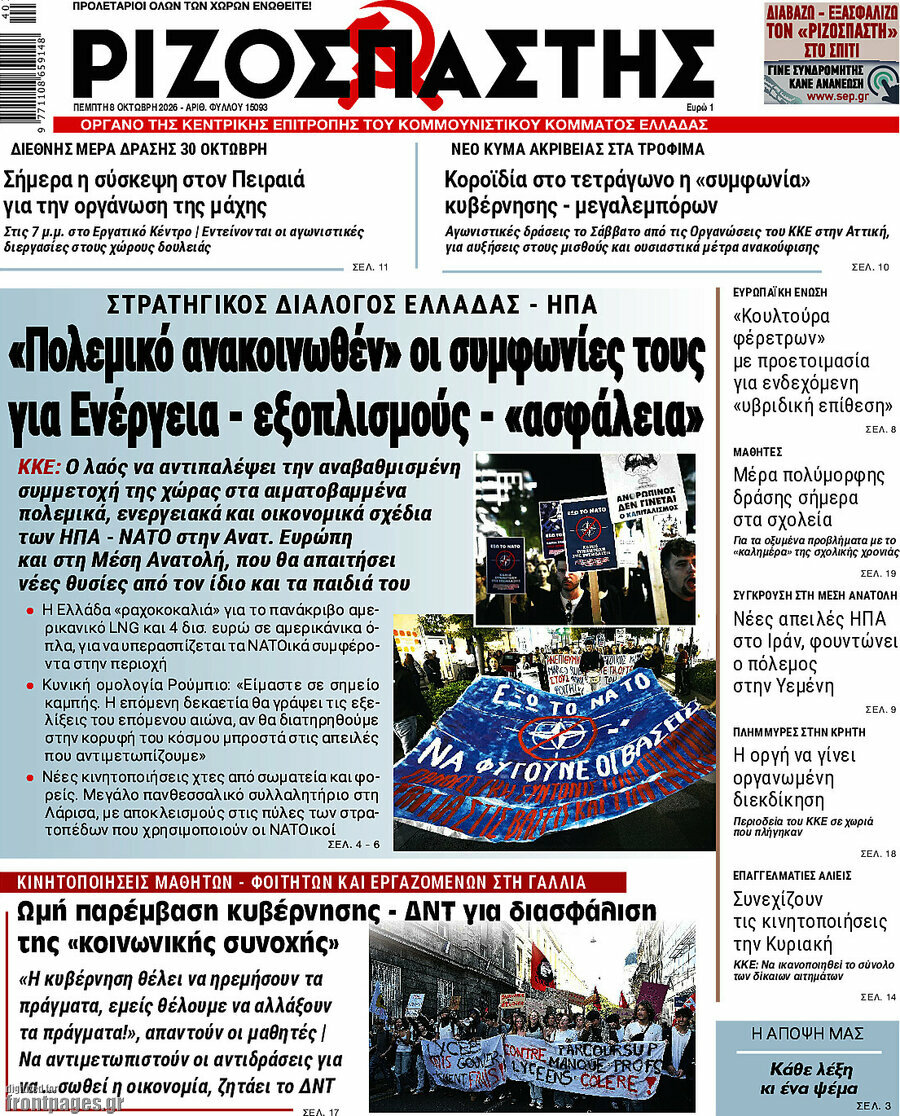
RIZOSPASTIS: Strategic dialogue between Greece and USA: Their agreements regarding energy, armaments and “security” constitute a war manifesto
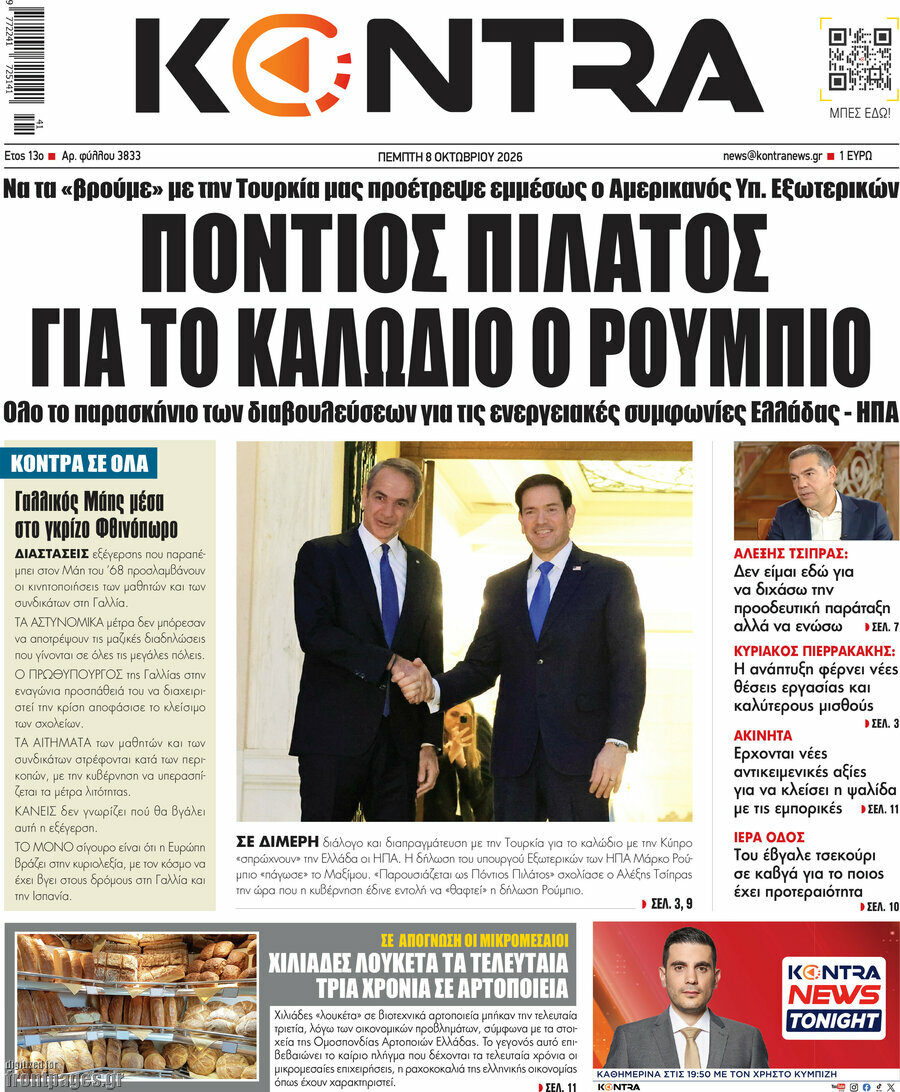
KONTRA NEWS: Rubio maintained a Pontius Pilate stance regarding the electricity cable
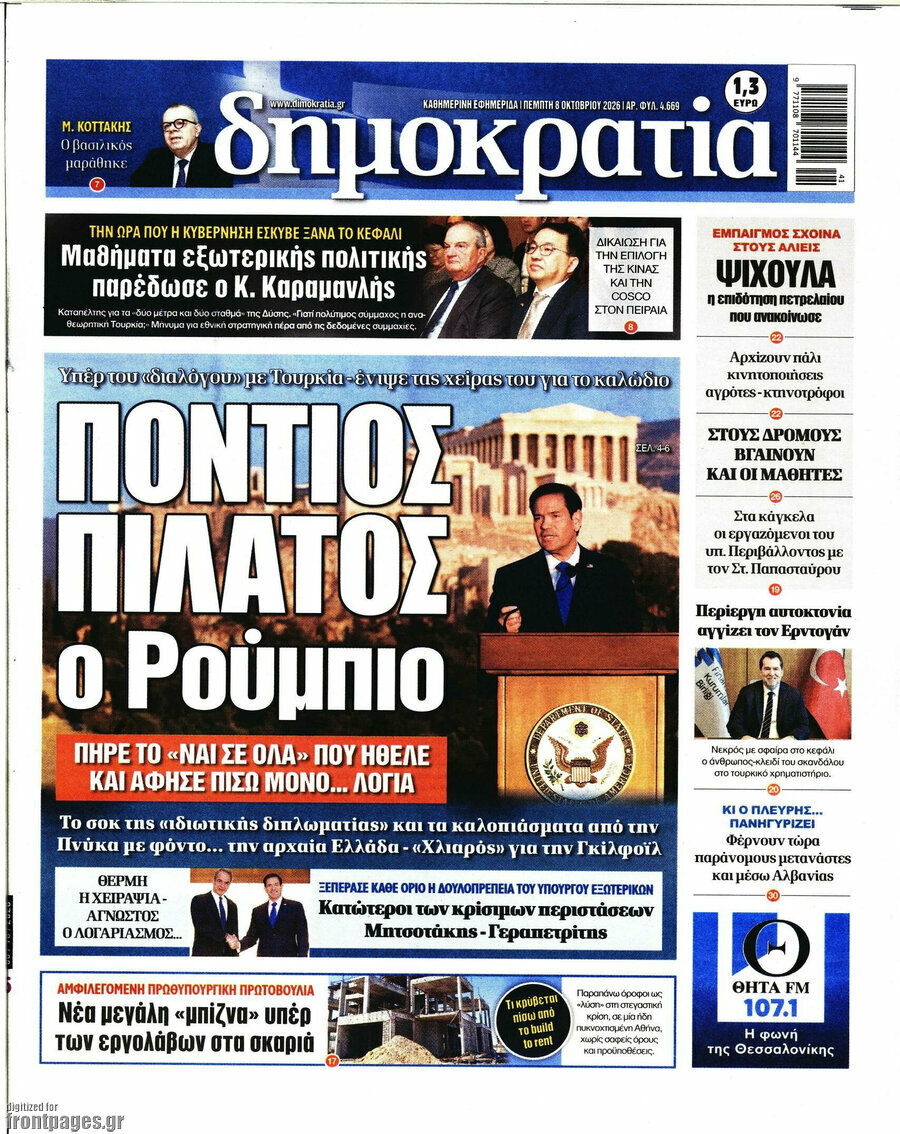
DIMOKRATIA: Rubio maintained a Pontius Pilate stance
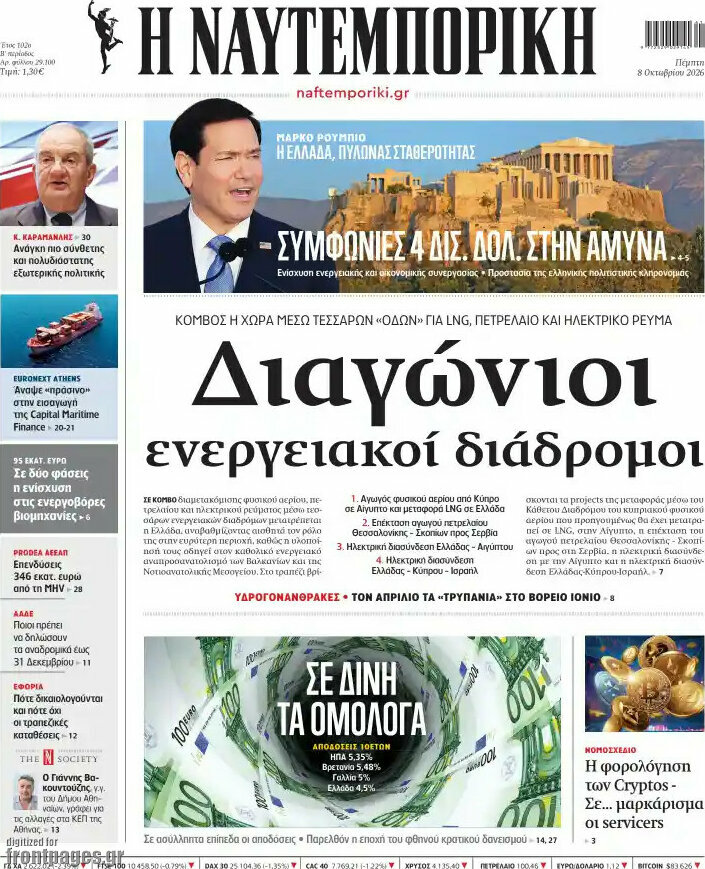
NAFTEMPORIKI: Diagonal energy corridors

DRIVING THE DAY
CRACKING THE BERLAYMONT CAREER CODE: How do you get a job running a European Commission department? Do a stint with the president first.
A POLITICO analysis found that 10 of 19 appointments to top jobs in non-technical directorates-general since 2023 went to officials who had worked in Ursula von der Leyen’s cabinet, a task force under her authority or a presidential service. The appointments chart how her circle reaches across the EU executive — and who is in place as she considers clustering or merging departments.
The jump: Paulina Dejmek Hack’s rise up the ranks is the latest indication of how von der Leyen and her powerful chief of staff, Bjoern Seibert, run their shop. Dejmek Hack last week landed the job of running the financial services department, after two weeks in post as the department’s deputy. She previously served in the Brexit task force in the Secretariat-General, set up to operate “under the direct authority of the President.”
Who might be next? Officials close to the Commission’s top ranks are watching who rises. One has tipped Fernando Andresen Guimaraes, von der Leyen’s former diplomatic adviser and now a director in the fisheries department, as a potential contender for the top job when it comes up for grabs.
That’s because it’s a pattern. Anthony Whelan, a former member of von der Leyen’s cabinet, became director-general at the competition department after a spell as deputy. Kurt Vandenberghe went from her cabinet to run the climate action department. Gert Jan Koopman took over what is now the department for enlargement and the Eastern neighborhood after working on the recovery fund with von der Leyen, Seibert and Stéphanie Riso. Riso became head of the budget department just over a month later.
More receipts: Elisabeth Werner moved from a deputy role in the Secretariat-General to lead the agriculture department. Former chief spokesperson Eric Mamer, who had also run von der Leyen’s internal think tank, DG IDEA, became the environment boss a month later. In the summer, Céline Gauer moved from the Secretariat-General to head the energy department. Ditte Juul Jørgensen — who played a leadership role in a transatlantic energy task force set up by von der Leyen — took over on trade. Michael Karnitschnig, a longtime Secretariat-General official overseeing external relations, is acting head of the department for the Middle East and North Africa.
The Commission’s reply: Spokesperson Balazs Ujvari said the executive has appointed around 200 senior officials since 2023 and that all selection procedures were merit-based and conducted in strict compliance with the rules. The director-general posts identified by POLITICO were advertised following vacancies, with eligibility and selection criteria published transparently, he said. “The decision to appoint a senior manager is always taken by the College,” Ujvari added.
The route: While there is no formal ladder, the officials’ paths included experience near the president: in her cabinet, a presidential task force or a Commission service close to her. Several served in deputy posts, gaining the senior-management experience needed to compete for a department’s top job. But Ujvari notes it isn’t the only route: Candidates for internally advertised director-general jobs can generally qualify from several senior grades, including hors classe adviser, director or principal adviser.
The upshot: Von der Leyen and Seibert have former colleagues running a significant share of the Commission’s departments. As the president weighs a restructure of the executive’s portfolios, those appointments offer a map of the officials who would have to make any new structure work — and of the professional ties already linking the Berlaymont’s top ranks.
BIG AND BREAKING
MEP FACES PARTY PROBE: A Croatian MEP faces an investigation by her national party following a POLITICO report that her friends and family attended a European Parliament event in Strasbourg for which her office claimed thousands of euros in public money.
CRUNCH TIME IN CHINA: Commission trade chief Maroš Šefčovič is in Beijing for talks with his counterparts that will show whether dialogue with China can actually deliver — with Chinese-made hybrid cars the test case. No deal today or tomorrow would raise the stakes ahead of next week’s Council, when leaders will debate whether to keep talking or retaliate. More for subscribers in Morning Trade.
SEE YOU IN SICILY: Ursula von der Leyen, who turns 68 today, is heading to the European People’s Party’s Study Days in Taormina next week, three officials tell Playbook, with a Monday speech in the works. Then it’s back to Brussels for Wednesday’s Tripartite Social Summit — and the European Council the day after.
THE REARMAMENT BACKLASH: Europe wants to rearm but the far-right parties surging across the continent have other ideas, seizing on public anger about the cost of living and weakening enthusiasm for higher defense spending.
Meanwhile, in Madrid: Spain’s far-right Vox sees the Nov. 29 snap election as a prime opportunity to reshape the political landscape after eight years of Socialist government.
RUBIO’S WARNING: Europe needs to “wake up from its long slumber,” U.S. Secretary of State Marco Rubio said in an address in Athens last night, leaning hard into Donald Trump’s “America First” foreign policy with the Acropolis looming behind him.
ŠUICA: AFTER CEUTA
TALKING TOUGH ON MIGRATION: The EU should step up returns of people with no right to stay while opening more legal routes into the bloc, Mediterranean Commissioner Dubravka Šuica told Playbook’s Zoya Sheftalovich from the Med9 summit in Split, a meeting of nine EU countries around the Mediterranean to discuss shared regional issues.
Simple? Speaking days after EU governments approved new rules to boost returns — and amid a push by governments to implement new emergency measures — Šuica said the message is simple: “Those who are illegally in Europe should leave Europe. Those who are in Europe legally can stay.”
The how: “We need partner countries,” the commissioner said. The EU should invest in the region “to prevent irregular departures,” she added, saying “this is the reason why we are signing bilateral partnerships with the countries in North Africa and the Middle East and also in the Gulf.”
Not enough: EU leaders are set to discuss ways to respond to migration at next week’s European Council, with the shadow of this summer’s mass crossing into Ceuta — in which more than 70,000 people entered the Spanish exclave in 48 hours — looming over talks. Greece has called for the temporary suspension of asylum applications in such emergencies, a proposal backed by Germany and Austria.
It’s on us: “Protecting our external borders is our European responsibility,” Šuica said. The Commission is expected to propose further measures for dealing with emergency migration scenarios after the Council.
20-SECOND PLAYBOOK PRIMER
Ambassadors have been discussing a plan that would allow non-EU countries to sign association agreements with the bloc on joining EU defense programs. But what are association agreements? They’re formal deals between the EU and another country that allow for closer cooperation in a particular area (in this case, defense) that goes beyond simple cooperation. Signing such an agreement doesn’t mean you are joining the EU, but some potential new members do sign them as preparation for one day becoming part of the bloc.
PARLIAMENT’S FIRST BUDGET WIN
DEAL ON DEVELOPMENT CASH: The European Parliament is expected to seal a deal today on the first major plank of the EU’s next seven-year budget. MEPs are set to agree among themselves the rules governing €200 billion in development funds, three officials involved in the negotiations told Gregorio Sorgi.
Today’s agreement on the Global Europe fund — which is due to be confirmed by a committee vote on Oct. 19 — comes amid divisions in Parliament over agriculture, green rules and Buy European, which threaten to delay the negotiations with member countries.
Tit for tat? Parliament’s two largest groups — the European People’s Party and the Socialists and Democrats — had to overcome disagreement over whether to cut development aid for countries that fail to readmit migrants that crossed into Europe.
The final compromise allows the Commission to cut financial assistance under certain circumstances, but safeguards funding for civil society and human rights groups. In another compromise, MEPs dropped references to “innovative solutions,” which was seen as code for using EU cash to build migrant return hubs abroad.
The Gaza question: Groups were also split over whether to earmark Brussels funds for the reconstruction of Gaza. MEPs mentioned that the EU should play a role in this process but, in a concession to the EPP, they dropped any figures.
DASHBOARD
The Brussels-Capital Region’s population stagnated in 2025 after “30 years of uninterrupted growth,” the Brussels Institute for Statistics and Analysis said Wednesday. Moves from abroad “remain the factor that contributes the most to population growth in the region,” but more people left Brussels to move to other regions in Belgium than arrived, according to the institute.
 |
5 MORE THINGS GETTING US TALKING
ARCTIC AMBITIONS: International Partnerships Commissioner Jozef Síkela is in Reykjavík for the Arctic Circle Assembly — the final stop on his tour of the region and one last chance to shape the debate before the College adopts its new Arctic strategy in two weeks. He’ll sketch out priorities including serving Arctic communities, strengthening the “Northern Neighbourhood,” boosting security and resilience, increasing investment and accelerating the fight against climate change.
PRESSED TO PULL OUT: The Trump administration pressured EU, Canadian and Lithuanian diplomats to withdraw from a disinformation conference over panels that warned against American influence, my colleagues scooped.
LOOK WHO’S COMING TO DINNER: The U.K. will take part in an EU Foreign Affairs Council on development for the first time since Brexit, with Development Minister Kirsty McNeill representing London at the official dinner in Dublin this evening after meeting her Irish counterpart Neale Richmond.
MAYORS SAY NO: Twenty mayors from big EU cities including Brussels, Rome, Paris and Madrid have come out against EU budget cuts in a letter seen by Playbook, signed with the President of the European Committee of the Regions Kata Tüttő.
BEEN HERE BEFORE: The EU’s top auditor, Tony Murphy, has warned that the bloc’s next seven-year budget risks suffering from the same “mistakes” that have plagued its €575 billion post-Covid fund.