Samaras seeks full probe into alleged spyware targeting
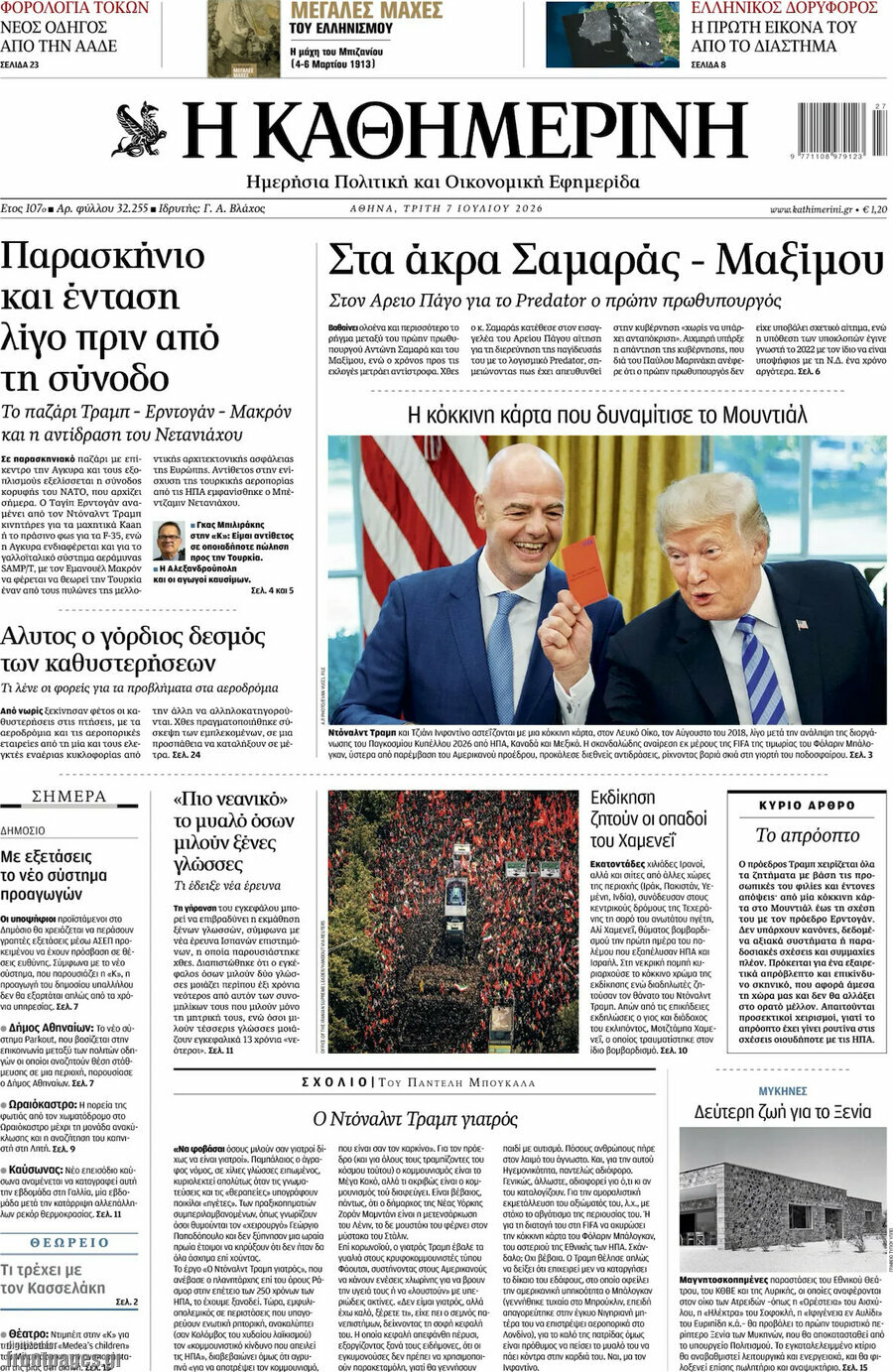
Former conservative prime minister Antonis Samaras has escalated his rift with the government, petitioning the Supreme Court’s top prosecutor for a full investigation into the alleged compromise of his phone by the invasive Predator spyware. Samaras noted in his petition that repeated public demands for clarity from the government have met a wall of silence – an issue he directly challenged Prime Minister Kyriakos Mitsotakis on in Parliament in early April.
https://www.ekathimerini.com/politics/1308749/samaras-seeks-full-probe-into-alleged-spyware-targeting/
PM Mitsotakis to attend NATO summit in Ankara
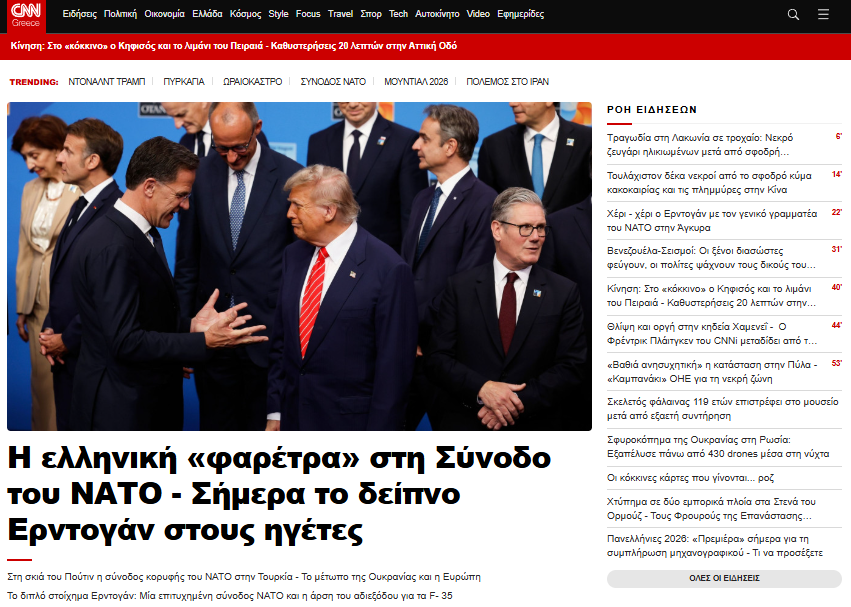
Prime Minister Kyriakos Mitsotakis will travel to Ankara on Tuesday afternoon, where he will attend an evening dinner hosted by Turkish President Recep Tayyip Erdogan for leaders of NATO member states.
https://www.amna.gr/en/article/1006797/PM-Mitsotakis-to-attend-NATO-summit-in-Ankararn
Gerapetritis: No move to lift US restrictions on F-35 sales to Turkey
Foreign Minister George Gerapetritis has told MPs that there is currently “no question” of the United States lifting restrictions on the sale of F-35 fighter jets to Turkey, stressing that any change would require a new decision by the US Congress.
Greece opens talks on acquiring US Precision Strike Missile
Greece has begun consultations with Lockheed Martin on the possible acquisition of the US-made Precision Strike Missile (PrSM), as Athens seeks to strengthen its long-range artillery capabilities. Sources said that, following an initial meeting in Paris at the Eurosatory arms exhibition, officials from the Greek Armed Forces and Lockheed Martin are expected to meet in Athens next week to prepare a letter of request to Washington, the first step toward a potential intergovernmental arms agreement.
ATHEX: Benchmark continues its ascent
The Greek stock market continued to rise to heights unseen since late 2009, taking the benchmark above 2,560 points on Monday.
https://www.ekathimerini.com/economy/1308812/athex-benchmark-continues-its-ascent

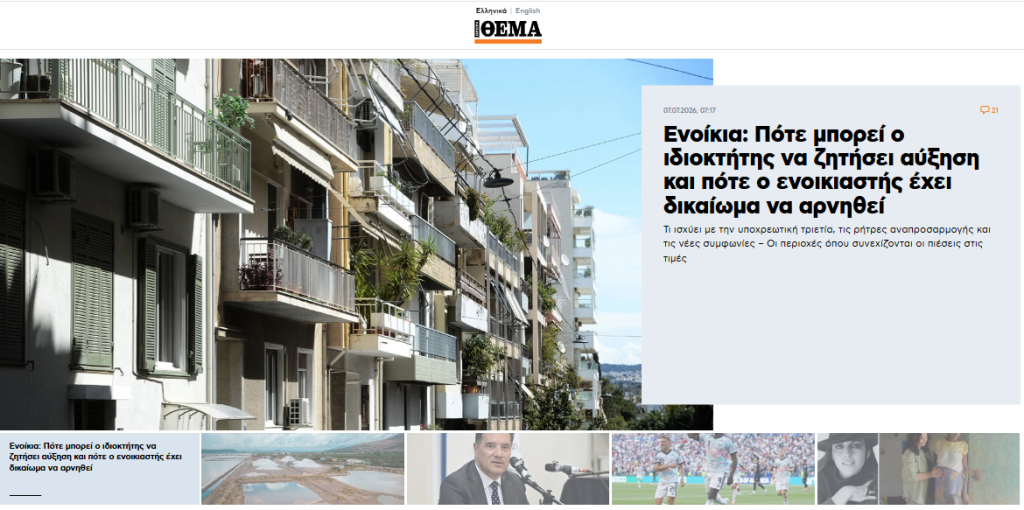
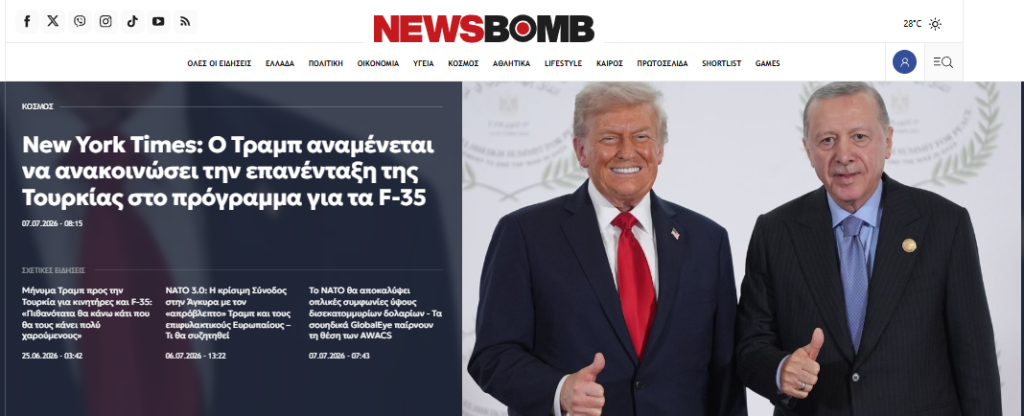
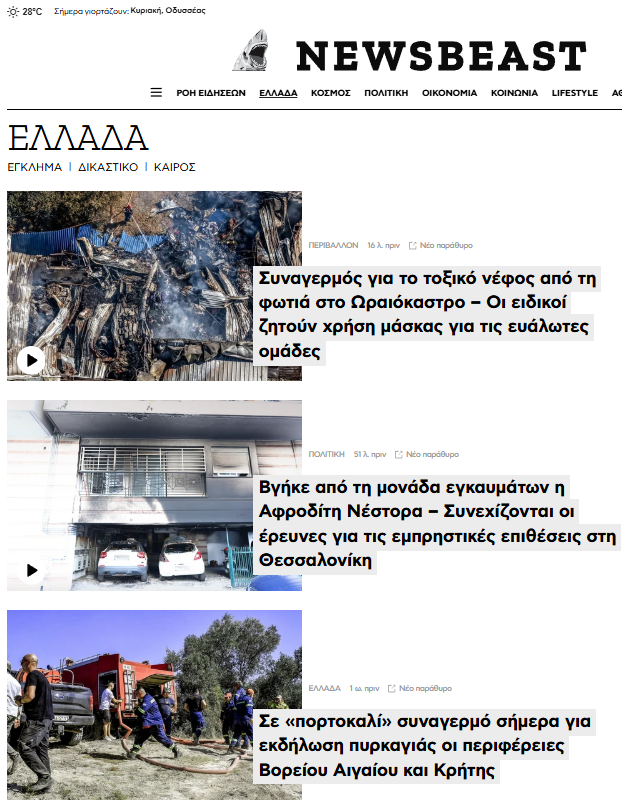

KATHIMERINI: Feud between Samaras and the government at extremes
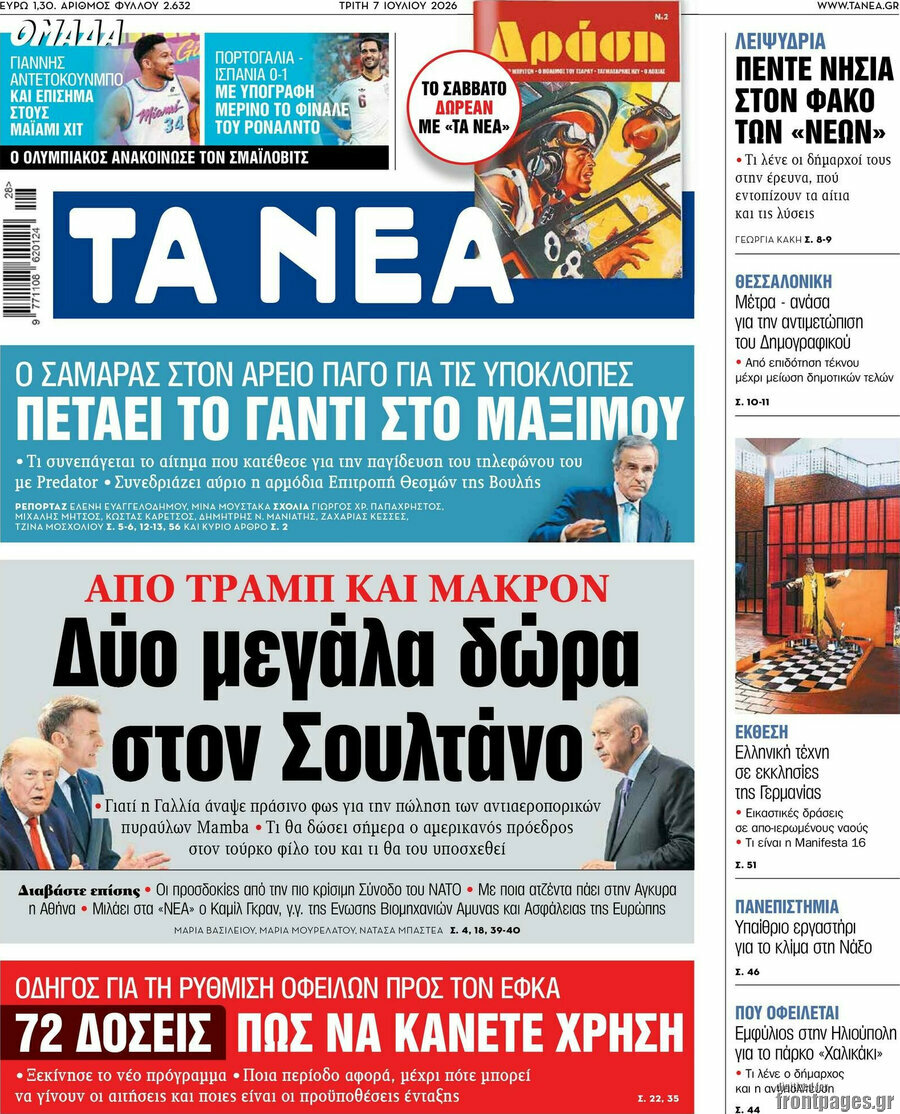
TA NEA: Trump and Macron: Two big gifts to the Sultan
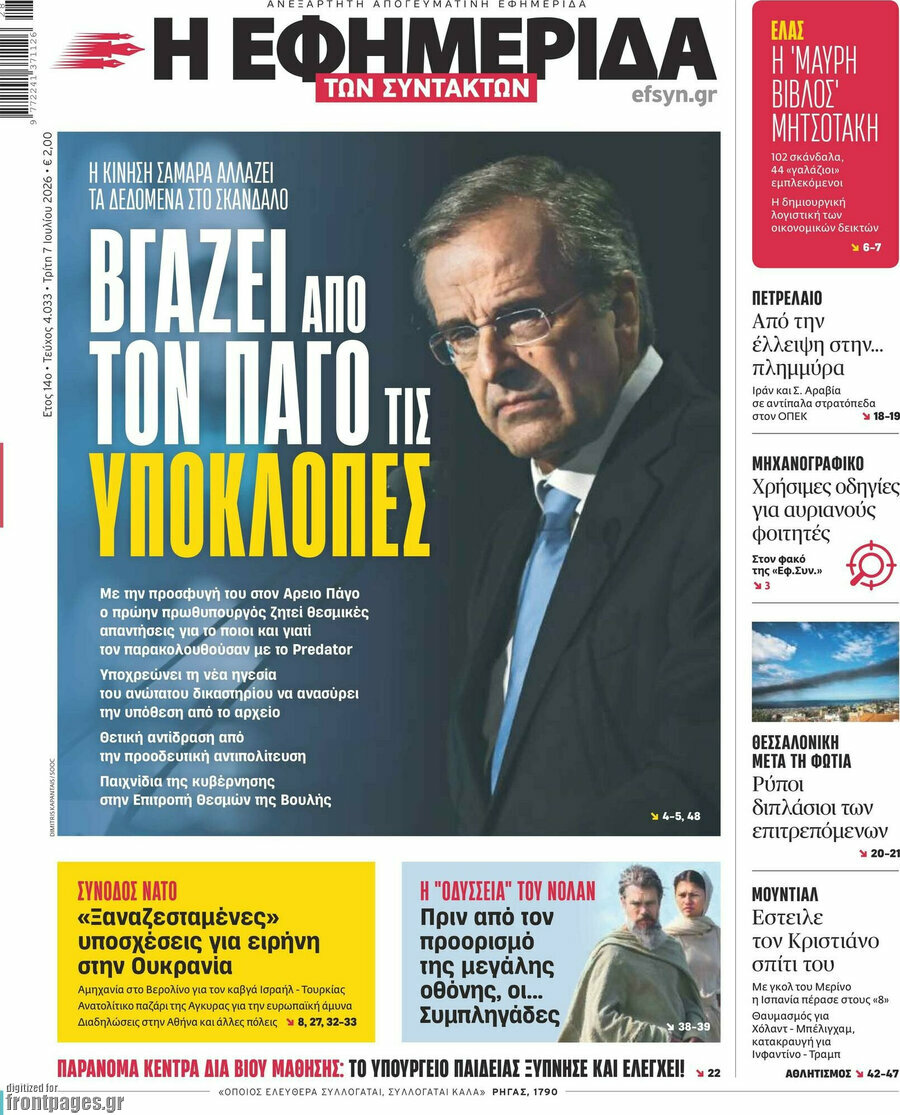
EFIMERIDA TON SYNTAKTON: Samaras is taking the wiretappings scandal out of the freezer
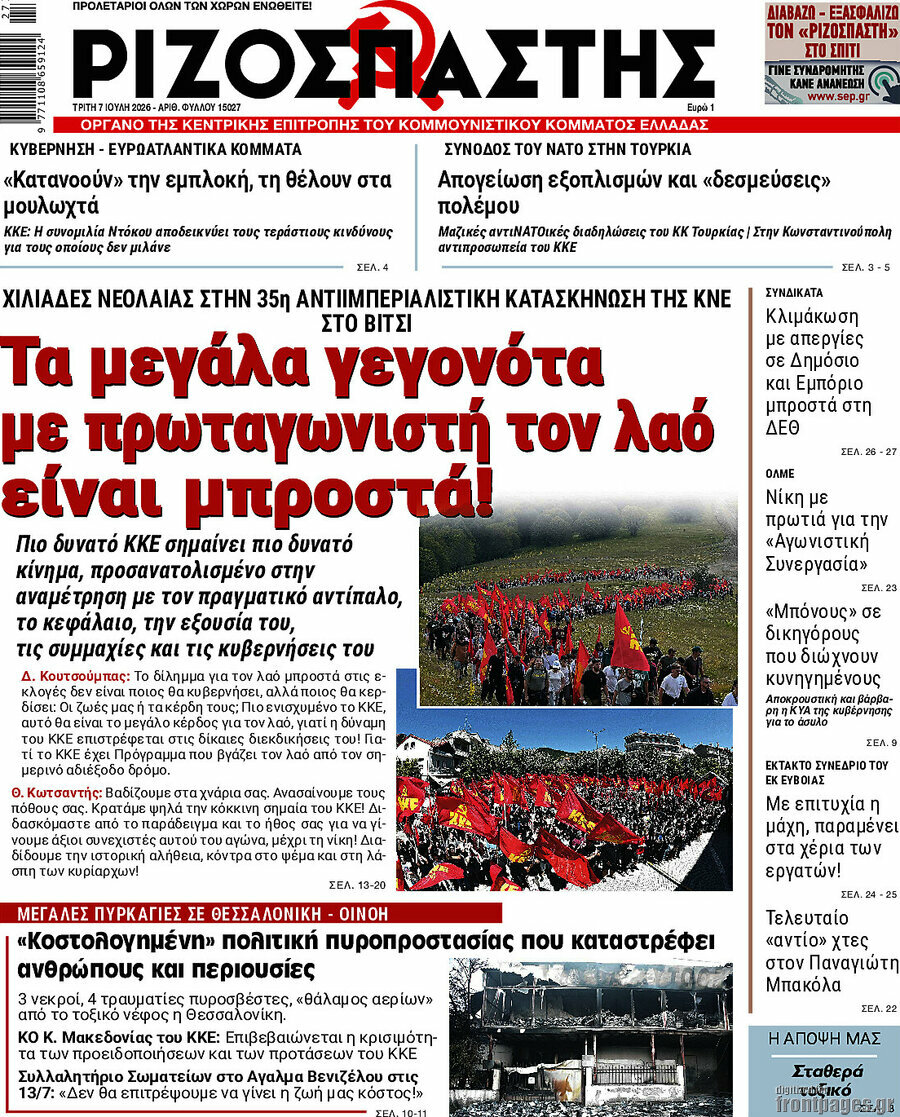
RIZOSPASTIS: The big developments with simple folks as the protagonist are ahead of us
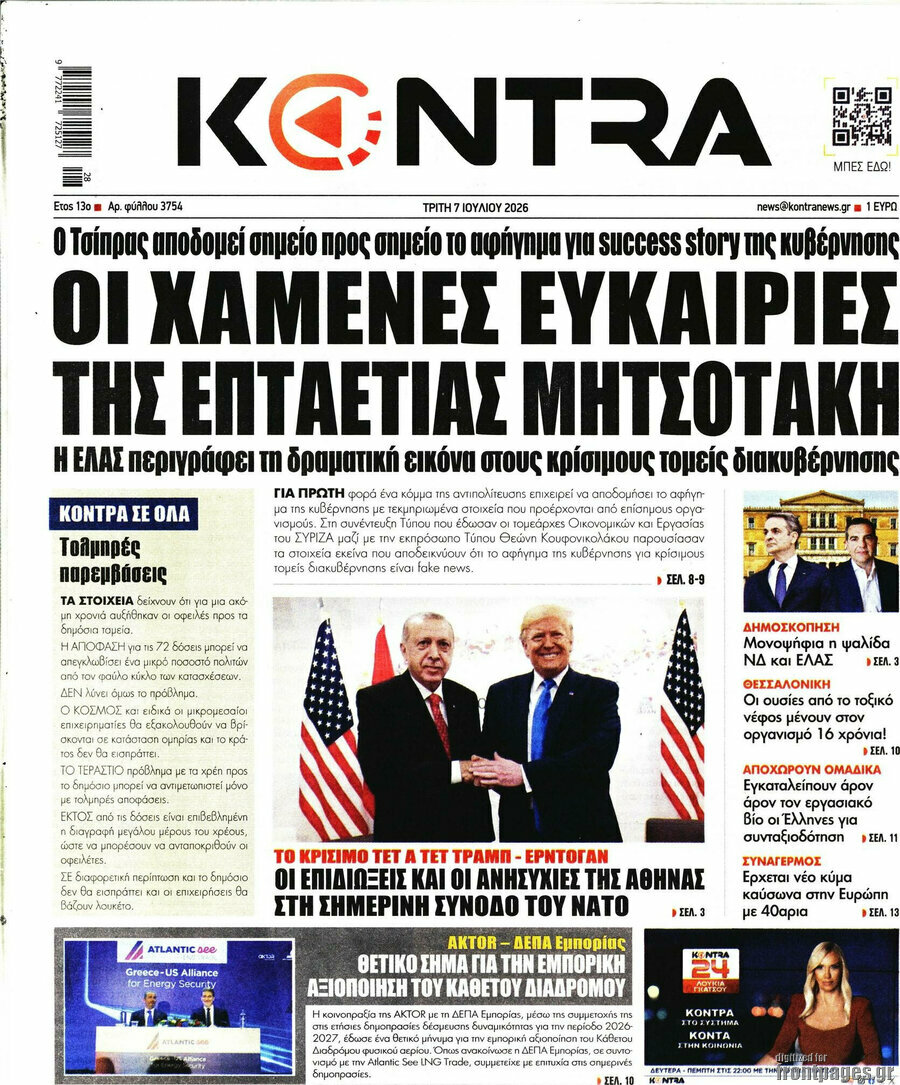
KONTRA NEWS: The lost opportunities of Mitsotakis’ 7-year tenure
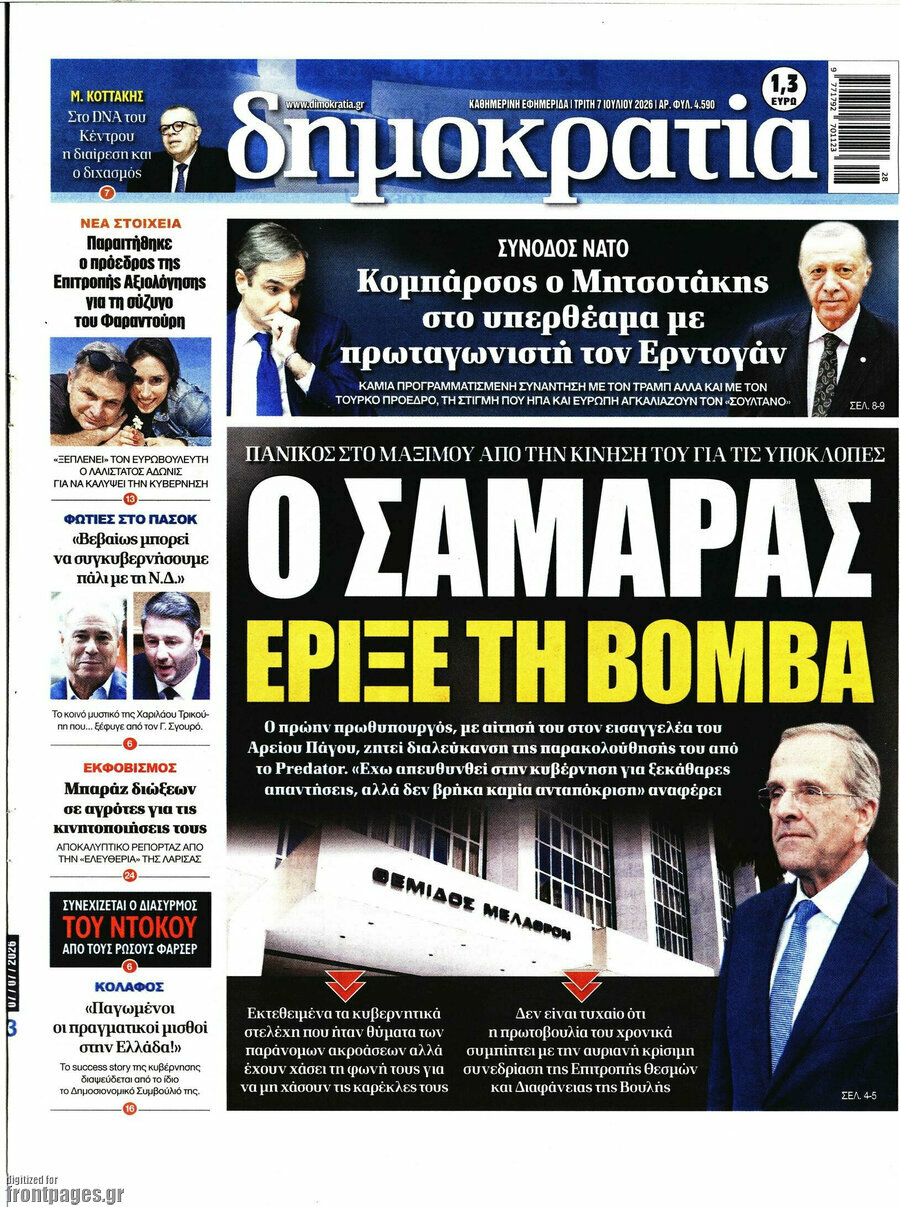
DIMOKRATIA: Samaras dropped the bomb regarding the wiretappings scandal
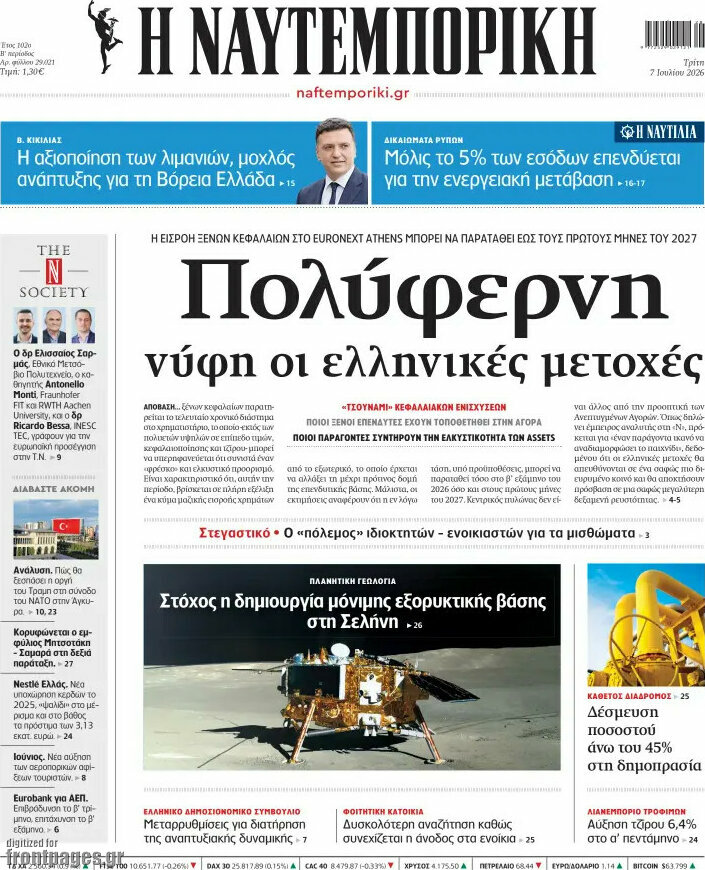
NAFTEMPORIKI: Greek stocks are brides with many suitors

DRIVING THE DAY
FRENCH JUDGES TO DECIDE LE PEN’S FATE: All eyes are on France as far-right leader Marine Le Pen learns if she can mount a fourth presidential bid next year — or whether she faces ineligibility, clearing the way for her protégé Jordan Bardella.
Shades of bleu: Le Pen and Bardella hail from the same party — but with notable political nuances. Today’s legal outcome could significantly affect Brussels, given polls suggest the National Rally has a strong chance of winning France’s 2027 presidential election.
What’s happening: Le Pen learns if she’s cleared to run for president or must serve a five-year electoral ban over her party’s misuse of European Parliament funds. The judge will begin reading the verdict around 1:30 p.m., with POLITICO reporters following developments here.
If Le Pen loses, it won’t be the end of the road for the National Rally, given that Bardella polls at least as strongly as his mentor in run-off scenarios against contenders like center-right former PM Edouard Philippe. Nor would Le Pen’s exclusion mark the end of the National Rally’s legal woes.
The question for Brussels: Who’s less bad for the EU?
Camp Le Pen: Both possible candidates view the bloc and its leadership negatively — Bardella made his opinions clear in a recent POLITICO interview. But Le Pen once campaigned for Frexit and exiting the eurozone. Her career has been damaged by clashes with the European Parliament and she appears to holds a grudge against the EU. Her mix of right-wing nationalism on migration and left-wing social policies also makes her hard to place on the European spectrum.
Bardella, by contrast, appears more of a traditional economic right-winger. Despite vowing to halve France’s EU budget contribution, some EU insiders feel more comfortable with his economic outlook. He has shown signs of distancing himself from Le Pen’s policies, with his aides watering down plans to lower the retirement age.
Almost acceptable: “You can’t prepare for either one winning, but at least with Bardella we know what to expect: anti-migration, anti-trade, perhaps more of a Meloni-like figure,” said a senior EU official, referring to the brand of conservatism promoted by Italian Prime Minister Giorgia Meloni and her grouping in the European Parliament, the European Conservatives and Reformists.
There’s a word for it: The official added: “If [Bardella] moves to ECR [from the Patriots for Europe], it will be a big step toward becoming salonfähig” — German for acceptable in polite society.
The bottom line: Le Pen and Bardella aren’t what Brussels would choose. But if pressed, many would say Bardella is more palatable.
BIG AND BREAKING
OPERATION PLACATE TRUMP: European NATO allies are pulling out the stops to prevent a Trump blowup, which means highlighting the big bucks being spent on defense, keeping the focus on the less divisive topic of industry and signaling their support on Iran.
Weber warning: Speaking exclusively to Playbook ahead of the NATO summit, European People’s Party chief Manfred Weber said Europe must get ready for the “what if” scenario of America reducing its presence in NATO. “We must be ready to step in,” he said. “That means building our own command structures, developing our own capabilities.”
Long live the alpha queen: Belgian Defense Minister Theo Francken told POLITICO that while European leaders should be careful not to alienate Trump, there are limits — especially when it comes to attacks on Meloni, the “queen of center-right in Europe. She’s the alpha. Leave her alone.”
PRE-EUCO ACCESSION POLICY CRUNCH: The European Commission will unveil its pre-accession policy review — internal preparations for bringing in new members — on Sept. 30, just two weeks before a gathering of leaders in Brussels, per an EU official. The tight timing leaves “a lot of people unhappy.”
SERBIA STANDOFF: EU ambassadors are set to block Serbia opening a new round of negotiations on membership of the bloc, despite efforts from the Commission to make enlargement a geopolitical tool to keep partner countries onside.
FOCUSING RESOURCES: The European Council’s General Secretariat has stopped circulating reports to member countries summarizing the Parliament’s plenary debates, according to an email seen by POLITICO. The Council press office said the objective of the move was “to focus resources on political analysis rather than on producing summaries of debates, which are public.”
EU LAWMAKER SAYS TRIAL IS POLITICAL: French MEP Rima Hassan wants to use her trial over accusations she glorified a terrorist attack to showcase what she believes is an attempt to silence pro-Palestinian voices. The trial kicks off today. Meanwhile, the Belgian government appears set to move ahead with its recognition of Palestinian statehood.
SENATE CANDIDATE ALLEGATIONS: A woman who dated Maine U.S. Senate candidate Graham Platner says he forced her to have sex with him nearly five years ago, despite her repeated objections, POLITICO reports. Platner, who denied the allegation, is now facing a loss of support among Democratic leaders in Maine and Washington.
CZECH X2 AT NATO
DOUBLE ACT AT NATO SUMMIT: There’s another Kafkaesque subplot playing out alongside the push to keep Trump focused in Turkey: the Czech Republic is sending not one, but two political leaders to represent the country.
Deal with it: This creates an obvious headache for foreign leaders. Who to meet? Prime Minister Andrej Babiš, who’s leading the country’s official delegation? Or President Petr Pavel, who’s also constitutionally guaranteed to represent Czechia abroad and is known for his pro-NATO stance?
The situation is “ridiculous,” according to a Pavel spokesperson. It stems “from the fact that for the first time since the founding of our country, the president was ruled out of the NATO summit unilaterally by the government.”
Rewind: Pavel successfully appealed the decision to exclude him from the summit in his country’s constitutional court and is now attending — sparking the Czech double act. But the fact that the two leaders won’t travel together creates a logistical — and political — mess.
Plane speaking: Pavel and Babiš are departing for Ankara from the same airport, but with different planes and at different times. Pavel offered to travel on the same plane but was rebuffed over “security concerns.” This isn’t the way it usually works, the spokesperson said: Pavel would be expected to “lead the delegation: one plane, one delegation.”
The PM’s view: Babiš has justified his move by saying he and his foreign minister are best placed to defend Prague’s defense spending decisions. A spokesperson for the PM argued that the government was in charge of foreign policy and that Babiš had decided to send a government delegation to Ankara given the “exceptional importance” of the NATO summit. As for the security concerns, he said they stemmed from an unwritten rule barring president and prime minister from traveling on the same plane.
On the ground, Pavel won’t be hiding in a corner. The president “considers it essential to hear firsthand the positions and thinking of Allied leaders” and he “therefore intends to make full use of the occasion to speak with his counterparts and other key participants,” the spokesperson said.
What does this mean for other leaders? It’s up to them, though Babiš is leading the official delegation and will speak during round-table discussions. “He’ll have to explain why he is not spending 2 percent of GDP on defense, let alone 5 percent. Which is fine,” the spokesperson added.
Stay in the loop: Our Global Security newsletter is on the sunny side of the paywall today, to help you make sense of what’s going on in Ankara. The team examines why Greenland is back in the headlines … and Canada’s new submarine deal.
20-SECOND PLAYBOOK PRIMER
The European Commission wants fresh talks with EU member countries to ensure the bloc’s flagship Entry/Exit System doesn’t ruin summer holidays. But what is the new border checking system? And what’s going wrong? Under the EES, non-EU citizens are fingerprinted and photographed — replacing traditional passport stamping. The EES is supposed to be quick, allowing people to upload their biometric data through self-service kiosks at border points. It’s also meant to ensure people don’t stay in the bloc for longer than they’re supposed to. But the rollout — which is the responsibility of national governments — has been plagued by problems. Some airports don’t have enough machines, others don’t have enough staff to help when there’s an issue.
TO SCAN OR NOT TO SCAN
CAN BIG TECH SCAN YOUR MESSAGES? MEPs will vote this week on whether to restore a legal exemption allowing companies like Meta, Google and Microsoft to voluntarily scan private messages for child sexual abuse material. The exemption expired in April after negotiations collapsed and Parliament rejected a last-ditch attempt to extend it.
Fight revived: Parliament President Roberta Metsola has pushed to reopen the file by inviting EU governments to move ahead with the proposal, despite Parliament having already voted it down. The move came at the request of her European People’s Party and passed without objections from other political groups, Sam Clark writes in to report.
Commission piles on the pressure: Four commissioners urged MEPs in a letter on Monday to back the proposal, warning that without it, child abuse will go undetected. “Disrupting detection seriously weakens our collective ability to identify abuse, support victims, and stop offenders,” they wrote.
Socialists and Democrats swing behind it: The lobbying appears to have worked. The S&D agreed Monday to support fast-tracking the proposal, significantly boosting its chances.
Why the odds favor adoption: Lawmakers will vote today on whether to fast-track the file. If approved, the final vote comes on Thursday. Because EU governments have already adopted their position, opponents would need 361 votes to block the proposal, while supporters need only a simple majority of those voting to approve it — giving the measure a procedural advantage.
**Ireland’s Council Presidency has kicked off. From competitiveness and AI to the EU budget and enlargement, our Research & Analysis Division breaks down the files and political dynamics that matter most. Read the full report to see what’s next for the EU agenda.**
4 MORE THINGS GETTING US TALKING
GOOGLE IN THE CROSSHAIRS: A landmark case is forcing Brussels to decide whether opening Google’s search data to rivals would boost competition without undermining the privacy of Europeans.
MYTHOS SAGA EXPOSES EU WEAKNESS: The U.S. has Mythos; China has DeepSeek; the EU has … an action plan.
CHANDRA IN PERIL: Throughout the U.K.’s recent political upheavals, Prime Minister Keir Starmer‘s Senior Adviser Varun Chandra has been building close ties with powerful figures in the Trump administration. Today, he’s facing an uncertain future.
FIFA FALLOUT: U.S. Congressional World Cup Caucus co-chair Sam Liccardo lashed out at President Donald Trump’s intervention to overturn a one-match ban on a key USA player. “I won’t cheer FIFA’s capitulation to power,” the Democratic congressman said. Meanwhile, French striker Kylian Mbappe has hit back at a Paraguayan lawmaker’s racist attack on him.