
Parliamentary Ethics Committee recommends lifting of immunity for ND MPs Chatzivasileiou and Athanasiou
The Special Permanent Committee on Parliamentary Ethics on Monday unanimously recommended lifting the immunity from prosecution of New Democracy MPs Charalampos Athanasiou and Tasos Chatzivasileiou, in connection with a case file examining intercessions they made on behalf of farmers for the payment of subsidies from the Greek payment authority for EU subsidies, OPEKEPE. Earlier, during an in-camera session of the committee, the two ruling party MPs had requested the lifting of their immunity. Parliament will also vote Wednesday on whether to lift the immunity of 13 lawmakers from the ruling New Democracy party who are allegedly implicated in the farm subsidies scandal.
Government calls on Lesvos farmers to stand down
The island of Lesvos is grappling with a deepening foot-and-mouth disease emergency, with confirmed cases reaching 43 and new outbreaks appearing 50 kilometers from the original sites – a sign, officials say, of failing biosecurity measures. The agriculture minister, Margaritis Schinas, condemned farmers holding blockades at the island’s port and preventing veterinary access to their livestock as “unacceptable and criminally liable,” warning that government support payments are contingent on compliance. “The Greek government cannot fund illegal acts,” he stated.
https://www.ekathimerini.com/politics/1301427/government-calls-on-lesvos-farmers-to-stand-down
Athanasios Kavvadas appointed Deputy Minister for Rural Development and Food
Athanasios Kavvadas has been appointed Deputy Minister for Rural Development and Food, replacing Makarios Lazaridis, government spokesperson Pavlos Marinakis announced during a briefing for political correspondents held in Thessaloniki on Monday.
Androulakis: Three interventions to rein in the banks’ excesses
The leader of main opposition PASOK-Movement for Change, Nikos Androulakis, in an article on the website tovima.gr on Monday, proposed three measures to limit the “lawlessness of oligopolies” in key market sectors such as food, energy, health and banks, for which, he noted, the Greek people are paying dearly.
https://www.amna.gr/en/article/986474/Androulakis-Three-interventions-to-rein-in-the-banks-excesses
ATHEX: New tumble for stocks on Athinon Avenue
The new closure of the Strait of Hormuz and the inconclusive statements about the resumption of peace talks between Washington and Tehran took their toll on money markets, with Athinon Avenue losing on Monday a significant portion of last week’s gains, with a notable decline in turnover. The drop for banks was considerably greater than for mid-caps, pointing to the international character of the day’s declining course.
https://www.ekathimerini.com/economy/1301437/athex-new-tumble-for-stocks-on-athinon-avenue


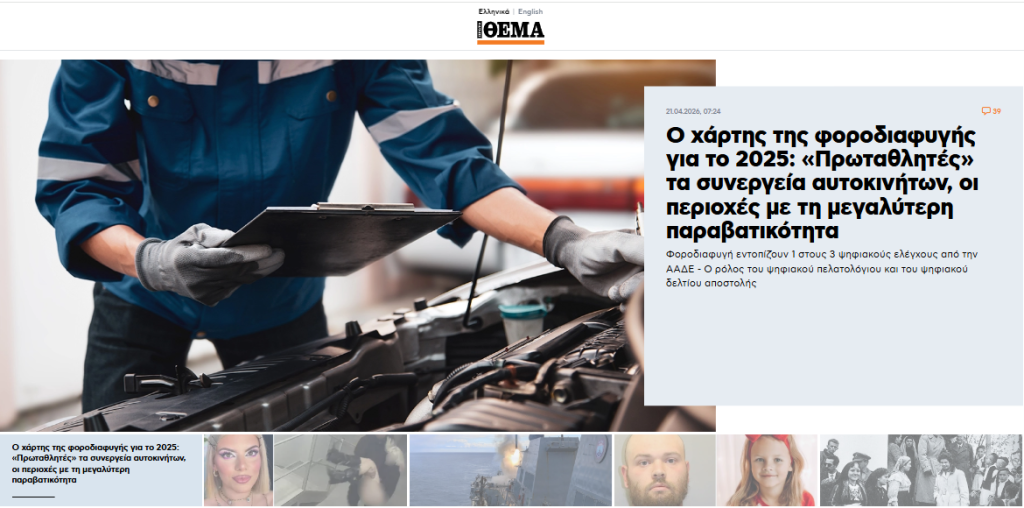

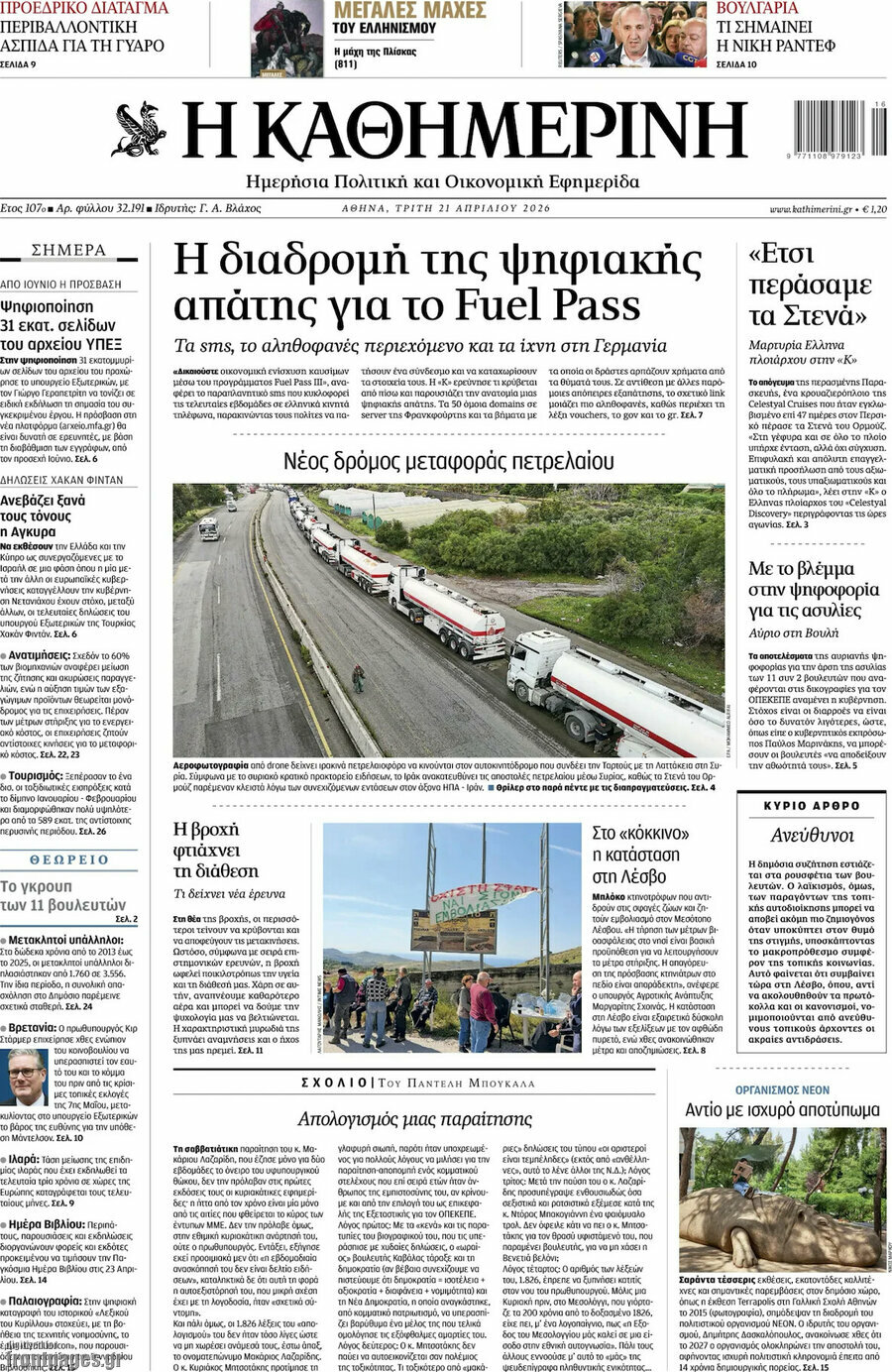
KATHIMERINI: The path of the digital fraud around the Fuel Pass
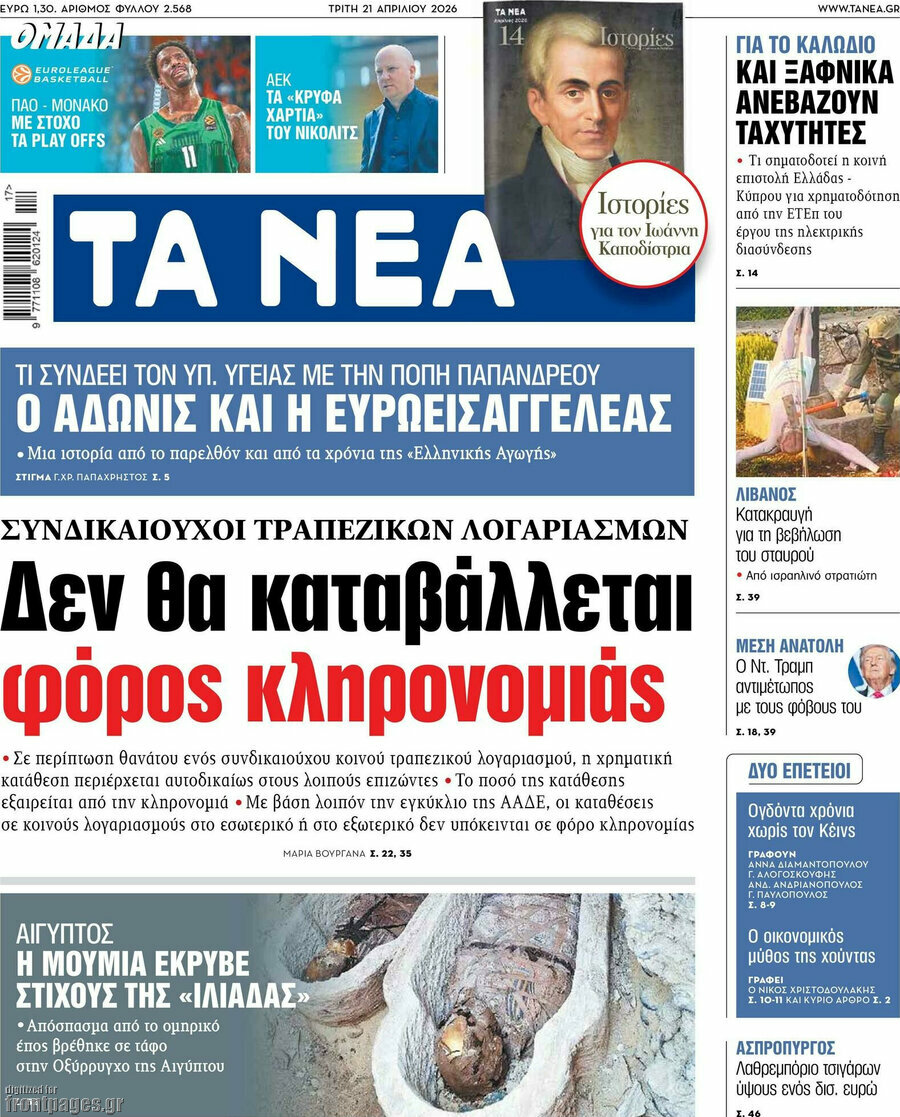
TA NEA: Bank accounts’ joint holders will not pay inheritance tax
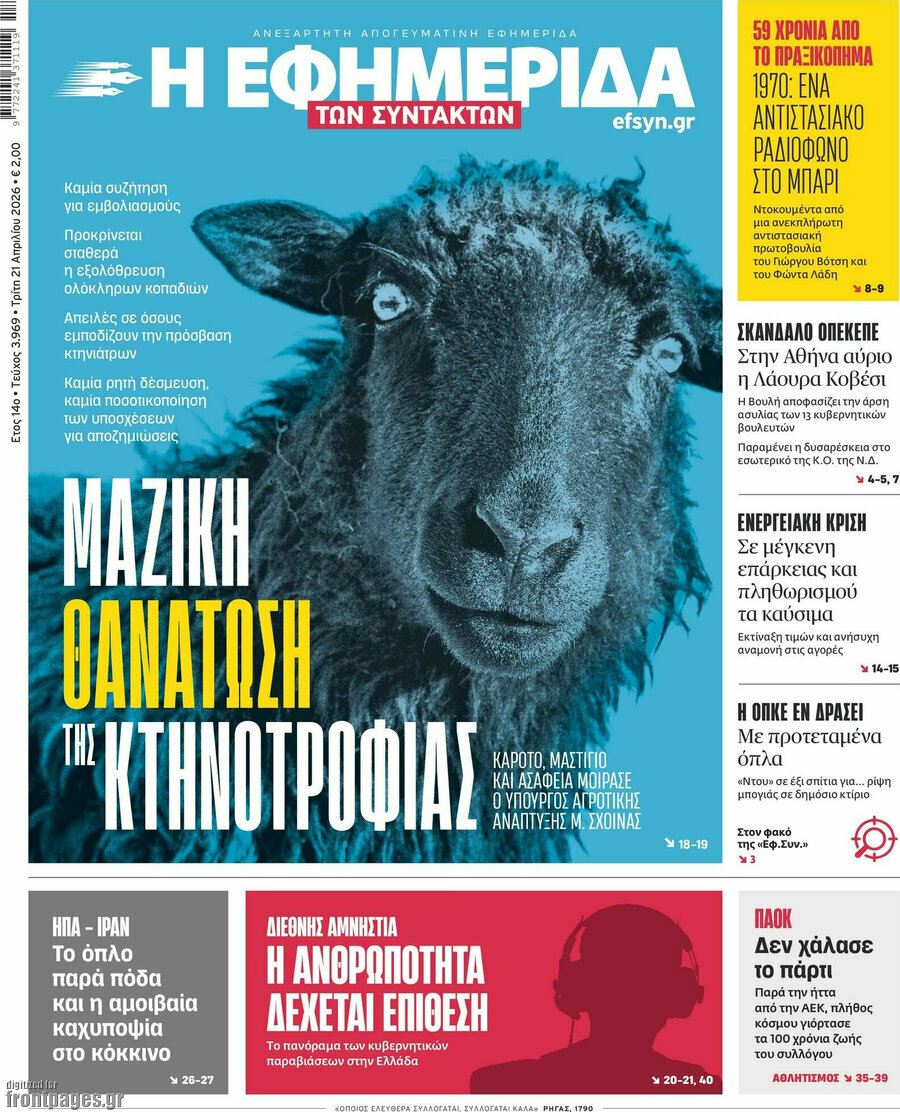
EFIMERIDA TON SYNTAKTON: Massive “slaughter” of livestock breeding
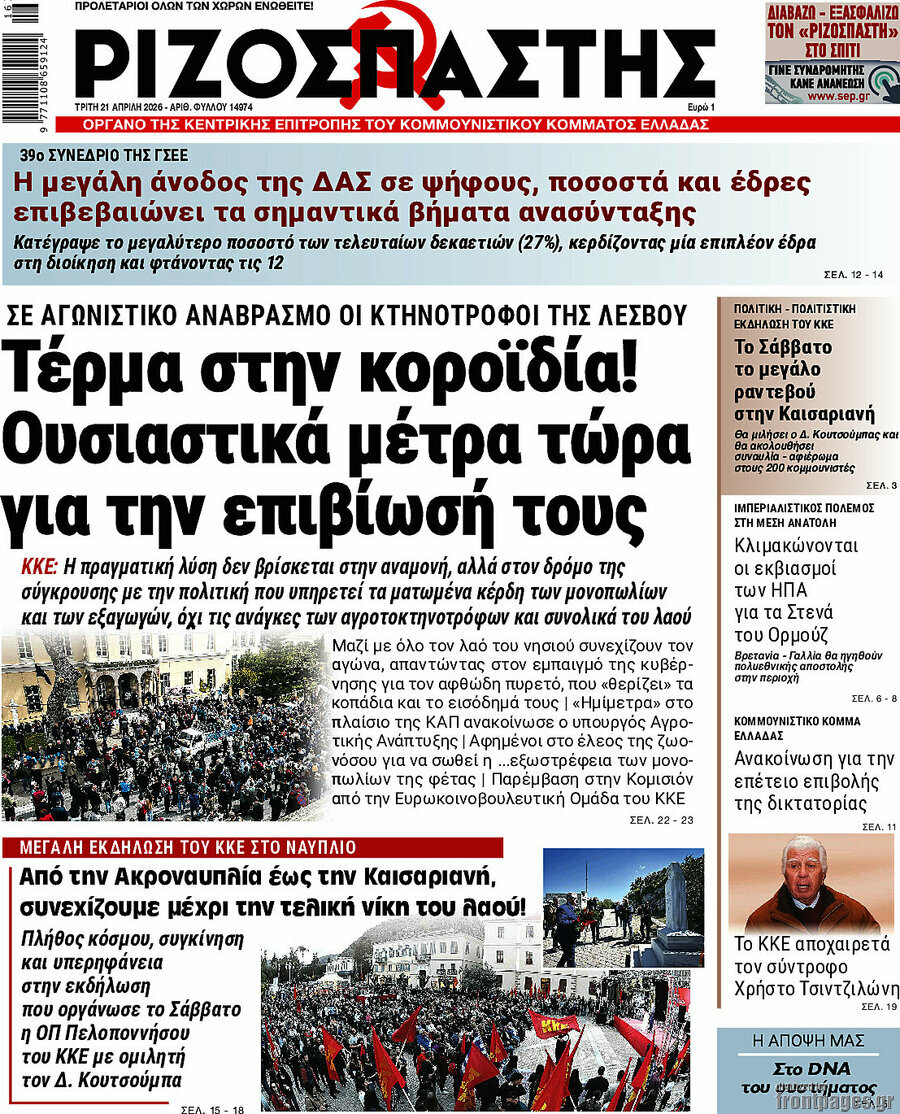
RIZOSPASTIS: Livestock breeders of Lesvos: No more mockery! Substantial measures are needed now to ensure their survival
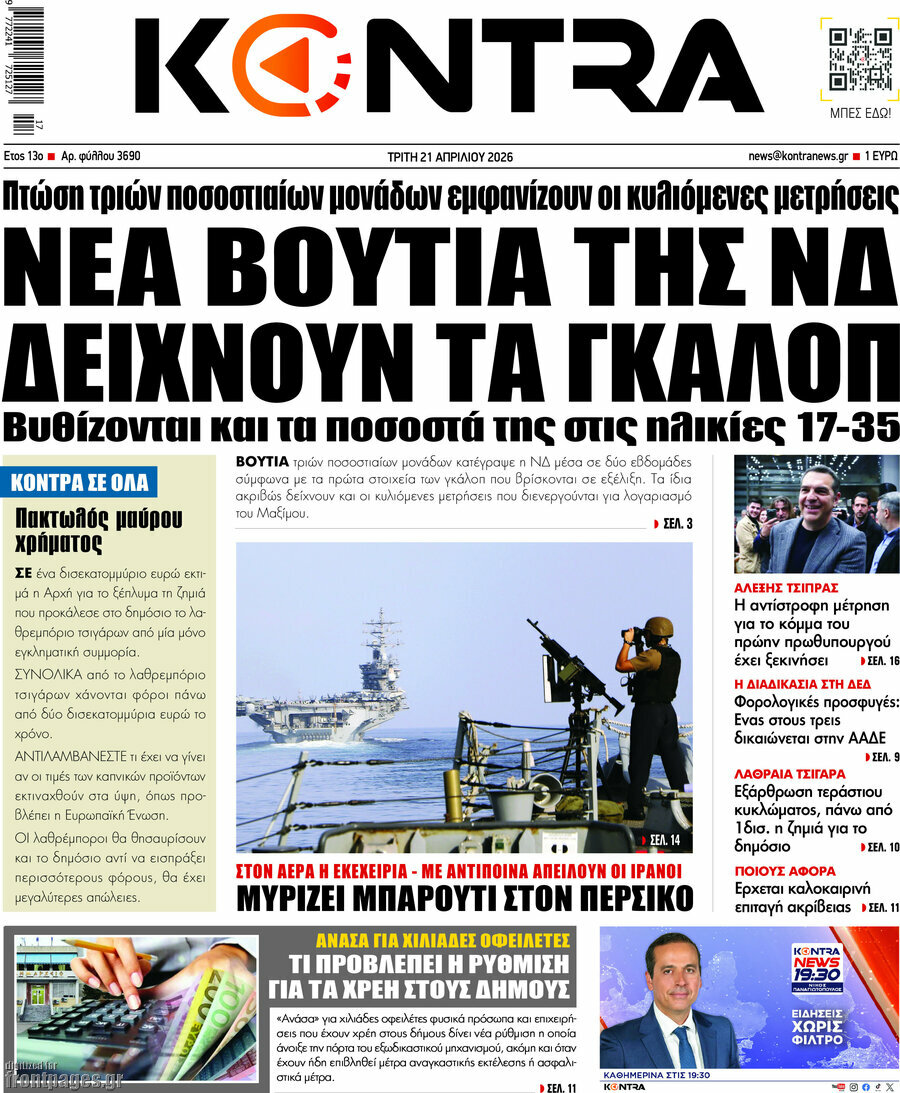
KONTRA NEWS: Polls show new plunge for ruling New Democracy
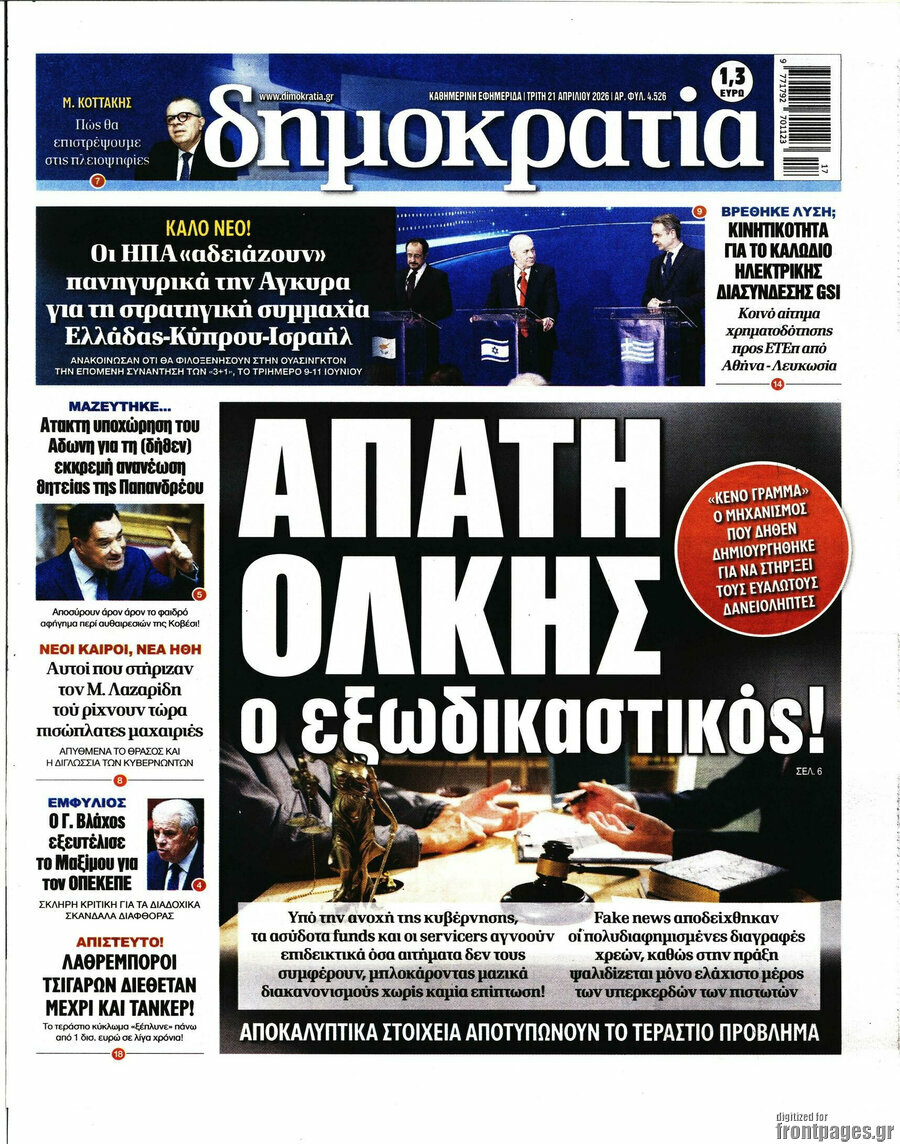
DIMOKRATIA: Out-of-court settlement is a first-class fraud!
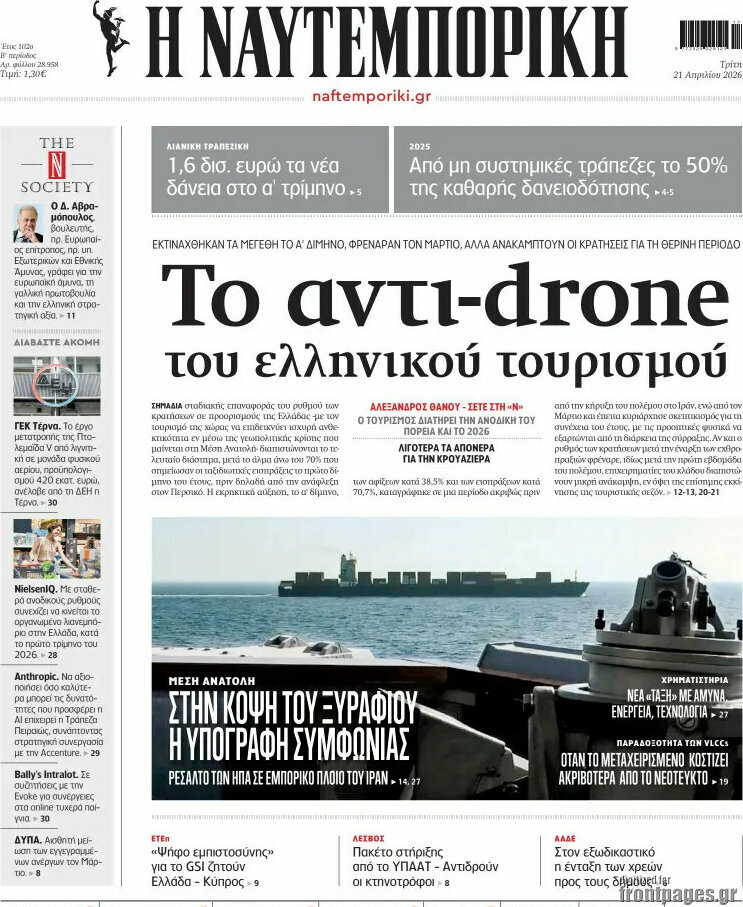
NAFTEMPORIKI: The anti-drone of Greek tourism

DRIVING THE DAY
ISRAEL IN FOCUS: EU foreign ministers are due to raise the prospect of fresh sanctions against violent West Bank settlers — as well as a possible suspension of the EU-Israel Association Agreement — during a gathering in Luxembourg today, according to diplomats and comments from leaders.
The push coincides with a wave of criticism from national leaders, including German Chancellor Friedrich Merz, over violence by West Bank settlers, as well as Israel’s controversial new death penalty law and ongoing humanitarian concerns in Gaza.
Spain, Ireland and Slovenia are leading the charge for a suspension of the association agreement (which underpins relations between EU and Israel) over the death penalty bill and other moves they claim violate human rights, the three countries announced in a letter on April 18.
Meanwhile, France and Sweden have co-signed a discussion paper, seen by POLITICO, calling for a ban on imports from West Bank settlements “on the basis that the illegal settlements fall outside the scope of the Association Agreement.” The letter urges the Commission to “urgently consider” the feasibility of tariffs on settlement products and import restrictions.
That’s not all: During a news conference Monday, following a meeting about a two-state solution for the Israeli-Palestinian conflict, the EU’s High Representative Kaja Kallas hinted at an opening for sanctions against violent West Bank settlers, following Hungarian Prime Minister Viktor Orbán’s defeat in the April 12 election.
“I will not speak for the new government [of Hungary] but definitely we can look into all these policies and see if they have a new approach,” Kallas told a news conference following the gathering on Palestine.
Orbán had been the sole holdout on tougher action towards Israel. But Hungary’s incoming Prime Minister Péter Magyar has signaled he could lift the block on some sanctions efforts. Magyar has also warned he would order the arrest of Israeli Prime Minister Benjamin Netanyahu, who’s sought by the International Criminal Court, if he were to enter Hungary. (I wrote more about the EU’s post-Orbán stance toward Israel here.)
Reality check: With Orbán’s representatives still in the room today (but not Foreign Minister Péter Szijártó, per an EU official), it’s unlikely the key Israel files will move forward. Sanctions against West Bank settlers could progress once Magyar is in power — but the path forward on suspending the association agreement is less clear.
Germany is opposed … while Italy has hardened its tone against Israel but hasn’t flagged any intention to seek the suspension. And Paris is being cautious: French Foreign Minister Jean-Noël Barrot, asked in the National Assembly whether he planned to seek a suspension, said Israel needed to “change its policies vis-à-vis Palestine” to avoid suspension — but stopped short of saying France would seek short-term changes.
NEXT UP — UKRAINE: Russia’s invasion of Ukraine will also be on the table when the foreign ministers gather in Luxembourg. “This is one of those councils where the agenda keeps moving until the very morning,” one EU diplomat told Koen Verhelst.
Pipeline clash: It all boils down to the Druzhba pipeline between Ukraine and Hungary, the diplomat said. If Russian oil starts flowing through the link, Orbán might be ready to drop his resistance to waving through the EU’s €90 billion loan to Ukraine, as Gregorio Sorgi and Koen report.
If that cork suddenly pops, a lot could be possible at today’s Foreign Affairs Council. The EU diplomat cited above speculated that the 20th sanctions package on Russia could soon be revived, given that Slovakia had linked its approval of the package to the repair of Druzhba. But two other diplomats were less hopeful, noting the loan to Kyiv is the first priority — as has been the case for months.
NOW READ THIS: Gabriel Gavin has this must-read profile of Bálint Ódor, Hungary’s long-serving permanent representative in Brussels whose time now looks like it’s coming to an end.
EU ENLARGEMENT
NO CANADA: Sorry, Ottawa — you’re not European enough to join the club. That was Enlargement Commissioner Marta Kos’ message to the European Parliament at an enlargement-focused hearing on Monday, Sebastian Starcevic writes in to report.
Europeans only: Asked by an MEP whether Canada, which is thousands of kilometers from Europe, could become a member of the EU, Kos replied that there were two preconditions to join the bloc. “One, you fulfill — you are a state. But you are not a European state.” We should add: There’s no evidence Ottawa had taken the suggestion (jokingly floated by France’s foreign minister) seriously.
Can we still be friends? A smiling Kos, clearly amused by the idea of Canadian membership , said she had been told not to look at the issue so narrowly. She called instead for “some special partnership agreement with countries … that cannot become a member of the EU but are valuable to us.”
SERBIA ON NOTICE: Kos was also asked about (and confirmed) POLITICO’s scoop that the EU will freeze funds for Serbia unless Belgrade repeals controversial judicial reforms. “We will not be able to pay,” Kos said. “It is €1.5 billion under the question mark.”
JOB-FIT: Meanwhile, an MEP raised fresh allegations that Kos, a Slovenian, had worked with Yugoslavia’s feared intelligence agency in the 1980s, with the lawmaker questioning whether she was fit to be a commissioner. “Yes, I am very fit for the job,” Kos said, without addressing the new claims. (She has long denied being an informant or spy, including at her Parliament confirmation hearing in 2024.)
ENERGY CRUNCH
STRASBOURG, SURE — BUT MAKE IT OPTIONAL: With Brussels urging Europeans to cut back on travel to save fuel, some in the European Parliament are wondering how the monthly pilgrimage to Strasbourg looks in the face of a global crisis, Bartosz Brzeziński reports.
Signature drive: Pressure is mounting in different corners of the hemicycle to park the Brussels–Strasbourg commute — at least for as long as the energy crunch continues. The right-wing ECR is collecting signatures until Wednesday for a letter to Parliament President Roberta Metsola, arguing the assembly should practice what the EU is preaching and keep plenaries in Brussels … for now.
Parallel track: Separately, four Dutch lawmakers, spanning an ideologically eclectic mix of left-wing advocates for animal rights to members of the far right, have made their own pitch to halt the trips, pointing to the roughly 4,000 lawmakers and staffers required to shuttle back and forth each month.
The play: Both appeals reach for the same precedent, noting the Strasbourg plenary was temporarily dropped during Covid-19 as a result of force majeure considerations and suggesting the current fuel squeeze might require the same response.
JET FUEL JITTERS: Meanwhile, EU transport ministers will dial in today to discuss the oil crisis, with a particular focus on jet fuel, Tommaso Lecca writes in to report. The Cyprus Council presidency told POLITICO that although the EU isn’t facing shortages, rising prices are putting pressure on the aviation sector. On Wednesday, the Commission will present its non-binding communication on how countries should respond, with a draft document showing the Berlaymont will urge countries to “support alternatives to air travel.”
ROMANIA CRISIS
SNAP ELECTION LOOMING: The Romanian government faces a political crisis after the Social Democrats (PSD) announced Monday they were withdrawing support from the coalition of center-right Prime Minister Ilie Bolojan, Max Griera writes in to report. The PSD also said it would withdraw its six ministers from the government later this week — throwing the country into instability barely a year and a half after the last election.
No solution in sight: The PSD’s move upends the troubled coalition of pro-European parties, which includes Bolojan’s National Liberal Party (PNL) and the Save Romania Union (USR), and is expected to trigger an election. Both the PSD, which commands the largest share of votes in parliament, and the far-right Alliance for the Union of Romanians (AUR) said they could file motions of no confidence against the government, with neither party interested in pursuing a coalition.
No easy way out: “We want snap elections [and we are] not interested in a coalition with PSD,” AUR leader George Simion told Max. “The government will fall, 100 percent.” AUR is topping the polls, at 35 percent, according to POLITICO’s Poll of Polls, followed by PSD at 22 percent.