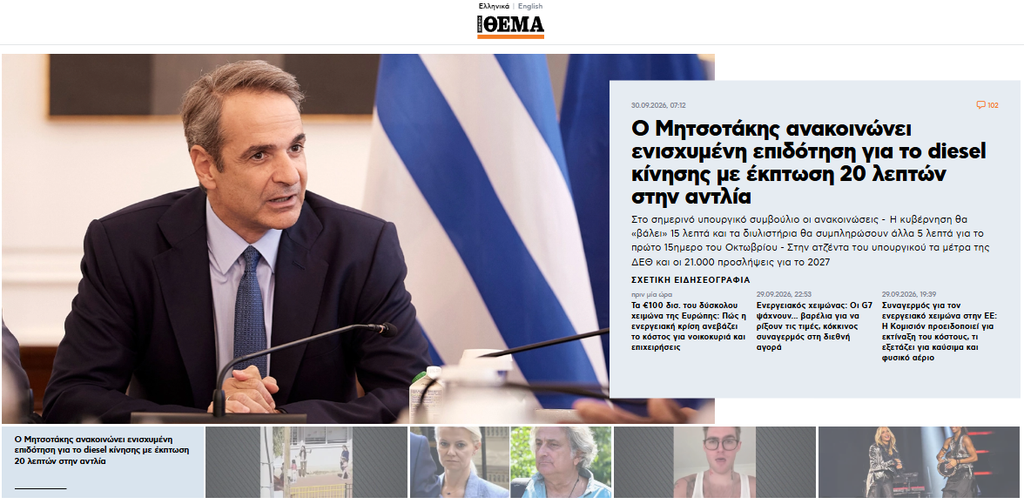
PM Mitsotakis to chair cabinet meeting
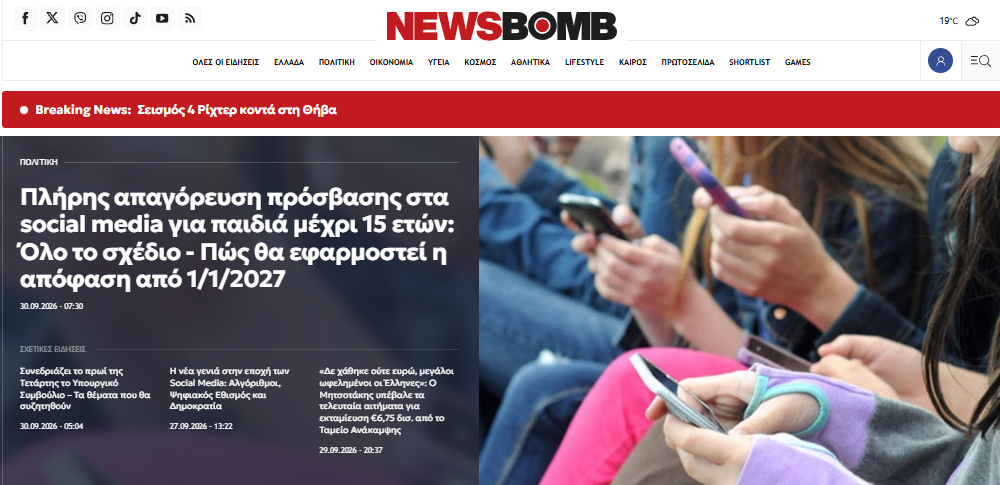
Among the issues to be discussed is the bill to boost incomes and promote saving, the completion of the milestones and targets of the Recovery and Resilience Facility and the submission of the country’s final payment requests, a new framework governing minors’ access to social media as well as a bill on the management and strengthening of development programmes.
https://www.amna.gr/en/article/1027089/PM-Mitsotakis-to-chair-cabinet-meeting
Former minister faces special court in Tempe case
Former deputy minister to the prime minister Christos Triantopoulos will face a special court over his handling of the aftermath of the 2023 Tempe rail disaster, following a ruling by the judicial council of the Supreme Court that opens the way for trial proceedings. Following the recommendation of Deputy Prosecutor Dimitris Mitroulias, judges referred Triantopoulos on a charge of breach of duty related to actions taken at the site of the collision between two trains on February 28, 2023, and the alleged alteration of the area before all victims had been recovered. Four other officials, including former Thessaly regional governor Kostas Agorastos, will also stand trial as alleged participants in the same offense.
https://www.ekathimerini.com/politics/1316683/former-minister-faces-special-court-in-tempe-case
Tsipras attacks government on EU farm subsidy scandal
Former prime minister Alexis Tsipras, whose new ELAS party is second in opinion polls, on Tuesday repeated claims that the governing conservatives exploited European Union farm subsidies to boost their electoral support. In a speech to livestock farmers in the western Peloponnese, Tsipras accused Prime Minister Kyriakos Mitsotakis of playing a “central role” in the OPEKEPE EU farm subsidy scandal. Scores of people have been convicted of fraudulently claiming EU subsidies for non-existent farming activity, while four lawmakers with Mitsotakis’ New Democracy party face trial for alleged misdemeanors linked with the scandal. They deny wrongdoing.
https://www.ekathimerini.com/politics/1316663/tsipras-attacks-government-on-eu-farm-subsidy-scandal
Transparency watchdog handed claims on medical association chief
Health Minister Adonis Georgiadis on Tuesday said he has referred allegations concerning the head of Greece’s biggest medical association’s business dealings to the country’s independent transparency watchdog. Georgiadis was speaking in the wake of the September 9 death of pop singer Giorgos Mazonakis at a private Athens clinic, which drew broad public attention and triggered an overview of health practices. He said that all allegations concerning companies owned by Giorgos Patoulis, a doctor and former Greater Athens regional governor elected with Georgiadis’ governing New Democracy party, have been referred to the National Transparency Authority. Patoulis is head of the Athens Medical Association.
ATHEX: Bourse holds steady on high turnover
The Euronext Athens (ATHEX) general index closed at 2,709.91 points, adding 0.08% to Monday’s 2,707.83 points. The large-cap FTSE-25 index expanded 0.12% to end at 6,962.69 points.
https://www.ekathimerini.com/economy/1316685/athex-bourse-holds-steady-on-high-turnover


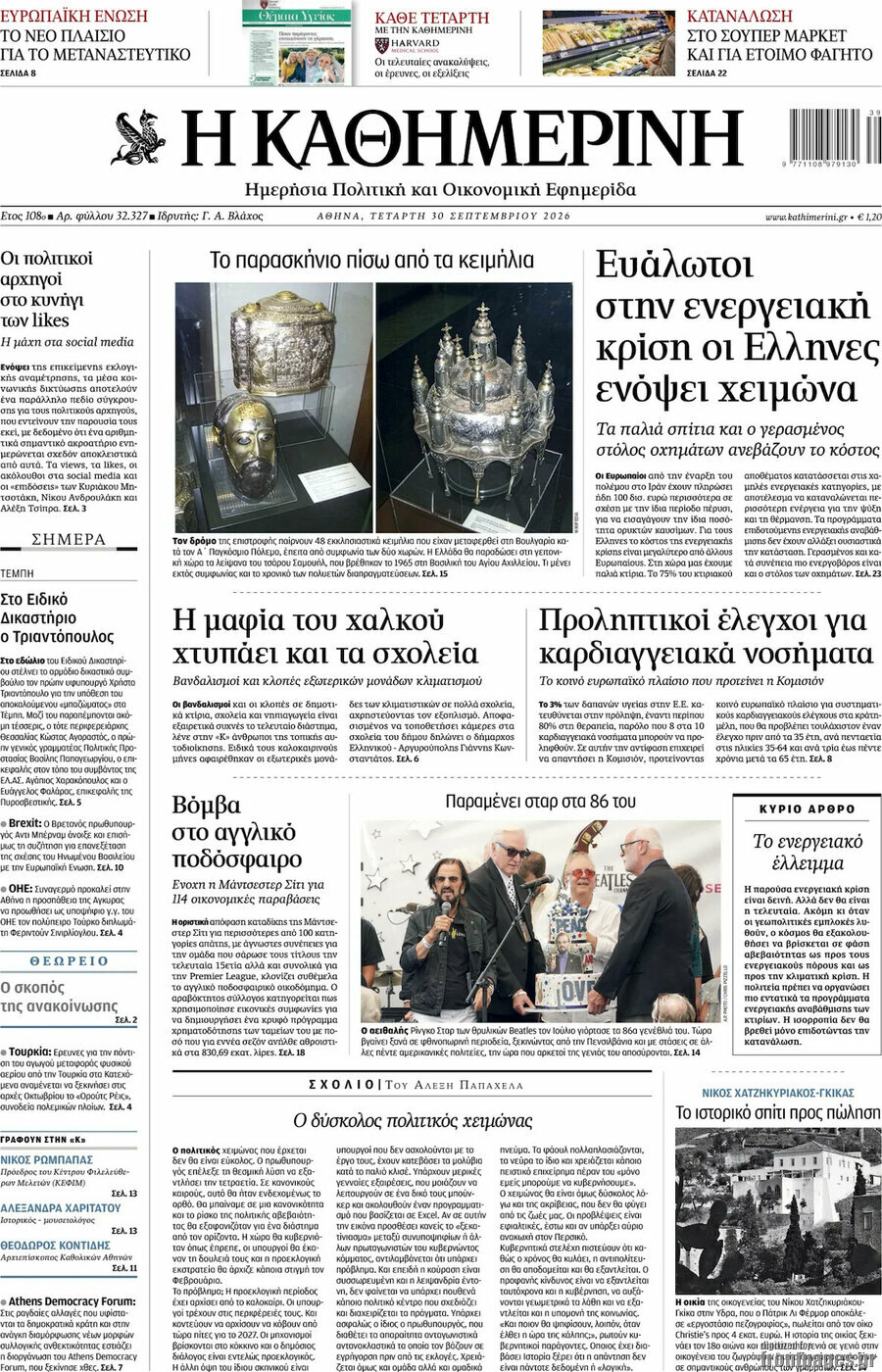
KATHIMERINI: Greeks are vulnerable amid the energy crisis and ahead of the upcoming winter
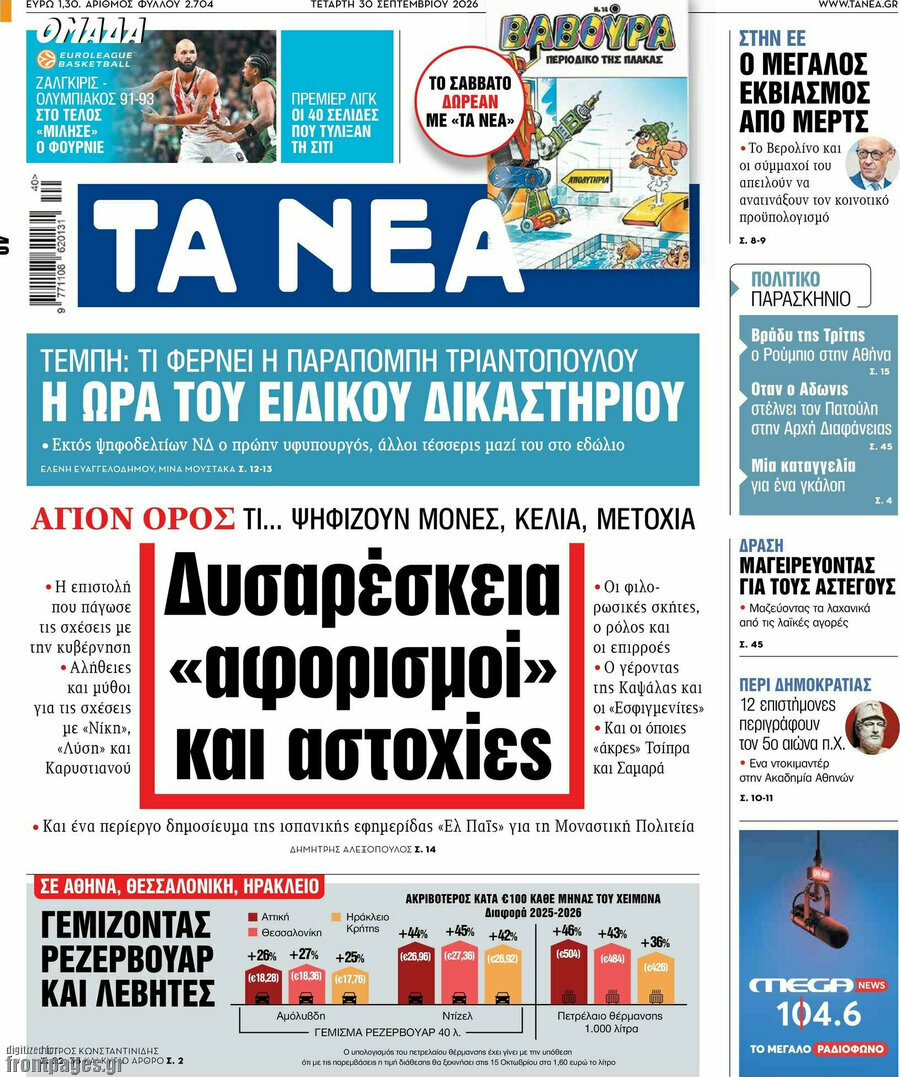
TA NEA: The political behavior of Mount Athos: discontent, “excommunications” and blunders
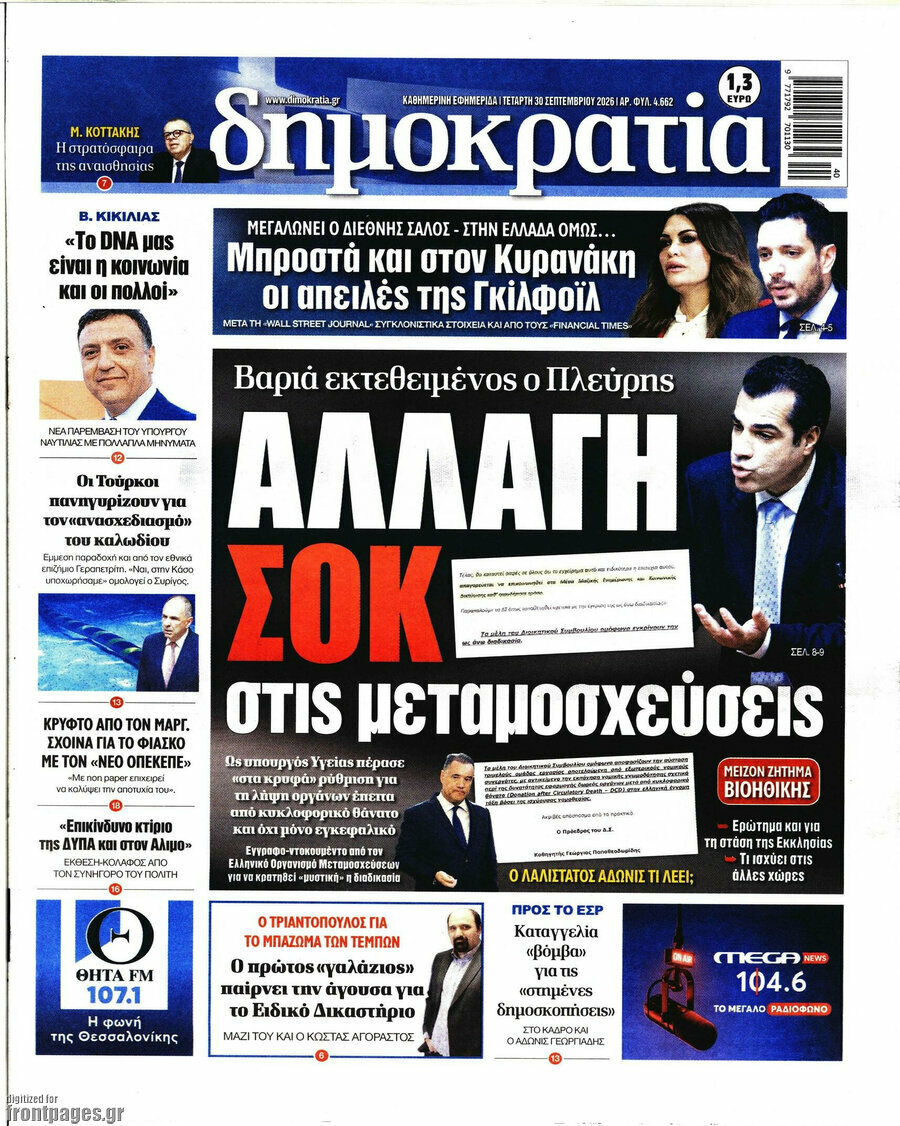
EFIMERIDA TON SYNTAKTON: This is how public opinion is being manipulated – Polls under scrutiny
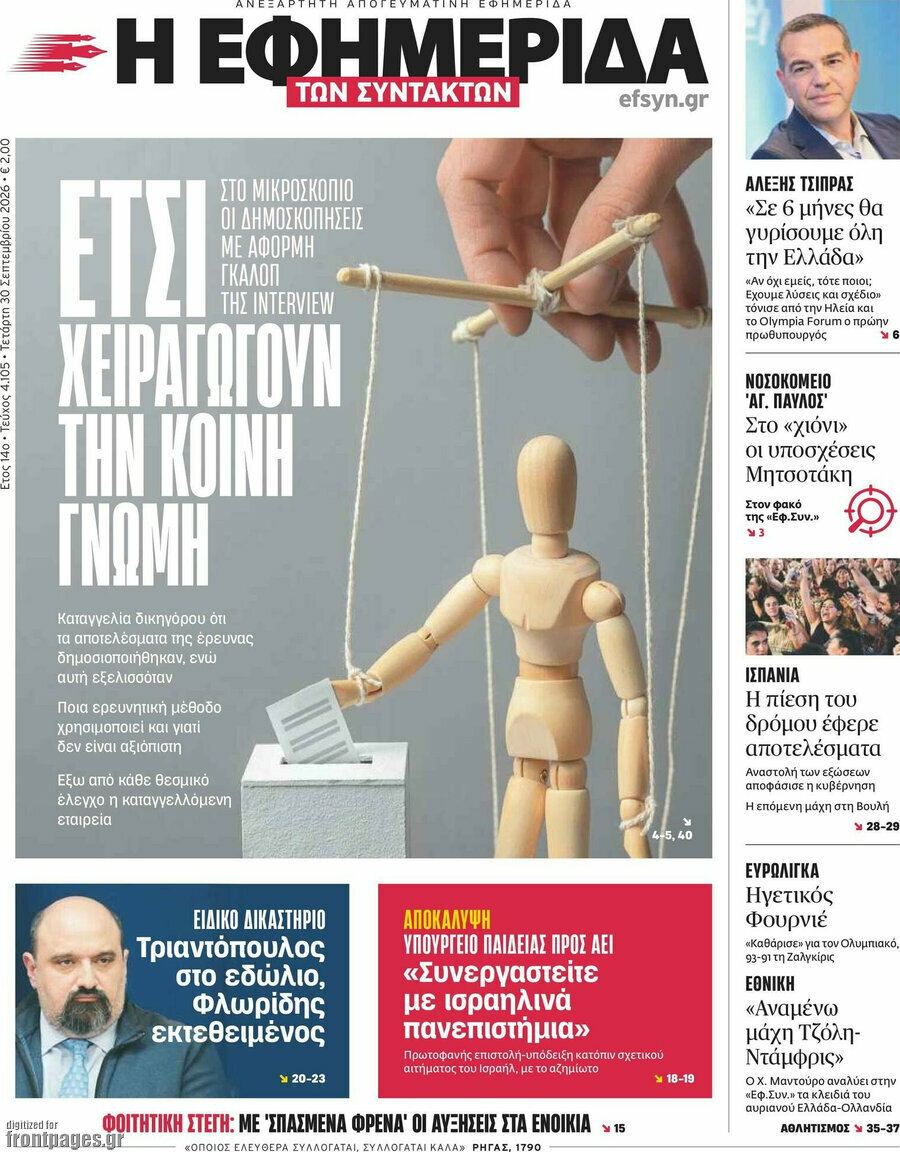
RIZOSPASTIS: The EU and tits government burden the simple folks with price hikes to fund war plans and benefit energy corporations
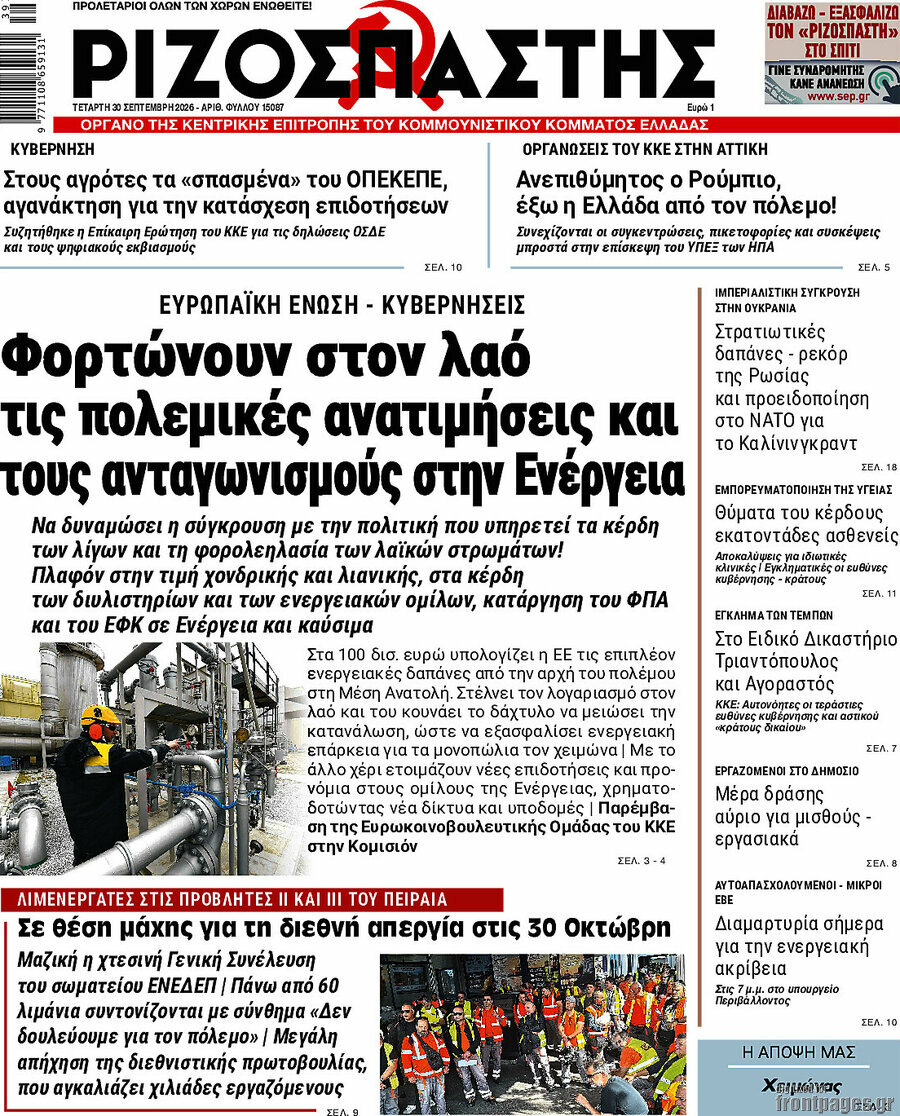
KONTRA NEWS: The big scam with the fake polls
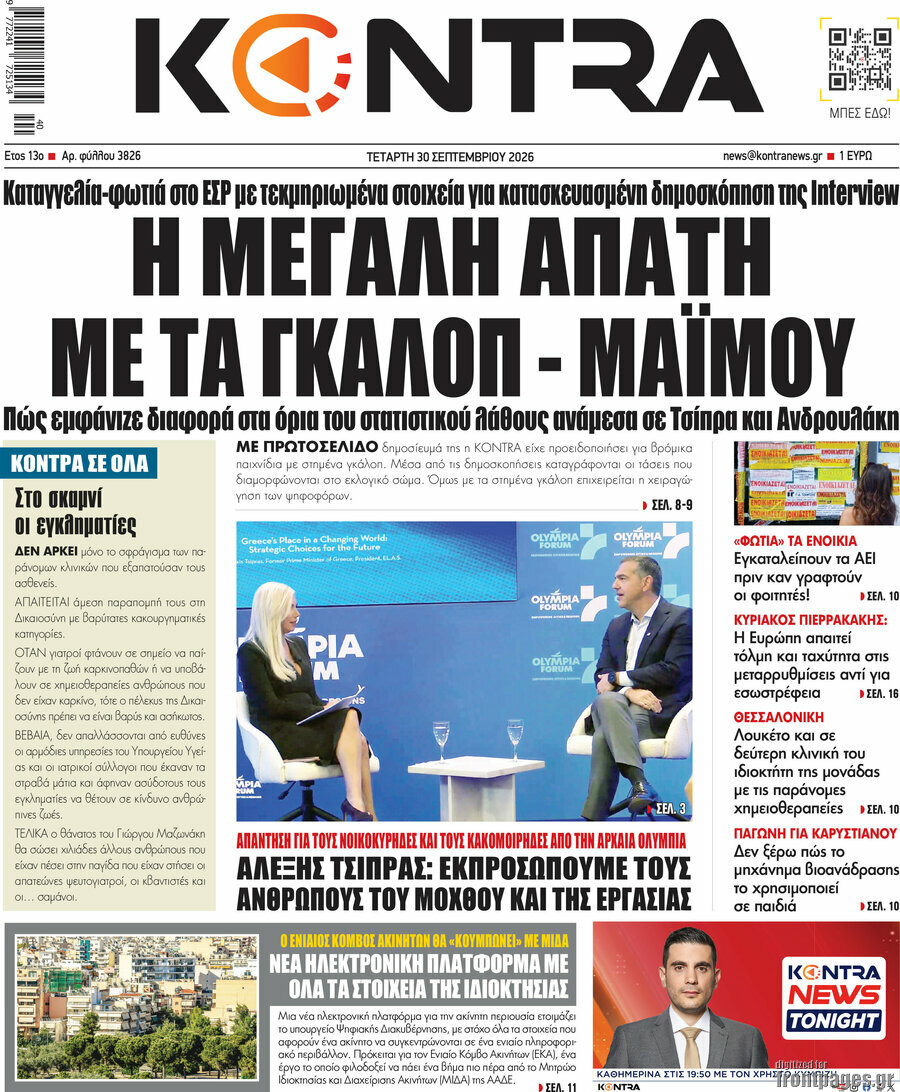
DIMOKRATIA: Shocking change regarding organ transplants
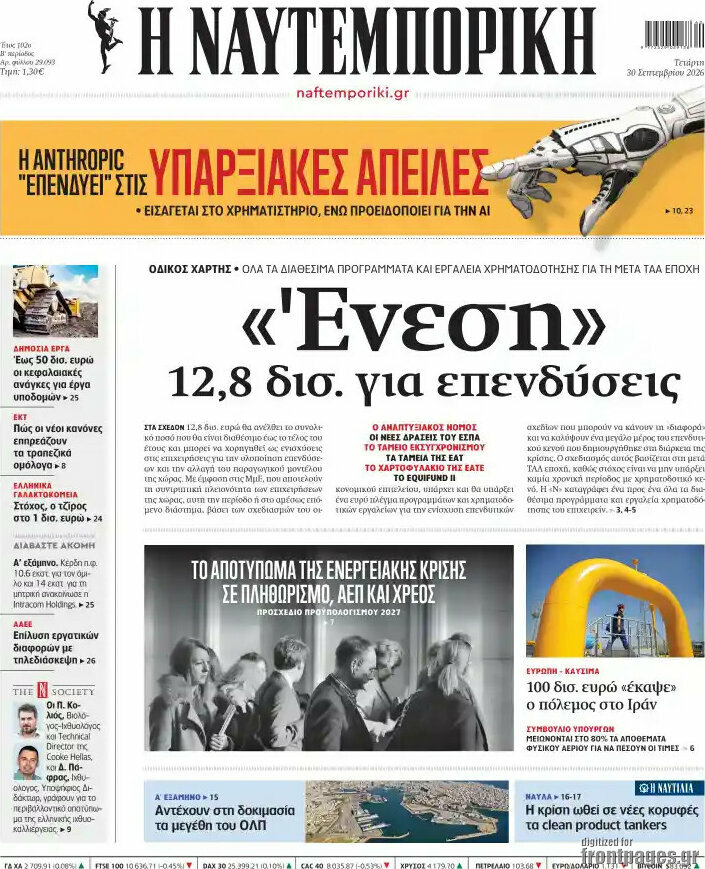
NAFTEMPORIKI: 12,8-billion-euro “injection” for investments

DRIVING THE DAY
EXCLUSIVE — WESTERN BALKANS TELL VDL TO SORT IT OUT: Western Balkan countries hoping to join the EU will use a visit by Ursula von der Leyen to tell her they deserve to be considered much closer to joining the bloc.
“She can make that case,” Kosovo Prime Minister Albin Kurti told Playbook, calling on the European Commission president to publicly back candidate status —formal recognition of Kosovo’s path toward EU membership. “We trust that our performance has earned us a merited step forward, and that step is candidacy.”
No consolation prizes, please: While Brussels is working on ways to bring countries closer to the EU before they formally join, Kurti warned against this becoming a road to nowhere. “It must be a pathway to full EU membership, not a parallel process or a substitute.”
Here’s the problem: The Commission is readying more defined plans, including indicative timelines, for countries closest to joining. Albania, Montenegro, Ukraine and Moldova are to be given a clear route to the finish line — while others will be told to keep driving.
Welcome to the waiting room: That includes Kosovo and North Macedonia, both on von der Leyen’s itinerary alongside frontrunners Albania and Montenegro. Her challenge is to convince them Brussels isn’t creating a second tier.
Skopje wants more too: “We deserve to be in a much more advanced position than we are right now,” North Macedonia’s Foreign Minister Timčo Mucunski told POLITICO’s Sebastian Starcevic. His gripe: Skopje has heard promises before. “Within five years, you’ll become an EU member state,” he recalled being told.
Enter the sweetener: Von der Leyen is expected to point to a forthcoming review of benefits for those further back in the queue. “The president’s message will be — if you deliver on reforms, we will deliver on our side of the bargain,” a senior Commission official said, granted anonymity to speak frankly. “The more reforms they do, the more access to EU funds they get.”
Kosovo’s case: Kurti argues his country is doing its part, pointing to its alignment with EU foreign policy, including Russia sanctions. “We are not asking for shortcuts or a back door,” he said.
But there are two sides to the story: An internal Commission assessment seen by Playbook’s Gabriel Gavin estimates that Kosovo has completed only 24-26% of its Growth Plan commitments, which let aspiring members unlock EU cash and some economic benefits as they reform. Countries need to deliver before they can get the perks, another EU official said.
BIG AND BREAKING
FAMILY FIRST: The Le Pen clan is tightening its grip on France’s far right as it reckons with the fallout from the disputed allegations that National Rally President Jordan Bardella made antisemitic comments as a teenager.
WHAT’S COOKING AT THE EU-CANADA SUMMIT NEXT MONTH: A draft joint statement indicates that the two sides are looking to flesh out cooperation on critical minerals and the supply of liquefied natural gas, according to extracts seen by POLITICO’s Camille Gijs (for subscribers).
EPP’S SERBIA TEST: The European People’s Party is finalizing a report on whether to expel Serbian President Aleksandar Vučić’s SNS party — but won’t publish it until after the country’s election to “avoid interference,” according to internal notes seen by Max Griera. It yesterday expressed “disbelief” and “condemnation” over Serbia’s public commemorations of convicted war criminal Ratko Mladić.
COLD SHOULDER: German Chancellor Friedrich Merz said Moscow isn’t ready for “serious talks” about ending the war in Ukraine after Russian Foreign Minister Sergey Lavrov’s dismissive assessment of a meeting with his German counterpart on the weekend.
THE FIGHT OVER “MADE IN EUROPE”: Brussels wants to turn “Made in Europe” from slogan into industrial strategy, but first it has to resolve these five fights — including what actually counts as European.
BUDGET BLOCKAGE
PARLIAMENT DRAGS ITS FEET: The Greens’ budget negotiator has warned that turf wars and resistance to change in the European Parliament are threatening to delay a deal on the next seven-year budget. “We’re so far behind that we won’t even have a Parliament position by the end of next year if we continue at the same pace,” Damian Boeselager told Gregorio Sorgi.
Party leaders will meet today to discuss ways to break the deadlock. Officials complain that the overlap between three different parliamentary committees — covering budget, agriculture and regional policy — has led to delays in negotiations over the National and Regional Partnership Plans (NRPPs), which include farmers’ subsidies and regional payouts and cover almost half of total spending.
Parliament risks missing its pledge to agree on a position on the budget by November and start negotiations with governments early next year.
Pointing the finger: “Some agricultural MEPs in [the] negotiation team on NRPP threaten the extreme to dictate their ideas into the law. I have one simple message to those destructive forces: it’s not going to work,” Boeselager said.
Negotiations aren’t any easier in the Council. In a fresh set of numbers expected next week, EU governments are bracing for a budget that’s more than €100 billion smaller than set out in the last negotiating document in June, four EU diplomats with knowledge of the discussions told Playbook.
Who stands to lose: Countries including Italy, Spain and Poland are lobbying Ireland, which holds the six-month rotating presidency of the Council of the EU, to refrain from such cuts. “I expect there will be cuts that will make Friends of Cohesion unhappy,” said one of the diplomats, referring to a group of countries pushing for a bigger budget.
Another thorny issue in Council involves funding the outermost regions including French Guiana, the Azores and the Canary Islands. France’s Emmanuel Macron, Spain’s Pedro Sánchez and Portugal’s Luis Montenegro asked for “adequate EU funding” for those regions in a letter seen by Playbook.
20-SECOND PLAYBOOK PRIMER
The European Commission is considering big changes to its civil service exam board, the European Personnel Selection Office … but what is EPSO? It’s an EU body responsible for selecting talented candidates for jobs in the institutions and agencies. It does this by conducting tests (known as competitions) for both generalists and specialists. Some 170,000 people applied to take a generalist test earlier this year, for which fewer than 1,500 roles could be available.
PARTY WATCH
THE LITTLE-KNOWN BODY HELPING DECIDE ESN’S FUTURE: The Committee of Independent Eminent Persons meets Thursday to start discussions on whether to deregister and defund the far-right Europe of Sovereign Nations party, the European home of Alternative for Germany.
What? The obscure committee advises the equally obscure Authority for European Political Parties, which scrutinizes financing and compliance with EU values. In July, the European Parliament approved a probe into the ESN over allegations that it breached the bloc’s values, including with anti-immigration and anti-LGBT rhetoric. The committee has two months to issue an opinion.
Each EU institution has two people on the committee: The Council has German law professor Pia Lange and Lithuania’s Linas Kontrimas, who ran to be an MEP in 2019. The Commission put forward ex-Commissioner Martine Reicherts and Alexander Italianer, former Commission sec-gen and deputy head of cabinet to José Manuel Barroso. The Parliament has Luca Vanoni (who has been a visiting professor at think tank MCC) and Anna Pacześniak, who sits on the scientific council of the Foundation for European Progressive Studies.
But ESN is worried about neutrality, saying “people with clear political affiliations … have been appointed to the committee,” according to Alexander Sell, a vice president. “In a true democracy, party representatives should not be involved in decisions regarding the funding of their political rivals.”
Nothing to see: Spokespeople and officials from the institutions insisted all appointments are in line with the law, which forbids sitting EU officials, commissioners and MEPs from being members, as well as employees of political parties and foundations. There’s no cooling-off period before joining the committee, the Parliament press service said.
Greens next: Sell said he hoped the authority would use the same process on the European Greens following allegations of antisemitism brought by a citizens’ group. Antisemitism accusations are dealt with “swiftly and seriously,” the European Greens said.
5 MORE THINGS GETTING US TALKING
AI WATCH: Leaders of some of the world’s biggest AI companies have signed a voluntary accord to police their own development, Donald Trump said yesterday after hosting tech titans including Elon Musk, Mark Zuckerberg and Jensen Huang for lunch at the White House.
The U.S. president — who has previously dismissed fears about runaway AI as overblown and a “hoax” — also signed an executive order last night renaming the technology “super intelligence,” my stateside colleagues report.
Meanwhile, in Europe: EU tech chief Henna Virkkunen says Brussels will keep pushing for global AI safety rules despite Washington making clear it wants no part of international regulation.
GREEK DRAMA: Greece’s opposition wants to know whether Trump’s ambassador to Athens, Kimberly Guilfoyle, threatened a minister during a clash over U.S. energy policy.
EAT, DRINK, REGULATE: Europe needs tougher rules on food, alcohol and tobacco to fight chronic disease, Austria’s health regulator told POLITICO at the European Health Forum Gastein (more in our Morning Health Care newsletter, which is free this week from 7 a.m.)..