Turkish research vessel stirs tensions
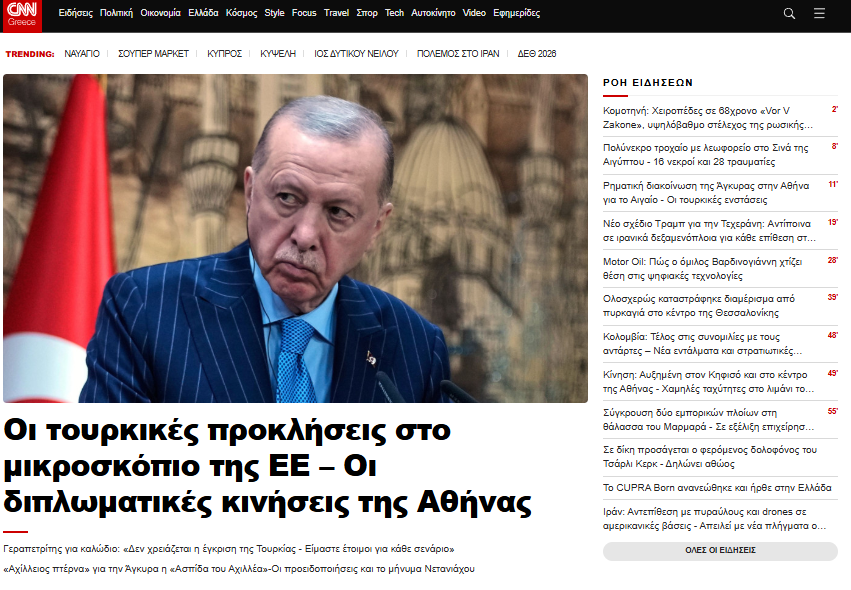
Greece and Turkey exchanged competing navigational notices after Ankara dispatched the oceanographic research vessel Tubitak Marmara to waters south of Kastellorizo, an area where Turkey only days earlier declared a marine park. The vessel has been operating several dozen miles south of the island since Tuesday morning under a Navtex issued by the Hydrographic Service station in Antalya for scientific research. Greece responded with a counter-Navtex issued from Iraklio, rejecting Turkey’s authority to issue notices in what Athens describes as an area of Greek jurisdiction and stressing that the sea zone lies within Greece’s potential continental shelf.
https://www.ekathimerini.com/politics/foreign-policy/1314003/turkish-research-vessel-stirs-tensions
Tsipras to unveil ELAS economic plan focused on fiscal discipline and social support
Former prime minister Alexis Tsipras is expected to outline three core rules for the economic planning of the Greek Left Alliance (ELAS) on Wednesday, as he presents the party’s economic program in Thessaloniki ahead of Prime Minister Kyriakos Mitsotakis’ speech at the annual Thessaloniki International Fair on Saturday. The first rule is that no permanent benefit will be introduced without a permanent source of funding, while no permanent spending will be financed with one-off revenue. Second, measures will be introduced in phases, evaluated before being expanded and reassessed annually. Third, the funding source, timing and implementation of every measure will be clearly identified.
High-ranking spy agency officer targets Intellexa execs over illegal wiretapping
Greece’s wiretapping scandal took a new turn on Tuesday after an active high-ranking officer in the country’s intelligence service EYP filed criminal charges against four business executives linked to the spyware developer Intellexa for espionage. According to his lawyer, Apostolos Pondas, the EYP officer is accusing Tal Dilian, the founder of Intellexa, his ex-wife and business partner Sara Hamou, Intellexa executive Felix Bitzios, and Yiannis Lavranos, who owned the Greek security firm that purchased Intellexa’s Predator spyware, of a series of felonies, such as breaching the confidentiality of telephone communications, forming a criminal organization, and espionage against Greece.
Eurozone inflation rises to 3.3% in August, 3.7% in Greece, according to Eurostat preliminary figures
Annual inflation in the eurozone is expected to rise to 3.3% in August 2026, from 2.9% in July, according to a preliminary estimate released on Tuesday by the European statistical agency, Eurostat. In Greece, inflation was estimated to reach 3.7% in August, up from 2.7% in July.
ATHEX: Withdrawal of buyers on price worries
The Euronext Athens (ATHEX) general index closed at 2,657.05 points, shedding 0.75% from Monday’s 2,677.26 points. The large-cap FTSE-25 index contracted 0.78% to end at 6,794.11 points.
https://www.ekathimerini.com/economy/1314022/athex-withdrawal-of-buyers-on-price-worries

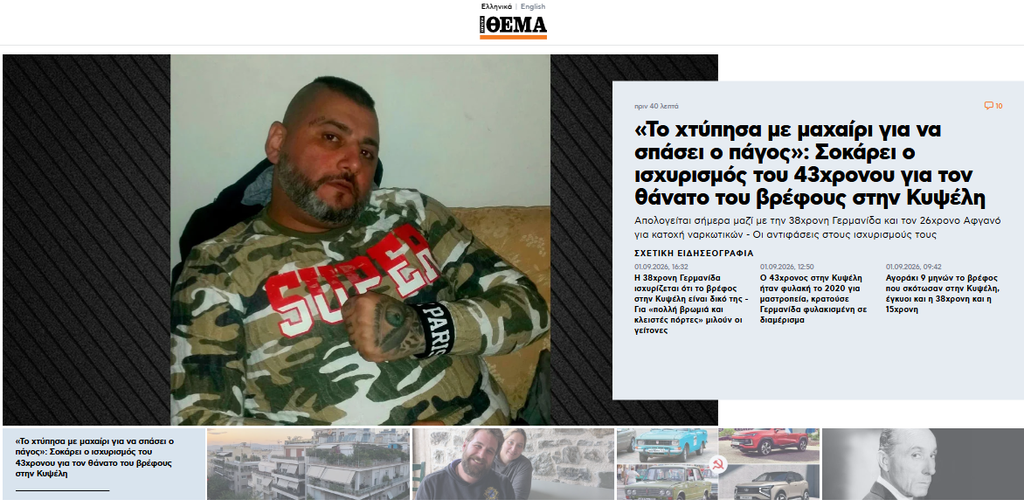
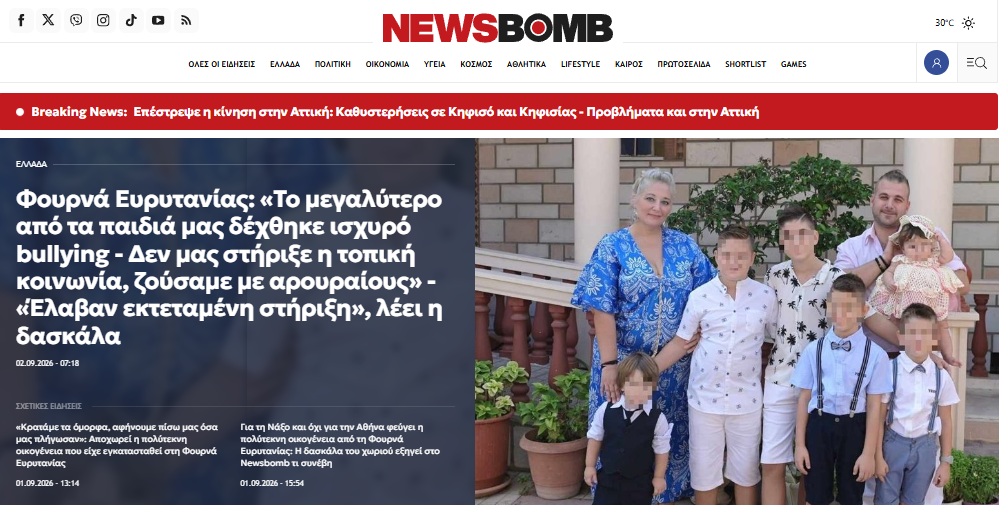

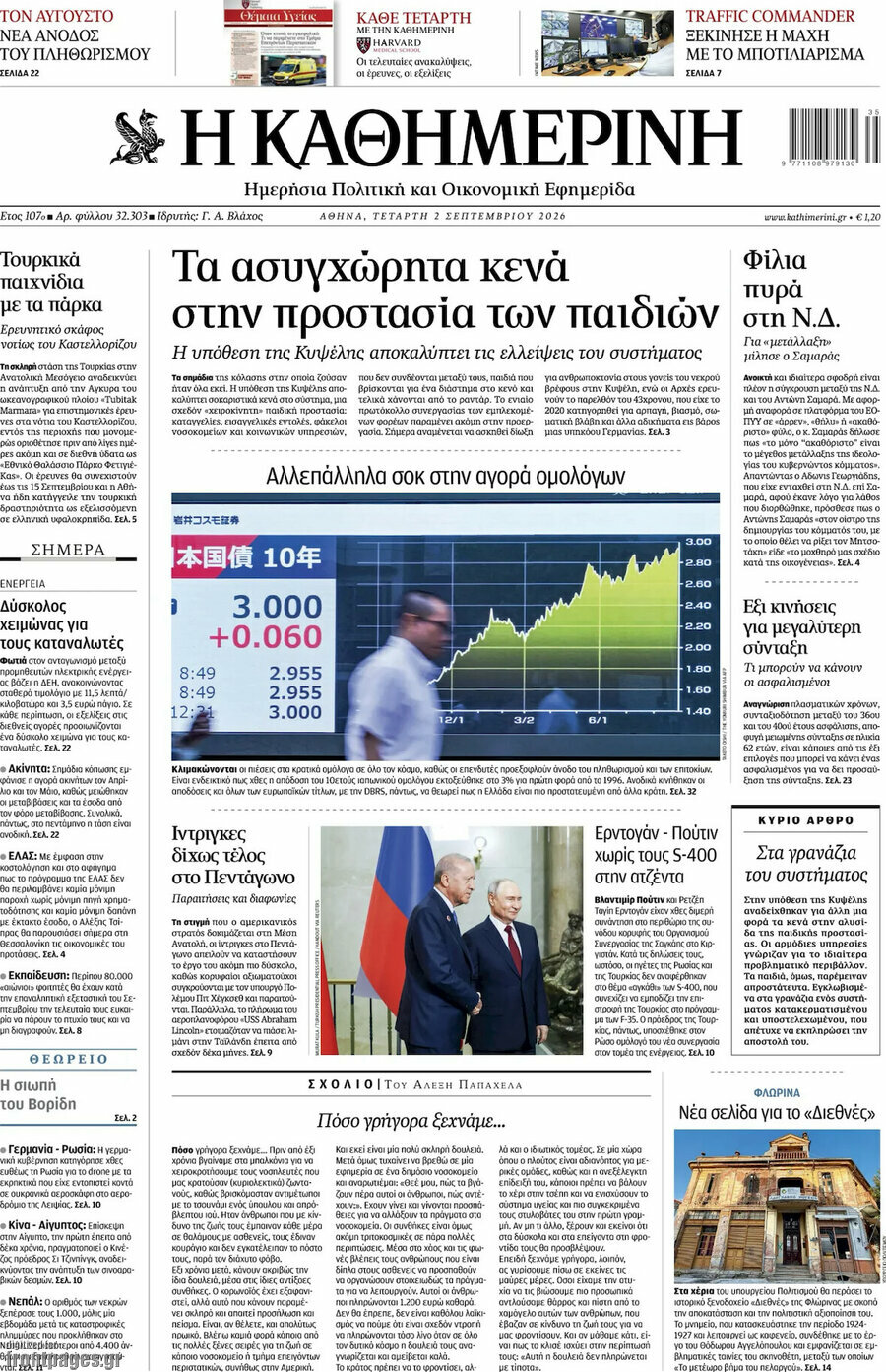
KATHIMERINI: The unforgivable gaps in children’s protection
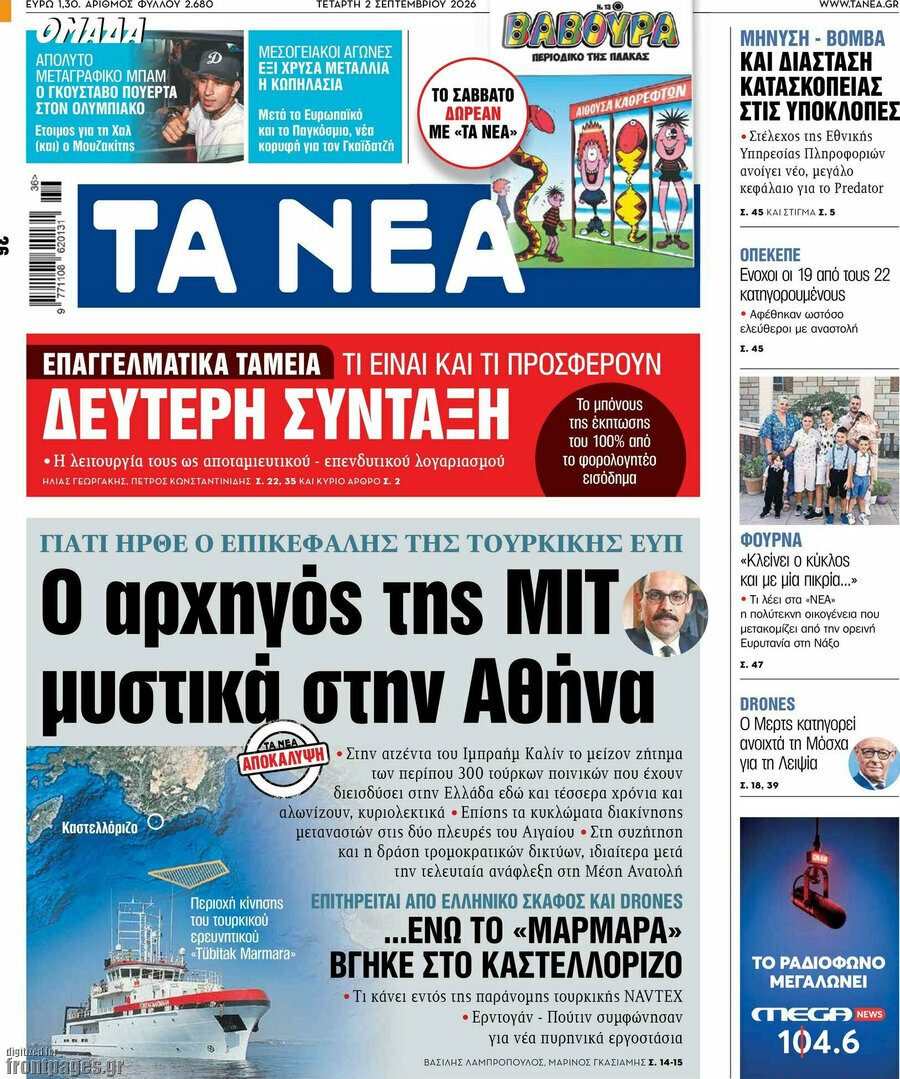
TA NEA: MIT’s head secretly visited Athens
EFIMERIDA TON SYNTAKTON: Asphyxiating pressure for the patriot missiles
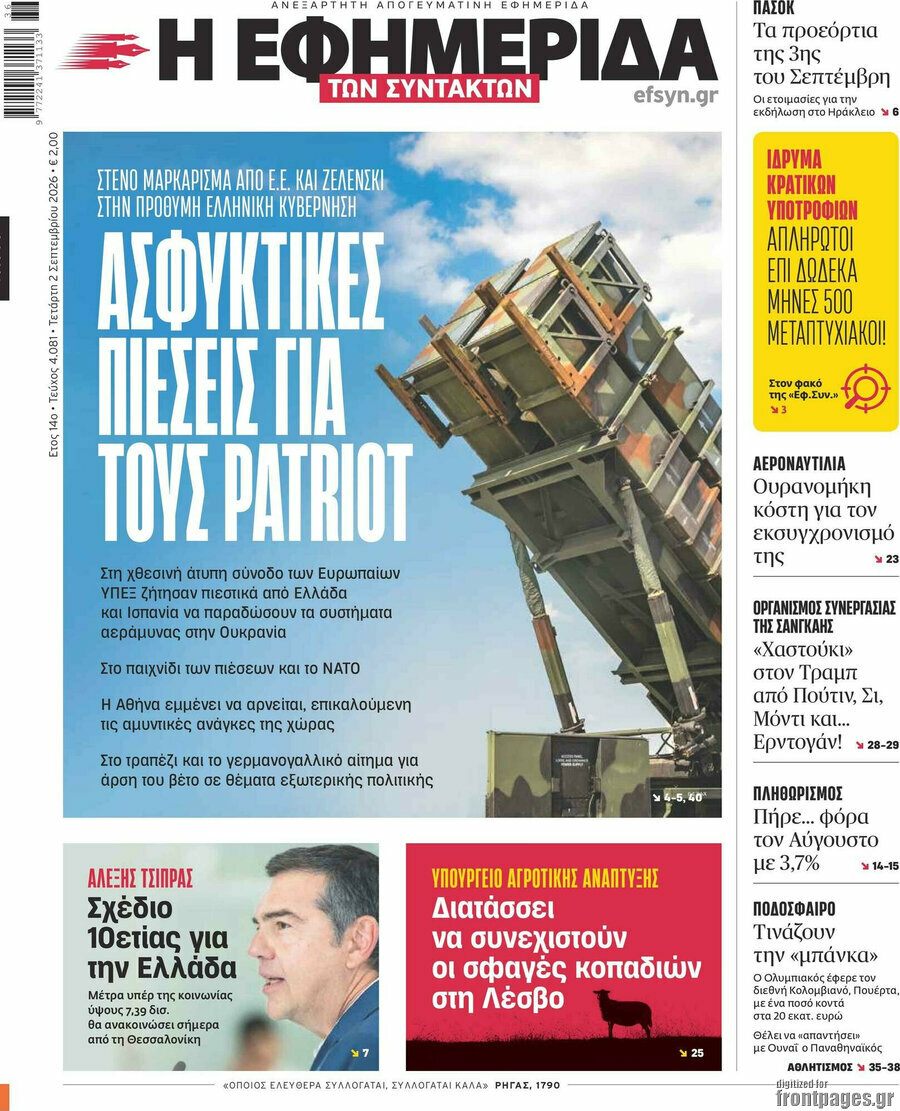
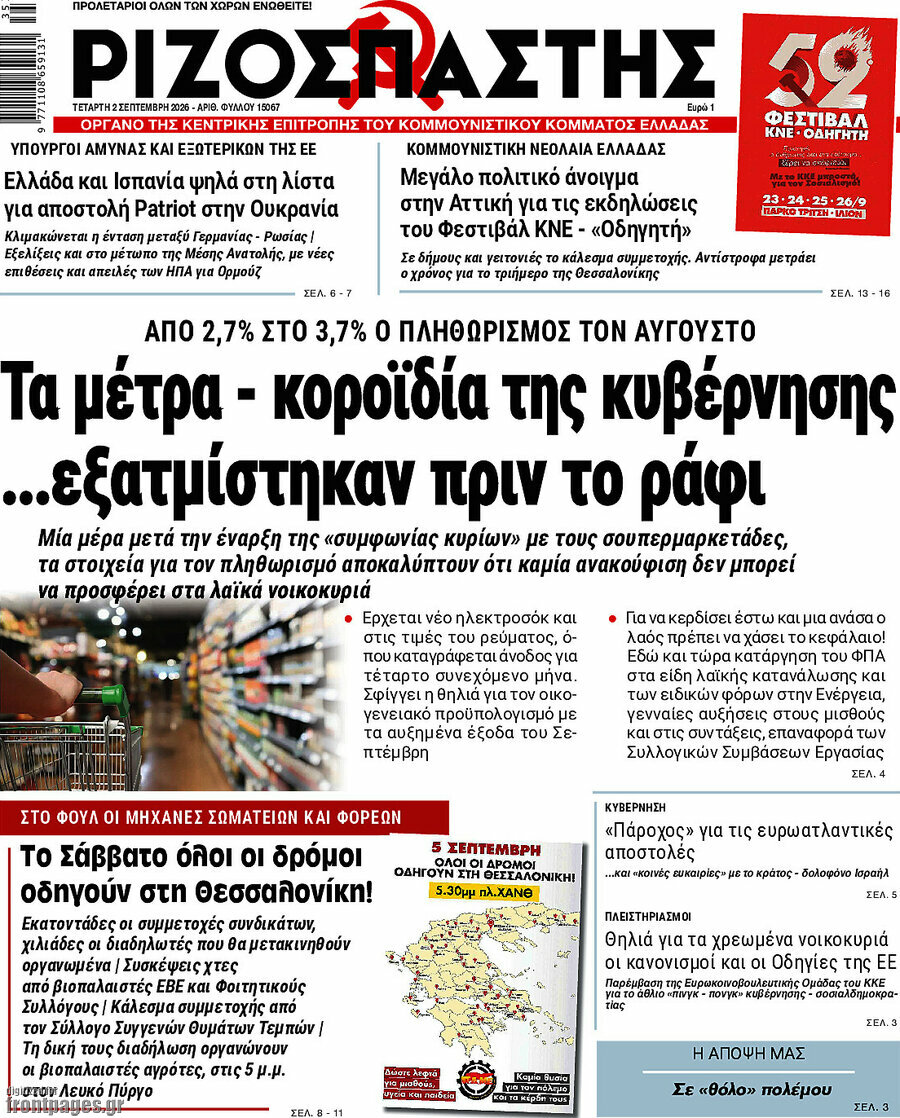
RIZOSPASTIS: The government’s measures against price hikes… evaporated in super markets
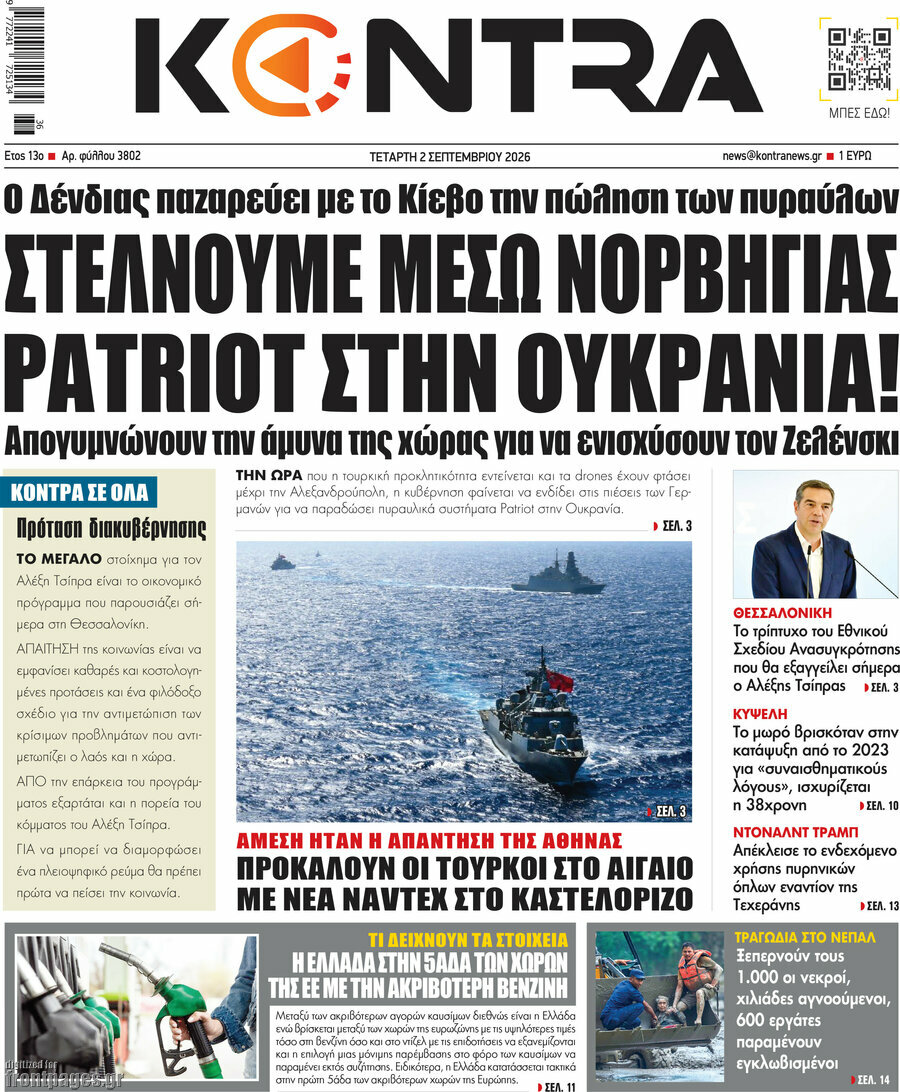
KONTRA NEWS: We are sending Patriot missiles to Ukraine via Norway!
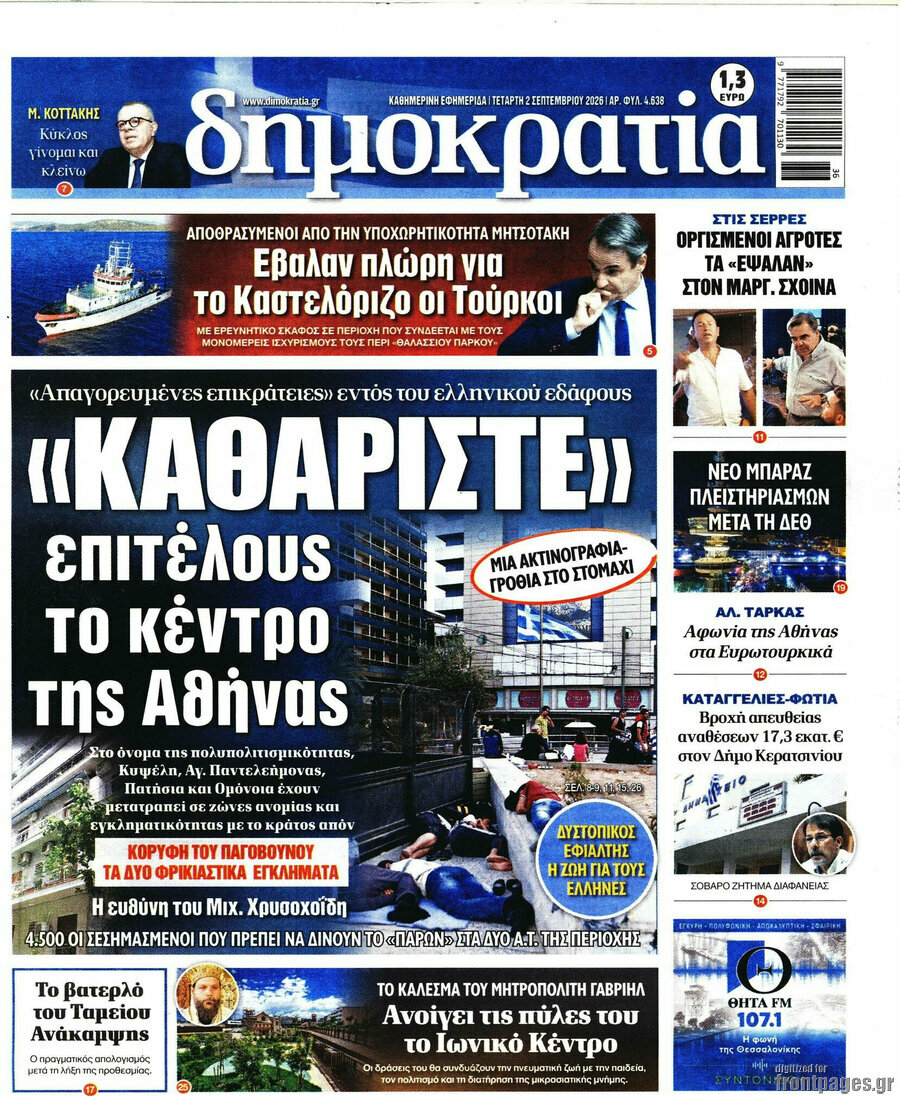
DIMOKRATIA: “Sweep” the centre of Athens at last!
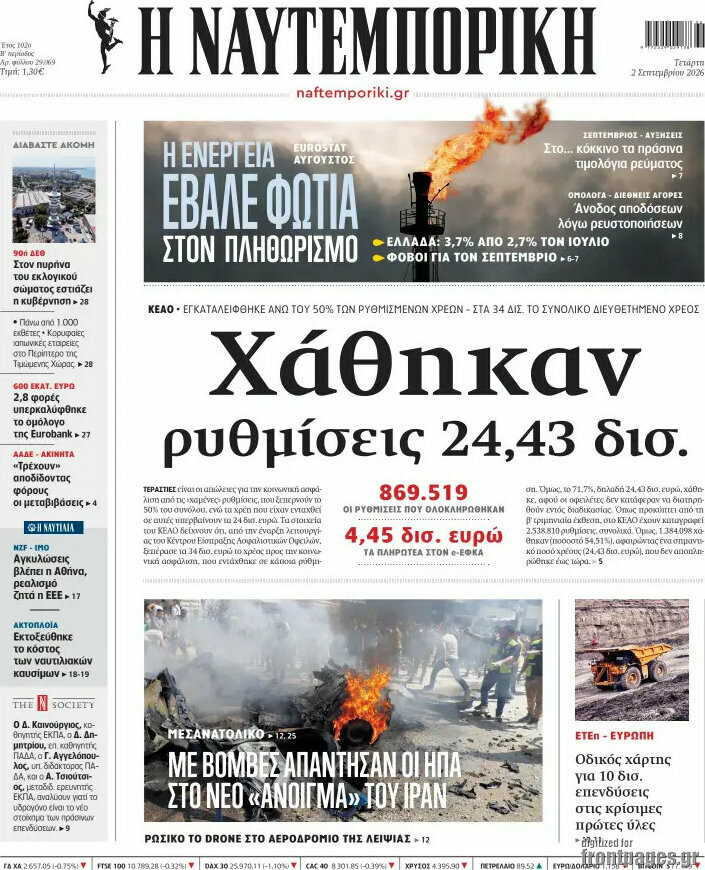
NAFTEMPORIKI: Debt repayment arrangements worth 24,43 bln were lost

DRIVING THE DAY
EXCLUSIVE — TIME TO WORK TOGETHER? Top European Parliament lawmakers want to replace the fragile alliance supporting Ursula von der Leyen with a formal German-style centrist coalition. They fear the European Commission president’s center-right group is too reliant on the far right to pass legislation — and might even be boosting right-wing populists by accepting their support.
Come together: Niclas Herbst and René Repasi,respectively the parliamentary leaders of German Chancellor Friedrich Merz’s center-right Christian Democrats and Vice Chancellor Lars Klingbeil’s center-left Social Democrats,told Max Griera in a joint interview that they want their EU political families to strike a deal to push through policies as a united front.
Common enemy: “If we don’t have trust, and if we don’t find good solutions, if we do not deliver for the people, the populists and extremists on the left and on the right will decide,” Herbst said while sitting in an armchair next to Repasi, in the center-left lawmaker’s office.
The far right’s gains in the 2024 EU election disrupted a balance among the European Parliament’s political groups that had driven EU lawmaking for decades. However, Herbst insisted the center-right European People’s Party hadn’t negotiated deals with the far right, but merely put forward its own positions, which far-right lawmakers then backed.
Averting catastrophe: A binding agreement resembling a coalition deal between the EPP and the Socialists and Democrats would restore stability, giving the Commission and capitals confidence in Parliament’s ability to deliver von der Leyen’s program, the MEPs said. Repasi warned that continued “frustration” and “distrust” could eventually drive the EPP and S&D apart, triggering a “political catastrophe.”
German model: Borrowing from the German model, the two MEPs say the groups should work together formally and no longer rely on trade-offs negotiated, file by file, by individual lawmakers. “If the trade-offs are not possible within a file we need to find a trade-off across files,” Repasi said. Compromises on which group gets the leading voice in different areas could be struck across files in advance, giving the two sides an incentive to stick together.
Political will: Whether Herbst and Repasi’s plan has legs depends on political will — and there’s not much of that to go around. “This is nothing new,” said a spokesperson for S&D chief Iratxe García. “It was already on the negotiation table in 2024.”
Would it work? The plan’s key weakness is that EU lawmakers have fewer incentives to follow the party line than their national counterparts. Involving more MEPs in coalition negotiations would create greater ownership and discipline among lawmakers, Repasi said, adding that the old way of politics “done by two or three people at the very top” has now “come to its limits.”
Forced together: Despite the two groups’ growing mistrust, they will soon have to find common ground on issues such as plans to water down a combustion-engine ban, a package simplifying environmental rules, a revamp of the EU border agency Frontex and the EU’s notoriously thorny seven-year budget.
There’s also the matter of who gets the Parliament presidency. Failure to find a common candidate would expose the centrist pact’s weakness before it even gets off the ground, Repasi said. Herbst agreed the two groups should settle on a common candidate.
BIG AND BREAKING
EXCLUSIVE — CEUTA COMES TO BRUSSELS: Juan Jesús Vivas, the mayor-president of the Spanish exclave of Ceuta, will be at the Berlaymont on Sept. 8 for high-level meetings, two European officials told POLITICO’s Sebastian Starcevic.
Meanwhile … Pedro Sánchez is struggling to regain control of Ceuta, which is spiraling into chaos weeks after officials said nearly all of the 72,000 migrants who crossed from Morocco had left the city.
GOODBYE, VETO? France and Germany are backing calls for faster EU decision-making on foreign and security policy after years of Hungarian obstruction, according to a letter signed by 11 EU countries and seen by POLITICO.
ICELAND POSTMORTEM: The referendum snub delivered a reminder that the EU’s appeal has its limits even in an increasingly dangerous world, Sebastian and Zoya Sheftalovich write.
HEAVYWEIGHT HELP: EU foreign policy chief Kaja Kallas is bringing together former political and military leaders to work out how Europe can defend itself as America’s security role changes, Nick Vinocur reports.
BRUSSELS HEADS NORTH
COLD SHOULDER, WARMER POLICY: Iceland may have rejected a return to EU accession talks but Brussels isn’t cooling on the High North. Quite the opposite: The Arctic is making its way up the EU agenda, three EU officials told Playbook.
Mark your calendars: There will be two key moments for the relaunch of Brussels’ Arctic policy. First is Ursula von der Leyen’s Sept. 16 State of the EU address, with the officials saying they expect the Arctic to get a mention. Then it will be time for the EU’s revamped Arctic strategy, presented later in the fall.
Not about Iceland, but … The Arctic revamp predates both Iceland’s referendum and Donald Trump casting admiring glances at Greenland, the officials stressed. “It was never meant to be about these two issues,” said one of the officials. Still, both an enlargement attempt and U.S. threats appear to have focused minds in Brussels.
“We are not newcomers here, but today’s environment demands more,” International Partnerships Commissioner Jozef Síkela said Tuesday. He’s not the only Brussels bigwig to be involved in the Arctic push, with Kallas and Fisheries Commissioner Costas Kadis also key players.
Also in the mix … is former Commissioner Jyrki Katainen, now advising the Commission on Arctic policy, with von der Leyen’s inner circle also closely involved in the form of advisers from her in-house policy think tank DG IDEA.
Goodbye, Green Deal Arctic: The current Arctic strategy dates back to 2021, or “Green Deal time,” as one official put it. The new version will reflect a chillier reality, per two officials: Russia, China and the U.S. are muscling their way onto an agenda once dominated by climate.
Arctic autumn: An internal document seen by POLITICO provisionally targets mid-October for release of the Arctic strategy, though two officials expect it slightly later. Before then, von der Leyen is due in Greenland on Sept. 6-7, followed by an Arctic summit in Finland on Sept. 13-14, with António Costa, Kallas and Síkela among those expected to attend. Finland’s Alexander Stubb and Denmark’s Mette Frederiksen are among those invited.
Don’t mention the poll: Then, in October, comes an Arctic Circle gathering in Reykjavík — which could be awkward.
20-SECOND PLAYBOOK PRIMER
Ursula von der Leyen is set to deliver a speech about space at the International Space Summit in Paris on Sept. 10, ahead of the European Commission’s unveiling of its European Space Shield. But what is the Space Shield? It’s a plan to protect the bloc’s satellites (including the Galileo global navigation satellite system) and other assets as space becomes a more hostile security environment.
BUDGET WATCH
BET ON A GAMBLING TAX: An EU-wide online gambling tax of 10 percent would rake in up to €5 billion annually for the bloc’s next seven-year budget, according to a study by the European Centre for International Political Economy think tank, commissioned by The Campaign for Fairer Gambling, an NGO.
Hot potato: The topic of new EU taxes, also known as own resources, is among the most controversial in the budget negotiations, pitting supporters, such as France and Spain, against skeptics that include Sweden. The European Parliament pitched the online gambling tax, triggering criticism from Malta, where a significant part of the sector is based. European affairs ministers will discuss own resources in Brussels on Sept. 22.
Number crunching: The mooted levy would increase revenue over the coming years as the online gambling market continues to grow, according to Fredrik Erixon and Ismail Abdi, the study’s authors. They calculated that a 3.5 percent tax would generate around €1 billion, which is slightly lower than the European Commission’s forecasts.
Up and up: “It’s going to grow and continue to generate more and more resources over time,” Erixon told POLITICO. Other proposed taxes on carbon imports (CBAM) and emissions (ETS), meanwhile, are set to decline as countries make their economies greener, he added.
Sector concerns: Gambling operators argue that higher taxes will propel gamblers to shift towards the illegal market. Erixon dismissed that criticism, saying that law enforcement “is more consequential” than taxation in reducing illegal gambling.
TIKTOK WARS
A HOUSE DIVIDED: The European Commission’s refusal to have an official TikTok account is facing pushback inside the Berlaymont, where some officials argue the EU risks ceding political ground by staying off a platform used by 200 million Europeans, Sebastian Starcevic reports.
The question of the executive’s presence on the platform has come up in meetings of commissioners, with at least one making a case for it, according to an official granted anonymity to discuss the internal divisions.
It’s a no: Dana Spinant, the Commission’s director-general for communications, opposes changing the policy, another official said. Spinant didn’t respond to a request for comment.
Security fears: The Commission banned the Chinese-founded app from staff devices in 2023 over cybersecurity concerns. The ban also applies to “personal devices enrolled in the Commission mobile device service,” the Commission said. “We follow the evolution of the platform, in particular the status of developments regarding data protection and cybersecurity concerns.”
Influencer paradox: There’s an irony in von der Leyen again inviting influencers — some of whom use TikTok — to share content from her State of the Union speech this month while refusing to let the institution have its own presence on the platform, one official said.
The invitations are part of a broader effort to make the EU more visible to younger Europeans. The Commission is also looking to lean more heavily into the U.S.-based YouTube, according to two officials, where it has over half a million subscribers.
DASHBOARD
Massive AI data centers are coming to Europe — just not all of Europe. Eighteen governments have pledged around €3 billion to back seven so-called gigafactories, while nine are holding back from a public-private bet meant to help the bloc close the gap with the U.S., Pieter Haeck reports.
 |
5 MORE THINGS GETTING US TALKING
RUN, BROTHERS, RUN: Justice Commissioner Michael McGrath will today meet Jordan and Cian Adams (better known as the FTD Brothers) after the pair ran 32 marathons across Ireland’s 32 counties to raise money for dementia research and awareness.
TOO HOT FOR NUCLEAR: Europe may be betting on a nuclear revival to help hit its climate targets, but climate change is making it harder to keep reactors running.
CHINA’S WARNING SHOT: Beijing’s latest retaliation against EU companies over Russian sanctions looks mostly symbolic — but it’s a reminder of how China could weaponize supply chains.
PHARMA, GO WEST: Donald Trump’s deals with drugmakers are sounding alarm bells in Europe, with pharma executives warning that investment could shift across the Atlantic.
LE PEN’S HIJAB GAMBLE: French presidential front-runner Marine Le Pen is doubling down on efforts to ban the hijab in public — despite doubts inside her own camp.