PM Mitsotakis to CNN’s Amanpour: Greece on path to stability, enabling tax cuts and support for vulnerable households
Prime Minister Kyriakos Mitsotakis, in a discussion with CNN journalist Christiane Amanpour held on the sidelines of an event co-organised by The Economist and iefimerida.gr titled “Capturing the Future”, underlined that Greece’s position in the world is largely defined by the strength of its economy and its capacity to implement domestic reforms.
Greece prepares for policy shifts under new EU Migration Pact
Greece has introduced a series of measures aimed at tightening migration management, including provisions on migrant returns, asylum procedures and external border controls, as part of legislation implementing the European Union’s new Pact on Migration and Asylum.
https://www.amna.gr/en/article/999627/Greece-prepares-for-policy-shifts-under-new-EU-Migration-Pact
Androulakis: Capital boost to Greek development bank using unused EU recovery funds
PASOK leader Nikos Androulakis proposed at the “Greece 2030” conference the capital strengthening of the Hellenic Development Bank using part of the unused funds from the Recovery and Resilience Facility. The proposal aims at the funding of social housing projects.
Paintings, permits and prosecutors
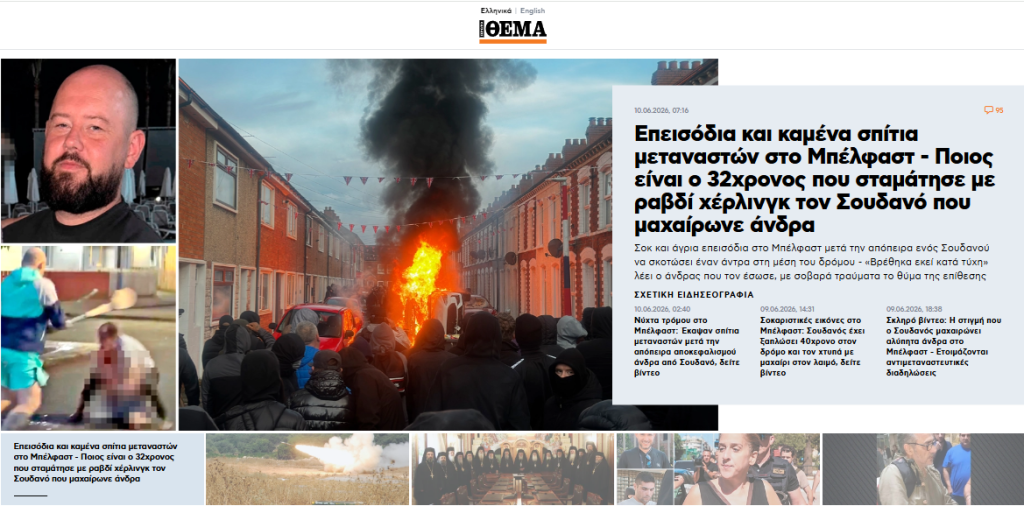
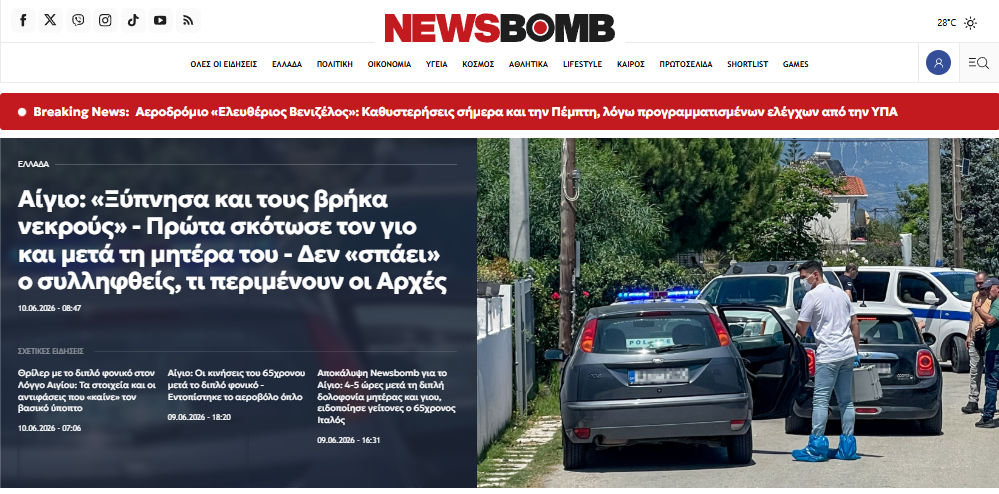
Court documents in a corruption investigation involving urban planning services in Greater Athens describe a network of public employees accused of more than 25 cases of bribery and breach of duty, according to findings by Greece’s Internal Affairs Service.
https://www.ekathimerini.com/economy/1306160/paintings-permits-and-prosecutors
ATHEX: Four-month high for main bourse index
The temporarily positive climate on the geopolitical front gave money markets a push of optimism on Tuesday, sending bourses higher in the eurozone. Athinon Avenue enjoyed a day of significant growth that took the benchmark to its highest level in over four months. Banks and other blue chips collected gains, while refineries declined – but any military action until the reopening of the market on Wednesday will likely turn that situation upside down.
https://www.ekathimerini.com/economy/1306176/athex-four-month-high-for-main-bourse-index



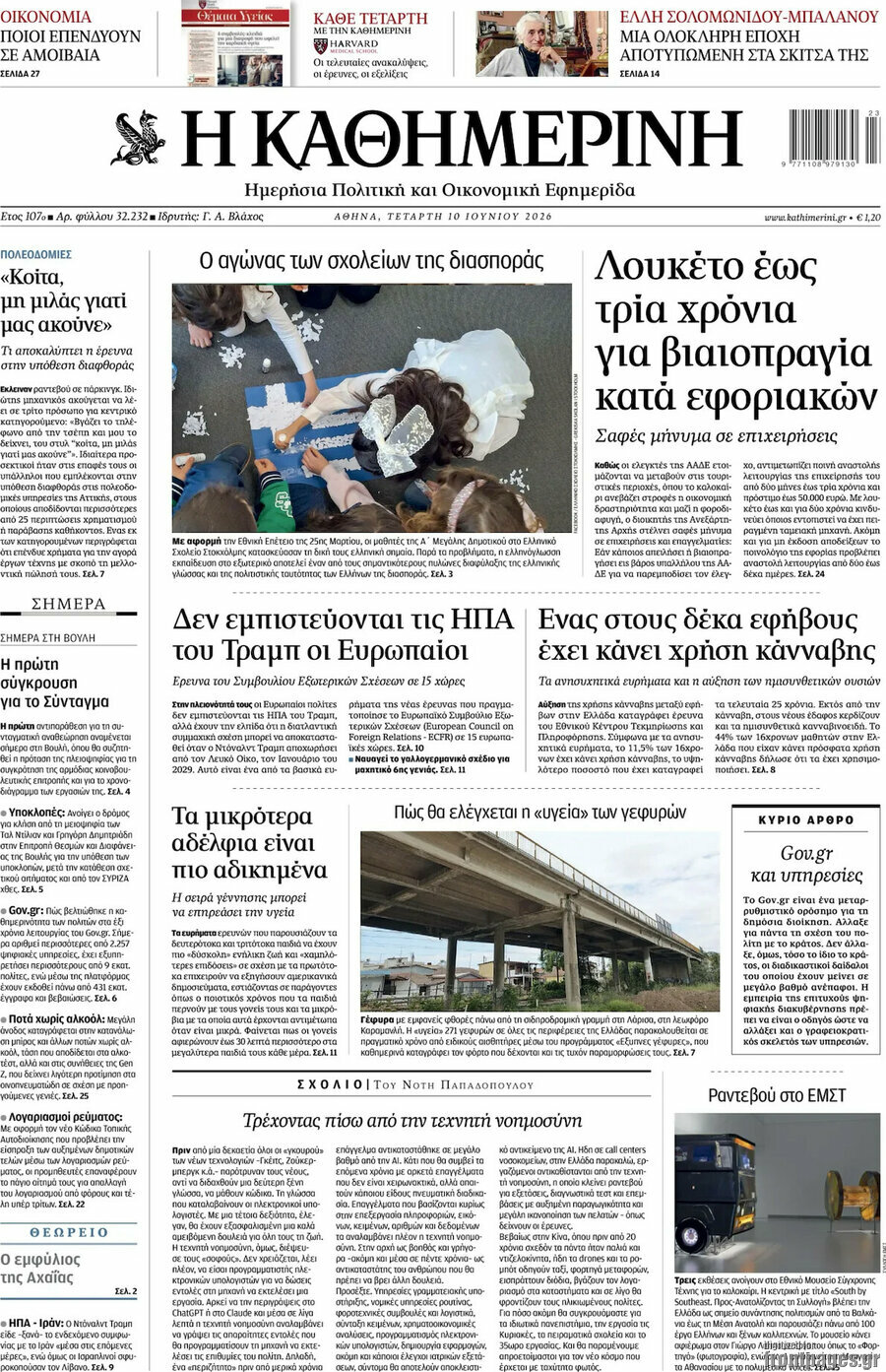
KATHIMERINI: Businesses will be shut down for up to 3 years if violence against tax-office officials takes place
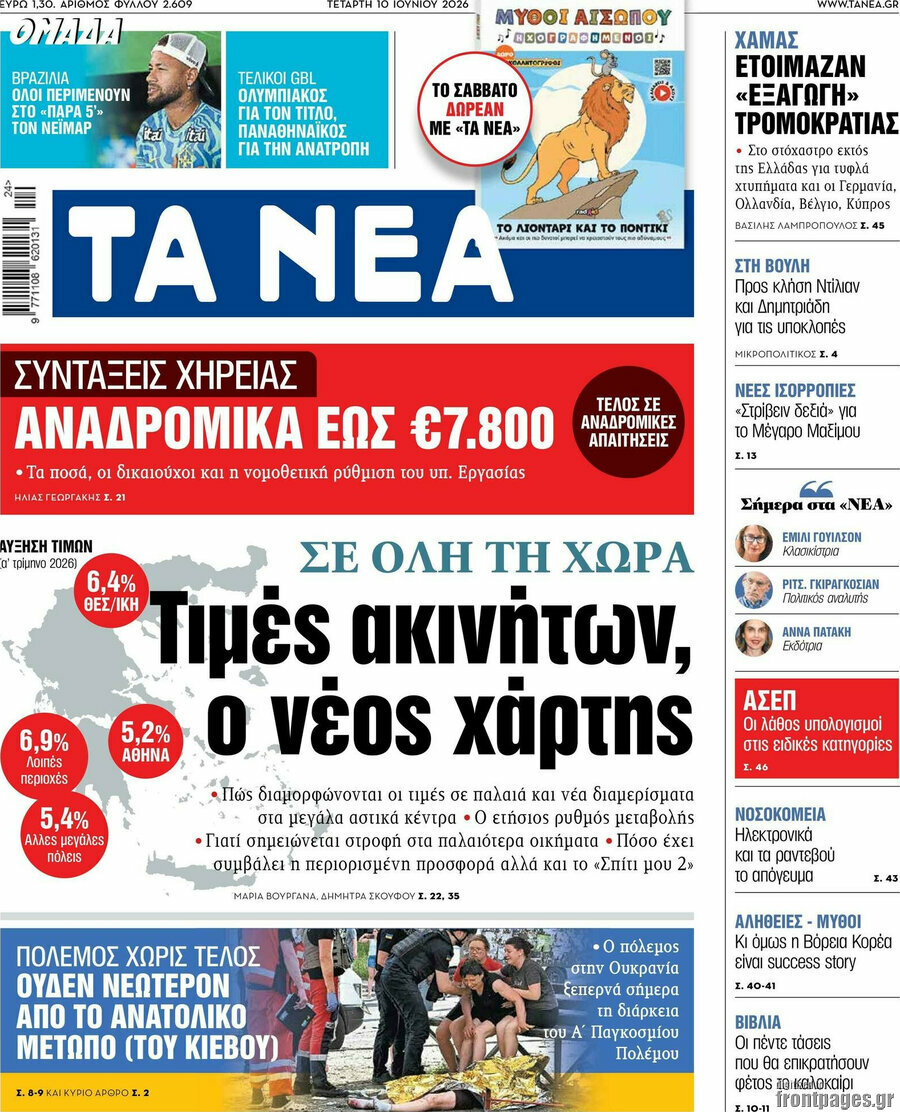
TA NEA: Real estate assets’ prices: the new map
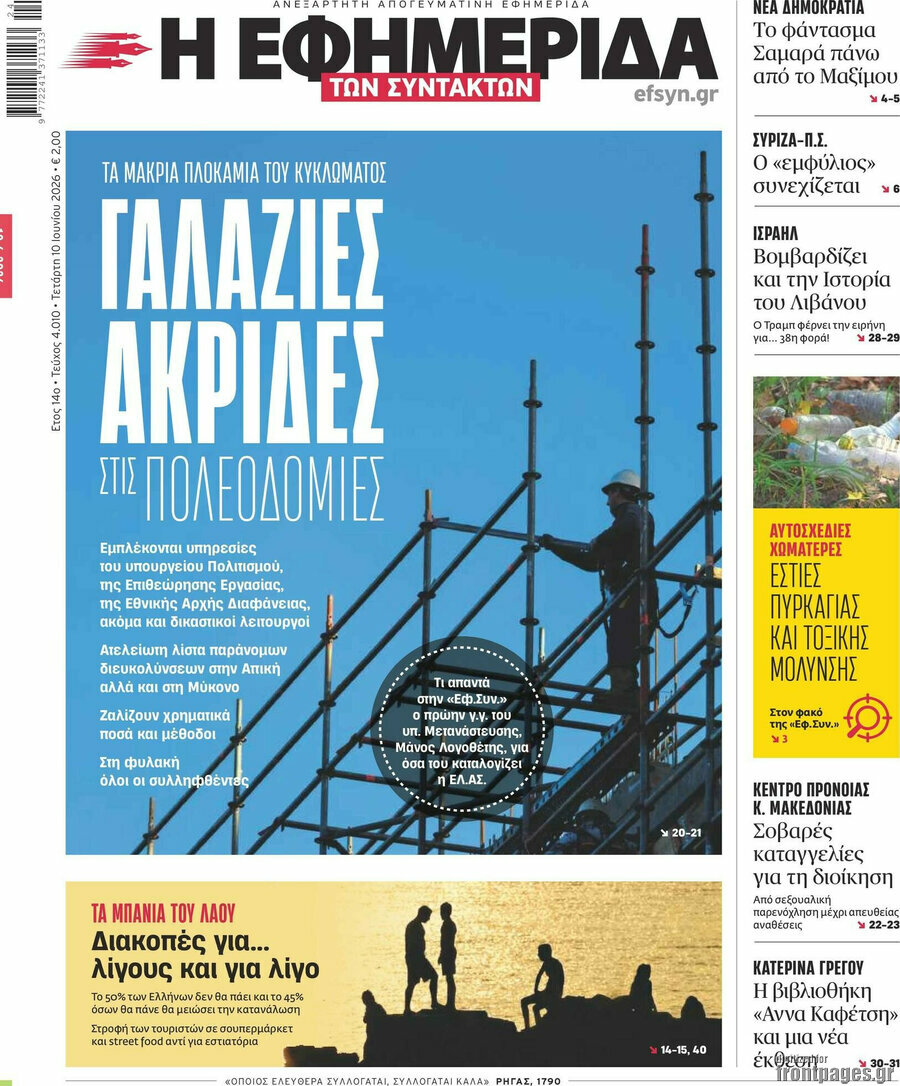
EFIMERIDA TON SYNTAKTON: New Democracy executives are involved in the urban planning scandal
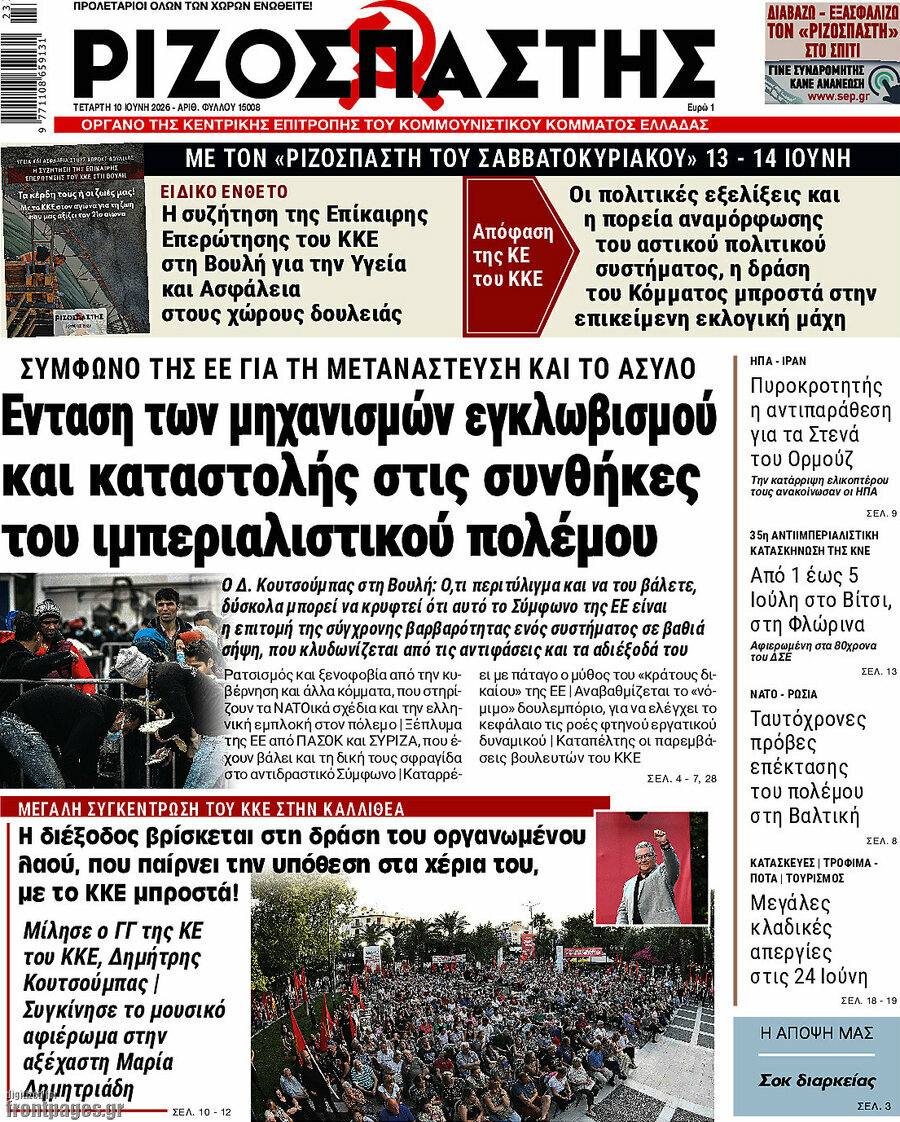
RIZOSPASTIS: The EU pact for migration and asylum will focus on suppression amid imperialistic war
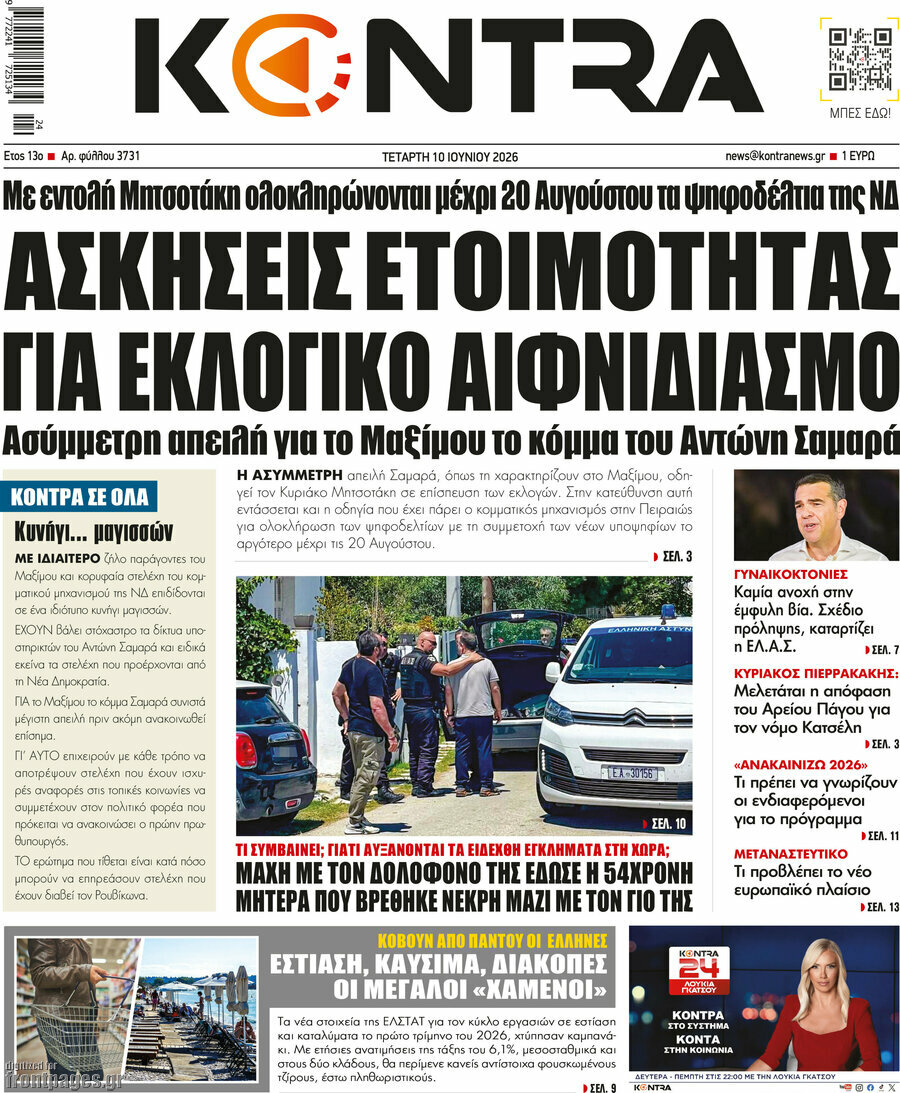
KONTRA NEWS: Mitsotakis launches preparedness drills for surprise elections
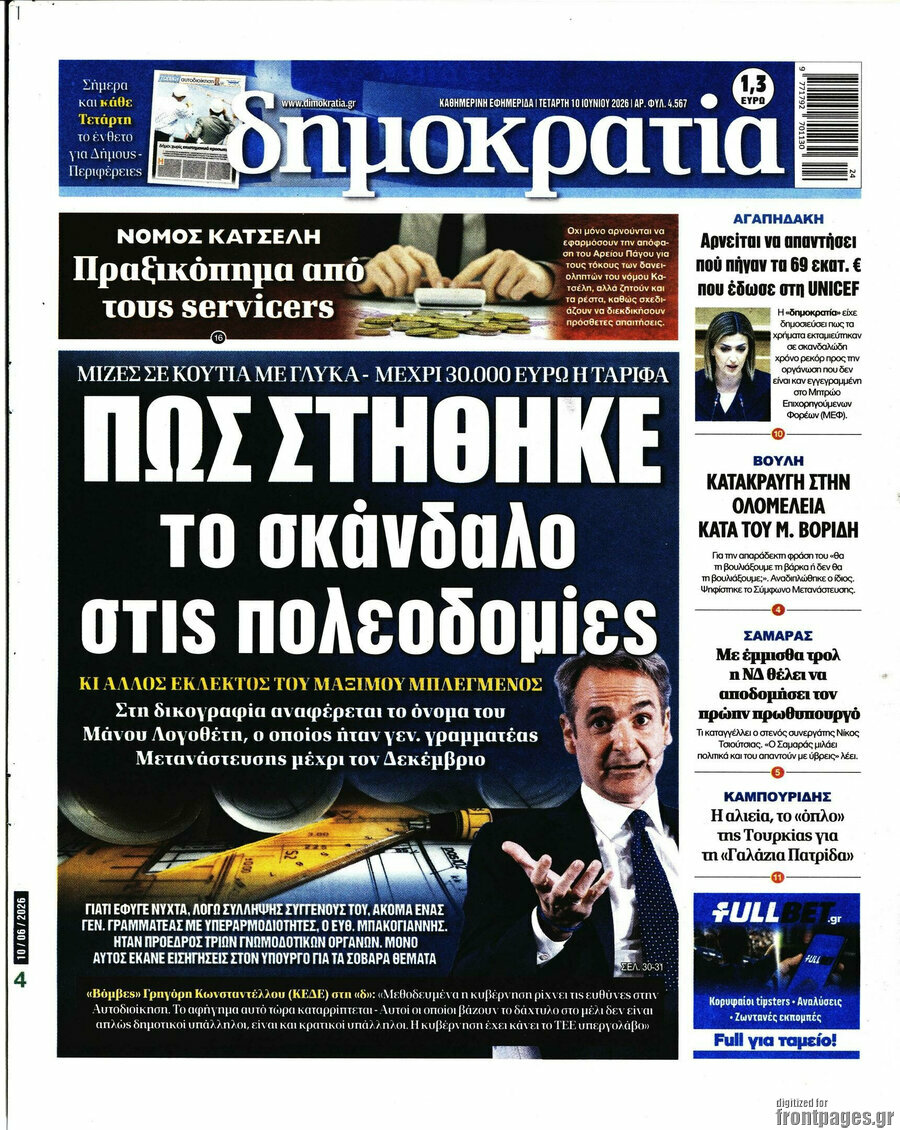
DIMOKRATIA: How the scandal involving urban planning offices was set-up
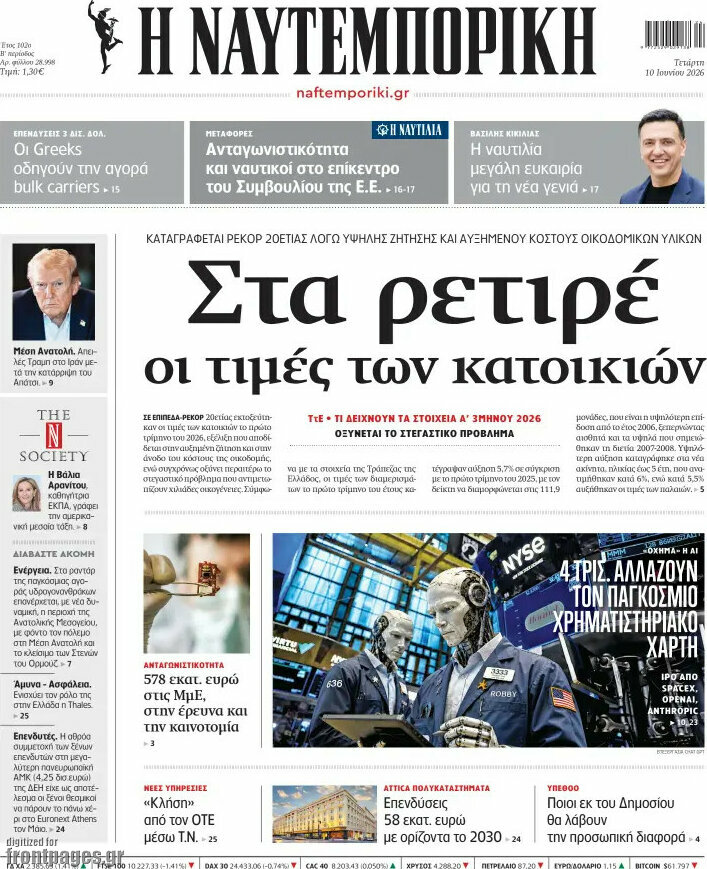
NAFTEMPORIKI: Record high prices for houses

DRIVING THE DAY
THE UNSTOPPABLE CENTRALIZATION DRIVE: Ursula von der Leyen’s habit of taking a personal interest in strategic dossiers has become one of the defining features of her presidency. Now she is extending her reach deeper into a policy area that taps into her political DNA: defense.
The next battleground: The European Security Strategy, due after next month’s NATO summit, is supposed to define the EU’s threats, priorities and tools. But as Jacopo Barigazzi and I report, the document may be less interesting than who gets to write it. Spoiler alert: the Berlaymont is taking charge.
Ursula’s Playbook: Two EU officials told us that the strategy is being drafted primarily by the Commission and, specifically, by Simon Mordue, von der Leyen’s chief diplomatic adviser, and Arnout Molenaar. Both once worked at the European External Action Service, before joining the growing circle of officials in the Commission president’s orbit.
EEAS’ shrinking footprint: Previous strategic documents, including the EU Global Strategy and the Strategic Compass, were largely handled by the EEAS. This time, two other EU officials told Playbook, the diplomatic service is expected to limit its focus mainly to Article 42.7, the EU’s mutual defense clause, and other issues where member states have requested specific guidance, such as the definition of threats.
Even Andrius Kubilius is on the outside. The defense commissioner is working on setting up a European Defense Union — a project specifically assigned to him by von der Leyen — and told Jacopo he could present his proposals “maybe after the NATO summit” in Ankara in early July. But asked about the security strategy, he laughed: “It’s high level. I don’t know what they are writing.” Turning serious, Kubilius added: “I’m talking and exchanging opinions, but what the final version will be, we shall see.”
EU national governments are watching closely. The issue isn’t just about institutional turf, but how far the Commission should go in areas such as defense, which many governments still regard as their exclusive territory.
“When it comes to war and peace, the Commission knows it has to be very cautious,” one EU diplomat told Playbook. Capitals are comfortable with Commission input on industry, trade and economic security, the diplomat said — but geopolitics is another matter.
A pattern: Placing trusted loyalists at the center of politically sensitive files is a familiar von der Leyen approach. Last week’s appointment of Siemens Chair Jim Hagemann Snabe as the Commission’s AI envoy is another example, Pieter Haeck reports. Snabe will report to von der Leyen and Executive Vice President Henna Virkkunen, supported by officials from DG IDEA — the president’s go-to pool of trusted operatives for sensitive files, as Playbook readers know well.
Takeaway: Von der Leyen remains firmly in control of the Commission, consolidating power in the Berlaymont while gradually sidelining alternative centers of influence — including, increasingly, the EEAS.
BIG AND BREAKING
WHAT SEOUL WANTS FROM BRUSSELS: South Korean President Lee Jae Myung meets Ursula von der Leyen and European Council President António Costa today for the first EU-Korea summit in three years. Top of the agenda: deepening defense ties between Europe and the Asian middle power.
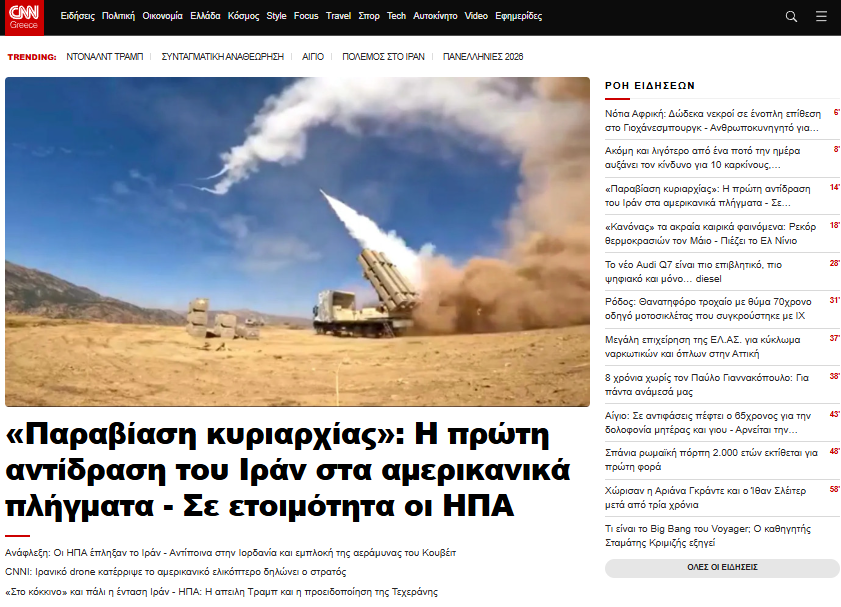
MIDDLE EAST LATEST: The U.S. and Iran exchanged strikes overnight after the downing of a U.S. Army helicopter near the Strait of Hormuz, which Donald Trump blamed on Tehran. The AP has the latest.
EMBRACING MAGA: The leader of France’s far-right Reconquest party Eric Zammour has spent the week cosying up to MAGA chiefs in Washington, bucking the trend of European leaders steering clear of Trump.
LE DEAL DU SIÈCLE: A €20 billion carve-up of French telecoms giant SFR is emerging as a major test of the EU’s willingness to abandon decades of caution about corporate mergers in its pursuit of European champions.
SCOOP — DRUG PRICING WAR: The Trump administration is launching a full-scale charm offensive to persuade European governments to follow Britain’s lead to pay more for medicines, POLITICO’s Caroline Hug and Hans von der Burchard report.
CAPITALS TURBOCHARGE DEPORTATION PLANS: Fresh from last week’s migration deal, EU capitals are already pushing to accelerate plans for return hubs.
AFTER THE FIGHTER JET FIASCO: Belgian Prime Minister Bart De Wever described the collapse of Europe’s €100 billion next-generation fighter project as “pure stupidity” … but what comes next?
PARLIAMENT’S HUNGARY QUESTIONS
EXCLUSIVE — MEPS WANT ANSWERS ON HUNGARY CASH: The European Parliament’s budgets and budgetary control committees will examine the Commission’s plan to unlock up to €16 billion in EU funds for Hungary at a joint hearing on July 14. Appearing before them will be Budget Commissioner Piotr Serafin, Executive Vice President Raffaele Fitto and Justice Commissioner Michael McGrath, according to two officials familiar with the plans and a Commission spokesperson.
Lawmakers want details after Ursula von der Leyen and Hungarian Prime Minister Péter Magyar reached a political understanding last month. MEPs are seeking clarity on the conditions attached to the money and whether the requirements imposed on Budapest have changed. “Unfreezing EU funds is never a political favor,” Andreas Schwab, chair of the Committee on Budgetary Control, told POLITICO’s Max Griera.
Greens lawmaker Daniel Freund wants the Commission to explain “what exactly the Hungarians are promising to deliver” and whether any milestones have been altered. Renew’s Lucia Yar warned that “if conditionality is seen as flexible depending on circumstances, we risk turning the rule of law from a principle into a political instrument.”
Sounds like a plan: The release of the funds depends on Hungary submitting a revised recovery plan. Magyar said on X late Tuesday that his government has put forward a “historically significant legislative package” to the Hungarian parliament, suggesting Budapest is moving ahead with the required reforms and could soon seek access to the frozen money.
But it’s not the plan yet: A Commission spokesperson told Playbook that the revised plan has not been formally submitted, although Brussels expects to receive it “very soon,” with a view to Council approval in July.
Why MEPs are nervous: The hearing comes against the backdrop of a separate legal battle over the Commission’s decision to release €10 billion to Viktor Orbán’s government in 2023. In that case, Advocate General Tamara Ćapeta said the Commission had failed to properly verify compliance with the required reforms and recommended that the decision be annulled.
20-SECOND PLAYBOOK PRIMER
The EU’s drugs agency has released its annual report on the continent’s narcotics problems. So, what are they? The agency warned of the growing availability of illegal drugs, with around one new psychoactive substance (that’s a drug that affects how the brain works and changes mood or behavior) identified every week in 2025. The agency also warned of the rise of synthetic opioids (which block out pain), such as nitazenes and orphines, particularly in Baltic countries.
TALK TO PLAYBOOK: On the Brussels Playbook Podcast, Ianasked listeners to write in with the most annoying misconception people in the rest of Europe have about their nationality. WhatsApp us on +32 491 050629 and listen from 7 a.m. to hear if we give you a shoutout.
TRANSATLANTIC RELATIONS
TRUST IN THE U.S. COLLAPSES: Most Europeans no longer believe American security guarantees can be relied upon, according to a major new ECFR poll of more than 19,000 people across 15 European countries to be published today. Playbook’s Zoya Sheftalovich got a preview.
Trump effect: Only 11 percent of respondents view the U.S. as an ally, down from 16 percent six months ago and 22 percent in November 2024. One in four now sees America as a rival or adversary. But most expect transatlantic ties to improve after Donald Trump leaves office.
Confidence in Europe: Majorities in every country surveyed doubt the U.S. would defend them if attacked, while most trust other European countries to do so. Europeans also increasingly back higher defense spending, buying European-made weapons and even joint borrowing to fund security investments. And most people across almost all countries polled oppose returning to Russian fossil fuel imports and instead favor investing in European renewable energy.
Ukraine support: Majorities continue to view Ukraine as an ally or necessary partner, but enthusiasm wanes when it comes to security commitments. Most respondents in Germany, Italy and Poland oppose sending troops after a peace deal, and there is no EU-wide consensus on Ukraine’s EU membership.
 |
7 MORE THINGS GETTING US TALKING
COMMISSION DEBATES ETS: The College is set to hold an orientation debate this morning on the future of the Emissions Trading System, the centerpiece of the EU’s climate policy, ahead of a broader reform proposal …
But watch the islands package: While commissioners debate the ETS behind closed doors, expect a more concrete signal from today’s package on islands and coastal communities. Playbook has learned that the Commission will call for targeted exemptions to ETS and maritime fuel rules for certain islands, arguing they need “a more gradual transition to decarbonization” to preserve connectivity.
Meanwhile … The U.N.’s aviation agency has entered the ETS debate. In a letter obtained by POLITICO’s Tommaso Lecca, the International Civil Aviation Organization urged Ursula von der Leyen not to extend the scheme further. More for subscribers in Morning Mobility.
CRYING WOLF? European jet fuel prices remain subdued and officials insist supplies are secure. But beneath the calm, warning signs are beginning to emerge.
NOW IT’S YOUR TURN: EU ambassadors are expected to sign off today on opening Cluster 1 of Ukraine’s accession talks. It comes after Kyiv delivered a fresh batch of reforms yesterday, with its parliament approving measures on judicial governance and railway safety. More votes are expected today, including on state aid, district heating and renewable energy permitting.
MFF TALKS GET REAL: Ambassadors will also begin receiving detailed presentations on the Cypriot EU presidency compromise for the next long-term budget. First up: the European Competitiveness Fund. The aim is to move toward a negotiating box with figures by the end of the week, a presidency spokesperson said.
DEFENSE OMNIBUS ENDGAME: Negotiators from EU countries and the European Parliament meet today for what is expected to be the final round of talks on legislation aimed at cutting red tape for Europe’s defense industry. Morning Defense has more for subscribers.