
PM Mitsotakis reveals plans for new increase in minimum wage at the end of March
“Addressing the persistent problem of high prices obviously remains our main objective. I believe that the establishment of the independent authority for consumers is an important step so that we have a better understanding of what is really happening in the market today, with the possibility of targeted interventions where the authority deems it necessary,” Prime Minister Kyriakos Mitsotakis stated on Tuesday, at a meeting of the Government Council for Economic Policy. Furthermore, the prime minister said that there will be a new increase of the minimum wage, which will be decided by the cabinet meeting at the end of March.
Parties in OPEKEPE farm subsidies probe issue separate findings
Government and opposition parties represented on the parliamentary committee investigating the OPEKEPE agricultural subsidy scandal have submitted separate findings, setting the stage for a political clash over whether former ministers should face further legal scrutiny.
Joint Statement by the US and 12 European countries on strengthening the security of natural gas supply in Central and Eastern Europe
A joint declaration on strengthening the security of natural gas supplies in Central and Eastern Europe was signed by the energy ministers and representatives of Greece, Bulgaria, Hungary, Poland, Romania, the Slovak Republic, Moldova, Ukraine, Croatia, Lithuania, Serbia, Bosnia and Herzegovina, and the United States.
Tourism revenues rise to 23.6 billion euros in 2025, Bank of Greece says
In the year 2025, the balance of travel services showed a surplus of 20,255.2 million euros, up from a surplus of 18,787.0 million euros in 2024. According to the Bank of Greece (BoG), travel receipts rose by 2,033.7 million euros, or 9.4%, to 23,626.0 million euros, while travel payments also increased by 565.5 million euros, or 20.2%, to 3,370.8 million euros. The rise in travel receipts was driven by a 5.6% increase in inbound traveller flows and a 3.8% rise in average expenditure per trip. Net travel receipts offset 59.9% of the goods deficit and contributed 89.0% to total net receipts from services.
ATHEX: Lent starts with banks dropping fast
The Greek bourse reopened on Tuesday after the long weekend with mild losses for the majority of stocks, in a market that is treading carefully amid geopolitical tensions and in anticipation of this week’s 2025 results announcements from the country’s main banks. It was the credit sector that led the day’s decline with considerable losses for some lenders, though a number of blue chips headed the other way, led by construction companies.
https://www.ekathimerini.com/economy/1296164/athex-lent-starts-with-banks-dropping-fast




KATHIMERINI: Folli Follie remains an open wound 8 years after the scandalous case was exposed
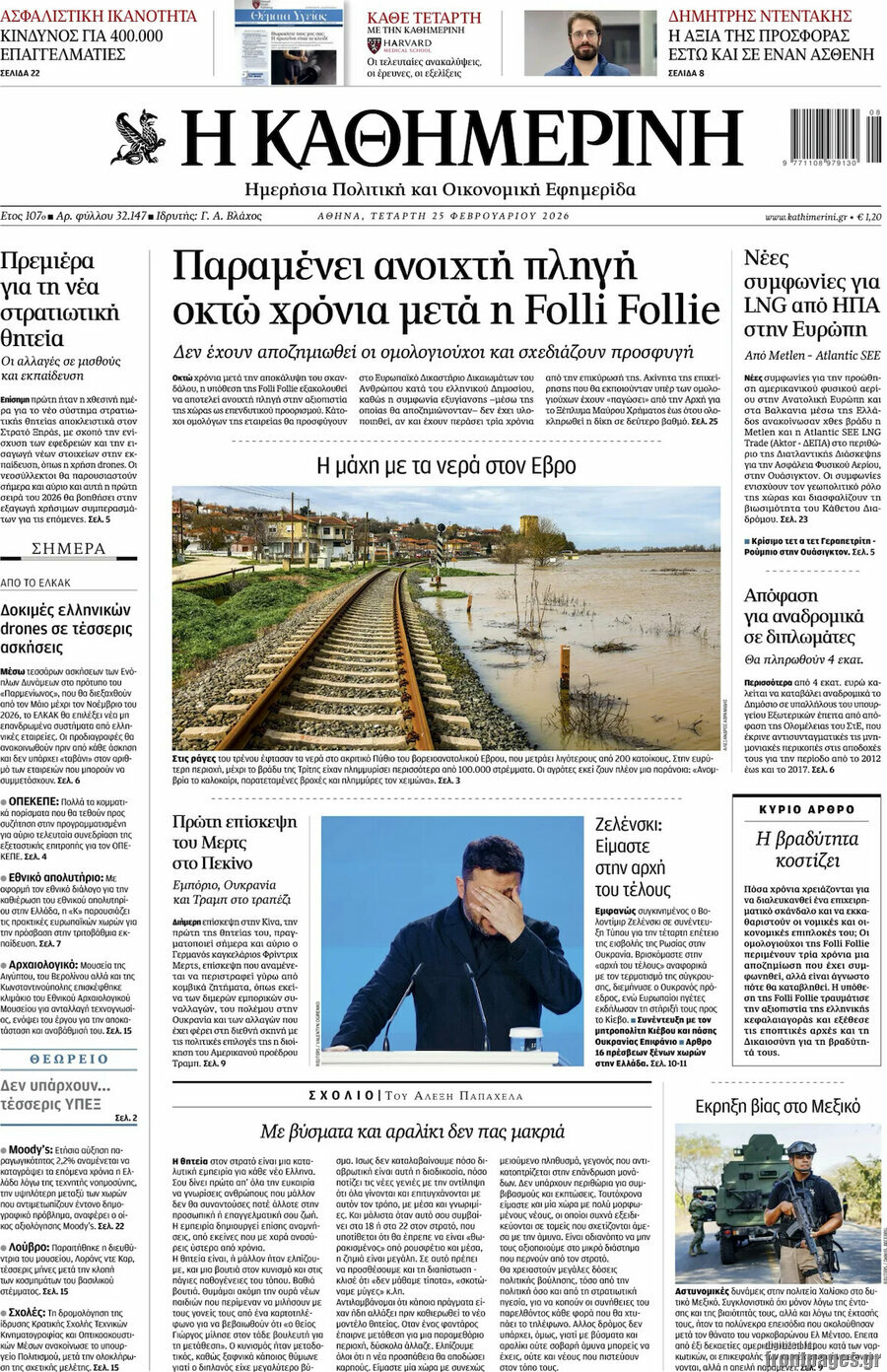
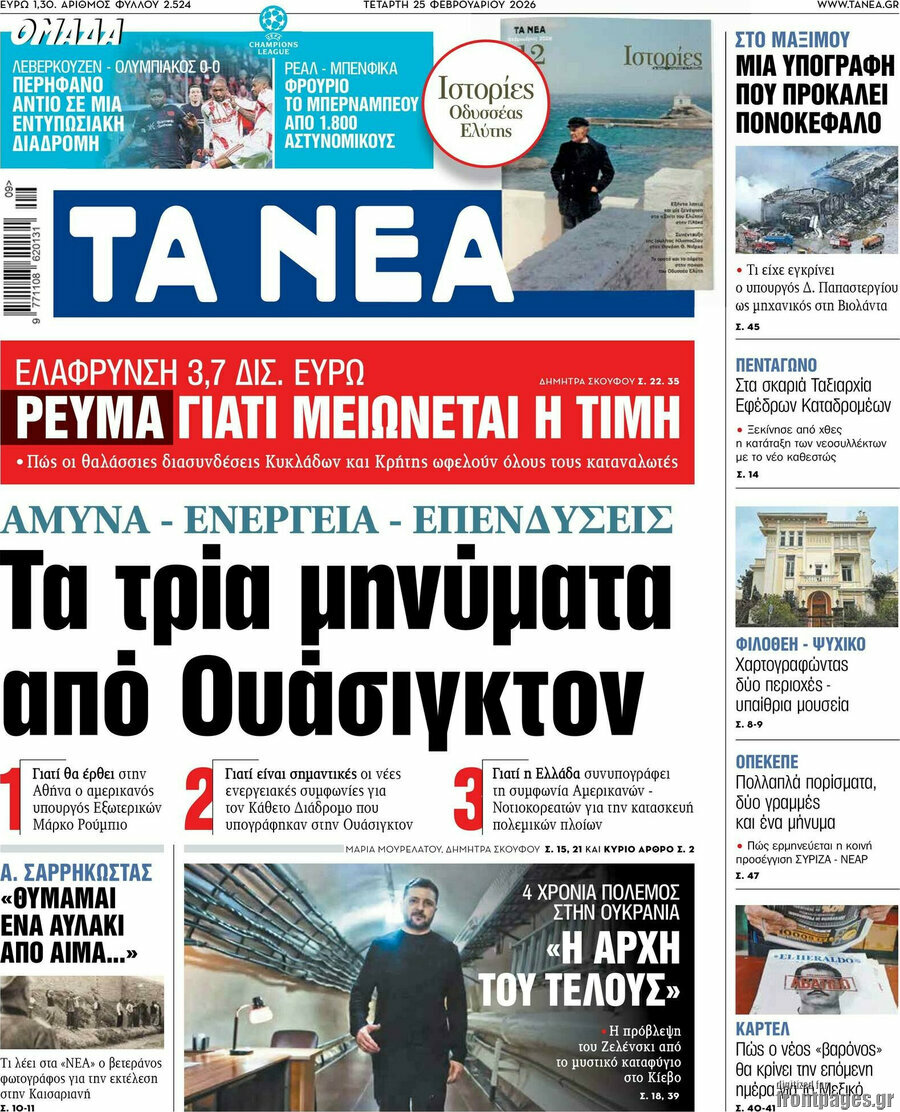
TA NEA: Defense-energy-investment: Washington’s three messages
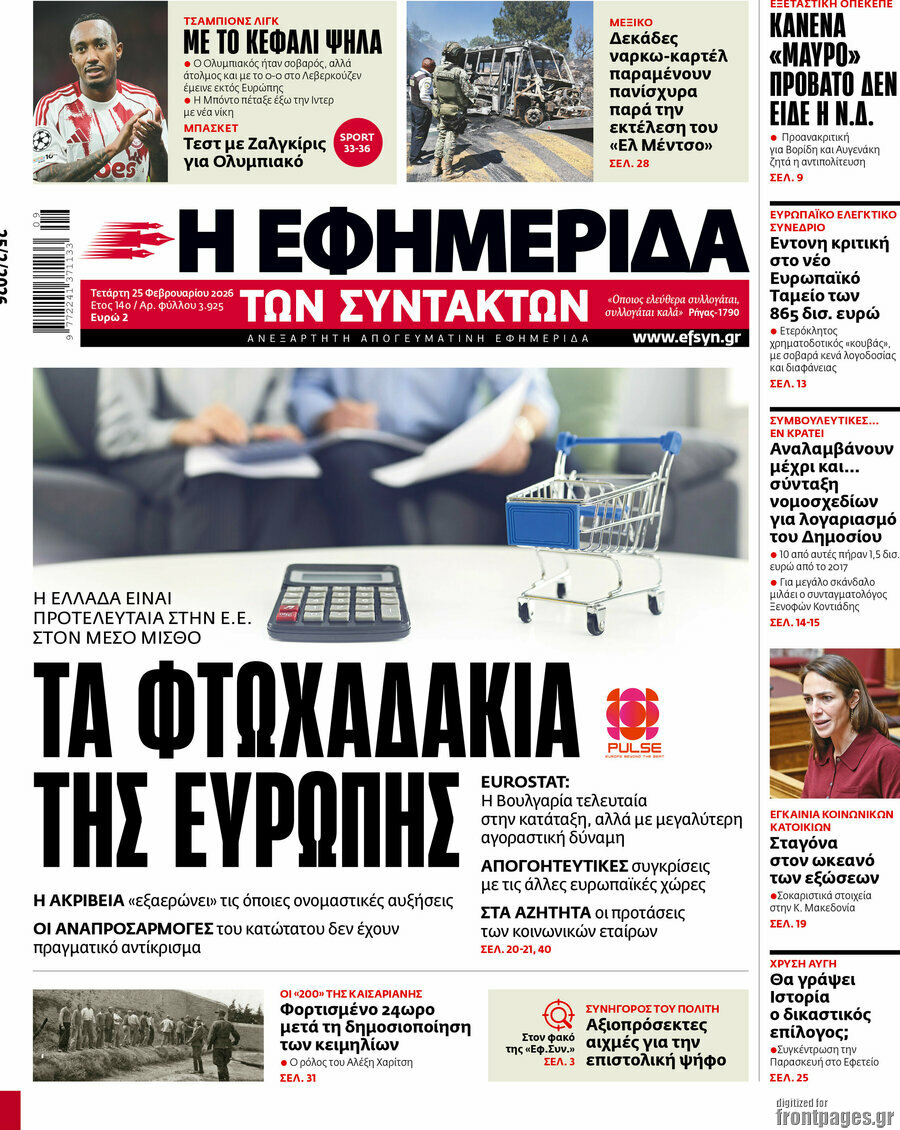
EFIMERIDA TON SYNTAKTON: Greeks are the paupers of Europe
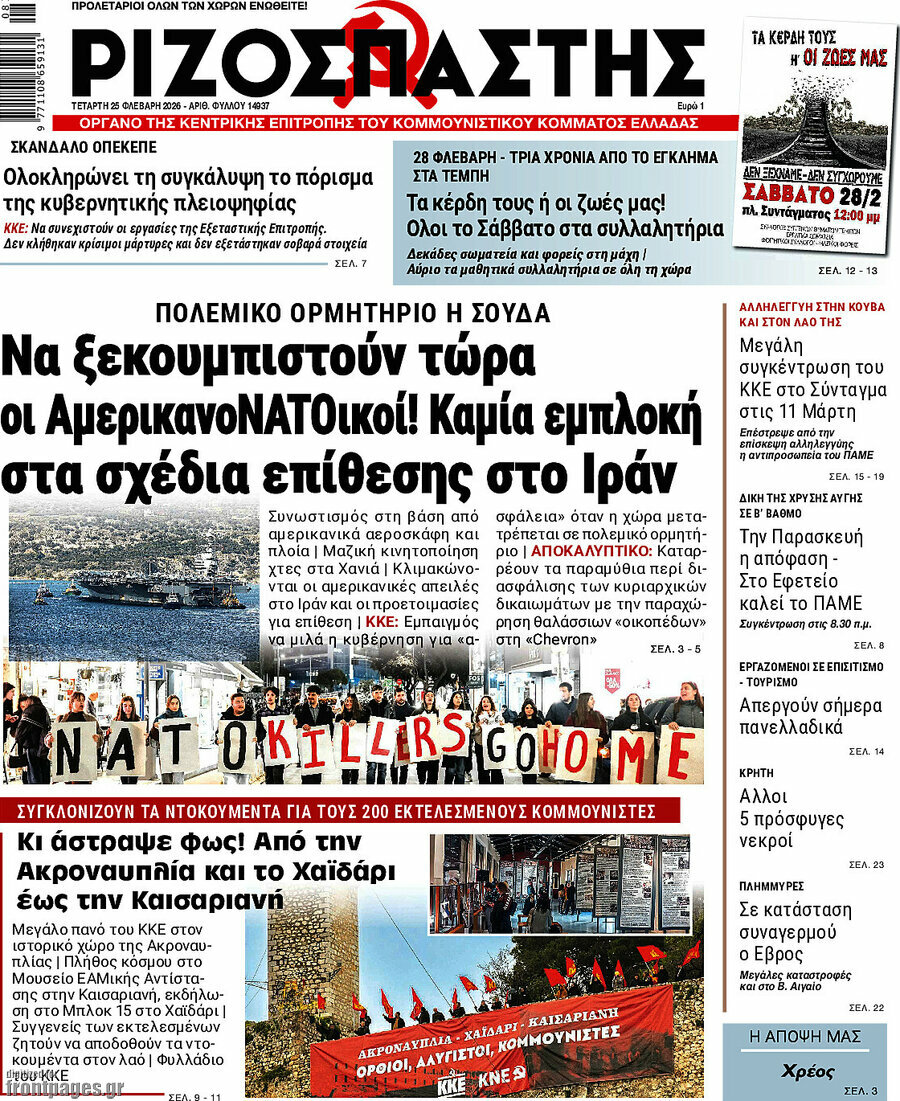
RIZOSPASTIS: US and NATO troopers must be ousted! No involvement in the attack plans against Iran
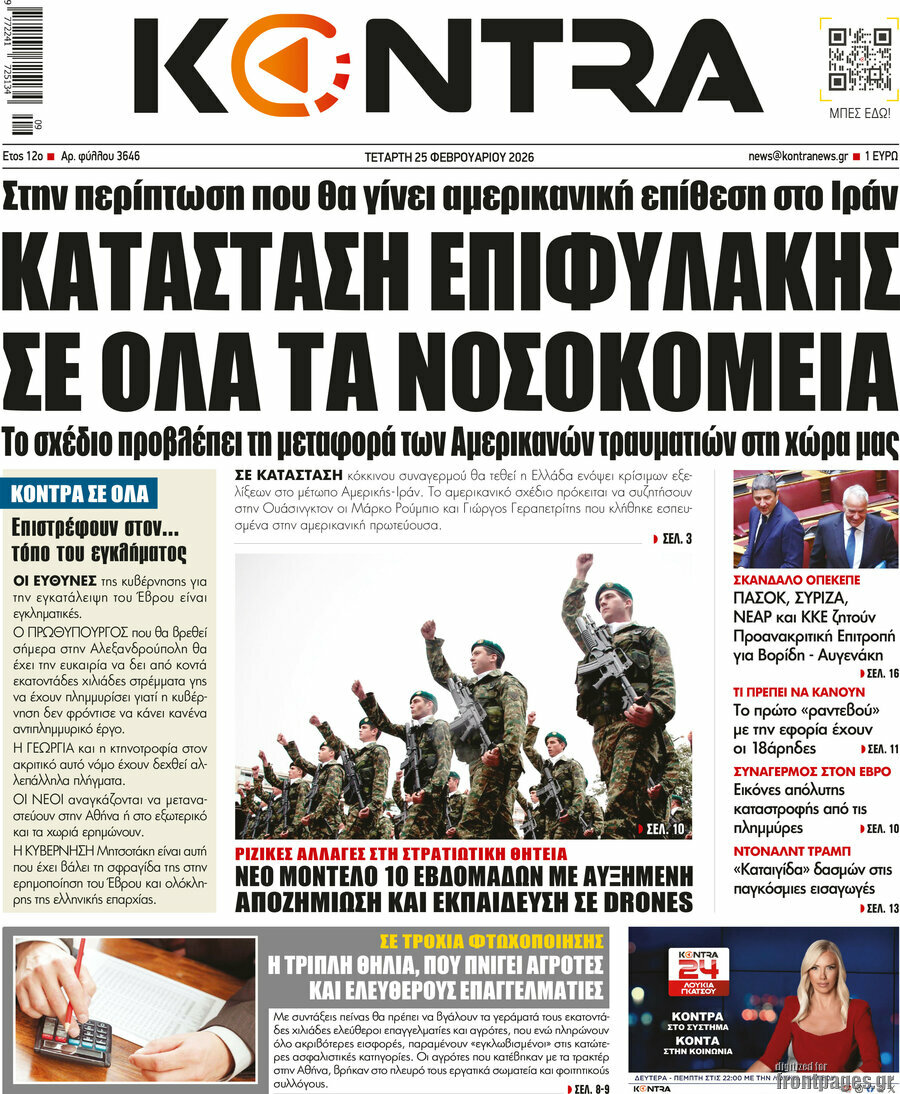
KONTRA NEWS: State of alert for all hospitals in case of a US attack against Iran
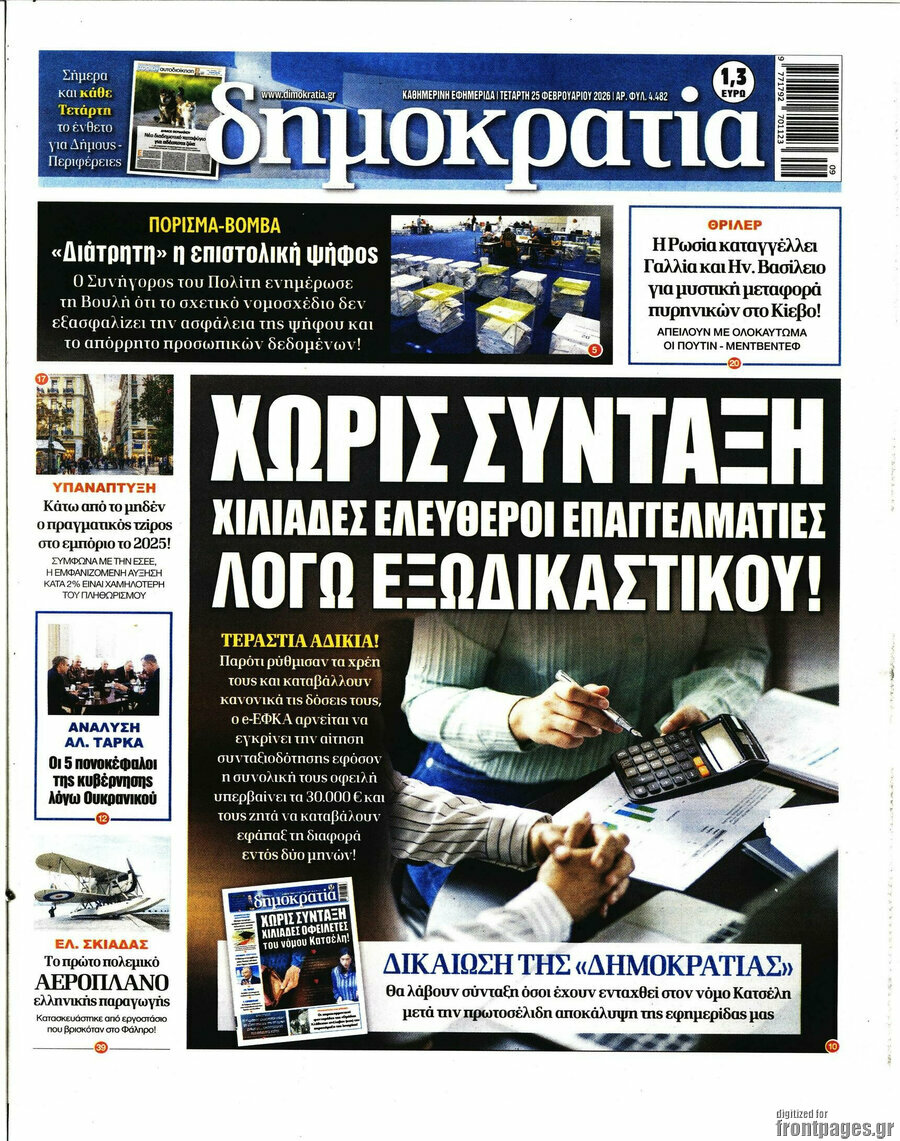
DIMOKRATIA: No pension for thousands of free lancers due to out-of-court settlement of their debts to social security funds
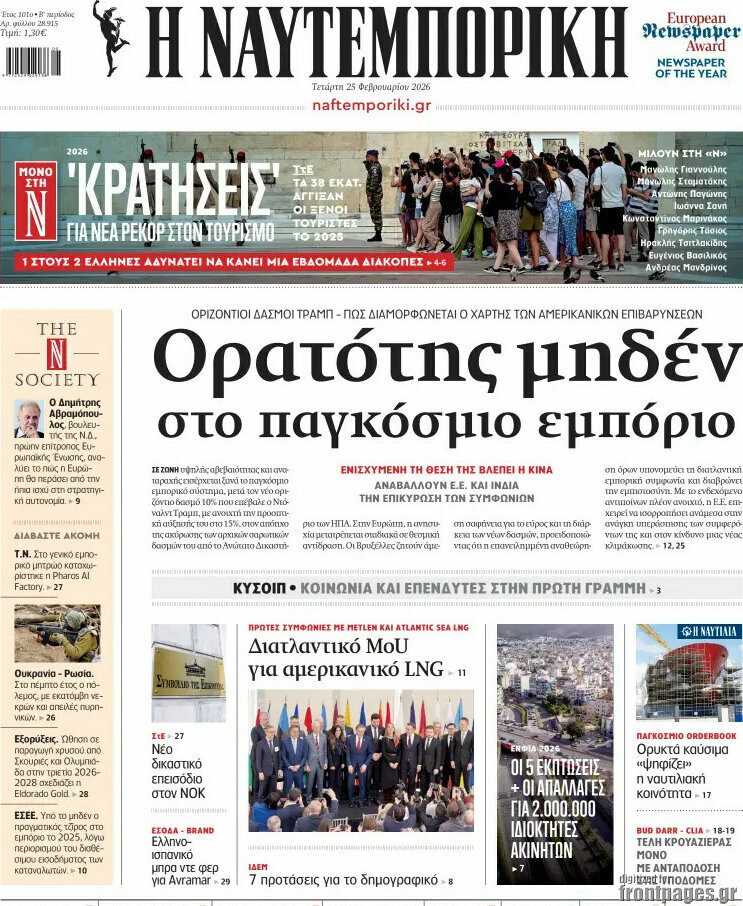
NAFTEMPORIKI: Zero visibility for international trade

DRIVING THE DAY
HUNGARY’S GAMBIT: For some in the EU, it’s a familiar playbook. The Commission needs to get a key initiative — a much-needed €90 billion loan to Ukraine — past the stubborn opposition of a member country. But a day after marking the fourth anniversary of Russia’s full-scale invasion, there’s a mounting suspicion in Brussels that Hungarian Prime Minister Viktor Orbán isn’t applying his usual rules of engagement. And with Kyiv set to run out of money in March, the scramble is on to find a workaround.
Still determined: European Council President António Costa and Commission President Ursula von der Leyen appeared intent on finding a way around Hungary’s opposition as they visited Kyiv this week. Their message: Take the hit, then move to solutions. As POLITICO’s EU Chief Correspondent Zoya Sheftalovich reports from the ground, they were unequivocal in saying that Hungary will not be allowed to sink the loan and a path will be found.
No need to panic: “Often we’ve had to deal with Hungary’s opposition to certain decisions, but at the end of the day we always found a way forward,” Economy Commissioner Valdis Dombrovskis told reporters in Paris, including my colleague Giorgio Leali. That view was echoed by diplomats who argued that a threat by an EU member to upend key initiatives is nothing new and that it’s too early to sound the alarm. “On sanctions, we’ve always found a way,” two said, echoing each other almost word for word.
But but but … That optimism isn’t shared by all players, as POLITICO’s Max Griera reports. Some worry that this time it’s different. There is an effort in Budapest to turn the Ukraine loan — and the broader clash with the EU — into a political trap for the country’s opposition in the lead-up to the Hungarian parliamentary election on April 12. Orbàn is acting obstructively in Europe “with the elections in mind,” one EU official told Playbook.
What’s the way through? Talks are underway inside the Commission and between capitals, and will continue today with another meeting of EU ambassadors. But the path forward is treacherous. “There is the pipeline, the elections in Hungary and Ukraine’s urgent need for the loan … it’s difficult to see at this stage where this is going,” one EU diplomat told POLITICO.
Times a-changing: Hungary “has become even more unpredictable than usual,” said one diplomat. What has unsettled diplomats and EU officials is that, whatever his public posture, Orbán has rarely gone back on a final deal once it has been struck. In his letter to Costa earlier in the week, he even described himself as “one of the most disciplined and consistent members of the European Council.” More than a few in Brussels concede there’s a grain of truth there. But with an election looming and his political survival on the line, will Orbán play by the same rules?
What’s in the Brussels toolbox? The EU executive and Costa, tasked with bringing Orbán into line, have limited room for lateral thinking. “Pushing him while he’s campaigning might not be the smartest move,” said the first diplomat.
Unviable nuclear option: The EU could always trigger Article 7, which allows the EU to suspend a member state’s voting rights and sidestep Hungary’s opposition to the Ukraine package. But that could play into Orbàn pre-election narrative. Another option would be rule-of-law conditionality — suspending EU funds — or infringement procedures. Yet these would take time … something Ukraine doesn’t have.
Call the plumbers: The broader view in Brussels is that this requires a different approach. That’s why Parliament and Council have already signed off on the elements of the loan package not subject to Hungary’s veto, ensuring the mechanism is ready. As one parliamentary official put it: “We’ve set up the plumbing so the cash can start flowing as soon as Hungary allows it.” That’s assuming, of course, that Budapest is ready to come to the table.
RESET
DOES BREXIT MEAN BREXIT? You’ve seen the rom-com trope: The two protagonists run to each other’s front door at the same time, missing the declaration of undying love. Cue: today. The EU is heading to London … the U.K. is in Brussels … both are talking reset. Will they ever be able to rekindle their love story?
Metsola goes first: European Parliament President Roberta Metsola landed in London last night ahead of today’s talks with Prime Minister Keir Starmer and Foreign Secretary David Lammy. She’ll then take a seat at prime minister’s questions in the House of Commons, which her team reckons is the first time a European Parliament president has attended PMQs.
We can work it out: The message will be the one Metsola delivered in Madrid weeks ago, a European parliamentary official said: Sure, Brexit happened — now let’s move on. Ten years later, it’s time to reset the partnership. It’s the same argument Metsola made in a Telegraph column published yesterday.
Hail to the chief: What’s notable is not just the message, but the messenger. Metsola has increasingly positioned herself as speaking for the EU in ways that veer from Parliament’s traditional lane. From highly visible loan-signing ceremonies to frequent engagements with Volodymyr Zelenskyy and coordination with member states, Metsola has built a distinctly presidential profile.
Vaulting ambition. No longer the EU’s rising star, she is consolidating authority in a way that looks deliberate. As we’ve noted before, the question is not whether the current role has evolved — it clearly has — but whether it will meet her high expectations. But that’s a discussion for another day.
KNOCK-KNOCKING ON BRUSSELS’ DOOR: U.K. Business and Trade Secretary Peter Kyle is in town today, meeting his EU counterparts and (this evening) European industrial leaders.
The objective: a charm offensive. London wants British companies treated as family members under the EU’s forthcoming Industrial Accelerator Act — the legislative backbone of the “Made in Europe” push. As it stands, U.K. companies would be excluded from certain public tenders and state aid schemes. The bid has revived old Brexit reflexes in Brussels, my colleagues Giorgio Leali and Jon Stone report.
France as bad cop: Four French officials told Giorgio that the U.K. should not receive preferential treatment in the new “Made in Europe” package — at least not at this stage. “You can’t have the cake and eat it too,” one official said, reviving the phrase that haunted Brexit negotiations.
Wait and see: According to the latest draft obtained by POLITICO, the Commission plans to identify “trusted partners” whose manufacturing could be deemed equivalent to EU-origin content — a potential way in for the U.K.
Careful what you wish for: A U.K. official insisted London is engaging “in good faith,” warning that excluding Britain could also damage European — including French — companies with tight links to U.K. supply chains.
Not everyone is comfortable: Complicating matters, the “Made in Europe” provisions are controversial even within the bloc. They represent a shift away from the EU’s traditional free-trade instincts, and several member states remain uneasy.
Macron’s man under pressure: The Commission’s Executive Vice President Stéphane Séjourné — President Emmanuel Macron’s ally in Brussels and point man on the file — is struggling to build consensus. The proposal has already been delayed by a week and nine Commission services have reportedly raised objections. It’s unclear how those internal fractures can be bridged quickly.
Whether British companies end up inside or outside the club remains an open question — and one that could be teased out as early as today.
How does July sound? Addressing the European Parliament’s International Trade Committee Tuesday, Maroš Šefčovič said the next EU-U.K. summit will “most probably” take place at the beginning of July, POLITICO’s Camille Gijs reports. But a U.K. official told Jon that the date of the next meeting has yet to be agreed upon.
EU’S FAO CAMPAIGN
SINGLE EU CANDIDATE FOR FAO (PART 2): Another familiar Brussels plotline is returning to a screen near you: Can the EU rally behind a single candidate for the top job at the UN’s Food and Agriculture Organization (FAO) — and actually win?
Tick tock: FAO members will elect a new director-general in June 2027 and formal candidacies must be filed by the end of this year, an FAO official told Playbook. That’s the distant future in Brussels time but just around the corner by U.N. standards.
We’ve seen this before … Back in 2018, the EU managed to agree on a single, heavyweight candidate: Catherine Geslain-Lanéelle, the former head of the European Food Safety Authority. She didn’t win in the June 2019 vote — hence her soft landing in Brussels, where she became a senior figure in DG AGRI.
What went wrong? It’s all academic now, of course, but EU coordination frayed, some member states quietly hedged and China’s Qu Dongyu secured the job. A former FAO official present during the 2019 race told Playbook the problem wasn’t just EU disunity. The Chinese campaign secured strong backing from African countries, while the European hit some diplomatic turbulence.
How to avoid that finale? This week at the Agrifish Council, Rome moved first. Agriculture Minister Francesco Lollobrigida and Foreign Minister Antonio Tajani formally floated the name of Maurizio Martina, the current FAO deputy director-general. Martina’s candidacy is politically intriguing: a former leader of Italy’s center-left Democratic Party, he’s now being championed by Giorgia Meloni’s right-wing government.
The unuttered question: Is this an Italian bid or the start of an EU one? Playbook spotted Martina yesterday in a meeting with Commission Executive Vice President Raffaele Fitto. When asked, FAO officials said they were unaware of the encounter — which could suggest Martina wasn’t on official FAO business.
It’s not what it seems … Martina pushed back when asked by Playbook whether he discussed an FAO bid with Fitto, insisting the meeting focused on technical cooperation: data analysis and FAO support for resilience and transformation planning.
Enter Phil: Former European Commissioner Phil Hogan may also consider a run. As agriculture commissioner, he helped push the Mercosur deal forward before moving to trade — and before the coronavirus “Golfgate” scandal cut his Brussels career short. But Dublin may not formally back his bid … and without some clout from a national government, no U.N. campaign survives long. Hogan didn’t respond to a request for comment.
What happens now? Cyprus’ Council presidency will launch consultations with member states in March and April, building on exchanges held during a ministers’ lunch earlier this week. The presidency plans to update capitals on the state of play in May. Buy some popcorn.
IN OTHER NEWS
A MAN WITH A BAN: Thierry Breton is back in the Brussels conversation — albeit by video link. The former EU tech commissioner is addressing the European Parliament’s Internal Market Committee today alongside three civil society representatives, all of them targeted by U.S. travel bans linked to their work on the Digital Services Act.
Christel Schaldemose, the Parliament’s rapporteur on the DSA, told POLITICO’s Eliza Gkritsi she will state clearly that Breton has the Parliament’s “full support.” And she’ll have company: Commission spokesperson Ricardo Cardoso said Tuesday the executive is providing Breton with “financial support” (without elaborating), while Emmanuel Macron has directly asked Donald Trump to lift the sanctions.
RUSSIAN ACCOUNTABILITY: The Commission wants the EU to become a founding member of the International Claims Commission for Ukraine, a body under the umbrella of the Council of Europe that would be responsible for assessing damage and ensuring compensation for victims of Russia’s war of aggression against Ukraine. “There can be no just and lasting peace without accountability for the aggressor and reparation for the victims,” Democracy Commissioner Michael McGrath told Playbook.
A COUP REVIEW: Spain’s government is set to publish 153 previously classified documents that could shed new light on the failed 1981 coup attempt, when armed Civil Guard officers stormed parliament and held lawmakers hostage for 12 hours. The publication is scheduled for noon today.
Golpe speculation: At the time, then-King Juan Carlos I was credited with foiling the coup and consolidating Spain’s fledgling democracy. But in the 45 years since then, theories have abounded over the monarch’s role in the affair. Researchers are tempering expectations, pointing out that the most sensitive records were likely destroyed in the immediate aftermath of the coup.
HELD UP BY BRUSSELS’ GOVERNANCE WOES: Several EU trade deals have been left awaiting ratification during the 600-plus days required by the Brussels-Capital Region to form a government, Belgian Foreign Affairs Minister Maxime Prévot told MPs Tuesday. With a new regional government finally in place, Prévot said he’d contact Minister-President Boris Dilliès “so we can pick up the pace.”