
Prime Minister Mitsotakis in India for the India AI Impact Summit 2026 – Meeting with N. Modi
The participation of Prime Minister Kyriakos Mitsotakis in the India AI Impact Summit 2026, taking place in New Delhi on Wednesday and Thursday is a strategic choice of high political and geo-economic importance, government sources emphasized.
Trump reaffirms US-Greece ties, signals plans to visit Athens
US President Donald Trump formally received Greece’s new ambassador to Washington, Antonis Alexandridis, during a credentialing ceremony at the White House, marking the start of his official duties in Washington and reaffirming the enduring strength and strategic depth of the US-Greece relationship. During the ceremony, Trump emphasized that bilateral ties are at their strongest point, reflecting close cooperation across defense, energy, trade, and regional security. The president also expressed his admiration for Greece, stated that he would like to visit the country, and conveyed warm regards to Greek Prime Minister Kyriakos Mitsotakis.
New constituency foreseen for Greeks abroad
The Interior Ministry has submitted a bill to Parliament for ratification that would extend postal voting to Greeks living abroad for national elections and establish a specific overseas electoral district.
Corruption watchdog urges return of €1.86 mln in irregular state benefits
Greece’s independent corruption watchdog said Tuesday it has discovered irregular state welfare payments worth a total €1.86 million made between 2020 and 2022, and urged authorities to recoup the money.
ATHEX: Athinon Avenue continues its decline
The Greek stock market suffered a decline for a third day in a row on Tuesday, with almost all blue chips and the majority of mid-caps in a universal move southward. Observers worry this all might signal a change in mood among traders that may not be based on a specific fiscal or corporate development but on the perception that the market has been overbought for now. If the recent 16-year highs were considered excessive for the benchmark, then profit-taking was predictable due now.
https://www.ekathimerini.com/economy/1295615/athex-athinon-avenue-continues-its-decline


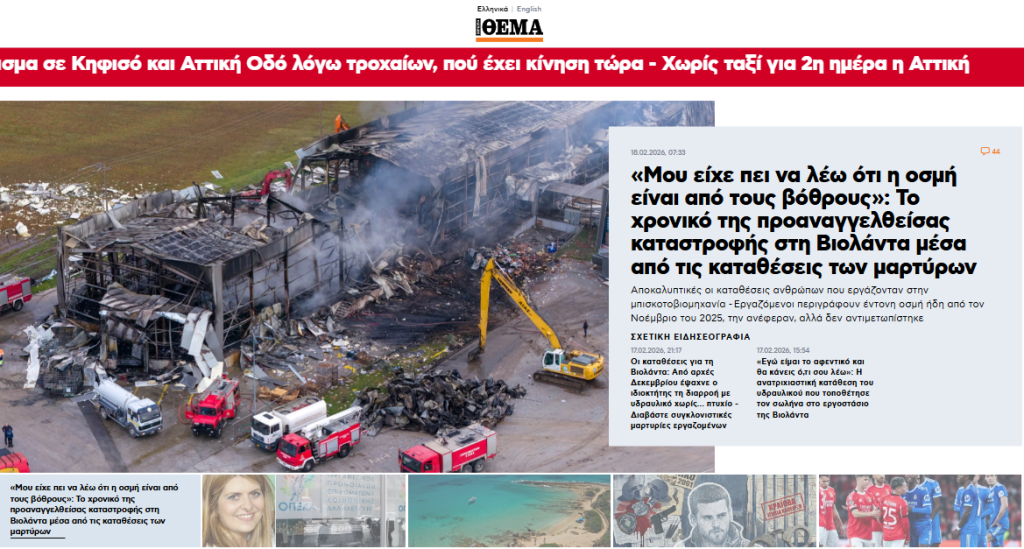
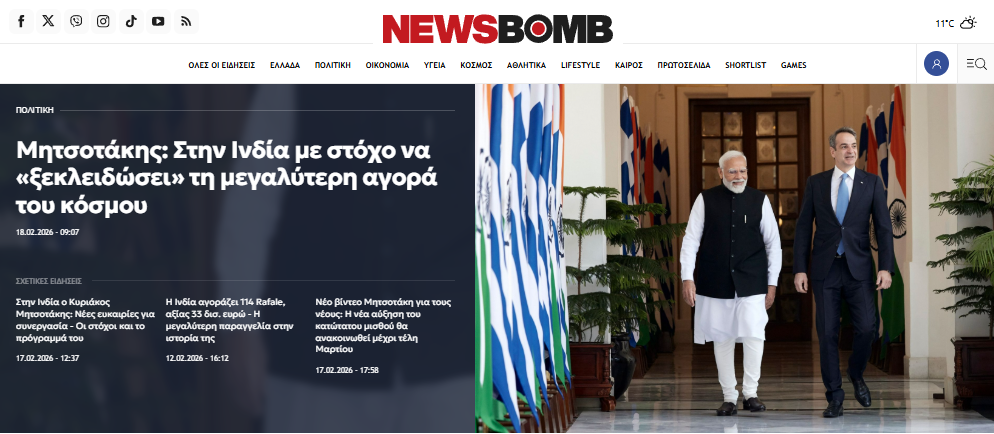
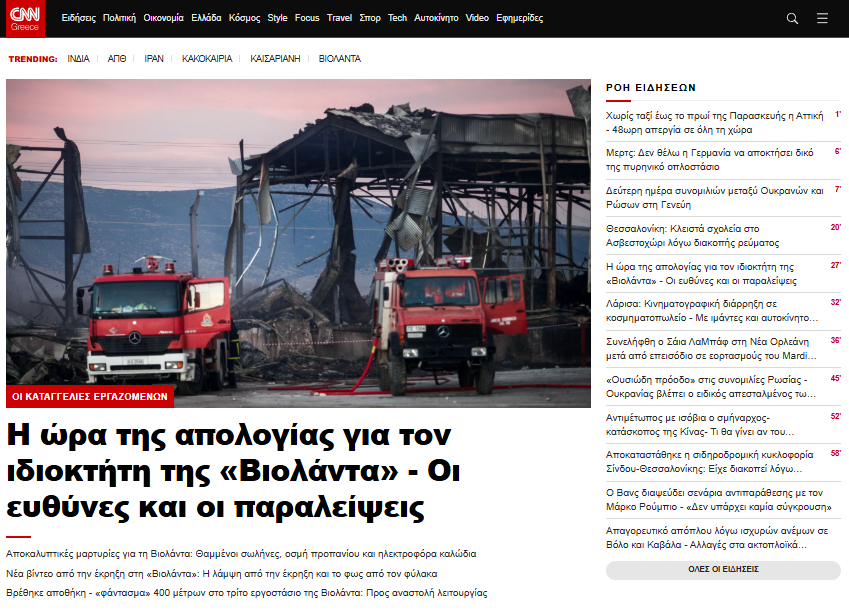
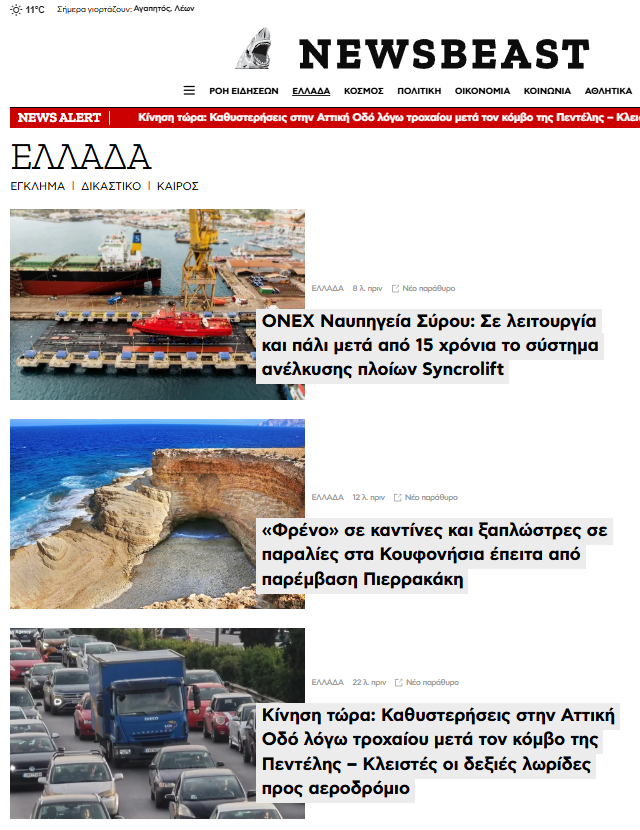

KATHIMERINI: 13.000 tax cases are stagnating in courts
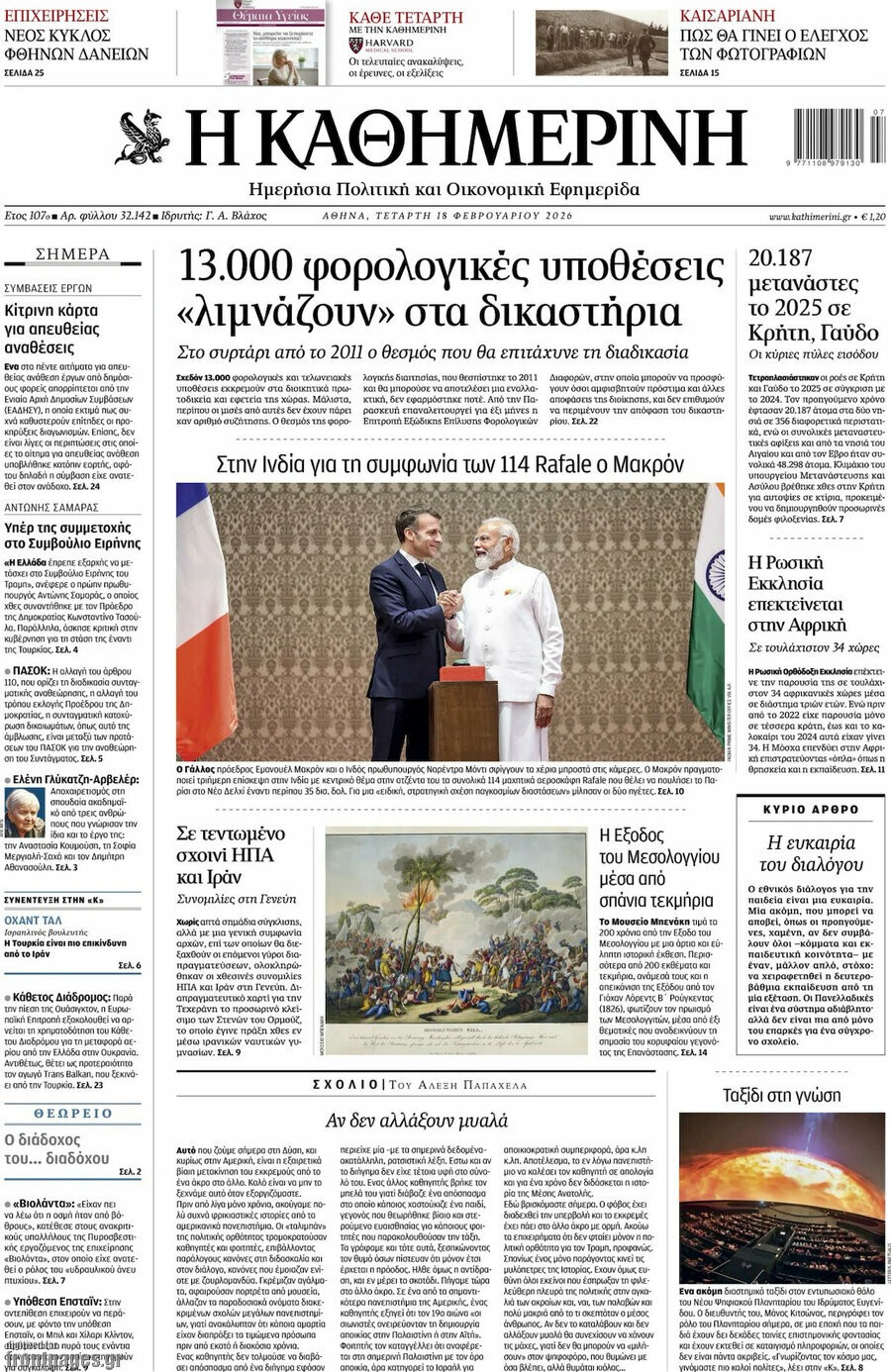
TA NEA: Greek F-35 jetfighters will carry “super missile”
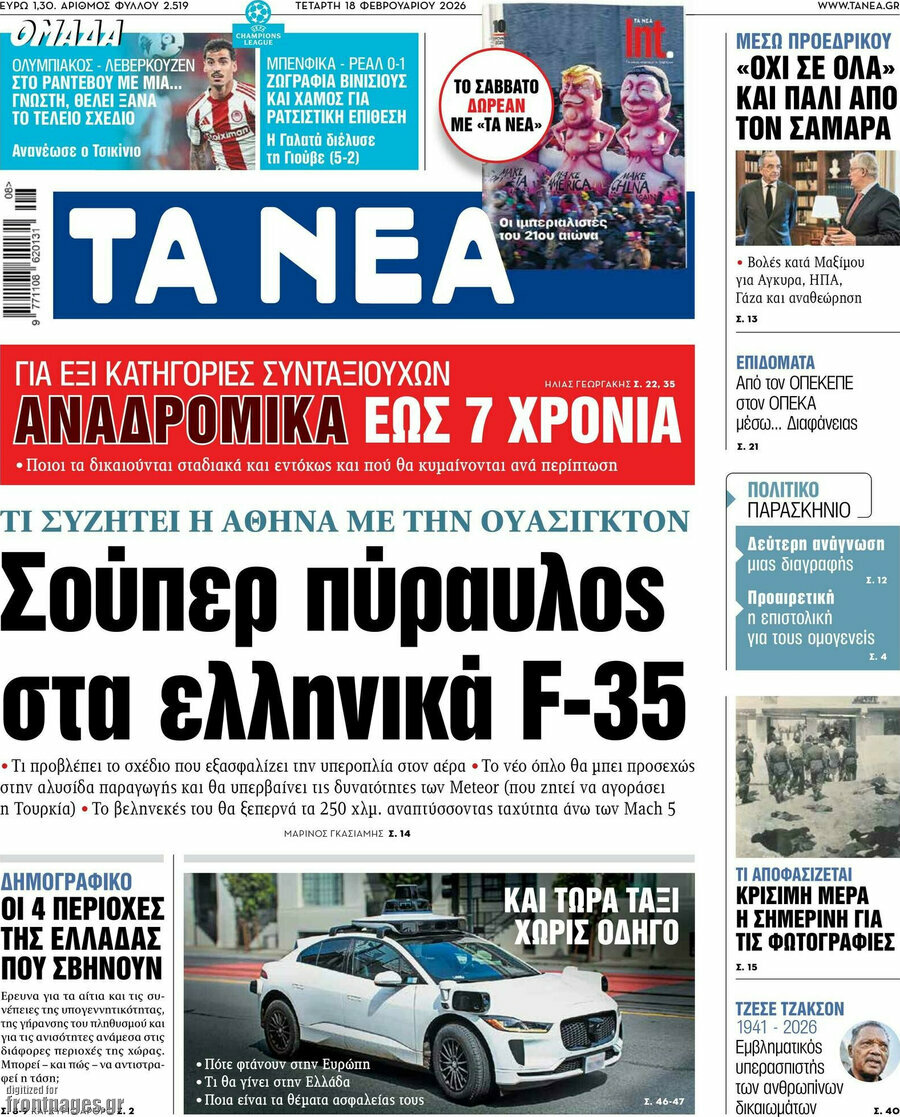
EFIMERIDA TON SYNTAKTON: Government confesses harsh austerity
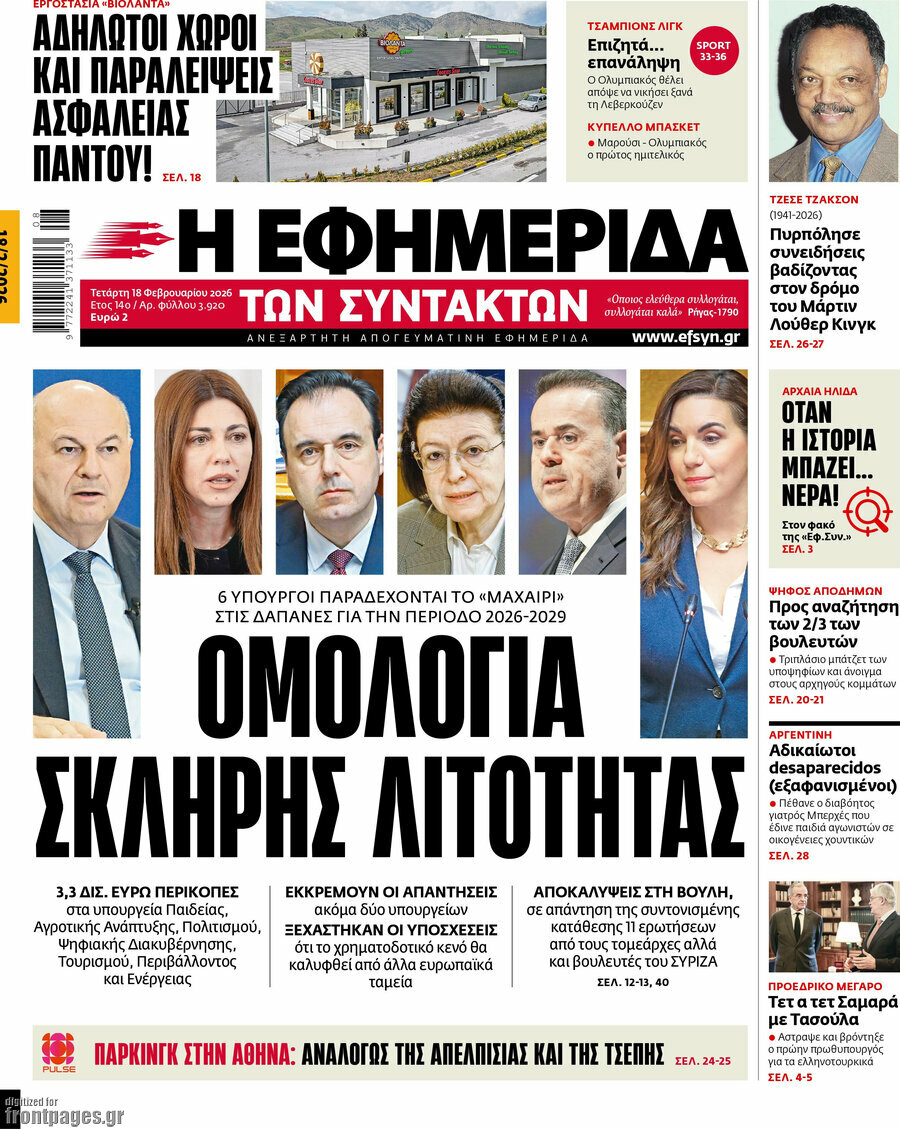
RIZOSPASTIS: Tempe fatal rail-crash anniversary on February 28: Unions and associations to host huge rallies throughout the country
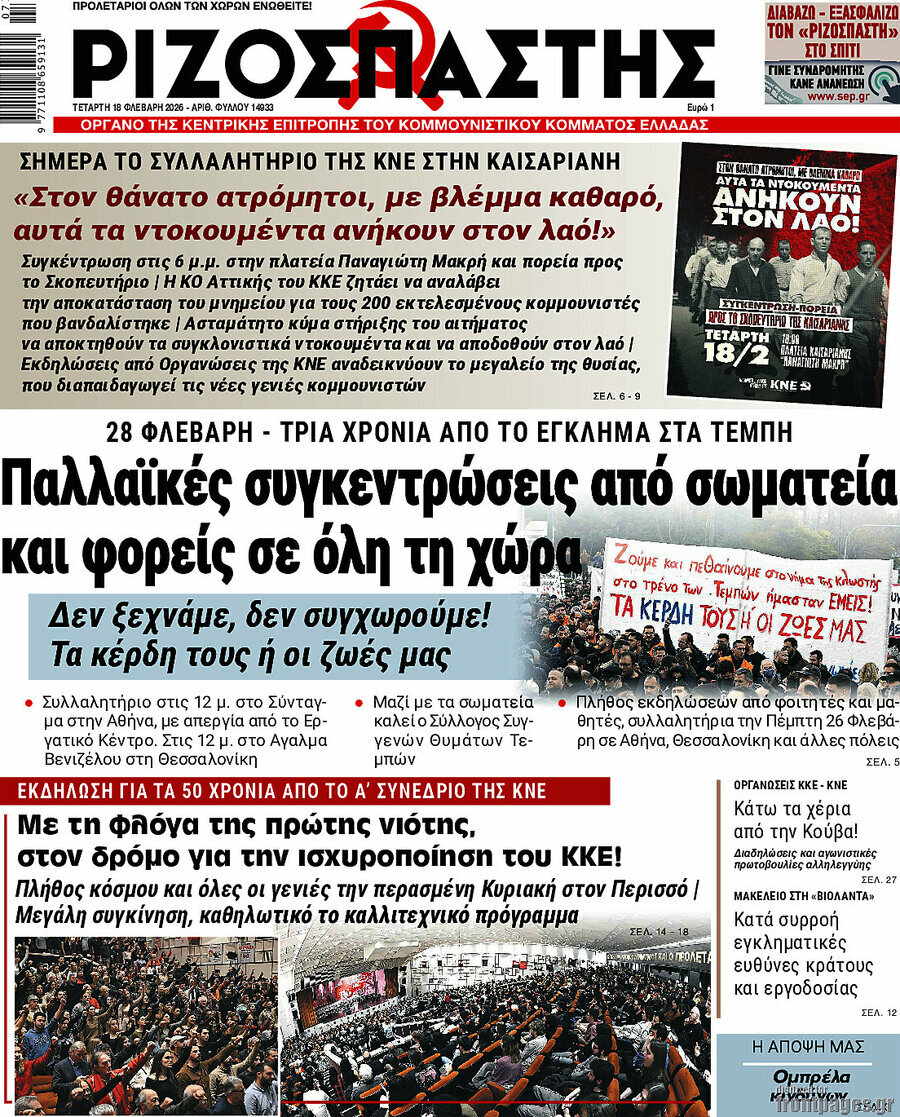
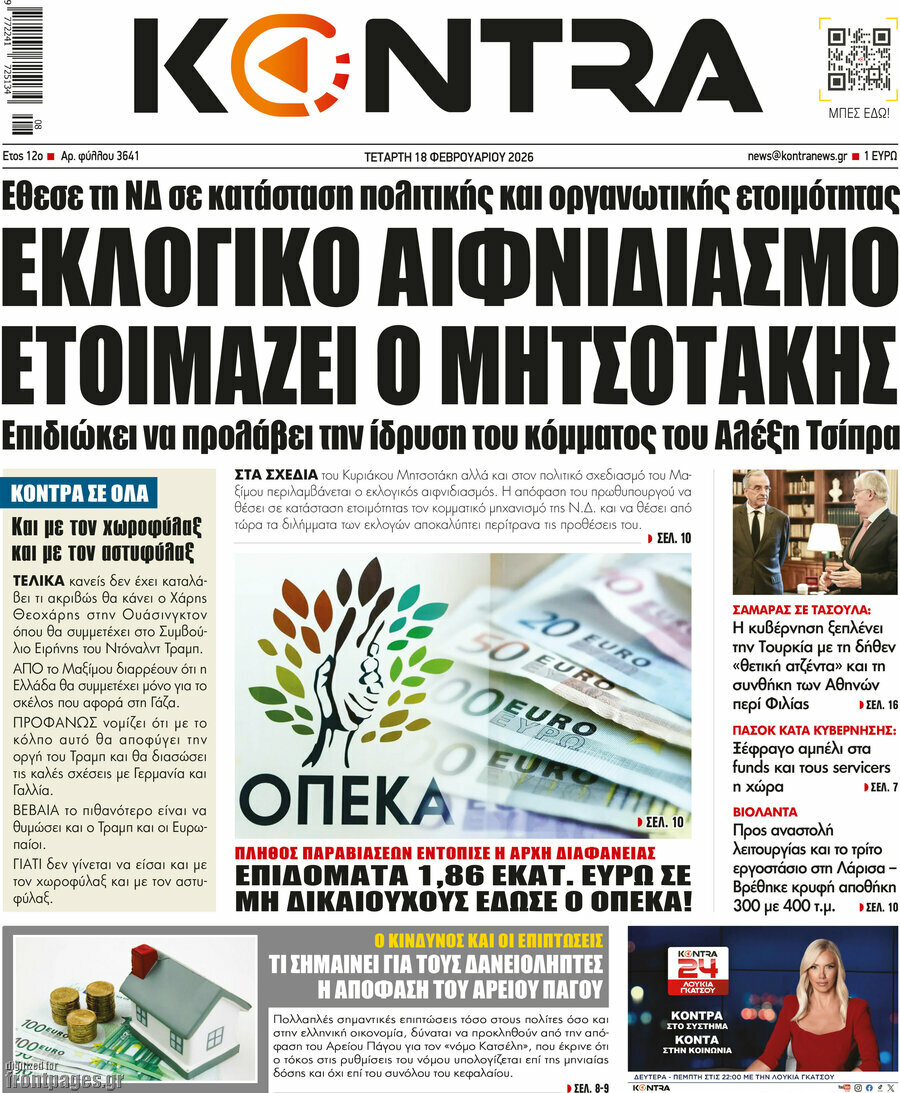
KONTRA NEWS: Mitsotakis is mulling surprise elections
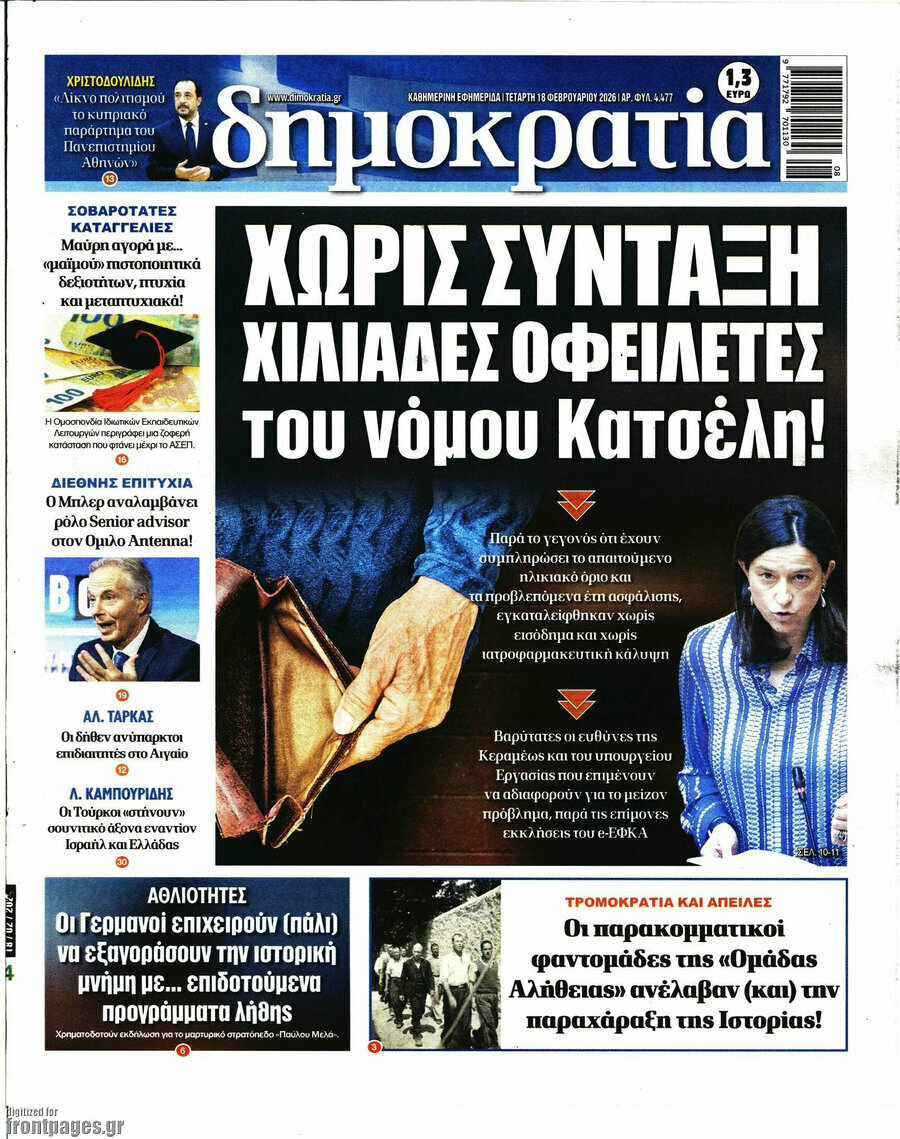
DIMOKRATIA: Thousands of debtors of the Katselis law are left with no pension
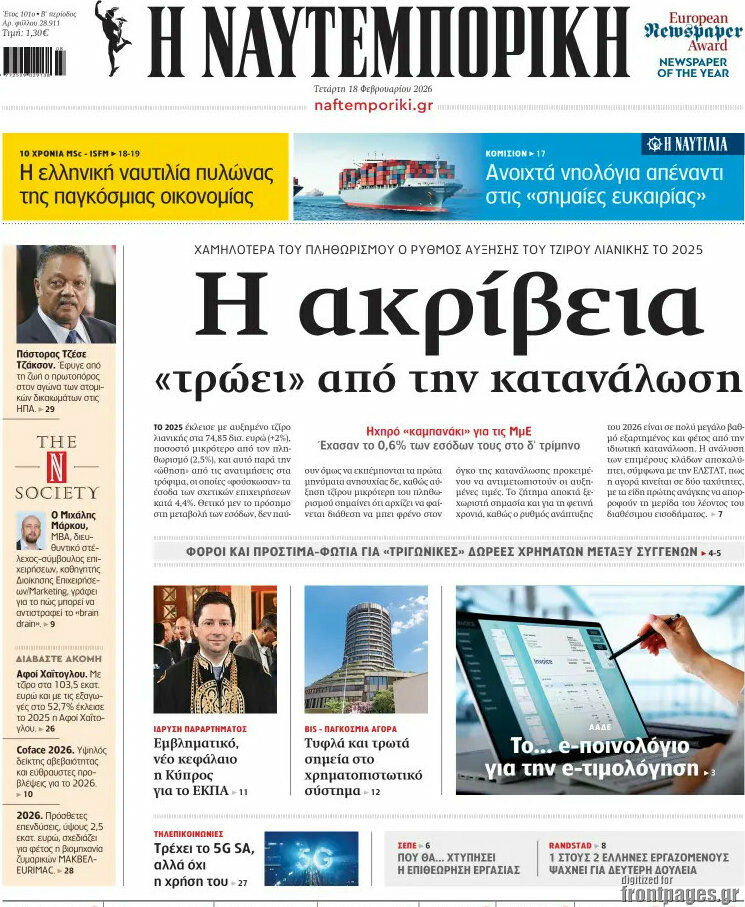
NAFTEMPORIKI: Expensive prices are “eating away” consumption

DRIVING THE DAY
NO TIME TO WASTE: Plans to rescue the EU’s ailing economy have pitted the protectionist instincts of industry chief Stéphane Séjourné against others in the European Commission. And the clock is ticking: The text of the Industrial Accelerator Act (IAA), a centerpiece of Commission President Ursula von der Leyen’s push to revive the struggling manufacturing sector, is due to be presented next week. The Feb. 26 deadline now appears unlikely to be met.
Aux armes! Rival camps of Commission officials are emerging on two key IAA policy questions: tougher rules on sending taxpayers’ money abroad and cutting dependence on foreign countries. Séjourné’s opponents have questions over which countries should be included as “trusted partners” and concerns about quotas for the use of European aluminum, cement and plastic in public procurement. The imposition of quotas has long been a French hobbyhorse, despite caution from other EU members.
Mounting opposition: Nine departments across the EU’s executive branch have raised concerns over the current draft of the IAA, officials say, setting the stage for tricky negotiations. A draft of the IAA obtained by POLITICO last week states that “Made in EU” should refer to things manufactured in the EU, Norway, Iceland and Liechtenstein. But different departments have different views on which other countries should be included, with DG TRADE, DG GROW and DG INTPA at loggerheads over the question. The U.K. and Japan are lobbying for the scope to include countries that have signed free-trade deals with the EU.
Fault lines: According to one commission official, we’re witnessing “a debate between those with a more domestic portfolio who wish to protect and reshore Europe’s industrial production, and those with a more external portfolio who focus on Europe’s trading partners, at the risk of offshoring Europe’s most strategic sectors.”
Ticking time bomb: “The Séjournés of the world are not helping themselves by insisting it’s going to be [done] on Feb. 26,” said a second EU official, cautioning that the negotiations will be hard to conclude in just a week, especially during half term. “If it were my file, I wouldn’t be promising it next Thursday. If you have nine [departments] saying we have to work on this, how is it going to be ready before Christmas?”
Fire up the bellows: Séjourné appears confident he can get the green light from his fellow commissioners. “We must produce the most strategic technologies here in Europe. It is now a matter of economic security,” he told Playbook. “That is precisely the objective of the IAA, which we are currently finalizing within the Commission, and there is no lowering of its ambition.”
What happens next? Raúl de la Hoz Quintano, the European People’s Party MEP serving as rapporteur on the IAA for Parliament’s largest grouping, told my colleague Max Griera that delays were understandable because “the Commission wants to carefully calibrate both the balance and the level of ambition of the proposal.” But it’s important for parliament and countries to get a chance to consider it “as soon as possible” to make sure the Buy European policy will “strengthen our industrial base while ensuring coherence and legal certainty,” the lawmaker said.
Need for speed: Industry, meanwhile, is running out of patience. “It’s not a great message [if] it’s being delayed yet again,” said Victor Van Hoorn, director of industry group Cleantech for Europe, “particularly as we see it as an essential tool if we want to have a chance of scaling up some of the future strategic technologies in Europe.”
Read all about it: My colleagues Francesca Micheletti, Jordyn Dahl, Zia Weise and Martina Sapio have all the details you’ll need.
PLAYBOOK INTERVIEW
IN THE EYE OF THE STORM: French leftist MEP Rima Hassan is dialing back her public engagements, amid the outcry that followed the death of a 23-year-old man who was attacked as far-right protesters picketed her speech at a university in Lyon last week. Hassan, who is of Palestinian origin and represents the anti-capitalist France Unbowed party, told my colleague Victor Goury-Laffont that the incident had far-reaching consequences. “Of course, there are lots of trips that I won’t be able to take,” she said.
Repercussions: Quentin Deranque, who was providing security for far-right Collectif Némésis activists, died Saturday after suffering multiple blows to the head outside the venue where Hassan was speaking. Nine people have been arrested, the BBC reports. And the incident is reverberating politically, too. French Education Minister Philippe Baptiste announced Tuesday he would seek to prevent political conferences at universities whenever authorities believed they could lead to confrontation — which Hassan sees as a road to censorship.
Police responsibility: “There was a succession of failures … My team knew [far-right groups] would protest two or three days in advance. I assume [police] had that same information,” Hassan said. “I would rather be attacked, end up in the hospital if necessary, than have unrest, violence and, more tragically, someone dying.”
NEIGHBORHOOD WATCH
REVIVAL PLAN FOR REGIONS ON RUSSIA’S DOORSTEP: European Commission Executive Vice President Raffaele Fitto is today set to unveil the EU’s plan to help areas that border Russia, Belarus and Ukraine and are suffering economically because of the war. The strategy, formally dubbed the “Communication on Eastern Border Regions,” will pour money into these areas to boost local businesses and prevent people from leaving.
What’s the problem: Towns and cities in the east of the Baltics, Finland and Poland have seen dwindling investments, reduced cargo traffic and a decline in tourism. The EU is concerned that if these easternmost regions start losing a large proportion of their population, Europe’s ability to defend its external borders is compromised.
So where’s the money coming from? There won’t be any new cash from the EU’s current budget for the plan (though Baltic countries have already set their sights on the next one). Instead, the Commission is creating incentives for international financial institutions to provide funding to the affected regions, according to a draft of the plan seen by POLITICO’s Gregorio Sorgi and Zoya Sheftalovich.
CAN’T SPELL INDIA WITHOUT AI: Commission tech chief Henna Virkkunen is touching down in New Delhi this morning to firm up a partnership with the world’s most populous country on the use of AI and mobility for talented tech workers. The visit comes as India pushes partners like the U.S. to share data with its government and increase local language use, according to this scoop from my colleagues in Washington.
“Europe and India are entering a new strategic phase,” Virkkunen told Playbook ahead of the trip. “For Europe, leadership in AI means combining investment, scale and responsible governance — building capacity through AI Factories and Gigafactories, while ensuring trust through a clear regulatory framework … Together, we can accelerate deployment, reinforce resilient value chains and ensure that AI remains innovative, competitive and aligned with democratic values.”
Opening a gate: Migration Commissioner Magnus Brunner is today announcing a new pilot with the first European Legal Gateway Office opening in India to help students and researchers come to the EU. According to Brunner, it is “the first initiative of its kind worldwide and sends a clear signal of the strategic importance of India to the European Union.”
LEGISLATION WATCH
MOVE THAT FILE: A series of showdowns between commissioners over legislative files has forced von der Leyen’s top team to reassess how they work together to ensure policies get passed while allowing time to debate the issues. They’ve agreed to overhaul processes to limit the potential for new initiatives to be delayed and then rushed through at the last minute with limited scrutiny, according to two Commission officials granted anonymity to speak to me and Sebastian Starcevic.
Previously, the five executive vice presidents had to manually refer legislative files put forward by their subordinates through the system — sending them for four sets of review individually. That had led to confrontations between EVPs and those underneath them, with allegations delays were being used as a way to change policies without a full discussion, the officials said. EVPs now cannot hold up consultations at key stages for more than a week before the file needs to be moved on.
ALSO DELAYED: The EU’s massive overhaul of its customs systems has been pushed back, as officials work to tie up loose ends before the final round of interinstitutional negotiations take place. The talks were scheduled for March 2, but are set to take place later in the month, my colleague Koen Verhelst reports.
IN OTHER NEWS
ITALIAN JUSTICE OVERHAUL: A referendum is always a high-stakes gambit for politicians riding high. Italian Prime Minister Giorgia Meloni is the latest leader to roll the dice with a nationwide vote on judicial reform that could reinforce her hold on power — or cost her dearly. Hannah Roberts in Rome has the story.
CITY OF SPIES: Decades after the fall of the Berlin wall, Germany is once again gearing up for an era of espionage, changing the rules to give its foreign intelligence agency sweeping powers. The move is designed to fill the void left by increasingly unreliable American partners, Nette Nöstlinger reports.
STRONGMAN THEORY: One in five Europeans say a dictatorship would be preferable to democracy, according to a new poll in five countries — Greece, France, Sweden, the U.K. and Romania — conducted by AboutPeople on behalf of think tank Progressive Lab, Nektaria Stamouli reports.
LAGARDE TO STEP DOWN EARLY: European Central Bank President Christine Lagarde is thinking about leaving her eight-year term before the French presidential election in April 2027 so that Emmanuel Macron and Friedrich Merz can choose her successor, the FT reports.