
Low expectations for Ankara summit
Prime Minister Kyriakos Mitsotakis and Turkish President Recep Tayyip Erdogan are scheduled to meet midday Wednesday in Ankara, 17 months after their last encounter, amid last-minute disruptions reflecting the persistent lack of trust that defines Greek-Turkish relations.
https://www.ekathimerini.com/politics/foreign-policy/1294926/low-expectations-for-ankara-summit
Government responds to Venizelos criticism on constitutional revision
The government has issued a sharp response to former minister Evangelos Venizelos following his criticism of what he termed “revisionary populism” in Sunday’s Kathimerini with regard to constitutional revision.
Air Force colonel remanded over alleged espionage for China
A 54-year-old Hellenic Air Force colonel was remanded in custody on Tuesday and has been charged with selling classified military information to China, following an eight-and-a-half-hour interrogation by a military prosecutor at the Athens Air Court. During his testimony, the officer accepted full responsibility and said he became involved without his intent. He said he did not attempt to justify or defend himself and placed himself at the disposal of his service and the justice system from the outset to facilitate the investigation.
Transparency Int’l 2025 report: Greece improves score in managing corruption
Greece improved its position in fighting corruption while corruption worsens globally, Transparency International said in its annual report for 2025 released on Tuesday. Greece ranked 56th among 182 countries evaluated, rising three levels compared to last year’s measurement, and managed to improve its rating by one point, reaching 50 with 100 being the best. In seven years, Greece has improved by 11 levels. According to the report, Over two thirds of countries (68 per cent) fall below 50, indicating serious corruption problems in most parts of the planet. At the bottom of the index, the countries scoring below 25 are mostly conflict-affected and highly repressive countries.
ATHEX: Rebound has not excited observers
The Athinon Avenue benchmark snapped its losing streak of the last three sessions and secured a rebound on Tuesday that was not led by banks, for a change. Instead, the day’s protagonists were Allwyn (formerly known as OPAP), Coca-Cola HBC and Sarantis. Nevertheless, the rebound was not enough to undo even half of Monday’s drop, and turnover was significantly reduced, to the lowest level of the last 12 sessions.
https://www.ekathimerini.com/economy/1294930/athex-rebound-has-not-excited-observers


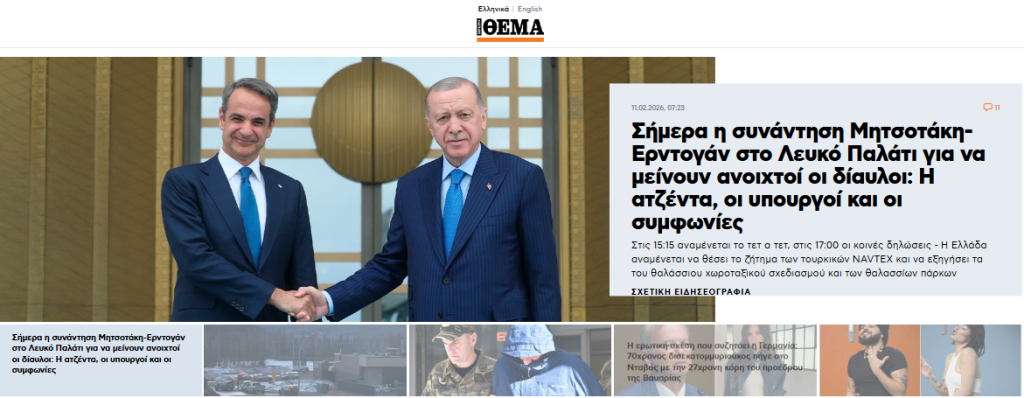
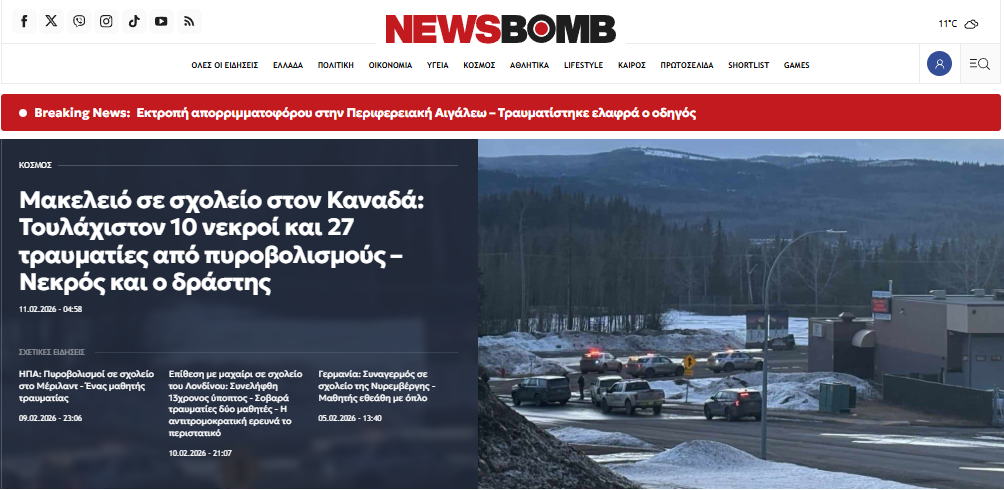
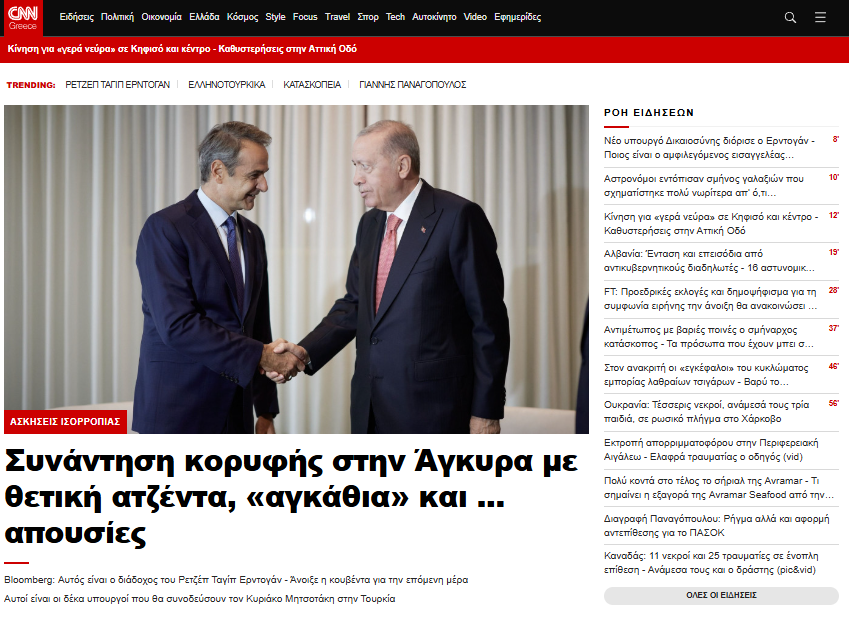

KATHIMERINI: Turks, Israelis and Iranians champion “Golden Visas”
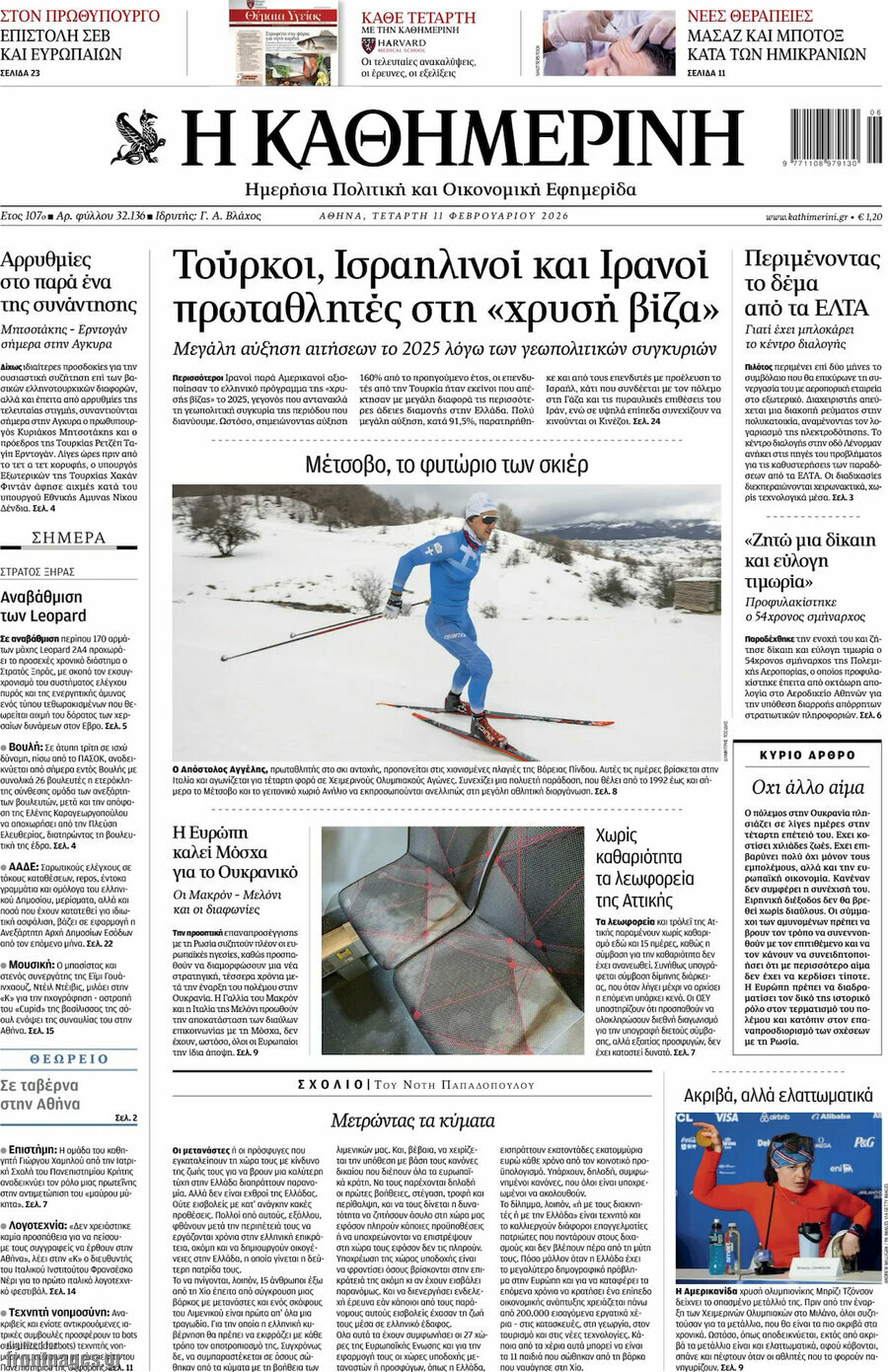
TA NEA: Turkey leaves window open for nuclear weapons
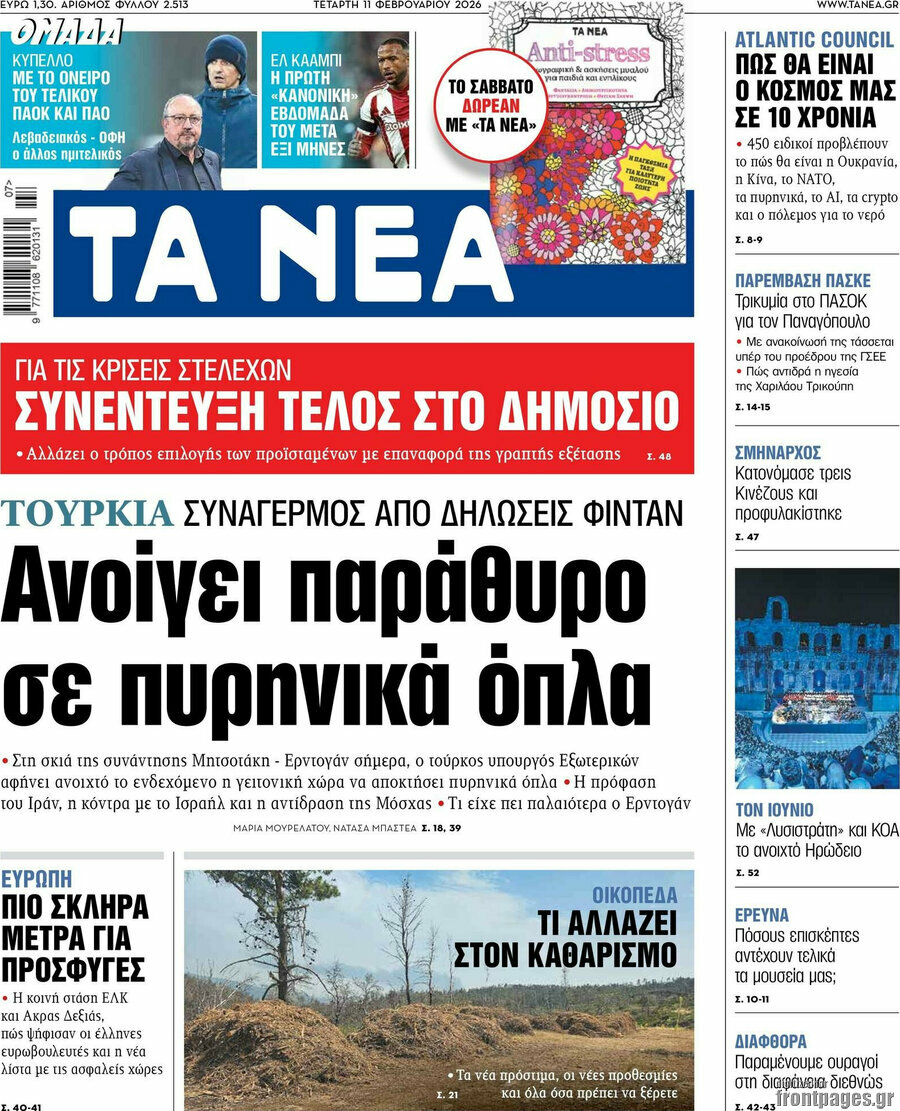
EFIMERIDA TON SYNTAKTON: Mr. Mitsotakis, do you agree with the tactics of the government’s spokesperson against the press?
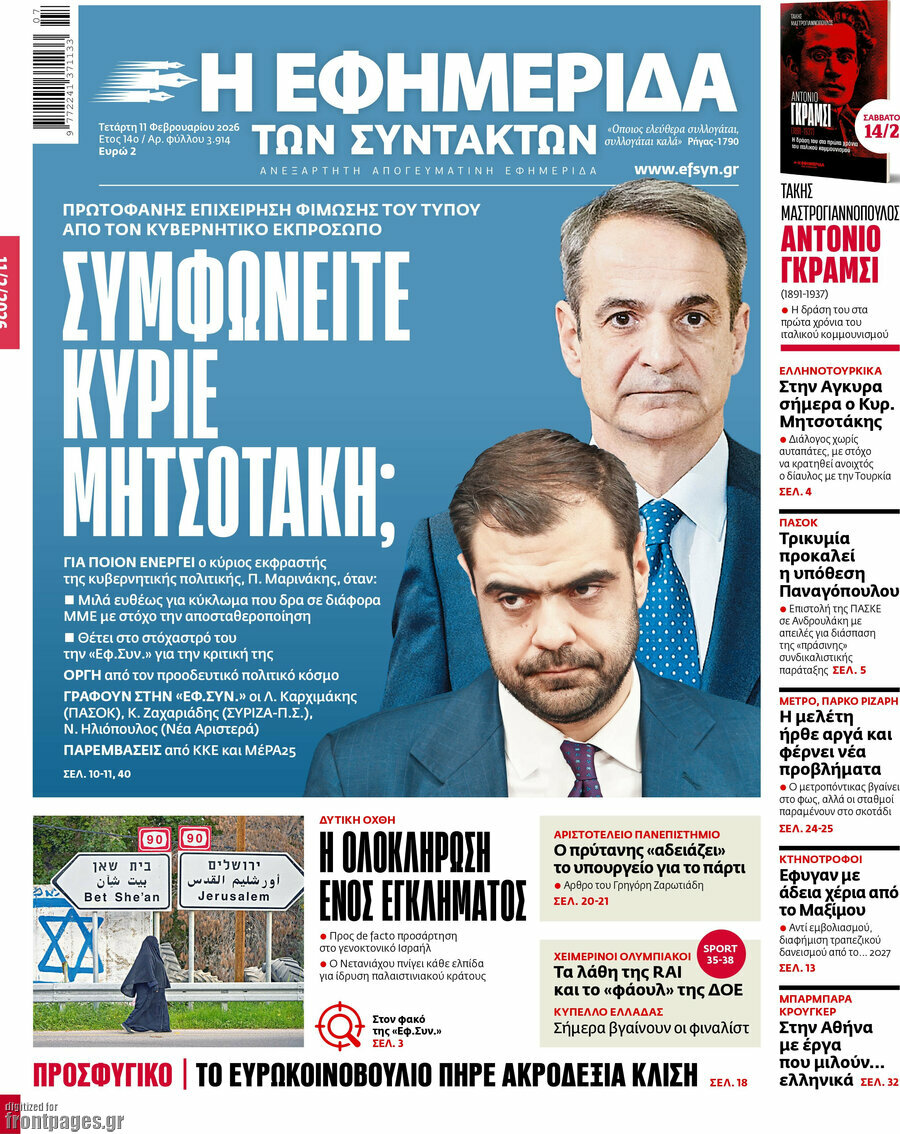
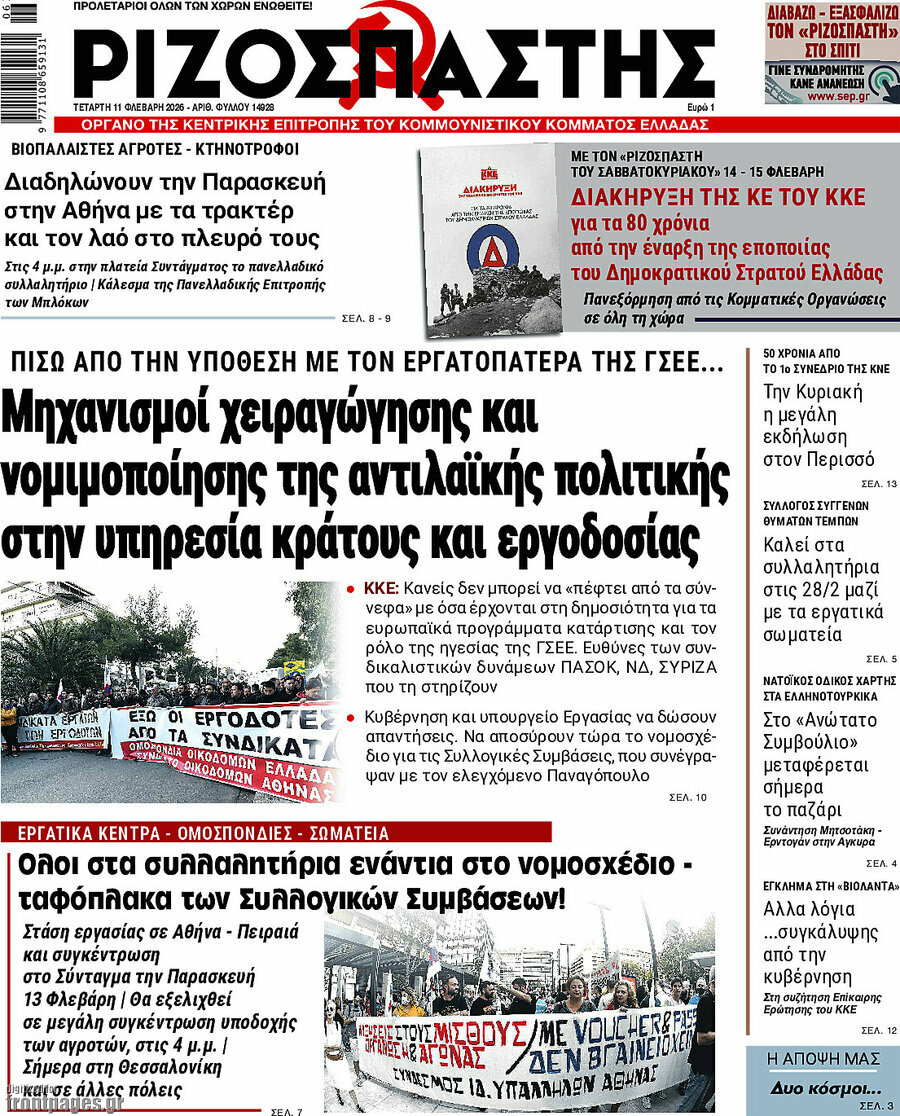
RIZOSPASTIS: GSEE corruption case: Manipulation mechanisms and legalization of antipopular policies at the service of the state and employers
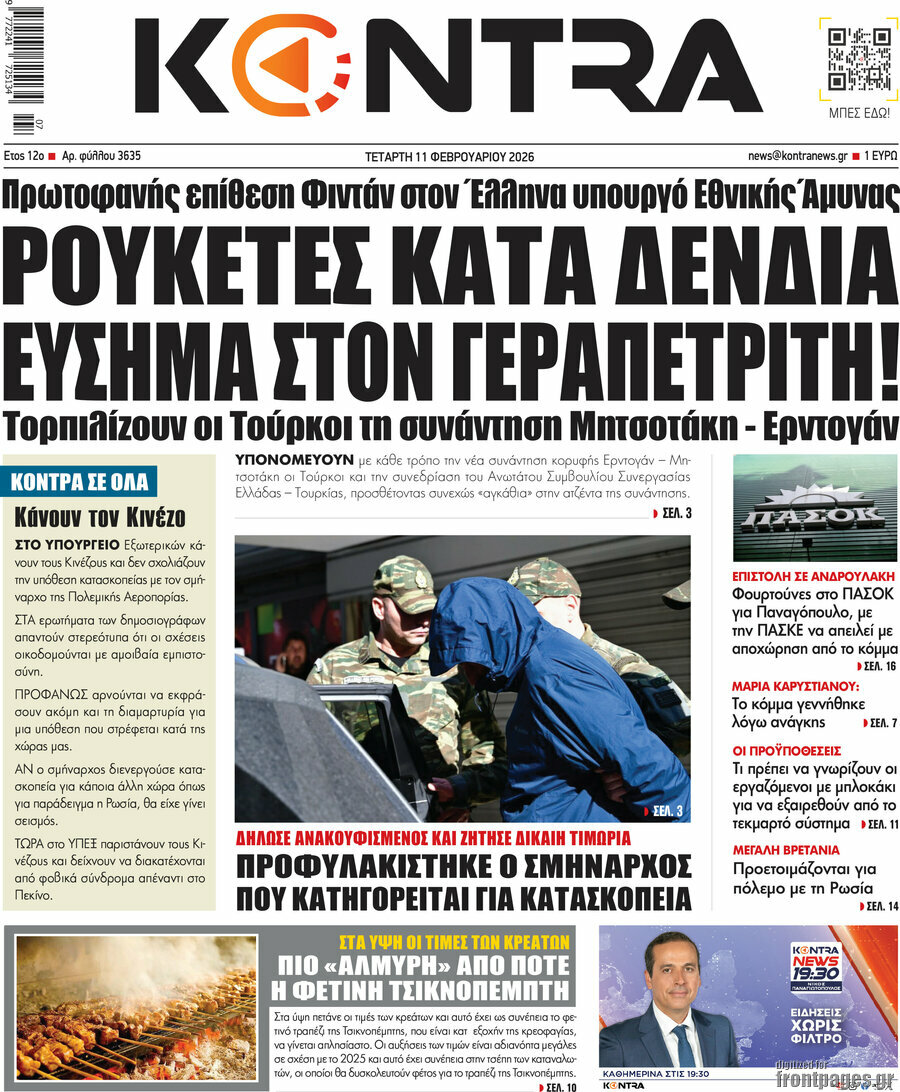
KONTRA NEWS: Turkish Foreign Minister Fidan: Missiles against Defense Minister Dendias, praise for Foreign Minister Gerapetritis
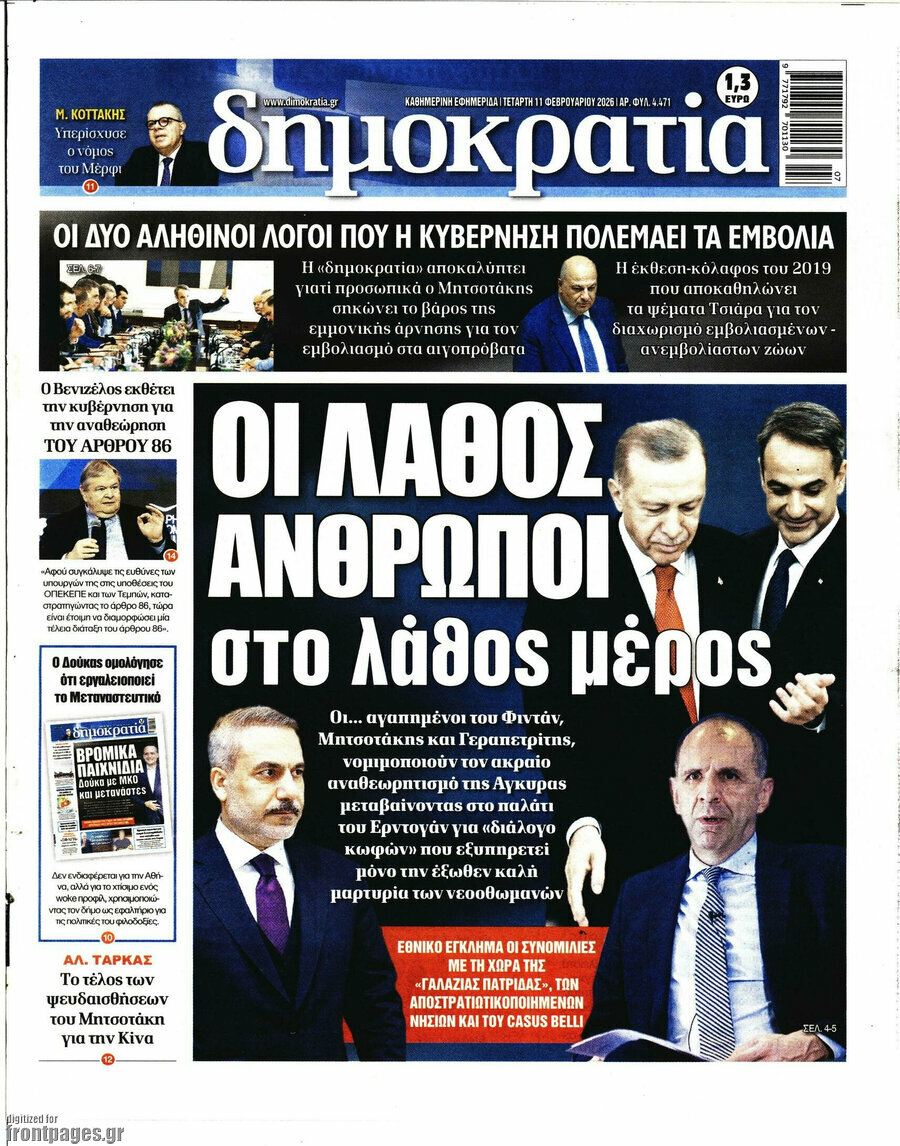
DIMOKRATIA: Wrong people at the wrong place
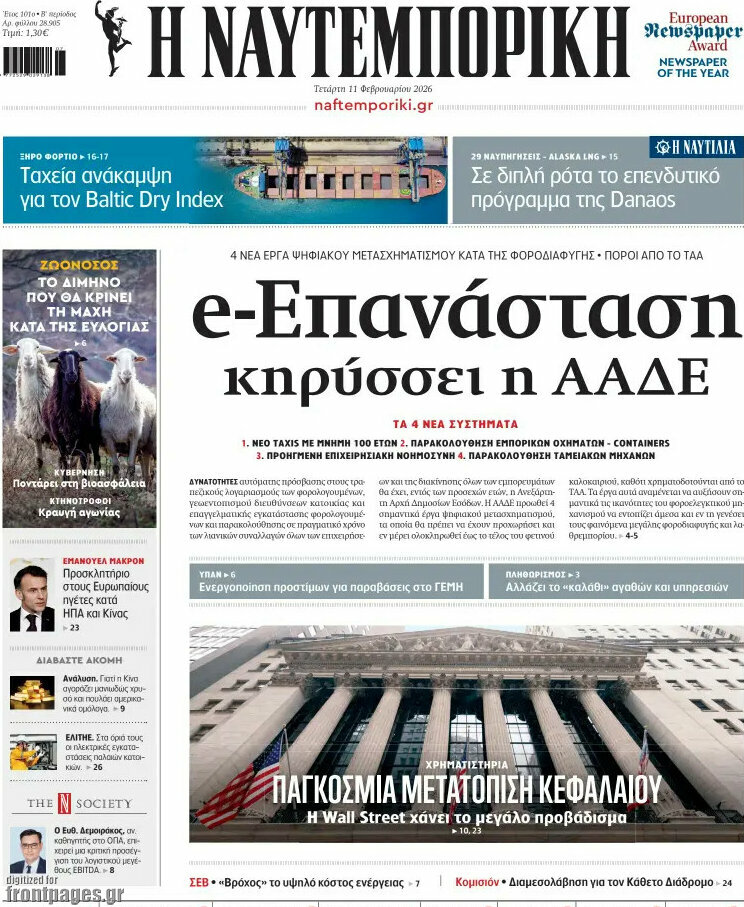
NAFTEMPORIKI: Public Revenue Authority launches e-Revolution

DRIVING THE DAY
BRUSSELS’ EYES ON BRATISLAVA: What happens in European Union capitals never stays local — and Slovakia is firmly back on Brussels’ worry list. Long-standing concerns about eroding democratic standards and alleged corruption have resurfaced in recent weeks, putting increasing pressure on the government of Prime Minister Robert Fico.
MEPs will turn up the heat in Strasbourg today with a debate in the European Parliament on the rule of law, fundamental rights and alleged misuse of EU funds, with lawmakers urging the European Commission to get tougher on Bratislava.
Brussels’ unease about Slovakia has been simmering for years — from the 2018 killing of the investigative journalist Ján Kuciák to restrictions on LGBTQ+ rights. But there are two issues that have recently pushed it back onto the agenda:
1. Whistleblowin’ in the wind: On Jan. 30, the Commission opened a probe into Slovakia’s dismantling of its whistleblower protection office, which the executive said was a breach of EU rules. Bratislava had a month to respond to the formal infringement notice before taking further action — which could include a multi-stage process resulting in the cut of EU payouts to the country. The Commission says it hasn’t yet received a reply.
2. Remember Hacienda? Allegations that EU funds intended to support rural tourism were used to build guesthouses that only privileged insiders could afford to stay in have reignited calls from MEPs, prosecutors and NGOs to freeze EU payments.
Move along: Fico’s office didn’t reply to a request for comment … but Katarína Roth Neveďalová, an MEP from the prime minister’s Smer party, told POLITICO’s Ketrin Jochecová that today’s Parliament debate is “totally absurd and political.” She insisted that no wrongdoing by the government has been proven and that European lawmakers are simply giving oxygen to Slovak and Hungarian opposition parties.
Agree to disagree: Progressive Slovak MEP Ľubica Karvašová argues the allegations of corruption in her country are anything but abstract. “This is money missing from schools, hospitals and infrastructure,” she said, adding that Parliament is just doing its job by applying scrutiny. “I would expect the same from the Commission,” she said.
Parliament has already sent two fact-finding missions to Slovakia — from the budgetary control committee in May and civil liberties committee in June — without producing a resolution. Its last formal position was in January 2024, in the previous mandate, when it criticized Fico’s criminal justice reforms. Today’s debate is expected to start a process toward a new resolution as early as March, according to a parliamentary official.
The new Hungary? Some MEPs warn the EU risks repeating the mistake it made of waiting too long to intervene against backsliding on the rule of law by Viktor Orbán’s government in Hungary. In that case, it took “10 years for the Commission to act — and it was too late. I don’t want that to happen in Slovakia,” Green MEP Daniel Freund told my colleague Gregorio Sorgi.
But Parliament Vice President Sophie Wilmès, who led the fact-finding mission to Slovakia in June, cautioned against that comparison, even though she believes Bratislava is moving in the same direction. “The mission was taken seriously and we were received at the highest levels of the state,” she said. “Dialogue is still possible.”
The Commission is treading cautiously, wary of Slovakia’s leverage on vital issues that require consensus among the EU27 — such as imposing sanctions on Russia, which Bratislava has threatened to block in the past. “They need Fico’s vote on unanimous decisions,” Freund said.
Democracy Commissioner Michael McGrath will attend today’s debate in Parliament, though he’s not expected to stray beyond the executive’s standard messaging on the rule of law in his remarks. Meanwhile, Commission Executive Vice President Raffaele Fitto, who oversees cohesion funds, will meet Fico in Bratislava.
The Fitto-Fico meeting was scheduled “months and months” ago — well before the Commission launched its infringement procedure — but Brussels’ concerns about rule-of-law backsliding are expected to come up. Progressive MEPs are hoping Fitto will press the need to protect EU funds, though the Italian commissioner, widely seen as a politician who prefers dialogue to confrontation, is not exactly the type to deliver a stern rebuke.
PRE-RETREAT RETREAT
COULDN’T THEY HAVE STARTED TODAY? That’s the question doing the rounds in Brussels as more than 20 EU leaders plus senior European Commission officials descend on Antwerp for a European Industry Summit — just one day before the Europe-saving leaders’ retreat on competitiveness.
Showing up: Commission President Ursula von der Leyen kicks off the festivities around midday with a keynote speech. Belgian PM Bart De Wever is the home-city host, joined by outgoing Dutch PM Dick Schoof, Italian PM Giorgia Meloni, German Chancellor Friedrich Merz and many others. Commissioners Teresa Ribera, Wopke Hoekstra and Stéphane Séjourné are also attending.
Why it matters: This is no ordinary talkfest. Since the 2024 Antwerp Declaration, signed by 1,300 organizations across 25 sectors, the format has helped set the tone for the Clean Industrial Deal, aka the rebranded Green Deal. It has also underpinned the push for simplification — or deregulation — that has defined von der Leyen’s second term, complete with her “fleet of omni-buses” (the president’s nerdiest pun to date).
New target for the razor gang: As my colleague Zia Weise explains, the bedrock of the bloc’s climate legislation — the Emissions Trading System, or carbon market — is in industry’s crosshairs, with an emerging alliance between business and red-tape slashing governments ahead of the Commission’s planned pre-summer revision. POLITICO’s Jakob Weizman has more on how EU’s chemical giants are lobbying to make this happen.
Cue the backlash: As industry once again moves to rework the foundations of EU climate policy in the name of economic necessity, a coalition of NGOs told von der Leyen Wednesday that she is prioritizing big business at the expense of the public interest and the Commission is following an industry-led “shadow roadmap” for deregulation.
And all of this is just the warm-up match. Nicholas Vinocur and Gabriel Gavin set the scene for Thursday’s informal leaders’ meeting.
DEFENSE MINISTERS MEET
UKRAINE ON THE TABLE: It’s Foreign Affairs Council time again — although it’s EU defense ministers meeting this afternoon, with Ukraine financing and joint defense spending front and center. My colleague Jacopo Barigazzi has mapped out what to expect.
Ministers will discuss how to step up support for Kyiv after EU ambassadors agreed last week on a €90 billion loan to finance Ukraine’s defense against Russia. The deal prioritizes weapons produced in the EU while still allowing Ukraine to procure arms from third countries such as the U.S. and the U.K.
Prodigious guest: Ministers will hear from Ukraine’s new defense minister, Mykhailo Fedorov. His background in the tech sector — and reputation as a tech prodigy — has sparked curiosity about how he plans to shape Ukraine’s defense strategy.
Strasbourg catch-up: The ministers may already be debating expenditure, but the EU’s lawmaking machinery is making up for any lost time. The European Parliament is expected to give final approval to the €90 billion loan today, clearing the last hurdle before Kyiv receives its first tranche of money.
The long and winding road: Parliament’s vote around noon will mark a significant moment, wrapping up months of bruising negotiations with — and within — the EU Council over how to finance Ukraine for the next two years.
SAFE and sound: Ministers will also formally approve the first batch of national defense plans under the €150 billion Security Action for Europe (SAFE) program, following ambassadors’ sign-off earlier this week.
FAC-fight club: The defense leaders will meet formally before heading to an informal, device-free dinner in the Europa building — the 1+1 format. Officially, the discussion will focus on the year ahead. Unofficially, one diplomat joked, the dinner may provide a safe space to vent about the Trump administration, confident that what’s said in Vegas …
MEANWHILE, IN KYIV … Volodymyr Zelenskyy’s government is planning for presidential elections and a referendum on any peace deal with Russia, with the intention of announcing them on Feb. 24, the fourth anniversary of Russia’s full-scale invasion, the FT reports this morning.
DRONE ACTION PLAN
EYES IN THE SKY: The College of Commissioners may have wrapped up Tuesday, but the Commission has more to unveil this morning. At 10.30 a.m., Executive Vice President Henna Virkkunen, Internal Affairs Commissioner Magnus Brunner and Sustainable Transport Commissioner Apostolos Tzitzikostas will present a new Drone Action Plan, designed to boost the European drone industry.
Taking the threat seriously: Europe’s security landscape has shifted — and drones are part of that shift. “Everything can be weaponized against us and Europe needs more than ever to act united and be prepared,” Virkkunen told Brussels Playbook, ahead of the action plan’s launch.
The plan will focus on boosting preparedness, improving detection and response capabilities, and strengthening defense readiness. The aim is to set out a clear path to counter drone-related threats — while investing in the technology to harness its benefits.
Whole-of-Commission effort: The action plan is led by DG CONNECT (digital) but pulls in DG DEFIS (defense), DG MOVE (transport) and DG HOME (internal affairs), reflecting the crossover between defense, internal security and civilian protection, from public spaces and critical infrastructure to external borders.
“This technology has enormous potential — both as an opportunity and as a risk. With drones, we protect our borders, prevent drug trafficking, and save lives in the Mediterranean,” Brunner told Playbook exclusively ahead of the presentation.
Reminder: The Commission has already flagged plans to deploy drones to support countries under migratory pressure. A €250 million call for drone and counter-drone projects at the EU’s external borders is in the pipeline.
PARLIAMENT CORNER
PROGRESS ON U.S. DEAL: The European Parliament’s top trade lawmakers on Tuesday agreed a common position on the EU-U.S. trade agreement, in a move that will be met with relief both in Washington and in Brussels, as Max Griera and Camille Gijs report.
Let the capital games begin: After the European Parliament goes through its internal votes — first in the trade committee on Feb. 24, then in next month’s plenary — the next hurdle will be to land an agreement with EU capitals. On paper, this is doable, given that EU members had made only limited tweaks to the Commission’s proposal, keen to avoid tensions with Washington.
This could still get messy: Bernd Lange, the lawmaker who chairs Parliament’s trade committee, expects agreement on the suspension trigger but warned the sunset clause and steel provisions may prove harder to swallow for capitals wary of angering the U.S. “I hope we can find a proper solution,” he said.
RIGHT IRKED BY SANCHEZ MIGRATION MOVE: Politicians on the right are pushing back against Spanish PM Pedro Sánchez’s plans to grant work permits to 500,000 undocumented migrants at a time when Brussels is trying to tighten asylum and migration rules.
Slap on the wrist: Migration Commissioner Magnus Brunner told Parliament during a debate on Tuesday that Spain “must ensure [its] decisions do not have negative consequences in other parts of the union.” And the top European People’s Party (EPP) lawmaker on migration, Tomas Tobé, said Sánchez’s moves undermine Brussels’ efforts to tackle illegal migration.
Let Spain be Spain: However, Socialists and Democrats Chair Iratxe García Pérez defended Spain’s approach as “an economic growth engine” and said the regularization of migrants gave them both rights and obligations, including paying taxes and contributing to social security.
QATARGATE MEP WANTS REFUND: Marc Tarabella, the former Belgian Social Democrat lawmaker caught up in the Qatargate scandal, wants the European Parliament to reimburse him the €28,668 he had to pay in fines. But Parliament’s leadership shot down his latest appeal at a meeting on Monday, according to a confidential note seen by POLITICO’s Max Griera.
Naughty corner: MEPs can be sanctioned by repaying 50 percent of their parliamentary operating allowance of around €60,000 a year if they miss more than half of plenary sitting days in a given period. Tarabella, who did not respond to a request for comment, missed 29 of 58 plenary days between 2022 and 2023.
CALLING IN THE FRAUD BUSTERS: Parliament employees reported five cases of “serious irregularities” in 2025, two of which were referred by the leadership to the anti-fraud office OLAF and the European Public Prosecutors Office, which are now investigating the claims, according to an internal note seen by POLITICO.
BIG BLOW TO DIGITAL EURO RAPPORTEUR: The draft opinion on the digital euro proposal by Spanish EPP lawmaker Fernando Navarrete was rejected by an overwhelming majority of EU lawmakers, POLITICO’s Giovanna Faggionato writes in to report. Navarrete, who is leading the Parliament’s work on the rules, is against the online digital euro, which he sees as a competitor to banks’ services.
EPP cracks: Around two-thirds of EPP lawmakers backed the amendment slamming the draft opinion — including the group’s ECON coordinator, Markus Ferber, who had personally backed Navarrete’s appointment as rapporteur.
Why it matters: The digital euro is meant to reduce Europe’s dependence on Visa and Mastercard and is a top priority for both the European Central Bank and the Commission. Delays are frustrating policymakers across party lines, including within the EPP’s senior ranks, officials told Giovanna.
ELECTION INTERFERENCE
ELECTION TRACKER: Viktor Orbán’s favorite EU-based think tank, MCC Brussels, is launching a “democracy interference observatory” that will kick off with a “detailed investigation” into Hungary’s upcoming parliamentary election in April.
“Dense networks”: The organization’s John O’Brien told POLITICO’s influence reporter Mari Eccles that the observatory would “expose, document, and analyze how the EU and EU-linked actors shape national elections across Europe.” The launch would reflect a “growing body of public evidence showing that modern elections are increasingly shaped … by dense networks linking EU institutions, national authorities, digital platforms, and activist NGOs.”
Republican insights: O’Brien pointed to a report from U.S. Republican lawmakers that accused the EU of acting as a “foreign censorship threat,” arguing that the bloc unfairly targets conservative and populist views and tries to manipulate elections in EU countries. It also claims that Commission officials have pressured social media companies to “globally censor” content — especially U.S and conservative publications — under the cover of fighting hate speech and misinformation.
Commission pushback: “In the face of very real threats and challenges to our societies and institutions, the Commission has taken firm and concrete steps to strengthen democratic resilience,” Commission spokesperson Markus Lammert told Playbook. Lammert pointed to initiatives such as the European Democracy Shield, the European Media Freedom Act, new transparency rules on political advertising and party financing, along with the Digital Services Act.
Transparency corner: A register filing last year showed that MCC Brussels had received more than €6 million to “acquaint and influence European policy makers,” with more than 99 percent of those funds given as part of a grant from Mathias Corvinus Collegium Alapítvány — a Budapest-based educational institution controlled by close political allies of Orbán.