
Deputy interior minister files defamation lawsuit over reports on municipal contracts
Deputy Interior Minister Vangelis Liakos filed a defamation lawsuit Monday against two journalists and a publisher over reports alleging that municipalities had awarded direct contracts worth hundreds of thousands of euros to businesses linked to his close relatives. The reports, published by local media outlets, concerned direct contracts awarded by several municipalities to businesses run by Liakos’ two sisters. One alleged that a bookkeeping firm operated by one sister had received contracts totaling 1.14 million euros from six municipalities since 2019. Another reported that a business run by his other sister had secured 13 direct contracts worth a total of 256,694 euros from four municipalities over the same period, mainly for communications, public relations and tourism consultancy services.
Mitsotakis rules out recognition of British ownership in any Parthenon Sculptures deal
No agreement on the return of the Parthenon Sculptures can involve recognition of foreign ownership, Prime Minister Kyriakos Mitsotakis said Monday, reiterating that their reunification in Athens remains a non-negotiable national goal. Speaking at the inauguration of the old Acropolis Museum, on the Acropolis itself, Mitsotakis said the dispute was not simply a legal claim over individual artifacts but a matter of restoring a monument that had been divided. “The Parthenon was not built to be broken up,” he said, arguing that its sculptures were conceived as a unified whole and should be displayed together at the site for which they were created.
Parliamentary Budget Office: Extreme climate events weigh on state budget, growth and public debt
The economic and regional dimensions of extreme weather phenomena and ecological and environmental destruction in Greece are highlighted in a research note by the Parliamentary Budget Office (PBO). The analysis is the first to estimate the impact of extreme climate events on the economy of Greece’s regions and link it to how the state finances recovery from natural disasters. To this end, it combines Eurostat regional accounts for the 2002-2023 period with satellite and climate data for 2001-2025. Approximately € 73 million annually is the estimated loss of value added in tourism-related services in the Dodecanese up to the third year following the 2023 Rhodes wildfire, while € 200-240 million is the estimated loss of value added in the agricultural sector nationwide during such a year. Approximately € 400 million is the estimated loss in fiscal revenues due to reduced output in a year like 2023 (0.16% of GDP), while approximately € 745 million is the estimated cost of compensation and support measures following wildfires and floods like those of 2023 (0.3% of GDP, at 2025 prices). Also, € 600 million is the estimated annual allocation from the Public Investment Programme (PIP) for supporting affected parties and preventing natural disasters from 2024 onwards.
Tourism: Over 34.2 mln visitors in Jan-Sept 2026 – Receipts jump 9.7% to €22 bln
Greek tourism is on track for a new record, as increased international travel traffic is accompanied by an even stronger rise in tourism revenues, boosting the sector’s contribution to the Greek economy. Data from the Bank of Greece (BoG) for the January-September 2026 period reflect the momentum of this year’s tourism season, with more than 34.2 million travellers visiting the country, compared with 31.6 million in the corresponding period of 2025. The rise in travel traffic translated into an even larger increase in revenues. Travel receipts reached € 21.958 billion, recording an increase of 9.7%, or € 1.934 billion, compared with € 20.024 billion in the same period of 2025.
ATHEX: Moderate recovery for local bourse
The Euronext Athens (ATHEX) general index closed at 2,562.36 points, adding 0.38% to Friday’s 2,552.23 points. The large-cap FTSE-25 index expanded 0.50% to end at 6,572.70 points, though mid-caps contracted 0.50%.
https://www.ekathimerini.com/economy/1322222/athex-moderate-recovery-for-local-bourse


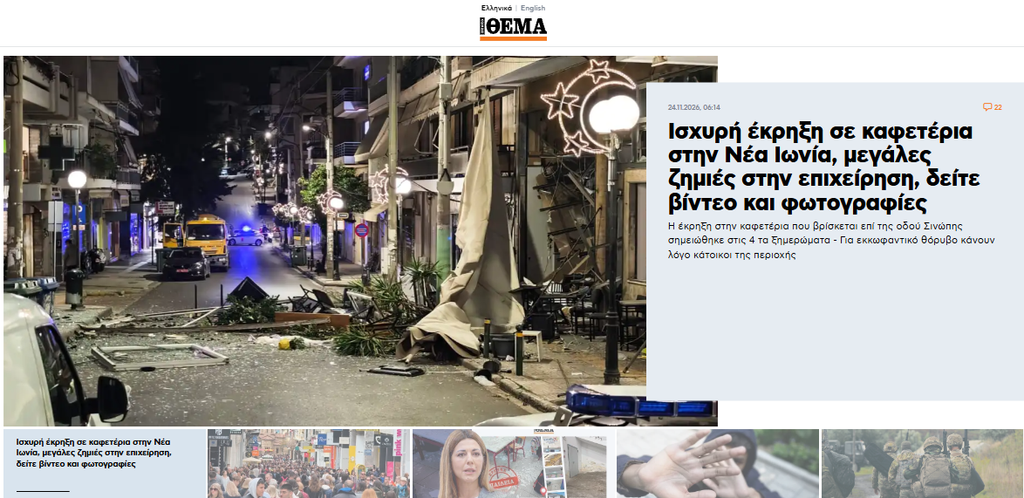

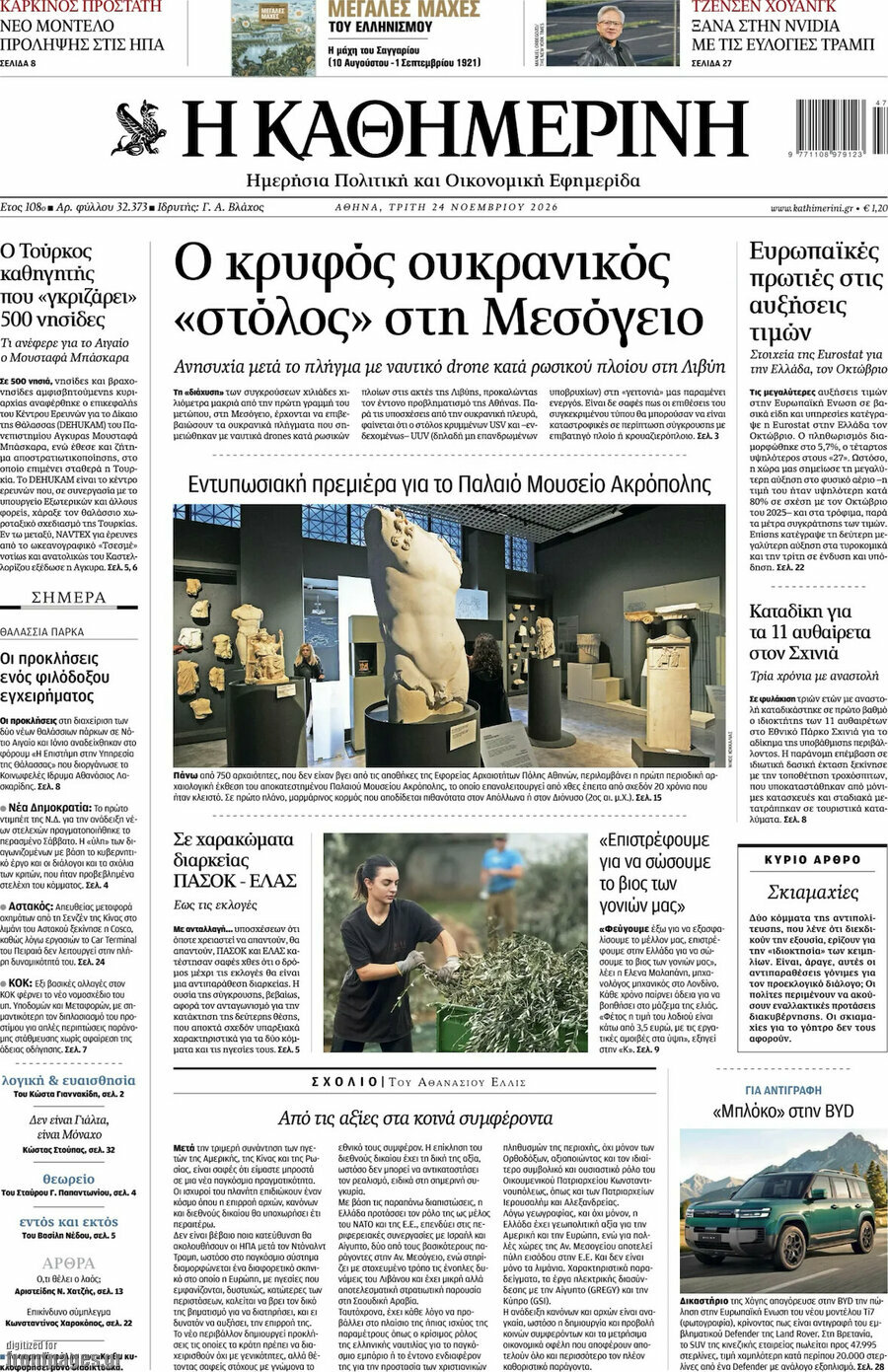
KATHIMERINI: The hidden Ukrainian “fleet” in the Mediterranean
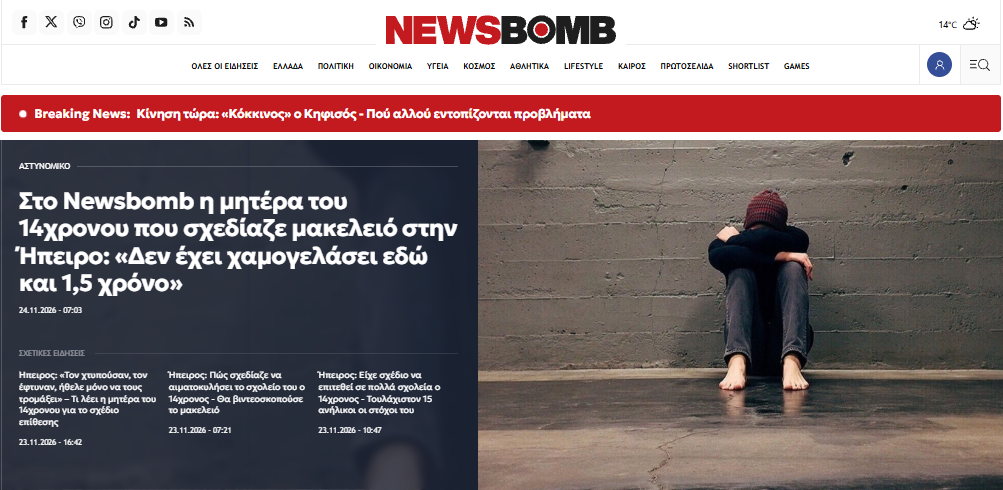
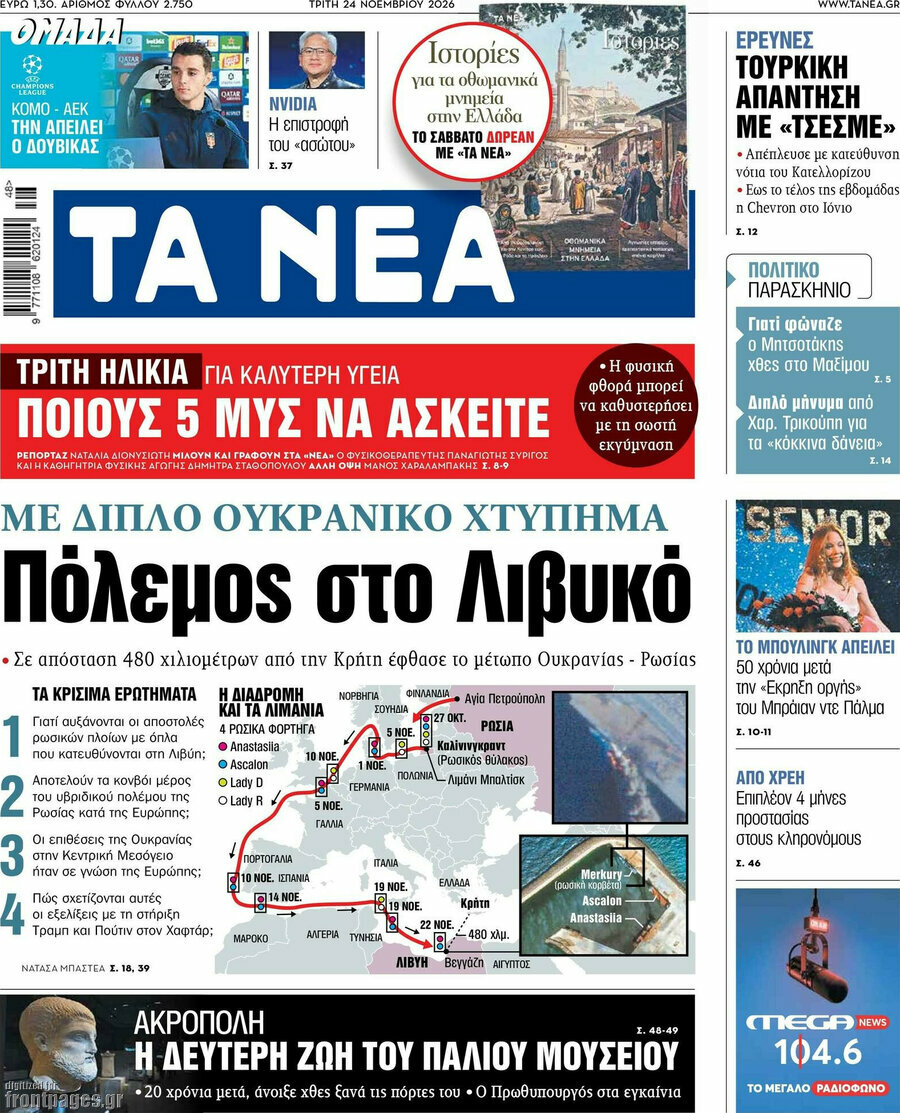
TA NEA: War in the Libyan Sea
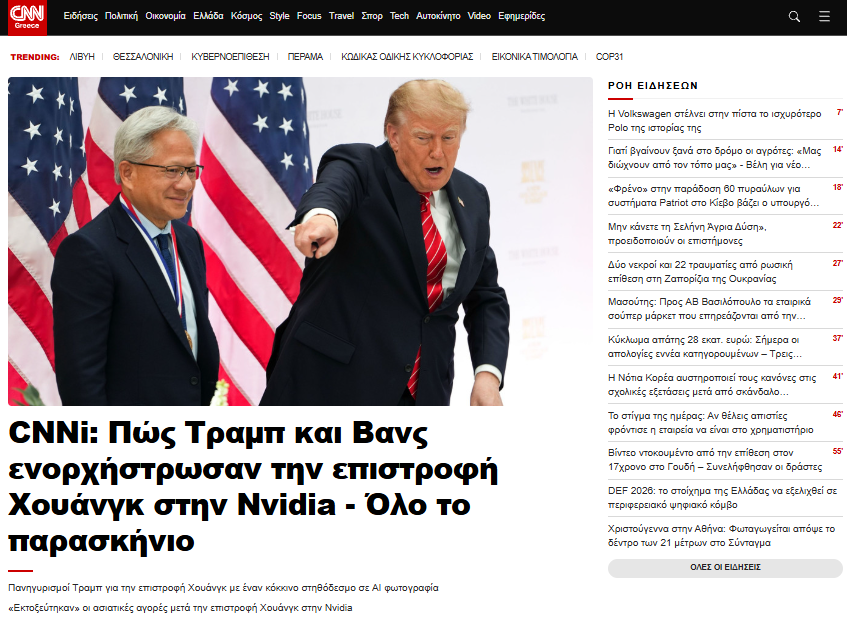
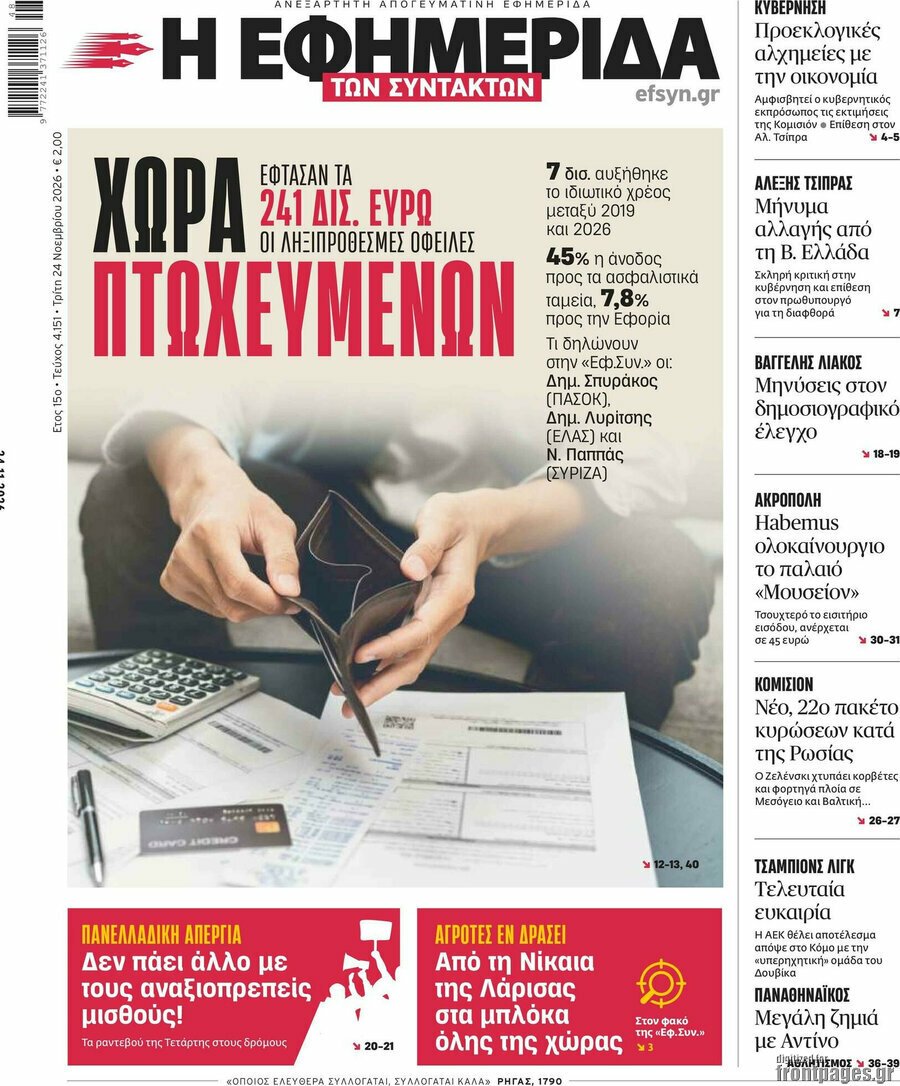
EFIMERIDA TON SYNTAKTON: A country of bankrupt citizens
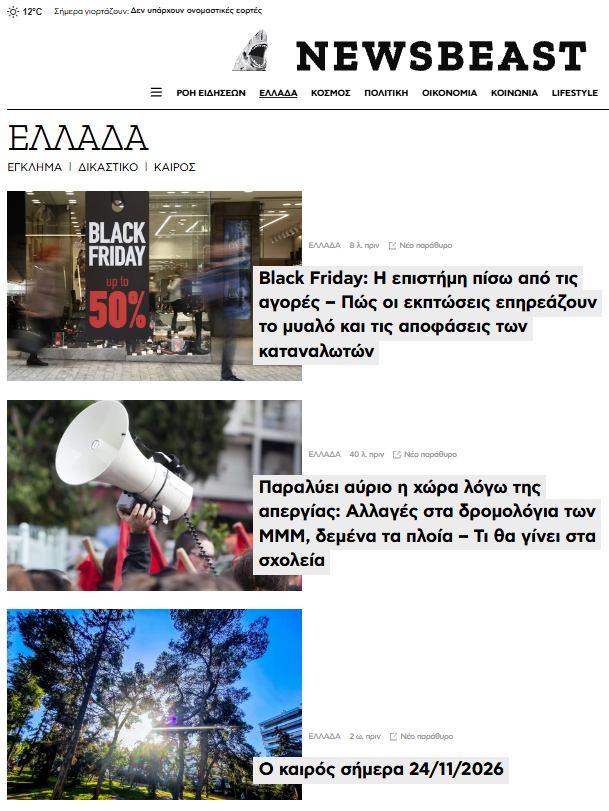
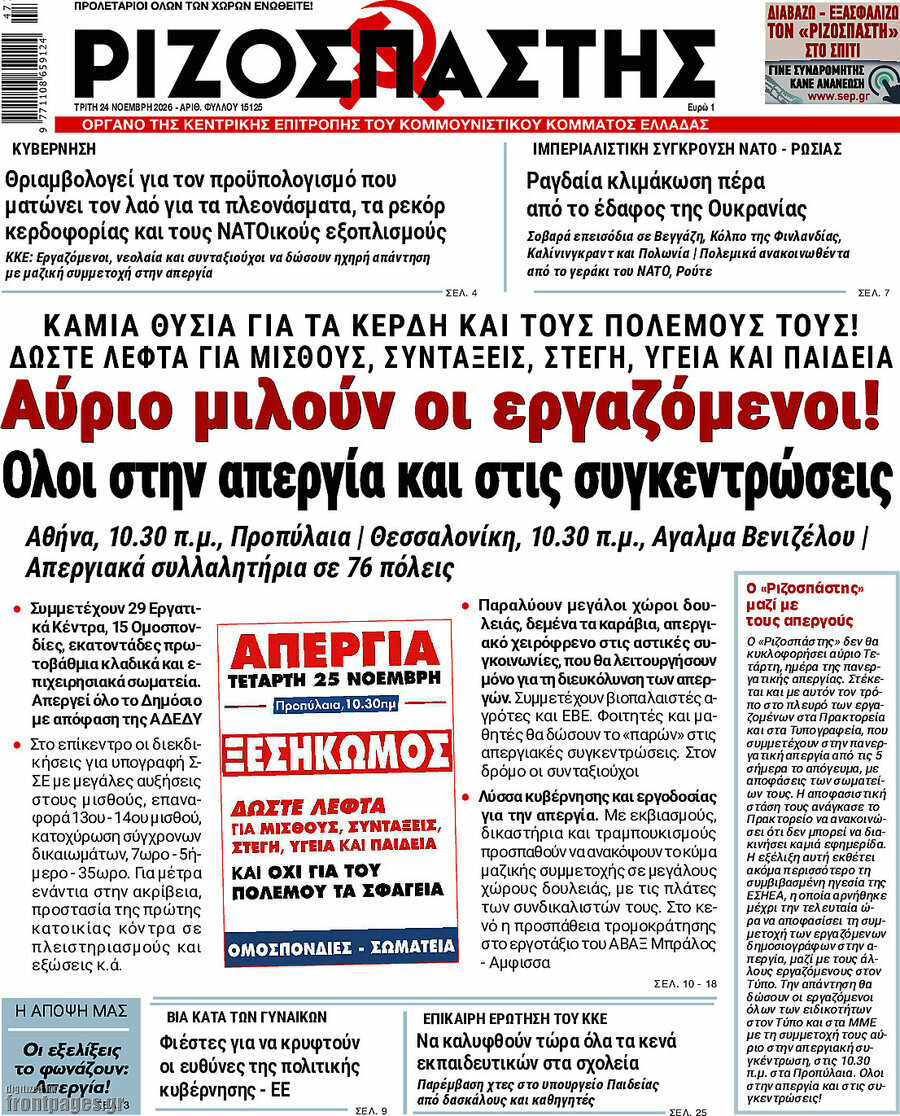
RIZOSPASTIS: Tomorrow, the workers will speak out
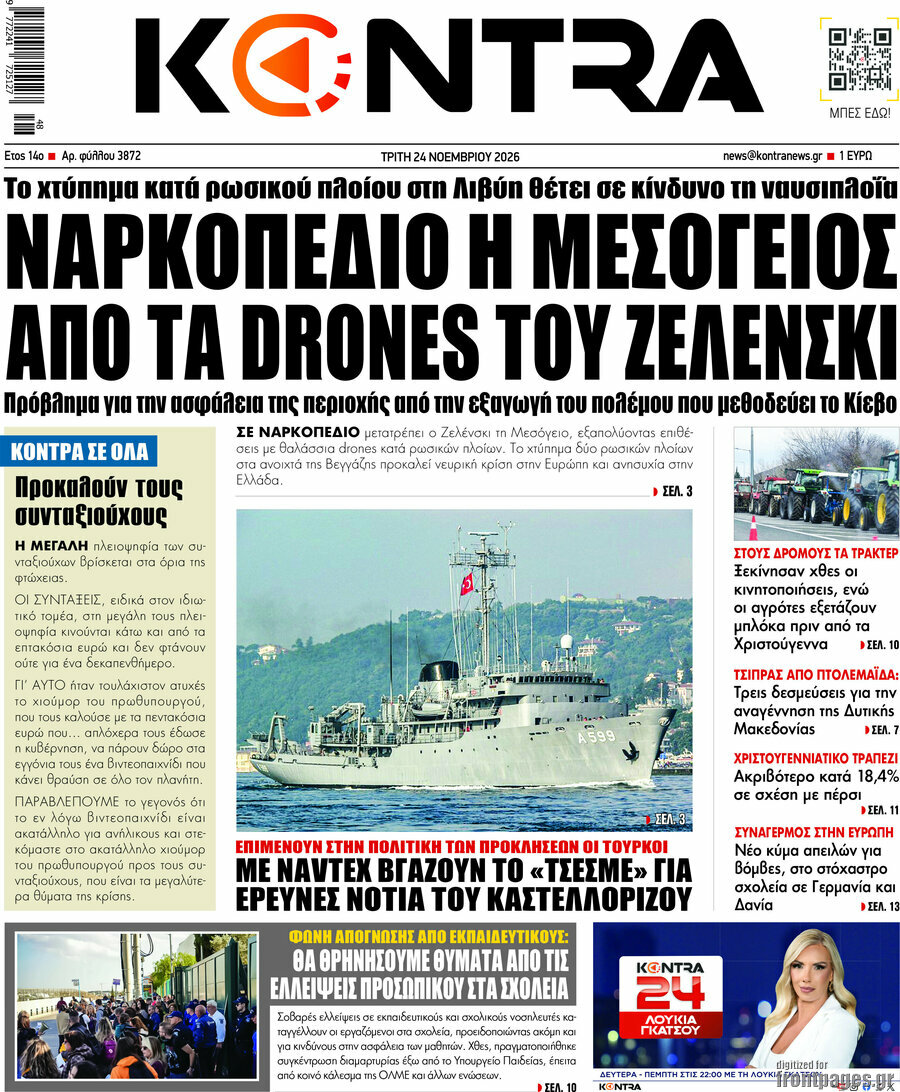
KONTRA NEWS: The Mediterranean is a minefield full of Zelenskyy’s drones
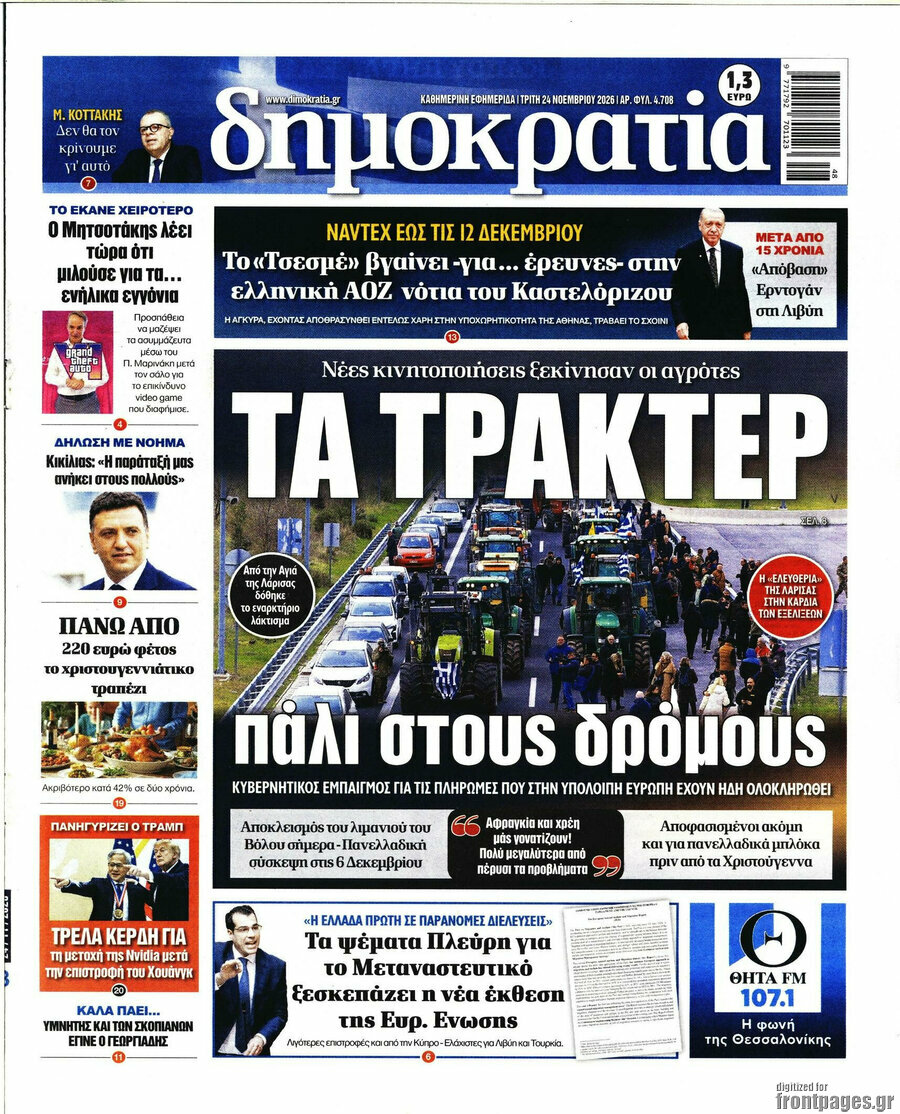
DIMOKRATIA: Farmers hit the roads again
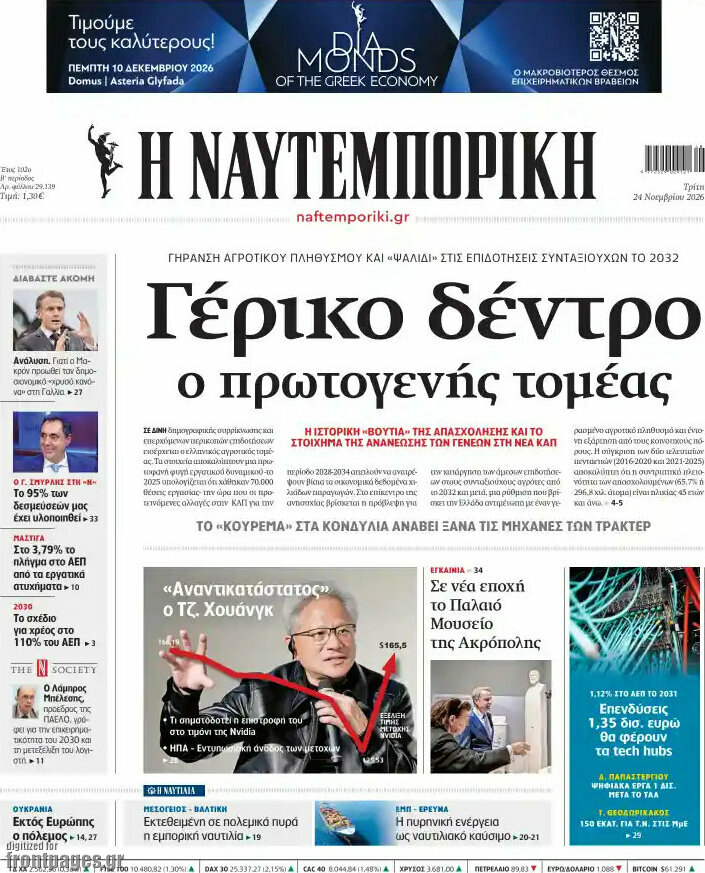
NAFTEMPORIKI: Primary sector is an old tree

DRIVING THE DAY
HOBBLING THE HAGUE: A Trump-backed proposal to curb the reach of the International Criminal Court will test Europe’s support for the court, after Washington last month imposed sweeping sanctions and threatened to dismantle it “brick by brick.”
The proposal would limit the ICC’s ability to prosecute citizens of countries that haven’t joined the court — including the U.S., Russia, China and Israel. It could shield Donald Trump, Vladimir Putin, Xi Jinping and Benjamin Netanyahu from prosecution, according to four senior government officials and EU lawmakers aware of the plans.
For Brussels, the dispute adds to wider tensions with Washington over digital taxes and support for Ukraine. It also puts EU countries at odds over how far to go in defending the court: some want to seek a deal with the U.S.; others want the European Commission to activate a blocking statute to stop EU countries complying with Washington’s sanctions.
When to watch: ICC member countries are due to debate the proposal, officially put forward by Guatemala, at the court’s annual meeting in The Hague starting on Monday, according to the officials.
What’s at stake: The proposal calls for dialogue with non-member countries on limiting the court’s ability to pursue their citizens. If adopted, it would mean “the ICC can no longer prosecute heads of state from countries that are not members of the Rome Statute” founding the court, French Socialists and Democrats lawmaker Chloé Ridel said.
A statement signed by Trump, Putin and Xi at their meeting in Shenzhen last week also called for limits on the ICC.
“The outcome of the trilateral summit between Xi, Trump and Putin clearly shows the intent by the three leaders … to empty the jurisdiction of the Court, and grant themselves and their citizens impunity from prosecution by the ICC,” said Dutch center-right MEP Dirk Gotink, who has written to U.S. lawmakers over the ICC.
“They want to save themselves,” a senior official from an ICC member country, granted anonymity to discuss the non-public process, said of Trump, Xi and Putin. (The ICC hasn’t brought proceedings against Trump or Xi. It issued an arrest warrant against Putin in 2023 over the alleged unlawful deportation and transfer of children from occupied areas of Ukraine, and against Netanyahu in 2024 for alleged war crimes and crimes against humanity arising from Israel’s military offensive in Gaza. Putin and Netanyahu have denied the allegations and rejected the court’s jurisdiction.)
The U.S. response: “President Trump and Secretary Rubio have made clear that the ICC must stop threatening American sovereignty. The United States never agreed to ICC jurisdiction over its service members, officials or nationals,” the State Department wrote in response to questions. “Either the ICC will end its threats, or we will end the ICC.”
Europe’s response: Belgium’s Foreign Minister Maxime Prévot told Playbook he is “concerned by the various reports surrounding possible new initiatives concerning the International Criminal Court.” The Shenzhen declaration’s language on the court’s jurisdiction and state officials’ immunity “adds to these concerns,” he said.
ICC backers are divided over whether to seek a deal with Washington or push for the Commission to activate the blocking statute, the senior official said. The Netherlands has denied a report that it is bending to U.S. pressure, and an EU diplomat described the Dutch as a “driving force behind the efforts of countries seeking to uphold the International Criminal Court.”
BIG AND BREAKING
GHOSTS OF THE SPANISH CIVIL WAR: The prospect of the far right entering national government after this weekend’s Spanish election is reopening the wounds of a war that began 90 years ago, Aitor Hernández-Morales writes.
FREDERIKSEN UNDER FIRE: The S&D group in the European Parliament will formally discuss Danish PM Mette Frederiksen’s migration stance following her recent comments about the “great replacement” theory and Denmark’s deal with Rwanda to host a return hub. Max Griera has the story.
PEACE WON’T END RUSSIAN ATTACKS: A peace deal in Ukraine wouldn’t stop Moscow’s sabotage campaign against Europe, the minister overseeing Poland’s intelligence services, Tomasz Siemoniak, told my colleague Bartosz Brzeziński.
“Only through sustained pressure can we make Russia accept a ceasefire,” Estonia’s Foreign Minister Margus Tsahkna argues on POLITICO today, explaining why his country is closing its border with Russia. That’s after Moscow’s foreign ministry yesterday accused Estonia of hostile actions “on the verge of triggering open war,” per Reuters.
And in Helsinki … Finland has summoned Moscow’s ambassador over suspicions that a Russian helicopter violated Finnish airspace over the weekend.
INSIDE GERMANY’S DRONE BUILDUP: Germany is launching a new kind of fighting force: its first-ever drone regiment, shaped by what Ukraine has learned on the battlefield, built to see farther, strike deeper and keep enemy drones at bay, Chris Lunday reports.
BUDGET BLOWUP
THE BIG BUDGET BRAWL: EU leaders are set to square off at this week’s European Council summit after the bloc’s 27 ambassadors clashed over the Multiannual Financial Framework last night, three EU diplomats told Gregorio Sorgi and me.
“This could be a bloody EUCO,” said one of the diplomats, adding that “if everyone goes too far, it’s too difficult to come back” in December, which is the informal deadline for governments to reach a deal on the next seven-year budget.
But in their three-hour discussion, ambassadors signaled it’s still too early to be making concessions. That’s despite some leaders appearing more conciliatory toward European Council President António Costa’s budget proposal, which suggested reducing the size of the next budget by a further €44 billion.
Northern European countries, the so-called frugals, pushed for more cuts while a rival coalition of southern and eastern states — the “Friends of Cohesion” — complained that the proposed budget is too small. A group of eastern countries rejected new EU-wide taxes, or “own resources,” arguing that the taxes would disproportionately affect them.
 |
Franco-German fight: The discussion became so unruly that ambassadors traded barbs. Germany’s Thomas Ossowski rejected funding for far-flung territories, saying they are remote and scarcely populated, according to one of the diplomats who was granted anonymity due to the sensitive nature of the talks. France’s Philippe Léglise-Costa shot back that “I prefer to pretend I didn’t hear what I just heard,” another diplomat said.
At Thursday’s summit, leaders will also aim to make progress on a €45 billion loan to Ukraine for 2027. German Chancellor Friedrich Merz is pushing four countries — Hungary, Slovakia, Czechia and Bulgaria — to share the borrowing costs associated with the loan and has threatened to block the EU budget if they hold out.
The new Orbán: Slovak Prime Minister Robert Fico is emerging as the most hard-core opponent of Ukraine financing, while Hungary, Czechia and Bulgaria are open to finding solutions, said two EU diplomats with knowledge of proceedings. A potential solution could involve paying the borrowing costs of the Ukraine funding that doesn’t finance military spending, Bulgarian Deputy Prime Minister Atanas Pekanov told Playbook.
20-SECOND PLAYBOOK PRIMER
Tomorrow there’s an EU-Western Balkans summit in Brussels …but what happens at these events? António Costa and European Commission President Ursula von der Leyen will meet the leaders of Albania, Bosnia and Herzegovina, Kosovo, Montenegro, North Macedonia, and Serbia. They’ll discuss the EU enlargement progress, economic integration and security cooperation between the two sides.
PARLIAMENT’S MIDTERM THEATER
COUNTDOWN: The leaders of Renew, the S&D and the EPP will meet this afternoon to hammer out a deal on a written coalition pact, two people familiar with the process told Max Griera. S&D leader Iratxe García and Renew’s Valérie Hayer are hoping that the agreement, which could be finalized as soon as next week, will curb Manfred Weber’s party’s reliance on far-right votes.
Five working clusters — each comprising one representative from each group — are drafting one-page programs about files the groups will commit to working on together and how they’ll do it. POLITICO’s Parliament WhatsApp channel has the full lineup of MEPs (you should sign up).
Yet a list of shared commitments may change little, as the three already agree on most files. The test is whether S&D and Renew can use their backing for a third term for Parliament President Roberta Metsola to extract a pledge from the EPP not to vote with the far right whenever it’s hard to reach a centrist compromise, according to three people.
What really matters … is the cluster negotiating coordination, dispute resolution and sanctions in case of breaches. It will determine whether the pact has teeth, or is just theater.
Tough sell: The conservatives don’t feel the need to avoid the far right when national governments are increasingly working with them. As it happens, Spain’s Dolors Montserrat is leading in three of the clusters for the EPP while her People’s Party is poised to join a government with the far-right Vox party after Sunday’s election.
5 MORE THINGS GETTING US TALKING
SKILLS AND JOBS: The Commission is today set to unveil its European Skills Observatory — a new platform bringing together EU data on education, employment and skills to help track labor market trends — amid fears AI could be squeezing young people out of entry-level jobs, according to an EU official.
DON’T WAIT FOR COHESION: The Commission will also approve its 10th Cohesion Report, a snapshot of Europe’s regions published every three years, alongside the European Semester. But its unveiling will likely slip to next week, since Commissioner Raffaele Fitto can’t make it to Strasbourg for unexpected personal reasons, two Commission officials told Playbook.
NVIDIA FACES A POLITICAL STORM: Jensen Huang is back at the helm of the leading global chipmaker — but he’s about to get a hostile reception on Capitol Hill from members of both parties. My stateside colleagues also report that Vice President JD Vance played a central role in Huang’s return to the company.
HOW EUROPE’S SECURITY SETUP COULD CHANGE: The U.S. and Russia are pressing Europe to overhaul the continent’s security architecture in a bid to end the war in Ukraine — and that could mean anything from giving Moscow a bigger say to no change at all, Victor Jack reports.
SANCTIONING SOLDIERS: The EU wants to target former Russian soldiers, banks, crypto platforms and sports teams in its 22nd sanctions package against Moscow since the full-scale invasion of Ukraine, European Commission President Ursula von der Leyen announced.