
PASOK party united, ensuing polls the true test
The main opposition socialist party PASOK emerged from its three-day congress Sunday having hardened its stance against any post-election cooperation with the ruling New Democracy party, reshaping the country’s political calculus. The congress projected an image of unity, with no significant internal dissent surfacing during proceedings.
https://www.ekathimerini.com/politics/1299643/pasok-party-united-ensuing-polls-the-true-test
Court win for whistleblower at scandal-ridden farm subsidy agency
A key whistleblower working for a state farm subsidies agency that’s at the heart of a European Union fund misuse scandal has won a court battle to regain the senior auditing position from which she was “illegally” demoted, her lawyers said Monday. Lawyers for Paraskevi Tycheropoulou said in a statement that an Athens court has ordered her reinstatement as director for internal auditing at the now-defunct state OPEKEPE organization.
Greece braces for thunderstorms from Storm Erminio
Greek authorities have warned of a severe weather event which is expected to sweep over the country late Tuesday and peak on Wednesday, bringing thunderstorms, gusty winds, and possibly hail. The weather is driven by a double cyclogenesis in the Mediterranean associated with heavy precipitation that has already brought storms in parts of western Europe.
https://www.ekathimerini.com/news/1299688/greece-braces-for-thunderstorms-from-storm-erminio
Theodorikakos: Strong possibility that profit margin cap for basic goods will continue after June 30
Development Minister Takis Theodorikakos on Monday warned of the risk of surging inflation and the threat of a slowdown in the country’s growth rate due to war in the wider Middle East region, in an interview with ANT1 TV.
ATHEX: No pretext found for a rebound
The benchmark of the Greek stock market narrowly managed to stay above the psychologically important 2,000-point level, but on Monday it dropped to its lowest point since the first week of November 2025. Uncertainty drives a trader’s cautious approach, with turnover also in decline. The market fears a further expansion of the war in the Middle East, and although it seeks the pretext for a rebound in the various statements from either side of the conflict, the outlook remains grim.
https://www.ekathimerini.com/economy/1299647/athex-no-pretext-found-for-a-rebound

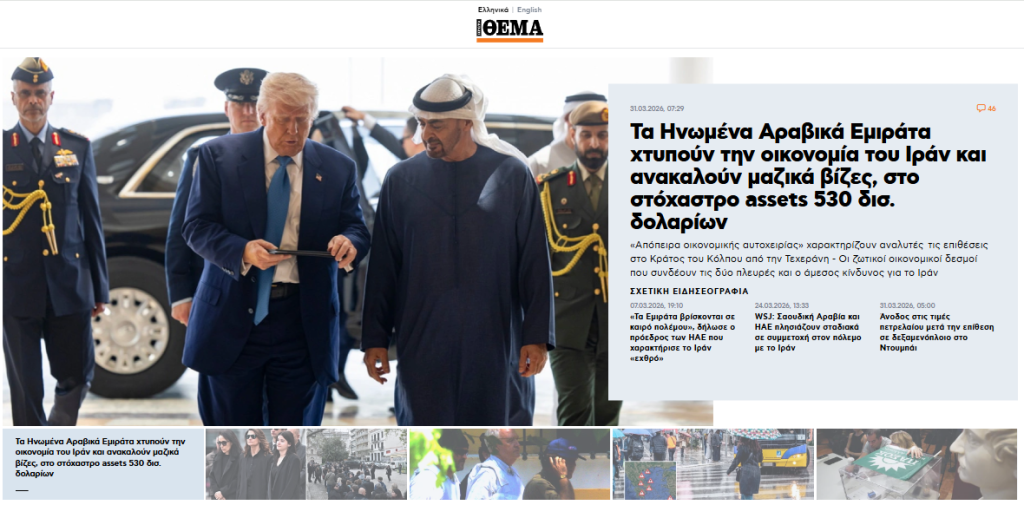
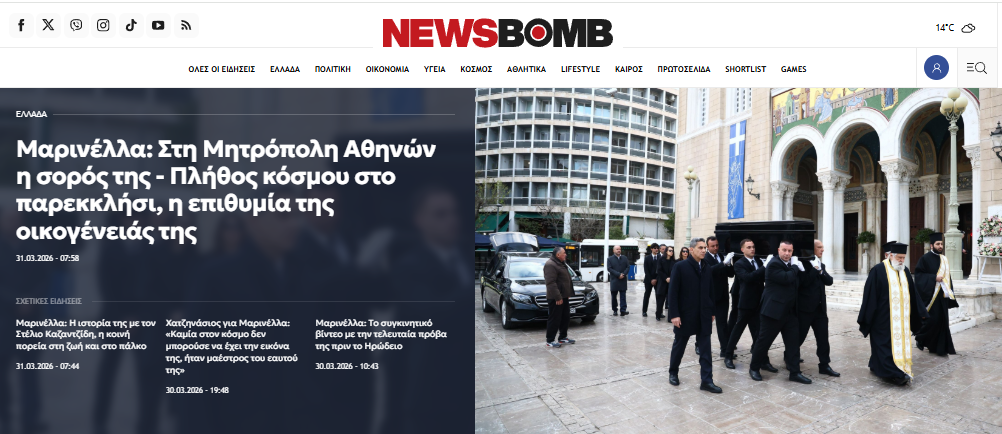
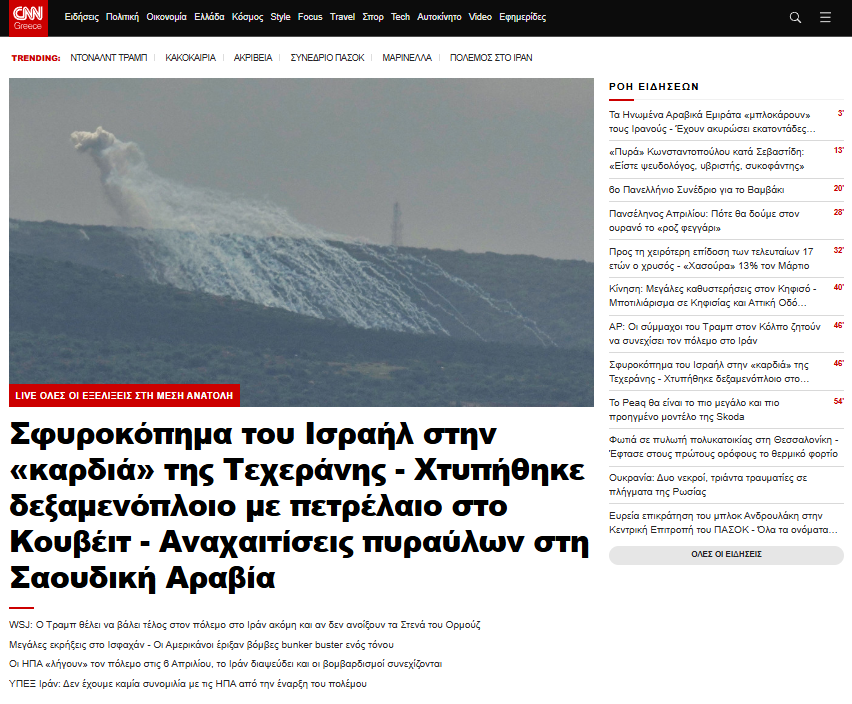
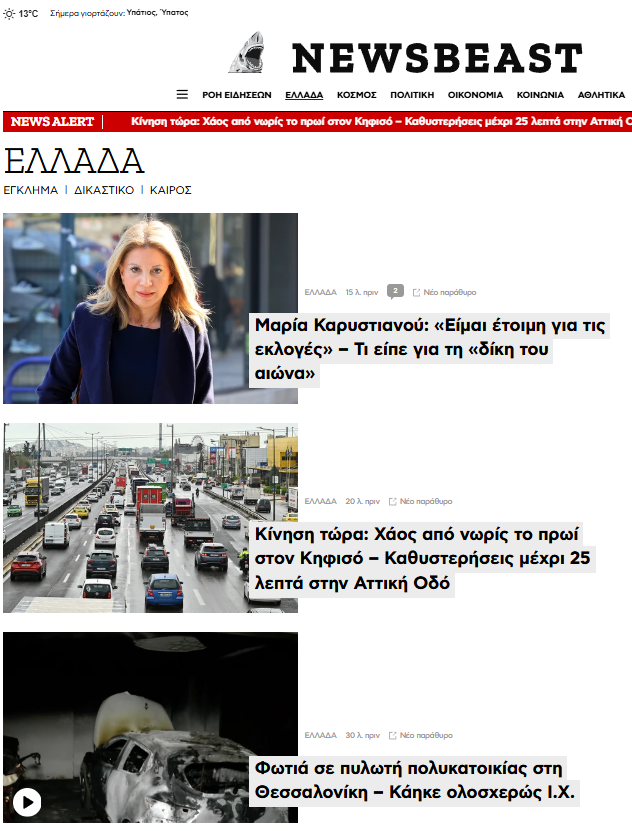

KATHIMERINI: Concern about Christians inside the “hell” of the Middle East
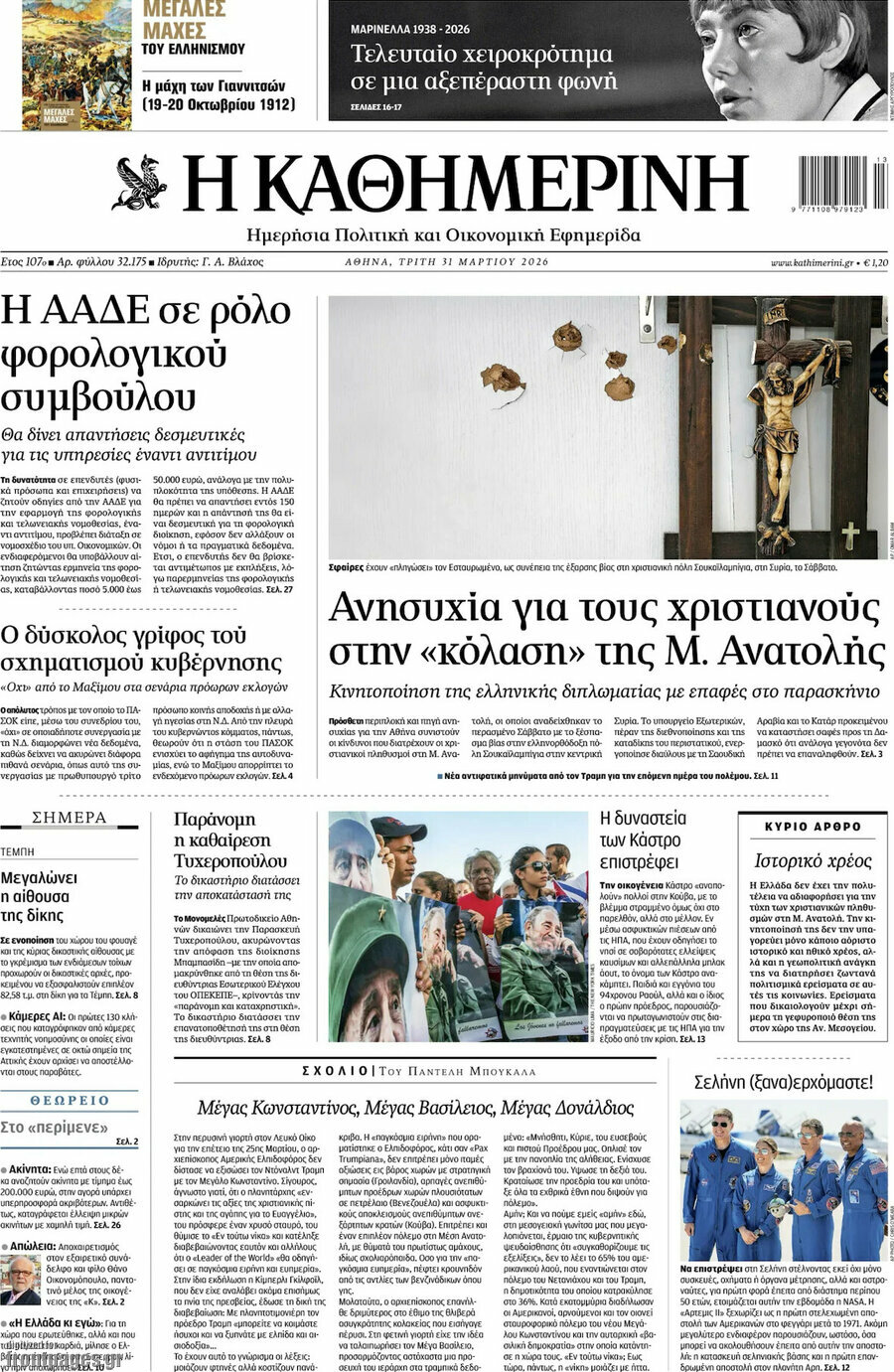
TA NEA: Fuel: SOS regarding adequate reserves
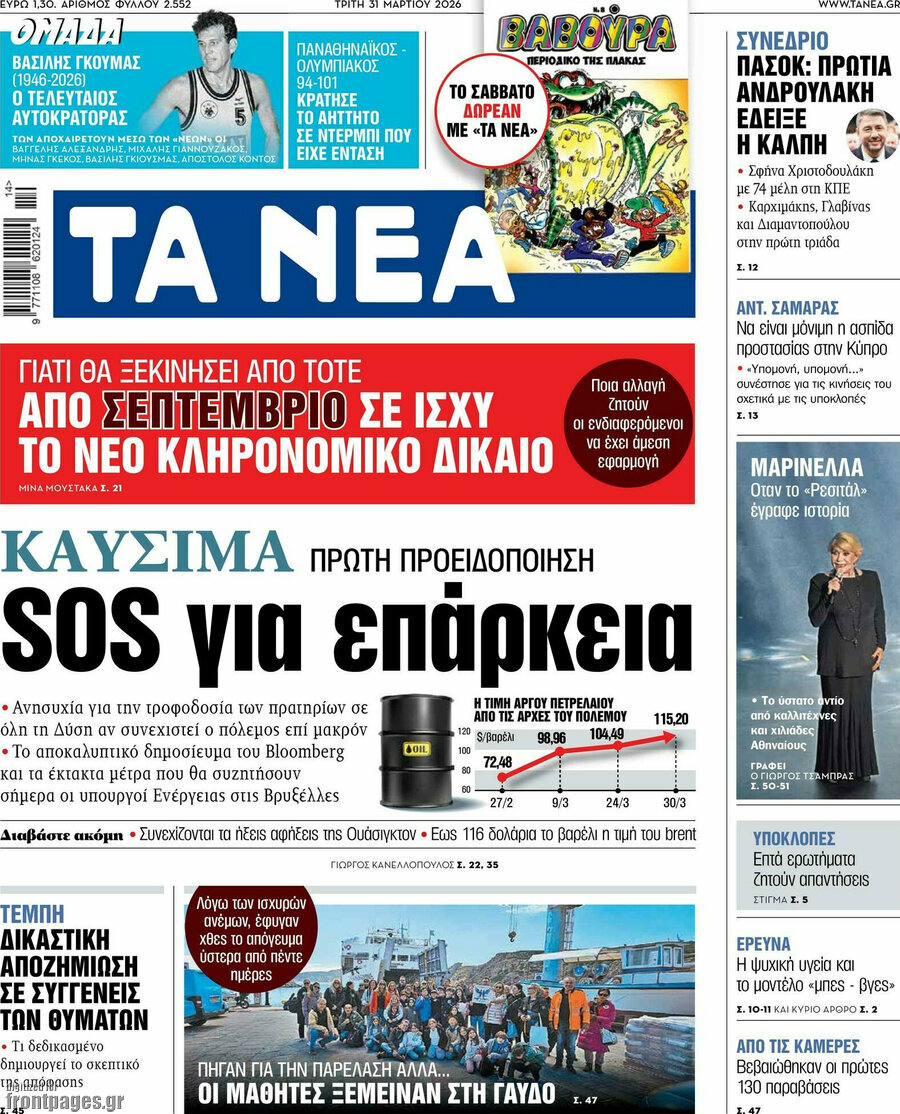
EFIMERIDA TON SYNTAKTON: The myths of the Mitsotakis system
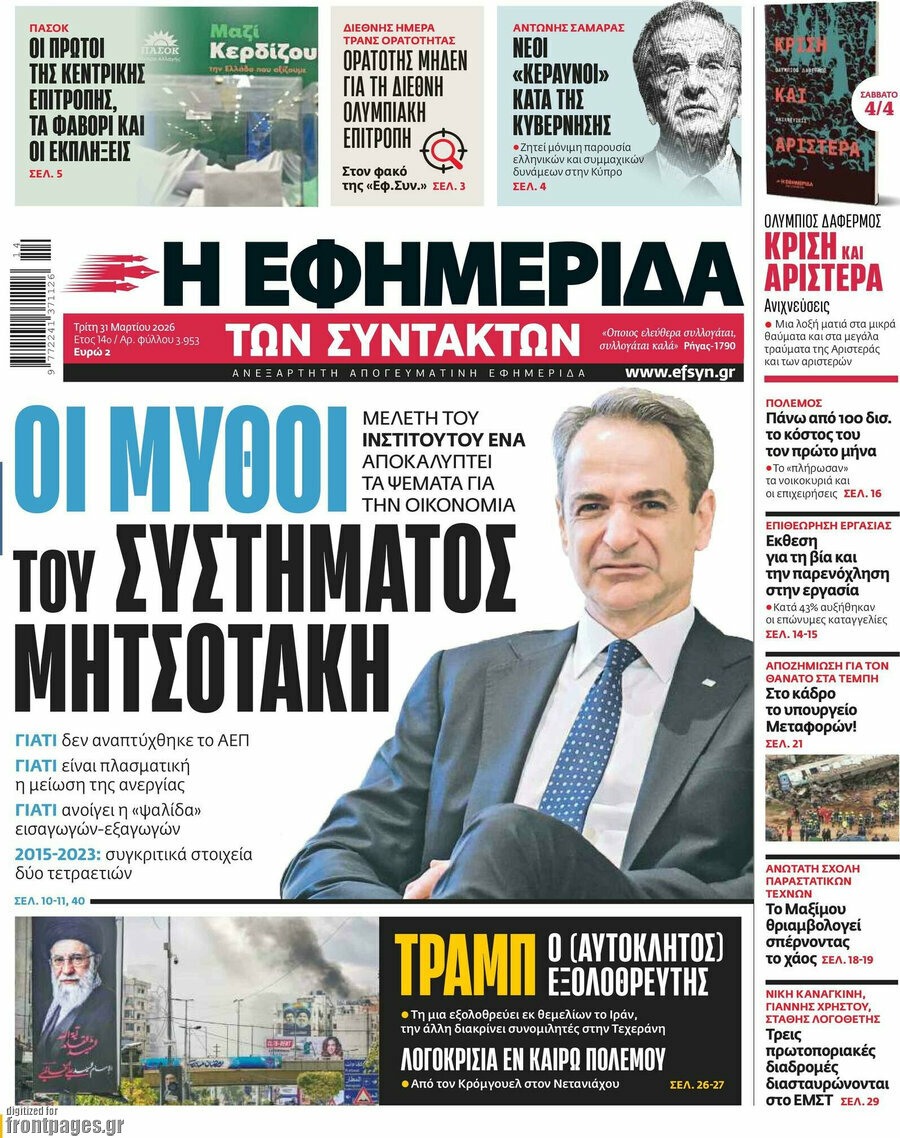
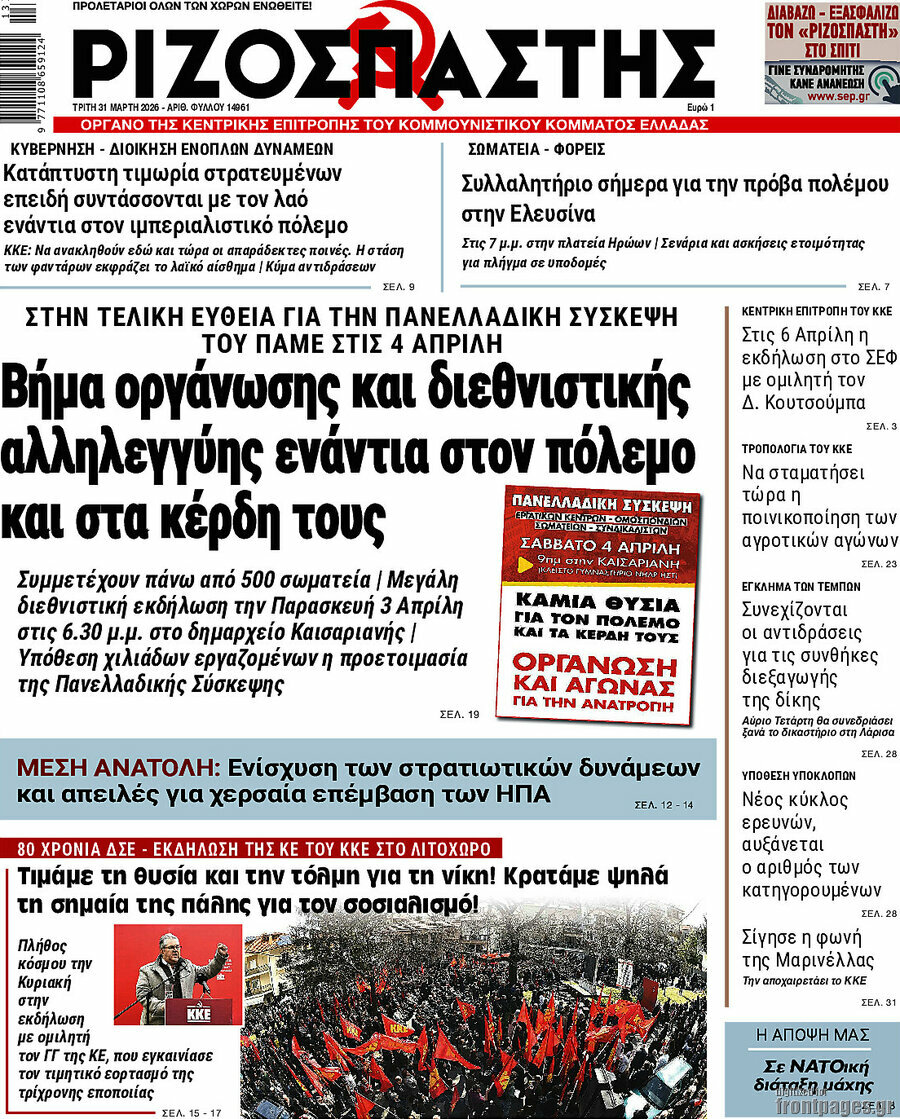
RIZOSPASTIS: The Greek Communist Party’s workers union convenes national meeting against war and profiteering
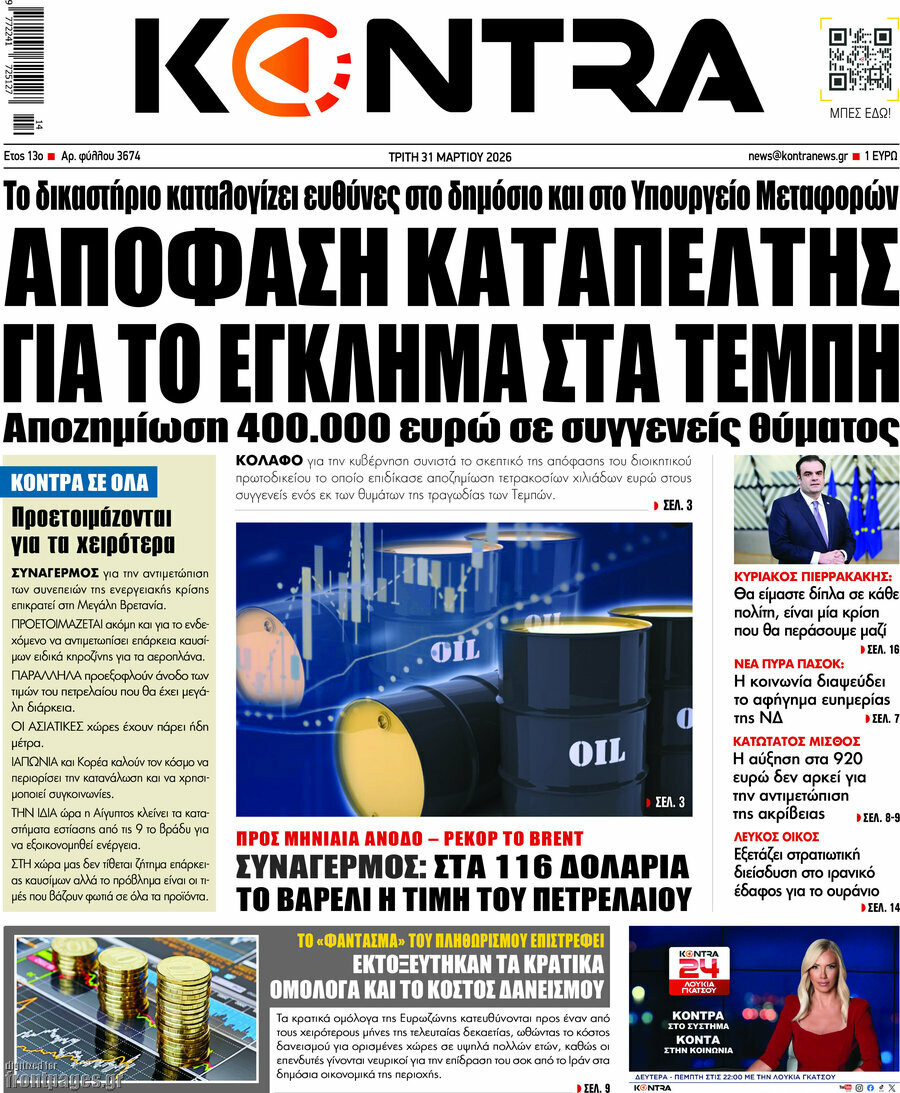
KONTRA NEWS: Court ruling slams the state and the Transport Ministry for the crime at Tempe
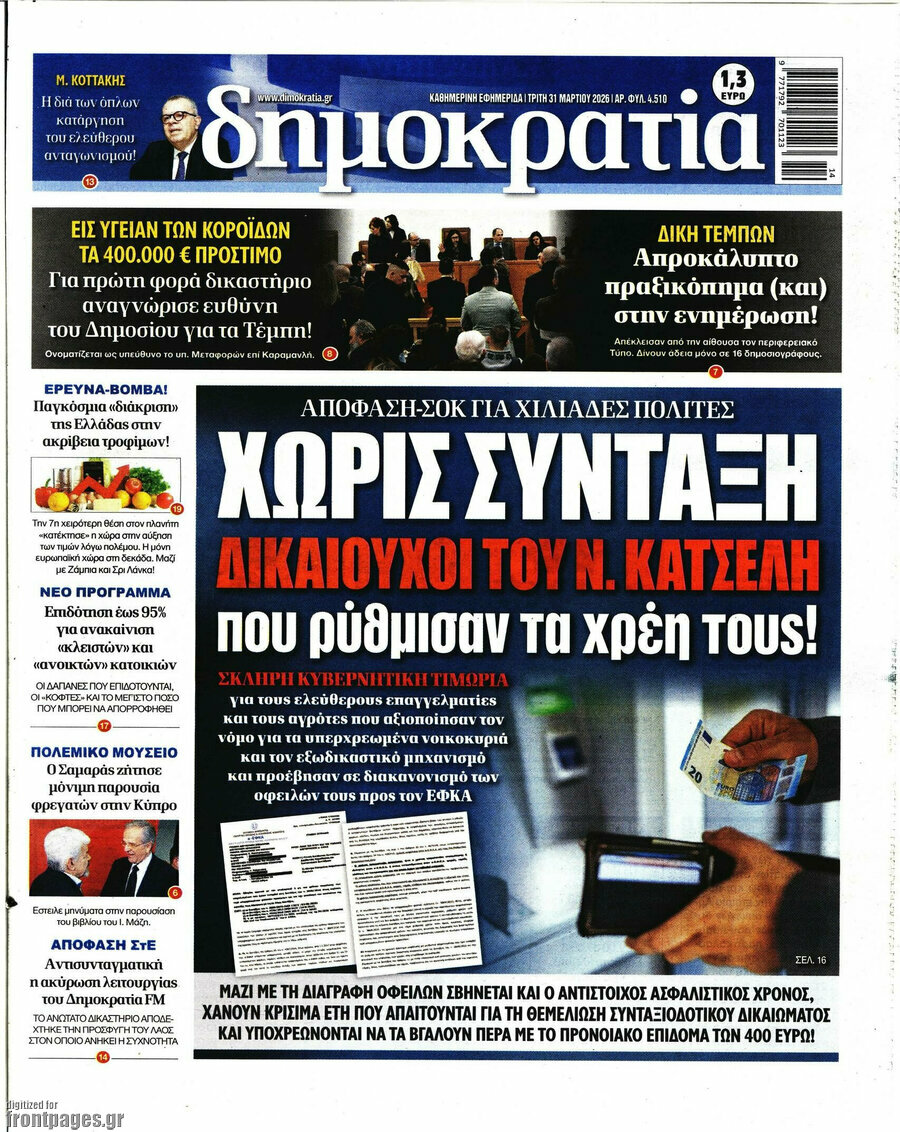
DIMOKRATIA: No pension for beneficiaries of the Katselis law who had regulated their debts
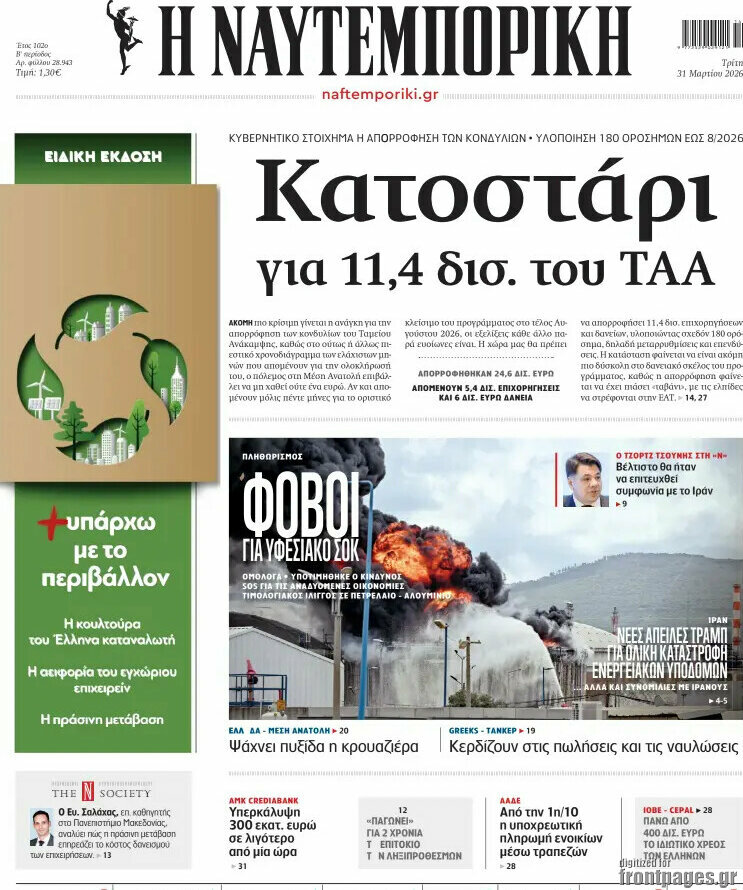
NAFTEMPORIKI: Speed race for 11,4 bln from the RRF

DRIVING THE DAY
EUROPE SHOWS UP FOR KYIV: The EU’s top diplomat Kaja Kallas hosts an informal gathering of EU foreign ministers in Kyiv today. The meeting marks the fourth anniversary of the Bucha massacre, when Russian troops killed more than 400 people in a commuter town 34 kilometers from the Ukrainian capital.
WWII-scale atrocities: The informal Foreign Affairs Council, which will bring together 12 EU foreign ministers plus other national representatives, will focus on bolstering accountability for war crimes committed during the war. “The scale of Russian atrocities in the course of its aggression is unseen on European soil since WWII,” Ukraine’s Foreign Minister Andrii Sybiha wrote in a post on X ahead of the meeting.
“There must be accountability and … no amnesty for Russian criminals, including the highest political and military leadership of the Russian Federation,” Sybiha wrote.
What’s in focus: The idea is to establish a special tribunal for the crime of aggression against Ukraine, something that has been discussed for years. The tribunal currently has about 10 states backing it, according to the Council of Europe, the non-EU human rights and democracy organization organizing the initiative. Of those countries (which the Council of Europe declined to name), Ukraine, Estonia, Luxembourg and Lithuania have completed parliamentary procedures to set up the tribunal.
What to look out for: The initiative needs the backing of as many countries as possible if it is to have international legitimacy and attract sufficient funding, ideally including larger countries. Germany and the U.K. have both shown support for the tribunal, though it’s unclear if either will make a public declaration today.
Come one, come all: The backers don’t have to be EU or even European countries — the so-called “Enlarged Partial Agreement” that underpins the tribunal allows for countries not belonging to the Council of Europe to join. (Russia, which was kicked out of the CoE in 2022, isn’t eligible).
Where would it be based? A key question that’s been dogging the debate since it got going in the aftermath of Russia’s full-scale invasion is whether the tribunal is established inside or outside Ukraine. If it’s outside, a natural home would be in The Hague, which already hosts the International Criminal Court.
Who’s going to Kyiv? The foreign ministers of Germany, Poland and Italy … France’s Europe minister … transport and education ministers from other countries … and the vice president of the European Parliament, Martin Hojsík, a Slovak member of the liberal Renew Europe group, according to diplomats and EU officials.
What won’t be happening in Kyiv: Any announcements on the EU’s 20th package of sanctions against Russia or its €90 billion loan for Ukraine. Both are being blocked by Hungary and the default position of the European Council is to wait until after Hungarian elections on April 12 and hope that Budapest lifts its veto.
Ukraine isn’t dithering: President Volodymyr Zelenskyy has been ramping up his outreach in the Middle East, striking a drone deal with Saudi Arabia and offering Ukraine’s help to reopen the Strait of Hormuz. “They understand that our armed forces have been highly effective in unblocking the Black Sea corridor,” Zelenskyy told journalists including my colleague Veronika Melkozerova during a WhatsApp group chat on Monday.
ENERGY CRISIS
EUROPE GEARS UP: With the EU facing a potential energy crisis, complete with flight cancellations and calls to ration fuel, EU energy ministers gather today to take stock and lay out a series of defensive options.
What’s on the menu: According to an invitation letter obtained by Morning Energy’s Ben Munster, ministers will address the possibility of a long-term energy crisis, the need to ensure a steady supply to hard-hit sectors like transport and preparations for a potentially rough 2026-27.
No joke: Energy Commissioner Dan Jørgensen reached out to EU capitals asking them to consider cutting back on oil and gas use, in preparation for a “prolonged disruption” to distribution from the Iran war.
What’s going on: This is the latest in a string of emergency summits devoted to containing the energy crisis now bearing down on Europe. National governments are pulling out the stops to shield consumers and businesses from the price increases. But with limited budgetary space to act, they’re looking to Brussels to come up with EU-wide solutions.
Keep things flowing: Monday’s emergency G7 meeting involving finance and energy ministers yielded a statement calling on “all countries to refrain from imposing unjustified export restrictions on hydrocarbons and related products.”
Rumor mill: There’s even growing talk in Brussels of a potential extraordinary European Council on the crisis, which is starting to draw comparisons to the Covid-19 era and its special-relief measures. The fact that Easter holidays kick off next week may reduce the chances of such a gathering taking place — but if leaders’ holidays are called off due to flight cancellations, they might have little to lose.
REFURB ROW
CONFERENCE AMBITIONS: The European Committee of the Regions has laid out plans for a €49-million renovation of its Brussels headquarters — but omitted from public disclosure a 450-seat conference hall estimated to cost €3.6 million, Gerardo Fortuna reports.
Project Conference Hub: Details of the proposed new hall for the CoR, the organization that brings together EU mayors and other local leaders, are contained in separate documents seen by POLITICO. The omission has prompted labor unions representing the committee’s workforce to complain about a lack of transparency.
Don’t call it a plenary hall: The hub’s features suggest it is being designed as a chamber to host the CoR’s 329 members for their plenary sessions, held up to six times a year. The documents reveal plans for interpreter booths, VIP areas and press facilities — in what would provide “autonomy from European Parliament and European Commission buildings,” that are currently used for the plenaries.
Regional grandeur: One staff union source described the project as a “megalomaniac plan,” saying it was being advanced subtly, under the broader — and less controversial — umbrella of necessary building renovations. The same documents indicate the space could be let out to other institutions.
A CoR spokesperson stressed the need to upgrade aging buildings to meet fire-safety, health, environmental and security standards — without referring to the conference hub.
Job alert: Separately, the vacancy notice for the CoR’s next secretary-general was published yesterday. Petr Blížkovský, who has held the post since December 2019, is approaching the end of his mandate. Blížkovský said he has yet to decide whether to apply.
HIGH TECH COMMS
TECH FAIL AT EUROGROUP: Raising your hand virtually during a Teams or Zoom meeting? That would be too easy. Eurogroup members are running a “mirror room” during their virtual meetings to keep track of speaking requests, Ryan Heath writes in to report.
How it works: Instead of using the “raise hand” function on their video-call software, a complete mirror of the meeting takes place in person in Brussels, where IRL advisers — acting on information shared by their minister on WhatsApp — stick their hands up when their boss wants to speak, according to two EU diplomats familiar with the setup.
Hard to explain: The chair in the “mirror room” then communicates that speaking order (also via WhatsApp) to the actual chair of the Eurogroup, who then calls on the next speakers. “It’s a rather odd, slightly archaic hybrid system, with ‘mirror’ arrangements that have grown up around the official platform. I can’t really explain the technical rationale,” one of the stumped diplomats told Ryan.
IN OTHER NEWS
SPANISH BACKLASH: Keep an eye on Washington’s reaction to Madrid’s decision to close Spanish air space to American aircraft involved in the Middle East war. U.S. Secretary of State Marco Rubio warned yesterday that the Trump administration will rethink its commitment to NATO when the war is over … and last night Republican Senator Lindsey Graham was encouraging Donald Trump to hit back at Spain by imposing sanctions and moving U.S. air bases out of the country.
SEEDS OF DOUBT: Kenyan farmers encouraged to grow castor beans by Italian energy giant Eni as part of a climate-friendly jet-fuel initiative have been left high and dry after being abandoned by middlemen, according to this joint report by POLITICO and SourceMaterial.
FALL OF THE BERLIN FIREWALL: The recent alliance between the European People’s Party and far-right groupings in the European Parliament to pass new migration rules remains politically sensitive in Germany, where cooperation with the far right is still a red line for Chancellor Friedrich Merz. That’s why a stunt by AfD MEP Alexander Jungbluth, in which he went to meet his new BFFs at the EPP’s German delegation in Brussels, landed particularly badly. Jungbluth filmed a social media video from the EPP’s offices suggesting the two sides had effectively become “friends” after voting together — but Playbook can reveal that Jungbluth wasn’t well received and got no further than the couch near the elevators.
NOW READ: How did the U.N. special rapporteur on human rights in the Palestinian territories find herself in the crosshairs of the Trump administration? Karl Mathiesen has this deep dive on Francesca Albanese, the Italian legal expert who has wound up on the receiving end of U.S. sanctions usually reserved for narco-barons and terrorists.