
Greece not joining Hormuz naval force
Greece has made clear it will not join a proposed European naval force to escort tankers through the Strait of Hormuz, even as France and other European partners push for broader engagement in the Persian Gulf amid escalating tensions with Iran.
https://www.ekathimerini.com/politics/foreign-policy/1298254/greece-not-joining-hormuz-naval-force
Androulakis: PASOK once again demonstrated its deep social and democratic roots
Main opposition PASOK leader Nikos Androulakis on Monday expressed optimism about the course of PASOK-Movement for Change following the previous day’s process to elect congress delegates. As he stated to public broadcaster ERT, “ PASOK once again demonstrated its deep social and democratic roots. Yesterday’s participation exceeded all expectations.” He noted that 174,813 citizens had sent a clear message “that the need for political change is a social priority that can become a reality.”
Greece approves purchase of air defense system, upgrade of F-16 jets
A Greek parliamentary committee approved on Monday the purchase of a three-billion euro multi-layer air and drone defense system and the upgrade of 38 F-16 fighter jets, with the total cost estimated at about €4 billion, two sources told Reuters.
Extra measures on energy cost
The average rate of gasoline per liter is about to climb over the psychological threshold of €2, with the price of diesel following close behind and, according to market estimates, coming a whisker away from €2, at €1.97-1.98/liter. In electricity, the price of a megawatt-hour in the wholesale market for Monday climbed above €100 and reached €100.39, from €83.39 the previous day and the average level of €89.54 last week, while for Tuesday, after a daily jump close to 16%, it climbed to €116.2. Against this backdrop, the government says it is ready to proceed with additional measures to support households and businesses for as long as the crisis lasts. Sources note that officials are proposing corrections to the fuel profit margin cap after the reactions it has caused in the sector and the advance warning of strike actions by fuel station owners
https://www.ekathimerini.com/economy/energy/1298281/extra-measures-on-energy-cost
ATHEX: Worries clip wings of investors
The positive start in Wall Street reversed early losses at Athinon Avenue on Monday and led to a mild growth in stock prices upon closing, on a day with reduced turnover. The global worries on commodity rates and the fear of stagflation keep investors at bay and contain even the prices of stocks with good prospects, while bond rates keep rising. Greek banks are turning their attention to the three-day Morgan Stanley conference they will take part in from Tuesday in London.
https://www.ekathimerini.com/economy/1298276/athex-worries-clip-wings-of-investors


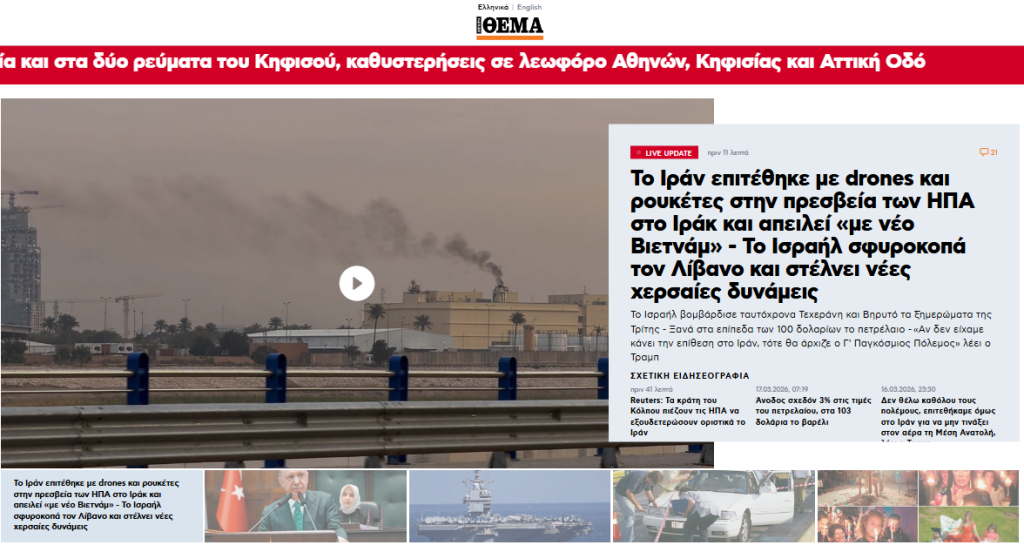
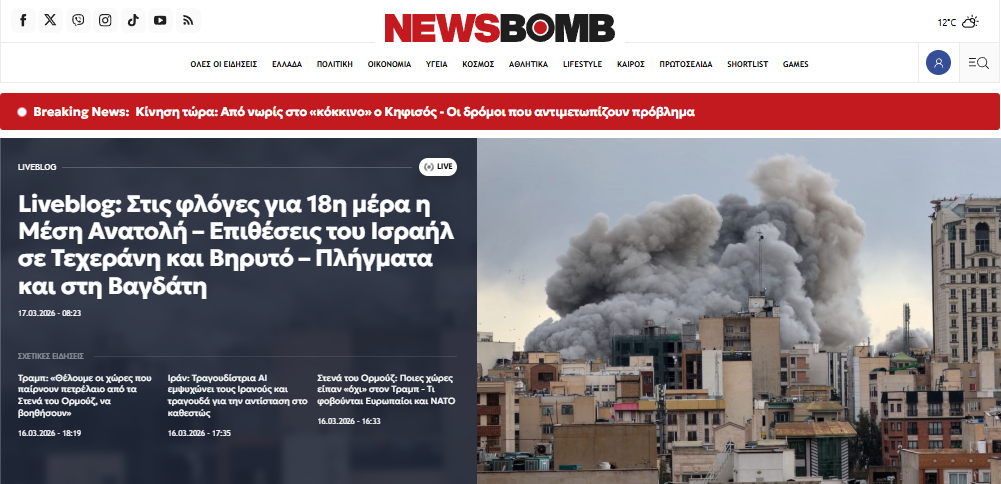
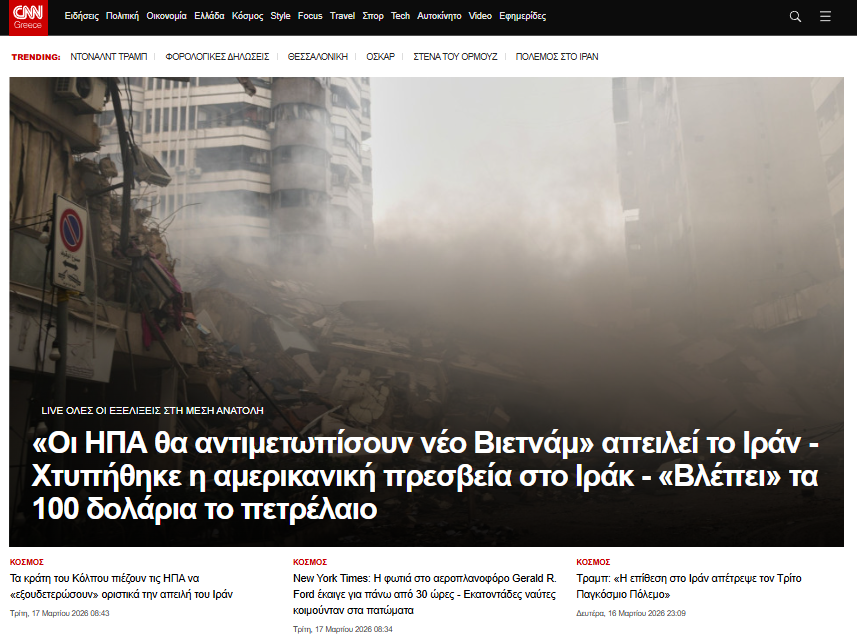

KATHIMERINI: Trump enters the narrow pass of Hormuz
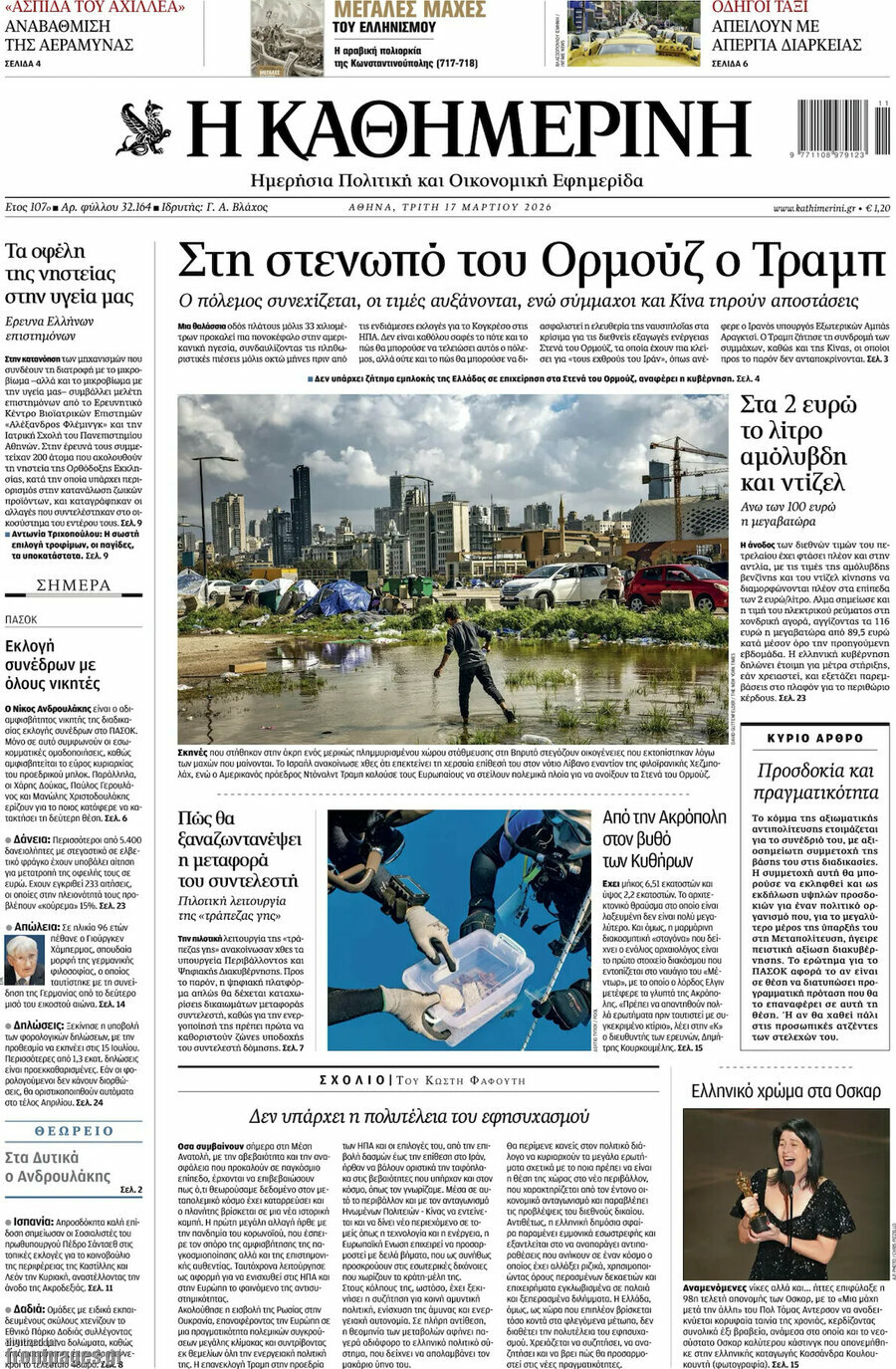
TA NEA: Scandals: 2+1 open wounds
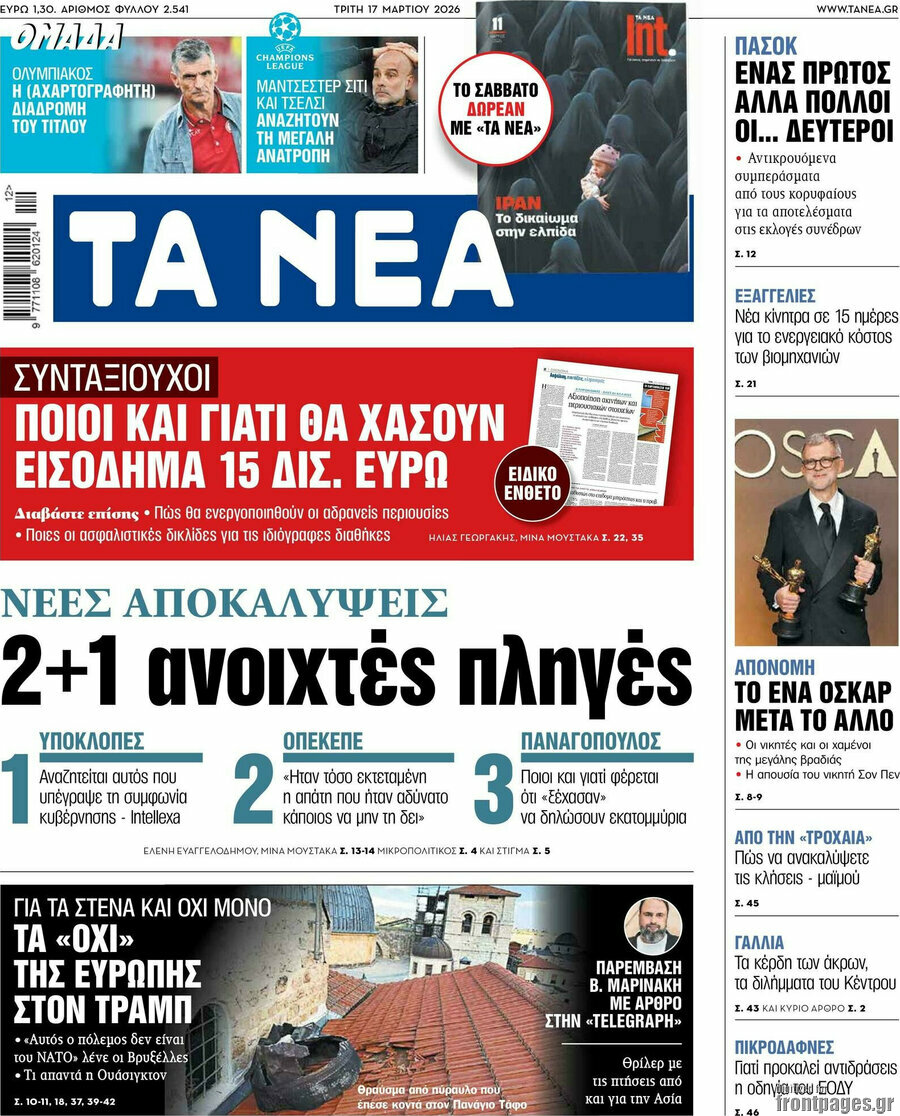
EFIMERIDA TON SYNTAKTON: Euro-Atlantic short-circuit
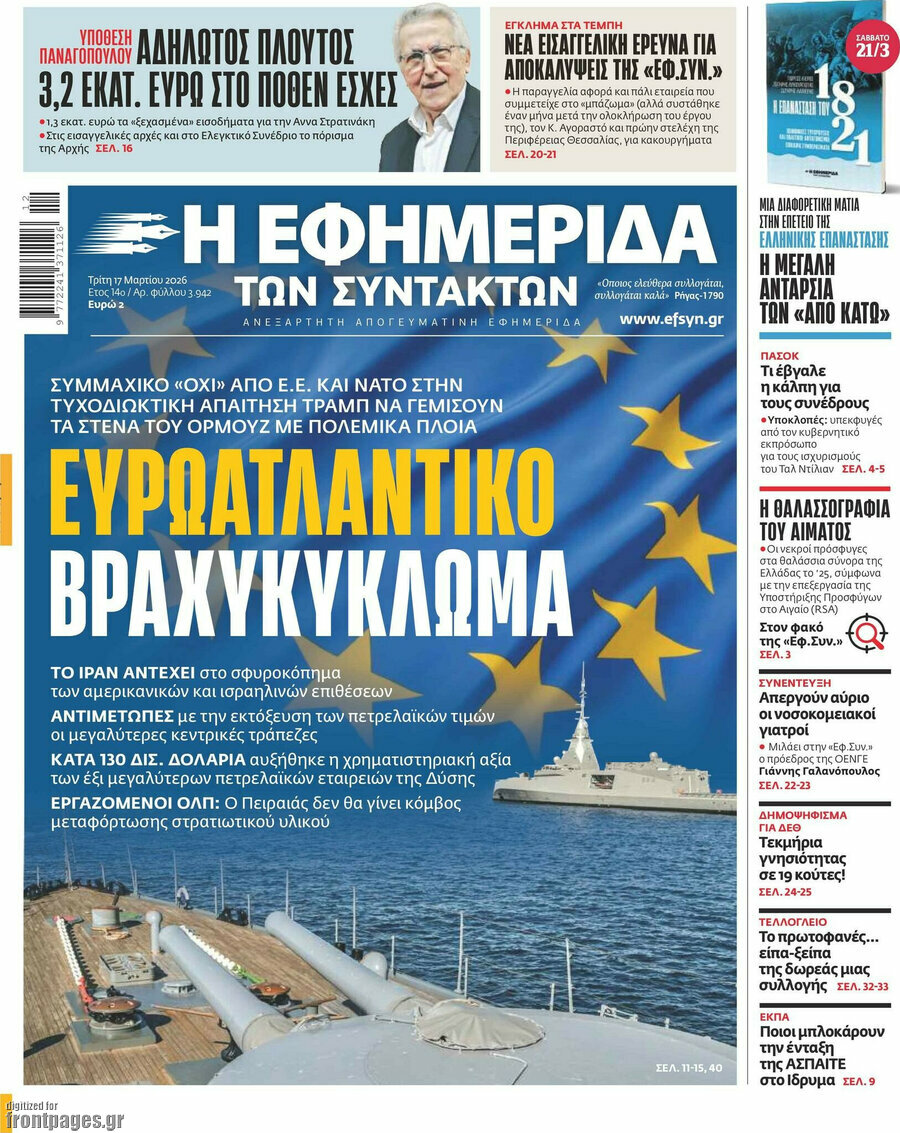
RIZOSPASTIS: The people enter the imperialistic massacre deeper because that is what large business groups ask for
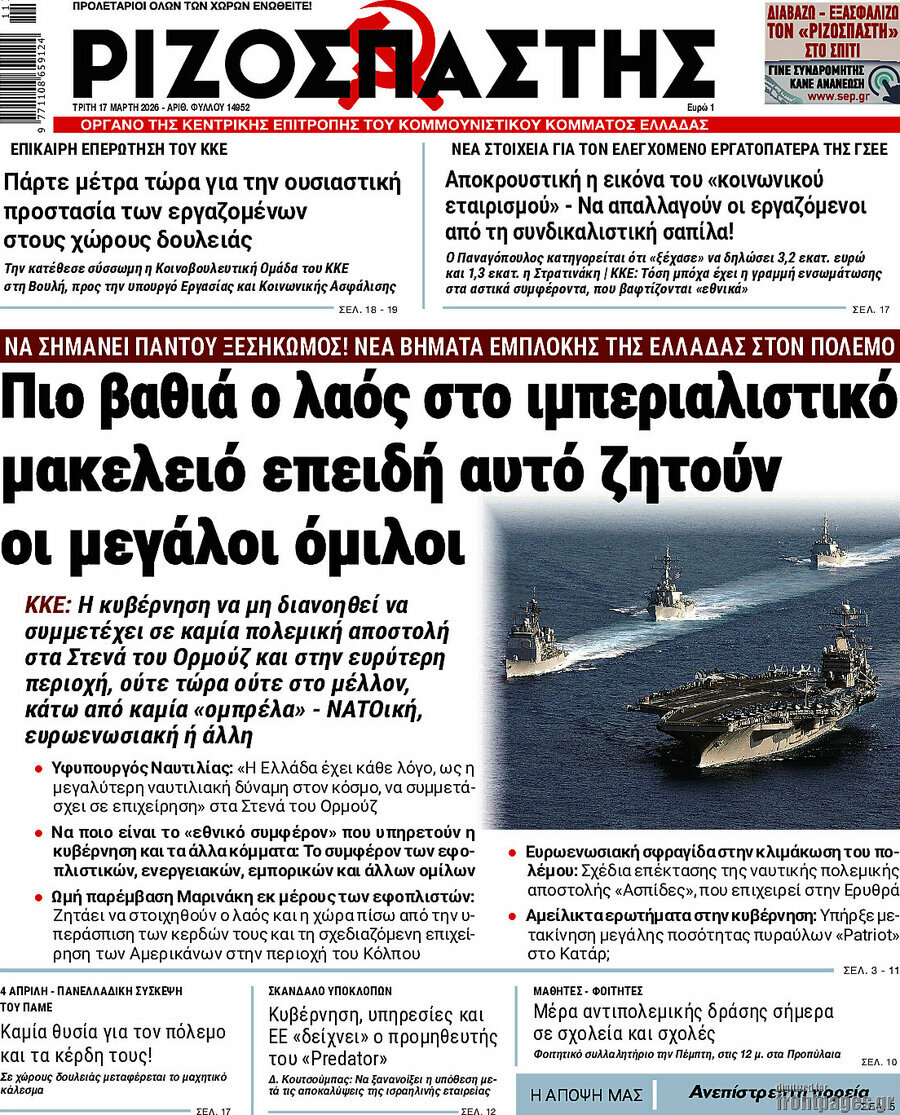
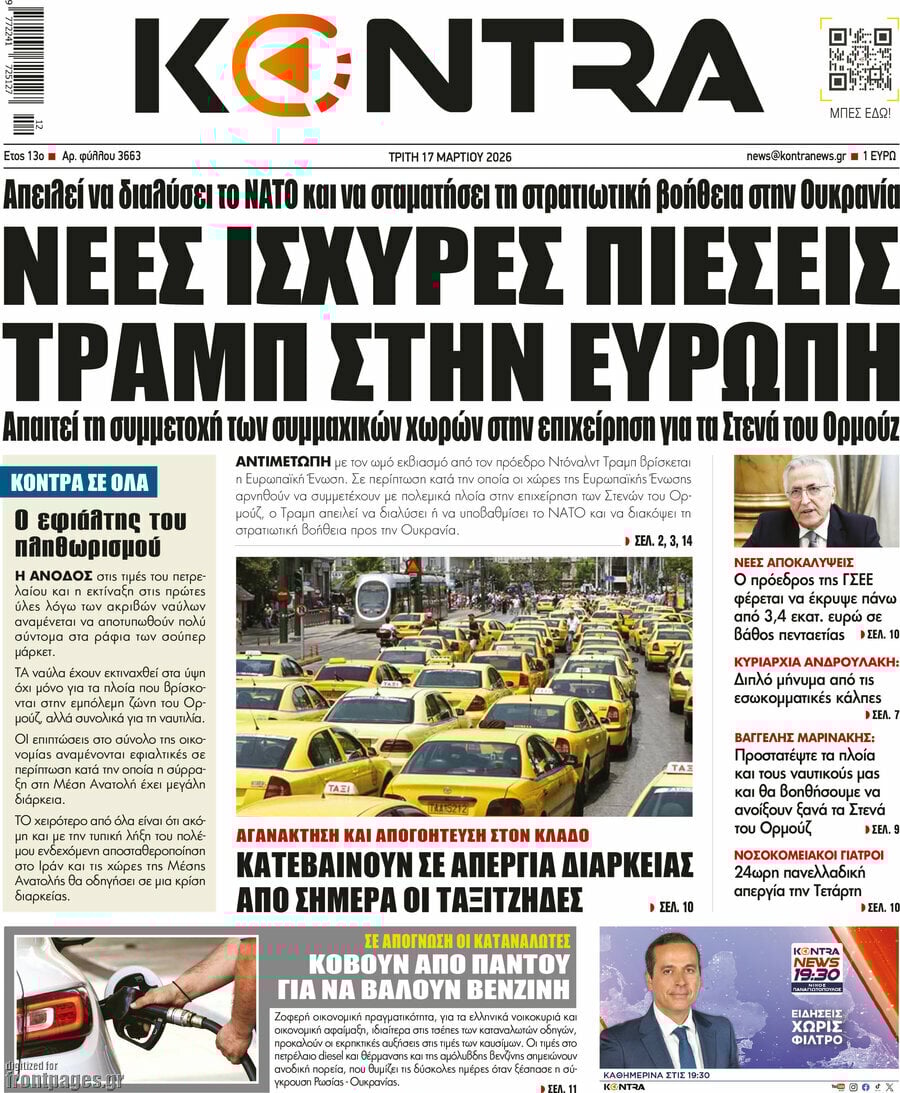
KONTRA NEWS: New intense pressure on Europe by Trump
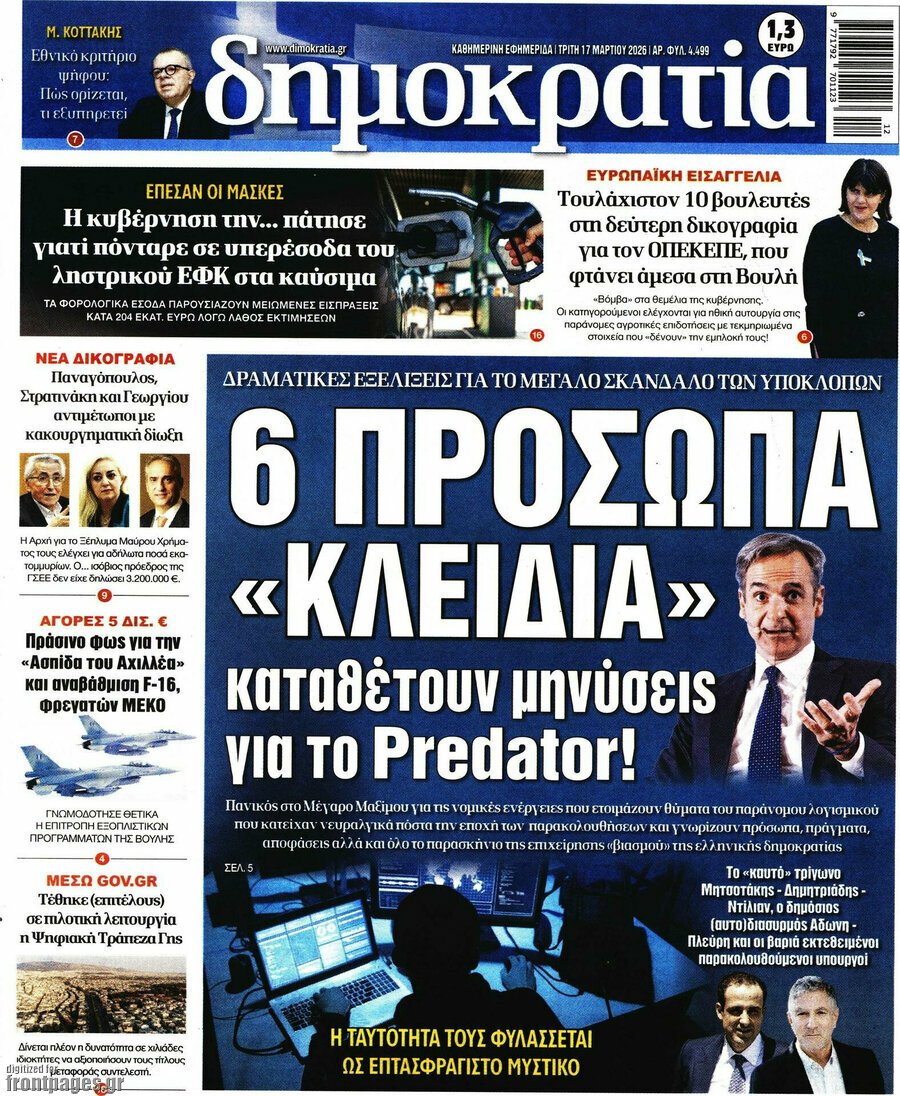
DIMOKRATIA: 6 “key” persons to submit lawsuits for the Predator case
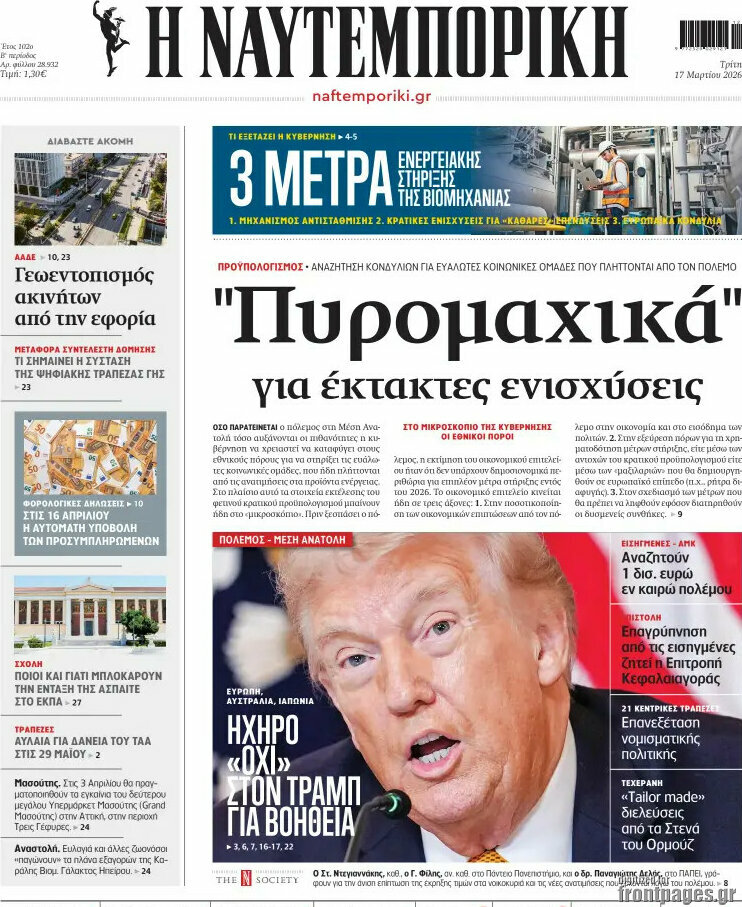
NAFTEMPORIKI: State budget: “Ammo” for extraordinary subsidies

DRIVING THE DAY
IRAN CRISIS OPENS UP NEW TRANSATLANTIC SPLIT: European leaders gathering in Brussels Thursday can add this thorny subject to their talks: the yawning transatlantic chasm between the U.S. and the E.U. on Iran. That gap appears wider than ever, now that European ministers have rejected U.S. President Donald Trump’s appeal for assistance in securing the Strait of Hormuz.
What happened: According to two EU diplomats granted anonymity to discuss the closed-door meeting, foreign ministers who met in Brussels Monday were near-unanimous (although no formal vote was taken) in opposing Trump’s request. A common line expressed during the Foreign Affairs Council, according to the same diplomats, was that EU countries are unwilling to send their ships and troops into harm’s way if Trump — who started the war with Iran, along with Israel — isn’t willing to do so himself.
Read about it: Seb Starcevic and Victor Jack have prepared this account of the day’s diplomacy.
Lonely: Not even Washington’s closest allies in Europe are showing much interest. The foreign minister of Poland, a country that has been at Washington’s side in most recent wars, invited Trump to formally request assistance via NATO, only to specify that Poland’s President Karol Nawrocki (ostensibly a Trump fan) has ruled out sending any Polish troops to the region.
Just make it end: The idea of joining forces with the United Nations to help broker a deal on freeing up the Strait of Hormuz, floated by top EU diplomat Kaja Kallas on Monday, hasn’t sparked much enthusiasm either, the diplomats said. It would be “unrealistic” to expect a anything like the Black Sea Grain Initiative (a U.N.-brokered deal among Ukraine, Russia and Turkey to allow Ukrainian grain exports via the Black Sea) with drones and missiles still flying, one said. Instead, Europeans are banking on hostilities winding down as soon as possible.
How’s Trump taking it? Not well. Speaking to a White House event in Washington, the U.S. president voiced frustration with long-standing allies that were refusing to help out, Reuters reports. “Some are countries that we’ve helped for many, many years. We’ve protected them from horrible outside sources, and they weren’t that enthusiastic [on helping]. And the level of enthusiasm matters to me.”
Not all European leaders are ready to dismiss Trump’s calls for NATO solidarity. Finnish President Alexander Stubb said allies have to take the U.S. president at his word when he says the future of the military alliance hinges on members’ willingness to secure the passage of ships through the Strait of Hormuz, Bloomberg reports.
Sound the alarm: EU-U.S. relations are on thin ice, again, just as the bloc’s leaders face a major obstacle in unlocking €90 billion in funding for Ukraine at Thursday’s summit. Hungary is showing no sign of letting up on its opposition to the loan. Add to that fresh worries about the future of NATO and … we’re back in crisis mode.
HUNGARY BLOWUP: Things are heating up for Hungary. Balázs Orbán, a political adviser to (but no relation of) Hungarian Prime Minister Viktor Orbán, posted on X that Germany’s Foreign Minister Johann Wadephul had threatened Hungarian’s envoy to Monday’s meeting with “serious consequences” if Budapest doesn’t lift its opposition to the loan.
Strong words: The diplomats who spoke to Playbook said Wadephul hadn’t used those words. But he did say that if Budapest’s blockade continues, the EU would have to think about how it deals with such behavior in the future. And he wasn’t alone: Both diplomats said several foreign ministers had spoken up on Hungary, some of them using even more direct language than the German minister.
Losing patience: That tracks with what Playbook heard from other diplomats in the run-up to the European Council summit: The tone toward Hungary is growing sharper and more direct amid frustration over Orbán’s obstructionism. This time is different, they argue, because Hungary is going back on its promise not to oppose the emergency loan.
Summing it up: “Let’s not forget: [Viktor] Orbán approved the loan at the December EUCO. And Hungary then agreed once more when council decided its position in Coreper,” one of the two diplomats cited above told Playbook. “Only at the very last moment did they make the U-turn. It’s not about not letting Hungary defend its interests; it’s about Hungary not keeping to their word, at the expense of everyone else’s interests.”
SLACKENING REGULATION: Meanwhile, the European Commission will look into loosening state aid rules and capping the price of gas to help member countries deal with the energy crisis triggered by the Iran war, according to a letter sent by Commission President Ursula von der Leyen, Ben Munster reports.
GENERAL AFFAIRS COUNCIL
ENLARGEMENT, MFF … WHAT’S GOING DOWN AT THE CAG: EU ministers gather today to talk about enlargement, the long-term EU budget and how to respond to the war in the Middle East at today’s General Affairs Council in Brussels. Playbook dives into these issues and more, courtesy of some helpful diplomats and Austria’s European Affairs Minister Claudia Bauer (formerly known as Claudia Plakolm).
Keeping Kyiv’s dream alive: The EU will present Ukraine (and also Moldova) with the informal details of their three remaining negotiating “clusters” — aka the legal steps they need to take to be ready to join the bloc, Zoya Sheftalovich writes in to report.
The idea, dubbed “front-loading,” is to give the two EU hopefuls a head start on membership negotiations, despite Orbán’s continuing moves to block them. The EU in December informally provided Kyiv and Chișinău with the other three negotiating clusters.
“The message is clear,” said a senior EU diplomat. “Ukraine and Moldova are progressing decisively on their European path and their future lies within the EU.”
Iran war impact: The plan had been to make the announcement on the sidelines of an informal General Affairs Council in Cyprus early this month, but that meeting was delayed after an Iranian drone struck a British air base on the island. The informal negotiating clusters will instead be presented today during meetings with Ukraine and Moldova on the sidelines of the GAC.
PREGNANT PAUSE: Meanwhile, at the GAC itself, European affairs ministers will agree on a proposal to allow proxy voting for MEPs who have recently had a child, the senior diplomat said. The proposal, which has already been approved by the European Parliament, would allow proxies from three months before the expected birth to six months after. The move will still require approval from national parliaments; the aim is to implement it by the next EU election in 2029.
MONTENEGRO TIME: After the GAC, the Cyprus presidency will hold an Intergovernmental Conference with Montenegro, when it announces that Podgorica has closed another negotiating chapter — the 14th — in its bid for EU membership.
AUSTRIA LEADS CHARGE ON MFF: Austria’s Bauer doubled down on opposing plans to boost spending at the European Commission in the bloc’s coming long-term budget, telling Playbook that hiring 2,000 new staffers in Brussels under the Multiannual Financial Framework would go down poorly with Austrian voters.
Flummoxed: “Austria and eight other member states do not understand when the Commission proposes an increase of 39 percent in administrative costs,” said Bauer. “In Austria, every federal state, every municipality is thinking about how to organize administration and also how to use e-government and automatization.”
An increase in the Commission’s budget would definitely cause political blowback in Vienna, Bauer said: “We cannot explain to the citizens — to the Austrian citizens — why we, as a national government, the federal government, have to save money everywhere, in every ministry, and on the other hand the European Commission wants us to pay itself even more,” she said.
HUNGARY FEELS SOME LOVE: The war with Iran and surging oil prices have changed “the mood” of the EU about Hungary’s insistence that it needs to import Russian oil via the Druzhba pipeline, Hungarian EU Affairs Minister János Bóka told Max Griera Monday.
Diplomacy: “I think now that most member states do understand that the Ukrainian decision to cut off access to the Druzhba pipeline undermines energy security … and this will have implications for the European Union as a whole,” he said. The comments follow a Hungarian government delegation meeting with EU country representatives in Kyiv at the end of last week “to inform” them about Hungary’s position regarding the pipeline.
Waiting for a fact-finding mission: Bóka said the Ukrainians had refused to meet or to give the Hungarian delegation access to the pipeline. Hungary would accept an EU-led fact-finding mission to check the state of the pipeline, as proposed by the Commission at the end of last week. But “to what … extent the Commission is actually committed to securing access to the Druzhba pipeline, it remains to be seen.”
NETFLIX IN EUROPE
POLITICO SCOOP — SARANDOS IN BRUSSELS: Netflix Co-CEO Ted Sarandos is in Brussels today with a clear message for EU regulators ahead of a looming review of Europe’s streaming rules: keep it simple.
In an interview with POLITICO Executive Editor Carrie Budoff Brown, Sarandos said Netflix can live with regulation, but warned the EU not to fracture the single market with a patchwork of national mandates, as officials prepare to reopen the Audiovisual Media Services Directive (AVMSD). The full interview will be available from 7 a.m.
Call for stability: “It doesn’t make it a very healthy business environment if you don’t know if the rules are going to change midway through production,” Sarandos said. “Having some stability is really important.”
His pitch to Brussels: Countries such as the U.K. and Spain that rely on production incentives rather than regulatory mandates create the most attractive investment environments, he said. What’s more, regulators are underestimating YouTube as a direct competitor for TV viewing, treating it more like social media than a streaming rival.
Rivals: “YouTube is a straightforward direct competitor for television, either a local broadcaster or a streamer like Netflix,” Sarandos said. “The connected television market is a zero-sum screen.”
The timing: It’s Sarandos’ first visit to Brussels as co-CEO. He’ll meet with Commission Executive Vice Presidents Henna Virkkunen and Teresa Ribera, along with Commissioners Michael McGrath and Glenn Micallef.
Skin in the game: The company is already deeply embedded in Europe’s audiovisual economy, spending more than $13 billion on European productions in the past decade and supporting 100,000 cast-and-crew jobs across Europe, Sarandos said. “It makes us one of leading producers and exporters of European storytelling … We’ve got a lot of skin in the game in Europe.”
On the collapsed Warner Bros. Discovery bid: Sarandos said the political dynamics around the deal “complicated the narrative, not the actual outcomes.” He added: “Paramount did a very nice job of creating a very loud narrative of a regulatory challenge that didn’t exist.”
IN OTHER NEWS
EU-U.S. TRADE DEAL — FOR REAL? You’ve heard it all before, but this time lead lawmakers working on the transatlantic trade agreement appear ready for a vote of committee members as early as Thursday, our trade colleagues report. The key MEPs are meeting (again) this afternoon to decide if the reassurances they have received from Washington are enough for them to move to a trade committee vote later this week.
Where were we? You’ll remember how, after the legal rebuke of U.S. President Donald Trump’s tariff agenda and his threats against Greenland and Spain, the European Parliament froze its deliberations on legislation designed to implement the EU’s side of the deal. The agreement was signed at Trump’s Turnberry golf resort in Scotland last summer.
Berlin bound: The trade deal is also on the agenda of Roberta Metsola’s Berlin visit. Last night the European Parliament president spoke at the Federation of German Industries’ Managing Directors Conference as part of a concerted C-suite schmoozing sweep ahead of Thursday’s European Council summit. Metsola told the captains of industry that she understood how important the EU-U.S. trade deal was for a “stable and reliable economic environment” for German business.
Cutting bureaucracy: Today, Metsola will meet Chancellor Friedrich Merz, following separate meetings with Justice Minister Stefanie Hubig and Bundestag President Julia Klöckner. Metsola’s chat with Merz will also focus on the need to slash EU red tape — the same issue that will be covered at Thursday’s EU summit, where Metsola and Merz will meet again.
Don’t mess with the cordon sanitaire: The Metsola-Merz meeting is also expected to cover the German leader’s displeasure with the preparedness of the European People’s Party (EPP) to turn to the far right in the European Parliament to get laws passed. Merz is expected to urge Metsola, an EPP MEP, to find majorities at the center, without the help of the populist Alternative for Germany.
Lashing out: Merz may also want to raise concerns that EPP staffers communicate with their far-right counterparts via chat groups, Hans von der Burchard writes in. “We condemn what has taken place at the employee level. We expect this to be stopped and, if necessary, for appropriate consequences to follow,” Merz said Monday, adding that EPP President Manfred Weber was to blame for this communication among staffers. Weber has been quoted by German media outlets as saying that he didn’t know about the chat groups and he had not authorized them.
DE WEVER BACKLASH: Belgian Prime Minister Bart De Wever’s controversial suggestion that the EU should negotiate with Russia is convulsing his own coalition government. Belgium’s leader made the case for a deal to normalize relations with Moscow to regain access to cheap energy, as costs spiral due to another war in the Middle East. Opposition politicians reacted furiously, while parties within De Wever’s government were also quick to distance themselves, Hanne Cokelaere reports.
FIFA MUST LIFT ITS GAME: The head of world football’s governing body, Gianni Infantino, needs to pull his socks up, according to European Sport Commissioner Glenn Micallef. In a sharp rebuke to FIFA, Micallef poked Infantino over safety and security fears for fans heading to the World Cup in North America this summer and criticized FIFA for its partnership with Trump’s controversial Board of Peace.