
Gerapetritis travelling to the US to meet Rubio
Greek Foreign Minister George Gerapetritis will travel to Washington, D.C. for a meeting with Secretary of State Marco Rubio at the United States Department of State, in a visit that signals sustained high-level engagement between Athens and Washington, according to information obtained by Kathimerini.
https://www.ekathimerini.com/politics/foreign-policy/1296102/gerspetritis-in-the-us-to-meet-rubio
Erdogan upbeat on prospects of trade with Greece
The volume of trade between Greece and Turkey could rise to 10 billion dollars this year, from 7 billion in 2025, Turkish President Recep Tayyip Erdogan said. Speaking after a session of his cabinet, Erdogan referred to his meeting with Greek Prime Minister Kyriakos Mitsotakis in Ankara on February 11.
Papastavrou in Washington: The Vertical Corridor is an “artery of peace and prosperity” for European energy security
Greece’s role as an emerging energy hub in Southeastern Europe and the strategic importance of the Vertical Corridor for Europe’s energy security were highlighted by the Minister of Environment and Energy, Stavros Papastavrou, speaking at the event “10 years of US-EU LNG cooperation”, as part of his visit to Washington.
Greece reaches agreement with collector on WWII photographs from Greece
The Greek Ministry of Culture authenticated the collection of WWII photographs from Greece owned by a memorabilia collector in Belgium, and reached an agreement to buy them, it said on Friday.
ATHEX: Minor losses after ups and downs
Amid geopolitical concerns about a US-Iran standoff, the US Supreme Court’s decision to reject President Donald Trump’s tariffs stirred things up further in European markets, with volatility being the main theme of Friday’s bourse session in Athens. The stock market ended the week with a mixed session, having experienced significant ups and downs in the course of the day. Eventually the benchmark and the majority of stocks edged lower. Notably the day’s transaction value was the lowest of the last 33 sessions.




TA NEA: Age limits for retirement: Winners and Losers
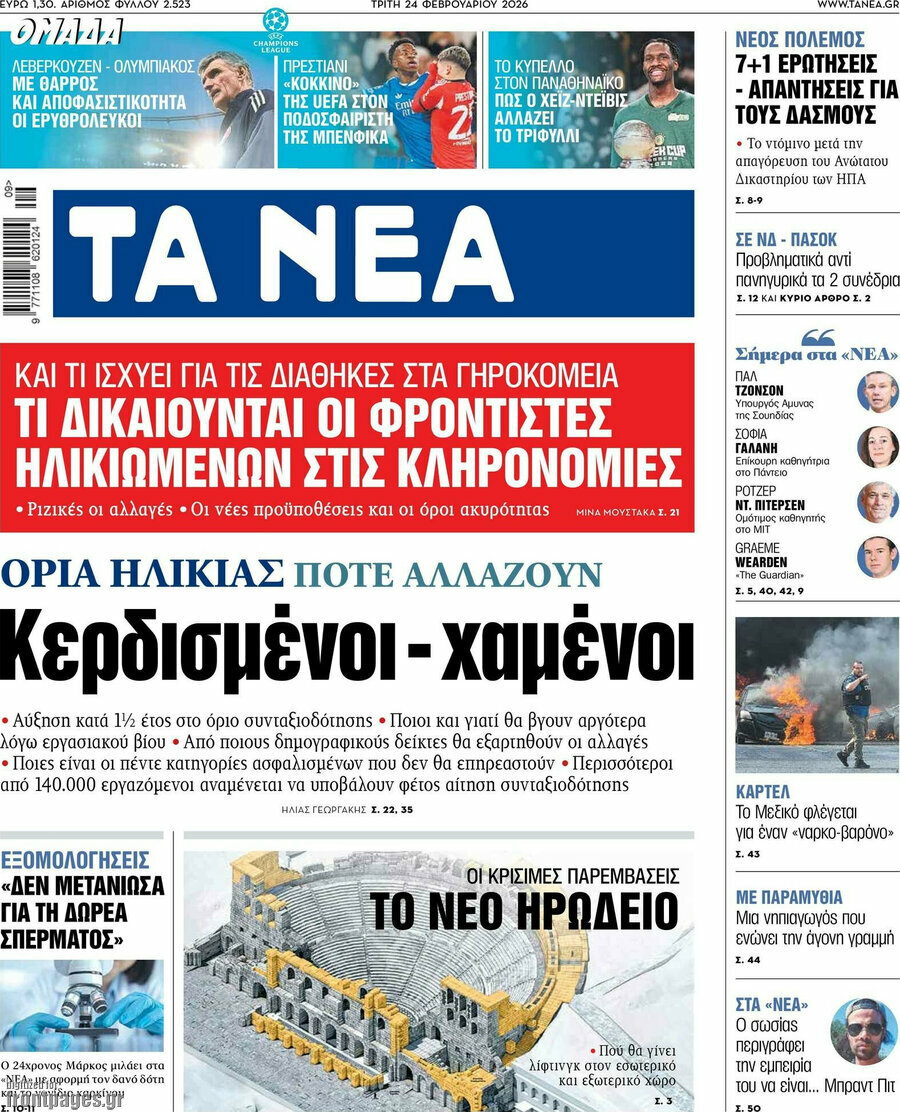
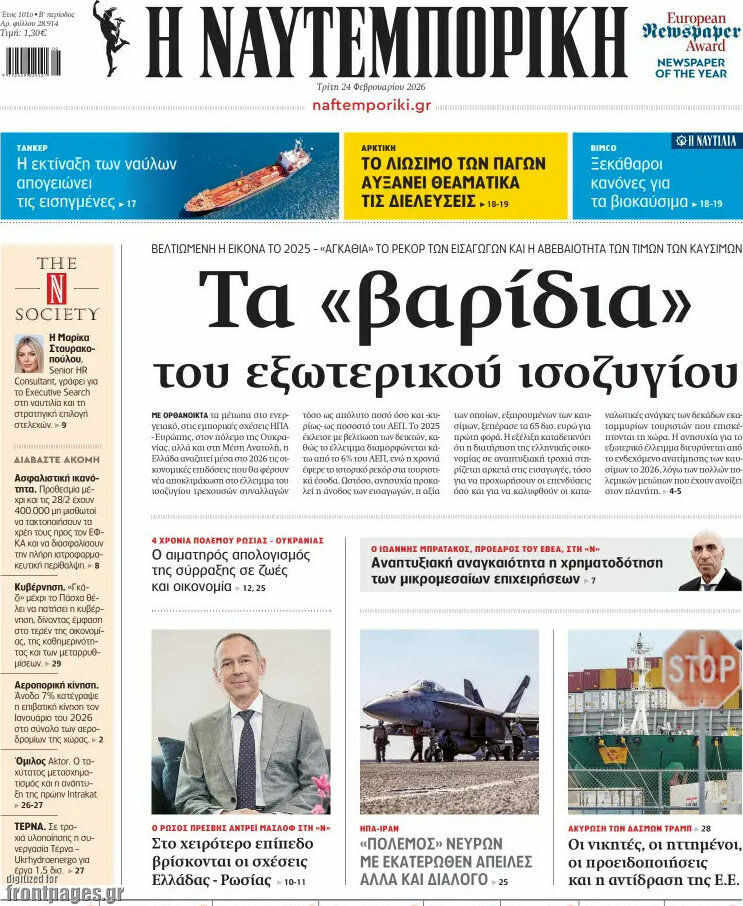
EFIMERIDA TON SYNTAKTON: General Confederation of Greek Workers (GSEE) President Giannis Panagopoulos has a life-long tenure and is also “irregular”
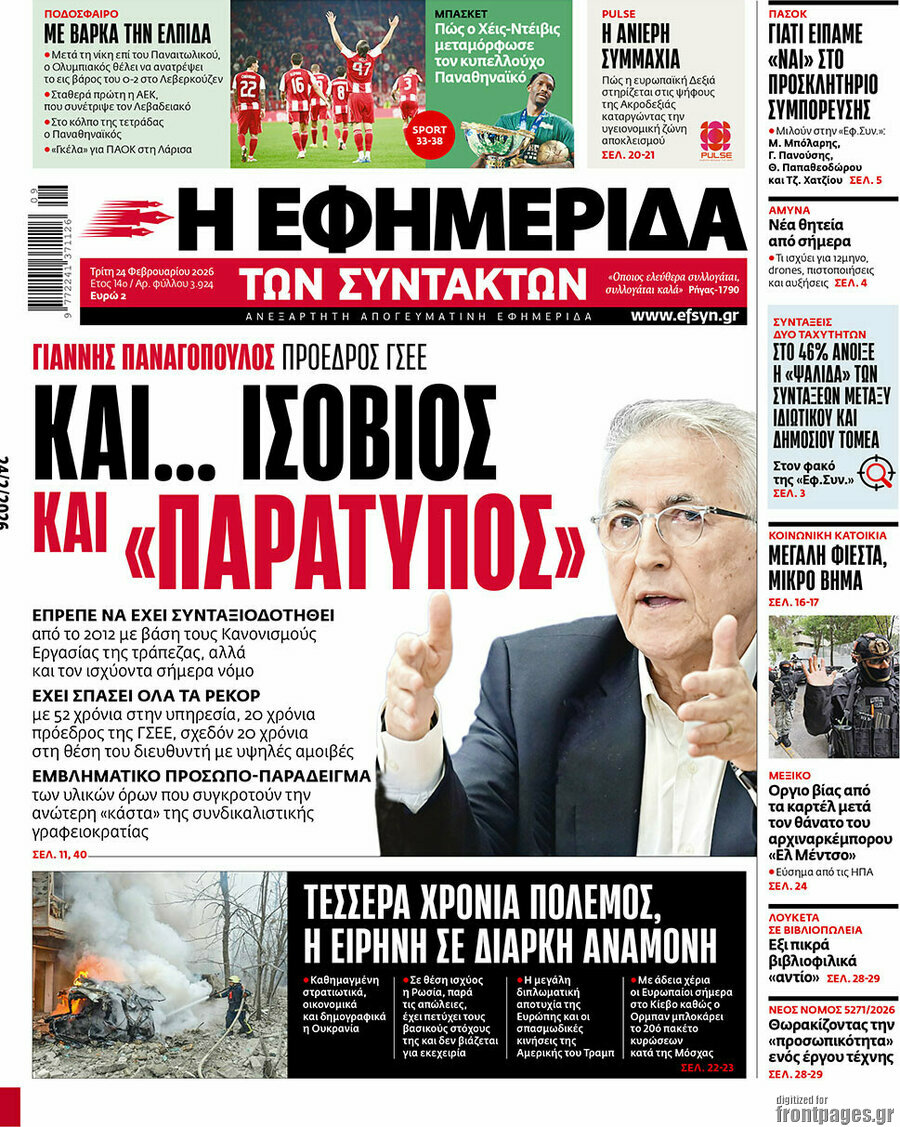
KONTRA NEWS: Ballistic missiles target Souda, Crete
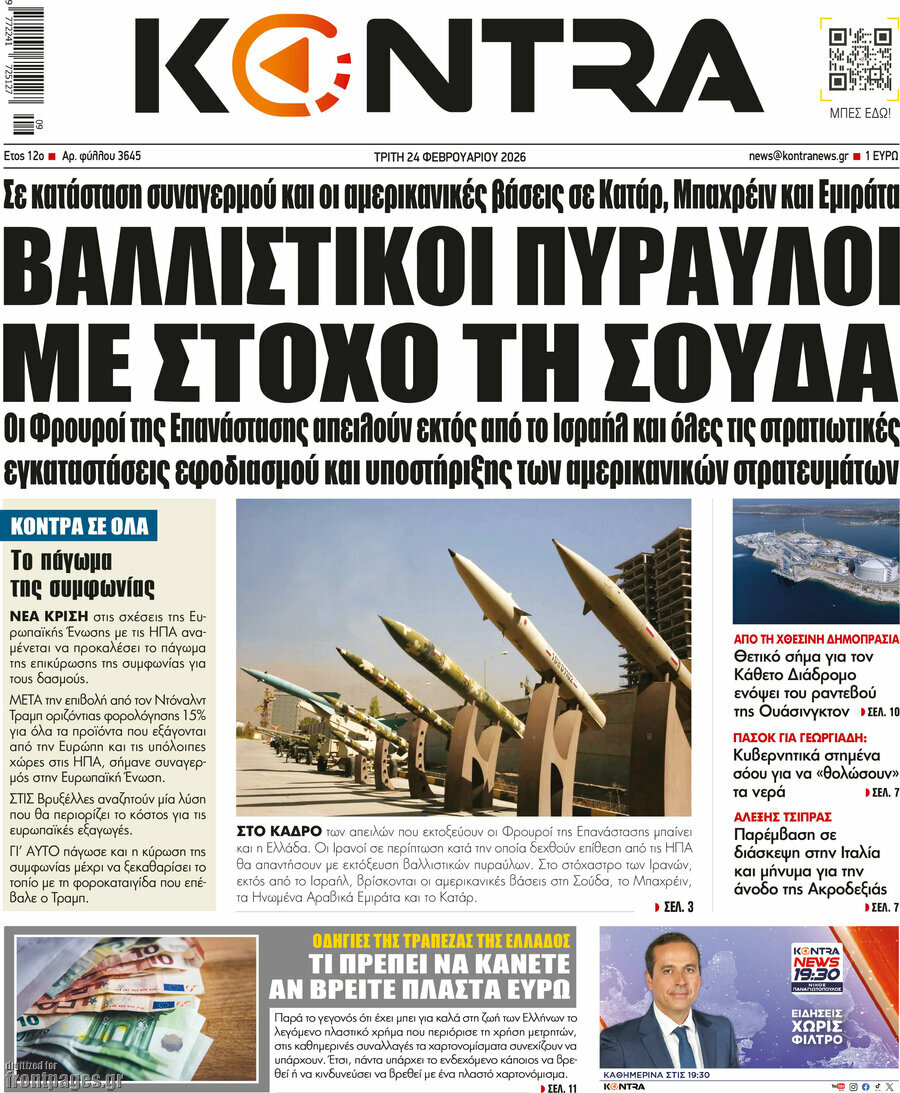
DIMOKRATIA: EU orders poverty pensions
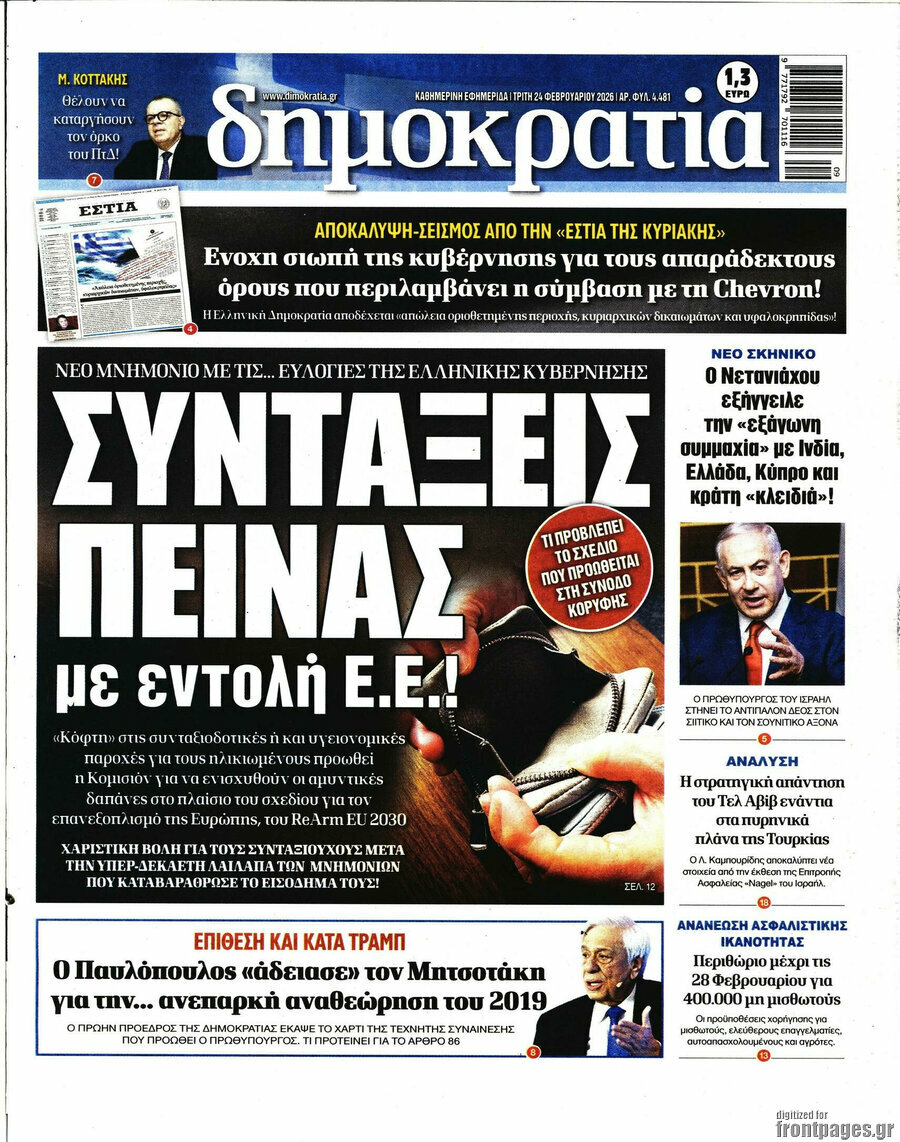
NAFTEMPORIKI: The “burdens” of the balance of payments

DRIVING THE DAY
ABOARD THE EUROPE EXPRESS: European Commission President Ursula von der Leyen and European Council President António Costa are due to arrive in Kyiv right about now, after an overnight trip to the Ukrainian capital.
That was then: The plan was to arrive on the fourth anniversary of Russia’s full-scale invasion carrying a €90 billion loan package for Ukraine and tough new sanctions against Russia. But after Hungary played wrecker over the weekend, the leaders are showing up with placeholders, reports POLITICO’s Zoya Sheftalovich, who traveled with the EU leaders last night.
Something to tide you over: Von der Leyen is expected to present Ukrainian President Volodymyr Zelenskyy with €100 million for an immediate winter energy support program.
Bullish about the rest: EU officials were initially downbeat on Monday, after Hungary refused to budge on its opposition to the EU’s 20th package of sanctions against Russia during a gathering of foreign ministers in Brussels. Orbán’s obstruction, rooted in a dispute over the transit of Russian oil through Ukraine to Hungary and Slovakia — my colleague Seb Starcevic unpacks it all here — left the officials deflated that they’d arrive in Kyiv with little to show but solidarity. Yet among those traveling overnight, there was optimism that the differences, particularly over the loan, would be ironed out.
Latest intel: The plan is to ask Zelenskyy how long it will take to repair the Druzhba oil pipeline, which Kyiv says was damaged in a Russian drone attack, and to press Hungarian Prime Minister Viktor Orbán to stick to his word to greenlight the package as soon as oil is flowing through it again. On sanctions, the thinking is that it might take a little longer to get Orbán on board — but officials are confident it will happen.
Costa told reporters last night that it is “completely unacceptable if a member state doesn’t respect and act in order to implement what we agreed at the European Council,” before adding: “Sooner rather than later we will have the loan.”
Trading blows: Earlier in the day, Costa had warned Hungary that failing to respect the agreement EU leaders reached on the loan in December would “constitute a violation of the principle of sincere cooperation” between member countries. Orbán shot back in a letter obtained by Playbook’s Gabriel Gavin, insisting he is “one of the most disciplined and consistent” leaders in the EU but arguing that his veto was justified by new circumstances.
Orbán told Costa: “You also certainly see the absurdity of the situation: we take a decision financially favourable to Ukraine that I personally disapprove, then Ukraine creates an energy emergency situation in Hungary, and you ask me to pretend that nothing happened. This is not possible.”
ALSO ON BOARD THE TRAIN TO KYIV … Croatia’s Prime Minister Andrej Plenković, on his fifth visit to Ukraine in 12 years, who sat down for a chat with Zoya. Plenković said it is important that EU leaders show up in person for today’s ceremony commemorating the fourth anniversary of the war to show “solidarity and support by being with Ukrainians.”
Plenković called Ukraine the “freedom shield for Europe” and added pointedly that Croatia “can deliver all the transport of all the oil that Hungary and Slovakia need for their oil refineries … just as we are delivering more than 90 percent of oil for Serbia.” We’ll have more from the interview soon.
HOW HUNGARY’S BLOCK IS PLAYING IN KYIV: Ukrainian Foreign Minister Andrii Sybiha dismissed Orbán’s justification for holding up Ukraine’s loan, telling Playbook that Slovakia and Hungary should “send their concerns to the Kremlin and ask Russia to stop pounding Ukraine’s energy infrastructure with missiles and drones, including the pipeline you’re talking about.”
Not in good faith: Sybiha said that Ukraine was “ready to act constructively” and had already proposed “several doable solutions” to resolve the oil dispute. But he cast doubt on Orbán’s motives, pointing to the upcoming Hungarian election that polls suggest Orbán could lose, and accusing him of “demonizing” Ukraine for political gain. “We demand Budapest stop dragging Ukraine into Hungary’s domestic politics,” Sybiha said.
Ready to talk? Sybiha said Kyiv had repeatedly pitched Budapest on a direct meeting between Orbán and Zelenskyy in an attempt to “detox” their relationship. But he claimed Budapest hasn’t replied, choosing “public ultimatums and blackmail” instead.
On the war: With Russia’s full-scale invasion now entering its fifth year, the foreign minister said “only pressure” will force Vladimir Putin to admit he won’t achieve his goals in Ukraine and accept a peace deal. That, Sybiha argued, means combining financial and military pressure and exhausting Russia’s war machine and economy. “We want to end this war as soon as possible,” he said. “We are at a culmination point of peace efforts.”
ZELENSKYY TO ADDRESS EUROPEAN PARLIAMENT: Ukraine’s president will speak to EU lawmakers during an extraordinary plenary session at 10:15 a.m., followed by a debate about Europe’s efforts to secure a just peace and sustained security for Ukraine. Parliament President Roberta Metsola is expected to say that the chamber has “not let Ukraine down” in its promise to support the country, and will “keep stepping up our support.”
EU-CHINA
MERZ’S BEIJING CHALLENGE: German Chancellor Friedrich Merz kicks off a three-day tour of China today, meeting with President Xi Jinping in Beijing before heading south to visit companies. But don’t expect Merz to strike a conciliatory tone with his Chinese counterpart, Jordyn Dahl writes in to report.
Changing times: For decades, Berlin held an outsized role in the EU-China relationship, often championing Beijing in Brussels in exchange for continued market access for German industries. With China’s automotive sector now under strain, that is no longer a given.
Laundry list of complaints: Merz will be addressing a soaring trade imbalance undercutting Germany’s manufacturers … China’s recent military drills around Taiwan … and the devaluation of the Chinese currency against the euro.
The EU’s point person: “He realizes he is possibly the most important politician for China in Europe,” long-time China watcher Jörg Wuttke told Jordyn. “I was surprised by how well prepared he was.” Wuttke briefed Merz on Feb. 17, ahead of the visit.
Standing alone: While some observers expected the EU to make a deal with China similar to those recently inked by Canada and the United Kingdom, a harder stance toward Beijing from both the Commission and Paris means such an outcome is off the table. Merz faces a dramatic choice: Stand shoulder to shoulder with German industrial champions or join France and other countries looking to get tougher with Beijing, as Jordyn and James Angelos report.
Some light reading: Merz may be spending the nine-hour flight from Berlin to Beijing reading “Breakneck”, by Dan Wang — a book the chancellor mentioned to a panel of six China experts who briefed him ahead of the trip.
PARLIAMENT CORNER
COULD BRUSSELS’ MOST HEATED RIVALRY END UP IN COURT? In a three-way love affair, there’s always a risk someone gets jealous — which may be why EU countries are threatening to sue the Commission for giving more powers to Parliament in September, according to a draft letter obtained by Max Griera.
No equality: Capitals are annoyed about a Commission promise to ensure the Council and Parliament get “equal treatment” in the legislative process. The letter states that the EU’s founding treaties have “clearly demonstrated” that there should be no equal treatment — the Council has more legislative power than the Parliament.
Bad romance: Addressed to Ursula von der Leyen and Roberta Metsola, the letter is slated for approval by EU capitals on Wednesday. The Council wants to change the “problematic” parts of the Commission’s deal before its ratification in March and is threatening to sue in the EU Court of Justice if the text isn’t amended.
Ignoring the common good: The lead Parliament lawmaker who negotiated the agreement, German conservative MEP Sven Simon, told Playbook it is regrettable that countries appear “increasingly preoccupied with institutional defensiveness, national reflexes and procedural minutiae” rather than EU shared interests.
NEW CASH WATCHDOG IN PARLIAMENT: German conservative lawmaker Andreas Schwab will today be appointed as the new chair of the European Parliament’s Budgetary Control Committee, succeeding Niclas Herbst, who left the post to become the new head of the German CDU delegation in December, Max reports.
EU PARLIAMENT DELAYS DEPORTATIONS BILL: The Home Affairs Committee on Monday postponed a vote on the returns regulation, which aims to facilitate deportations of migrants. Negotiators failed to reach an agreement within the initial timeframe. The vote is now expected on March 9.
Glass half empty: Negotiations started in mid-November, but lawmakers “have only discussed about 50 percent of the text,” said Dutch MEP Marieke Ehlers, negotiator for the Patriots for Europe group. “We have not even talked about return hubs yet,” she said, referring to the most controversial part of the law allowing for the creation of deportation centers in third countries.
IN OTHER NEWS
HARD PASS ON MEETING: Charles Kushner, the U.S. ambassador to France, is set to be barred from direct access to members of the French government after failing to show up for a meeting Monday about the Trump administration’s social media remarks on the death of far-right activist Quentin Deranque. A French diplomat told POLITICO’s Victor Goury-Laffont that Kushner’s no-show revealed an “apparent misunderstanding of the basic expectations of an ambassador who has the honor of representing his country.”
EPSTEIN REVERBERATIONS: A celebrated Swedish-American businesswoman known for promoting female leadership wrote to Jeffrey Epstein with names of young women for the convicted sex offender to meet at his New York home, according to correspondence released by the U.S. Department of Justice and reviewed by POLITICO’s Kathryn Carlson and Helen Collis. There is no suggestion that any of the women Barbro Ehnbom proposed to Epstein were underage or were abused by Epstein. Ehnbom didn’t respond to multiple requests for comment but said in a LinkedIn post in Swedish that she was “disgusted to have had any kind of contact” with someone “exposed for actions that lack any defense.”
Meanwhile, former EU Trade Commissioner Peter Mandelson was arrested in London Monday on suspicion of misconduct in public office in a case arising from his connection to Epstein.
BUKELE’S BLUEPRINT: El Salvador’s Vice President Félix Ulloa will tell a group of right-wing MEPs today that Europe should stop criticizing others for violating human rights and instead copy his country’s hardline measures against violent crime, Playbook’s Gabriel Gavin reports. Ulloa will defend the state of emergency under which tens of thousands of alleged gang members have been locked up in overcrowded prisons — including the notorious CECOT facility, where the Trump administration controversially sent hundreds of Venezuelans as part of its crackdown on migration.
President Nayib Bukele’s security model “is now very popular” and being closely watched by European politicians, as they face pressure to tackle organized crime in their countries, Ulloa told Playbook ahead of meeting MEPs from the European Conservatives and Reformists. But Europe would have to change its attitude to human rights and treat violent offenders much more harshly, he said, citing Norwegian mass murderer Anders Behring Breivik as an example of prisoners being treated too well. “We need a new way to adapt the concept of human rights in the 21st century.”
DRAWING THE CURTAIN: Justice Commissioner Michael McGrath is finally unveiling his plan for a European Centre for Democratic Resilience to pool expertise in fighting foreign information manipulation. McGrath is kicking off work on the center at a lunch with ministers on the sidelines of the General Affairs Council, Eliza Grkitsi writes in to report. He is then scheduled to hold a press conference.
Tl;dr: The center is the anchor of the EU’s Democracy Shield (a wide-ranging initiative to fight hybrid threats and misinformation) and the subject of an institutional turf war. It has been slammed as inadequate by European lawmakers and civil society groups, in part because participation is voluntary.