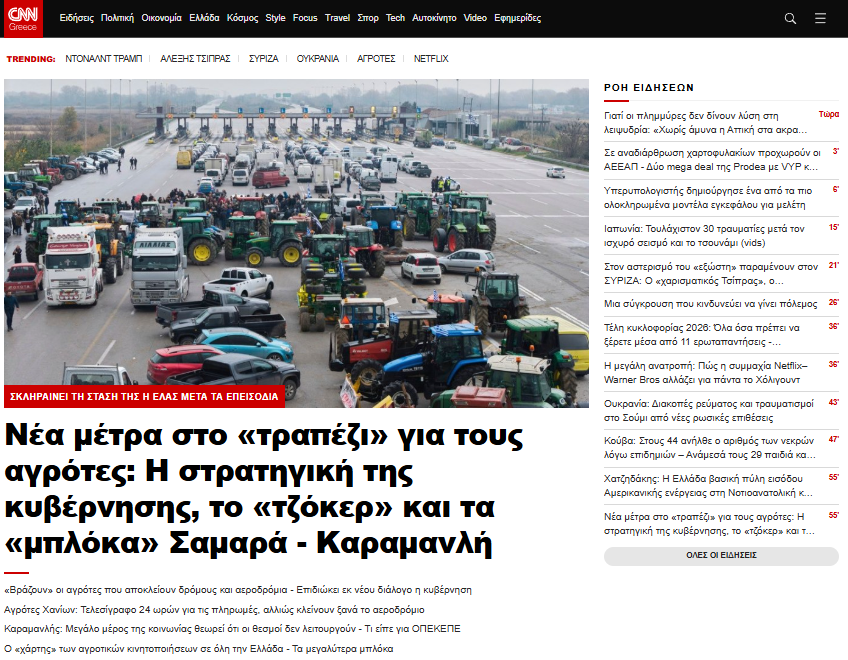
PM urges farmers to scale back protests, promises payments by year-end
Prime Minister Kyriakos Mitsotakis on Monday urged protesting farmers to scale down their blockades, while reaffirming that significant payments and other support would be made by the end of December.
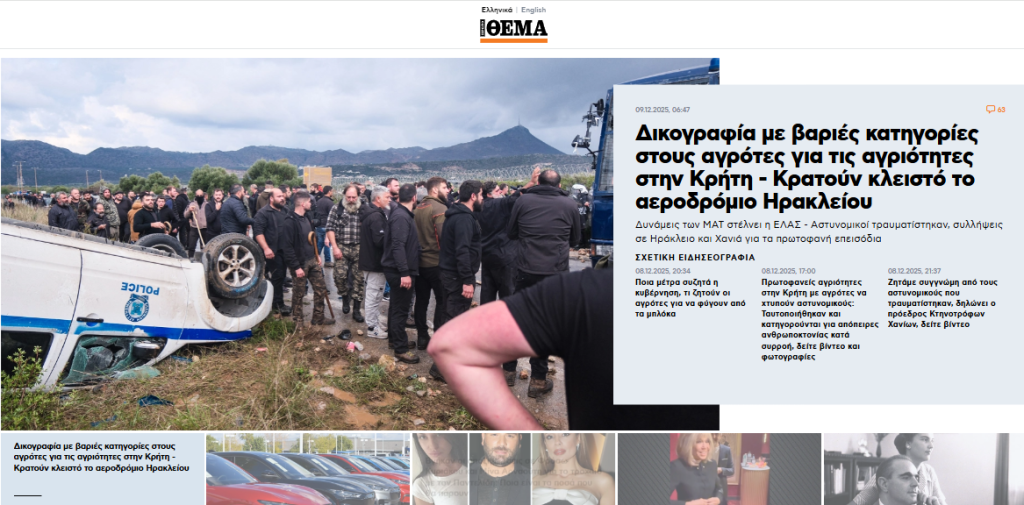
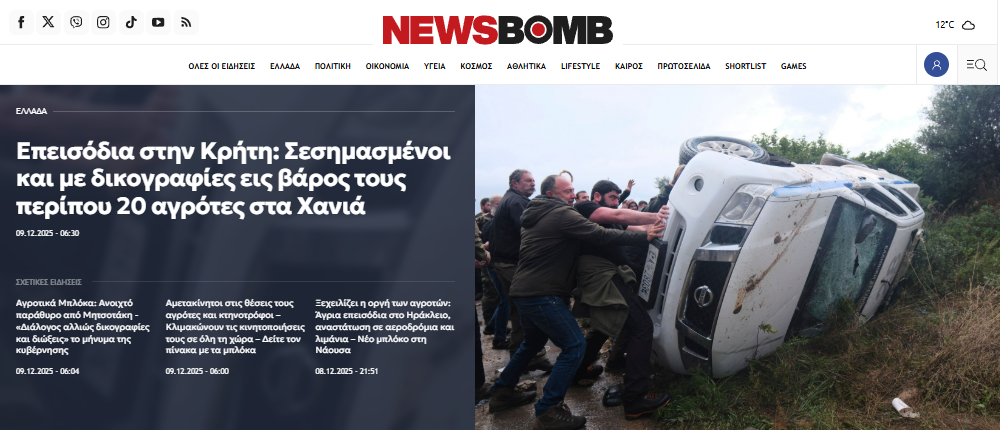
Case files drawn up against farmers involved in incidents on Crete
Police continued identifying participants in incidents earlier on Monday between protesting farmers and police at Heraklion and Chania airports. According to police sources, a number of individuals have been identified and case files drawn up against them, allegedly including serial attempted homicide, possession and use of weapons, grievous and serial bodily harm, damage and complicity, among other felonies.
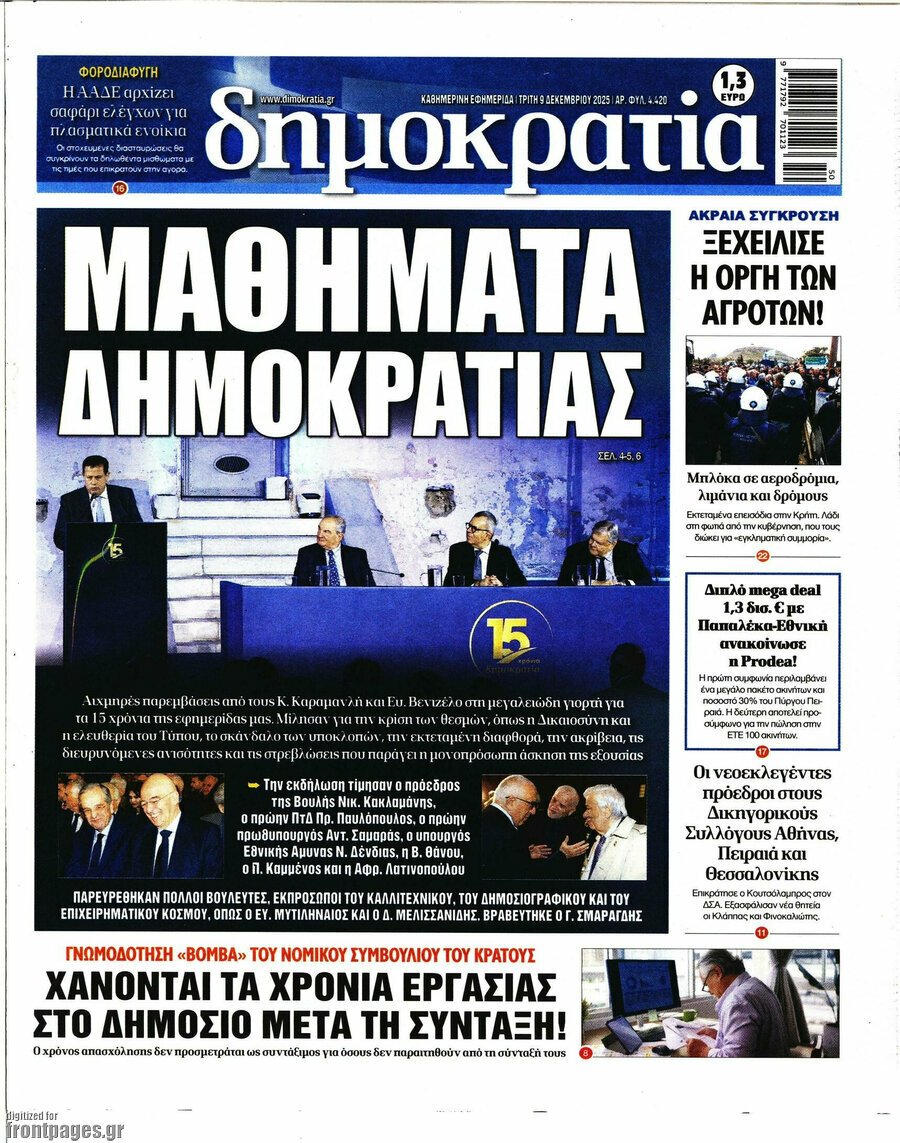
Karamanlis’ warning over quality of democracy
Former conservative prime minister Costas Karamanlis warned that political polarization, degraded public discourse, and unresolved questions over phone surveillance threaten the quality of Greece’s democracy. Karamanlis linked rising political tension to widening inequality and the erosion of the middle class, calling it “a mine laid at the foundations of the democratic system.”
https://www.ekathimerini.com/politics/1289202/karamanlis-warning-over-quality-of-democracy
Greece, Germany agree to cancel backlog of asylum cases under EU rules
Greek Migration Minister Thanos Plevris met with his German counterpart Monday on the sidelines of the EU Justice and Home Affairs Council in Brussels, reaching an agreement to cancel all outstanding asylum cases tied to the EU’s Dublin Regulation.
ATHEX: Another step higher for the benchmark
The Greek stock market edged higher again on Monday, with the benchmark climbing to an eight-week high after successive sessions with moderate growth that step-by-step are bringing the index closer to the decade-high of 2,123 points reached in August. While major players have now ceased making any moves ahead of the festive season and the end of the year, smaller investors are persisting with moves that will help them close their books for 2025 in a better position.
https://www.ekathimerini.com/economy/1289156/athex-another-step-higher-for-the-benchmark


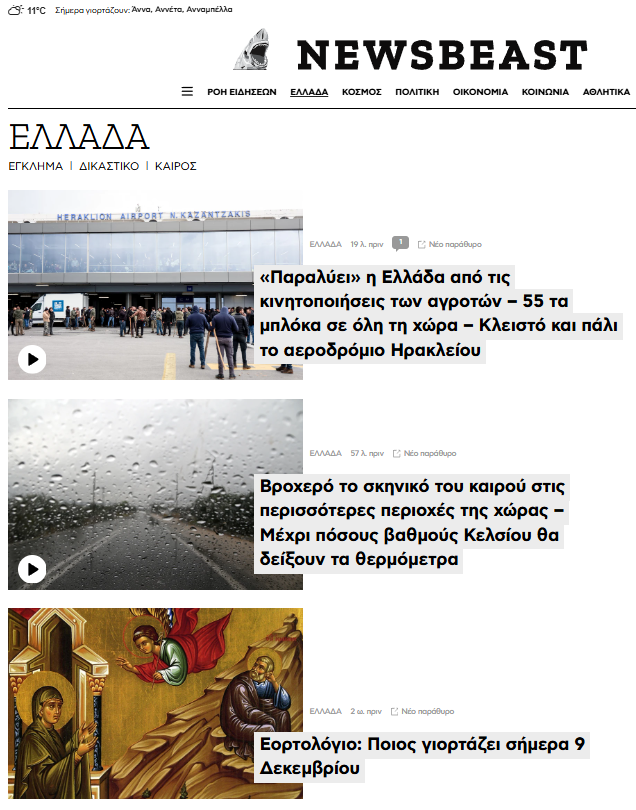

KATHIMERINI: In search of a way out from the tension scenery

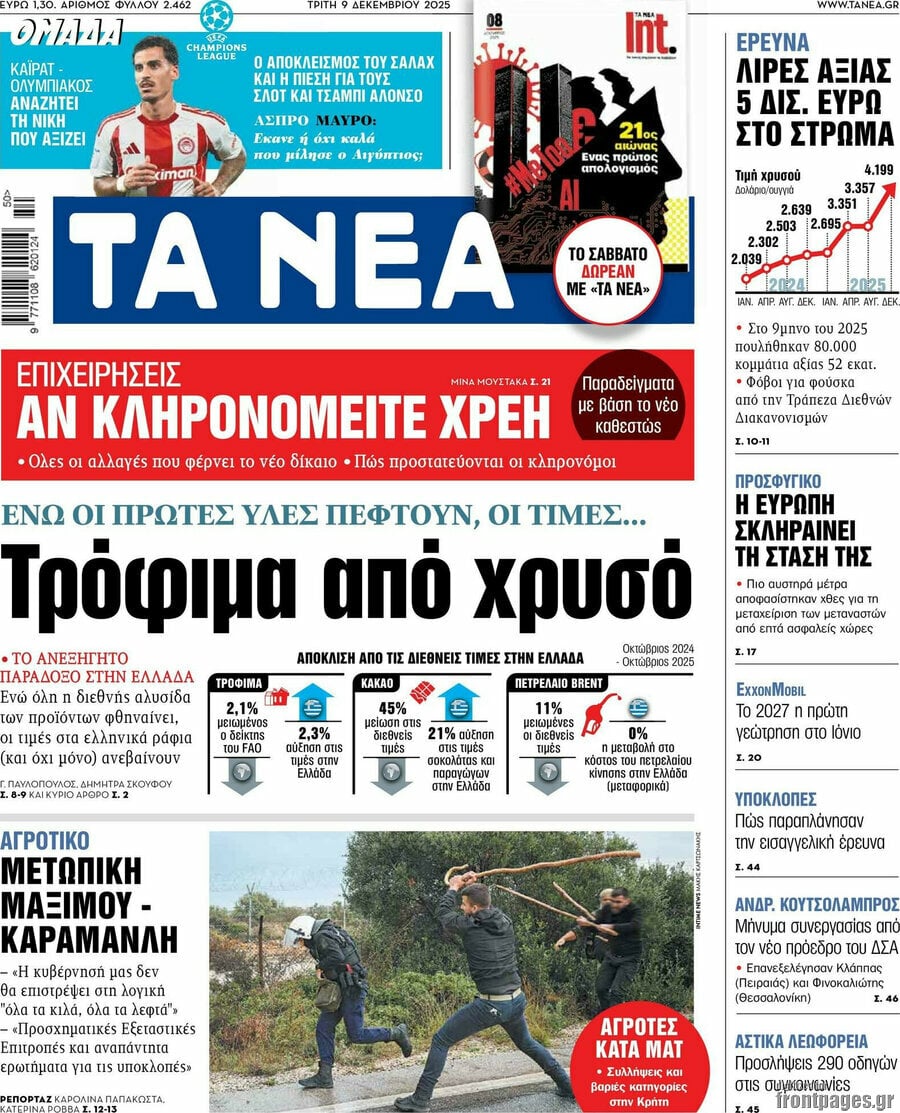
TA NEA: Food made of gold
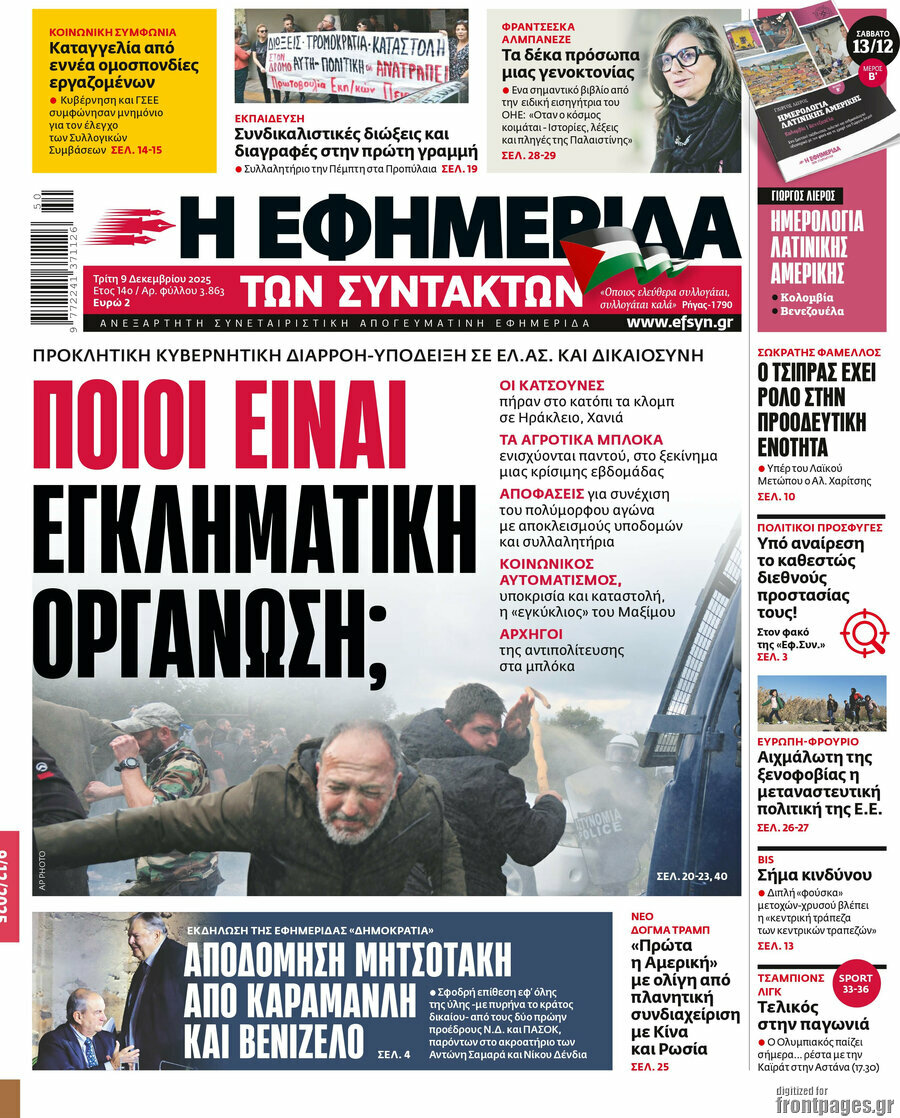
EFIMERIDA TON SYNTAKTON: Who is the criminal organization now?
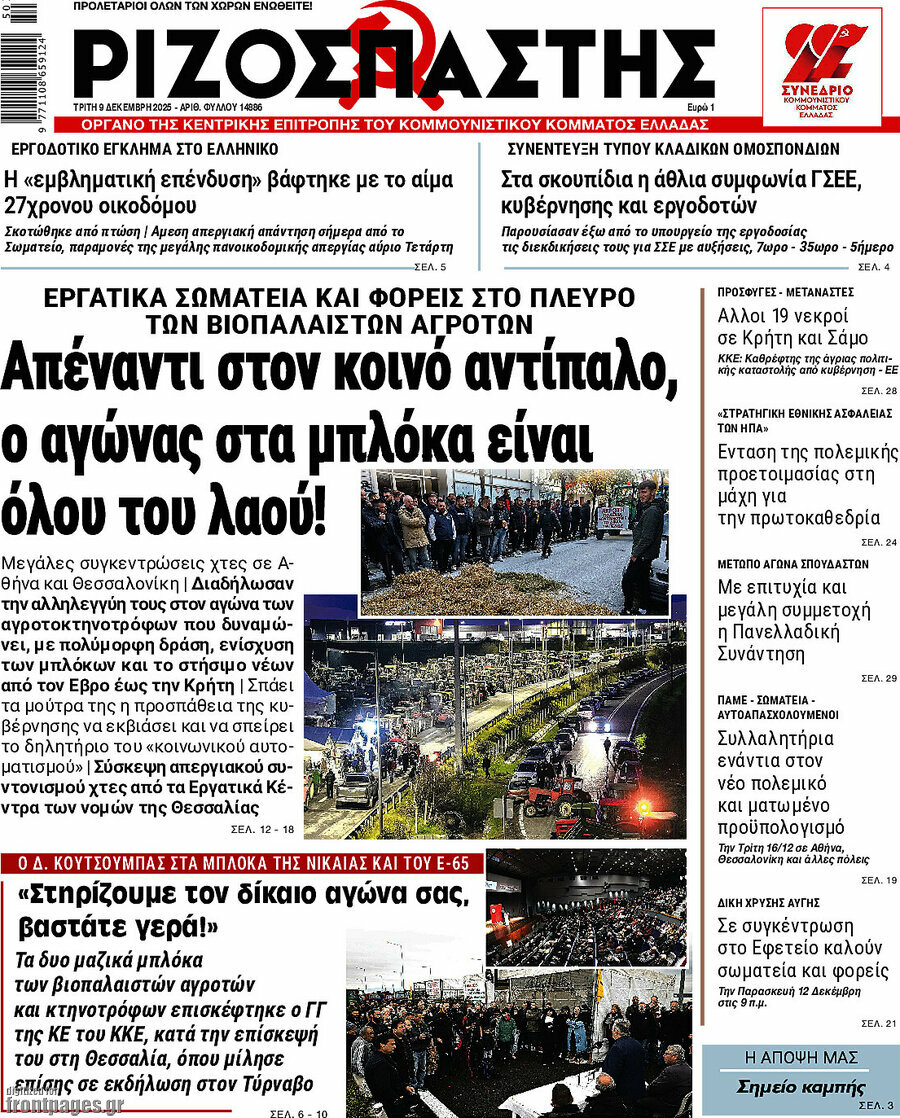
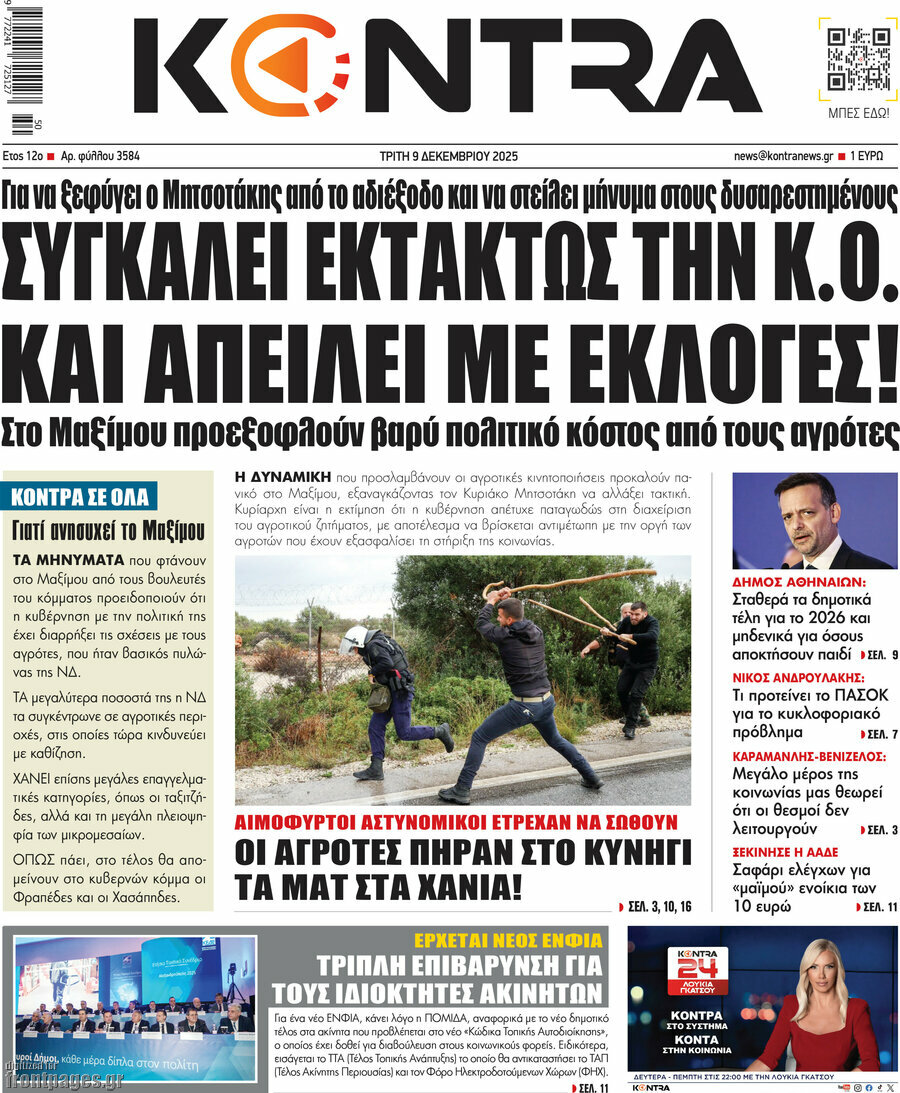
RIZOSPASTIS: Farmers’ blockades against the common enemy represent the whole of society
KONTRA NEWS: Mitsotakis calls for emergency meeting of ruling party’s parliamentary group and threatens with snap elections
DIMOKRATIA: Democracy lessons
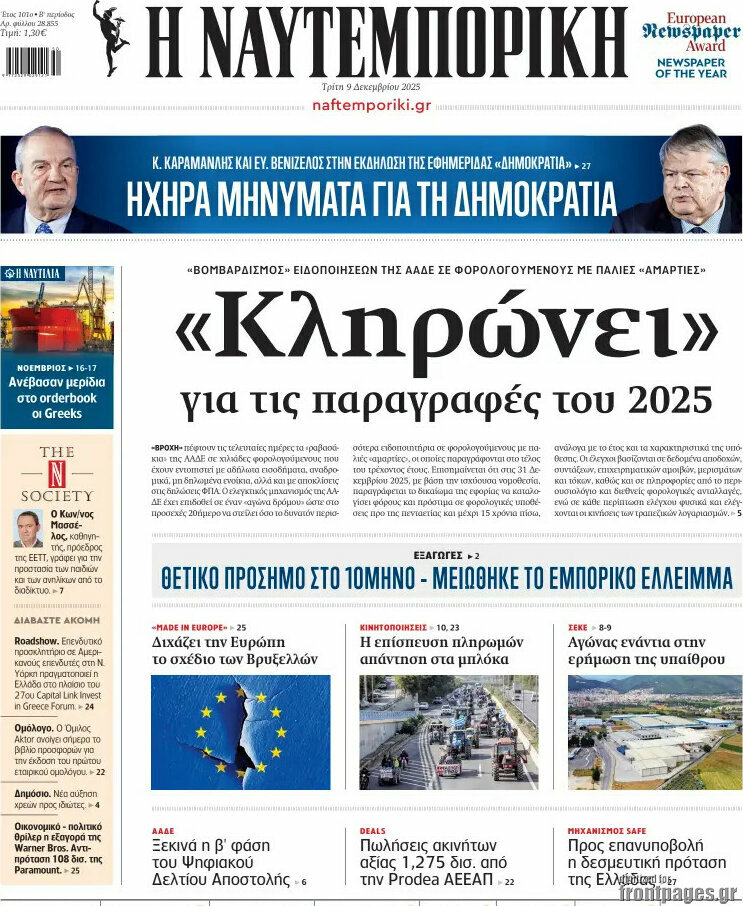
NAFTEMPORIKI: Tax debts: Independent State Revenue Authority targets cases reaching statute of limitations in 2025

DRIVING THE DAY
“ABSOLUTE IGNORANCE”: EU leaders and politicians are ramping up their response to a U.S. strategy document calling on the bloc to resist “civilizational erasure,” with one former top EU official accusing Washington of being clueless about Europe.
Like, not smart: “Who are they to say the European Union is devastating cultural identity?” Věra Jourová, European Commission vice president from 2014 to 2019, told Playbook. “Nobody. It’s absolute ignorance.”
Fake news: Jourová — who’s previously accused X owner Elon Musk of “not being able to recognize good and evil” — went on to say that Washington’s portrayal of the EU as a cultural wasteland on the brink of collapse didn’t match her experience.
European pride: “I traveled around the EU in the past 10 years. I saw self-confident people proud of their culture, language and arts,” she went on. “Yes, some countries have a problem of integrating [people from] third countries. But overall I never saw anyone in Europe saying the EU is somehow stopping [me] from expressing my identity.”
Moscow cheers: As for Musk’s call to “abolish the EU,” Jourová — who was formerly in charge of media freedom in the bloc — said “this is exactly what is being celebrated in the Kremlin. And everything which is celebrated in the Kremlin is not good for Europe.”
The pushback is gaining momentum just days after the publication of the United States National Security Strategy, which is more scathing about the European Union than Russia or China. The document calls for “cultivating resistance to Europe’s current trajectory within European nations” — a pledge that has set alarm bells ringing across the continent.
After a muted initial response, EU politicians and senior officials are sharpening their rhetoric, with Council President António Costa warning Monday that Europe “cannot accept this threat of interference in Europe’s political life.” (The former Portuguese PM also said that Europeans should be ready to replace the U.S. in its leadership of NATO by 2027).
Playbook reached out to the heads of the biggest groups in the European Parliament for their reactions. Here’s what came back:
— Manfred Weber: “The U.S. is abandoning its role as the leader of the free world,” according to the head of the conservative European People’s Party (EPP). Weber went on to accuse Washington of becoming a “selfish dealmaker” under President Donald Trump. The only way forward, he said, is for Europe to integrate “foreign policy, defense policy and energy policy” so that decisions are taken at a “European level.”
— Iraxte García: The obsession with European decline is a “MAGA fantasy,” according to the chair of the Socialists and Democrats (S&D) group. Rather than undermining sovereignty, the EU bolsters it by “ensuring growth, stability and peace,” García said.
— Valérie Hayer: The authors of the strategy are trying to “distort our political landscape and empower those who undermine and fracture European unity,” the head of the liberal Renew Europe group wrote. The fact that “extremist parties” sought backing from abroad shows “their claim to be ‘patriots’ is nothing but a toxic sham,” Hayer added.
— Roberta Metsola: Parliament’s president said the EU should be “unapologetic” about its “ability to legislate for ourselves.”
Who didn’t reply: The EU far right, as well as national leaders. The Patriots for Europe group in the European Parliament gave our reporter Max Griera a “no comment” on the U.S. strategy. Commission President Ursula von der Leyen — who will be interviewed on stage at POLITICO’s P28 Gala dinner on Thursday — also declined to comment. So did the leaders of France and Germany (although Friedrich Merz said he was skeptical of Trump’s peace plan, following a meeting with Keir Starmer and Volodymyr Zelenskyy in London).
The bottom line: The impact of the U.S. strategy is sinking in. Europe’s responses — namely the call to take over NATO — suggest Brussels is now taking the hint from Washington, at least in terms of the Americans’ rhetoric. What remains to be determined is whether the bloc is ready to take the bold steps towards integration that Weber is calling for. So far, EU leaders have balked at the prospect.
EU EMBRACES SAUDI ARABIA
RIYADH BESTIE: In keeping with a new era of hard-nosed diplomacy, the European Union is casting aside any trepidation it might have had about engaging directly with Saudi Arabia as Dubravka Šuica, commissioner for the Mediterranean, heads to Riyadh, Gerardo Fortuna tells us.
Turning the page: The gruesome 2018 murder of journalist and activist Jamal Khashoggi at the Saudi consulate in Istanbul may still hang over EU-Saudi ties. But overriding interests are pushing the EU to reengage, Šuica told Playbook.
Water under the bone saw: “With our Gulf partners, we are entering a new era,” Šuica said of her trip to Riyadh. “For us, the Kingdom of Saudi Arabia is not only a major global actor reshaping its future, but a trusted and reliable partner.”
Seeking partnership: Šuica’s task is to inch closer to launching negotiations on an EU-Saudi Strategic Partnership Agreement — a legal deal that would formalize ties between Brussels and Riyadh under the 2021 EU Gulf Strategy, which covers all Gulf countries.
Deeper strategy: The move follows top EU diplomat Kaja Kallas’ weekend trip to Doha, Qatar, where she formally kicked off talks with the oil-rich kingdom. In Riyadh, Šuica will be focused on economic diplomacy — the new North Star of Europe’s approach to the Gulf.
“We want partners to invest in our initiatives, like the Pact for the Mediterranean and the India–Middle East–Europe Economic Corridor (IMEC),” an EU official said about Šuica’s trip.
DENMARK HAILS MIGRATION VICTORY
FROM PARIAH TO LEADER: Danish Minister for Immigration and Integration Rasmus Stoklund has hailed the fact that his country’s hardline approach to migration — once criticized as inhumane — is now on its way to becoming mainstream EU policy.
Long time coming: A deal struck by EU ministers Monday evening that will allow capitals to remove rejected asylum seekers, set up processing centers overseas and create removal hubs outside their borders, had “been many years in the making,” the center-left Stoklund said in an interview with POLITICO’s Zoya Sheftalovich.
What a difference: Ten years ago, the minister quipped, other social democrats “wouldn’t meet with me,” amid condemnation of Denmark’s migration policies. Since then, “there’s been a huge change in perception,” he said.
View from Stockholm: Sweden — long contrasted with Denmark as having a more humane approach to migration — was also feeling upbeat. Monday’s deal is vital to “preserve … any public trust at all in the migration system today,” Swedish Migration Minister Johan Forssell told Hanne Cokelaere.
EU for you: Both ministers linked tougher migration policies with the idea that Europe was stepping up for its citizens.
Bear in mind that Stoklund’s prime minister, Mette Frederiksen, told me earlier this year that U.S. Vice President JD Vance had a point on migration. So, what did the minister have to say about U.S. warnings of “civilizational erasure?”
Stepping it up: “When I speak to my colleagues in the Council, I don’t have a feeling of a Europe that is falling apart, or Europe that is losing it,” Stoklund said. “On the contrary, we see European countries that step up and take decisions that are controversial from some perspectives.”
Hope on Ukraine: The ministers meeting Monday also spoke about Ukraine, Stoklund said — and “there was no hesitation and no doubt about whether we support Ukraine or not. We are a unified union.”
EU SANCTIONS
PSST! WANNA KNOW HOW TO DO BUSINESS WITH RUSSIA? The Belgian-Luxembourg Chamber of Commerce in Russia and Belarus (CCBLR) is offering a webinar to advise companies on how to deal with restrictions on dealing with Russia.
Per an invite obtained by Playbook, an experienced Russian financial executive will advise participants on “Alternative Payment Channels & Digital Transactions” — ie, how to deal with the fact that “many Russian banks [have been] disconnected from SWIFT” and “major payment systems suspended operations.”
Hard times: The invite laments that companies and individuals have been forced to adopt “complex workarounds for cross-border payments, including intermediaries, fintech services, third-country routing, QR-based operations and cryptocurrency channels.”
Ask anything: Participants can ask Alexey Poroshin, managing partner of First Investonomika Group and co‑chair of the Financial and Credit Support Center of Delovaya Rossiya, for details. It’s all part of a Microsoft Teams “interactive Q&A session.” (Playbook note: Microsoft suspended sales to Russia in March 2022. The fact that Russian banks are disconnected from SWIFT, forcing workarounds, is due to EU sanctions regime against Moscow.)
No encouragement: Asked if the webinar aimed to help EU businesses evade sanctions, Oleg B. Prozorov, CEO and general director of the CCBLR, wrote in an email that the seminar was “designed as an informational session … It does not constitute advisory services, nor should it be interpreted as encouragement to pursue particular schemes or strategies.”
100 percent legal: The session would be “strictly within the framework of EU, Russian and international law,” Prozorov added.
Berlaymont view: Playbook reached out to the Commission, with Deputy Chief Spokesperson Olof Gill saying he could not comment on the event’s legality, noting that sanctions enforcement is up to national authorities.
Be advised: Providing legal advisory services to conduct transactions that would violate sanctions if carried out by a person in the EU is illegal. An EU official added: “It is expected that no EU operator, or [member state] body such as a chamber of commerce, would take part in an event where advice is given on how to circumvent sanctions.”
EUROPEAN PARLIAMENT
DIE LINKE AND THE MADURO JUNKET: The European Left party, home of Germany’s Die Linke, Belgium’s Workers Party and Greece’s Syriza, among others, has been slapped with a €3,000 fine. Its infraction? Accepting an all-expenses paid trip from Nicolas Maduro’s government to observe the Venezuelan election in 2024, which the European Parliament condemned as plagued by “electoral fraud” and lacking “integrity,” Max Griera tells us.
SOCIALISTS WEIGH UP WHIP: The Socialists and Democrats are considering appointing a chief whip as part of changes aimed at adapting to a more fragmented chamber, according to two officials. (Other groups already have the role but the S&D does not.)
Objective A — tame rowdy troops: With less leverage after the 2024 EU election, the Socialist leadership has found it hard to keep troops in line when striking deals with the center-right EPP. Group Chair Iratxe García was left red-faced in October when some lawmakers revolted against the deal she had signed with EPP chief Manfred Weber. That meant the EPP ultimately voted with the far right to pass a tough deregulation package.
Objective B — plum job: In the January 2027 midterm job reshuffle, Italians and Germans are expected to press García’s Spanish delegation to hand over the group chair — especially since the EPP plans to retain the Parliament presidency, which German Socialists had hoped to claim. Creating a powerful chief whip role could help appease the Germans and bolster García’s leadership, with the Italians keeping the secretary-general position.
Wider strategy: The Socialist leadership is also discussing which counter-narratives to use against the EPP to regain political space in Brussels and in the capitals, as well as policy areas where the group has more leverage, given that the EPP cannot make deals with the far right. One such policy area could be the EU’s long-term budget. Stay tuned.
IN OTHER NEWS
DEAL ON FIRST OMNIBUS: More than 80 percent of Europe’s companies will be freed from environmental reporting obligations after EU institutions reached a deal on a proposal to cut green rules late on Monday, Marianne Gros reports.
The deal is a legislative win for von der Leyen in her push to cut red tape and turbocharge competitiveness. It comes after months of tense negotiations, which strained the parliamentary coalition that got her reelected and led her own political family, the EPP, to team up with the far right to get the file over the line.
ZELENSKYY SAYS “NO” TO CEDING TERRITORY: Ukrainian President Volodymyr Zelenskyy said Monday his country would not make territorial concessions to Russia as the Trump administration looks to broker a peace deal between the two countries. Following a London meeting with leaders from France, Germany and the U.K., Zelenskyy told reporters that Ukraine had “no right to give anything away” under Ukrainian, international or moral law.
The Ukrainian leader then zipped over to Brussels for a late meeting with NATO Secretary-General Mark Rutte, von der Leyen and Costa at the NATO chief’s Brussels residence, where they discussed the peace talks and reparations loan. The EU leaders reiterated the bloc’s “ironclad” support for Ukraine, von der Leyen and Costa said in a joint statement. “Our positions have been aligned on all issues,” Zelenskyy posted.
UP, UP AND AWAY: Lithuania is facing an onslaught of meteorological balloons crossing into its airspace from Belarus that has forced the repeated closure of the airport in its capital in recent days. The balloons are ostensibly used for smuggling cheap cigarettes into the EU, but Lithuanian Foreign Minister Kęstutis Budrys told Playbook’s Gabriel Gavin the tactic represents a “hybrid attack” by Russia’s authoritarian ally.
Old tactics: “This represents Episode 2 of a series that started in 2021, when [Belarusian dictator Alexander] Lukashenko directed thousands of illegal migrants toward the EU’s external border,” Budrys said. “Back then, just like now, it took some time to convince member states this was indeed an attack and [to] prompt action. Today, there is no longer any doubt within the EU regarding the political and legal aspects of that action.”
Sanx for nothing: Lithuania has briefed European allies on the tactic in recent days and is now pushing capitals to support adding hybrid attacks to the criteria for new sanctions to be imposed on Belarus. Budrys now wants Brussels to sign off on new restrictions against “those launching these attacks, their masterminds and the corrupt ecosystem supporting them.”