
Greece joins EU defense program
Greece joined 18 other European Union member-states in submitting national plans Sunday for the SAFE (Security Action for Europe) program, which offers low-interest loans to strengthen European defense capabilities.
https://www.ekathimerini.com/politics/foreign-policy/1288459/greece-joins-eu-defense-program
Farmers, breeders determined to continue their protests in Greece
Farmers and animal breeders continued their mobilizations over lack of better policies from the government on Monday, particularly over high production costs and delayed subsidies, with roadblocks and a determination to continue.
Mitsotakis cites 22% income rise, sets spring 2027 election date
Prime Minister Kyriakos Mitsotakis told investors in London that his government will continue major economic reforms ahead of elections set for spring 2027, signaling stability to markets and voters alike.
Androulakis: I have zero tolerance for corruption
Main opposition PASOK-Movement for Change leader Nikos Androulakis on Monday announced that he will send a letter to the parties of the “ democratic opposition,” aiming to reach an understanding on revising the law on ministerial responsibility. In an interview with Open TV, Androulakis accused the government of “ trying to protect corruption,” using Article 86 to prevent the judiciary from investigating ministers “ in successive cases.” “ I call on all democratic opposition parties to come to an understanding on how Article 86 will be revised. We must coordinate and produce a comprehensive proposal for revising Article 86,” he stressed.
https://www.amna.gr/en/article/952881/Androulakis-I-have-zero-tolerance-for-corruption
ATHEX: Index regains all ground lost on Friday
The benchmark of the Greek stock market recovered all its Friday losses on Monday and returned to the verge of 2,100 points, while traders and investors heard Greece’s success story at the Morgan Stanley event in London, in collaboration with the Athens Exchange. While the trading volume remained relatively low, banks saw most of the purchase action and outperformed, with some energy stocks offering a helping hand too.
https://www.ekathimerini.com/economy/1288464/athex-index-regains-all-ground-lost-on-friday



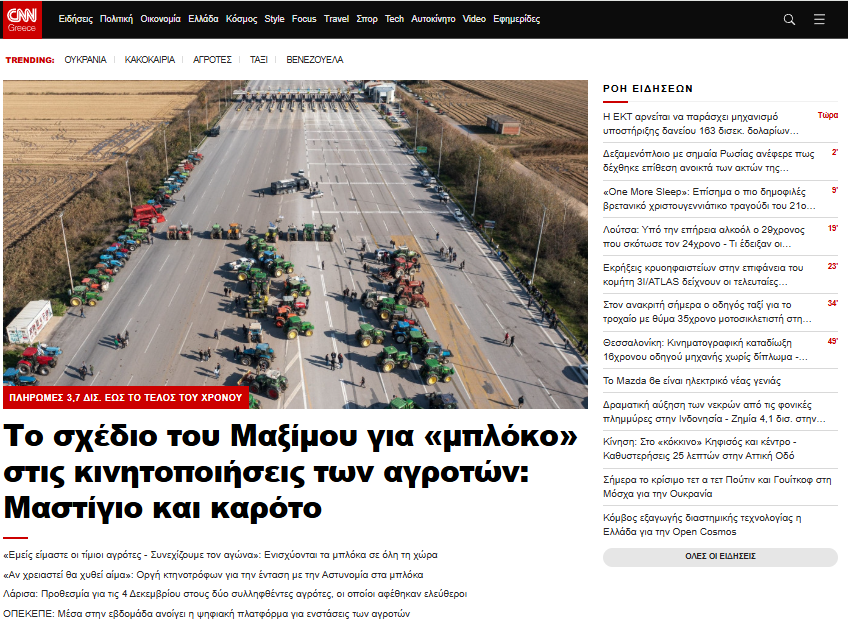


KATHIMERINI: Concerns that the farmers’ blockades will last
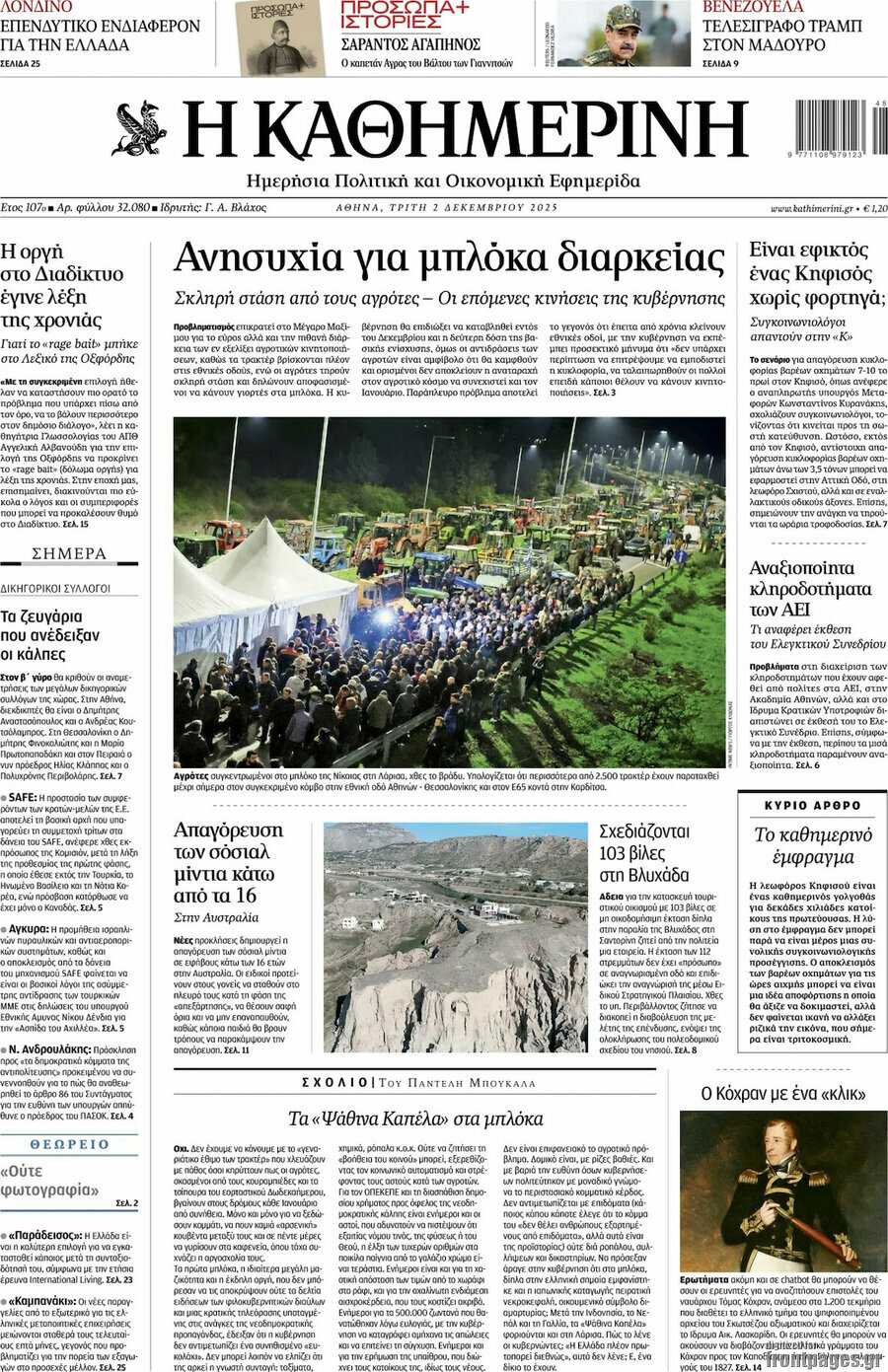
TA NEA: Mitsotakis’ confession: “My life after i step down…”
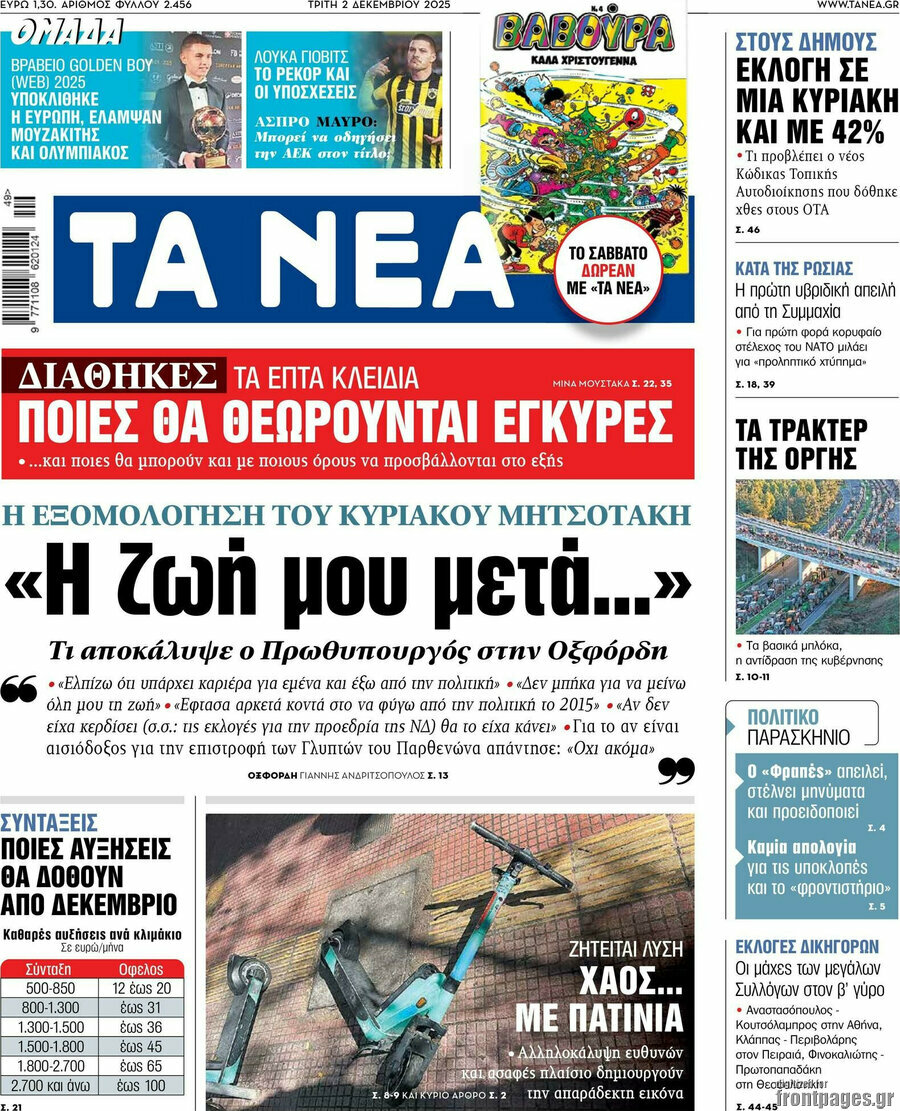
EFIMERIDA TON SYNTAKTON: Farmers are full-on regarding their protests

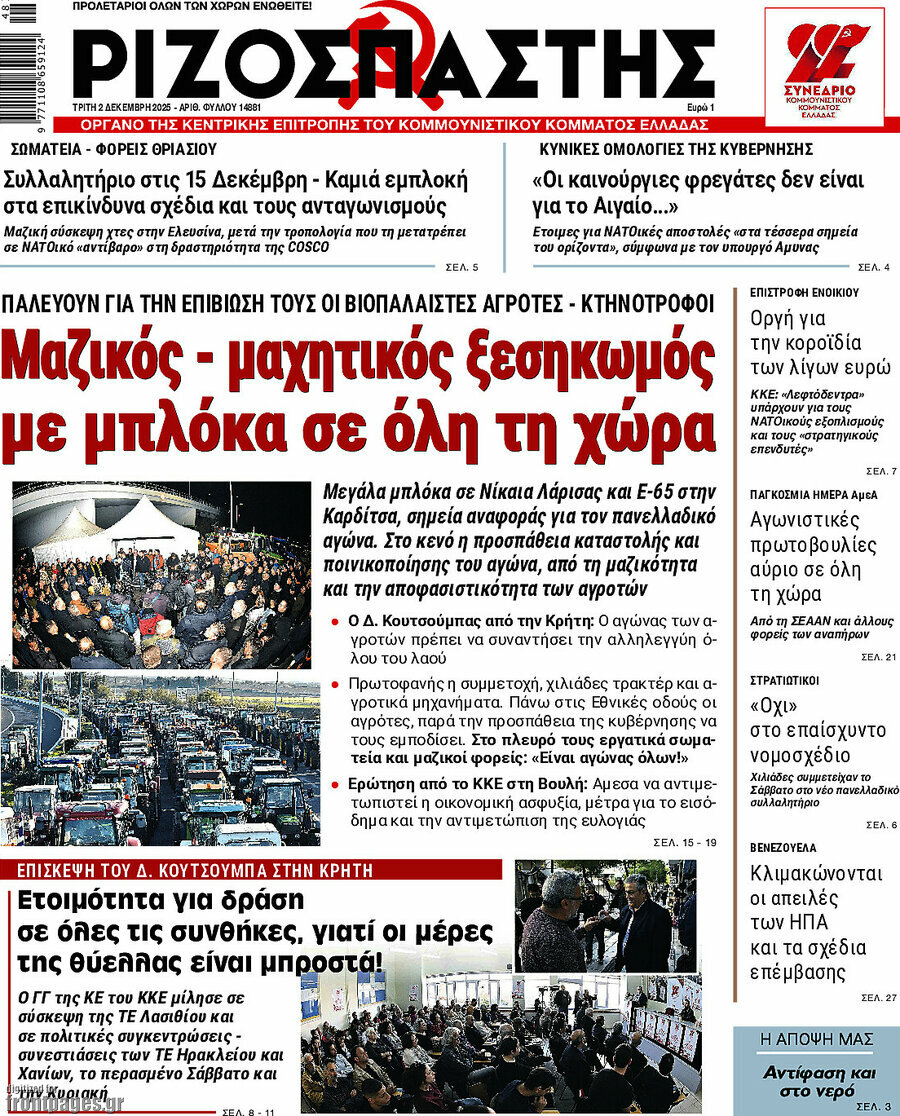
RIZOSPASTIS: Massive uprising by farmers with blockades throughout the country
KONTRA NEWS: The government plans to deal with farmers with violence and teargas

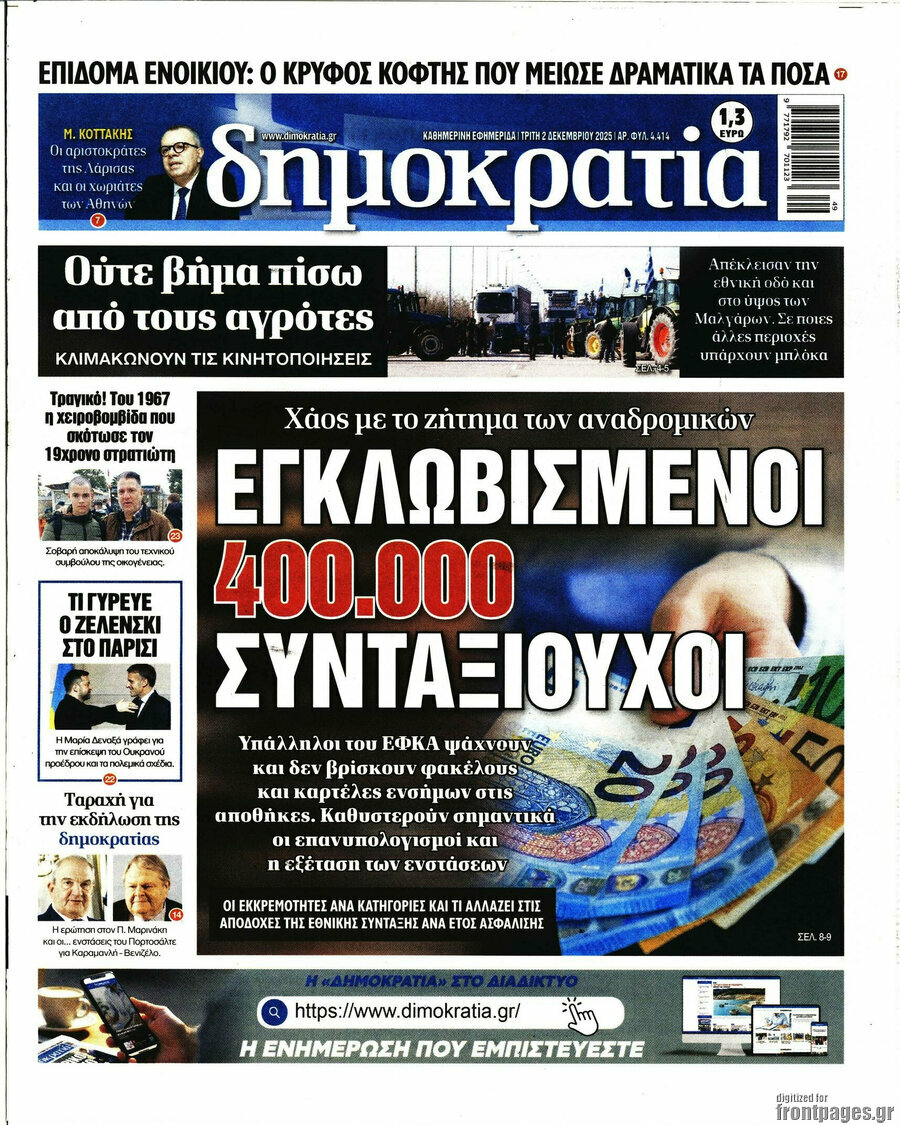
DIMOKRATIA: 400,000 pensioners are trapped regarding retroactive payments
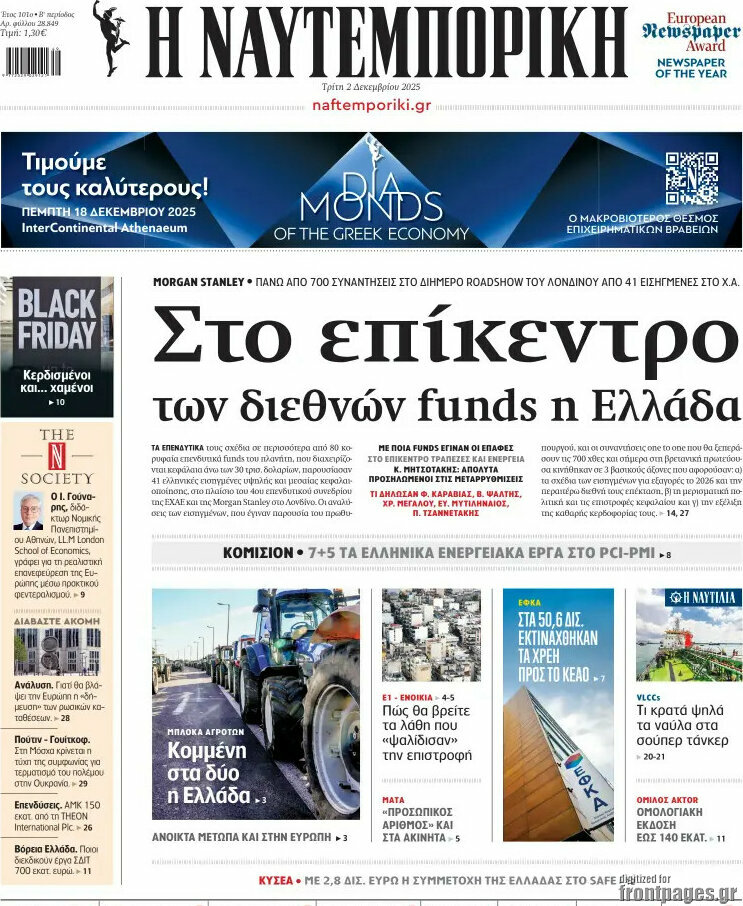
NAFTEMPORIKI: International funds focus on Greece

DRIVING THE DAY: HARD TURN ON MIGRATION
REJECT DEPORTATIONS AND FIND OUT: In a major potential hardening of the EU’s migration policy, the bloc is looking to remove trade benefits from developing countries that refuse to take back migrants who have been denied asylum, Camille Gijs and Gabriel Gavin report.
Making the link: According to a document obtained by Gabriel, preferential trade terms for developing third countries may be reviewed in the context of “the readmission of that country’s own nationals” who have been identified as “irregular migrants to the Union.”
Prepare for pain: “Where the Commission considers that an insufficient level of cooperation on readmission persists,” the document reads, such benefits “may be withdrawn temporarily.”
Toughening up: The potential measures — which are set to move toward becoming law after being agreed by negotiators from the EU’s three main institutions on Monday night — show how Brussels is hardening its stance on migration amid a surge in support for right-wing parties, and under the stewardship of the Danish EU presidency.
Danish M.O.: Denmark has long stood out among EU countries for its hardline approach to migration, with policies that include paying migrants to return to their country of origin. But now some aspects of Copenhagen’s muscular approach to deporting migrants — long a legal sticking point for EU countries — is becoming mainstream EU policy.
The Trump aspect: The deal comes just five days after U.S. Secretary of State Marco Rubio instructed American diplomats to press their host countries over “mass migration.” While Monday night’s deal had been in the works since well before Rubio’s push, the broader context is unmistakable: Brussels is under pressure, both from EU leaders and its most powerful ally, to get tougher on migration.
Leading by example: The Americans’ posture doesn’t come out of nowhere. In the early days of his second term, Trump wielded the threat of trade tariffs against Latin American countries if they didn’t accept deportation flights. If implemented, the EU approach could embrace this blueprint.
Fine print: Tweaking intricate trade agreements to the detriment of the non-EU partner could only be done with the agreement of the countries in question. The suggestion is that the potential measures are being considered as part of an overhaul of the Generalized Scheme of Preferences, a 50-year old program that enables poorer countries to export goods to EU members at lower tariff rates.
Changing tack: Until now, the EU has balked at the idea of using punitive measures against countries that refuse to take back migrants, due to opposition from the European Parliament, the European Commission and a handful of capitals. But the political winds are changing, with the right now more powerful than ever in Parliament.
PUSHING BACK AT BELGIUM
“BLANKET GUARANTEES” ATTRACT FRIENDLY FIRE: EU countries are chafing at the prospect of having to provide blanket financial guarantees to Belgium in exchange for an agreement on tapping Russia’s frozen assets to help Ukraine, Gregorio Sorgi reports in a must-read piece.
No blank check: Four diplomats said that while their capitals might be ready to agree on a fixed figure for backstopping Belgium, they would draw the line at an open-ended commitment that could result in years of payments, extending beyond the end of Russia’s war on Ukraine.
To infinity and beyond: The diplomats told Gregorio that agreeing to Belgium’s demand in full could leave them exposed to billions of euros in repayments. “If [the guarantees] are infinite and without limits, then what are we getting ourselves into?” one of them said.
SPEAKING OF BELGIUM … Top EU diplomat Kaja Kallas was asked during a press conference about Belgium’s insistence that accepting the reparation loan from seized Russian money would be an “obstacle to peace,” as Belgian Foreign Minister Maxime Prévot said in Monday’s Playbook.
The Kallas take: If anything, the loan would be an obstacle for Russia obtaining its preferred terms in any outcome. Agreeing to it would “definitely strengthen Europe’s position vis-à-vis Moscow … I don’t in any way diminish the risks or the worries that the Belgian government has … but we need to move on,” Kallas said.
Moscow’s marathon: Kallas also warned that Russia would exploit Europe’s hesitation and division over financial support for Ukraine. “If I [were] Russia, I would also try to outlast, to see if we get the funding for Ukraine defense or not. In the short term I would come back to the negotiation table and ask even more,” she added.
FOR YOUR RADAR TODAY: Donald Trump’s special envoy Steve Witkoff and son-in-law Jared Kushner will meet Russian Vladimir Putin in Moscow to discuss ending the war in Ukraine. Kremlin spokesperson Dmitry Peskov told reporters the meeting would be in the second half of the day, according to a preview by Reuters.
RUSSIA’S MONEY, CONT.
U.S. OBJECTED TO EU’S FROZEN ASSETS PLAN: By now, Belgium’s objections to using a pot of €170 billion in immobilized Russian assets are well-known. But Belgian Prime Minister Bart de Wever may have some powerful allies in his refusal to go along with the “reparation loan” — Donald Trump’s administration.
Scoop: When EU sanctions envoy David O’Sullivan traveled to Washington during the summer, U.S. officials told him in no uncertain terms that their plan was to return the assets to Russia after the signing of any peace plan, according to two senior diplomats who spoke to Playbook and Gregorio.
Undeterred, Commission President Ursula von der Leyen forged ahead with plans to use the assets to fund Ukraine. In her State of the Union speech on Sept. 10, shortly after O’Sullivan’s trip, von der Leyen announced that the EU planned to use the assets to fund Ukraine via a reparation loan — in what one of the diplomats said was a bid to put a European stamp on the assets.
Not a fan: The U.S. may never have been on board with that idea. When Trump’s original 28-point peace plan leaked in November, it included investing $100 billion of the assets in American-led “efforts to rebuild and invest in Ukraine.” The remainder would go toward a “separate US-Russian vehicle,” the plan suggested.
Money grab: This point became the source of tension after the plan leaked, with EU officials bristling at the prospect of the U.S. taking part of the assets (even if it was nominally to rebuild Ukraine) and sharing the rest with Russia, per several diplomats.
In the dark: Belgium is now echoing the American view that seizing assets would be an obstacle to peace. While the EU has weighed in on the plan and, according to some reports, kiboshed the contentious 14th point on the immobilized assets, EU officials are in the dark about what’s included in the latest version of the plan. A Commission spokesperson declined to comment when contacted by POLITICO.
ALSO PUSHING BACK: The European Central Bank has said it won’t backstop the planned reparation loan, dealing another blow to the EU plan, the Financial Times reports this morning. The ECB concluded that the Commission’s proposal violated its mandate, according to the paper.
MAKE OR BREAK FOR RUSSIAN ENERGY BAN: Energy Commissioner Dan Jørgensen is dialing up the drama to the max ahead of crucial talks today on phasing out Russian energy imports, telling Gabriel Gavin that officials have a chance to “make history tonight and change the course of our energy future.
Big picture: The Danish commissioner cast the proposed phaseout as a “chance to choose independence over blackmail, and to show our unwavering support to Ukraine. Europe must not hesitate. Let’s make it happen, together.”
Step back: Officials, diplomats and lawmakers are hashing out the final sticking points of the so-called RePOWEREU plan. That’s Europe’s way of addressing the criticism that it’s spent more money on importing Russian energy than on helping Ukraine since the start of Moscow’s full-scale invasion. The plan is due to be implemented from the start of next year.
Down to the wire: This is the third set of inter-institutional talks (“trilogues,” for the experts) and, Jørgensen hopes, the last. But per our colleagues on Morning Energy, this may not be the end, as a fourth trilogue is in order if the more skeptical group prevails.
PARLIAMENT’S CORRUPTION WIN
DEAL EXPECTED ON ANTI-CORRUPTION BILL: The European Parliament is expected to strike a deal with national capitals today on a hotly debated anti-corruption directive that would turn up the heat on public officials found to be abusing their power, Max Griera reports.
Italian pushback: Parliament and the Council have been at loggerheads, with a group of countries led by Italy questioning the idea that an EU law would force member countries to address “abuse of office” by public officials as a crime. (Giorgia Meloni abolished a law pertaining to the same crime in 2024.)
Danes clinch it: But Parliament is now poised to accept a compromise sent by the Danish presidency that would force countries to ensure that “at least certain serious violations … by a public official … are punishable as a criminal offense,” per a compromise proposal seen by Max.
“The Council didn’t want this bill,” Renew negotiator Raquel García told Max. “They have been fighting every inch of terrain.” German Greens MEP Daniel Freund called the bill a victory because now the Commission had a legal basis to be a “pain in the ass for whoever does not follow the rules.”
Capital concerns: Some Council members weren’t pleased, arguing that the directive would be the first EU-wide anti-corruption measure creating definitions and minimum sanctions, forcing countries to report to Brussels on their corruption cases.
Kettles and pots: The measures EU capitals have been pushing back on are pretty similar to the conditions that Brussels imposes on countries applying to join the bloc, such as Ukraine. “How can we push Ukrainians to make their anti-corruption body independent if we do not require the same inside the EU?” said ECR lawmaker Mariusz Kamiński.
IN OTHER NEWS
TOP EU OFFICIALS’ ARMENIA PILGRIMAGE: Kaja Kallas and Enlargement Commissioner Marta Kos are headed to Yerevan, Armenia, as part of Europe’s bid to bolster its influence in Central Asia and coax countries away from Moscow’s embrace, Gerardo Fortuna writes.
Find a friend: EU officials told Playbook that Armenia is searching for geopolitical alternatives to Russia and that Brussels is happy to oblige. The country lies along the coveted Middle Corridor linking Europe to Central Asia’s energy and trade routes — and is thus a hinge state in geopolitical terms.
The Kos play: “We have a once-in-a-generation opportunity to support the normalization of relations in the South Caucasus and work toward a much closer partnership with Armenia. We are fully seizing the moment,” the commissioner wrote in comments shared with Gerardo.
Roll call: Besides Kallas and Kos, Armenian Foreign Minister Ararat Mirzoyan, who is also the chair of the EU-Armenia Partnership Council, will be in the house.
SUSTAINABLE FUTURE SUMMIT: Questions about Brussels’ commitment to halting the climate crisis will loom over Day 1 of POLITICO’s Sustainable Future Summit, which starts this morning. The EU’s climate chief Wopke Hoekstra will kick things off by talking about where the EU stands on its climate journey — and there’s plenty more following that. You can follow the day’s events on our live blog and check out the program here.
O CANADA! According to two diplomats who spoke to Jacopo Barigazzi and Chris Lunday,Canada has reached a final agreement to join the EU’s €150 billion Security Action for Europe program. This marks the first time a third country will formally participate in the bloc’s flagship joint procurement initiative.
FIGHTING THE FAR RIGHT: My Paris-based colleague Victor Goury-Laffont looks at the fierce battle emerging between the French left’s two main contenders for the pivotal 2027 presidential election: the old-school radical Jean-Luc Mélenchon and the more centrist pro-NATO Raphaël Glucksmann. Unless one manages to completely overshadow the other, Victor reports, the left will likely spend the coming year locked in a civil war.