Constitutional debate takes election tone
The Parliament debate Wednesday on constitutional revision turned into the first major confrontation among political leaders since the summer recess, offering what observers in the chamber described as a preview of the lengthy election period ahead. The plenary session featured the key dilemmas expected to shape the campaign strategies of the main political rivals, as well as sharp exchanges and competing narratives aimed at their respective voter bases. A clash between Prime Minister Kyriakos Mitsotakis and PASOK leader Nikos Androulakis dominated the proceedings and set the tone of the debate. Other party leaders also adopted campaign-style rhetoric, following their appearances at the Thessaloniki International Fair the previous week.
https://www.ekathimerini.com/politics/1315490/constitutional-debate-takes-election-tone
Turkey escalates islands rhetoric
Turkey’s foreign minister has renewed accusations that Greece is militarizing demilitarized Aegean islands, statements Athens rejected as part of what Greek officials called a strategy of escalation. Foreign Minister Hakan Fidan, speaking from Azerbaijan, said the militarization of the islands constitutes “a threat to Turkey.” The remarks come ahead of the planned resumption of the Greece-Cyprus Great Sea Interconnector electric cable project under a French flag, and amid a series of arms deals with Israel that will bring Israeli-made weapons to several islands. Greece recently signed the Achilles Shield air defense agreement with Israel, and the first launchers of the PULS precision-strike missile system are expected to arrive in 2027.
https://www.ekathimerini.com/politics/foreign-policy/1315481/turkey-escalates-islands-rhetoric
Poll shows deep voter skepticism
A new Pulse RC poll for Skai TV reveals widespread voter skepticism toward Greek political leaders following their appearances at the Thessaloniki International Fair (TIF). Only 32% evaluated Prime Minister Kyriakos Mitsotakis’ presence positively, while 54% viewed it negatively. PASOK leader Nikos Androulakis and ELAS leader Alexis Tsipras each scored 25% positive marks, with negative evaluations reaching 54% and 57%, respectively. On addressing inflation, 31% responded “none” when asked which leader’s proposals best handle the issue, with Mitsotakis getting 25%, Tsipras 19% and Androulakis 11%. Regarding implementation, 40% found Mitsotakis’ measures unrealistic, a figure rising to 44% for Androulakis and 55% for Tsipras. In voting intention, New Democracy leads at 26.5%, followed by ELAS at 15% and PASOK at 10.5%.
https://www.ekathimerini.com/politics/1315489/poll-shows-deep-voter-skepticism
FMCG sales in Greek super markets up 5.6% in January-July, data shows
Sales of fast-moving consumer goods (FMCG) in Greek supermarkets continued to grow in the first seven months of 2026, rising 5.6% in value. Both fixed-barcode products and products sold by weight contributed to the increase, with food remaining the main driver of the market. More promotional activity, slower growth in unit sales and a stable private-label market share also shaped market conditions. According to data compiled by Circana, total FMCG sales rose 5.6% in value in January-July 2026 compared with the same period in 2025. Sales reached € 8.394 billion, up from € 7.949 billion a year earlier, an increase of around € 445 million.
ATHEX: Blue chips grab all the attention
The Euronext Athens (ATHEX) general index closed at 2,698.76 points, adding 0.13% to Tuesday’s 2,695.21 points. The large-cap FTSE-25 index expanded 0.14% to end at 6,929.65 points.
https://www.ekathimerini.com/economy/1315494/athex-blue-chips-grab-all-the-attention

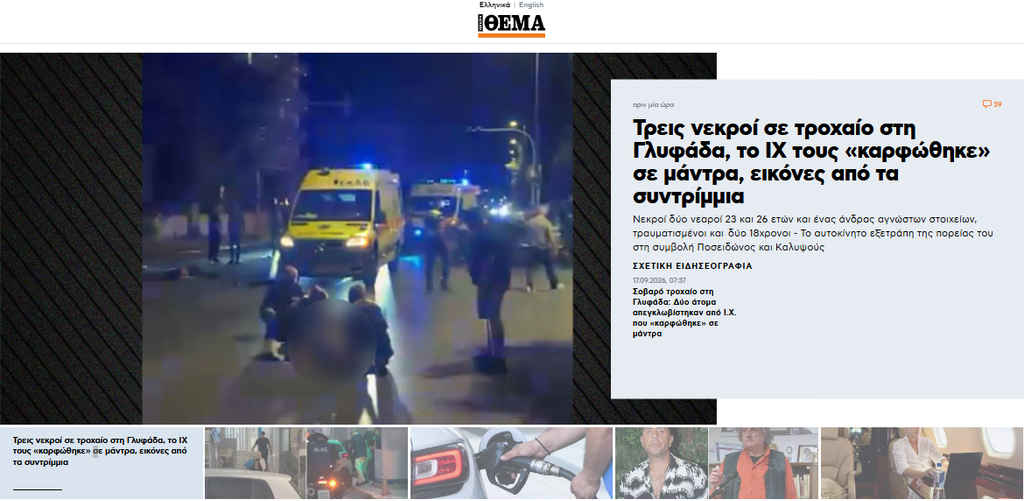
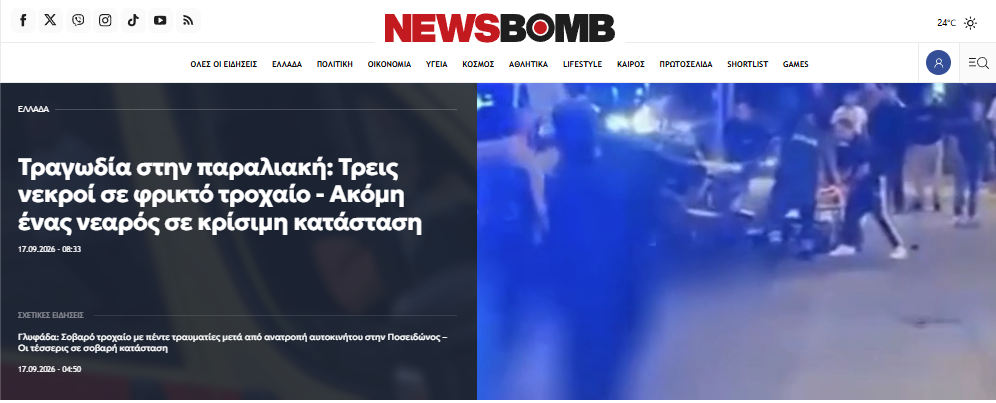
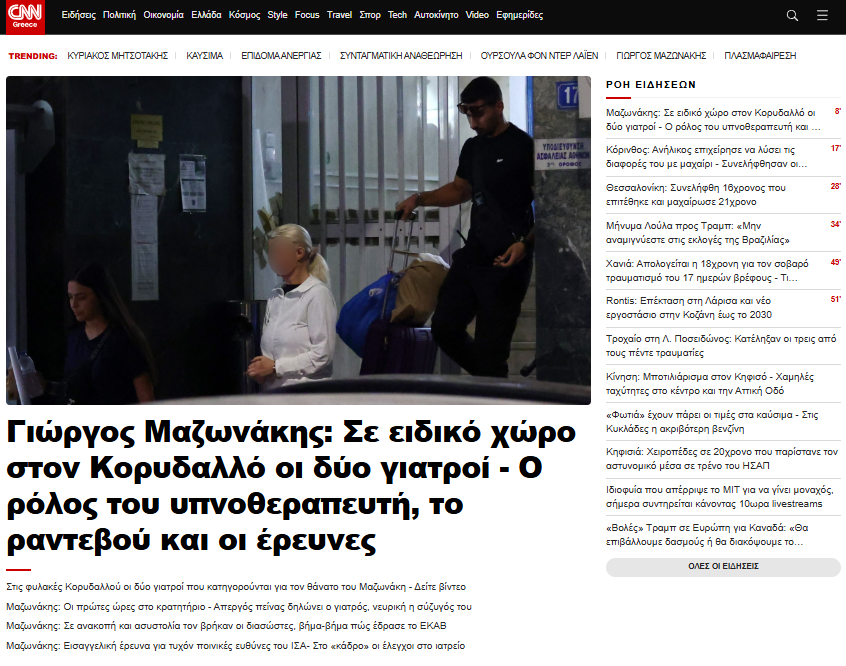

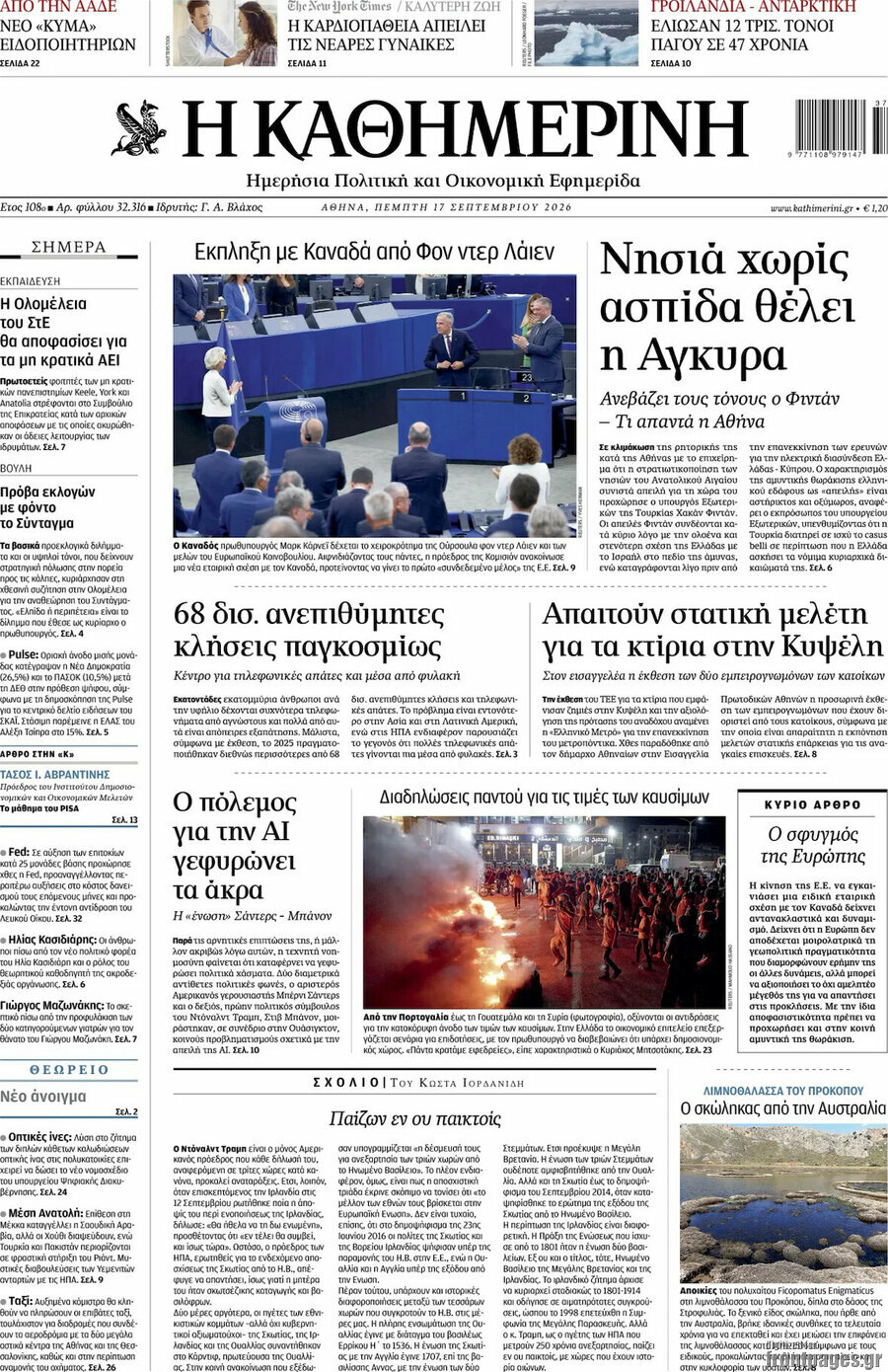
KATHIMERINI: Ankara wants defenseless Greek islands
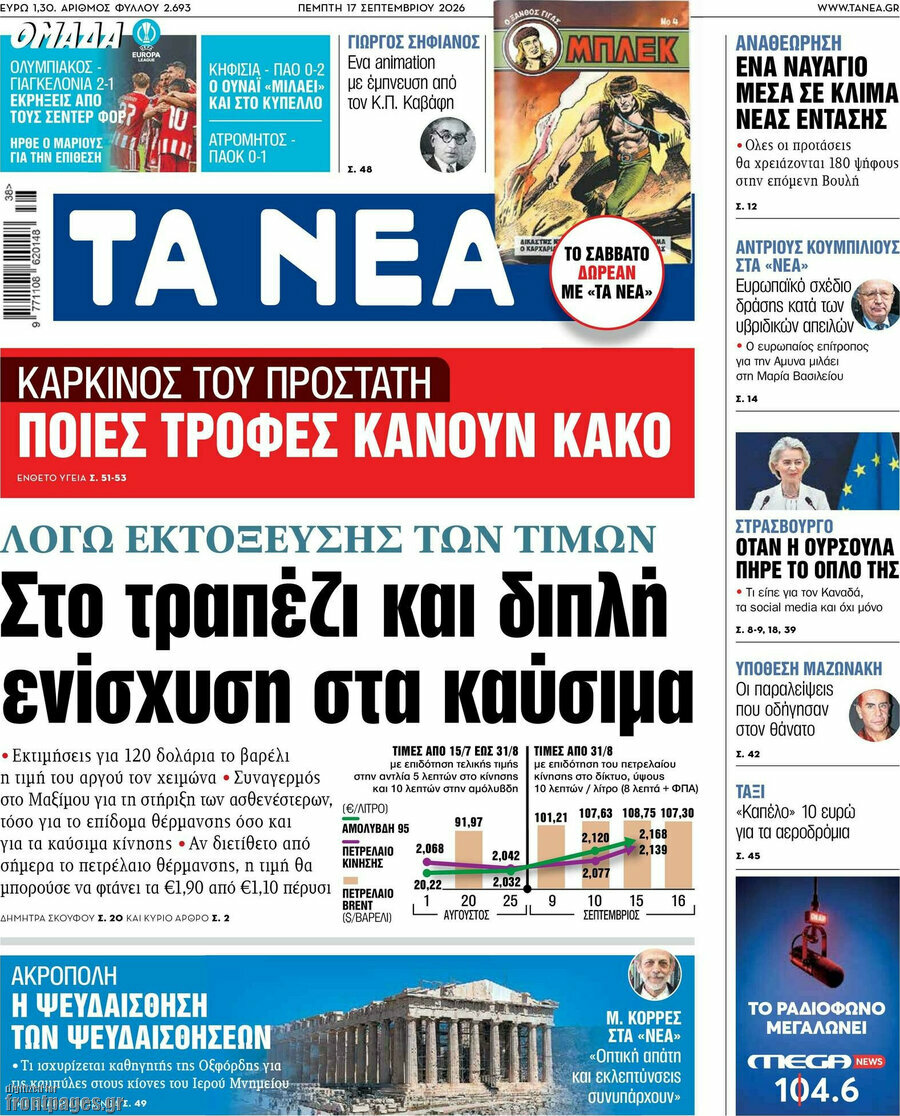
TA NEA: Double support for fuel under discussion
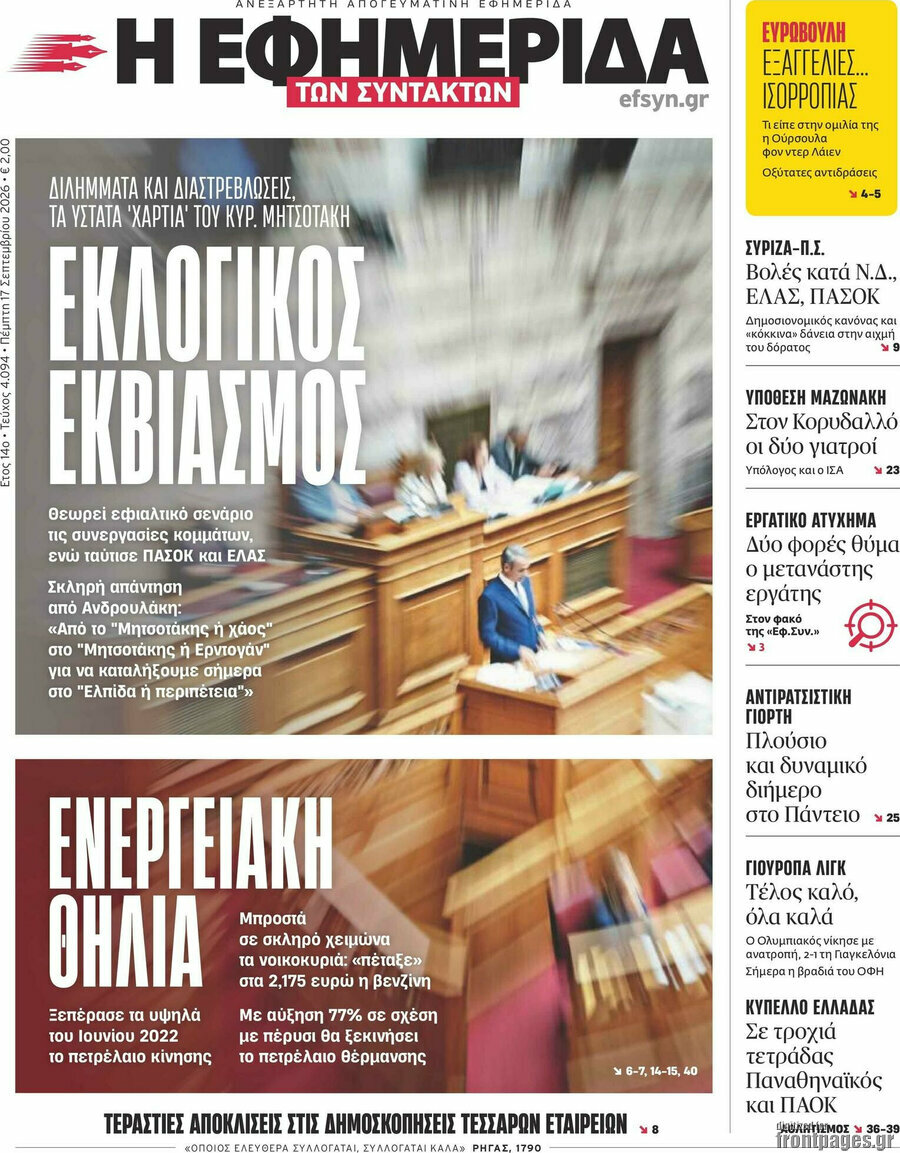
EFIMERIDA TON SYNTAKTON: Elections blackmail by the PM – Energy noose
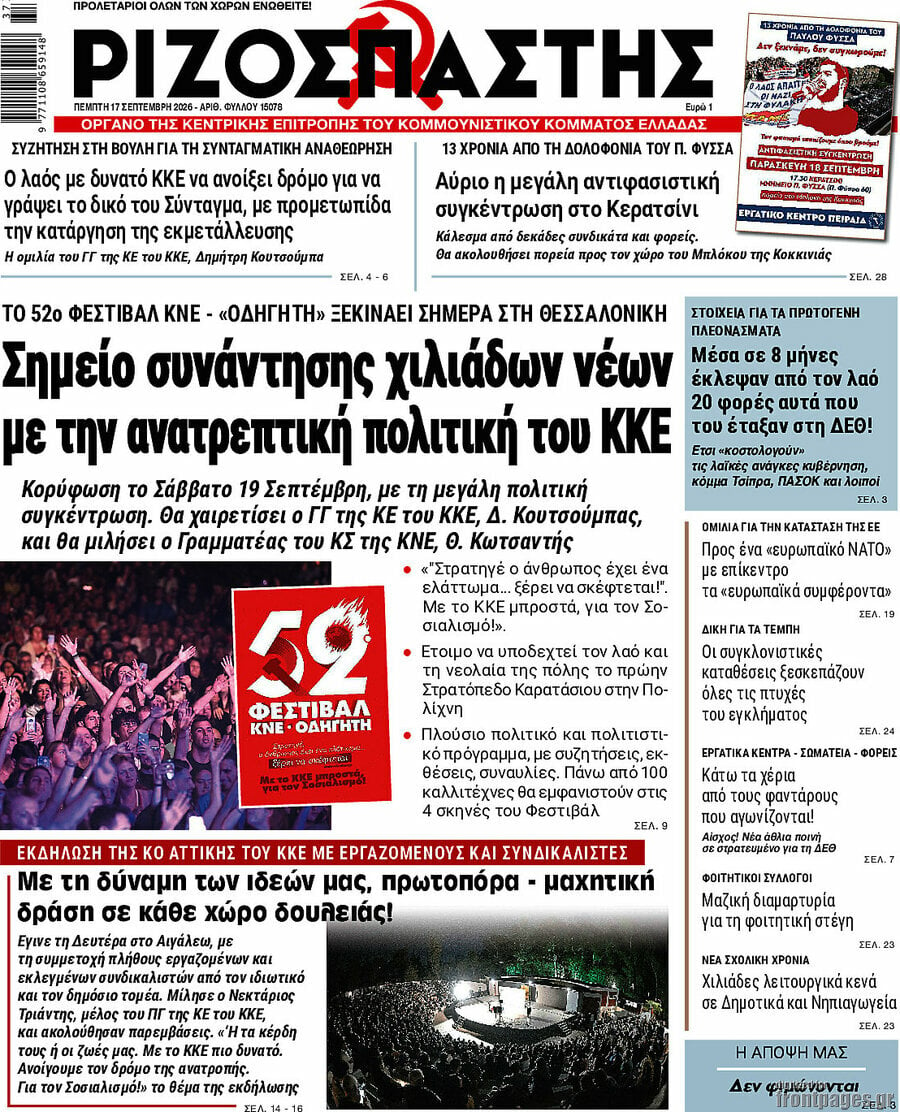
RIZOSPASTIS: Communist Youth Festival starts today in Thessaloniki
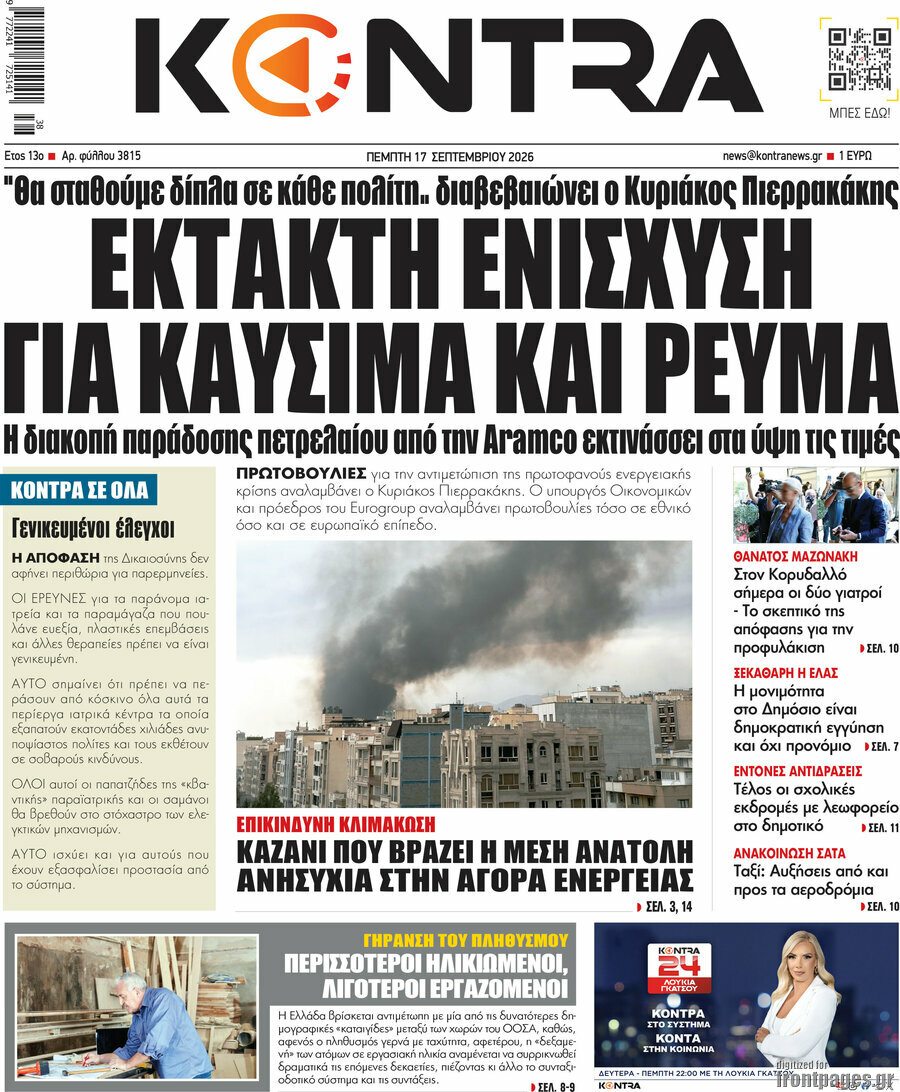
KONTRA NEWS: Extraordinary subsidy for fuel and electricity
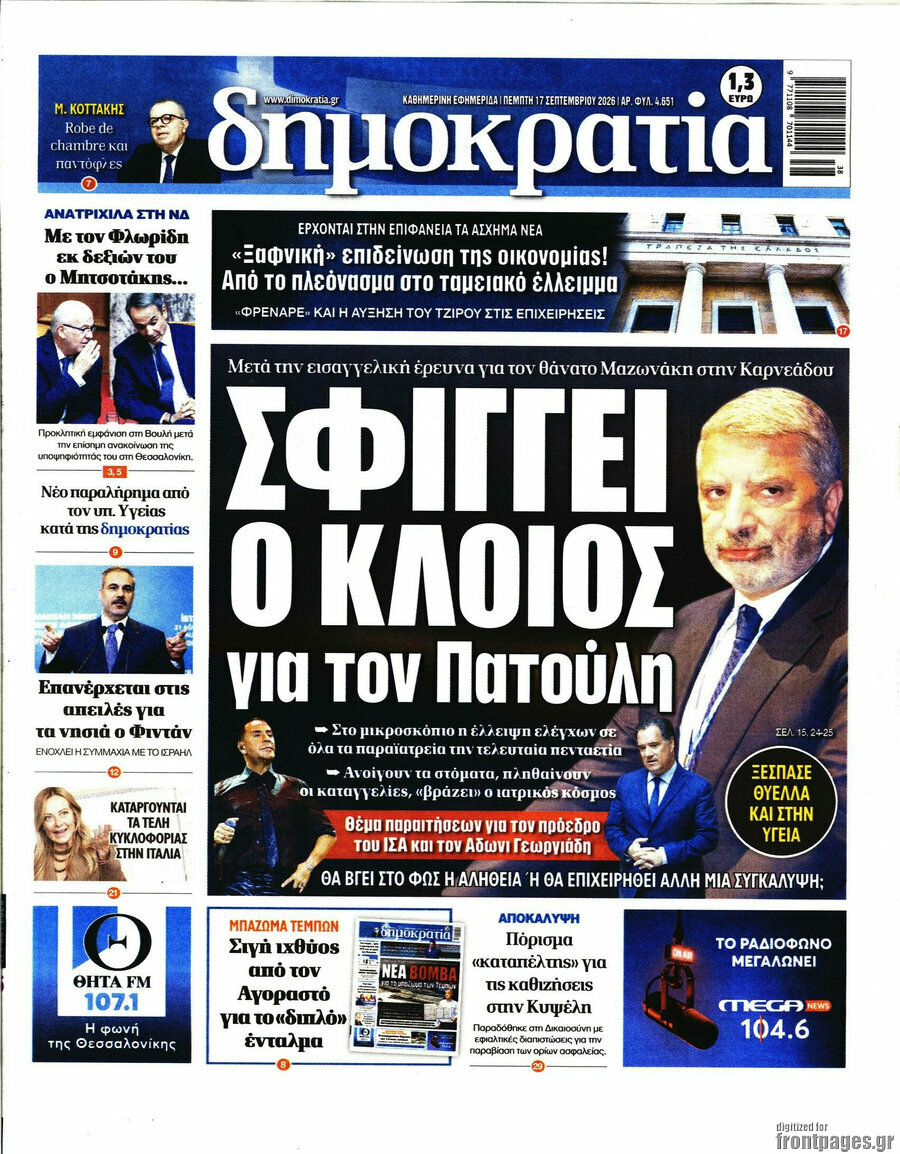
DIMOKRATIA: The noose tightens for the head of the Athens Medical Association Patoulis
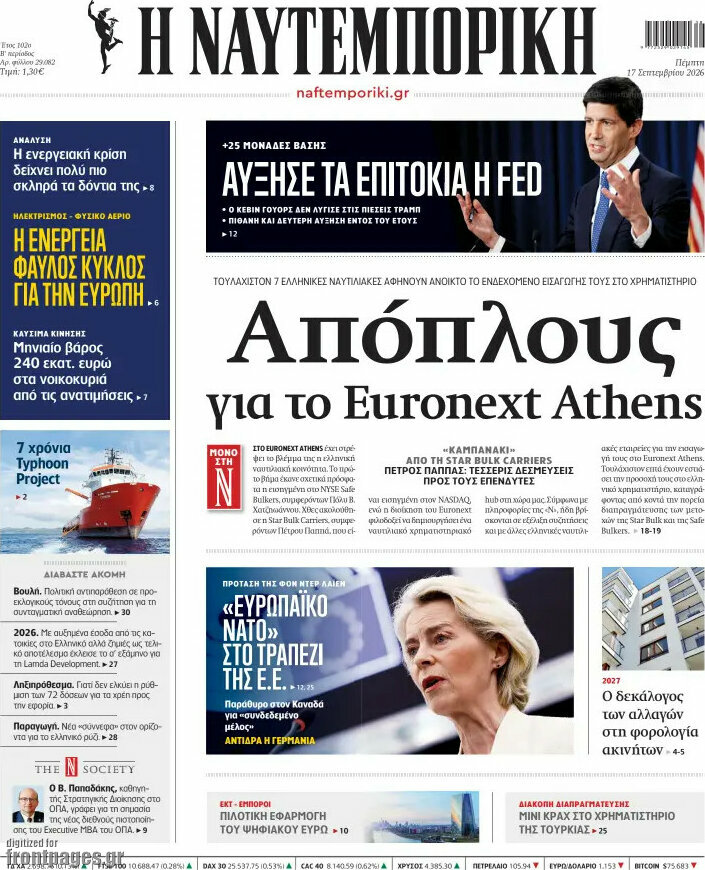
NAFTEMPORIKI: Setting sail for Euronext Athens

DRIVING THE DAY
A MIXED BLESSING: The EU’s burgeoning friendship with Canada was already getting complicated before Donald Trump crashed the party overnight.
First came the will-she-won’t-she fuss over whether Commission President Ursula von der Leyen would attend Prime Minister Mark Carney’s speech in the European Parliament today.
Then came yesterday’s bombshell: von der Leyen’s proposal for Canada to become an “associate member” of the EU. A draft of the speech obtained by POLITICO before von der Leyen took to the stage didn’t contain the Canada line. And one diplomat said the version that capitals received didn’t have it either.
Nobody seems entirely sure what an EU “associate member” is, since that status doesn’t exist yet. “We’re entering terra nova,” Climate Commissioner Wopke Hoekstra said outside the chamber — which might have been a Canada joke, given that Terra Nova is the old name for Newfoundland. “We’re entering the unknown,” Hoekstra added.
Commission Executive Vice President Teresa Ribera conceded that the Canada move is first and foremost a declaration of intent — but called the idea “quite thrilling and interesting.” But MEP and EU law professor René Repasi said doing it “properly” would require treaty change. A more realistic route, he suggested, could look more like the European Economic Area. (Sorry, Britain: Associate membership isn’t on the cards in any post-Brexit reset.)
But here’s the really awkward bit: The idea wasn’t presented in advance to European capitals and even Ottawa seems to be distancing itself from the “associate” label, as Sebastian Starcevic and Max Griera report.
“We’re not there,” Jonathan Wilkinson, Canada’s incoming ambassador to the EU, told reporters in Strasbourg when asked about associate membership. “What we’re focused on is actually driving results.”
Stuck in the middle with you: Von der Leyen’s speech also floated the creation of a European Security Council that would bring together the leaders of Canada, the U.K., Norway and Ukraine. That’s an extension of Carney’s famed Davos speech in which he called for the world’s “middle powers” to stand together against autocrats, as Nicholas Vinocur reports.
But the European Security Council would sit outside of NATO — which might cause a problem with the military alliance.
Cue the Carney-val: Von der Leyen’s speech yesterday was reassuring — doctors won’t be replaced by AI; housing is a right; Europe is less vulnerable to another energy crisis — but hardly a barnburner. The verdict among those Playbook spoke to in Strasbourg was that it was all rather flat. Expectations are higher for Carney’s address today. One MEP from von der Leyen’s own political family said it could make the Commission chief’s unconvincing performance look even worse.
Stay tuned: Carney is due to speak in the European Parliament at 11:30 a.m. Watch it here and follow on our live blog.
BIG AND BREAKING
SWEDISH ELECTION UPDATE: Social Democratic Party leader Magdalena Andersson is on course to become prime minister, with her center-left bloc now holding an unassailable lead after 99.9% of results were declared.
RUSSIA SANCTIONS: The U.S. House passed the sweeping Russia sanctions bill championed by the late Sen. Lindsey Graham overnight, giving Washington more tools to squeeze Moscow — but Democrats worry a tariff provision could be turned against America’s allies.
RATE HIKE: The Federal Reserve has lifted official U.S. interest rates for the first time in three years — and hinted there might be more to come — in an early test of the relationship between new Chair Kevin Warsh and Donald Trump.
GETTING READY: European People’s Party chief Manfred Weber told colleagues on Tuesday that he’ll run for reelection and asked for their support … and announced that he’s set up a task force (“Win 2029”) to map out the group’s strategy to confront the far right in the next European Parliament election, according to a document seen by POLITICO.
COSTA ON TOUR
COSTA’S BIG BUDGET DEBRIEF: European Council President António Costa is in Dublin today to debrief Irish Taoiseach Micheál Martin on his tour of EU capitals.
Costa has visited 24 leaders to bring them closer to an agreement over the EU’s next seven-year budget before an informal end-of-year deadline. His input will be crucial for Ireland, which holds the rotating presidency of the Council of the EU and plays a key role in steering the discussions.
Dublin will put forward a new negotiating document, or negobox, with revised figures that will set the tone for a leaders’ meeting on Oct. 15, which will last for two days and touch on other issues including competitiveness, enlargement and Ukraine.
Appetizer: After making it to Dublin on a delayed Ryanair flight, Costa will share with Martin the findings of his meetings to help him strike the right balance in the negobox. The taoiseach has been carrying out his own budget consultations, including a call with French President Emmanuel Macron and a meeting with the Visegrád Group.
“It will be a moment to compare notes and chart the way for the October European Council,” said an EU official. Costa’s priority is to narrow down which EU-wide taxes — or own resources — could finance the budget with strong backing among countries.
Costa won’t find encouragement from a heated discussion on the size of the budget among the EU’s 27 ambassadors on Wednesday, which was “the most useless session so far,” according to one EU diplomat. “It was smoke and mirrors,” said a second diplomat, adding that countries caused confusion by using different metrics to calculate their budget contributions.
With friends like these: Germany renewed calls to slash the budget by hundreds of billions of euros — warning that otherwise there will be no deal by the end of the year, and EU payouts will be delayed after 2028, said one of the diplomats. France retorted that this would lead to the expiry of Germany’s discount on budget contributions, better known as a rebate.
20-SECOND PLAYBOOK PRIMER
How close are Canada and the EU? Well, there’s a trade agreement (the EU-Canada Comprehensive Economic and Trade Agreement, or CETA) and trade in goods and services between the two sides was €130 billion in 2025. There’s also the EU-Canada Strategic Partnership Agreement, which covers the likes of human rights, economic and sustainable development, and justice.
KOSOVO WAITS
A BIG LETDOWN: While Canada got a song and dance about associate membership, the countries that have been in the EU’s waiting room for years got nothing concrete from von der Leyen’s big speech yesterday.
And they’re feeling forgotten.Playbook’s Zoya Sheftalovich spoke with Jeton Zulfaj, Kosovo’s chief negotiator with the EU, who lamented that four years after officially applying to join the bloc, Kosovo hasn’t even received candidate status. “There is no criteria left for us to fulfill,” Zulfaj said.
“We’re doing good as a country,” Zulfaj added, checking off a list of achievements and reforms. “What is lacking is unity from the EU. And this unity is not going to just miraculously happen if nobody looks for it, if nobody pushes it, if we are not on the agenda.”
Five EU countries — Cyprus, Greece, Romania, Slovakia and Spain — don’t recognize Kosovo’s independence, broadly due to concerns about territorial integrity and the precedent of unilateral secession. That leaves Kosovo’s EU path hostage to the bloc’s lack of consensus about its very existence.
Russia benefits: “We feel like [Kosovo] has been very much neglected,” Zulfaj said, adding that Moscow was attempting to stoke divisions and anti-EU sentiment in Kosovo. “You cannot be complacent about the region and then wonder why there is malign influence … The people there are waiting for the EU to deliver.”
DASHBOARD
POLITICO analysis of State of the Union addresses over the past decade shows how the bloc’s narrative has shifted toward defense, security, energy and artificial intelligence. In 2020, the speech highlighted Green Deal plans and post-pandemic recovery programs; back in 2015, it focused on the Greek debt crisis and an upsurge in refugee arrivals in 2015.
 |
5 MORE THINGS GETTING US TALKING
ENDGAME IN BERLIN: Hans von der Burchard runs through the scenarios facing Germany’s embattled Chancellor Friedrich Merz.
MEANWHILE, IN EAST GERMANY: Center-left state premier Manuela Schwesig is close to halting the rise of the far right — but it’ll come at a steep price for Merz.
SOTEU POSTMORTEM: Von der Leyen’s remarks about AI showed the limits of her power … competition chief Teresa Ribera said she’s open to giving AI companies more room to cooperate on safety without running afoul of antitrust rules … and while von der Leyen diagnosed Europe’s ecological malaise, she was less forthcoming about the cure.
CEUTA CALL: The EU as a whole is threatened by the crisis in Ceuta — and should step in to clean up the mess, Spanish opposition leader Alberto Núñez Feijóo argues in an op-ed on POLITICO this morning.
ATTAL GOES FEDERAL: French presidential hopeful Gabriel Attal is expected to take aim at von der Leyen in a speech outlining his EU platform today — with a pitch for a United States of Europe, my colleague Sarah Paillou reports. (Reminder: His partner Stéphane Séjourné is one of von der Leyen’s executive vice presidents.)