
Intellexa founder says he plans to appeal Greek court ruling over wiretapping scandal
The founder of surveillance firm Intellexa, Tal Dilian, plans to appeal against his conviction by a Greek court on charges of breaching personal data during the wiretapping scandal that rocked Greece in 2022, he told Reuters on Tuesday. The affair, dubbed “Predatorgate” in Greece, emerged after allegations by a financial journalist and a political leader that they had been subject to state surveillance via the phone malware Predator, the flagship spyware product of Intellexa. The case led to the sacking of the head of the state intelligence service, EYP, and the prime minister’s chief of staff. Traces of Predator were found in dozens of phones. Dilian has made it clear that the surveillance technology has only been sold to governments, and that they bear responsibility for using the technology legally.
Government seeking to counter gloom with wage rise
The cabinet convenes Thursday amid a heavy political climate, focusing on a minimum wage increase to bring the monthly total to more than €900, and on foreign policy developments, officials said. The meeting takes place as the wiretapping case returns to prominence and the trial over the Tempe rail disaster begins amid tensions.
https://www.ekathimerini.com/politics/1299119/government-seeking-to-counter-gloom-with-wage-rise
Alexis Charitsis resigns leadership of Nea Aristera party
Alexis Charitsis resigned as leader of the Nea Aristera (New Left) party on Tuesday, citing as reason a disagreement with leading members on the party’s extroversion. Nea Aristera’s Political Bureau said it would hold an emergency congress to elect a new leader. Central Committee Secretary Gavriil Sakellaridis will serve as acting president until a replacement is elected.
https://www.amna.gr/en/article/980533/Alexis-Charitsis-resigns-leadership-of-Nea-Aristera-party-
BoG chief Stournaras calls on Greek banks to remain vigilant in volatile environment; meets with ECB, SRB heads
Bank of Greece Governor Yannis Stournaras called on credit institutions’ leaders to be vigilant in order to reduce to the greatest degree possible credit threats and repercussions on banks’ ability to continue to fund the economy without obstacles, on Tuesday. Following a series of meetings he held with European officials, Greece’s central banker said that despite the fact the bank sector is currently in a much stronger position, the Middle East war creates a new, serious turmoil on the supply front, which starts off with energy prices, while it also affects the pricing of other goods and services significantly, with serious repercussions for the global economy, capital and currency markets, and the banking sector as well.
RRF money is running out; focus on reforms, says OECD chief
For Greece to continue seeing its public debt declining, it needs to strengthen reforms that will increase productivity and offset the loss of resources from the expiration of the EU’s Recovery and Resilience Facility (RRF), the secretary-general of the Organization for Economic Cooperation and Development (OECD), Mathias Cormann, said in an interview.



KATHIMERINI: Controls and alcotests reduced road fatalities
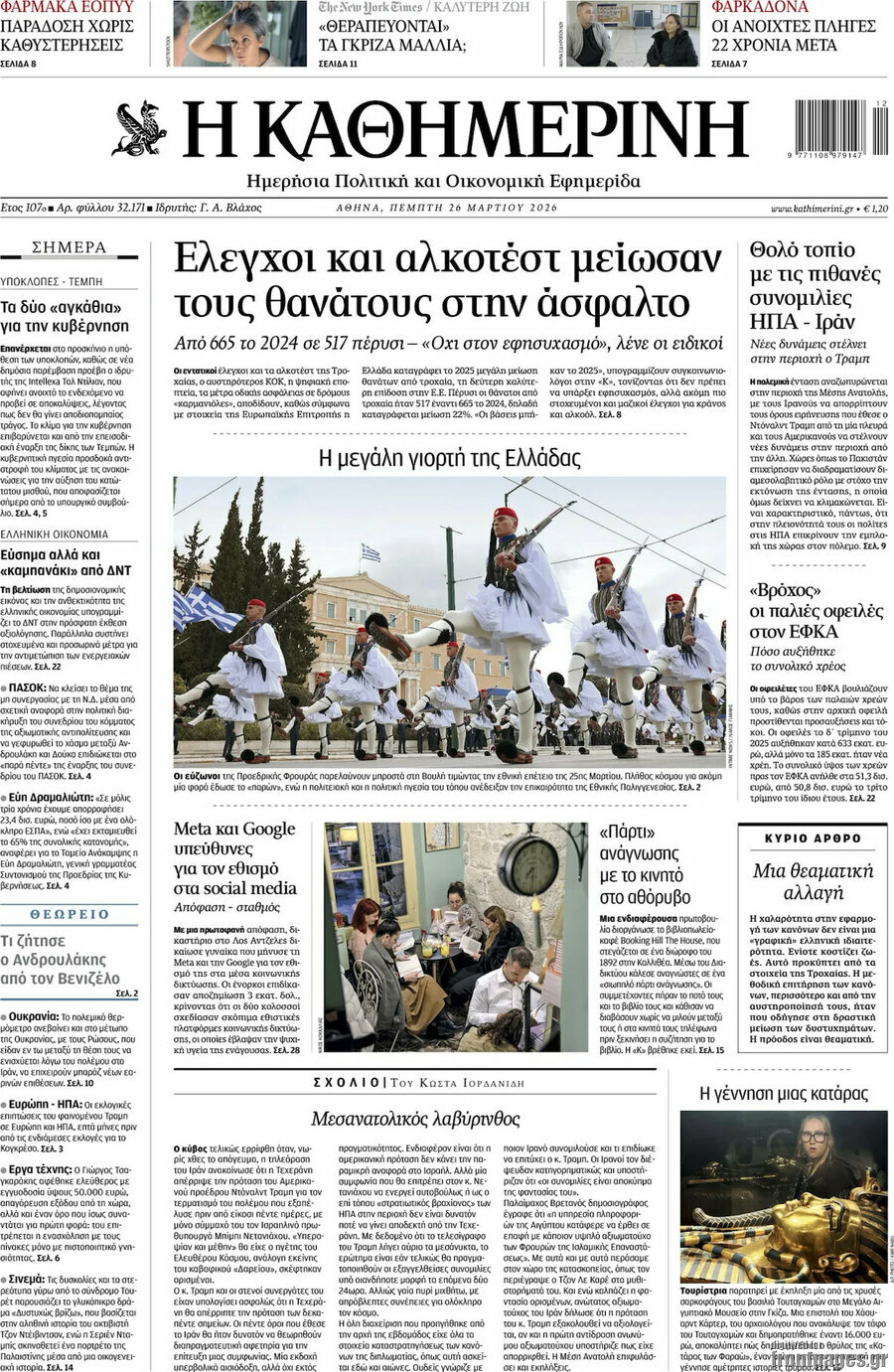
TA NEA: Wiretappings scandal: The wound reopens
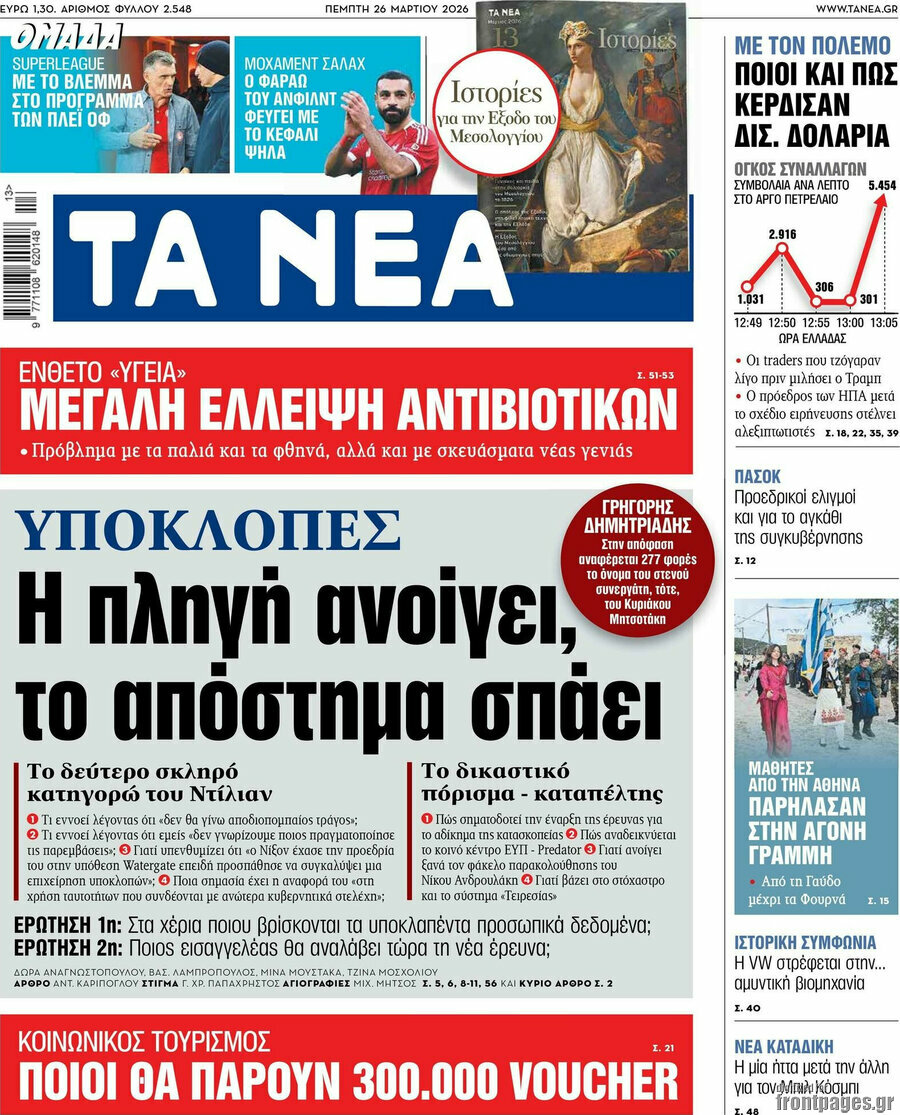
EFIMERIDA TON SYNTAKTON: Predator wiretappings scandal: The buyer, the targets and the PM’s office
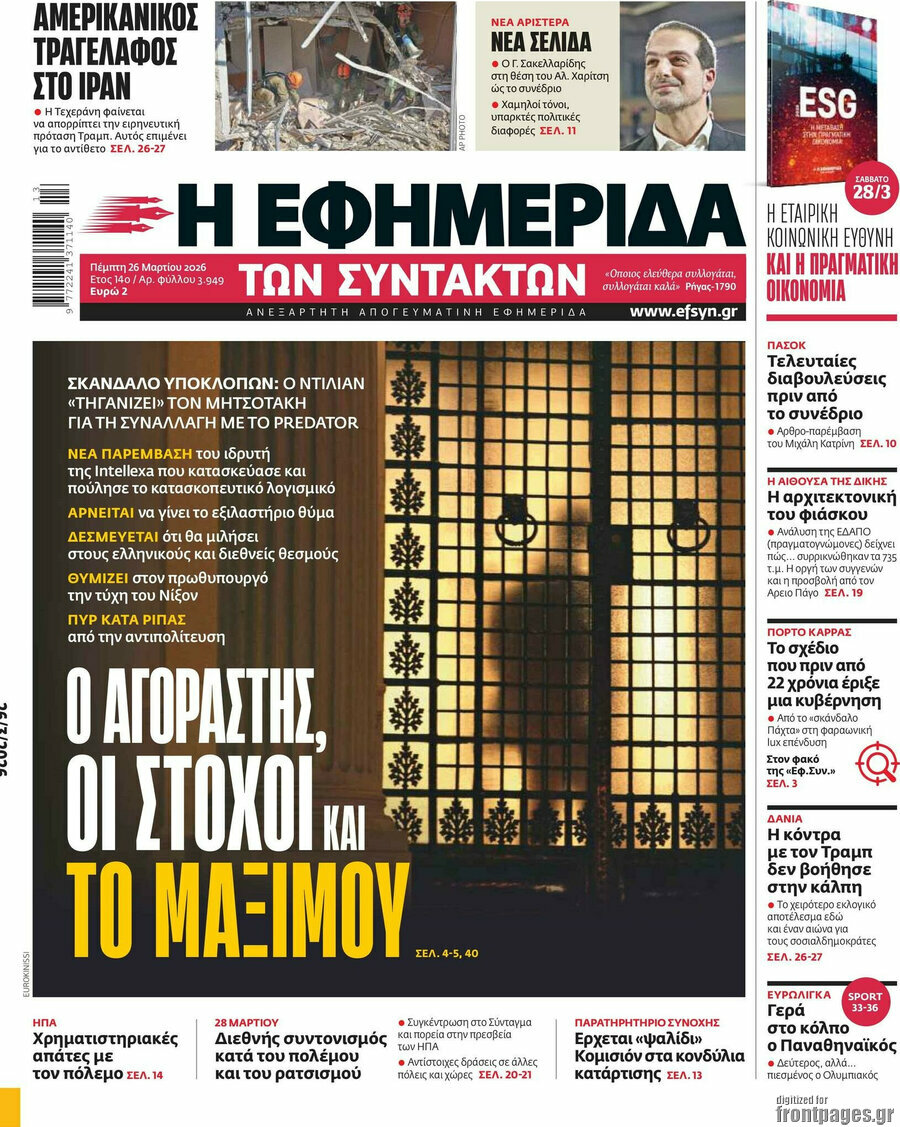
RIZOSPASTIS: Price hikes: Fake support measures place the full burden on simple folks
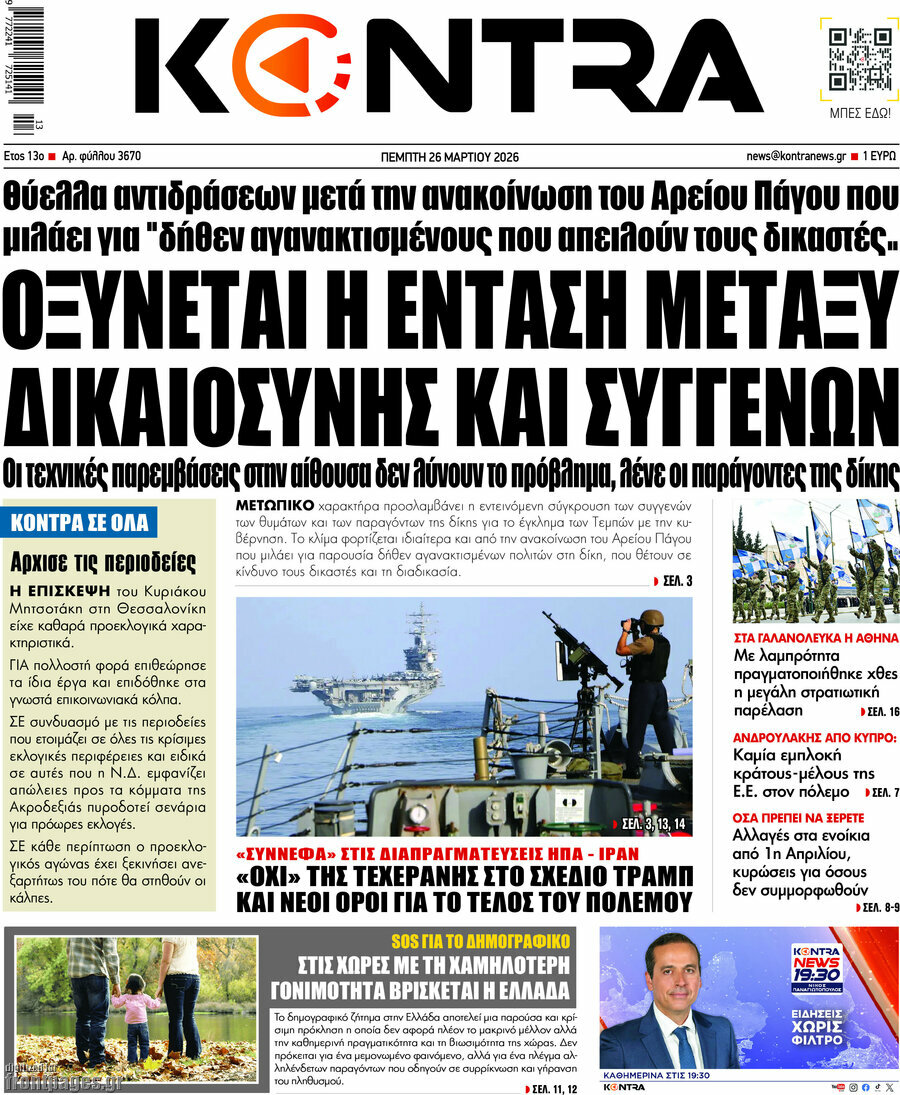
KONTRA NEWS: Escalating tension between Justice and the relatives of the Tempe fatal rail-crash victims
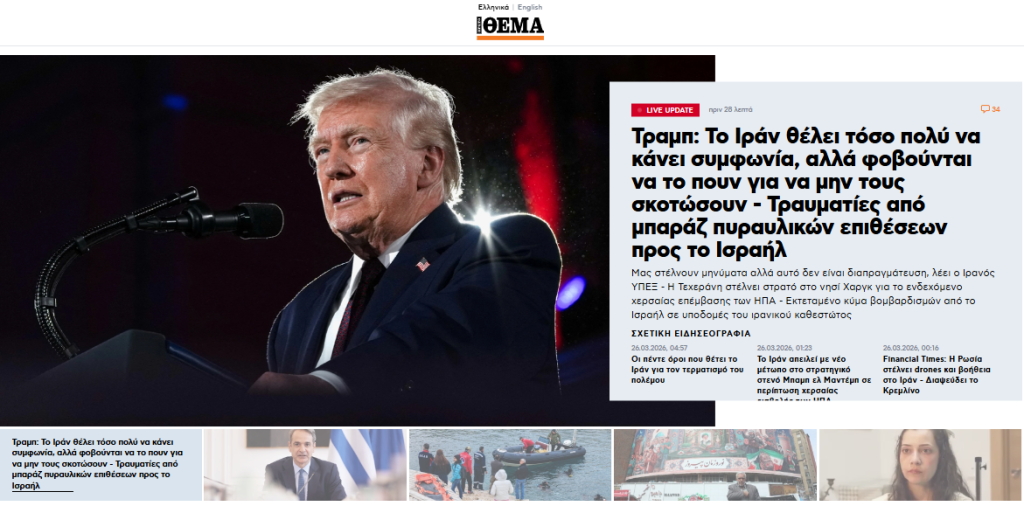
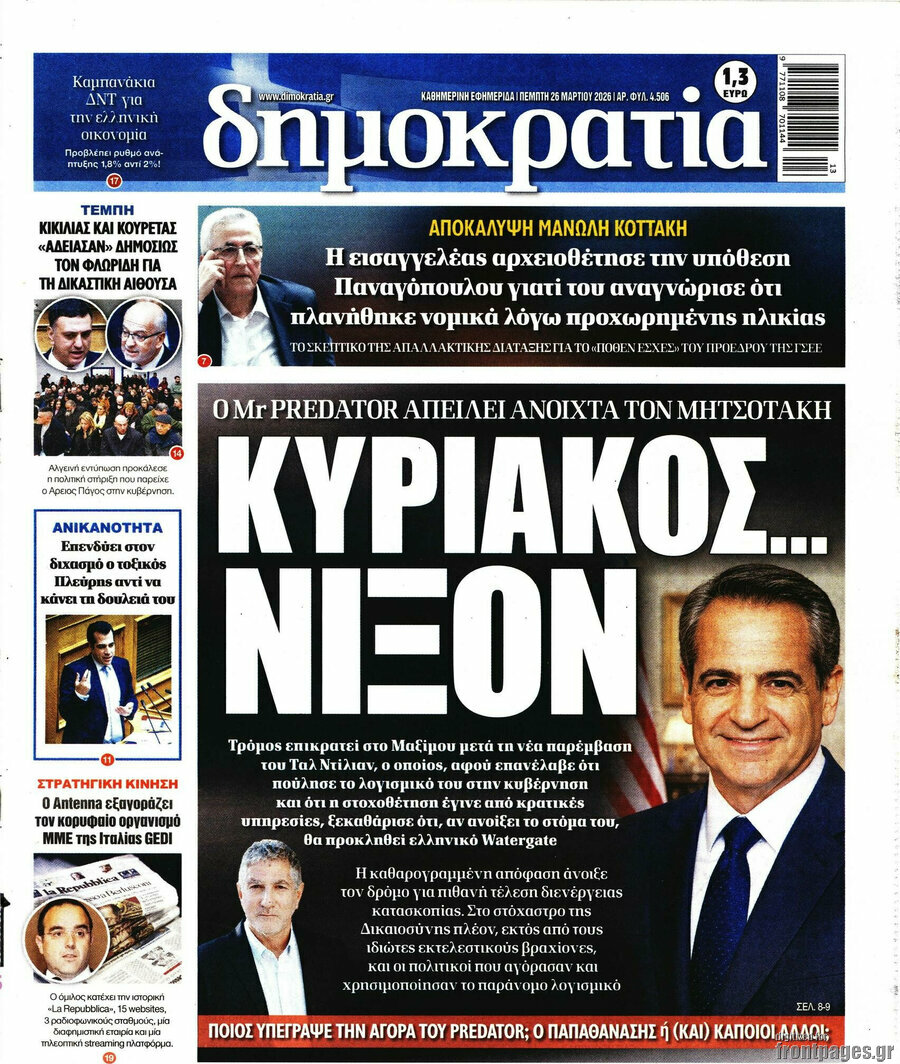
DIMOKRATIA: PM Mitsotakis is involved in wiretappings scandal just like Nixon was with Watergate
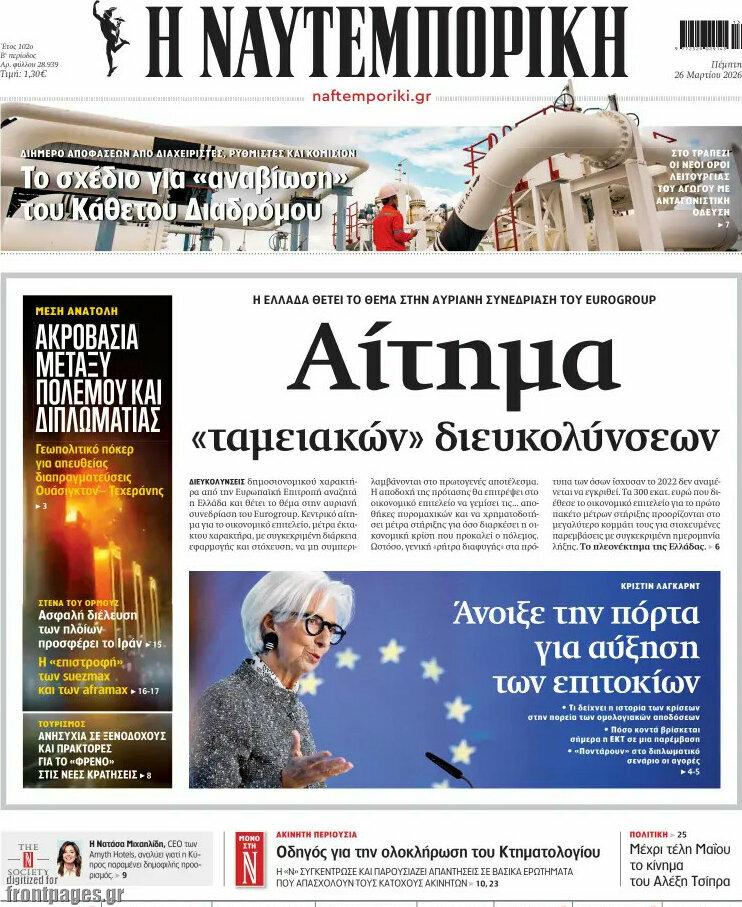
NAFTEMPORIKI: Greece to file “budgetary” facilitation request at tomorrow’s Eurogroup

DRIVING THE DAY
MIGRATION’S PIVOTAL YEAR: Immigration policy is back in the spotlight today as EU institutions meet to finalize a cornerstone of the bloc’s push to speed up deportations of unauthorized migrants — despite a last-ditch attempt by left-wing lawmakers to block the plan. And a meeting of senior officials on the worsening crisis in Sudan will highlight the external pressures driving Europe’s move to tighten its borders.
Trilogues kick off: Lawmakers are set to meet officials from the EU Council and the European Commission to discuss what is seen by both the executive and members states as an essential file to manage the flow of people coming to Europe. Migration Commissioner Magnus Brunner has called the returns regulation the “missing piece” needed to make the broader system work.
Politically locked in: The move to interinstitutional talks underscores how settled the direction of travel has become, with the objections of left-leaning lawmakers largely swept aside by the alliance of center-right and far-right parties. A majority spanning the European People’s Party, the European Conservatives and Reformists, Patriots for Europe and the European of Sovereign Nations secured Parliament’s position earlier this month, bulldozing its way through left-wing amendments. It’s a done deal.
That doesn’t mean left-leaning MEPs have given up. They will vote in today’s mini-plenary in Brussels in the hope of overturning the parliamentary mandate and upending the subsequent trilogue. The effort isn’t likely to succeed, but it highlights unease over the EU’s increasingly restrictive turn. “It’s incomprehensible that Parliament’s position aligns with the far right on such a critical issue,” French Socialists and Democrats (S&D) MEP Murielle Laurent said in a final appeal for lawmakers’ votes.
The concerns: The return regulation remains one of the most controversial pieces of its new asylum framework, with the International Rescue Commitee, a humanitarian non-profit, saying Wednesday it “will pave the way for new offshore detention centers which are essentially legal black holes.”
Sudan urgency: As this unfolds, a Senior Officials Meeting (SOM) will today address the situation in Sudan, now described as the world’s largest humanitarian crisis, with more than 33 million people in need of assistance. The head of the U.N. migration agency in Sudan, Mohamed Refaat, told Playbook’s Nicholas Vinocur that the conflict risks reaching a tipping point comparable to Syria in 2011 — with potentially large-scale displacement beyond the region.
This difference this time is that former German Chancellor Angela Merkel’s 2015 statement of solidarity — Wir schaffen das — has been replaced by a more pragmatic and hard-nosed deportation posture.
Next stop, Berlin: Crisis Management Commissioner Hadja Lahbib is expected to stress that Sudan must remain a top EU priority. And today’s SOM feeds into the Berlin Ministerial on April 15, where the EU and partners will seek to mobilize humanitarian support and coordinate response efforts — including through a new Team Europe Initiative.
FROM BRUSSELS TO D.C.
EU-U.S. DEAL HEADS TO PLENARY: After months of political friction, the European Parliament votes at 11 a.m. on whether to implement last year’s EU-U.S. trade agreement, following a debate at 9 a.m.
On track — but not straightforward: The proposal is expected to pass, according to POLITICO’s ace trade watcher Camille Gijs, but assembling a majority has been anything but smooth. Washington’s increasingly combative tone — from rhetoric on Greenland to launching a Section 301 investigation into the EU — has hardened attitudes in Parliament, with MEPs recalibrating their support.
MasterpLange: Trade Committee Chair Bernd Lange remains confident of a “strong majority” in favor of the deal, despite headwinds (plus a logistical challenge: the S&D lawmaker is expected to fly in from Cameroon — more on that below — just in time for the vote). To lock in more skeptical groups, including the S&D, MEPs led by Lange added safeguards to the text of the deal, beyond those agreed with the U.S. in Turnberry.
Before Sunrise: These include a “sunrise clause,” requiring the U.S. to lift tariffs on steel derivatives, and a “sunset clause” that would see the deal expire in March 2028.
It ain’t over ’til … If approved, the vote only clears the way for interinstitutional negotiations — can we just say trilogue without a visit from the jargon police? — with member countries and the Commission, potentially kicking off as early as April 13.
HELLO FROM THE OTHER SIDE: While MEPs vote in Brussels, Commission Executive Vice President Teresa Ribera is in Washington, D.C., following a stop in California for a meeting with Meta CEO Mark Zuckerberg and Governor Gavin Newsom (a frequent Trump foe), POLITICO’s Jacob Parry writes in to report.
Same message, different coast: Ribera described her meeting with Newsom as constructive, focused as it was on climate and tech. But she stopped short of formalizing cooperation — possibly mindful of how the U.K.’s recent agreement with California antagonized the Trump Administration. “We are always happy to join forces with the U.S. and defend the same values,” Ribera said, pointing to shared commitments on rule of law and sustainability.
All I’m askin’ … is for a little … The commissioner also rejected calls from the Trump administration to revisit EU tech regulation. “Do you allow anyone to tell you when you need to cook or to watch TV or to turn on the washing machine at your house?” said Ribera in an interview with my U.S. colleagues Christine Mui and Chase DiFeliciantonio. “I think that it’s a matter of respect.”
Engaging Big Tech: Ribera’s meetings with Meta and Google didn’t focus on specific cases but touched on AI, labor impacts and the EU’s Digital Markets Act. Ribera framed the exchanges as a chance to hear industry concerns — while defending EU rules as effective and “very necessary.”
HUNGARY’S FROZEN DEFENSE ASSET
HUNGARY LEFT WITHOUT DEFENSE MONEY: The long-running European Commission vs. Hungary standoff has entered a new phase. Brussels has moved ahead with the pending allocations from its €150 billion SAFE loans-for-weapons program, but has left Hungary as the only EU member still empty-handed.
Czech and French are SAFE: Under a decision Wednesday, Prague is set to receive €2.1 billion and Paris €15.1 billion, pending final loan agreements. France had initially sought more than €16 billion, but diplomats say the trimmed figure reflects deficit constraints. A French official told POLITICO’s Jacopo Barigazzi the lower amount isn’t an issue.
The price of filibustering? But for Hungary: zip. The country’s national plan is still unapproved, with no clear timeline. Several diplomats and officials told POLITICO’s Gregorio Sorgi that this looks like payback for Budapest’s veto of the EU’s €90 billion loan to Ukraine, which is unlikely to be resolved any time before the April 12 election.
Don’t expect the executive to say that. A Commission spokesperson insists “the assessment is ongoing” and approval will come “once ready.”
What changed: Just weeks ago, the Commission appeared close to green-lighting Hungary’s request — partly to avoid accusations of targeting Prime Minister Viktor Orbán ahead of the elections. But support inside the Berlaymont waned, only for opposition to stiffen after Budapest blocked the Ukraine loan.
Growing isolation: Tensions have only deepened, with recent allegations that Hungary maintained contacts with Moscow on EU decision-making rattling diplomats. Some now say Budapest is being quietly sidelined over concerns of how information is shared, with leaders — including Polish Prime Minister Donald Tusk — increasingly reluctant to engage when Hungarian officials are in the room.
Commission turns up pressure — gently: Executive Vice President Henna Virkkunen said Wednesday that reports of leaks from closed-door ministerial discussions are “greatly concerning,” adding the Commission expects clarification from Budapest — without saying when or how.
G7 AND WTO MINISTERIAL
ALL AROUND THE WORLD: Two major non-EU gatherings today are attracting the attention of a usually bubble-focused Brussels.
Meet me in the abbey: EU foreign policy chief Kaja Kallas and EBRD president Odile Renaud-Basso don’t have to go that far to reach the picturesque Abbaye des Vaux-de-Cernay, south of Paris, where G7 foreign ministers meet today and tomorrow.
Start without me: The meeting’s top guest is running a tad late, my French colleague Clea Caulcutt writes. U.S. Secretary of State Marco Rubio is only expected to join the gathering on Friday.
No matter: Ministers will have a lot to talk about even without Rubio, such as how to respond if they get called “cowards” again over their lack of support for the U.S.-Israel war on Iran. Or, more seriously, the U.K.’s offer to host a summit on re-opening the Strait of Hormuz.
Don’t forget Ukraine … The French see the G7 meeting as an opportunity to showcase European unity on Ukraine, just as Volodymyr Zelenskyy warns he’s under pressure from the U.S. to cede territory. Ukrainian Foreign Minister Andrii Sybiha will be on hand to talk through those concerns. There will also be a G7 session on finding the money to repair the steel arch of Chernobyl, damaged in a Russian drone attack.
CUT TO YAOUNDÉ: The four-day World Trade Organization Ministerial Conference officially opens in Cameroon — a test of whether the institution can still deliver meaningful outcomes. Canadian PM Mark Carney is leading a middle-power charge to save global trade from Trump’s disruption, my colleagues Graham Lanktree, Camille Gijs, Zi-ann Lum and Caroline Hug report.
Agriculture, familiar deadlock: Farming Commissioner Christophe Hansen represents the EU in negotiations that have repeatedly stalled. An EU official described this as a “ministerial of reform,” but past experiences — notably the EU-India divide In Abu Dhabi over public food stockpiling — underscores the difficulty of reaching an agreement.
Trade defense rethink: Trade Commissioner Maroš Šefčovič also faces a delicate balancing act ahead of a broader review of EU trade-defense instruments, due this summer. A joint Dutch-German paper circulating in Yaoundé is expected to push debate toward more “out-of-the-box” responses to unfair subsidies in sectors like chips, steel and chemicals — including greater use of plurilateral agreements among willing WTO members.
IN OTHER NEWS
VANCE IN BUDAPEST: U.S. Vice President JD Vance will visit Hungary on April 7-8, to offer his government’s support for the reelection of Prime Minister Viktor Orbán. The dates, which hadn’t previously been made public, were outlined in an excerpt of a State Department cable obtained by POLITICO.
But in Germany … AfD leader Alice Weidel has advised her lawmakers to cut back on their schmoozing with MAGA Republicans, amid concerns that the unpopularity of the U.S. war against Iran could cost the party in upcoming elections. Nette Nöstlinger and Pauline von Pezold have the story.
Another date for your calendars: U.S. President Donald Trump will meet Chinese President Xi Jinping on May 14 to 15, the White House announced Wednesday. The summit, originally scheduled for March 30, was delayed because of the war in Iran.
NOT ALL ROADS: Call it a culinary upset: carbonnade beats carbonara. Lille defeated eight rival cities to host the new EU Customs Authority, including Rome in a final run-off.
WHO CAN BEAT GIORGIA MELONI? Italy’s opposition senses an opportunity … but it needs a leader and a plan. Hanna Roberts reports.
HERE WE GO AGAIN: The newly minted EU-Australia trade deal is already giving grief to President Emmanuel Macron, with angry farm lobbyists calling it “Mercosur II,” my colleague Giorgio Leali reports.
BANKING ON RELIGION: Former EU Financial Services Commissioner Mairead McGuinness is expected to be appointed today as the bloc’s special envoy on religious freedom. It’s a role that had recently been offered — provocatively, some argued — to former Commission top civil servant Martin Selmayr, in a spectacular Brussels power struggle.