
Greece backs UN Security Council resolution condemning Iranian attacks on Gulf
The United Nations Security Council on Wednesday adopted a resolution calling on Iran to immediately halt its attacks against Gulf states, warning that the strikes violate international law and pose a serious threat to international peace and security. The resolution, submitted by Bahrain and Jordan, was co-sponsored by 135 UN member states, including Greece, and urges Tehran to stop military actions targeting countries in the Gulf and the wider region.
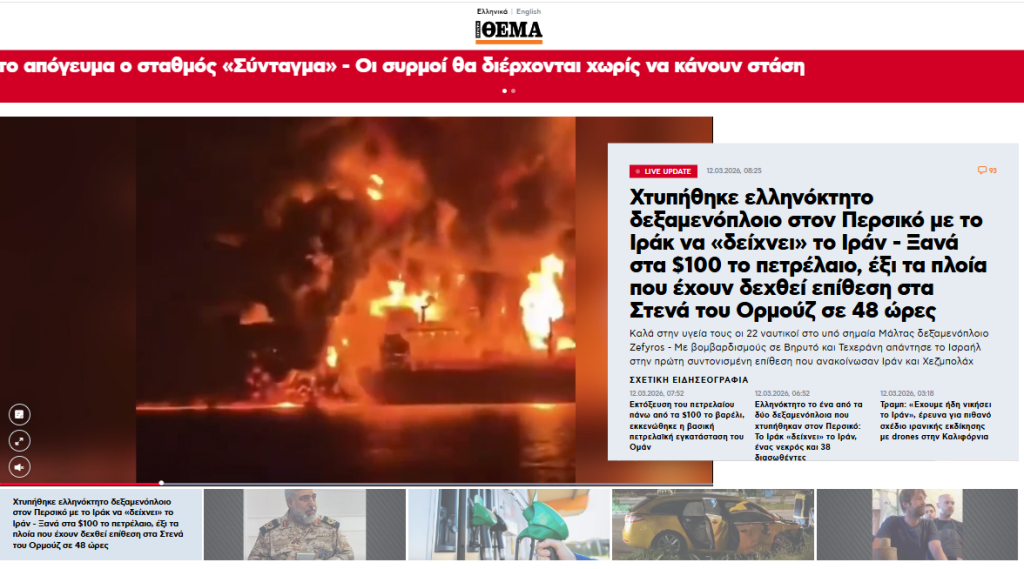
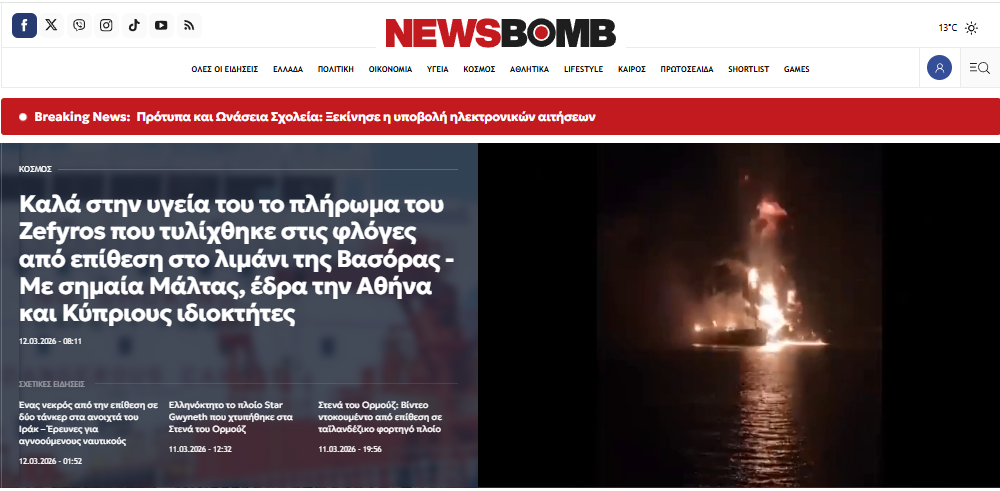
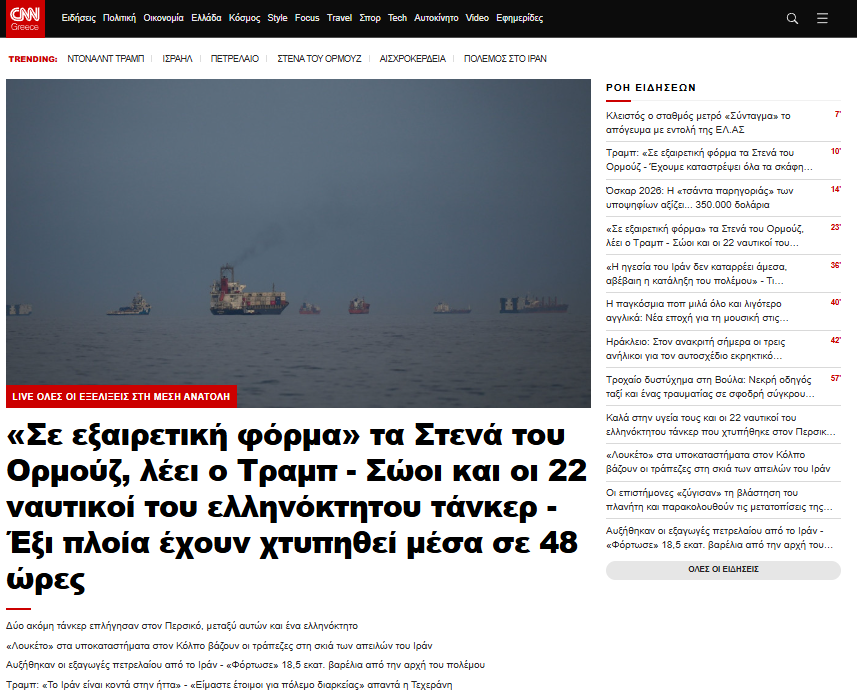
All 22 seafarers safe after attack on Greek-owned tanker in the Persian Gulf
All 22 Georgian nationals serving as crew members aboard a Greek-owned tanker flying the Malta flag are reported to be in good health after the vessel was struck by what is believed to have been an Iranian unmanned surface vessel while conducting a ship-to-ship (STS) cargo transfer operation within the territorial waters of Iraq.
Immediate imposition of profit margin caps on fuel and essential goods until June 30
The Greek government is implementing emergency measures for the fuel and basic goods markets through a legislative act that is being fast-tracked and is expected to be published in the Government Gazette on Wednesday. The measures aim to prevent profiteering amid international disruptions and will be in effect until June 30. They apply to industry, supermarkets, fuel trading companies, and service stations, with caps on profit margins and intensified inspections.
Golden Dawn case concludes with appellate decisions; four led to jail, including founder’s wife
The conclusion of the case against the former party of Chryssi Avghi (Golden Dawn) came on Wednesday at appellate level, four years after the trials of the officially termed criminal organization first began. Athens’ five-member Criminal Appeals Court upheld sentences for seven of the former party’s leading members, while for all others it either converted their sentences to fines or suspended them entirely.
ATHEX: Wait-and-see for traders on bourse
In an extremely volatile environment, with the war in the Middle East fanning uncertainty in markets and commodity prices fluctuating wildly, the Greek stock market chose to keep a waiting stance on Wednesday, with the majority of stocks posting small gains. The banks index was almost a non-mover, the benchmark edged slightly higher and turnover dropped to its lowest daily level since the start of the year.
https://www.ekathimerini.com/economy/1297773/athex-wait-and-see-for-traders-on-bourse



KATHIMERINI: Modus operandi of call centers deceiving old people exposed
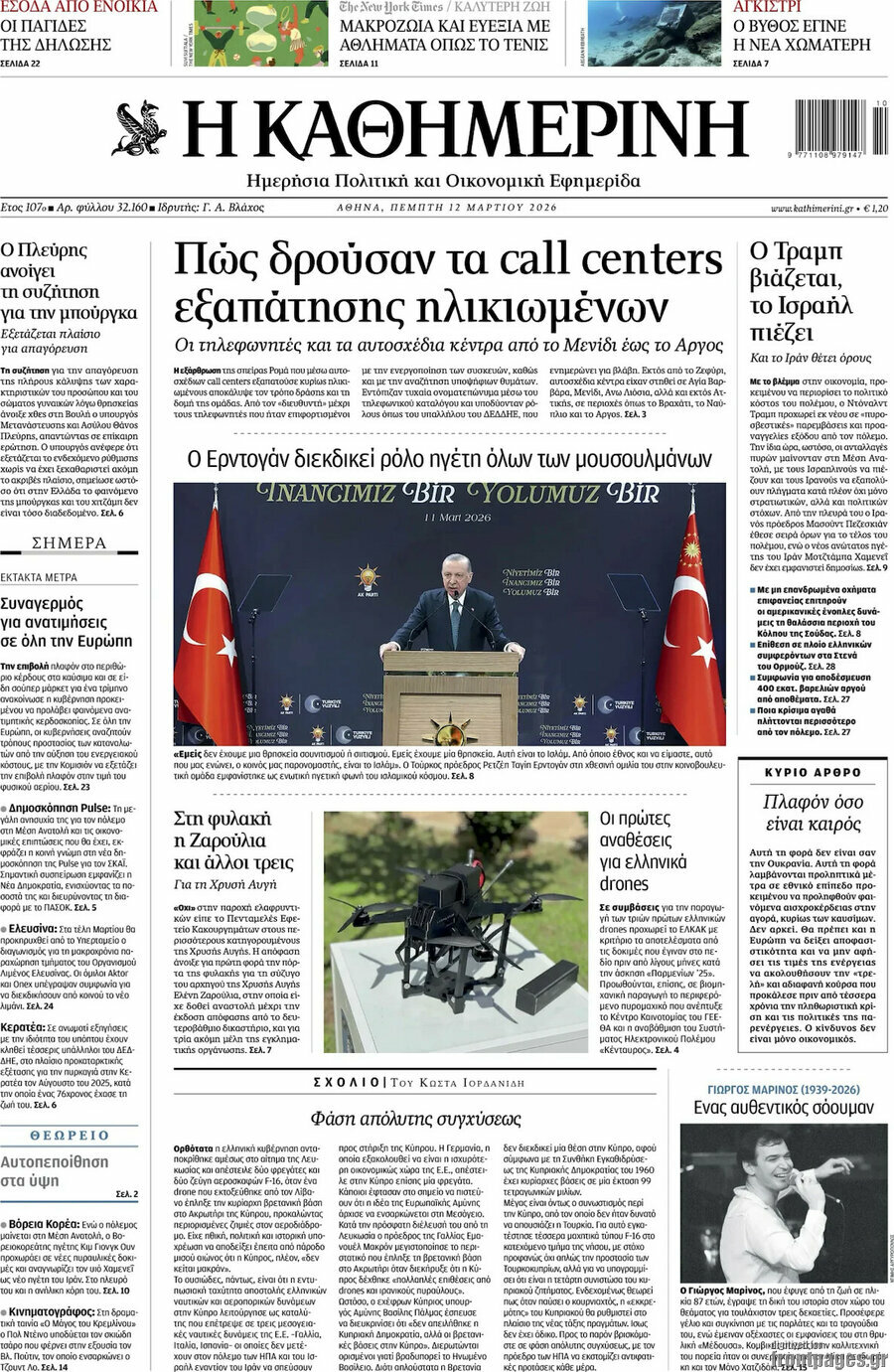
TA NEA: Cap on profits: How it works
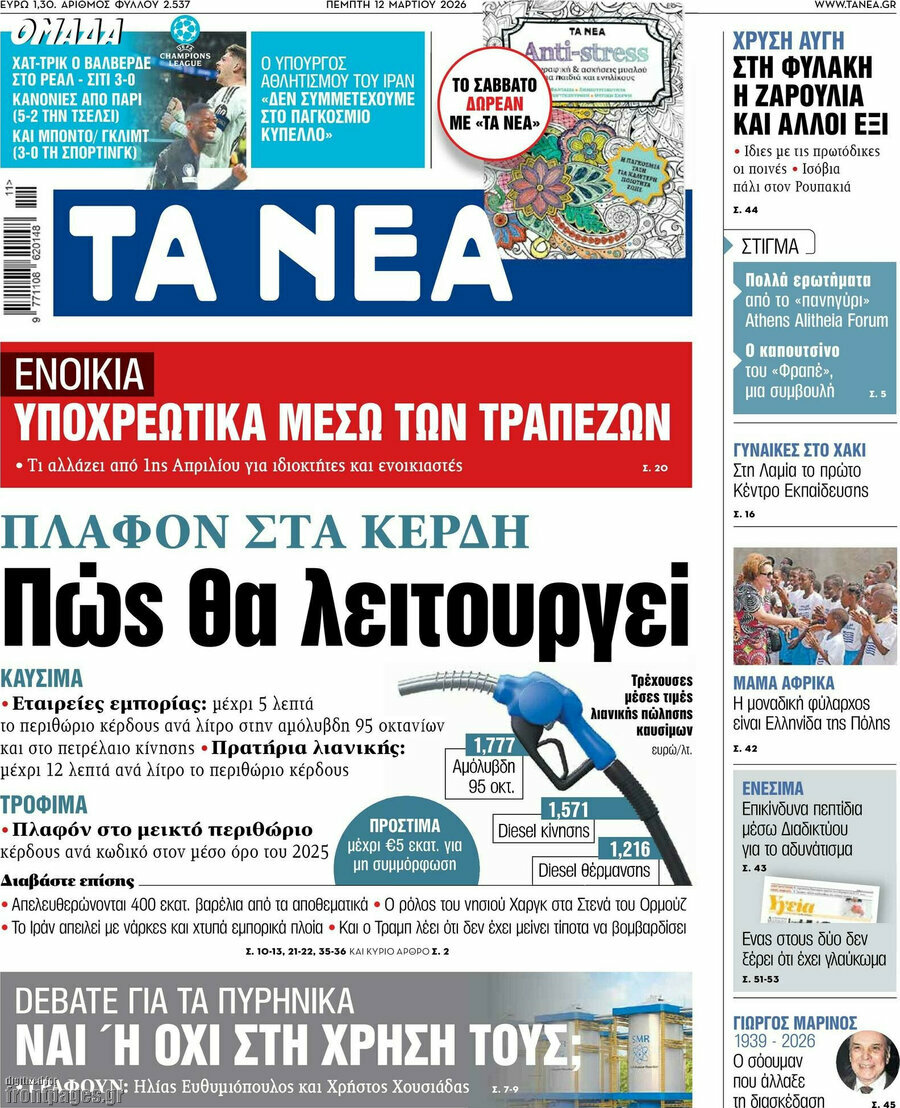
EFIMERIDA TON SYNTAKTON: Fraudulent measures regarding fuel prices
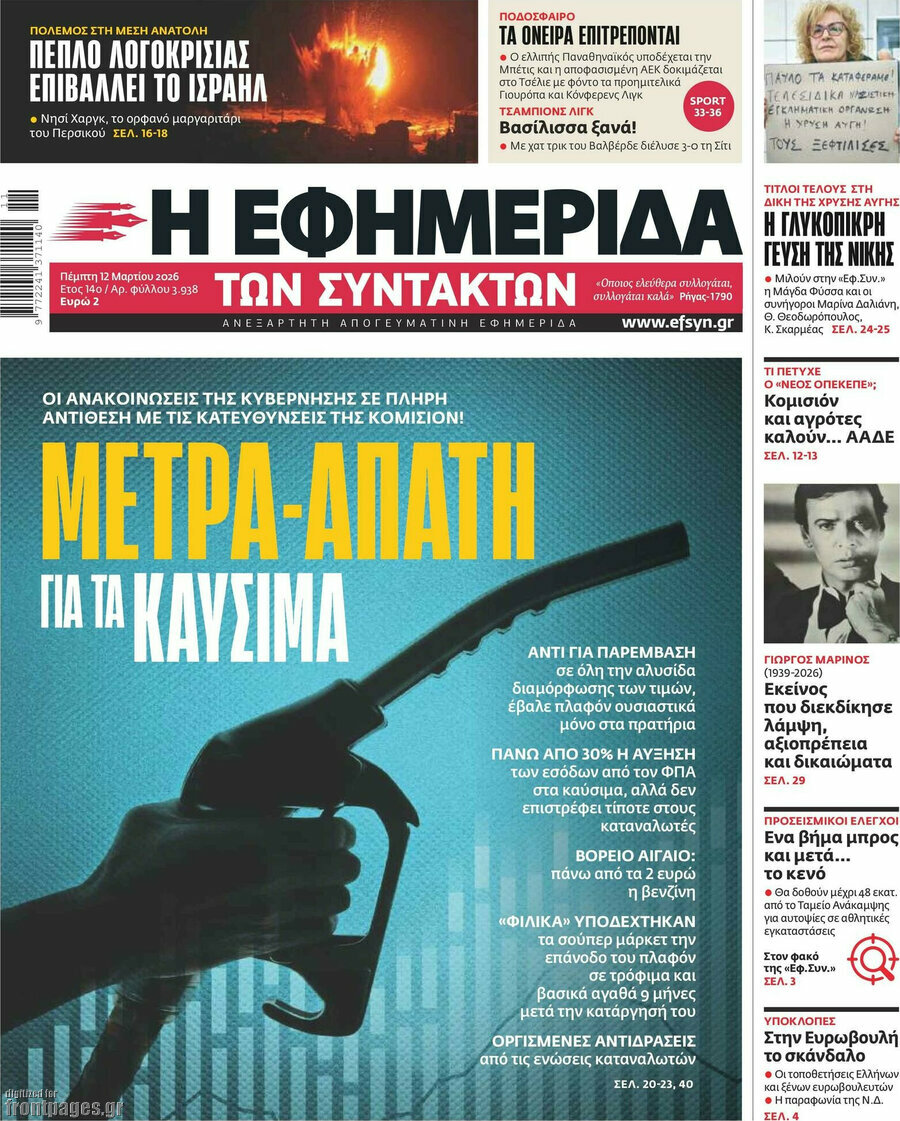
RIZOSPASTIS: Cuba is not alone!
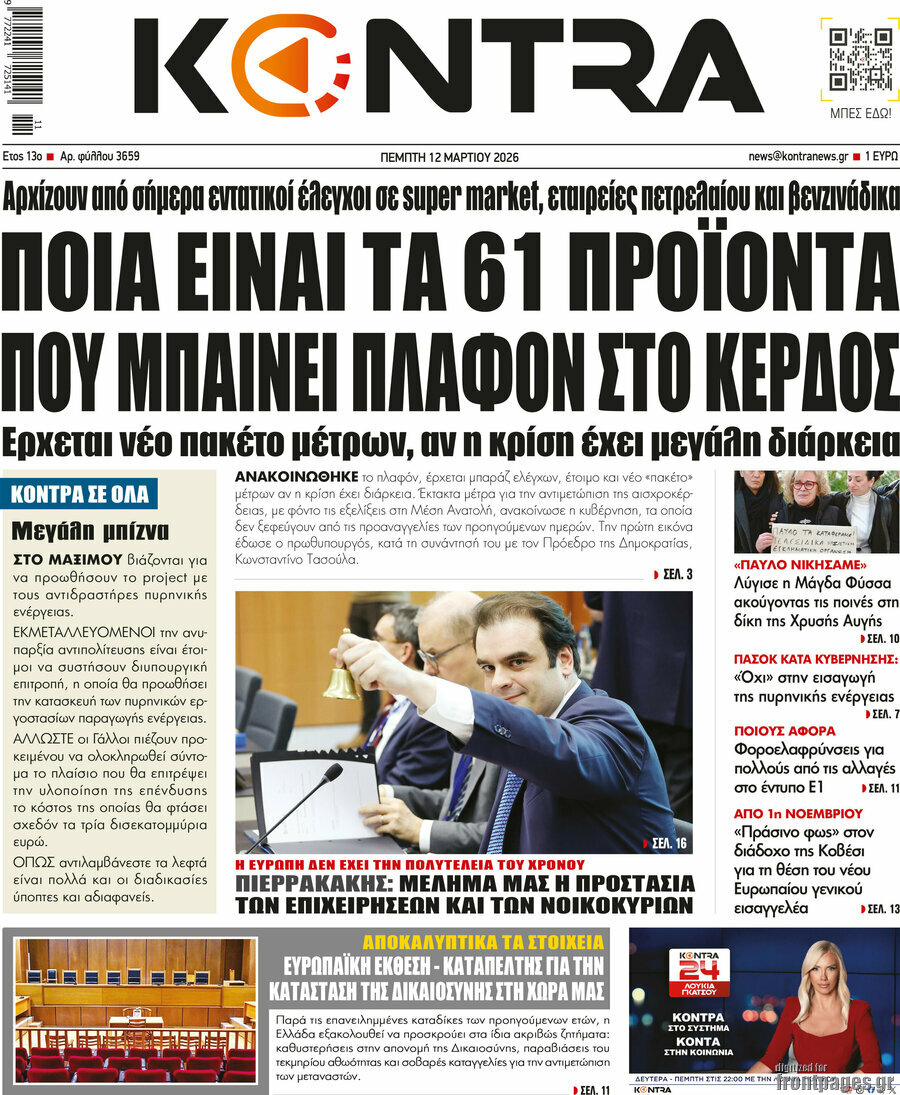
KONTRA NEWS: Cap on 61 products’ profit margins
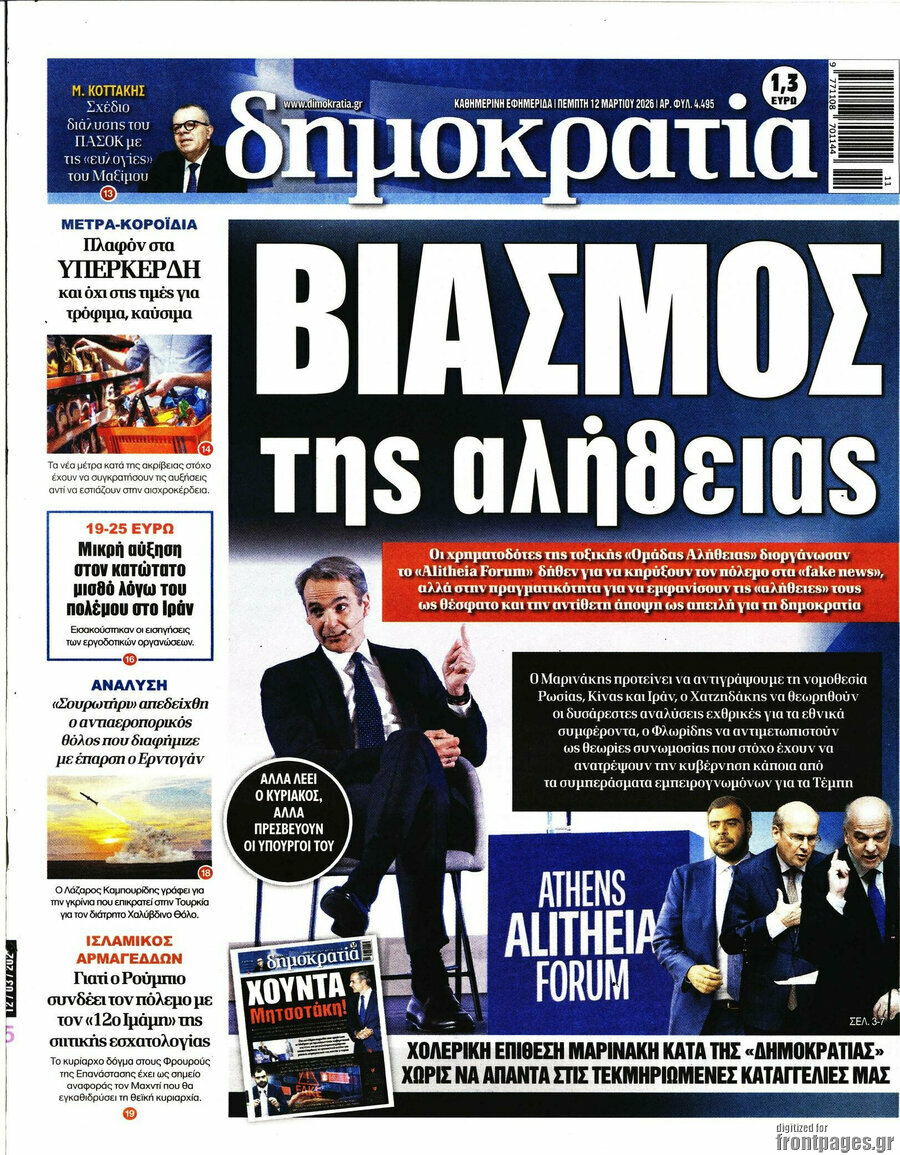
DIMOKRATIA: The government is raping the truth
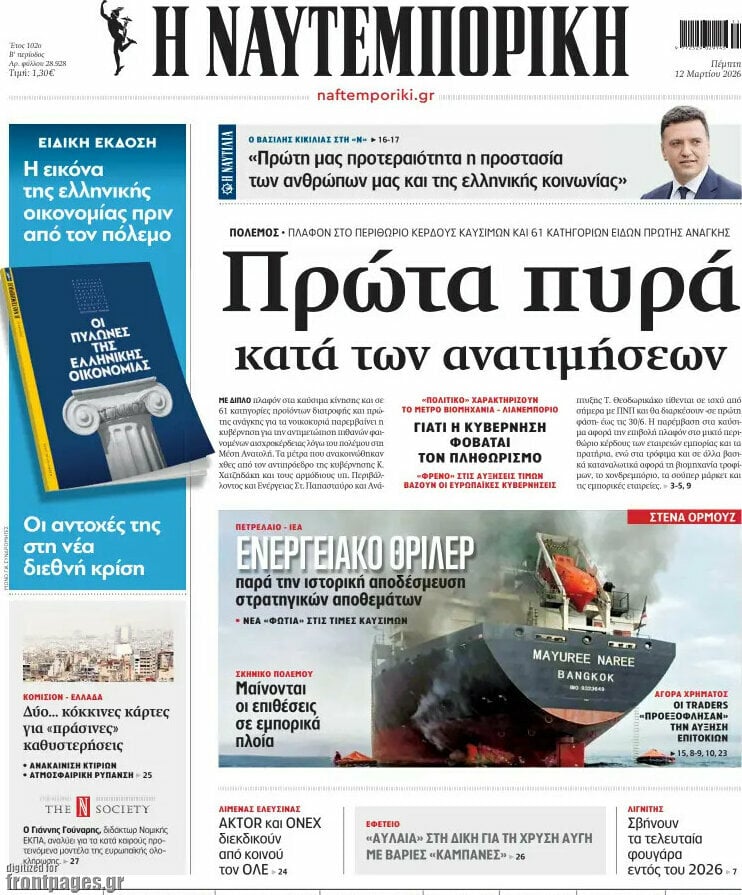
NAFTEMPORIKI: First fires against price increases

DRIVING THE DAY
CALL TO ACTION: Ukrainian President Volodymyr Zelenskyy used an interview with POLITICO to call on European allies to ensure the country receives the EU’s much-needed €90 billion loan to ensure it can continue defending itself against Russia.
Zelenskyy told my colleague Gordon Repinski in Kyiv the money is essential to guarantee Ukraine’s defense — and that Hungarian Prime Minister Viktor Orbán’s veto is an effort to support the aggression of Russian President Vladimir Putin.
“It’s not something personal,” the Ukrainian leader said. “It’s not [a] conflict between Hungary and Ukraine. The conflict [is] between Europe and Hungary.” The EU last week said language used by Zelenskyy towards Orbán — interpreted by Budapest and others as a personal threat — was “not acceptable,” as the row between the two continued to escalate (more on that on the Playbook podcast).
Diplomats are pushing to ensure a deal can be reached before next Thursday’s European Council meeting in Brussels. But one envoy, granted anonymity to speak frankly, said they fear the issue has become a personal spat that won’t be resolved before Hungary heads to the polls for critical parliamentary elections next month, in which Orbán is facing the most serious challenge yet to his 16-year hold on power.
Everything but: “He’s standing on the side of [the] Russian leader. He’s doing the same [as Putin]: blocking everything for Ukraine. Only one thing he doesn’t do today — he is not attacking by missiles or drones our territory,” Zelenskyy told Gordon. “They never helped us with military support from the very beginning of this war … They said … clearly that they will not support Ukraine because they have really real friends in Russia. And they are friends — strategic partners.”
In the pipeline: Orbán has insisted he is prepared to stop blocking the funds — agreed by EU leaders in December — if Ukraine repairs the Druzhba pipeline, damaged by Russian drone attacks, and ensures cheap oil continues to reach his country.
Sightseeing: Meanwhile, Hungary has despatched what it describes as a government delegation to Ukraine to try to assess damage to the pipeline. But Ukrainian Foreign Ministry spokesperson Heorhii Tykhyi said the group has no official status and had entered the country “as tourists.”
Sanctions countdown: Budapest, along with Slovakia, is also threatening to block the rollover of EU sanctions on Russian oligarchs and companies, which envoys are hoping to sign off at a meeting of ambassadors Friday ahead of the deadline Sunday. Brussels will also need the Hungarians on board if it is to pass the next sanctions package — the 20th to be imposed on Moscow since the start of the war — in time for next week’s summit.
READ MORE — Zelenskyy’s message for Donald Trump: Put pressure on Putin, not me.
Why is Zelenskyy’s patience wearing thin? This is Jamie Dettmer’s take.
HUNGARY ELECTION
AI-GENERATED CONCERNS: Hungarian opposition leader Péter Magyar will be campaigning in a constituency close to Budapest today and his team is bracing for political opponents to target the local candidate with AI-generated videos, produced with the assistance of Russian intelligence services. Magyar announced his concerns on social media Tuesday, calling on Orbán “to immediately halt the planned election fraud and order Russian agents out of Hungary.”
The strategy:Zoltán Tarr, opposition party Tisza’s No. 2 and long-time Magyar confidant, told POLITICO that by issuing a warning on what the party expected to happen, it was hoping to “neutralize” the government’s tactics. And while the system may not be “100 percent waterproof or leakproof,”Tisza always received some hints of what Orbán’s Fidesz party’s next move would be.
Sex tape: Magyar used that same strategy when an anonymous website — which he claimed to have been set up by Fidesz — threatened to release a (non-AI) sex tape involving the opposition leader. The tape has not yet been released.
Forcing resignations: Analysts expect the campaigning to get dirtier in the lead-up to the April 12 election, as the deadline elapsed to make any changes to candidate lists. The objective of such smear campaigns “is to push us as far as possible and break us, or force us to give up,” Tarr said, adding the muckraking also targets family members and takes a psychological toll. “They are singling out some of us in the hope that one might resign,” he added.
Fidesz denies allegations the party is working with Russia to meddle in the elections. The leading Fidesz lawmaker in the European Parliament, Tamás Deutsch, accused Tisza of spreading false information. “As part of this serious interference, the pro-Ukrainian and pro-Brussels Tisza party is spreading disinformation through sympathetic media outlets in Brussels and Hungary,” he told POLITICO, as Max Griera reports.
Orbán’s political director Balázs Orbán accused the media of “building the election-fraud narrative,” claiming reporters know the patriotic governing parties are leading in every poll that hasn’t been produced by “foreign-funded propagandists.” POLITICO’s Poll of Polls puts Tisza at 48 percent and Fidesz at 39 percent.
COMMISSION WATCH
TOXIC WORKPLACE? EU officials working in some European Commission departments may have been exposed to lead in office drinking water, according to an internal email seen by POLITICO. TAO-The Independents, a union representing staff across the Commission, said it “has been informed that lead has been detected in drinking water fountains in several buildings of the Commission.”
Heavy metals: It is alleged two buildings were affected by the lead: the imposing Madou Plaza Tower, home to top competition and antitrust officials; and Covent Garden, which hosts several research and innovation agencies.
Act now: “This is a serious issue for workplace health,” the union said in its message to staff. “Workers have the right to safe drinking water and to testing procedures that accurately reflect real exposure conditions. We call on our administration to act urgently on this issue.”
All clear: A Commission spokesperson told Playbook that “three weeks ago, during regular testing of the water quality, results showed irregularities in a very limited number of buildings.” Precautions were immediately taken, water was cut off and further tests were carried out that found lead levels met “applicable standards,” the spokesperson said. “The health of our staff members is an utmost priority for the Commission.”
OFFICIALS WANTED
BUREAU-VISION JOBS CONTEST: The search for Europe’s next top officials is on, with more than 170,000 people applying for fewer than 1,500 spots on the fast-track scheme for AD5 grade roles. The competition has become a battleground for national influence in the institutions, with countries underrepresented in the workforce pushing their citizens to take part in the competition — the first since 2019.
Some things never change: And yet, wealthier countries are still struggling to attract people, with the Netherlands making up only 1.6 percent of applicants despite accounting for almost 4 percent of the EU population. Almost half of all those taking part are Italian. Exams will be held in the coming months.
 |
IN OTHER NEWS
NUDIFICATION BAN: The EU is inching closer to banning AI tools that can create sexualized content without people’s consent, according to the almost-agreed upon proposals between European Parliament lawmakers and EU countries, seen by POLITICO.
Finish line: Both sides have included near-identical language that would ban generating images of real, identifiable people’s “intimate parts” or “sexually explicit activities.” EU capitals are set to sign off on their position during a meeting of ambassadors on Friday. The Parliament’s lead committees vote on the matter next Wednesday.
THE BATTLE FOR THE CAPITAL: Paris is at the center of a showdown in the political race to succeed Mayor Anne Hidalgo. But who could come out on top? My colleague Clea Caulcutt is following the story.
SPANISH RESENTMENT: Madrid is furious at the EU for not pushing back hard enough against Donald Trump’s threats of an all-out trade embargo on the country over its refusal to let American planes use its bases in the military campaign targeting Iran.
While you were sleeping: Oil prices rose above $100 per barrel again overnight as Iran stepped up attacks on energy infrastructure and transport across the Middle East. Two tankers were set ablaze in Iraqi waters. The U.S. said it would release 172 million barrels of oil from its strategic reserve as part of a coordinated international effort announced by the IAE Wednesday to counter soaring prices.