
Woman killed in Athens suburb, swept away by floowaters
A woman was killed in Glyfada, a southern suburb of Athens on Wednesday evening, after being struck by a car swept along by fast-moving floodwaters. Amid intense rainfall, the 56-year old woman was carried by the floodwaters along with several vehicles, while she was walking. Earlier on Wednesday, a 53-year old coast guard officer was pulled unconscious from the sea at the harbor of Paralio Astros in the eastern Peloponnese on Wednesday after falling into the water while securing boats against gale-force winds. A wave of severe weather affecting Greece since early Wednesday is expected to persist until Thursday afternoon, bringing heavy rain, thunderstorms, snowfall and gale-force winds.
https://www.ekathimerini.com/news/1293015/woman-killed-after-car-swept-by-floodwaters-in-glyfada
Anticipation shapes political landscape
Polling by Pulse for SKAI shows Greece’s opposition landscape largely frozen as voters await potential new parties from former SYRIZA leader Alexis Tsipras and activist Maria Karystianou.
https://www.ekathimerini.com/politics/1292998/anticipation-shapes-political-landscape
Greece, Turkey hold positive agenda talks in Athens
Greece’s Deputy Foreign Minister Haris Theocharis and his Turkish counterpart Mehmet Kemal Bozay met Wednesday in Athens to discuss the Joint Action Plan under the Positive Agenda framework between the two countries. Both officials welcomed the progress achieved so far under the Joint Action Plan, which includes projects of mutual interest in trade, the economy, customs, tourism, transport, innovation, science and technology, agriculture, environmental protection, social security and health, youth, education, sports and business cooperation, they said.
Registered unemployed declined to 915,889 in December 2025
The total number registered as unemployed on the Public Employment Service (DYPA) registry declined to 915,889 in December 2025, marking a decrease of 61,798 people (-6.3%) compared to the same month in 2024, and an increase of 21,824 people (2.4%) compared to the previous month, November 2025.
https://www.amna.gr/en/article/964449/Registered-unemployed-declined-to-915-889-in-December-2025
ATHEX: Buyers win playing the Trump card
Traders were appeased by the speech of US President Donald Trump in Davos on Wednesday afternoon, and stock prices at the Greek bourse swung from decline to growth by closing. That served to cover not only the morning’s losses but also some of those recorded on Tuesday. Geopolitical uncertainty persists, though, even if Trump ruled out the use of violence regarding Greenland, and stock volatility is expected to continue in the short term.
https://www.ekathimerini.com/economy/1293010/athex-buyers-win-playing-the-trump-card


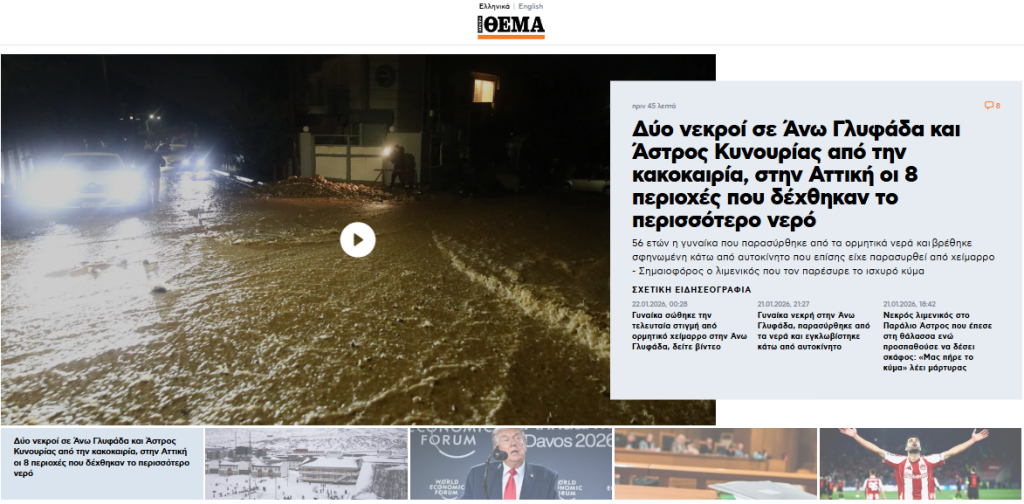
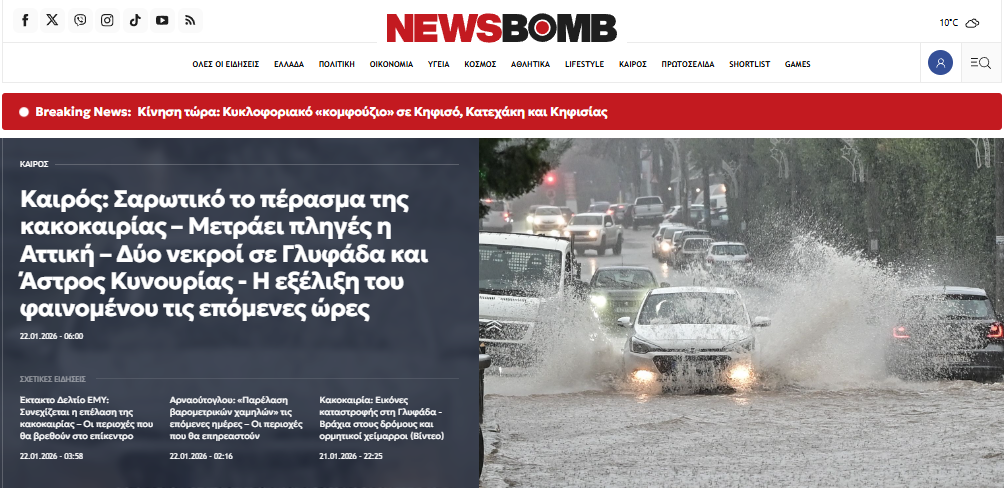
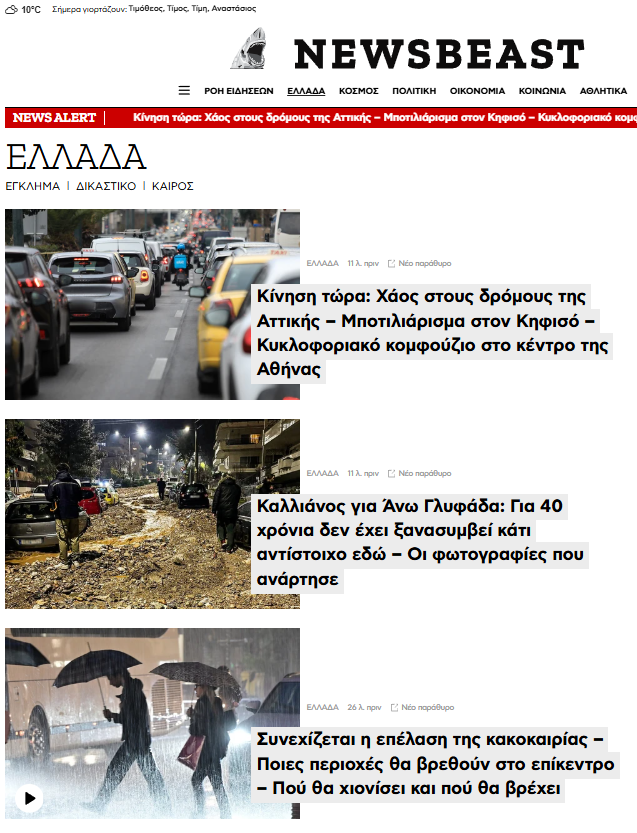

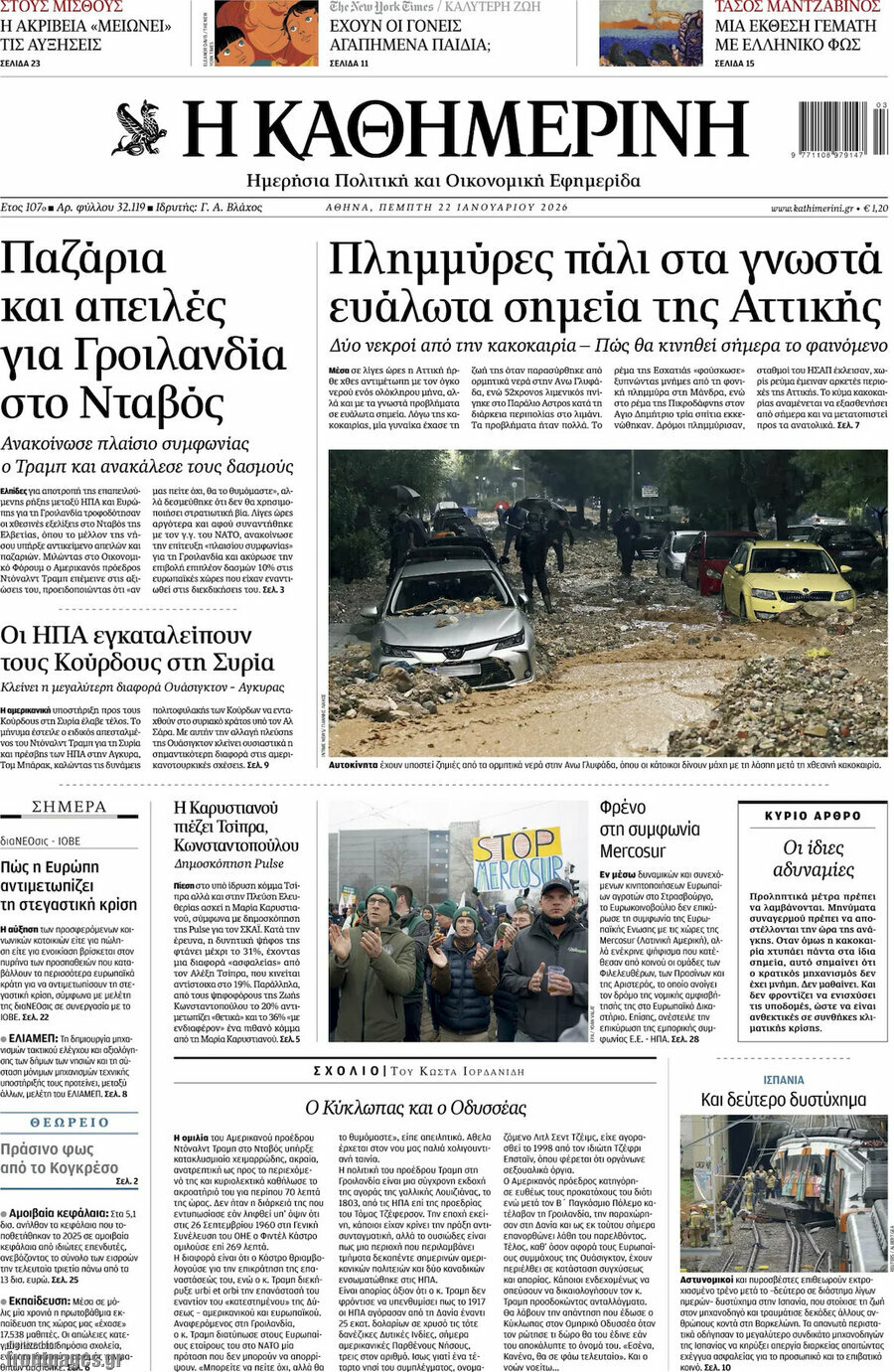
KATHIMERINI: Floods again at Attica’s vulnerable spots
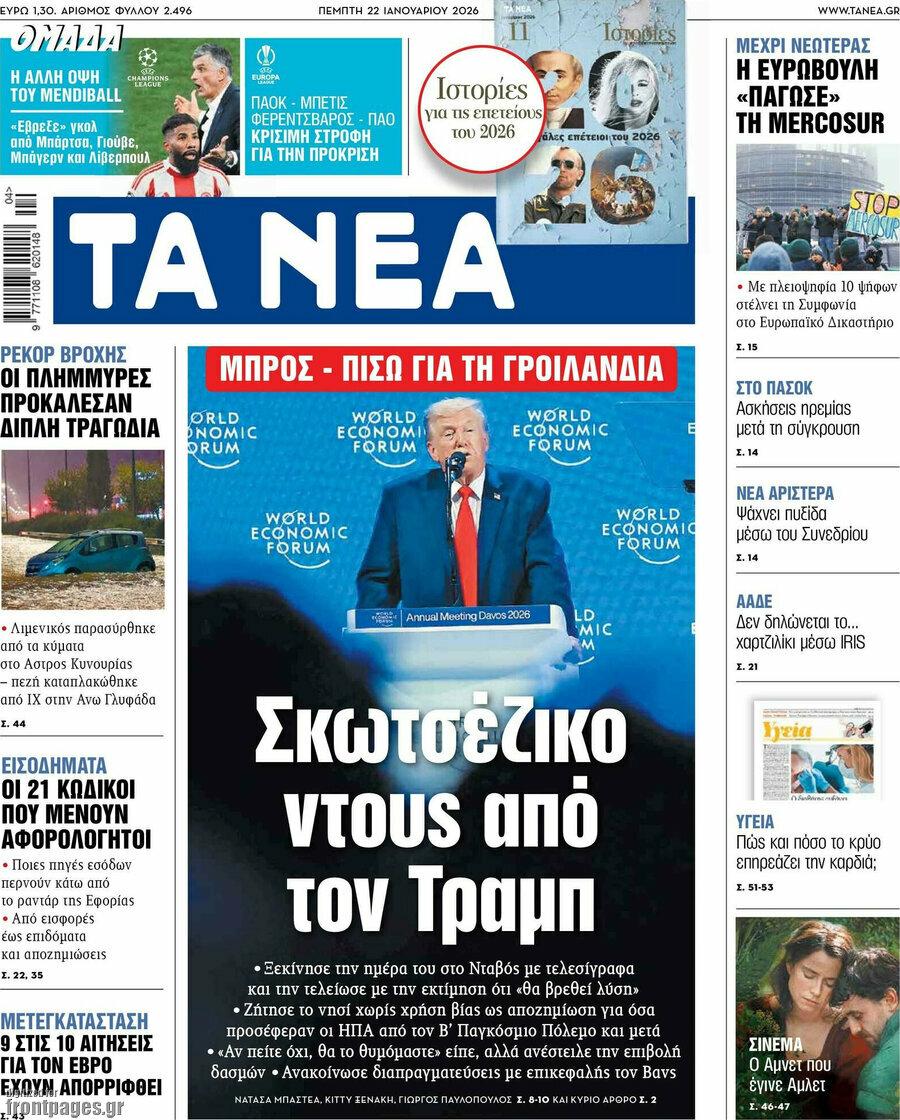
TA NEA: Cold shower by US President Trump
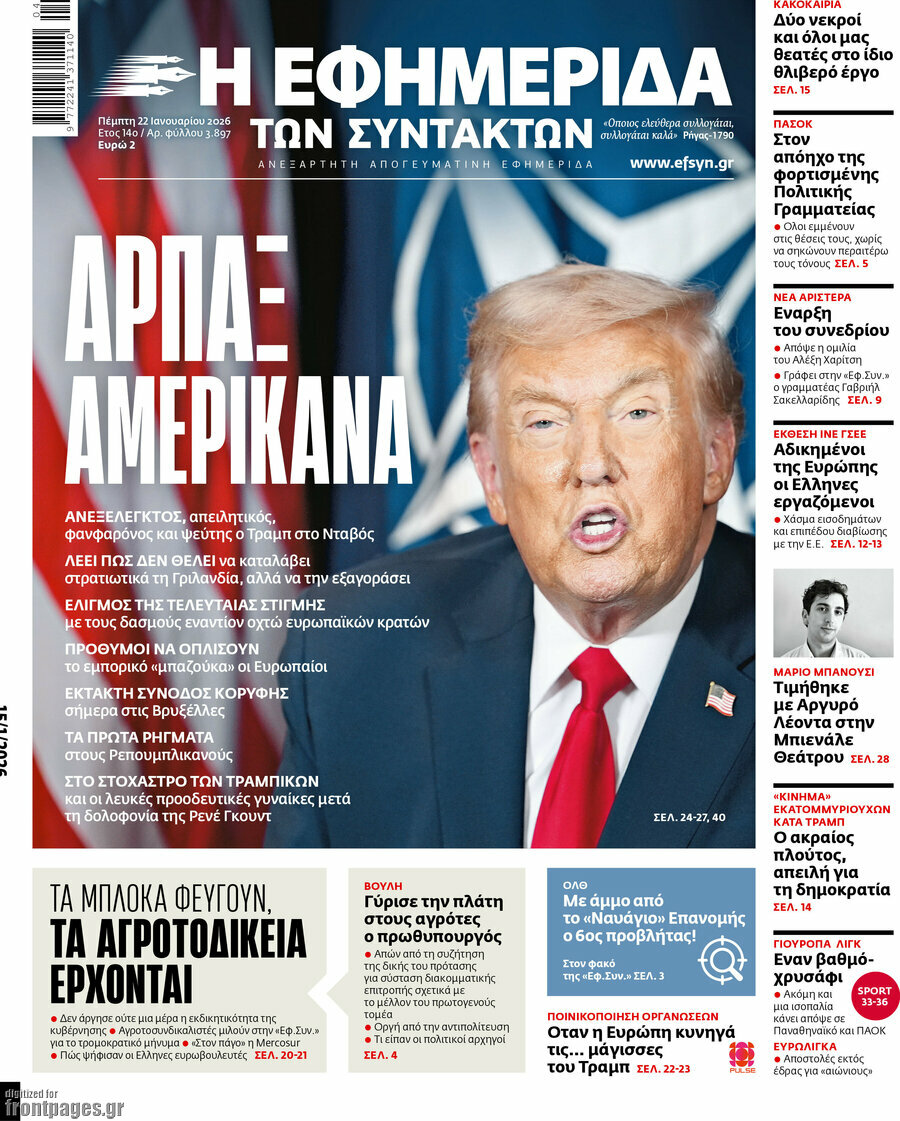
EFIMERIDA TON SYNTAKTON: Predator America
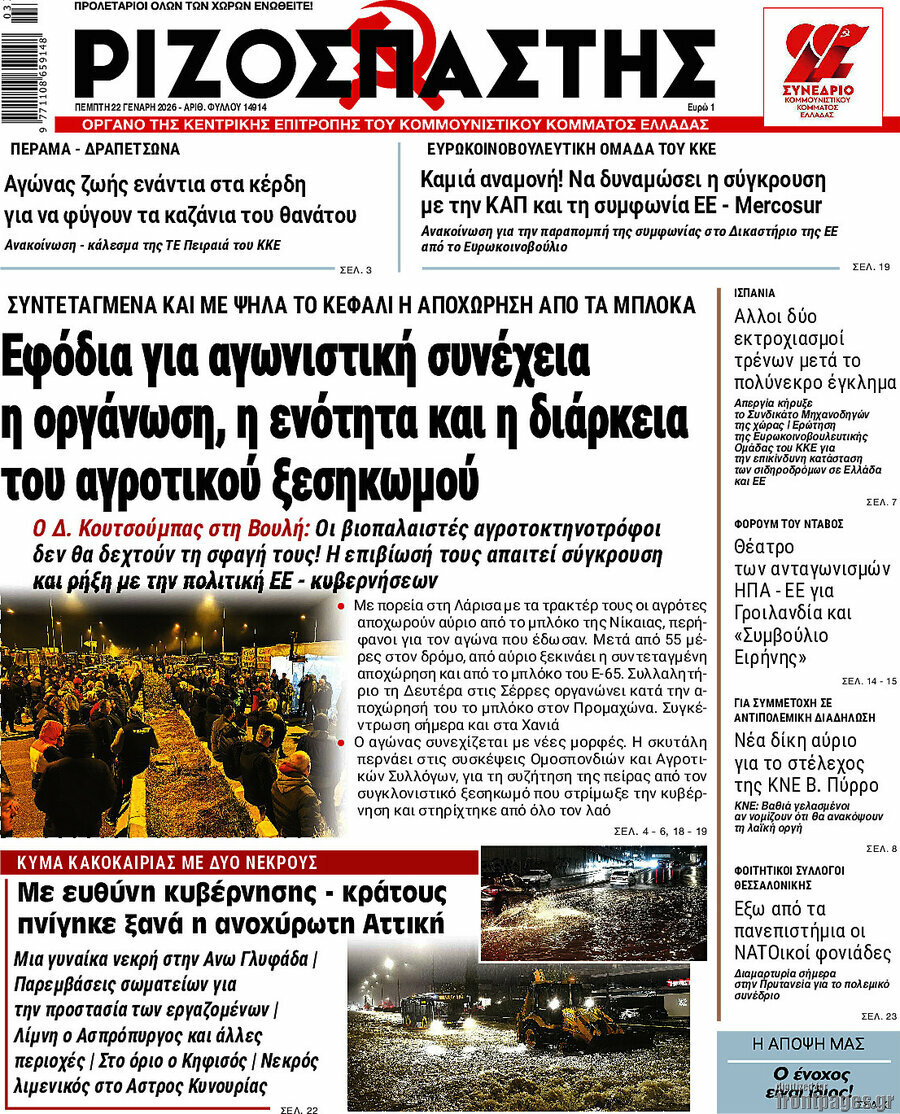
RIZOSPASTIS: The organization, unity and duration of farmers’ uprising is the basis for future battles
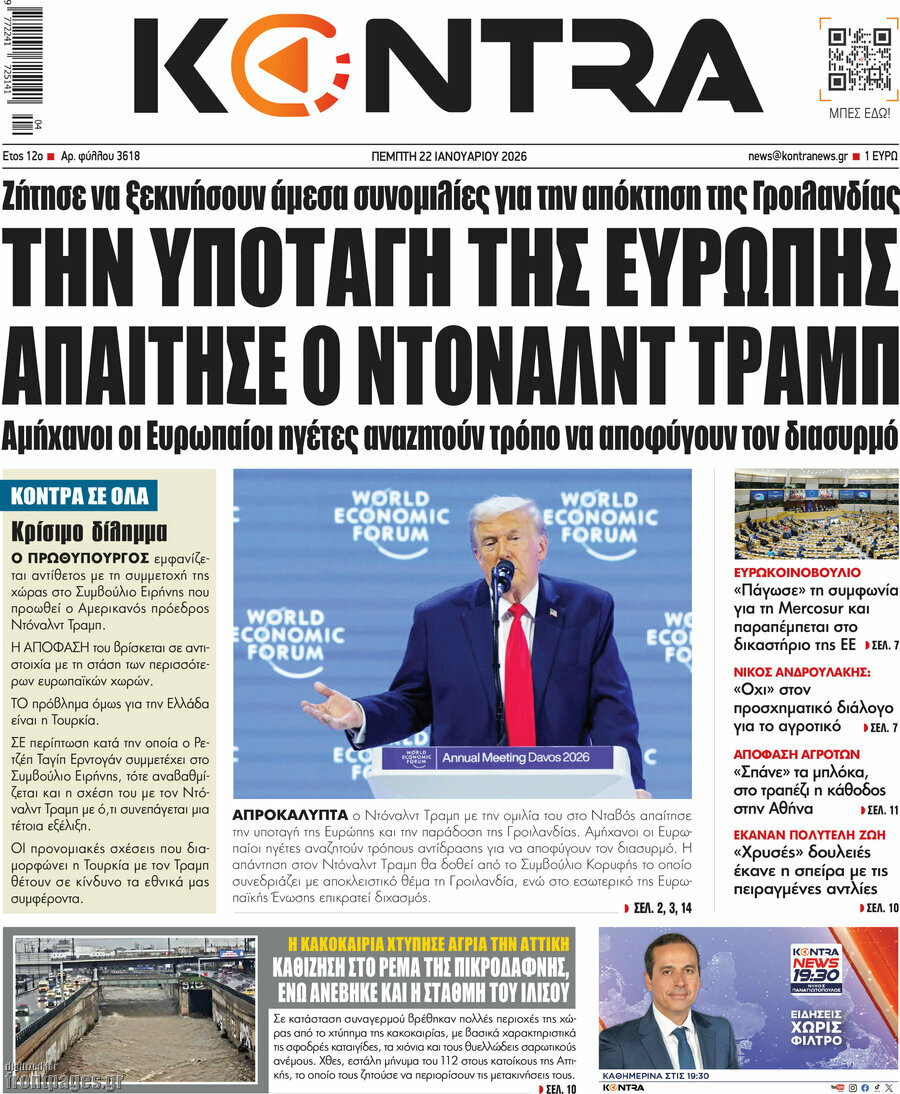
KONTRA NEWS: Donald Trump demanded Europe’s submission
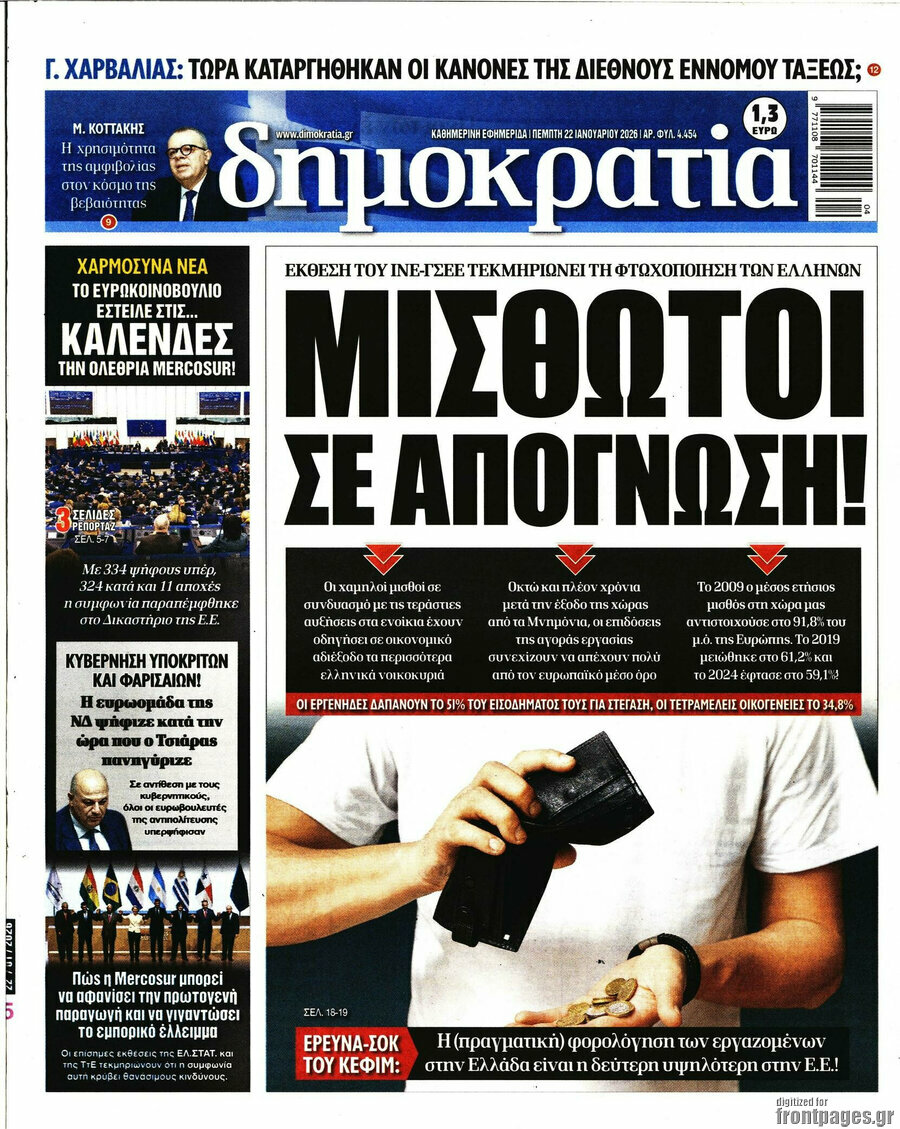
DIMOKRATIA: Wage-workers in despair
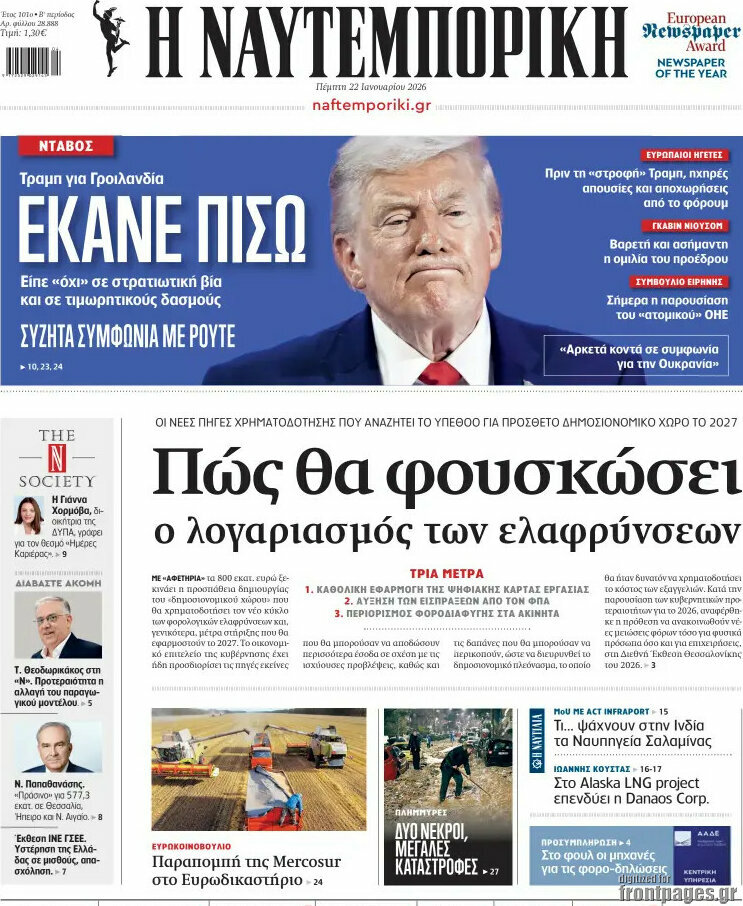
NAFTEMPORIKI: Interventions to boost the funding of tax alleviations and support measures

DRIVING THE DAY
A DOUBLE SIGH OF RELIEF: It all happened in a matter of hours — the kind of fast pace we may need to get used to in 2026. In one fell swoop, U.S. President Donald Trump took the threat of a forceful seizure of Greenland off the table and scrapped the tariff threat linked to the issue — which had been expected to dominate today’s extraordinary EU summit.
What now? The European Council will go ahead because it was never just about Greenland or tariffs. “It’s about the transatlantic relationship in all its dimensions,” one EU official said. Leaders will also discuss what to do with Trump’s “Board of Peace” and how to recalibrate relations with Washington more broadly.
Tune in: EU leaders are heading to Brussels for a 7 p.m. meeting (doorsteps from 5:30 p.m. and the usual live blog on POLITICO’s website shortly before that). The get-together was convened by Council President António Costa last Sunday, after Trump threatened to impose a 10 percent tariff from Feb. 1 on six EU countries (plus Norway and the U.K.) that publicly backed Denmark over Greenland.
There’s no denying that Trump’s barn-storming visit to Switzerland has turned the agenda of today’s meeting on its head, with the president’s speech providing “food for thought in most, if not all, capitals — tariffs or not,” another EU official said.
Pure Trump: The 72-minute speech was “100 percent Don and MAGA — in tone and content,” as one EU diplomat put it privately. Trump’s greatest hits included describing wind turbines — or “windmills” — as “losers,” repeatedly confusing Iceland and Greenland and reminding Europeans that without America they’d be speaking German and … “a little Japanese” — a line delivered, for the record, in a city where people were speaking German long before the Normandy landings.
TL;DR: While Trump still wants Greenland, he said, “I don’t have to use force. I don’t want to use force. I won’t use force.” That was followed by a line worthy of a “Godfather” movie: “You can say yes and we’ll be very appreciative. You can say no and we will remember.”
(Green)land of confusion: My colleague Gabriel Gavin collected a first wave of reactions — with many officials sounding worried and confused, rather than relieved.
TACO time: By evening, Trump announced on Truth Social that he had reached “the framework of a future deal” on Greenland with NATO and would not impose the threatened tariffs on European allies. It was arguably a textbook “Trump Always Chickens Out” moment — the acronym coined by FT columnist Robert Armstrong.
Mark saved the world today: Enter stage left NATO Secretary-General Mark Rutte, name-checked by Trump from the Davos podium. He managed to lock in an agreement of some kind. The nature of that deal remains a mystery, however. We only know that it involved all seven NATO Arctic allies to ensure that Russia and China never gain a foothold in Greenland.
As of publication, Rutte had not been formally invited to the European Council, according to one EU official — despite being the key person in the room where it happened. A senior NATO military official told POLITICO’s Victor Jack there is currently no planning underway within NATO for a Greenland exercise, let alone a full NATO mission in the Arctic.
Stubb nails it: At a panel on European security that included Rutte Wednesday, Finnish President Alexander Stubb was asked: “Who or what can defuse the tensions over Greenland?” “Oh, Mark Rutte,” he replied, triggering laughter in the room and on the panel. “Thank you, Alex,” Rutte said, grinning.
Brussels was stunned by Trump’s U-turn. Diplomats, officials across institutions — no one saw this coming. When I asked my trusted pool of insiders for reactions, I received an insane number of taco emojis, plus many messages saying: You’ll have to rewrite everything again. Which is true — this is at least the third draft of this Playbook top.
Positive reactions … Italy’s Giorgia Meloni hailed the news, effectively claiming victory for having kept the dialogue going. Danish Foreign Minister Lars Løkke Rasmussen said the day was ending on a better note than it began. Dutch PM Dick Schoof added that the EU was now on the path to de-escalation. Skepticism persists in second wave of reactions collected by Gabriel.
How will this impact today’s summit? “It takes the pressure off,” one EU diplomat told Playbook, adding that the broader conversation about transatlantic relations remains necessary. Another diplomat said the shift puts the issue back where it belongs: a NATO problem to be discussed within NATO — rather than an EU issue to be handled with EU tools (like the notorious trade bazooka).
The meeting that matters: All eyes — and ears, in the case of POLITICO’s Brussels team ready for behind-closed-doors whispers — are on the EU ambassadors’ meeting this morning at 10 a.m. “That’s what will really give a sense of how EUCO will go,” one EU official explained.
Something has changed: “I don’t see us going back to daddy’s strategy,” one diplomat said, referring to Rutte’s cringeworthy reference to Trump as “daddy” last year. Even if Trump opens the door to negotiations, he won’t find the same uncertain Europe — but one ready to bite back. POLITICO’s Zoya Sheftalovich explains how the U.S. is now considered the bad guy.
BOARD OF PEACE
WHAT TO DO WITH THE INVITE? Two EU officials confirmed that leaders at today’s summit will look for a united EU response to the — how to put it? — not particularly welcome invitation to Trump’s proposed Board of Peace. The initiative for a multinational body to administer Gaza is widely seen in Brussels and national capitals as an attempt to create a parallel structure to the United Nations.
Skepticism goes beyond the decision to invite Russian President Vladimir Putin and the reported $1 billion buy-in for permanent status. The explicit ambition to sideline the U.N. has dampened interest even among governments typically open to Trump-led initiatives, as Esther Webber explains.
The EU nays: France and Sweden have publicly declined, citing this risk of duplicating — and ultimately weakening — the U.N.’s role as the primary international mediator in Gaza and beyond. Denmark has also confirmed it will not participate, amid tensions over Greenland.
The (one) yay: Hungary, of course.
Let me get back to you: Italian Prime Minister Giorgia Meloni, speaking to public broadcaster RAI, said Rome was “interested” in Trump’s proposal, but stressed Italy could not join immediately due to constitutional constraints. Germany remains undecided.
Follow the line: Even the European Commission has been invited — via a personal letter to Commission President Ursula von der Leyen. That invitation has been paused as Brussels looks to coordinate a single EU response.
The White House says around 30 countries are expected to sign on. The list includes Middle Eastern heavyweights such as Egypt, the UAE, Saudi Arabia, Qatar, Turkey and Jordan — alongside Pakistan, Indonesia, Argentina, Azerbaijan (or “Aberbaijan,” as Trump pronounces it) and Vietnam. And, yes, Belarus.
OVERLOOKED BUT NOT FORGOTTEN: Trump said he will meet Ukrainian President Volodymyr Zelenskyy at Davos today. A face-to-face had been planned for Wednesday, but Zelenskyy remains in Kyiv, grappling with an energy crisis triggered by Russian strikes on power infrastructure and persistent shortages in Western air-defense support.
We can work it out: Ukraine was meant to be the central theme of Davos, with expectations that the U.S. might commit itself to security guarantees. Instead, the war was eclipsed by Greenland. In his speech, Trump said he had not forgotten the “horrible war” and insisted he was still personally working to end it.
Meanwhile, in Moscow: American special envoys Steve Witkoff and Jared Kushner are set to meet Putin Friday, followed by talks with Ukrainian representatives at a later stage. If Putin and Zelenskyy don’t do a deal, “they’re stupid — and that goes for both of them,” Trump said from Davos. “I know they’re not stupid, but if they don’t get this done, they are stupid,” he said, adding that he believes both sides are now at a point where an agreement is possible.
NOW HEAR THIS … In a special episode of the EU Confidential podcast from Davos, Anne McElvoy talks about how the Greenland crisis unfolded with guests including Finland’s Foreign Minister Elina Valtonen, Latvian President Edgars Rinkēvičs and Canada’s Foreign Minister Anita Anand. Listen and subscribe to EU Confidential here.
PARLIAMENT CORNER
AH YES, THE CENSURE MOTION: Amid all the noise, it’s easy to forget that Ursula von der Leyen faces a no-confidence vote today — triggered by far-right MEPs over the EU–Mercosur trade agreement.
No biggie: The Commission president is unbothered — so much so that she won’t even be in the chamber. The fourth motion of censure in just seven months is all but guaranteed to fail. Still, even doomed parliamentary ambushes are never entirely comfortable.
Another headache: A more substantive setback landed on Wednesday, when MEPs voted — by a margin of just 10 votes — to refer the EU–Mercosur trade deal to the EU’s Court of Justice. That move could delay ratification by up to two years, although German Chancellor Friedrich Merz has little appetite for waiting and has urged the Commission to provisionally apply the deal anyway.
F-BOMB BLAST FROM THE PAST: You may remember Anders Vistisen, the Danish Patriots for Europe MEP who last year — during the first Greenland-related flare-up — memorably told Trump told Trump to f**k off in a plenary debate. Well, not according to the transcript. For a time, the European Parliament’s official record claimed Vistisen had merely used the very British “bog off!” and not … the other word (don’t make me swear twice!).
Lost in transcription: In an email exchange seen by POLITICO, Vistisen’s office asked Parliament’s translation services to restore the actual wording. The transcript has since been corrected — verbatim, as requested.
EU EXECUTIVE IN DAVOS
HISTORY IS MADE BY THOSE WHO SHOW UP: A sizable number of Commission highflyers made it to Davos, including Wopke Hoekstra, Andrius Kubilius, Maroš Šefčovič, Valdis Dombrovskis, Apostolos Tzitzikostas, Henna Virkkunen, Hadja Lahbib, Michael McGrath, Marta Kos — and, of course, Ursula von der Leyen.
CEO-heavy agendas: Unsurprisingly, business meetings dominated. Justice Commissioner McGrath is scheduled to meet today with Pinterest CEO Bill Ready, while Virkkunen will sit down with Tim Cook and SAP CEO Christian Klein.
Rebuilding EU–U.S. trust: Economy Commissioner Dombrovskis carved out time to speak exclusively to Playbook about the central theme of this edition: how to stabilize transatlantic relations.
No winners: “Everyone on both sides of the Atlantic loses when trust between the EU and the U.S. is undermined,” he said, noting the depth of economic ties. More than €4 billion in goods and services cross the Atlantic every day — suggesting any attempt by Washington to hurt the EU would ultimately rebound on the U.S. itself.
Eyes on the real war: Dombrovskis also warned against letting political noise overshadow the conflict in Ukraine. “Let’s not divert our attention away from Ukraine — the human suffering is immense,” he said. In several Davos panels, including at the Ukraine House, the commissioner has been pushing the Ukraine Support Loan, which he oversees and hopes can be delivered as quickly as possible to ease the situation on the ground.
Even if you’re not in Davos … you’re still talking about Davos. Executive Vice President Teresa Ribera, speaking to POLITICO’s Karl Mathiesen while en route to Strasbourg, said Trump’s speech was a reminder that clean technologies must be deployed faster to reduce Europe’s external energy dependence — including the (roughly) one quarter of EU gas imports that come from the U.S.
Make the Green Deal Great Again? After Donald Trump mocked wind turbines as “losers” — as in technology that loses money — Ribera offered a counterpoint. “Renewable energy, electrification and modern grids mean freedom — lower dependence, fewer vulnerabilities, and a chance to invest in innovation and strong industrial hubs.”
MIGRATION INFORMAL MINISTERIAL
MIGRATION DEBATE IN CYPRUS: Migration is firmly on the agenda as EU ministers and senior officials gather in Nicosia to tackle what Internal Affairs Commissioner Magnus Brunner has described as the “missing piece” of EU migration policy: returns. Our colleague Hanne Cokelaere is on the ground.
Returns have become the buzzword in EU migration discussions, with ministers increasingly frustrated that too few rejected asylum-seekers actually leave after receiving return orders. Cyprus, incidentally, recorded the third-highest number of returns in the third quarter of 2025, behind Germany and France. This morning’s talks focus on how deportations can be strengthened in concrete, operational terms.
Deportation centers: The most politically sensitive moment is expected to come from a side event led by Germany’s Interior Minister Alexander Dobrindt. The meeting is intended to kick off negotiations on so-called return hubs outside Europe, according to Berlin Playbook’s Hans von der Burchard.
It’s about deterrence: The concept is straightforward — and controversial. Asylum seekers who enter the EU irregularly despite having little chance of receiving protection would be transferred to remote “return hubs,” likely to be located in Africa, where their repatriation to countries of origin would be processed. The political message is explicit: Don’t attempt irregular entry or pay smugglers for a journey that won’t ultimately get you to Europe.
The core group: Under the leadership of Germany and the Netherlands, a group of five countries is meeting today to push the idea forward. Alongside Berlin and The Hague, ministers from Austria, Denmark and Greece are taking part, together with Brunner.
Look, it’s working! Dobrindt is expected to argue that tougher policies deliver results. Figures from Germany’s Interior Ministry, seen by Welt and reported by Philipp Woldin, show deportations rose by 15 percent year-on-year — and by 45 percent compared with 2023.
Location matters: Cyprus provides a politically charged backdrop. Classified by the Commission as a country “under migratory pressure,” the island received the second-highest number of asylum applications per capita between 2024 and 2025, according to EU data.
On a lighter note: No informal Council would be complete without a showcase of the host country. Delegates will round off the day with a wine tasting at the Dafermou Winery south of Nicosia, followed by a gala dinner.
IN OTHER NEWS
TRANSATLANTIC (BUT SANCTIONED) BRETON: Former EU tech czar Thierry Breton told Nicholas Vinocur in an interview that the U.S. should “correct the ban” against him, but that he remains firmly pro-American. Breton also pushed back against what he described as widespread misunderstandings of EU tech rules — which, he argued, ultimately led to the sanctions against him.
Super Mario says FIRE: Former EU Commissioner Mario Monti, in an op-ed for POLITICO with former MEP Sylvie Goulard, is less conciliatory, arguing the EU should not waste this bazooka opportunity and deploy the Anti-Coercion Instrument.