
Farmers’ meeting to determine further action
Greece’s farmers appear ready to escalate their protest actions, based on decisions taken at local assemblies. However, Thursday’s meeting of representatives from the farmers’ blockades, scheduled for 2 p.m. in Serres, will also determine whether a delegation will agree to meet with the government.
https://www.ekathimerini.com/news/1290177/farmers-meeting-to-determine-further-action
PM Mitsotakis in Brussels for EU–Western Balkans Summit and European Council meeting
Prime Minister Kyriakos Mitsotakis travels to Brussels to participate in the EU-Western Balkans Summit on Wednesday evening and the European Council meeting on Thursday. Government sources report that Greece is firmly in favour of European Union enlargement as an investment in security and stability in the region. The same sources stressed that this is a process that depends on the performance of each candidate country. They added that it is a difficult process that requires reforms and compliance with the prerequisites of the accession process.
High-Level Cooperation Council with Türkiye definitely in first quarter of 2026, Greek diplomatic sources say
The High-Level Cooperation Council between Greece and Türkiye will definitely take place in the first quarter of 2026, Greek diplomatic sources said on Wednesday, while the two countries are in contact to find a definite date.
Budget: Primary surplus of 12.6 billion in Jan-Nov 2025
A primary surplus of 12.6 billion euros was recorded in the eleven-month period from January to November, exceeding forecasts on which the state budget introductory report was based by five billion euros, according to a statement released by the National Economy and Finance Ministry on Wednesday. Parliament passed the state budget introductory report in a vote on Tuesday evening.
https://www.amna.gr/en/article/957426/Budget-Primary-surplus-of-126-billion-in-Jan-Nov-2025
ATHEX: Bourse loses more ground on Eurobank
Eurobank dominated proceedings at the Greek stock market for another day on Wednesday, accounting for over a third of turnover and leading the benchmark to a small decline even though the final count showed rising stocks outnumbering the losers on the day. While there is plenty of scope for investors to position themselves in promising local stocks, they appear to be holding fire for now, at least as far as the mid- and small-caps are concerned – which is where most of the big returns are hidden.
https://www.ekathimerini.com/economy/1290132/athex-bourse-loses-more-ground-on-eurobank


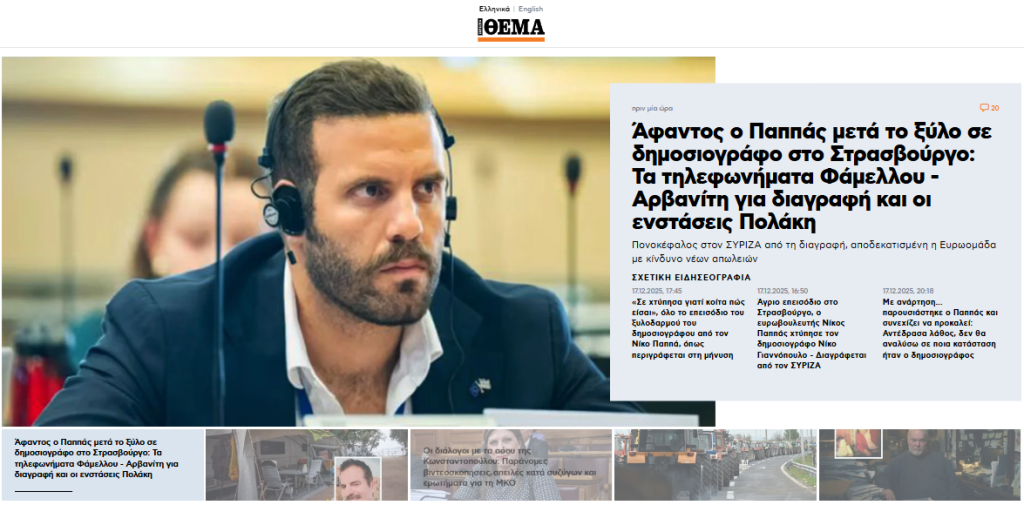
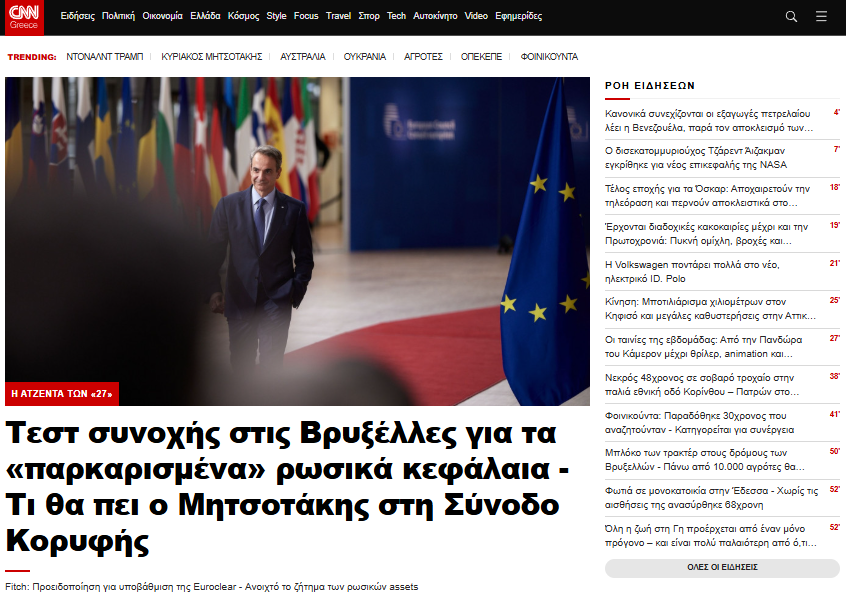

KATHIMERINI: Automatic collection of VAT
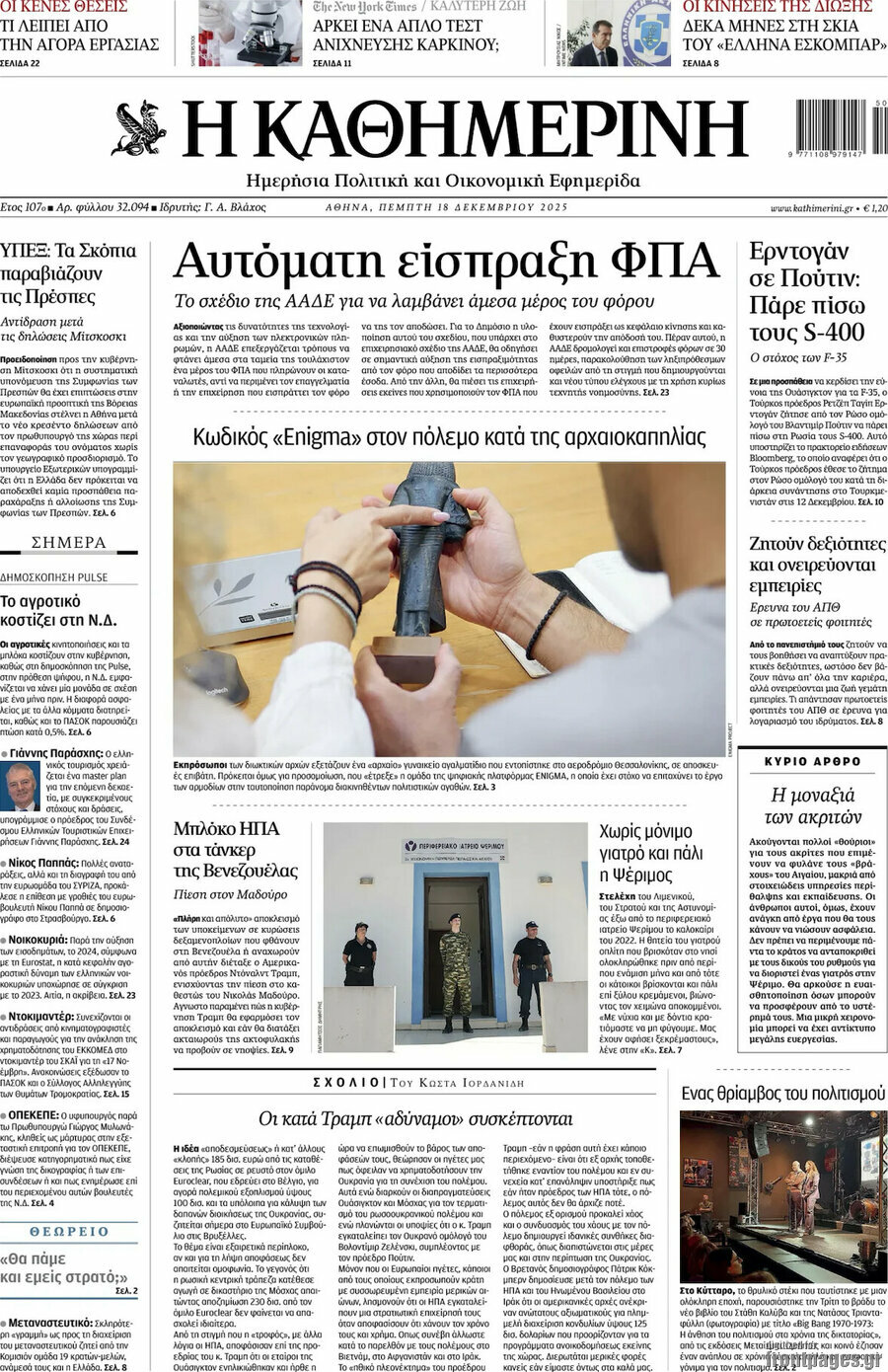
TA NEA: State employees: It’s raining bonuses ahead of the upcoming elections
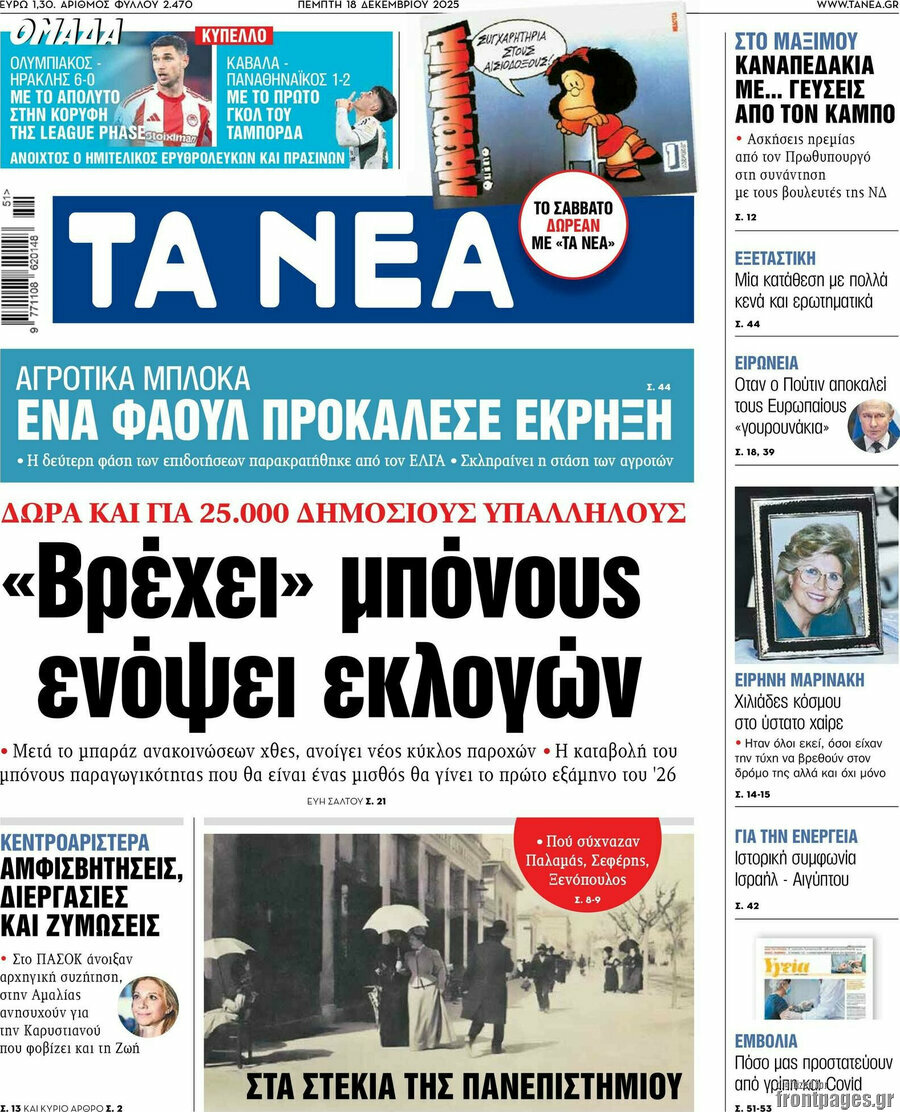
EFIMERIDA TON SYNTAKTON: New fiasco sets farmers’ blockades ablaze
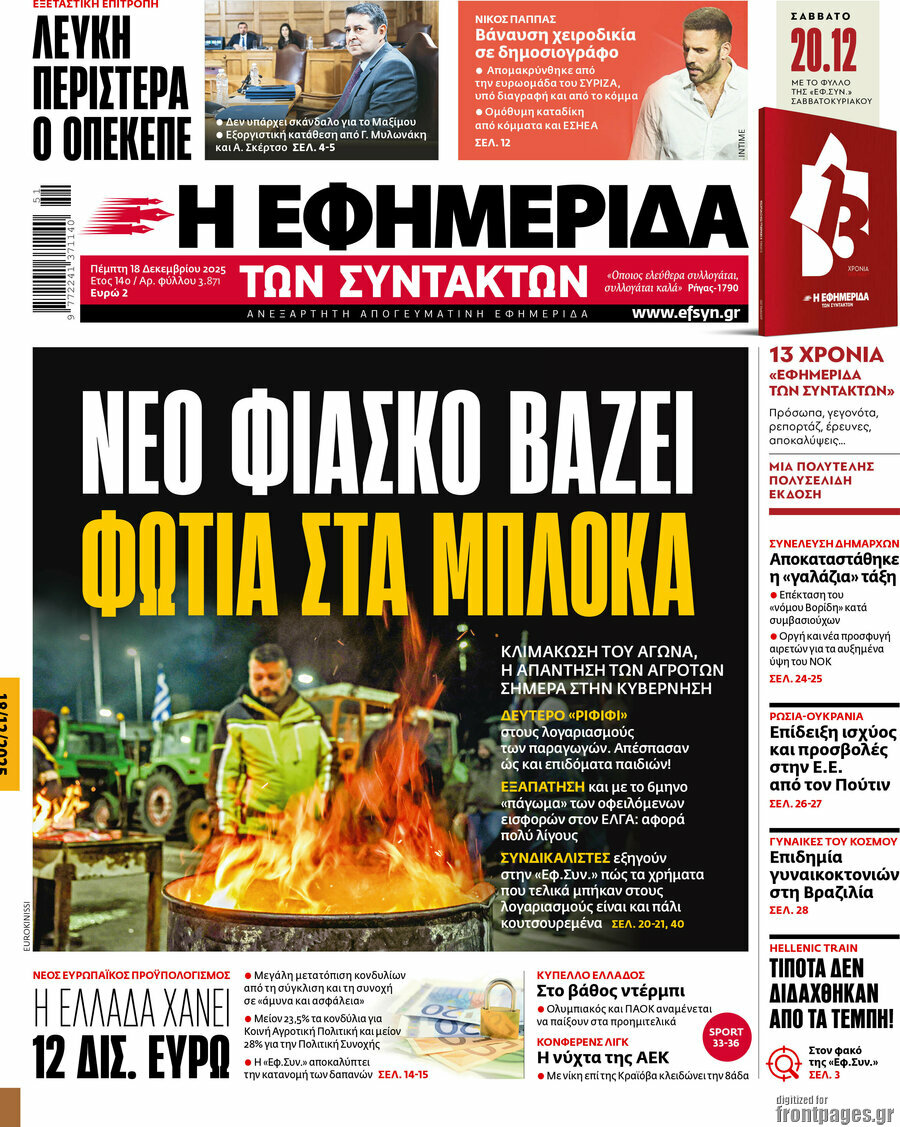
RIZOSPASTIS: Majority of Workers’ Federation (GSEE) agrees to “freezing” of wages and work contracts
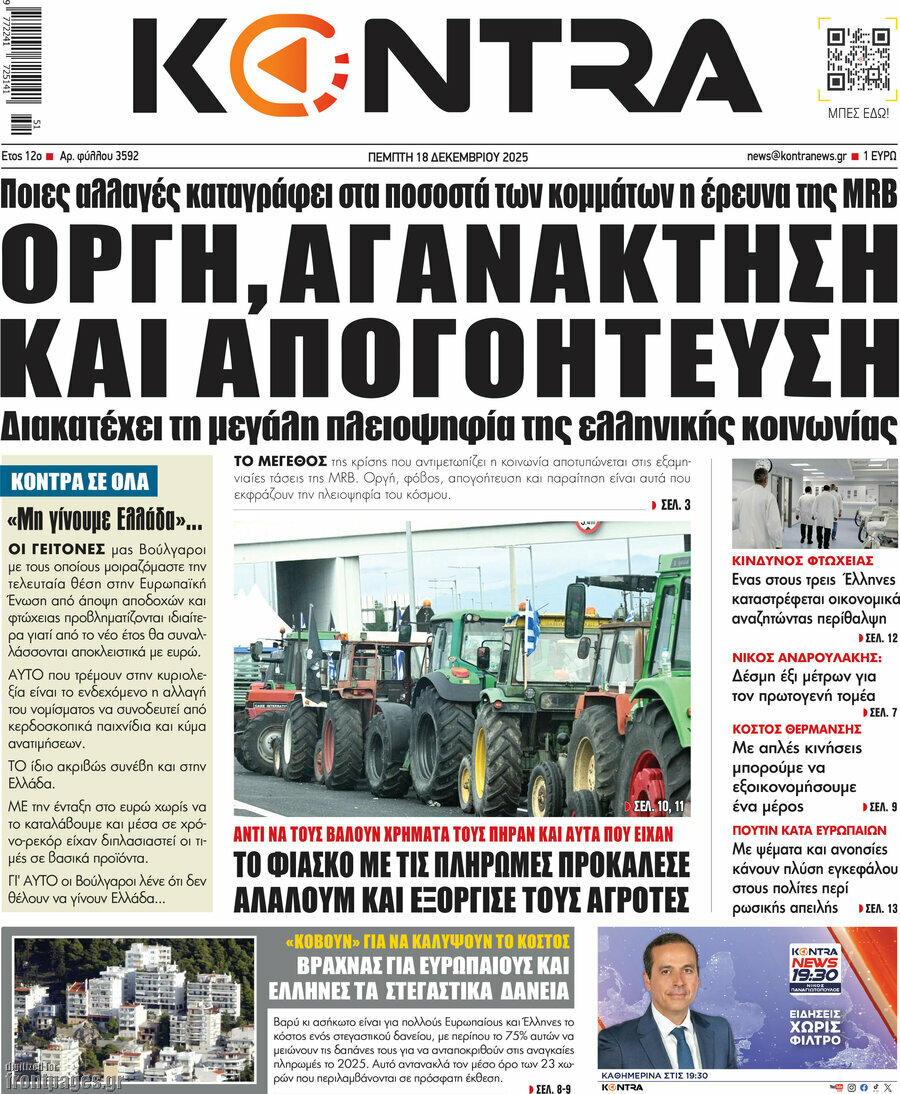
KONTRA NEWS: Rage, indignation and disappointment
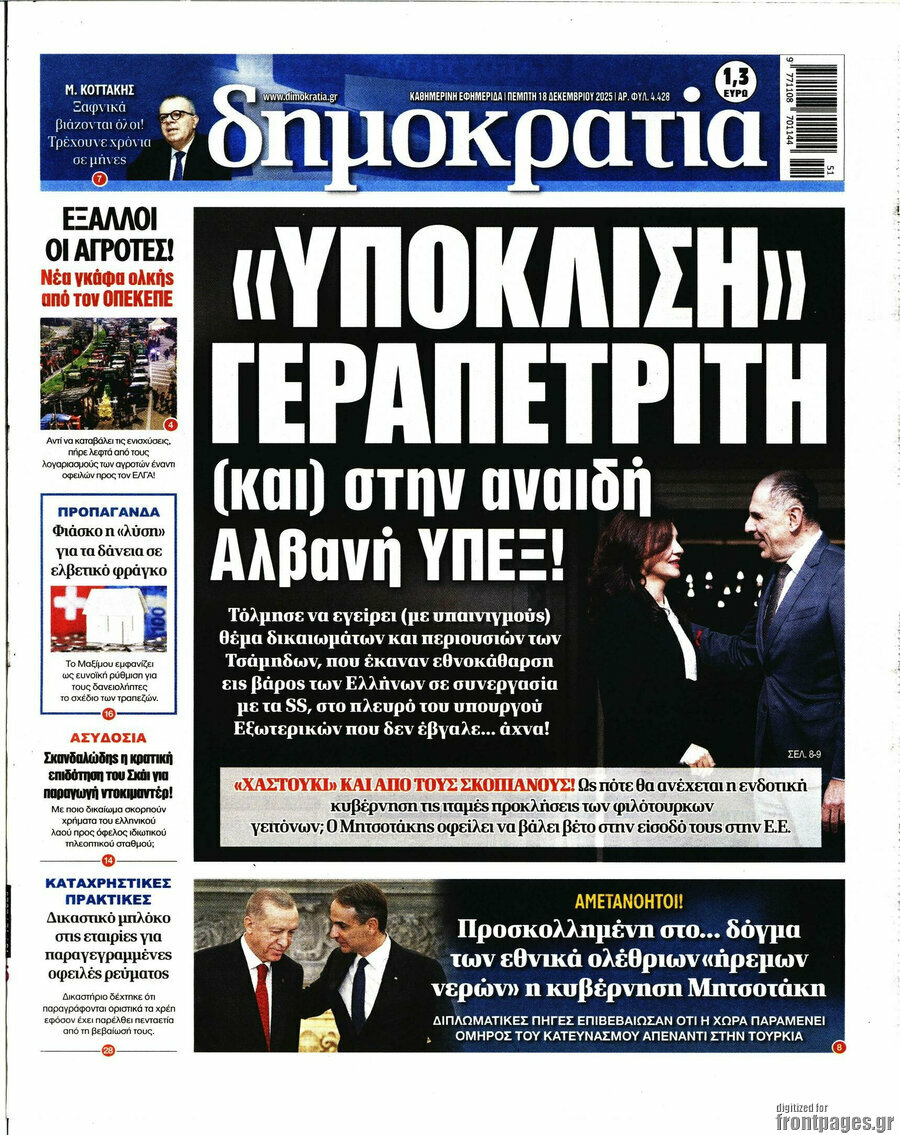
DIMOKRATIA: Foreign Affairs Minister Gerapetritis “bows” to his rude counterpart from Albania
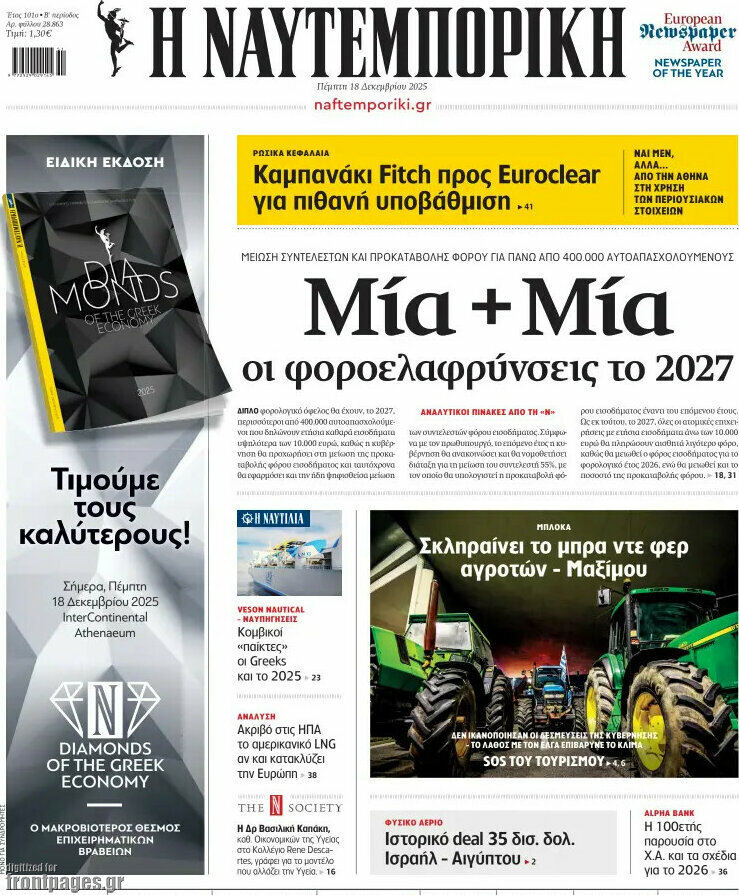
NAFTEMPORIKI: 1+1 tax alleviations for 2027

DRIVING THE DAY
IT’S COUNCIL TIME — AGAIN! EU leaders are back in Brussels for what could be the most consequential summit of the past few years. Doorsteps start at 8:30 a.m., but if you’ve slept through your alarm, fear not: POLITICO’s live blog will keep running for as long as leaders are able to talk, argue, negotiate and pontificate.
Action-packed: Expect this running order, shared with Playbook by an EU official: Ukraine, enlargement, the Multiannual Financial Framework … then dinner on geoeconomics. President Volodymyr Zelenskyy will be in Brussels, but is expected to arrive after talks begin, according to another EU official — his attendance pointing to just how pivotal the day is.
Ukraine is the thing: There are plenty of key topics on the table, but ultimately leaders are facing one significant decision: how to fund Ukraine’s financial needs for the next two years. Whatever instrument is chosen, a decision is expected on a €210 billion package for Kyiv.
Cred on the line: This is a point underlined by Commission President Ursula von der Leyen on Wednesday, and it was echoed by leaders including Italy’s Giorgia Meloni. Last October, the EU committed itself to cover Ukraine’s needs; failing to deliver now would be catastrophic for credibility.
Fork in the road: There are two options, if von der Leyen’s comments in Strasbourg on Wednesday are anything to go by. The first suggests channeling revenues from frozen Russian assets; the second lays out a plan of EU borrowing. The Commission had originally floated a third option, but Brussels being Brussels, Plan C has already fallen by the wayside.
But really, just one: Even capitals wary of using frozen assets concede that this option is the only one so far seriously considered by EU ambassadors. Those opposing it argue the Commission — backed by Germany — never allowed Plan B, involving an EU-backed debt guaranteed by the common budget, to get off the ground.
Unless Orbán is right: Hungary’s Viktor Orbán is already predicting frozen assets won’t even be discussed in Brussels, insisting talks have shifted to joint loans. He has again questioned EU support for Ukraine ahead of the summit, prompting one EU diplomat to tell Playbook: “We are not surprised. Orbán is acting as Moscow’s agent.”
The deeper fault line: Look behind all of the noise and bluster and what you get is the EU’s old, never-quite-extinguished North–South divide over common borrowing. It’s a scenario examined here by Gregorio Sorgi and Zoya Sheftalovich.
History repeats: “The closest parallels are the 2012–13 euro crisis and Greece in 2015,” a senior EU diplomat said — a moment in time that demanded creative solutions. Germany, alongside Nordic and Eastern countries, says there is no alternative to using the frozen assets.
One-day summit? Not anymore: European Council President António Costa has already broken his own rule of keeping summits to one day. Leaders are now facing the prospect of staying through until Friday — or even into Saturday. My sources agree: Two days is the likeliest outcome. But there are a lot of moving parts.
THE OTHER COUNCIL
MORE THAN ASSET PAINS: Sure, Ukraine dominates. But there’s more, with the rest of the agenda about positioning for what comes next — strategic debates on the future of the EU budget and geoeconomics (read: life beyond America’s shadow). Leaders will also be asked to take stock of files already in motion, from migration to enlargement. Seb Starcevic has mapped the “pain points” in this piece.
Elephant on the table: Mercosur. The trade deal is expected to hover, ghostlike, around the sidelines of the summit. France is calling for a delay, while Giorgia Meloni surprised many by siding with Emmanuel Macron, saying it’s too early to seal the trade deal between the EU and South American countries.
Last-ditch effort: The European Parliament and EU ministers struck a late-night deal on Wednesday on farm safeguards tied to Mercosur, in an eleventh-hour bid to bring heavyweights France and Italy on board the controversial trade pact.
Summit spillover: While the Mercosur deal is expected to go to EU ambassadors on Friday for formal adoption, it’s also expected to surface at leaders’ level. “It will be discussed by relevant leaders on the margins of the summit,” one EU diplomat told Playbook. “This is no longer a Coreper [the gathering of EU ambassadors] issue.”
I go to Rio — or not: The Italian wobble could deny the deal the qualified majority it needs: 15 countries representing 65 percent of the EU population. This carries the risk of upending von der Leyen’s plan to fly to Brazil on Saturday to sign the deal.
Why Italy blinked: Meloni’s shift probably isn’t about trade alone and the Italians may be leveraging this for other reasons. For example, there’s the re-emergence of rebates and correction mechanisms in the long-term budget debate, floated this week by the Danish presidency. This has already become an irritant in several Mediterranean capitals (again, it’s the North-South divide in action).
Annoyance spreading: German Chancellor Friedrich Merz isn’t happy, something he made apparent even to his own MPs on Wednesday. A group of governments led by Germany and Spain is warning that Paris’ Mercosur blockade undercuts Europe’s bid for commercial independence. In Brasília, President Luiz Inácio Lula da Silva’s patience appears to be wearing thin, as reported by the FT.
Dining for strategic autonomy: Leaders are also set to sign off on defense spending and competitiveness measures aimed at the U.S. and China — that’s what the geoeconomics dinner is all about. It’s part of the EU’s renewed effort to diversify its economic, military and political ties, and rely less on Washington.
FARMERS ARE BACK
CUE THE TRACTORS: If you heard sirens this morning, you already know what to expect: Farmers are back in Brussels. We’ve seen this movie before, although this time the bigger cast will make it a blockbuster.
Protest of the century: As leaders meet today for their end-of-year summit, around 10,000 farmers from all 27 member countries are expected to march through the EU quarter in what farmers’ lobby Copa-Cogeca says is the largest pan-European farm protest Brussels has seen this century (and yes, we’re already a quarter of the way through it!).
Routes, security talks: Organizers say 40 to 45 national farm organizations have formally signed on — a first for Brussels, POLITICO is told. Farmers will gather late morning near Boulevard Albert II before marching toward Rue de la Lou and Place du Luxembourg. The mandatory props, the tractors, will be at center stage: parked around the Cinquantenaire esplanade and at the start and end points of the march. The routes will attract tight security, given that the EU summit will lock down the Schuman area.
Top-shelf response: Agriculture Commissioner Christophe Hansen is set to meet farm leaders early in the day, alongside von der Leyen, Costa and commissioners Jessika Roswall, Piotr Serafin and Maroš Šefčovič — the level of access farm groups now expect when tractors roll into town.
“I understand the anger,” Hansen told my colleague Bartosz Brzeziński in an interview, while acknowledging that Brussels has “limited possibilities” to relieve all the pressure farmers are under. The interview underscores the near-tragic irony: Hansen’s doing most things right, yet is still being haunted by tractors.
No CAP in hand: The farmers’ grievances are well known, although somewhat broader than last year. They include pressure over the post-2027 EU’s farming subsidies (CAP), trade deals — especially Mercosur — and the cumulative effect of rules, costs and crises. Our story breaks down the grievances, employing a highly scientific rating system. Warning: it involves manure.
Northern French farmers unshackled: Organizers insist they’re aiming for a disciplined show of strength. “We’ve told everyone to behave,” Peter Meedendorp, head of young farmers group CEJA, told POLITICO’s Rebecca Holland. “But maybe the group from northern France — they are more radical — we can’t say what they’ll do.”
CAR PACKAGE PRIDE
HOEKSTRA DOUBLES DOWN: It’s been a rollercoaster ride of a week for Europe’s car sector. The Commission’s newly unveiled industry package has left several capitals fuming, with Spain’s Prime Minister Pedro Sánchez calling it a “historic mistake.” But Climate Commissioner Wopke Hoekstra defended the executive’s overturning of the combustion engine sunset deadline in an exclusive interview with POLITICO’s Jordyn Dahl.
Crown jewels: The EU’s climate boss called the proposed reform of the 2035 legislation a balanced approach that gives something to everyone: flexibility for automakers and local content requirements for Paris. “The crown jewel of democracy is compromise,” he said. And you know what they say about a compromise: A good one pleases nobody.
If that is the measuring stick,Hoekstra and his fellow commissioners knocked it out of the park. While the center-right European People’s Party (EPP) is doing a victory lap over having kept its campaign promise to overturn the 2035 deadline, Friedrich Merz promised to push for more. “The proposal is a step in the right direction. The details will certainly need to be discussed further,” he said.
The opposing reactions to the auto package, coupled with a Parliament similarly divided over the future of climate policy in the EU, sets the stage for dramatic EU institution negotiations. Hoekstra isn’t buying Merz’s push for more pro-industry concessions, with the commissioner saying he expects the 2035 legislation to remain either as it is or relatively unchanged. “I have reason to be optimistic — having talked to many of the folks involved,” he said.
Stimulating steel: A key sweetener in the package is an offset mechanism built around vehicles made with EU-produced green steel. For Hoekstra, that’s the legislation’s real selling point. “We’ve been searching for a very long time for ways to stimulate demand — especially in steel,” he said. “Now, there will be a market for it.”
ABORTION VOTE
CAMPAIGN GROUP CARRIES THE DAY: Lawmakers on Wednesday overwhelmingly backed a proposal to set up an EU fund to help women pay for abortion care — a significant step toward expanding access across the bloc.
Organizers from the group My Voice, My Choice, which presented the proposal as a European Citizens Initiative (ECI) last year, told POLITICO’s Claudia Chiappa they weren’t confident it would pass.
Opposition mobilized: In the weeks leading up to the vote, tensions had risen across party lines, with MEPs from center-right and far-right groups teaming up to stop the resolution, put forward by Renew’s Abir Al-Sahlani on behalf of the Committee on Gender Rights and Gender Equality.
A divided House: The resolution passed 358–202, with 79 abstentions. The vote exposed deep splits within the EPP: 71 MEPs voted in favor, 68 against.
 |
Competence clash: Conservative critics argued the proposal infringes on member states’ powers. Equality Commissioner Hadja Lahbib pushed back during Tuesday’s debate, telling POLITICO that ECIs such as this one “send a strong signal, reflected in the 1.2 million people who signed it. Today’s vote in the European Parliament will contribute to shape the next steps.”
Low profile: European Parliament President Roberta Metsola — known for her stance against abortion — stayed conspicuously quiet. While usually quick to mark major parliamentary votes on X, she skipped the public celebration this time. Asked about the vote, a spokesperson told Playbook that the bill “received the backing of a majority of MEPs, in line with the Parliament’s long-standing position.”
What happens next: The Commission now has until March 2026 to respond, outlining any legislative or non-legislative steps it plans to take. “Today, the European Parliament has spoken,” said Nika Kovač, the coordinator of the campaign. “Now it’s the Commission’s turn to act and help ensure safe and accessible abortion for all women in Europe.”
PLAYBOOK INTERVIEW
RAMA SPEAKS: Albania has “no problem” with the EU’s incoming proposal to curb new members’ veto rights at the start of their membership — an idea aimed at reassuring enlargement-skeptic capitals. “I think it’s a good idea,” Albanian Prime Minister Edi Rama told our reporter Jakob Weizman in the lobby of The Hotel Brussels, before dashing off to Wednesday night’s EU–Western Balkans summit.
His mantra: Rama acknowledged that dissent inside the EU is inevitable — but suggested he would take a different approach from Hungary’s when it comes to blocking EU policy. His guiding principle, he said, is that new members should be upfront about what they believe, but should ultimately fall into line. Albania is widely seen as one of the frontrunners for accession, with Rama targeting full membership by 2030.
Balkan schmoozing: POLITICO’s enlargement reporter Jakob spotted Merz deep in conversation with Rama, while North Macedonia’s Prime Minister Hristijan Mickoski chatted with Ursula von der Leyen ahead of the annual family photo. Sadly, delays piled up and the press conference was canceled. The summit then wrapped up with a familiar declaration.
IN OTHER NEWS
ANOTHER MIGRATION DEAL: Parliament and the Council struck a late-night deal on Wednesday allowing EU countries to deport migrants to third countries where they are not nationals and to designate “safe” destinations where asylum claims can be fast-tracked for rejection.
NOT A GREAT START FOR FICO: Slovakia’s prime minister had an eventful departure for Brussels on Wednesday evening. Robert Fico posted on X that a vehicle carrying boarding stairs on the tarmac damaged his aircraft, leaving it “no longer airworthy” and forcing his delegation to abandon it.
SEND ME ORBÁN! Belgian Prime Minister Bart De Wever inadvertently gatecrashed a press conference on Wednesday. Leaning over his office balcony, the Flemish nationalist asked a group of journalists who they were waiting for. The answer: Viktor Orbán. “Ah,” De Wever joked, “send him up, I have something to discuss with him.”
DON’T TALK ABOUT MONEY! The European Commission has confirmed its partnership with U.S. advisory firm Gartner, but insisted the benchmarking exercise the firm will support will not touch on staff pay. In comments to Playbook, a spokesperson said the deployment of the consultants would “help us understand the broader context we work in by comparing our organization and operations with other organizations … It will provide fact-based insights and an outside-in perspective.”
KICKED OUT: Greek MEP Nikos Pappas has been expelled from his political group after allegedly assaulting a reporter at a bar in Strasbourg, Nektaria Stamouli and Max Griera report.