
Tsipras returns with book launch
Former prime minister Alexis Tsipras returned to the public stage Wednesday at Athens’ Pallas Theater, launching his new book “Ithaca” in an event that marked his attempt to reassert his political narrative, blending self-criticism with calls for unity and signaling renewed ambition for Greece’s progressive movement.
https://www.ekathimerini.com/politics/1288676/tsipras-returns-with-book-launch
Heavy rain and strong winds – Red Code in 9 regions
The Emergency Weather Bulletin issued on Wednesday by the National Meteorological Service (EMY) has been updated. According to it, heavy rains and storms are expected from Thursday (04-12-2025) until early Saturday (06-12-2025) in most areas of the eastern and mainly southern part of the country.
https://www.amna.gr/en/article/953772/Heavy-rain-and-strong-winds—Red-Code-in-9-regions
Farmers’ mobilizations continue in Greece as tractors block highways, customs station
Farmers and livestock breeders continued their protests on Wednesday over the high costs of production and delays in disbursement of agriculture subsidies by blocking major roads and customs stations, temporarily or long-term. In addition, producers were also considering actions ahead of a trial on Thursday of their colleagues who were arrested during recent incidents at a protest.
IELKA: Inflation in supermarkets rose by 1.75 pct in November
Inflation in supermarket chains rose by 1.75% in November compared with the same month in 2025, while compared with October it remained unchanged (-0.05%), according to the monthly survey by the Research Institute of Retail Consumer Goods (IELKA). Overall, the rolling 12-month period (December 2024-November 2025) showed an increase of +1.06%.
https://www.amna.gr/en/article/953560/IELKA-Inflation-in-supermarkets-rose-by-175-pct-in-November
ATHEX: Previous days’ stock gains evaporate
Geopolitical concerns in Europe and the lack of any domestic developments that would boost the local bourse move resulted in the benchmark of the Greek stock market losing the gains it had made on Monday and Tuesday, coming off a 14-week high. Even so, the mid-caps index avoided losses and turnover remained at rather high levels.
https://www.ekathimerini.com/economy/1288679/athex-previous-days-stock-gains-evaporate


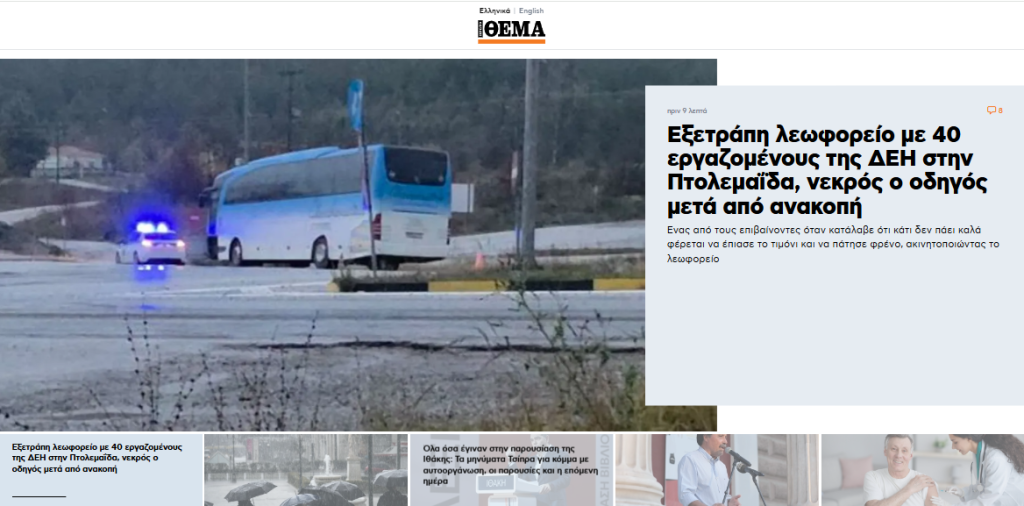
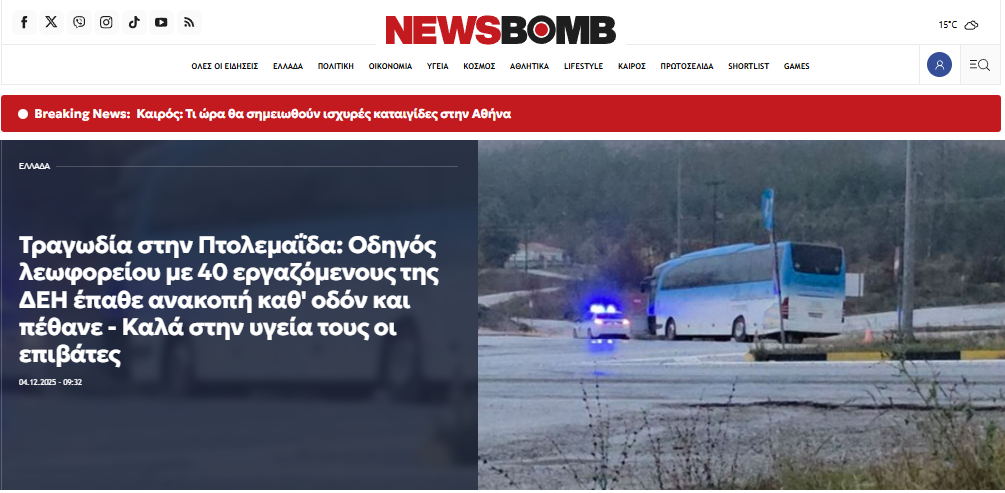
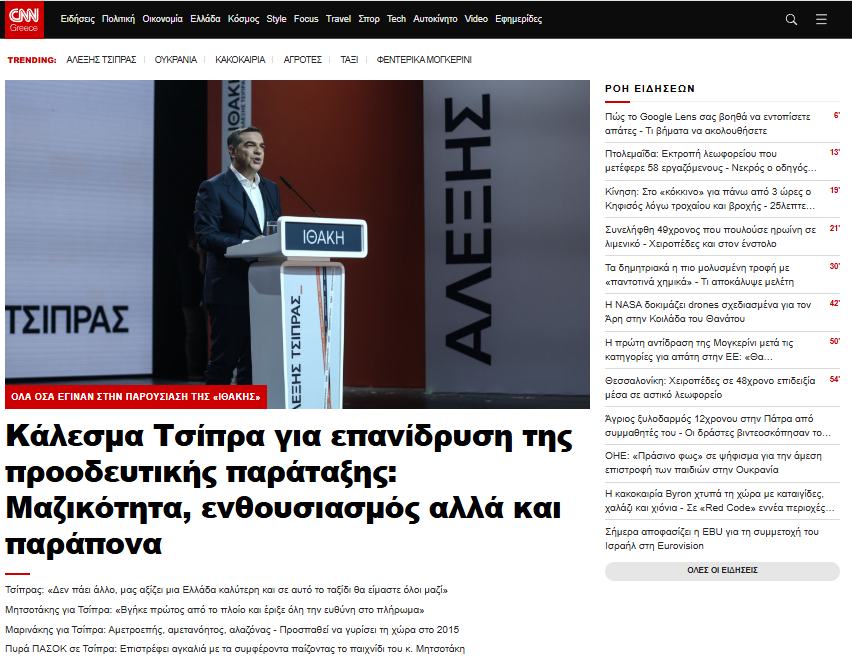
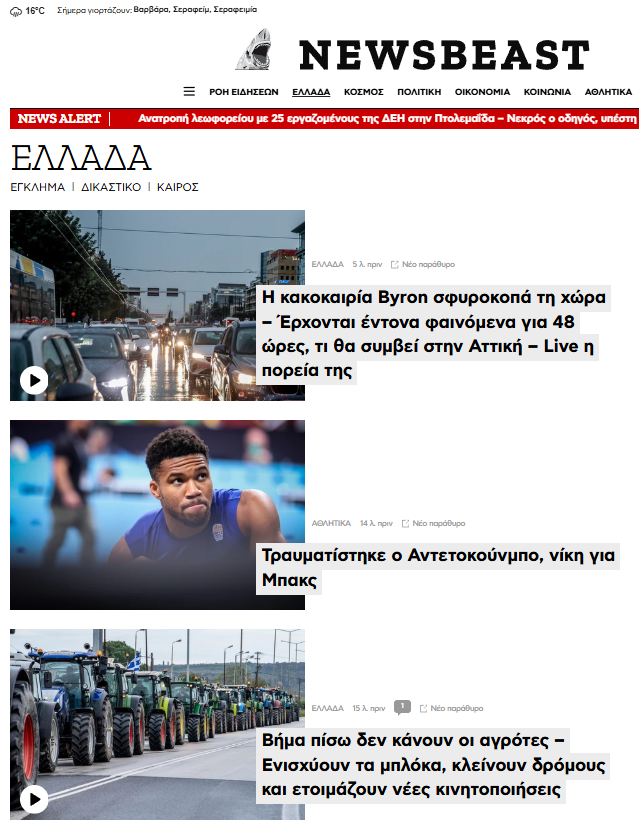

KATHIMERINI: Livestock breeder: “I had 900 animals, now I am left with 2 dogs”

TA NEA: Orange electricity bills: When are they in our best interest?

EFIMERIDA TON SYNTAKTON: A new “Metapolitefsi” [political transition]

RIZOSPASTIS: Farmers’ blockades and solidarity intensify

KONTRA NEWS: Tsipras: Greece needs a democracy shock

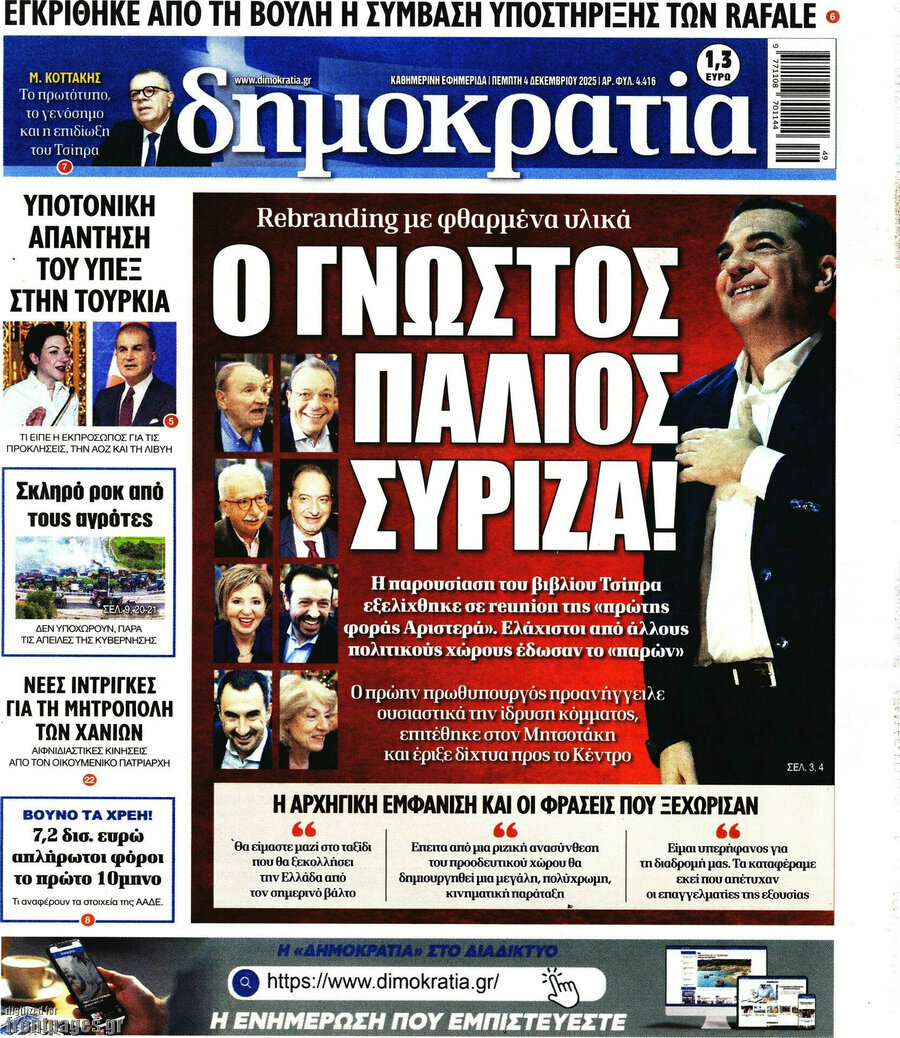
DIMOKRATIA: Good old SYRIZA
NAFTEMPORIKI: Last chance for the euro-economy


DRIVING THE DAY: BELGIUM’S DOUBLE TROUBLE
IT’S BELGIUM VS. THE EU — AGAIN: Italians may often be the punchline of corruption jokes (I’m saying that as an Italian), but another rule holds: whenever there’s turbulence in the bubble, the Kingdom of Belgium’s never far away.
The Brussels dynamic: Frustration is now building with the country hosting the EU’s headquarters, and its chronically unsettled relationship with European institutions. Be it opposition to using frozen Russian assets (which has antagonized more than one EU member) or a judiciary eager for the spotlight, the mood is the same: Belgium jams the gears and scolds everyone else while doing it.
Belgian police, criticized for their handling of the Qatargate investigation, were “very soft” in their conduct of the raid on former EU foreign policy chief Federica Mogherini’s home on Tuesday morning, because children were present, a source close to that probe told Playbook. But that will do little to settle wider concerns about how Belgium’s law enforcement authorities approach high-stakes cases involving politicians.
Infinite damage:EU officials say they’re increasingly uneasy about working in a country where prosecutors can publicly expose people before cases are fully formed. “The reputational damage is infinite,” said one Commission official, granted anonymity to speak candidly. “Even if you’re cleared — whenever that is — the harm is done.”
All show, no substance: Two other EU officials questioned the integrity of the Belgian justice system, noting that authorities held flashy press conferences and detained suspects but then failed to advance cases in the Qatargate affair and this year’s bribery probe into Chinese tech giant Huawei’s lobbying activities.
Institutional faith: One of the officials speculated that the Belgian investigators often overplayed their hand and could be short on evidence to back up their allegations — at the very time that faith in EU institutions is being eroded by public attacks from Russia.
“Let’s see if there’s a real case or not,” a veteran former EU official told me, adding that procurement arrangements by EU institutions are all vetted by a centralized committee that “usually doesn’t miss spotting a problem.”
Standing firm: As Commission President Ursula von der Leyen’s team continues to distance itself from the corruption allegations unfolding across the street, Mogherini said in a statement she has full confidence in the Belgian justice system and trusts that “the correctness of the College’s actions will be established.”
Sannino steps aside: As first reported by Euractiv, the other big name involved in the alleged fraud, Stefano Sannino, is being temporarily replaced by Michael Karnitschnig, deputy director general of DG MENA — and cousin of former POLITICO colleague Matthew Karnitschnig, now at Euractiv. Playbook also hears that Matti Maasikas, who is temporarily taking the post that Martin Selmayr was in line for, has his eye on the role.
Not just politicians: In the Berlaymont, jokes are circulating about needing an “omnibus” just to deal with the European Public Prosecutor’s Office. Industry reps and even some at EU leaders’ level share the impression overheard by Playbook: too much prosecutorial posturing, not enough delivery.
REPARATION LOAN KERFUFFLE: True to form as the resident troublemaker, Belgium didn’t wait for the Commission’s formal proposal to finance Ukraine’s defense by dipping into locally held Russian assets. The reparation loan plan was rejected before it landed. Foreign Minister Maxime Prévot said Belgium felt “not heard” and that the draft “does not address our concerns” — before the proposal had seen what passes for the light of day in Brussels.
Cards on the table: On Wednesday, the Commission unveiled its plan showcasing a preferred outcome: reparation loans backed by immobilized Russian assets. Joint borrowing is Plan B. Von der Leyen underlined why: the first needs qualified majority voting to get up; the second needs unanimity. And especially where Ukraine-related issues are concerned, unanimity is the kiss of death for any proposal.
14 days to save Ukraine: Belgian PM Bart De Wever remains defiant about the idea of being pressured into a compromise. “We still have a good 14 days, which is an eternity in politics. Anything can still happen. We will have many more meetings. But those conditions remain on the table,” he said in a TV interview.
Now read this: What will it take to convince Belgium to support the loan? We took a close look at what the Commission has offered to meet De Wever’s conditions.
Cui bono? Well, (again) these arguments are playing into Russia’s hands, as Tim Ross, Gregorio Sorgi, Hans von der Burchard and Nicholas Vinocur write.
Capitals react: EU ambassadors were briefed Wednesday afternoon. Diplomats say that questions lit the room up like a Christmas Tree, with the Belgian representative reading out a De Wever-approved statement, declaring the proposal dead on arrival.
Trench warfare: Financial experts will plough through the fine print of the Commission’s proposal this morning, while groups of countries will huddle with the Danish Presidency and Commission later in the day.
Belgian brinkmanship: EU ambassadors meet again on Friday, then next Wednesday, Friday and even Sunday, ahead of the EU summit on Dec. 19. Many fear it could become a record three-day summit, something European Council President António Costa is hoping for, with the Belgians determined to push back, right up to the last minute.
It didn’t work the first time … German Chancellor Merz — who nearly sank the November summit with an op-ed in the FT disliked even by von der Leyen’s team — is having another go at upending proceedings with a piece in Frankfurter Allgemeine Zeitung endorsing the Commission’s approach as fully compatible with international law. Timing not accidental.
PEACE PROSPECTS
EUROPE WANTS BACK IN THE GAME: The emerging debate in Brussels isn’t just about peace plans — it’s about Europe’s relevance. The question haunting diplomats and EU officials is what the bloc needs to do to get itself back at the top negotiating table. The answer Brussels keeps circling back to: using frozen Russian assets as leverage.
Good or bad leverage? De Wever warned last week that the Commission’s proposal risks weakening a future peace deal by burning through bargaining chips before talks even start. Von der Leyen dismissed that line, arguing the opposite: Turning immobilized Russian money into reparation loans is “a very clear message to Russia” and will strengthen the EU’s position when negotiations eventually materialize.
But Defence Commissioner Andrius Kubilius delivered a blunt message in a wide-ranging interview with POLITICO marking his first year in office: Europe needs to stop riding on Donald Trump’s coattails and craft its own peace plan for Ukraine.
Stand alone: The EU, he said in an interview for Pro subscribers, must be “independent or at least be ready to be strong in geopolitical developments,” including drafting its own blueprint for how peace in Ukraine should look “and discussing [it] with our transatlantic partners.”
Reality check: Kubilius acknowledged that “Ukraine is facing a big challenge on the ground,” but stressed Kyiv’s growing capability to hit inside Russian territory. “Ukraine is winning,” he argued. Territory is hard to hold, but what Ukraine has achieved in the last three years is “unbelievable.”
Europe as security guarantor: At a briefing attended by Playbook, former Danish PM and ex-NATO chief Anders Fogh Rasmussen offered a similar warning. So far, U.S. guarantees have underwritten European security promises to Kyiv. But if Washington were to step back, Europe must be ready to step in alone.
Troops, and then some: Rasmussen said Europe “does have the capacity” to guarantee Ukraine’s security, but only if it takes a hard look at what post-war deterrence actually requires. A ceasefire or peace deal, he argued, would necessitate a military presence inside Ukraine, along with preparations to prevent the next Russian attempt.
Rasmussen’s basket: His formula involves around 20,000 troops, 150 fighter jets for an air shield and a naval mission in the Black Sea to keep navigation open. U.S. involvement would still be “very welcome,” especially through intelligence sharing and space-based surveillance.
Alpine cavalry: Croatia’s prime minister made a similar point Wednesday at the Grand Continent Summit, in Italy’s Valle d’Aosta, attended by POLITICO’s Jacopo Barigazzi: “Should a peace agreement eventually be reached,” Andrej Plenković said, “it must be acceptable to Ukraine, and must include security guarantees robust enough to prevent Russia from restarting the war after rebuilding its forces.”
CAN EUROPE DEFEND ITSELF? Europeans don’t think so. Presented at the same event, a new Cluster 17 poll across nine EU countries — France, Italy, Spain, Germany, Poland, Portugal, Croatia, Belgium and the Netherlands — shows 69 percent of respondents believe their country couldn’t defend itself against a Russian attack. In Portugal, Italy and Belgium, that anxiety breaks through the 80 percent mark.
Know your enemy: Nearly half (48 percent) of Europeans now see Donald Trump as an “enemy of Europe,” up four points since September. POLITICO’s Victor Jack reports that at NATO headquarters, acting U.S. lead Christopher Landau delivered a pointed warning behind closed doors: European governments should stop trying to “bully” U.S. defense firms out of the bloc’s rearmament efforts, three NATO diplomats said.
Talks continue: Merz’s foreign policy advisor Günter Sautter took part in talks on the peace negotiations with European and Ukrainian colleagues in Brussels on Wednesday — but without the Americans, according to my Berlin Playbook counterpart Hans von der Burchard.
WHILE YOU WERE SLEEPING: President Trump told reporters in the Oval Office that it wasn’t clear whether the talks between Vladimir Putin and his envoys Steve Witkoff and Jared Kushner would lead to a peace deal because it “takes two to tango,” the BBC reports. Witkoff and Kushner will meet with Ukraine’s senior negotiator Rustem Umerov in Miami today, the White House confirmed.
SCOOTING TO THE SINGLE MARKET
MOBILITY FOR EVERY SIZE: Transport ministers roll into Brussels today to talk on a wide spread of mobility-related files — from the very big (tanks and other heavy military vehicles) to the very small (micro-mobility gadgets multiplying on Europe’s streets, including our beloved city — Brussels Corner has the latest).
Dutch scooting ahead: The Netherlands will formally present a new initiative — now backed by 16 countries, from Germany to Hungary — calling on the Commission to propose EU-wide safety and quality rules for e-scooters.
“What a great idea”: These are the words that Dutch Infrastructure Minister Robert Tieman says he heard repeatedly when pitching the plan to fellow ministers. Speaking to me by phone while addressing me as “Mr. Fortuna,” which never hurts, the minister said his counterparts seem unusually aligned.
Treat e-scooters like cars: The idea is simple … if a scooter model is approved in one EU country, it shouldn’t need to undergo another approval process elsewhere — much like cars today.
The real winners are… manufacturers and operators, rather than consumers (who nonetheless will receive safer e-scooter models). No surprise, then, that Micro-Mobility for Europe — the coalition representing Bird, Bolt, Lime, Tier-Dott, Voi and others — has thrown its weight behind the plan.
Just the opening act: Tieman says the point is to create a landing zone for a much bigger debate on EU-wide rules for the growing universe of micro-mobility devices — including Segways and whatever infernal contraption will next be developed.
IN OTHER NEWS
EXCLUSIVE — BILL GATES ON A GLOBAL SETBACK: POLITICO’s Dasha Burns sat down with Bill Gates for an exclusive podcast interview as the Gates Foundation releases its 2025 Goalkeepers report — and the headline is grim. Gates tells Dasha he was “horrified” back when 10 million children were dying annually in 2000 and that the world should remember the “miracle” of cutting that number in half over the past 25 years.
But now, with wealthy nations pulling back on global health funding, Gates warns that the reversal of that progress was tragically predictable. The full interview drops next week. Watch the exchange here and read the full report here.
MACRON MEETS XI: French President Emmanuel Macron warned of the “disintegration of the international order” as he met China’s President Xi Jinping in Beijing as Playbook prepared to go to pixel, according to the FT’s write-up. Both leaders stressed the need for multilateralism amid growing trade tensions … and the FT also reported overnight that the U.S. pulled back from imposing sanctions on China’s spy agency to protect a trade deal between the two countries.
BREXIT BLUES: British PM Keir Starmer has been talking up the need to build bridges with the EU after years of post-Brexit neglect — but Brussels has far more pressing matters to deal with. My London-based colleagues Jon Stone and Dan Bloom take a look at Starmer’s attempts to “reset” the relationship, and find skepticism about how much room for maneuver the U.K. leader actually has.