
PM Mitsotakis visiting the US for UN General Assembly
Prime Minister Kyriakos Mitsotakis will visit the United States for the 81st high-level week of the United Nations General Assembly in San Francisco, where global leaders will gather from September 22-28, where he will meet with high-tech companies and Greeks active in Silicon Valley. He will then visit New York on Wednesday, where investment will be at the centre of the prime minister’s agenda. Specifically, Mitsotakis will participate in a roundtable with more than 30 institutional investors with exposure to Greece and leading Greek companies.
https://www.amna.gr/en/article/1024630/PM-Mitsotakis-visiting-the-US-for-UN-General-Assembly
PM Mitsotakis to unveil government and refinery industry initiative on heating oil
The government will announce a significant initiative on heating oil in the next few days, Prime Minister Kyriakos Mitsotakis said in his weekly review on Sunday. “In the coming days, we will announce a significant government and refinery industry initiative on heating oil aimed at bringing the starting price below € 1.75 per litre, lower than the level at which last winter’s season ended. At the same time, we are moving ahead with a across-the-board increase in the heating allowance, benefiting not only those who use heating oil but also households that heat their homes with other forms of energy,” the prime minister said. “We are also extending the diesel subsidy throughout October. Of course, even if a government has fiscal reserves, the scale of the problem makes a European response necessary. If the European Union allows emergency national measures that are not counted towards expenditure limits, we could also consider a temporary cut in fuel taxes,” he added.
European Parliament delegation to inspect rail safety progress
European lawmakers will be holding three days of meetings with Greek officials, railway authorities and unions, and victims’ relatives this week as they scrutinize changes to the country’s rail system since the 2023 Tempe disaster that claimed 57 lives. The European Parliament’s Committee on Petitions delegation will visit Larissa in central Greece and Athens from Monday through Wednesday, focusing on railway safety, compliance with European Union legislation and the progress of EU-funded infrastructure projects.
Greece receives two credit-rating boosts
Greece received two credit-rating boosts on Friday, with Moody’s turning its outlook for the country positive and Scope Ratings raising its sovereign rating to BBB+, as Finance Minister Kyriakos Pierrakakis said the decisions showed the economy had become more resilient and credible. Moody’s changed its outlook to positive from stable while maintaining Greece’s rating at Baa3, while Scope upgraded the rating by one notch to BBB+ from BBB, with a stable outlook.
https://www.ekathimerini.com/economy/1315766/greece-receives-two-credit-rating-boosts
ATHEX: Bourse finally gets back to the top level
The Greek bourse has finally returned to the level of developed markets, securing more and better exposure in the trading world and attracting quality capital, especially for its nine blue chips that are entering the prestigious EuroStoxx 600 index. The rebalancing of this and other indexes on Friday, along with the September triple-witching, created a “Big Friday” at Athinon Avenue, with record turnover that exceeded €4.2 billion, while the benchmark lost significant ground. The Euronext Athens (ATHEX) general index closed at 2,661.30 points, shedding 0.99% from Thursday’s 2,687.91 points. On a weekly basis, it conceded 2.39%.
https://www.ekathimerini.com/economy/1315755/athex-bourse-finally-gets-back-to-the-top-level


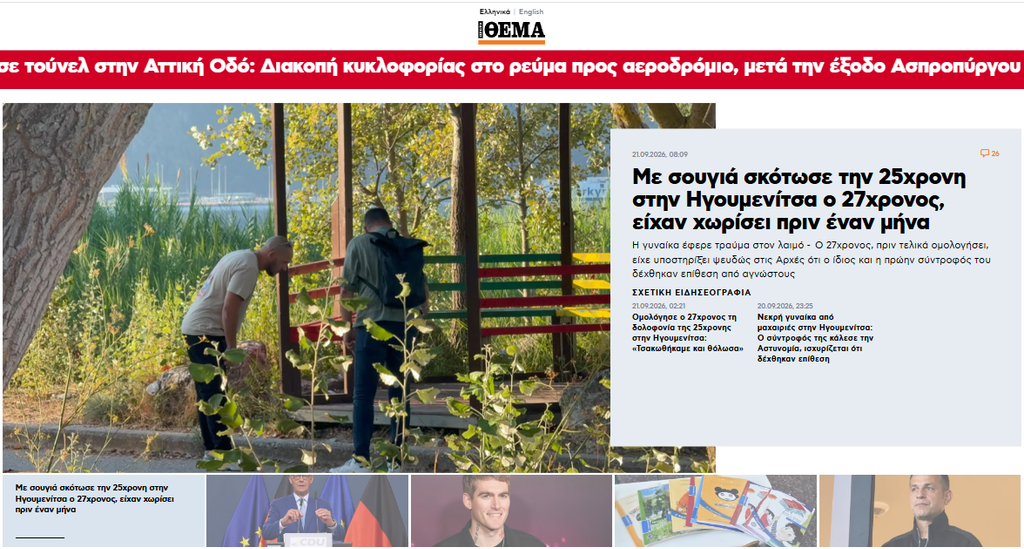


SUNDAY PAPERS
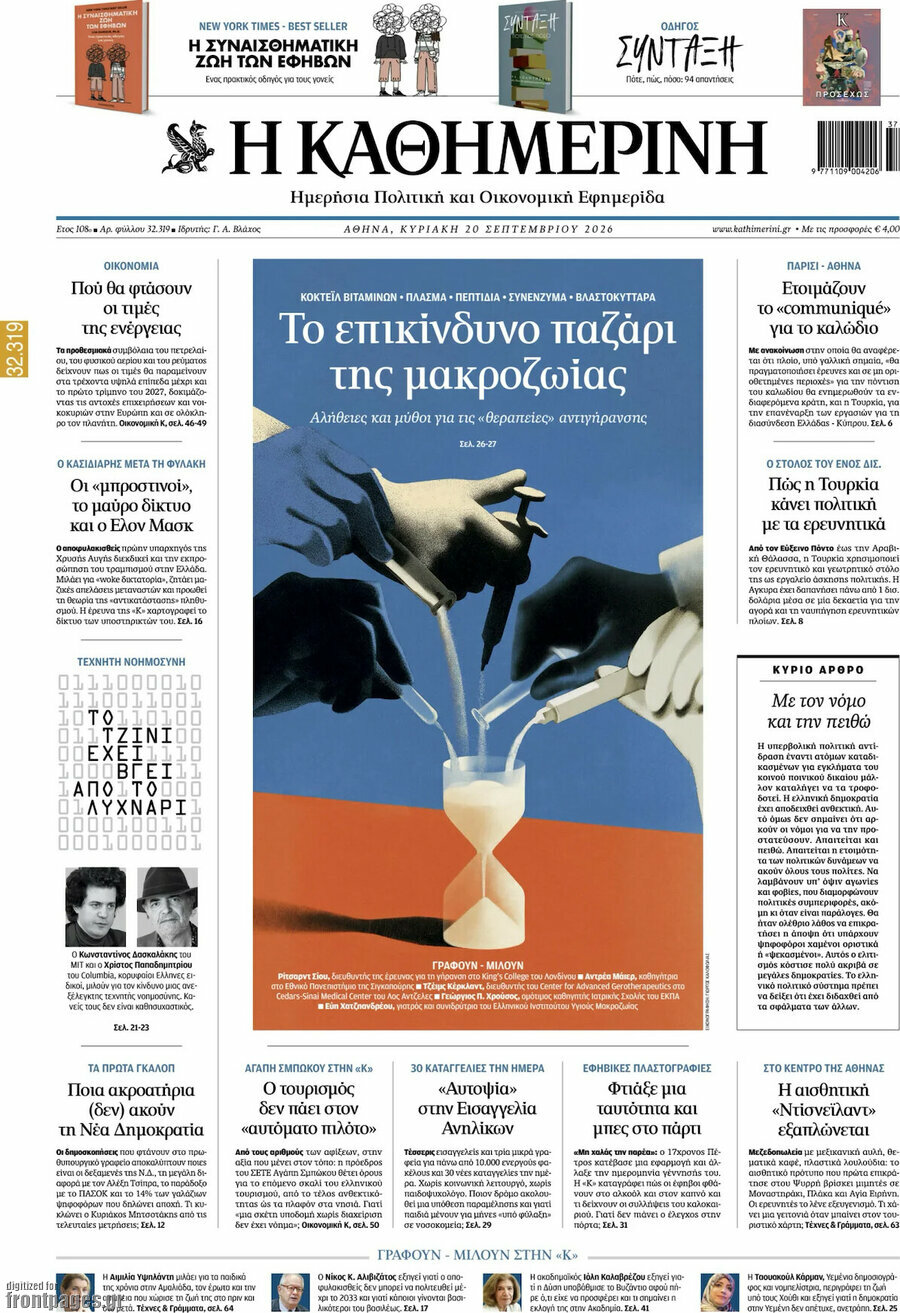
KATHIMERINI: The dangerous “market” for longevity
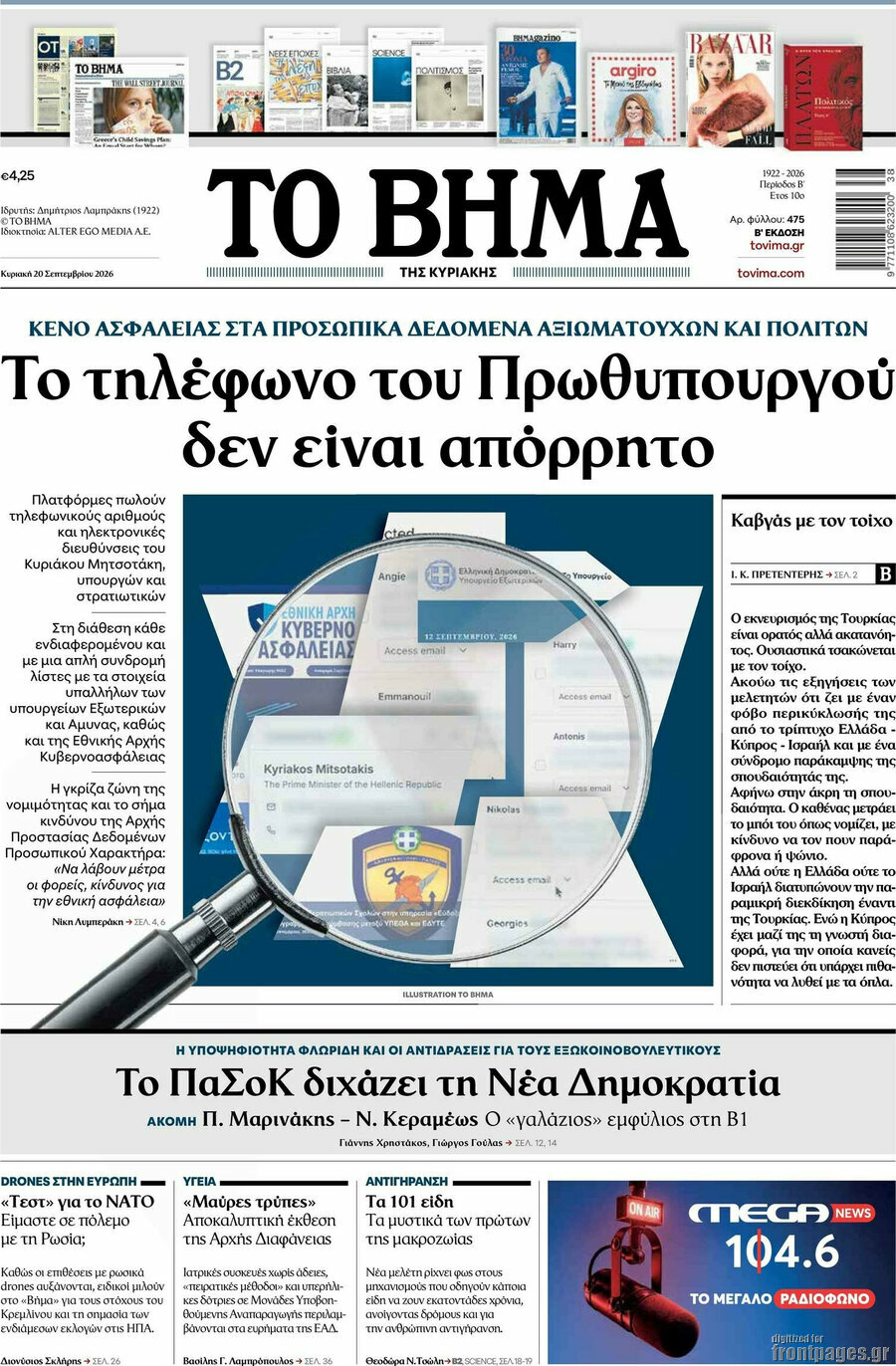
TO VIMA: Security gaps linked to personal data: The PM’s telephone is not classified
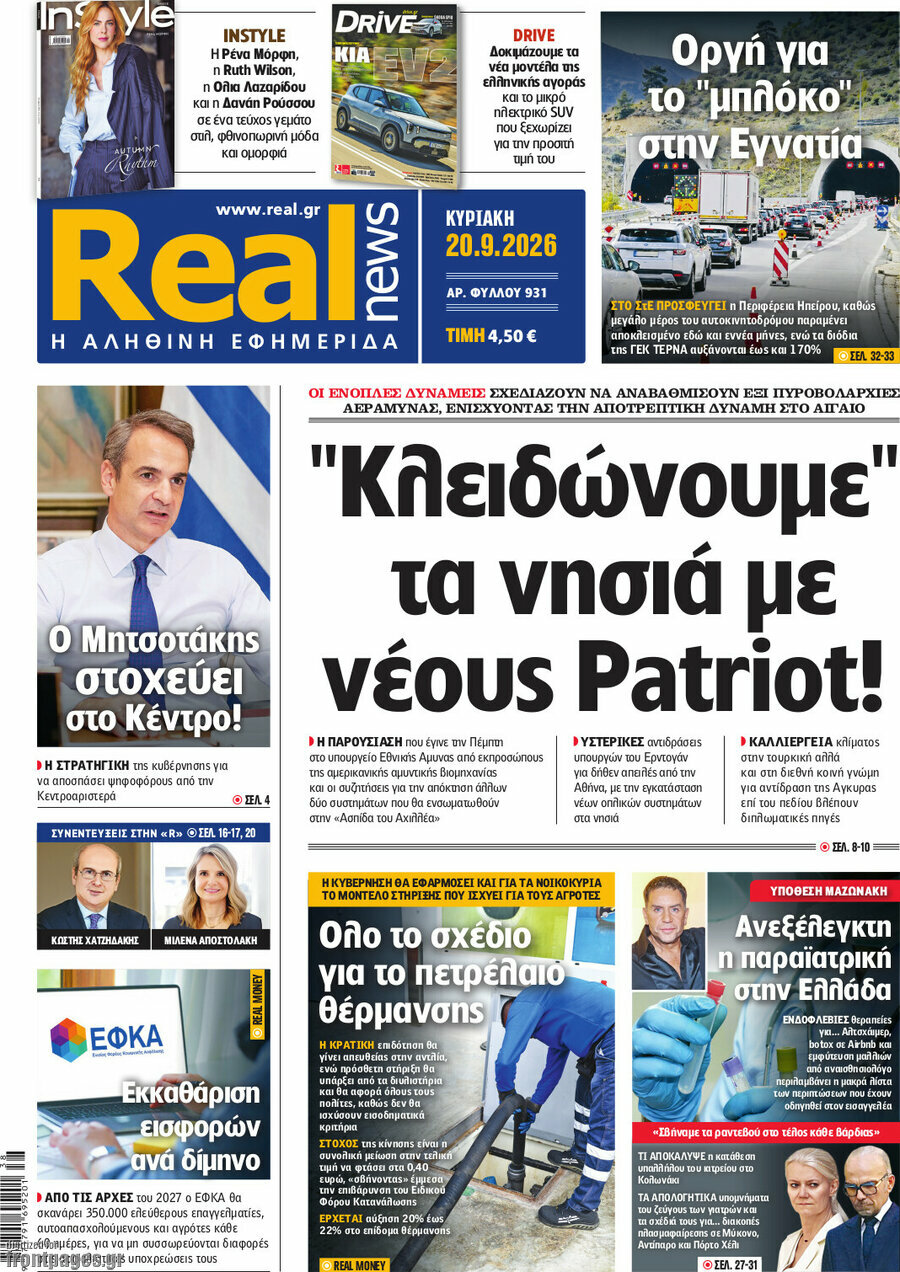
REAL NEWS: We are “locking” the islands with new Patriot missiles!
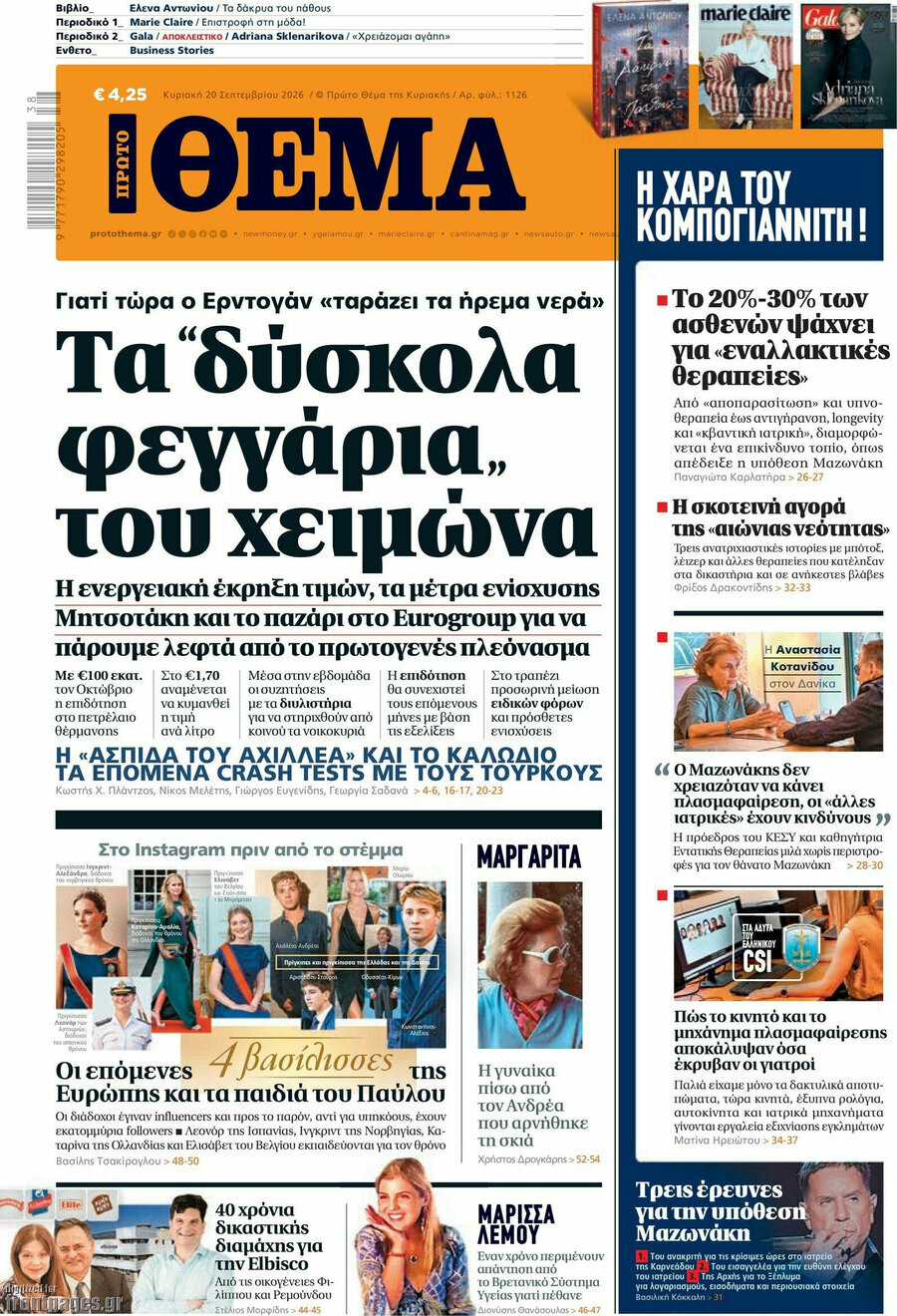
PROTO THEMA: Winter’s major issues
MONDAY PAPERS:
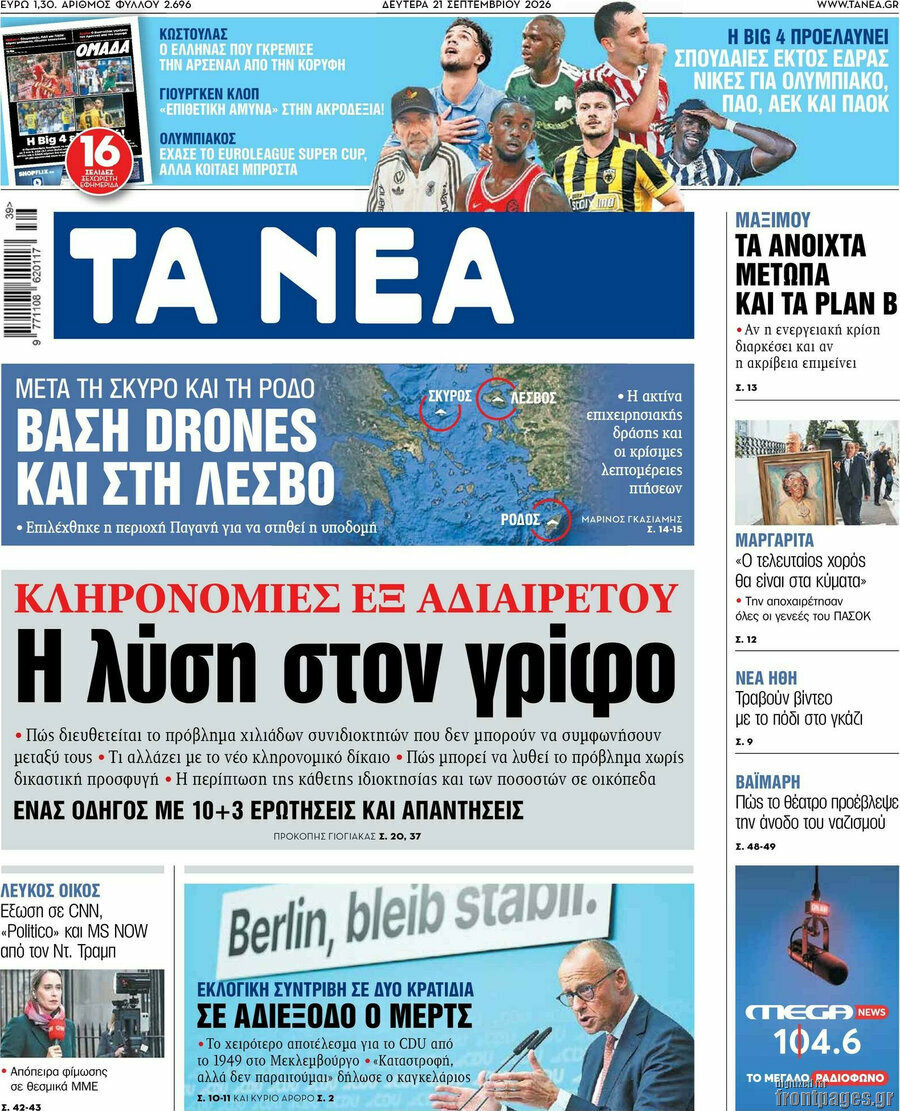
TA NEA: Undivided interest inheritances: The solution to the riddle
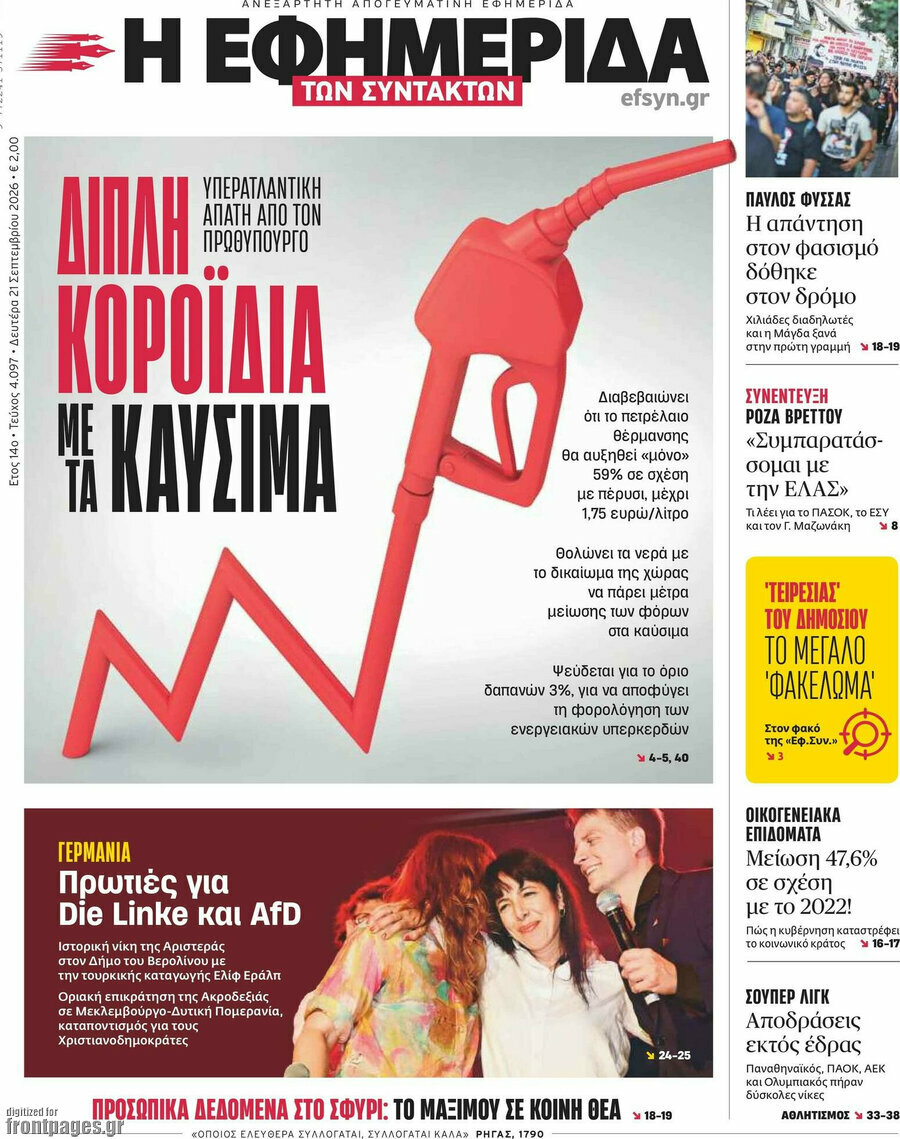
EFIMERIDA TON SYNTAKTON: Double deception by the PM regarding fuel
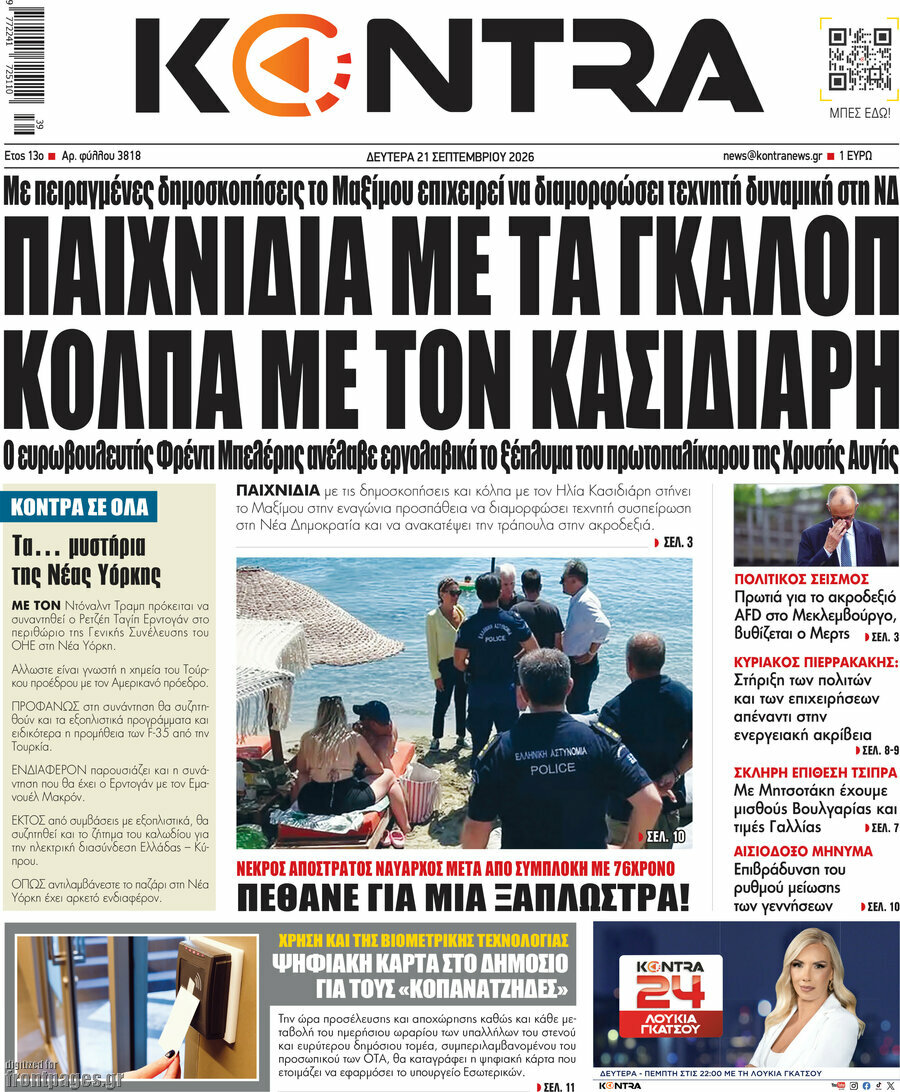
KONTRA NEWS: PM’s office plays games with polls; tricks regarding released ex-leader of Golden Dawn Kassidiaris
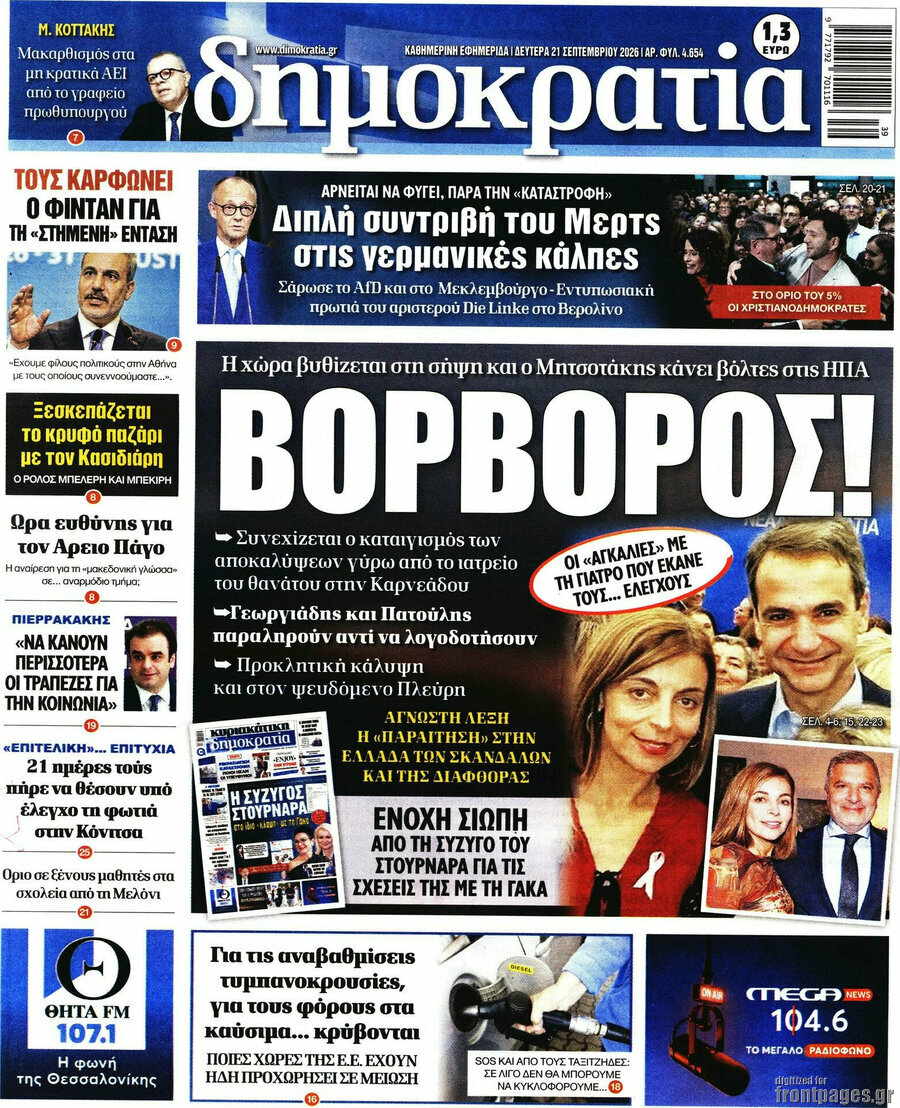
DIMOKRATIA: Sludge!
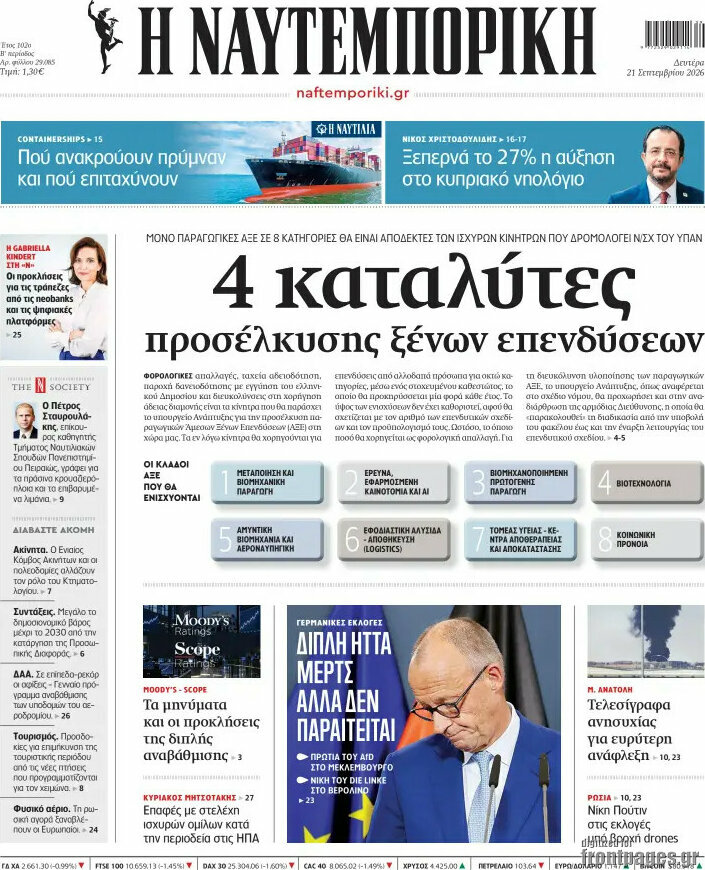
NAFTEMPORIKI: 4 catalysts to attract foreign investment

DRIVING THE DAY
EXCLUSIVE — COSTA’S ART OF THE DEAL: European Council President António Costa told Playbook that any plan to cut the EU’s next seven-year budget risks running into opposition from national governments.
“It’s easier to say ‘I want to reduce the global volume’ but it’s much more difficult to reach a consensus to cut on the different policies funded by the budget,” Costa told Gregorio Sorgi.
Over the past month, the Council president visited the leaders of most EU countries — he’s due to visit Stockholm and The Hague in the coming weeks — to sound them out on the most sensitive issues in the negotiations. In an interview with Playbook, Costa laid out for the first time what the leaders told him.
Playbook joined Costa on a packed (and late) Ryanair flight to Dublin last week. At the leafy Farmleigh House, an official country residence, Costa compared notes with Irish Taoiseach Micheál Martin, whose country holds the rotating presidency of the Council of the EU and will put forward a budget negotiating document, the “negobox,” early next month.
Although German Chancellor Friedrich Merz and four other leaders called for cuts of several hundred billion euros in an op-ed on POLITICO last week, Costa said he sensed little appetite from most leaders to downsize specific pots of money in the budget. “I ask, ‘Who wants to cut on defense?’ No one. ‘Who wants to cut on competitiveness?’ No one. ‘Who wants to cut on agriculture?’ No one.”
“Everybody agrees that we can cut on [EU] administrative expenditure butit’s a very small amount [and] it doesn’t solve the problem,” Costa said. (It makes up only 6% of the total budget.) There’s greater appetite from governments to cut foreign aid, worth €200 billion for the next seven years, an EU official with knowledge of the negotiations said.
Costa believes that introducing new EU-wide taxes, or own resources, is key to averting major cuts and keeping national contributions to Brussels stable. New own resources are more likely to be approved if they generate fresh revenue that is not already collected by national governments, he said.
Costa pointed to a proposed EU tobacco tax, which governments have criticized because it taps revenue already collected by capitals. But he said newer products such as vapes and e-cigarettes are not taxed in many countries. Focusing on these products can generate “new money,” he said. “Then it means it’s easier [to secure an agreement.]”
BIG AND BREAKING
THIS WEEK IN NEW YORK: A host of top EU officials and national leaders are attending UNGA, including Commission President Ursula von der Leyen, Costa, High Representative Kaja Kallas, European Parliament President Roberta Metsola, and Commission Executive Vice Presidents Teresa Ribera and Roxana Mînzatu.
THE CARNEY-VAL CONTINUES: Costa told Gregorio the EU can do more with Canada on defense, AI and strengthening democracy … and European Investment Bank President Nadia Calviño will meet Canadian PM Mark Carney in New York this week, my colleague Kathryn Carlson reports (for subscribers).
STILL IN CONTROL: Russia’s ruling United Russia party was last night on track to easily win a tightly controlled parliamentary election, the Associated Press reports, after Ukraine launched a massive drone attack on Moscow over the weekend.
Meanwhile in Kyiv: Ukraine’s President Volodymyr Zelenskyy posted on X that he’ll meet Donald Trump in New York this week, hinting that “this meeting could change a lot.”
Secret drone plan: Moscow is ramping up its capacity to make the killer drones it deploys in attacks on Ukrainian cities, according to plans from a Russian state company obtained by POLITICO.
TIGHTENING THE SCREWS: The Trump administration is stepping up its campaign against the International Criminal Court, preparing sweeping sanctions that would effectively cut it off from the global financial system, the Wall Street Journal reports. Reuters hears similar.
RED TAPE WARNING
EXCLUSIVE — VIENNA HITS PAUSE: Austria is leading a push with 10 other countries to pause new EU legislation for 12 months for what the country’s Europe Minister Claudia Bauer describes as a “year of simplification.”
Roll up your sleeves: “We can’t go on tabling new legislative proposals when existing rules have not been fully implemented,” Bauer said in an interview with Playbook, referring to a discussion paper signed by Austria, Germany, Italy, Poland, Denmark, the Czech Republic, Slovakia, Slovenia, Lithuania, Portugal and Hungary and seen by POLITICO.
Brussels is already scrambling to roll out red-tape-cutting packages known as “omnibuses” — but those efforts don’t go far enough, according to Bauer.
“What we are doing now is mostly ex-post simplification,” she said. “We fully support the Commission’s omnibus packages but it cannot become the standard that we have new legislation and then a whole string of other acts to simplify it. Simplification should start before legislation is adopted.”
The signatories want any proposed laws from Brussels to undergo a rigorous assessment to determine its suitability and whether it supports the wider aim of bolstering economic competitiveness. All new regulations would be subject to an impact review every five years.
The key demand: Brussels must devote an entire year to stocktaking of current laws and implement what’s already there. “Such an effort should not be viewed as deregulation, but as an exercise in legislative deep-cleaning,” a draft of the discussion paper reads. “To quote Elvis Presley, we need a little less conversation and a little more action,” added Bauer.
Several of the signatories also favor severely limiting the EU’s operating costs — something that might fit well with cutting back on laws.
The bottom line: Advocates of slashing red tape are sharpening their rhetoric and sending a warning to the Commission: Cut back on regulations and directives ASAP — or else.
20-SECOND PLAYBOOK PRIMER
Germany’s chief of defense, Carsten Breuer, was voted in as the chair of NATO’s highest military authority. But what is that authority and what does it do? As chair of the NATO military committee, Breuer will be expected to give honest military advice to allies — helping assess the feasibility, financing and capabilities of operations. He will also oversee dozens of working groups of NATO military staff, and broker consensus on formulating military advice.
RUSSIA SANCTIONS
NOW OR NEVER: France’s actions this morning will determine whether one of the EU’s sanctions programs against Russia falls apart.
EU ambassadors will gather from 9 a.m. If they don’t extend sanctions on some 3,000 Russia-linked companies and individuals, the current batch will expire at midnight Tuesday. After France and Slovakia sought to remove prominent individuals from the list, this is the final chance for capitals to agree, three diplomats told Playbook.
“Ultimately, it’s up to the French: will they let the entire sanctions regime collapse?” said one of the diplomats, granted anonymity to discuss closed-door talks.
France stunned other EU countries by seeking to lift sanctions targeting Russian-Uzbek billionaire Alisher Usmanov, because of concerns about a French citizen detained in Azerbaijan, just as Europe is growing increasingly worried about Russia. France’s own President Emmanuel Macron is among those sounding the alarm about the security threat, announcing plans Friday to protect critical infrastructure against a potential attack.
Attempts to negotiate a compromise last week failed, despite countries agreeing to extend the expiration deadline, the diplomats said.
5 MORE THINGS GETTING US TALKING
THE COMPANY TRUMP CAN’T IGNORE: POLITICO Magazine has a must-click story on the complicated rise of Anthropic and how its new Mythos model changed Washington’s approach to artificial intelligence.
GREENLAND DEAL: The U.S., Greenland and Denmark will ink a deal at UNGA on “strengthened security in the Arctic and North Atlantic Area,” per a Danish statement.
WHY THE RIGHT FAILED IN SWEDEN: The Sweden Democrats’ disappointing performance in last week’s Swedish election goes against the recent trend. Tim Ross has more on the lessons learned.
VEIL BAN: Italian Prime Minister Giorgia Meloni said her government is preparing two legislative proposals that would ban face coverings in Italian schools and restrict the number of foreign students allowed in classrooms.
DIPLOMATIC CLASH: France will summon Iran’s ambassador after Iranian authorities sealed a French language center affiliated with its embassy in Tehran, Reuters reported overnight.