French stake in electricity interconnection project grows
With France having a greater stake in the implementation of the Great Sea Interconnector (GSI) – the power cable linking Greece to Cyprus and Israel – Athens hopes that Paris will also play an active part in managing Turkey’s objections to the project, even confronting it if necessary. When French President Emmanuel Macron and Greek Prime Minister Kyriakos Mitsotakis met Wednesday at the International Space Summit in Paris, the former committed to the research vessel that will make seabed soundings in the southeastern Aegean on behalf of French cable-laying company Nexans flying the French flag. This is not just a detail: in doing so, France will also undertake to inform Turkey about the sounding and cable-laying process.
Androulakis targets New Democracy, Tsipras ahead of election
PASOK leader Nikos Androulakis said Sunday that his party’s goal in Greece’s next national election is to finish first and have the ability to form a government, while ruling out cooperation with the governing New Democracy party after the vote. Speaking at the Thessaloniki International Fair, Androulakis said PASOK’s strategy was to pursue “political change” and rejected a coalition with New Democracy even if Prime Minister Kyriakos Mitsotakis were not in office. He said PASOK’s recent congress had unanimously approved the party’s course and that the strategy would not change. Androulakis also took aim at former prime minister Alexis Tsipras, whose new political formation is competing for support among center-left voters. He criticized Tsipras over the transfer of nonperforming loans to investment funds and questioned his political consistency, while presenting PASOK as the alternative for the middle class, disadvantaged voters, the political center and center-left.
PM Mitsotakis to Türkiye: We threaten no one, but neither do we accept threats or demands from anyone
Prime Minister Kyriakos Mitsotakis sent a strong message to Türkiye from Kastellorizo that Greece seeks dialogue and good neighbourly relations but will not accept threats, instructions or challenges to its sovereign rights. “We threaten no one, but neither do we accept threats or demands from anyone. We are ready to defend our territorial integrity and our sovereign rights,” the prime minister stressed, speaking at the official ceremony marking the 83rd anniversary of the Liberation of Kastellorizo. He also stressed that, for Athens, dialogue is “a choice of self-confidence and faith in international law”. As Mitsotakis noted, in Kastellorizo, Greece’s borders coincide with Europe’s borders, while the territory of Megisti is also European territory.
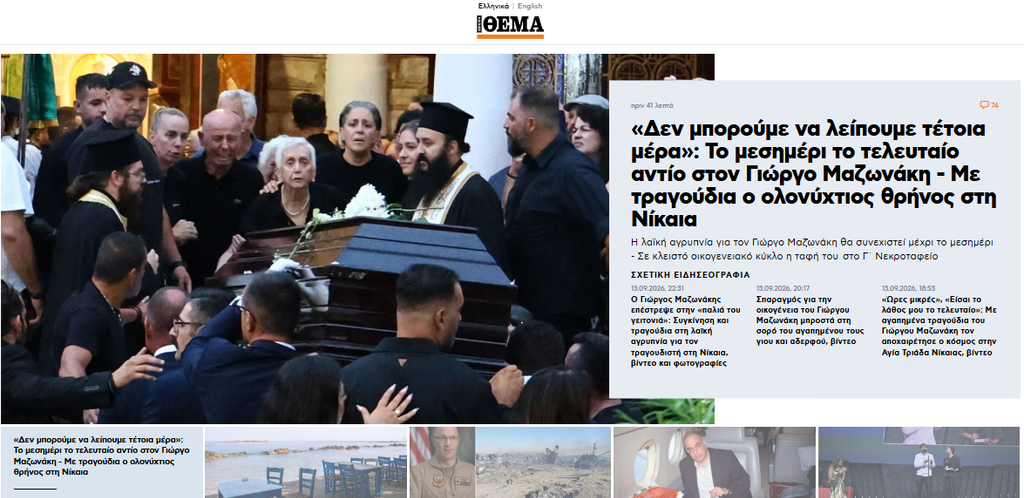
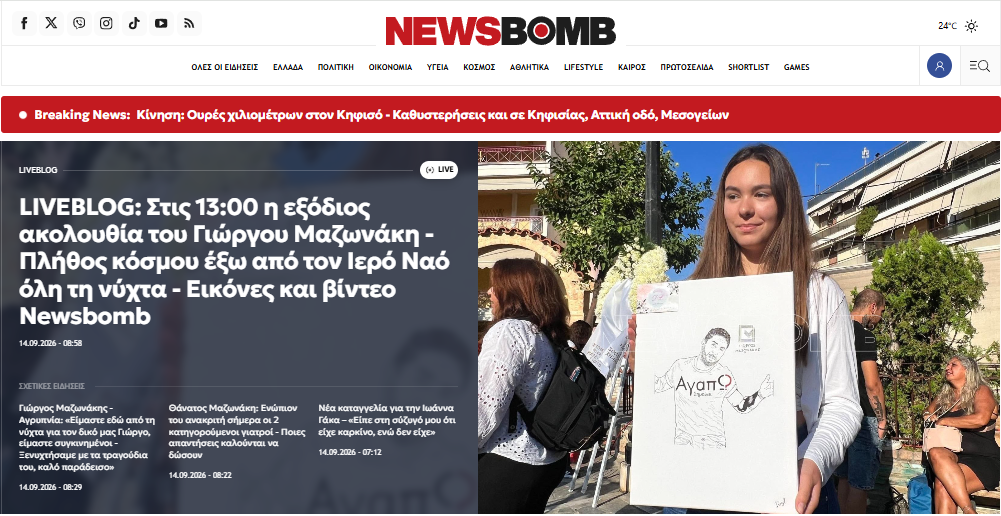
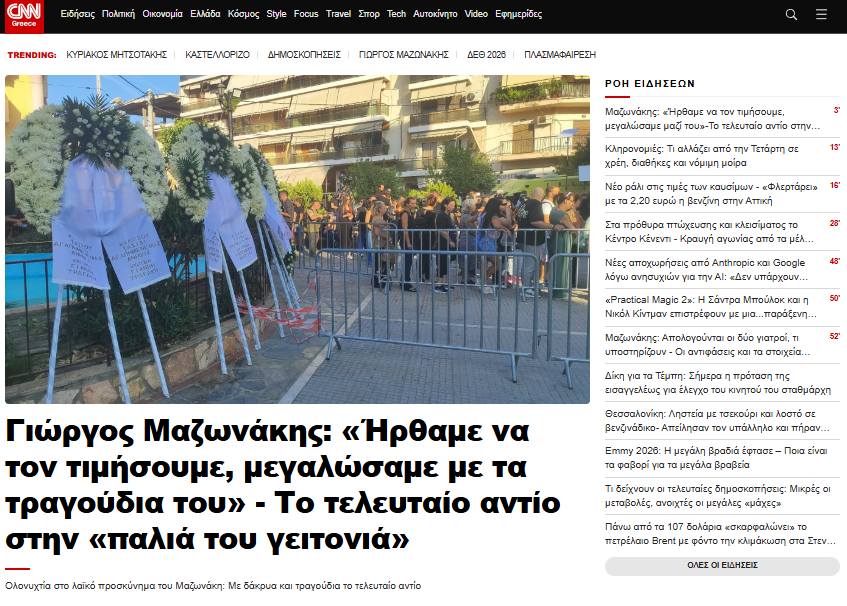
Thousands gather overnight to bid final farewell to Giorgos Mazonakis
Thousands of people gathered Sunday evening outside the Holy Trinity Church in the Athens suburb of Nikaia to pay their final respects to popular singer Giorgos Mazonakis, who died Wednesday at the age of 54. The gathering, described as an overnight vigil, began at 7.30 p.m. and continued into the early hours of Monday. Meanwhile, the two doctors charged in connection with Mazonakis’ death are expected to appear before an investigating magistrate Monday to give their statements about what happened at the private clinic in Athens’ Kolonaki district, where the singer suffered cardiac arrest while undergoing plasmapheresis.
ATHEX: Benchmark on another 17-year high
The Euronext Athens (ATHEX) general index closed Friday at 2,726.49 points, adding 1.07% to Thursday’s 2,697.58 points. On a weekly basis it earned 0.93%.
https://www.ekathimerini.com/economy/1315067/athex-benchmark-on-another-17-year-high


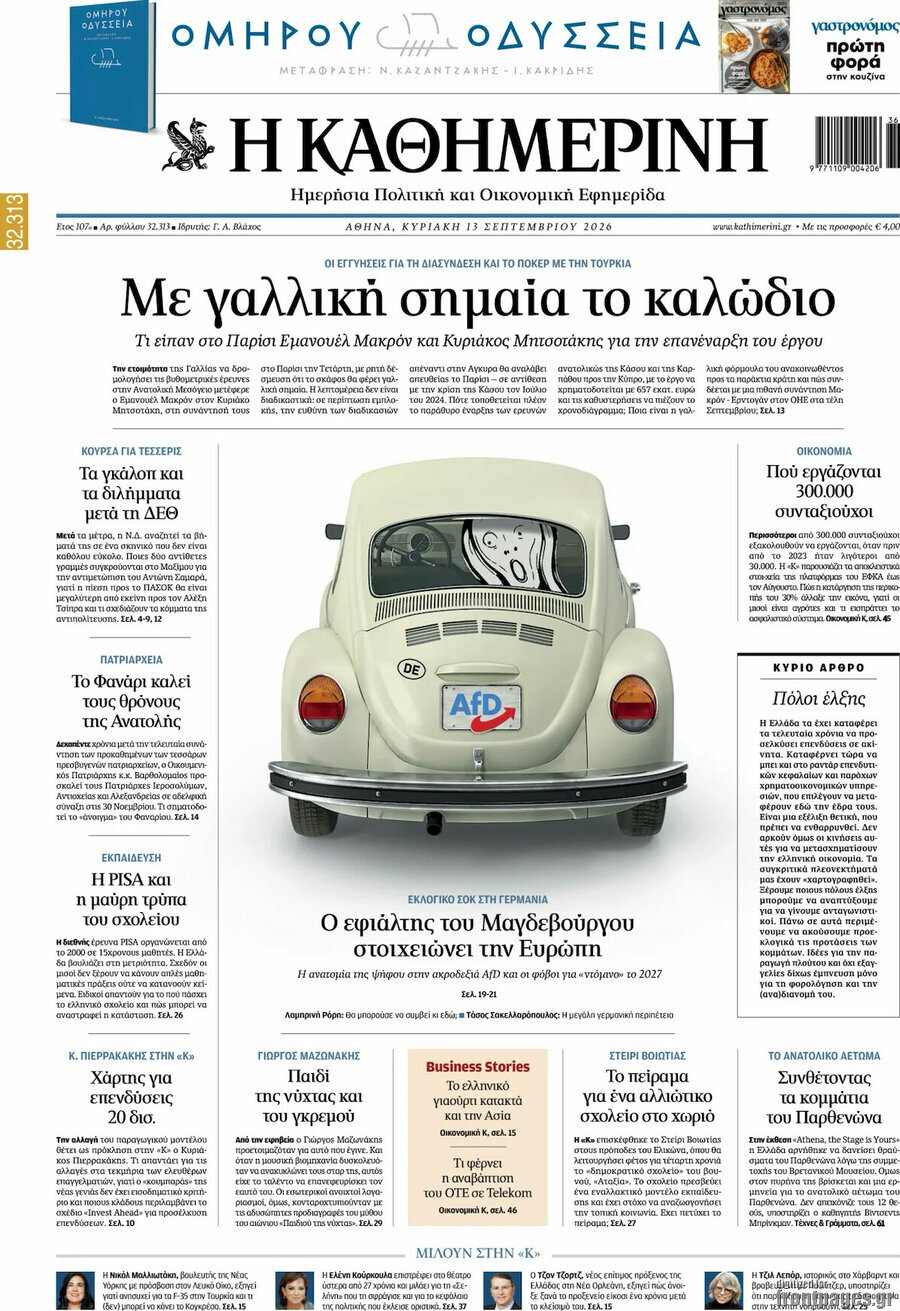
SUNDAY PAPERS
KATHIMERINI: French stake in electricity interconnection project grows
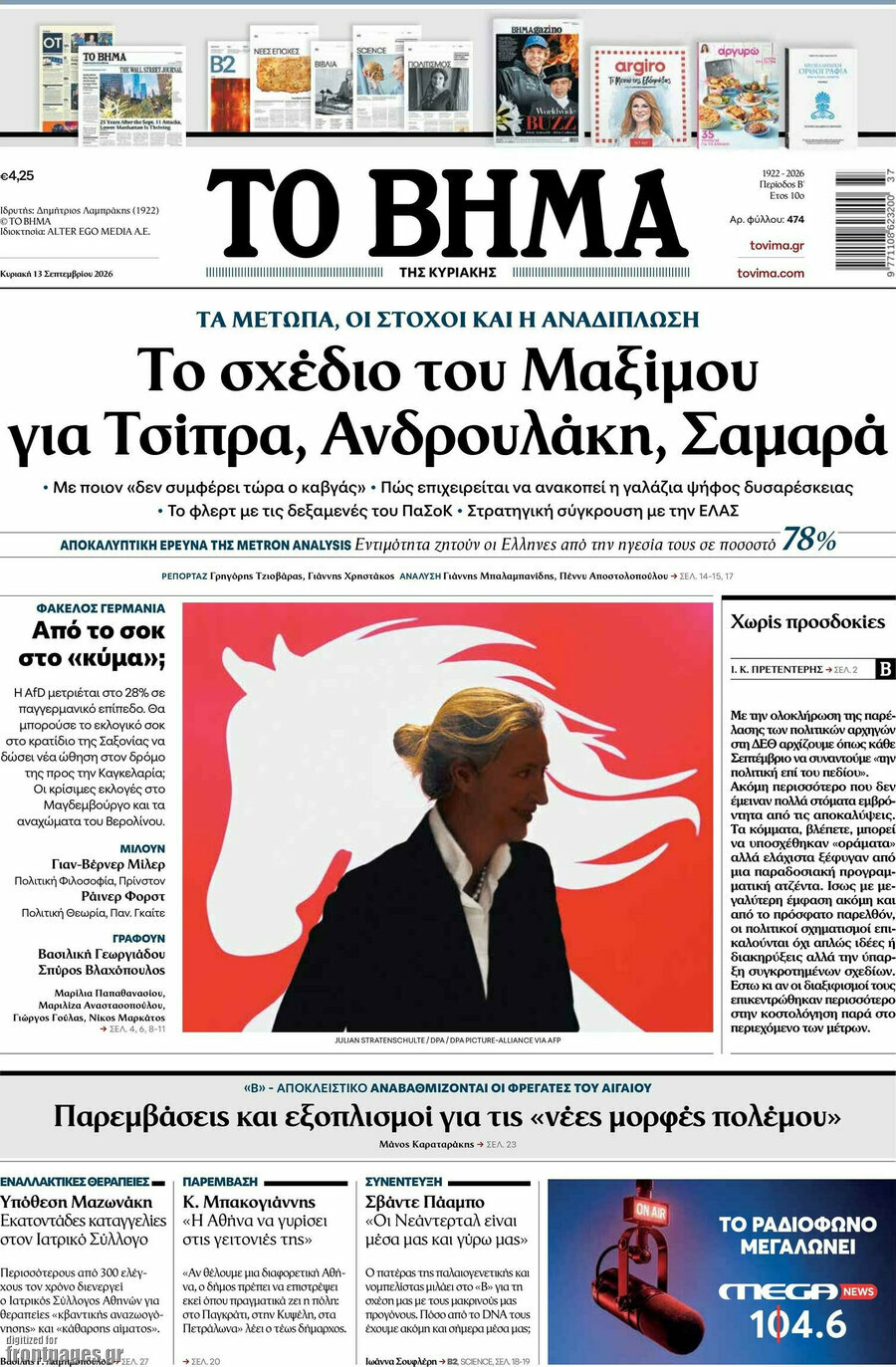
TO VIMA: The government’s plan to deal with Tsipras, Androulakis and Samaras
REAL NEWS: The energy nightmare is back!
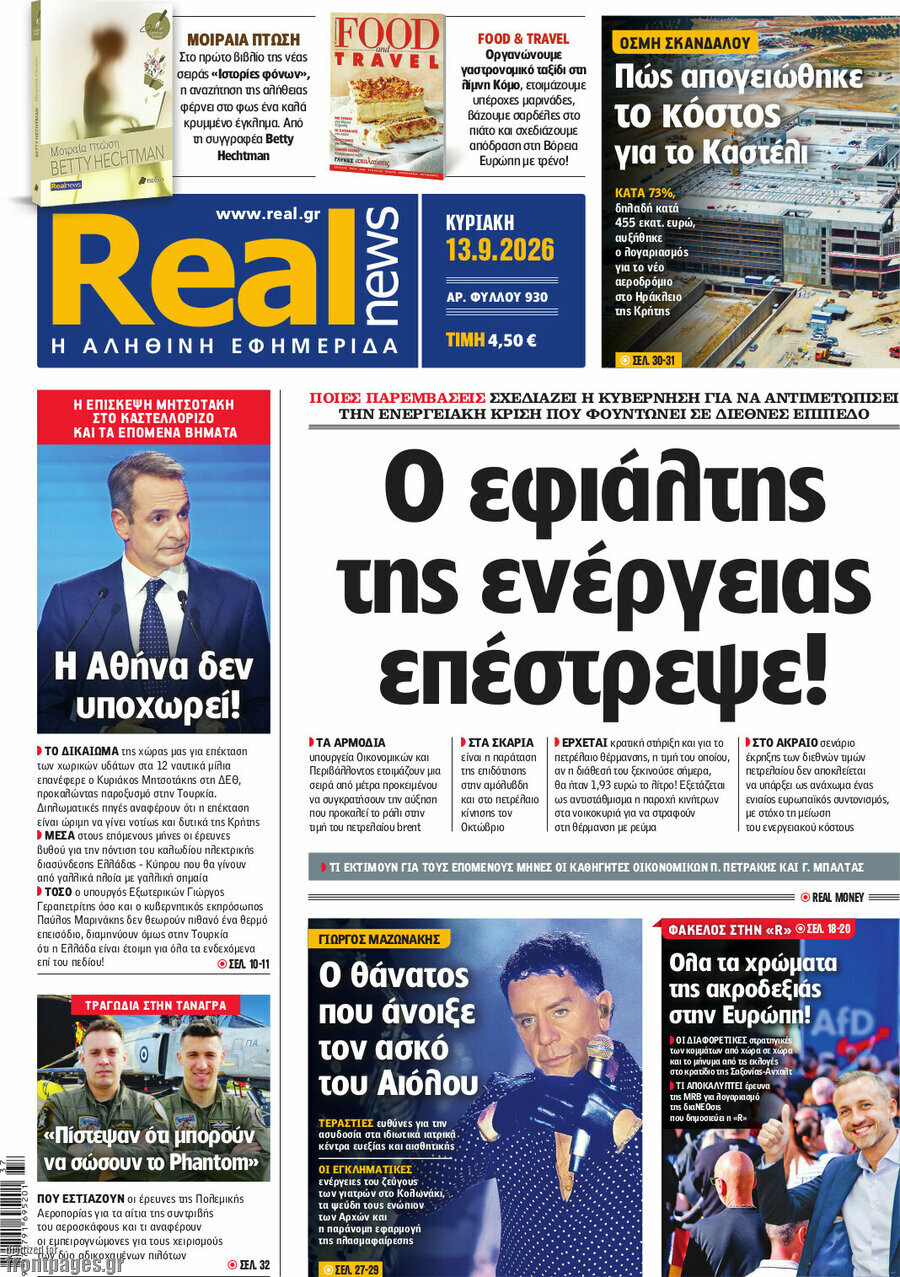
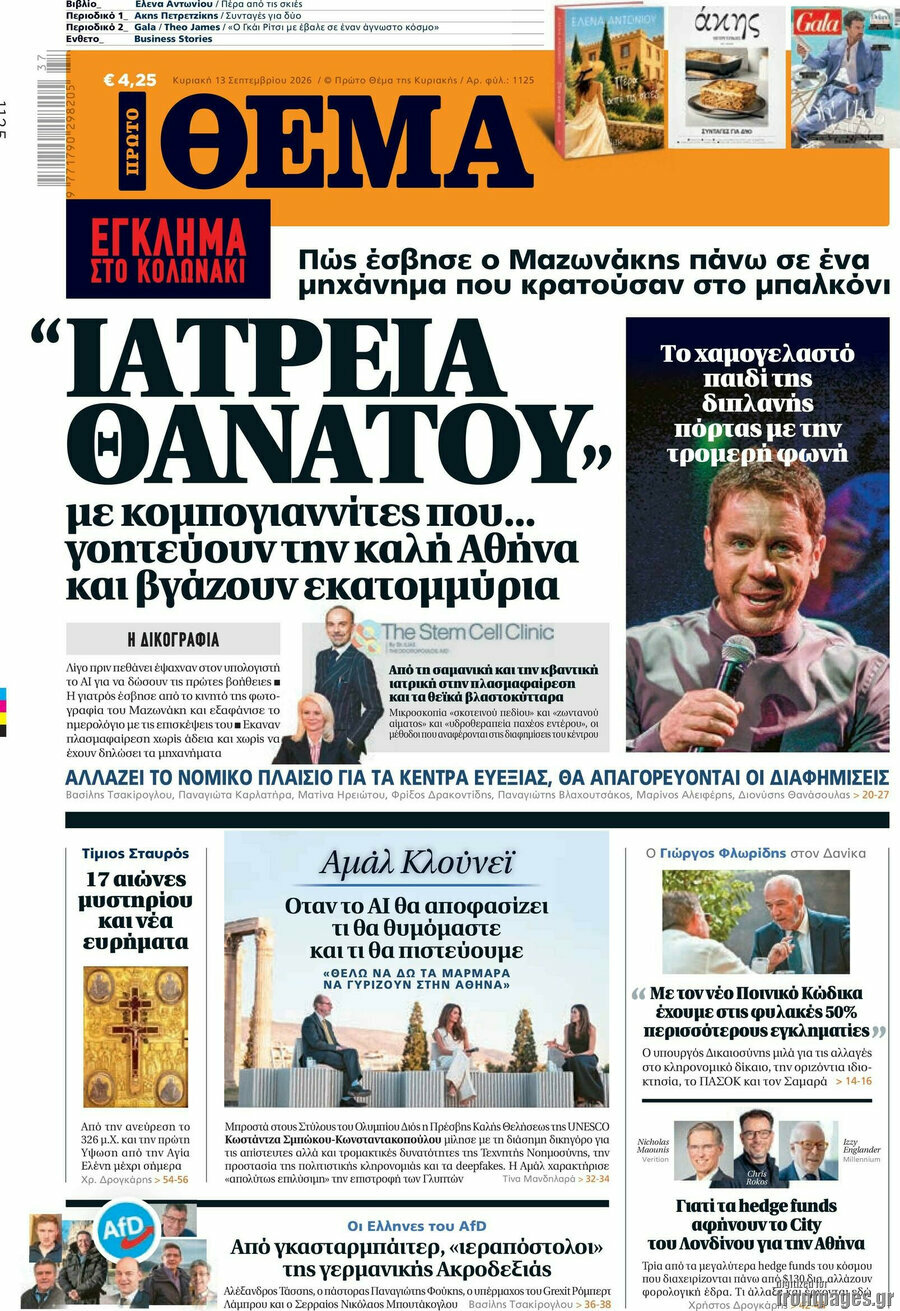
PROTO THEMA: Lethal doctor offices with fake doctors who charm the upper class and enjoy millions in profits
MONDAY PAPERS:
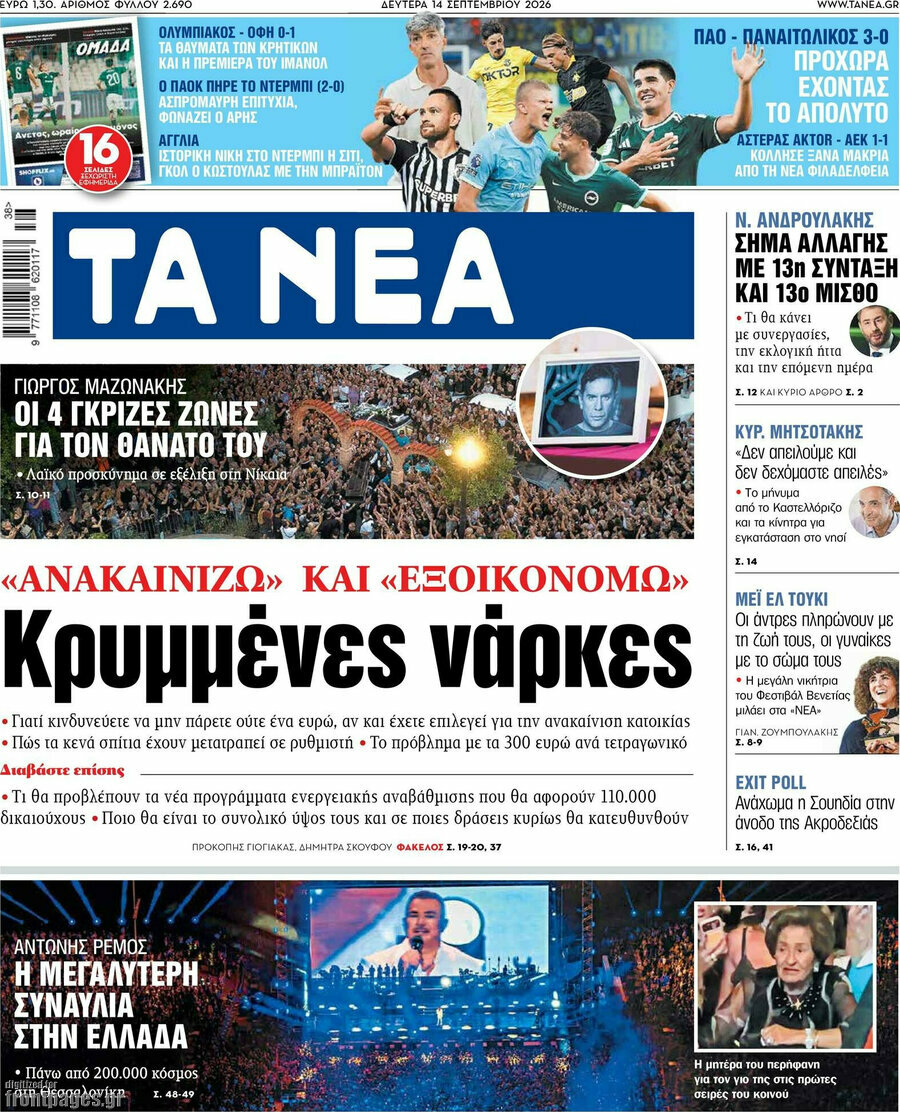
TA NEA: Power-saving programs for households: Hidden “landmines”
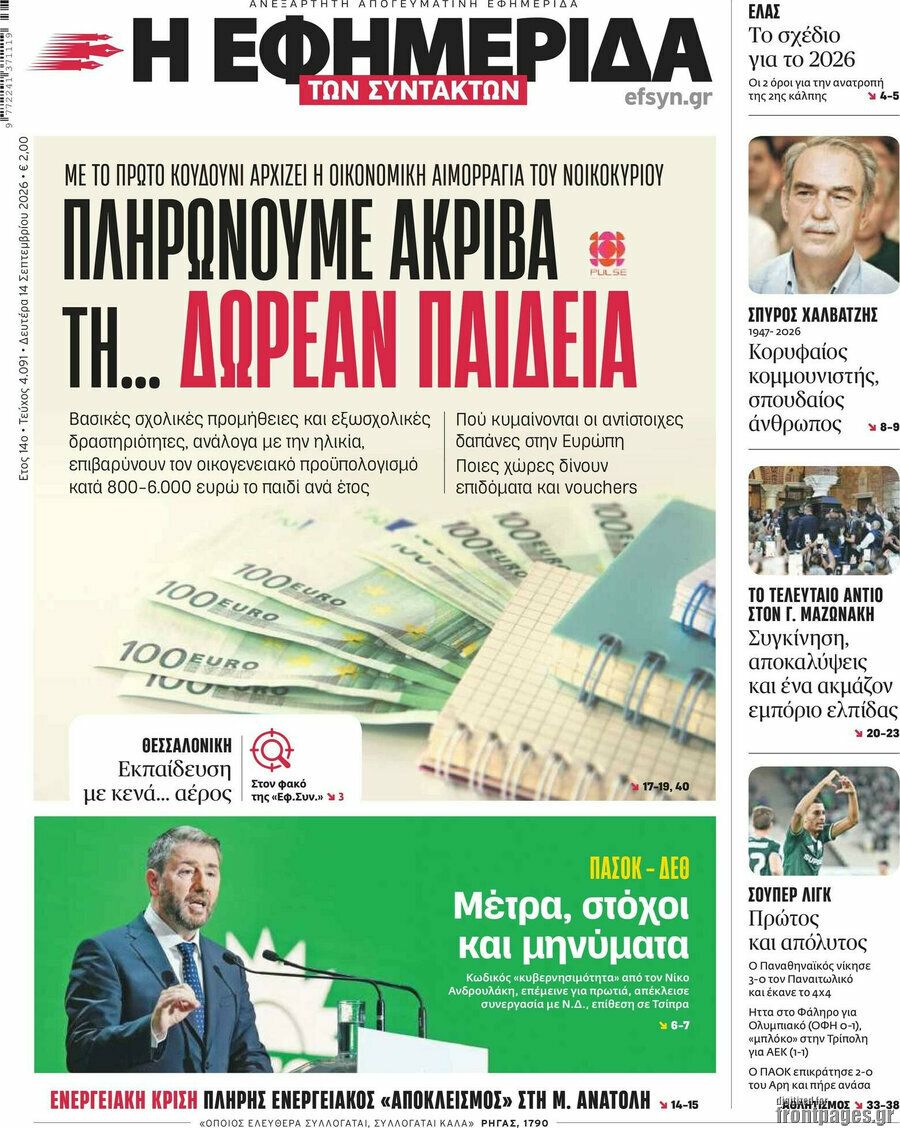
EFIMERIDA TON SYNTAKTON: We are paying dearly for… free education
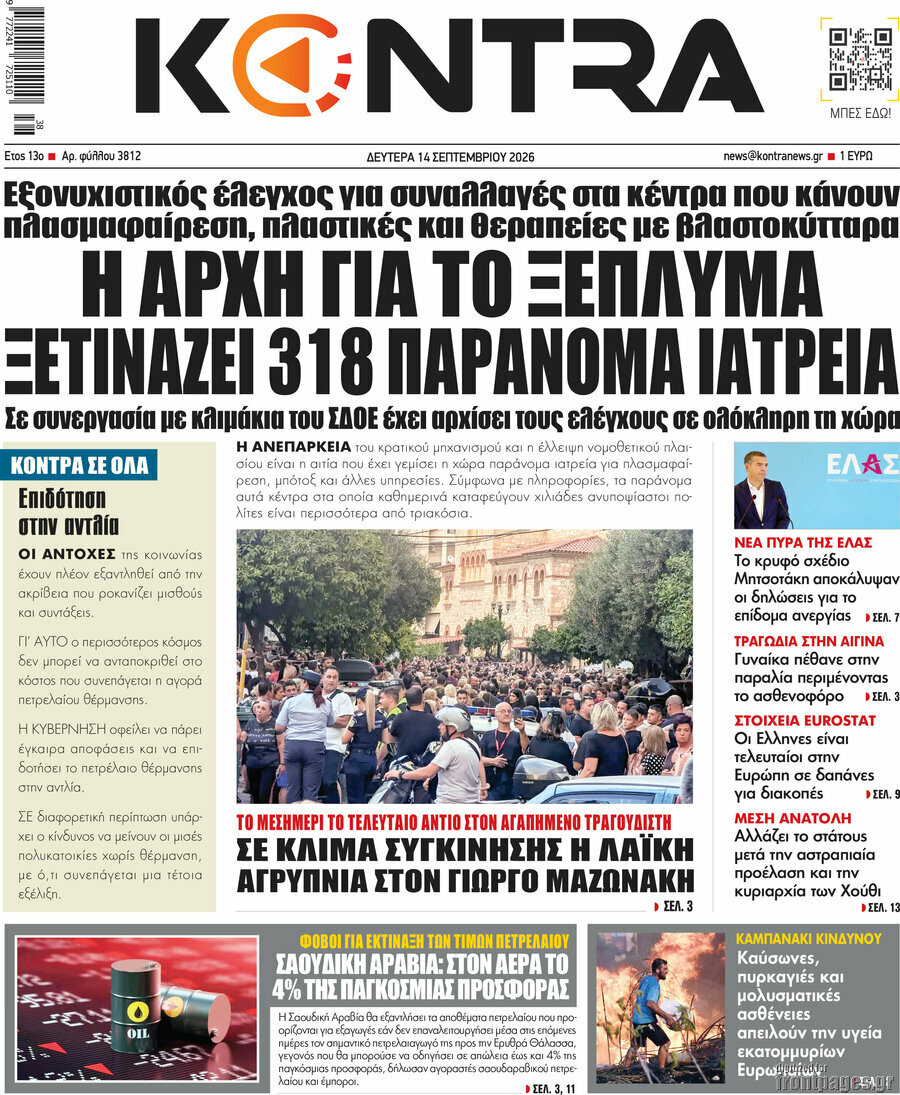
KONTRA NEWS: Authority against Money Laundering places 318 illegal doctor offices under scrutiny
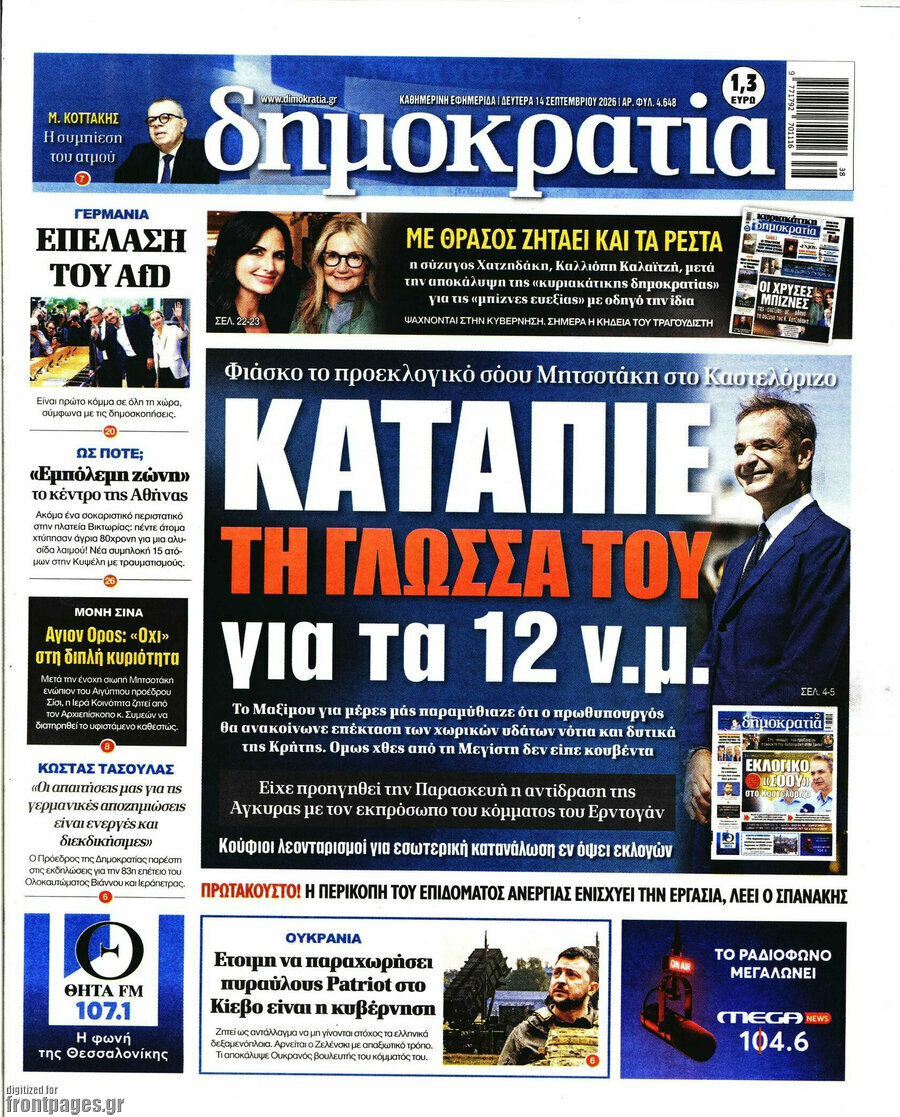
DIMOKRATIA: The PM did not say utter a single word about the 12 nautical miles during his visit in Kastellorizo
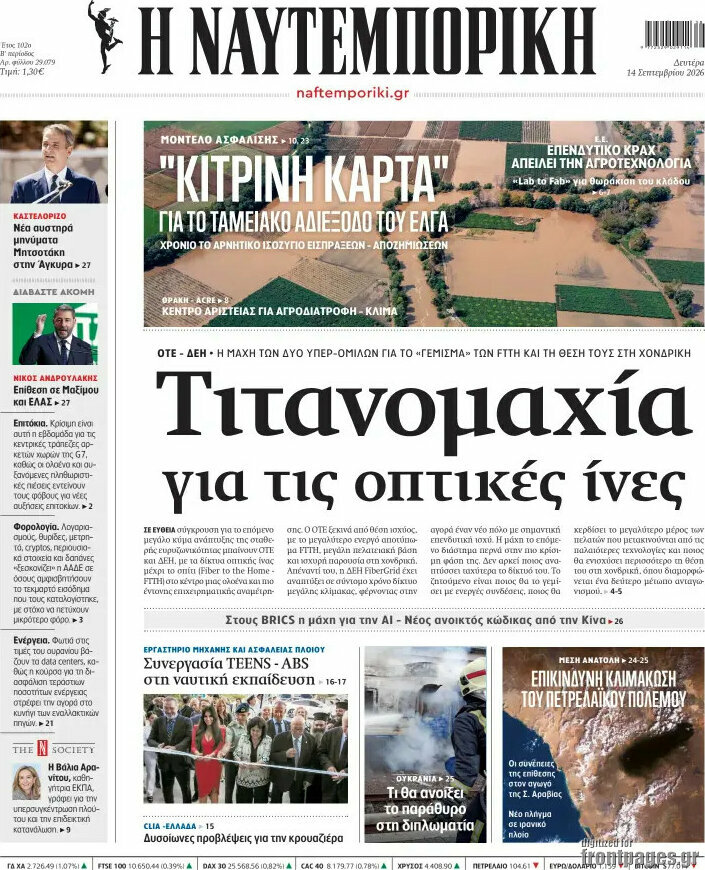
NAFTEMPORIKI: OTE-PPC: Clash of the titans regarding fiber optics

DRIVING THE DAY
BRUSSELS TAKES ON “WEAPONIZED” MIGRATION: The European Commission is weighing legal measures to help EU countries respond faster to sudden arrivals of large numbers of migrants, including coordinated returns of groups of people, three EU officials and diplomats told Playbook.
The plans, which could be trailed in Ursula von der Leyen’s State of the Union speech Wednesday, are a response not just to the crisis in the Spanish exclave of Ceuta but also recent cases of deliberate or “weaponized” migration into Baltic states via Belarus, the officials said.
The push is part of a broader Commission effort to show that it’s tightening control over irregular migration as right-wing parties gain ground. The Berlaymont points to falling asylum numbers, a beefed-up EU border force and fast-tracked talks on boosting the EU’s partnership with Morocco.
Von der Leyen floated the “one grouped return” initiative at a lunch with EU ambassadors on Friday and received “generally positive vibes” from the room, per one diplomat, granted anonymity to speak frankly about the confidential meeting.
The Commission would provide legal guidance on when countries could temporarily suspend asylum applications in certain circumstances. “We can provide the legal texts and interpretations, but the member states decide what they want to do,” an EU official said.
But there’s a legal risk: The diplomat warned the plan could become a “legal nightmare” if it breached the principle of “non-refoulement” — the rule barring states from sending people to places where they could face serious harm.
The EU official said countries could invoke the Geneva Convention, which allows states to protect their borders from “invasion,” adding “there are court cases ongoing in Lithuania on this point.”
Von der Leyen is also expected to cite falling asylum applications, promote deals with non-EU countries and revive calls to triple the staff of the EU’s border agency, Frontex, the diplomats said.
Here again, there could be opposition: “Von der Leyen floated to basically expand the border force to 30,000,” added the diplomat cited above. “There’s quite a lot of skepticism about this … You’d have to pull people off national border forces.”
Amid the tub-thumping, the EU’s Dublin system risks breaking down, a second diplomat warned. The rules generally make the country of first entry responsible for an asylum claim — and require it to take back applicants who move elsewhere. The diplomat accused Italy of flouting them. “A lot of people are very concerned.”
The bottom line: Though asylum numbers are down, the political pressure on migration is still sky-high. “We have to be clear that migration is still a top issue for people,” European People’s Party chief Manfred Weber said in a statement ahead of the speech.
BIG AND BREAKING
THE EU’S CANADIAN GOODIE-BAG: Officials are weighing how to pull Canada closer into Brussels’ economic and security orbit ahead of Mark Carney’s arrival as a guest at this year’s SOTEU, Playbook’s Max Griera, Gabriel Gavin and Gerardo Fortuna write.
More on Carney’s visit: The Canadian PM said last night he wants a “unique alliance” with the EU, not membership, after the WSJ reported earlier Sunday that Canada was seeking “associate member” status … and the FT says Ottawa is considering backing an EU loan for Ukraine as part of the diplomatic dalliance.
HOW TO WRITE A SOTEU: The contents of the Commission president’s big set-piece speech in Strasbourg are a closely guarded secret, but Gabriel has pulled back the curtain on how it comes together in a must-click story this morning.
RATING LAST YEAR’S PLEDGES: A year after von der Leyen touted what she called the EU’s “independence moment,” Brussels has turbocharged its efforts on tech, defense and trade — but it remains heavily dependent on foreign partners, Gerardo reports.
LAST-MINUTE SANCTIONS PUSH: Ambassadors are keen to roll over the EU’s Russia sanctions listings before they expire Tuesday, but Slovakia is pushing back on key parts — and France has now also weighed in, taking “everyone by surprise,” per one diplomat. (More in Morning Trade for subscribers.)
PARTING GIFT: Donald Trump announced he’ll remove the 10% U.S. tariff on Irish whiskey as he presented the Irish Open trophy at his golf resort in Doonbeg last night.
ARCTIC STRATEGY
EUROPE GOES NORTH: What are European Council President António Costa, EU foreign policy chief Kaja Kallas, International Partnerships Commissioner Jozef Síkela and a bunch of European leaders doing in Rovaniemi — Finland’s official hometown of Santa Claus — in September?
Not getting a head start on Christmas … but rather putting the finishing touches to the EU’s Arctic strategy.
Who’s there: The European Arctic Summit gets underway today, following a working dinner last night hosted by Finnish Prime Minister Petteri Orpo. Among those attending: Germany’s Friedrich Merz, Denmark’s Mette Frederiksen, Romania’s Nicușor Dan and leaders from the Baltics.
The High North has shot up Brussels’ agenda — something Ursula von der Leyen underscored during her visit to Greenland last week. And it’s not just geopolitics: Around half a million EU citizens live in the Arctic region, while security, critical raw materials, connectivity and climate are all increasingly part of the equation.
Expect a show of force: Today’s program includes a visit to the Lapland Air Wing and a military demonstration while leaders are expected to commit in a statement to keeping the Arctic a region of peace and stability — while acknowledging Russia as a long-term threat to Euro-Atlantic security.
“The Arctic is on the front line of global power competition,” the bloc’s top diplomat Kaja Kallas told Playbook, pointing to new shipping routes and an increasingly assertive Russia and China. “We must devote sufficient funds, forces and focus to the region.”
A hint is in the name: The unveiling of the Commission’s revamped Arctic strategy is penciled in for Oct. 20 — but the strategy is already getting a broader label. “Northern Neighborhood” will be added to the title, reflecting Brussels’ push for closer engagement with partners including Greenland, Iceland, Norway and Canada.
Speaking of partners … The EU’s goal in Rovaniemi is to get a final reality check from the countries most exposed to developments in the region before the strategy lands. Síkelatold Playbook the summit is “a unique opportunity to gather input from top European leaders” and turn the EU’s offer into “a more strategic, more focused and more visible presence in the region.”
The Arctic is expected to feature prominently in von der Leyen’s State of the Union on Wednesday, potentially offering a preview of what’s coming in October.
That could make the speech worth watching for another reason. Kallas’ team has done much of the work on the Arctic file. If Ursula unveils a big Arctic initiative from the Strasbourg stage, watch who gets the credit.
20-SECOND PLAYBOOK PRIMER
On Wednesday, Ursula von der Leyen gives her State of the Union speech. But how long has this annual tradition existed? The first such speech was given in 2010 by José Manuel Barroso, with the idea being that the Commission president reviews the achievements of the past year and outlines the priorities for the forthcoming one. Von der Leyen will this week deliver her sixth State of the Union speech (there wasn’t one in 2024, the year of the last EU election).
LABOUR MOBILITY
ON THE MOVE: The Commission will tomorrow unveil the Fair Labour Mobility Package, designed to make it easier for people to work across borders while giving national authorities more tools to crack down on fraud, exploitation and bogus paperwork. The Commission will shoulder most of the up-front costs of implementing the package, with the aim of ultimately generating substantial savings for governments, workers and employers by cutting administrative burdens, an official told Zoya Sheftalovich.
Among the proposals is a skills portability initiative to make it easier to take qualifications with you across the EU. That would cut the time authorities have to assess qualifications for those in regulated professions — such as doctors, nurses, architects and civil engineers — from 120 days to 30, the Commission official said.
There’s also a new European Social Security Pass. Workers and employers could request documents such as the European Health Insurance Card and unemployment forms online, store them in the EU Digital Identity Wallet and have them verified instantly. The idea is to make life easier for the roughly 14 million EU citizens living in another member country and 2 million cross-border workers — and harder for fraudsters.
The European Labour Authority will get a stronger role coordinating cross-border inspections, helping crack down on businesses that are exploiting workers.
6 MORE THINGS GETTING US TALKING
GERMANY’S TOMAHAWK PLAN: Germany’s defense ministry will earmark nearly €3.4 billion to buy U.S.-made Tomahawk cruise missiles and Typhon launchers, according to an internal government planning document seen by POLITICO.
DRUG DEAL: Germany is exploring a potential drug pricing proposal with the Trump administration in a bid to avoid new U.S. tariffs.
NEW PLENARY RULES: The European Parliament is implementing new rules for plenary sessions today with an eye to “making them more lively,” per a Parliament official — including allowing Council and Commission officials to intervene more freely and ending debates earlier.
REVIVING EUROPE’S SPIES: With Russia stepping up its campaign of hybrid sabotage and China intensifying its espionage activities, Europe’s largely dormant intelligence agencies are being given new powers to protect national interests, Antoaneta Roussi reports.
LEIPZIG SUSPECTS: German security authorities have identified a Belarusian citizen and a Russian national linked to the country’s military intelligence services as the main suspects in the failed drone attack on Leipzig-Halle airport last month, Welt reports. (Welt is owned by Axel Springer, POLITICO’s parent company.)
IT’S COMING FROM INSIDE THE HOUSE: The biggest threat to the EU is not external but comes from the domestic politics roiling Germany and France, former Belgian Prime Minister and former European Council President Herman van Rompuy said at an event in Brussels on Saturday, Seb Starcevic reports.