
A challenge to Greece’s East Med policy
The recent ratification of the Turkish-Libyan memorandum delineating zones of maritime influence by the once reticent Libyan parliament represents a major challenge to Greek policy in the Eastern Mediterranean, and Greece is trying to find ways to blunt its effects. The Turkish-Libyan maritime zone delineation is widely viewed as illegal, given the two countries are not neighbors: Egypt and Greece stand in the way. That is, unless one accepts the Turkish arguments that islands do not possess a continental shelf or territorial waters, something that almost every other nation rejects. What concerns Athens mostly in the short term is the fate of the Great Sea Interconnector (GSI) project that will link the power grids of Greece and Cyprus and, eventually, Israel. Turkey has attempted to scupper GSI and maintains its tough stance. It considers the whole sea expanse from the western coast of Cyprus to the eastern coast of Crete part of its continental shelf.
https://www.ekathimerini.com/politics/foreign-policy/1319239/a-challenge-to-greeces-east-med-policy
State Department: Ratification of Turkish-Libya memorandum ‘unhelpful and provocative’
The U.S. State Department has described the announcement of the ratification of the Turkish-Libyan memorandum as “unhelpful and provocative”, noting that it has heightened tensions in the region and stressing that Washington’s position on the issue remains unchanged. “We encourage all countries, including partners in the Eastern Mediterranean, to resolve maritime disputes through good-faith negotiations and avoid any provocative behaviour. Greece and Turkiye are both NATO allies. We encourage them to engage bilaterally to address any areas of disagreement. The peaceful resolution of such disputes paves the way for commercial investment and exploration that will benefit the entire region,” the State Department said.
Sinai archbishop agrees to sign deal with Egyptian government
Egypt and the monastery at Mount Sinai have tentatively agreed on a deal aimed at protecting the ancient institution and averting a court ruling that could further threaten its property rights. The agreement, outlined on Friday after months of uncertainty and weeks of intense negotiations, seeks to safeguard the monastery’s autonomy while recognizing the application of Egyptian law and court decisions to its external affairs. Under the proposed terms, Egypt would recognize the monastery’s right to govern its internal affairs, including the admission of monks, the election of its archbishop and its administration.
Bakery chain owner arrested on tax-fraud, sex-crime allegations
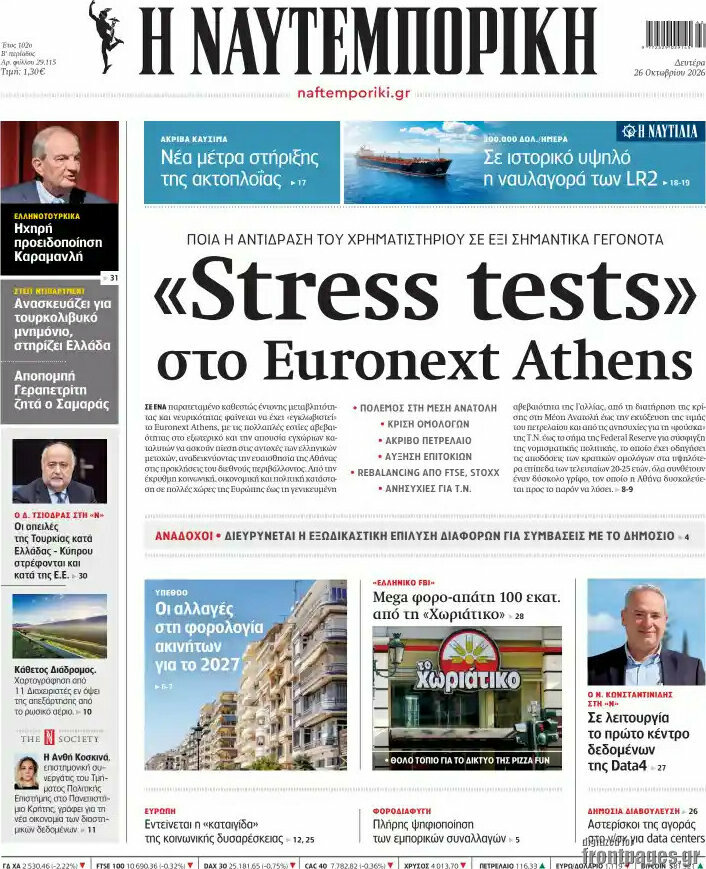
Police have arrested the owner of a Greek bakery chain as part of a months-long investigation by organized-crime authorities into alleged tax fraud estimated to have cost the state more than €100 million. Aggelos Giannakopoulos, owner of the Horiatiko bakery chain, was arrested along with an unspecified number of other suspects, including the company’s head accountant, police announced on Sunday. The accountant is suspected of having played a key role in the alleged criminal organization under investigation. According to sources, the case file includes suspected offenses involving the formation of a criminal organization, fraud against the state, tax evasion, and the non-payment of VAT and social security contributions. The investigation, launched in January by the Directorate for Combating Organized Crime, widely known as the “Greek FBI,” has also examined alleged links between the businessman and cases involving pimping and human trafficking, according to the same sources.
ATHEX: Benchmark, banks sink to 3-month low
The Euronext Athens (ATHEX) general index closed Friday at 2,530.46 points, shedding 2.22% from Thursday’s 2,587.93 points. On a weekly basis it declined 3.18%.
https://www.ekathimerini.com/economy/1319185/athex-benchmark-banks-sink-to-3-month-low


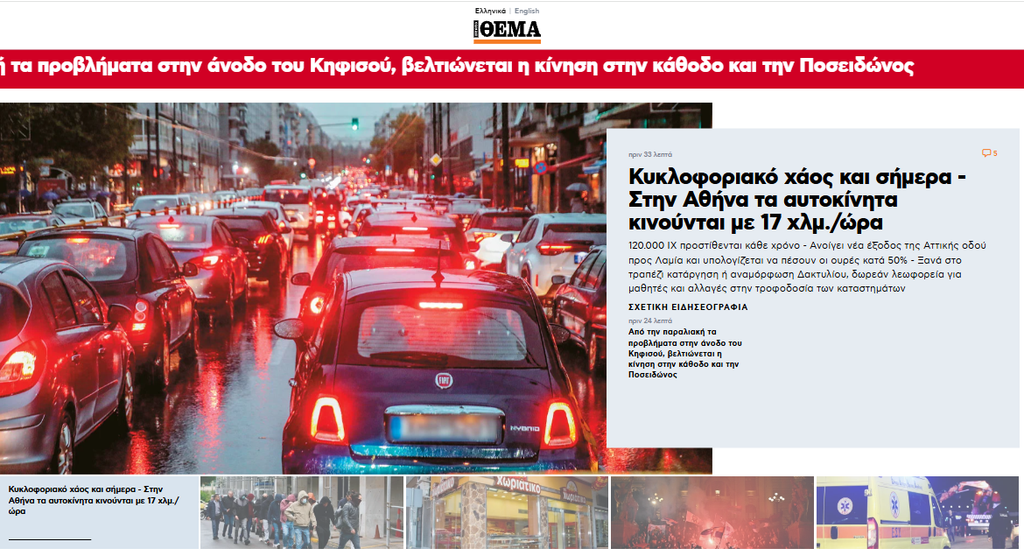
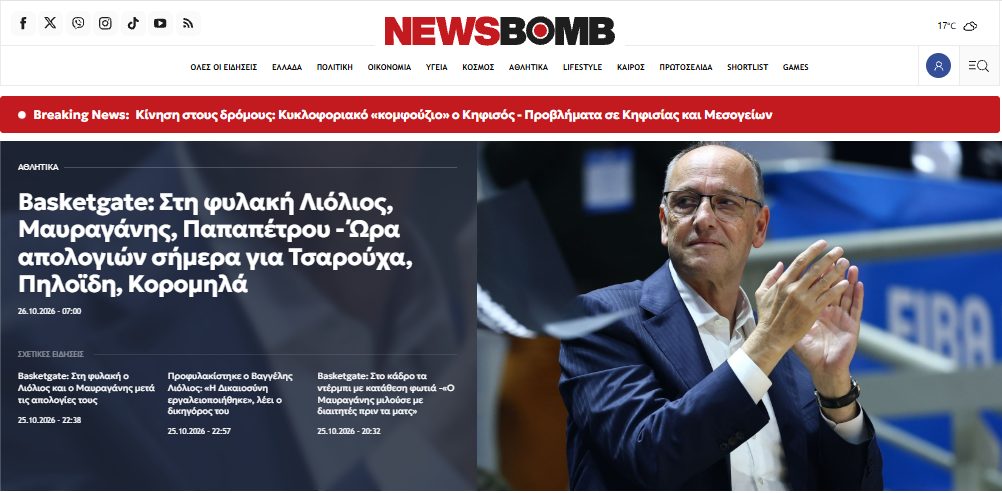
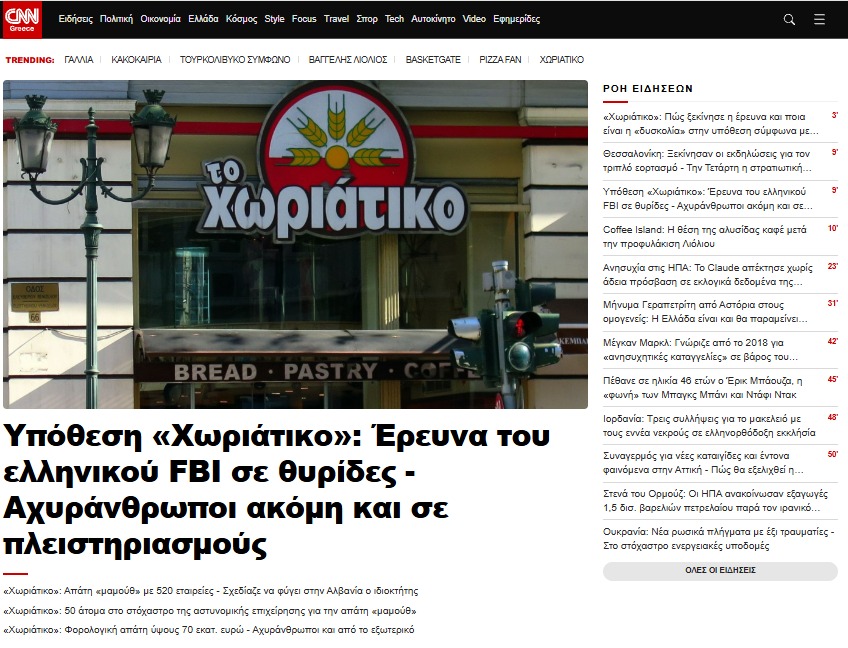
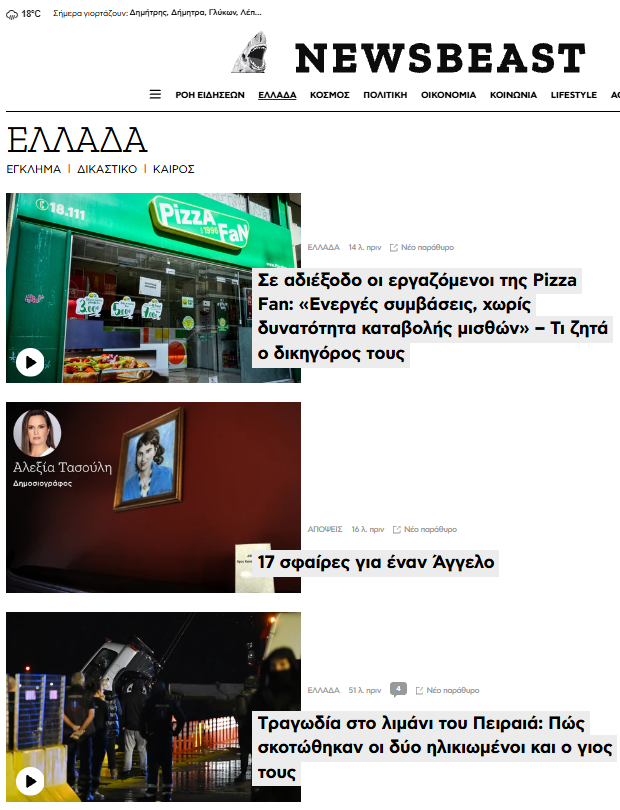

SUNDAY PAPERS
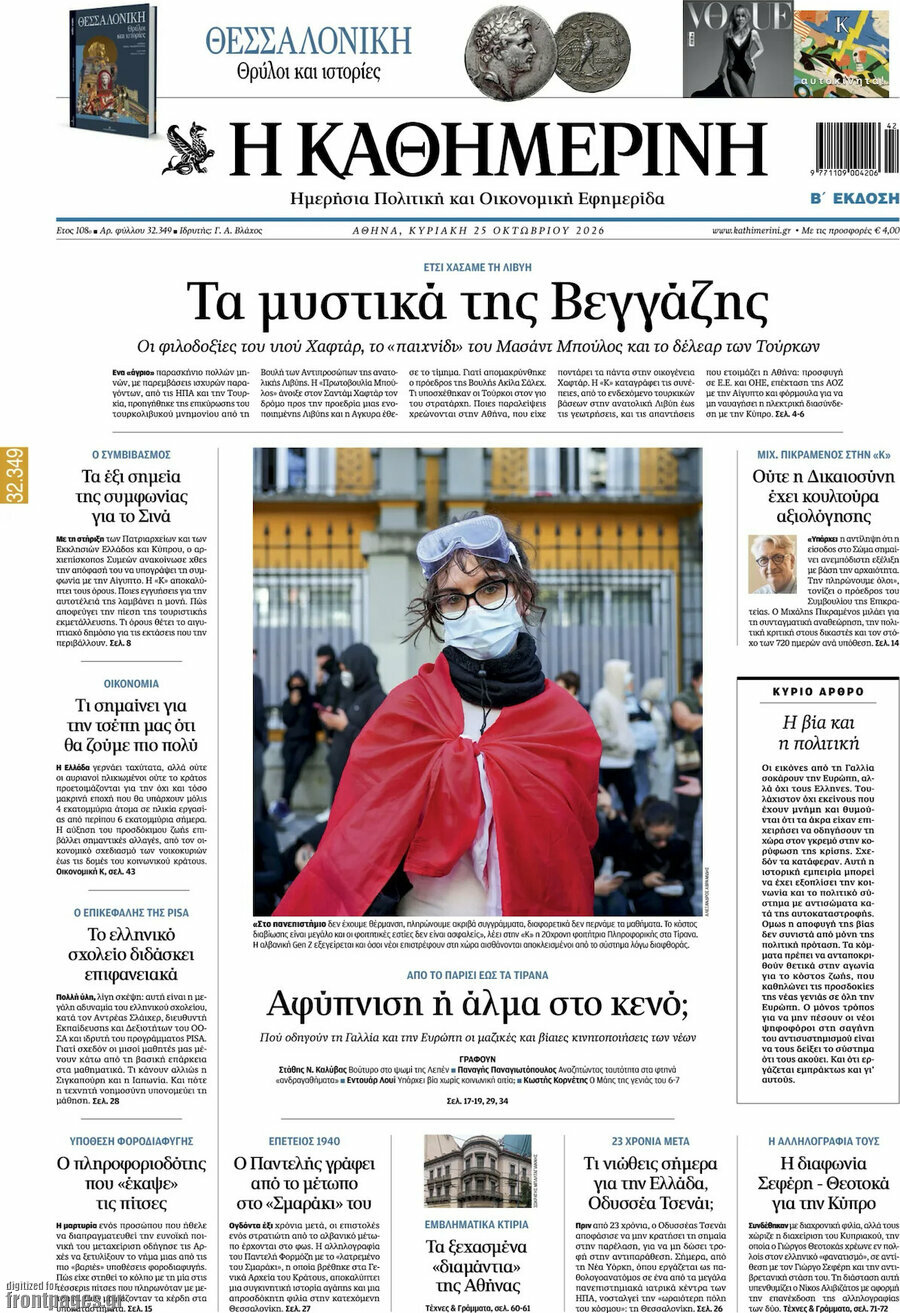
KATHIMERINI: The secrets of Benghazi
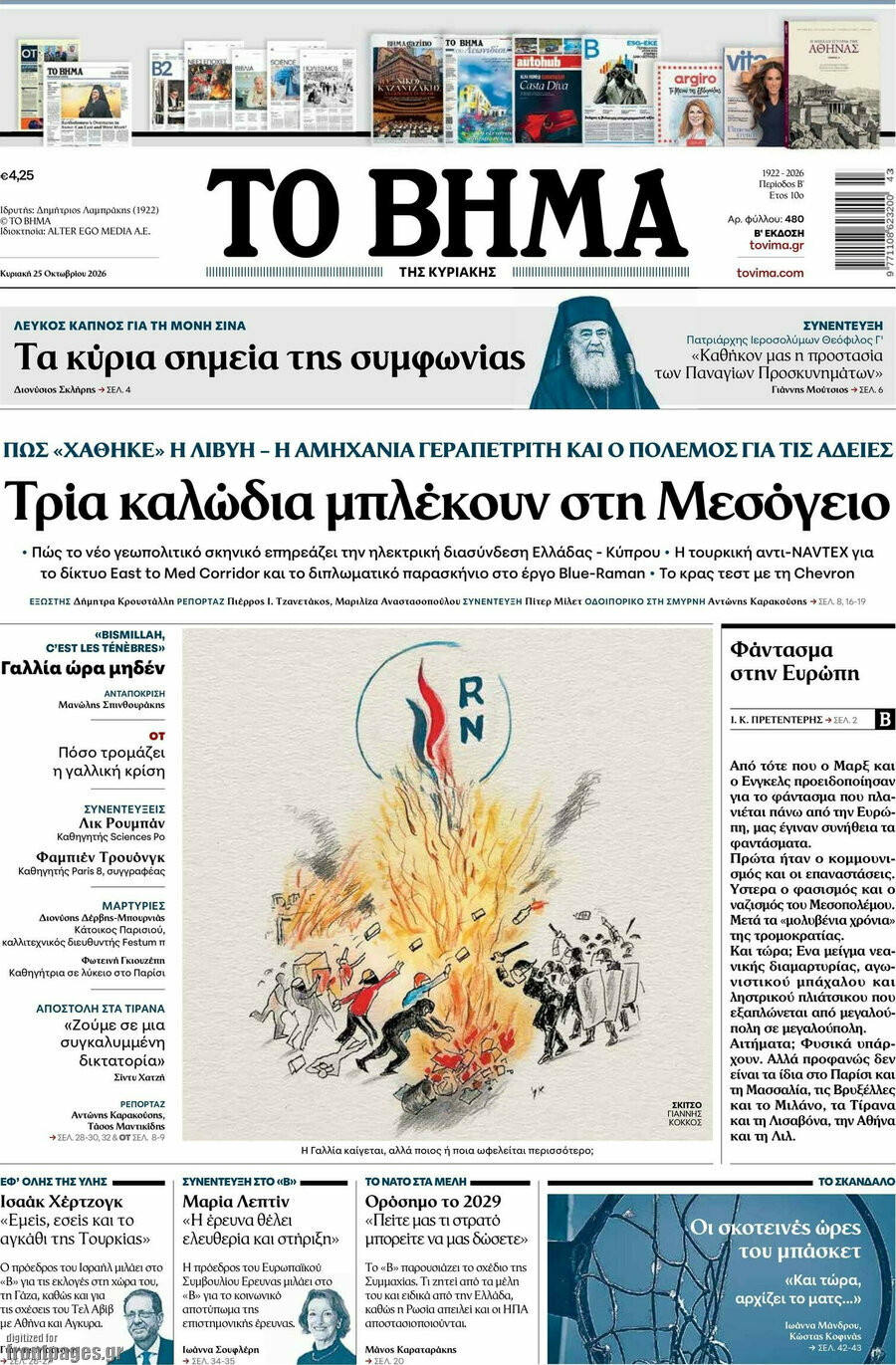
TO VIMA: Three cables entangled in the Mediterranean
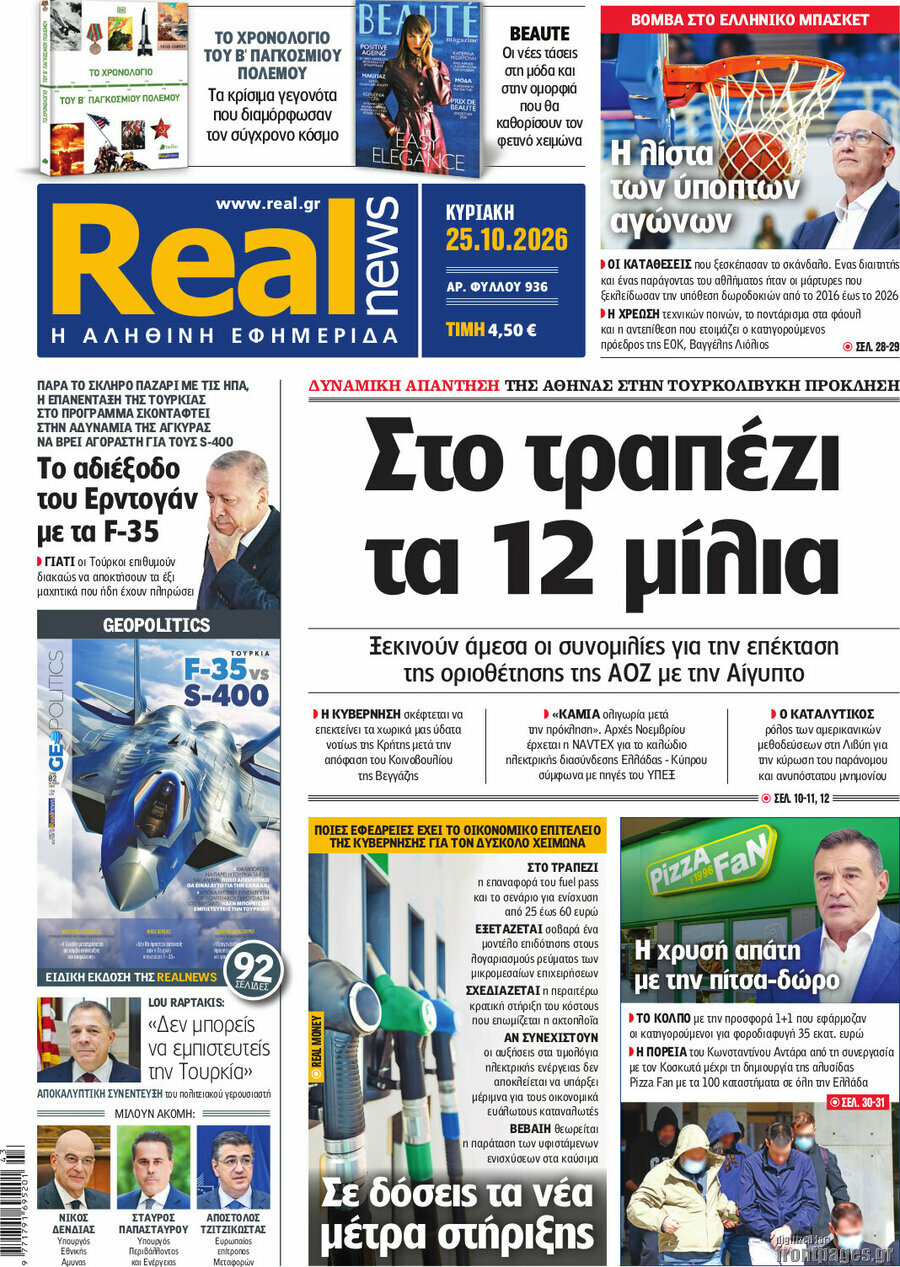
REAL NEWS: 12 nautical miles under discussion
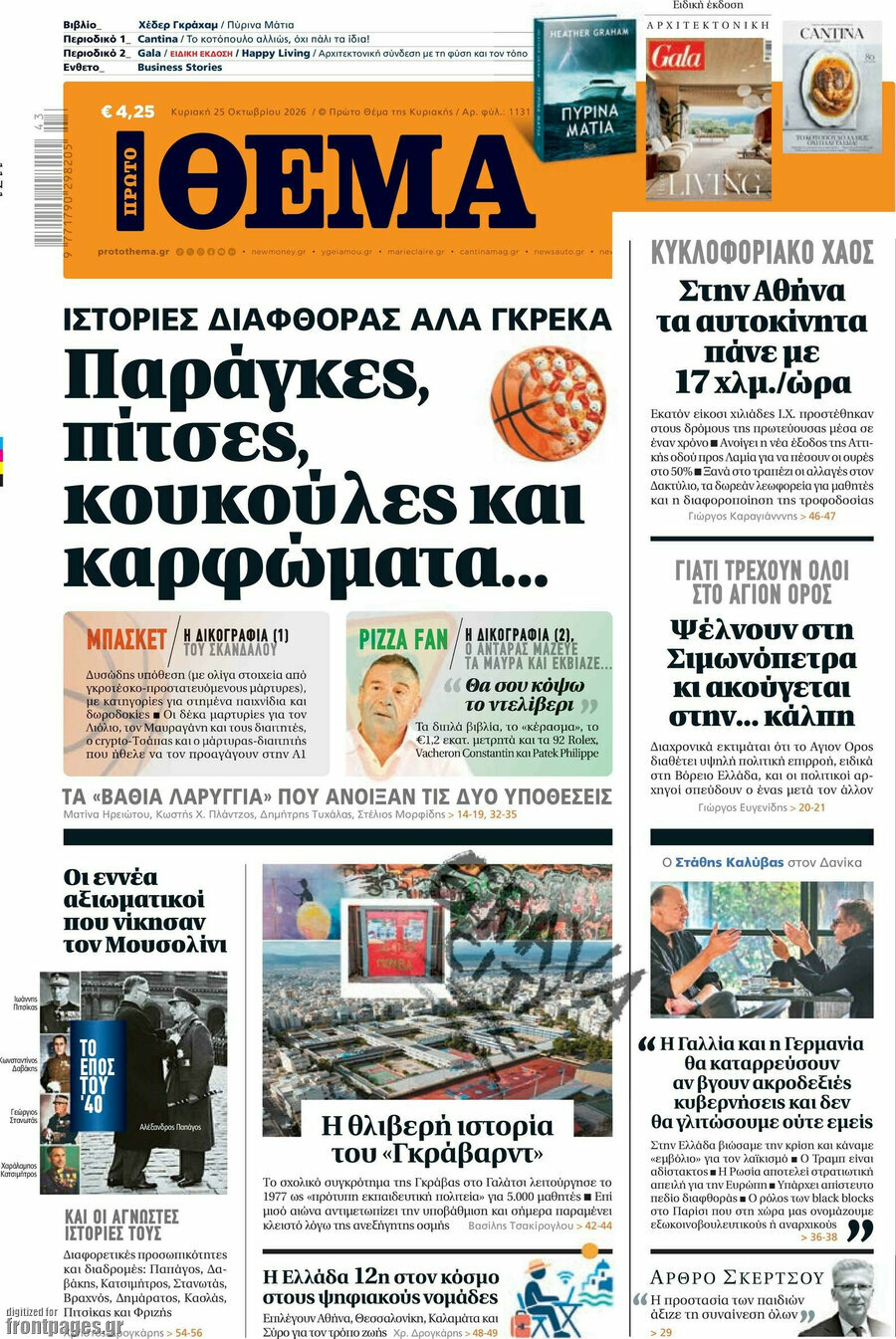
PROTO THEMA: Greek corruption stories: fixed basketball games, pizzas, hoods and snitching…
MONDAY PAPERS:
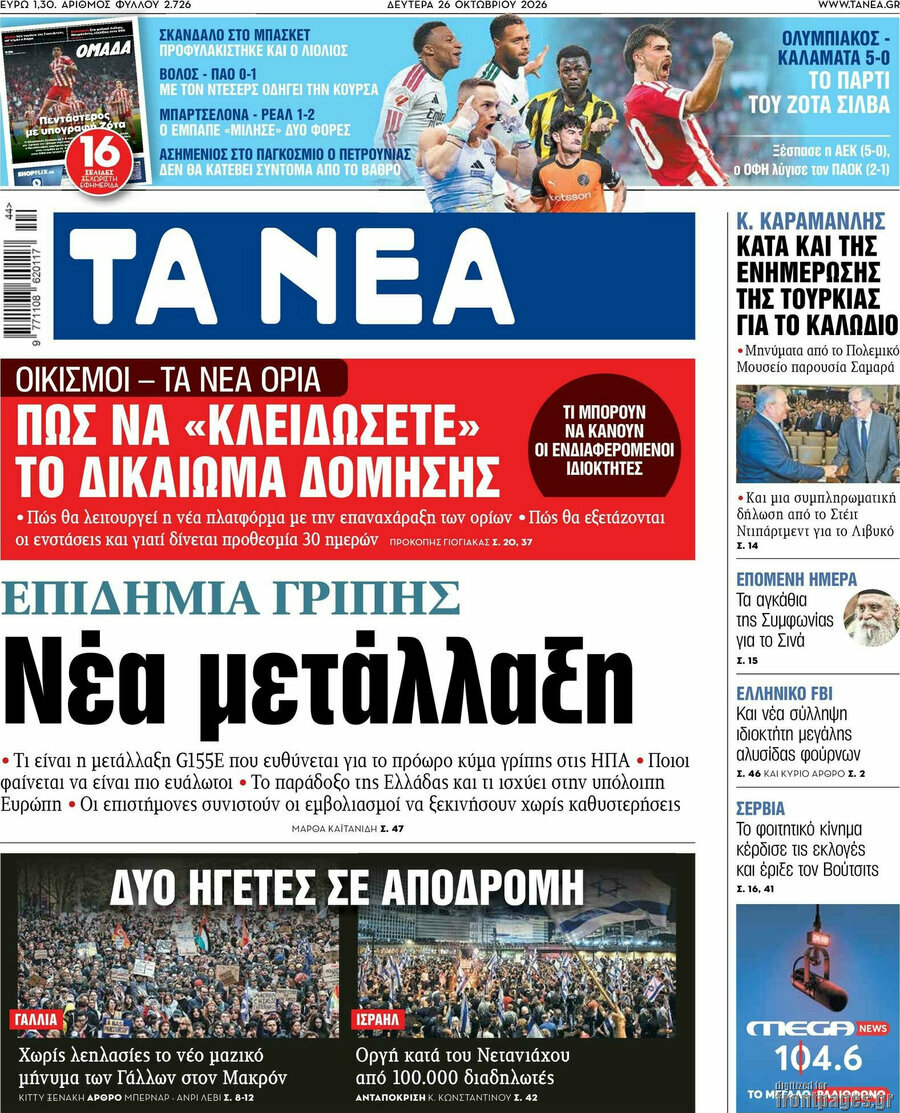
TA NEA: Flu epidemic: new variant
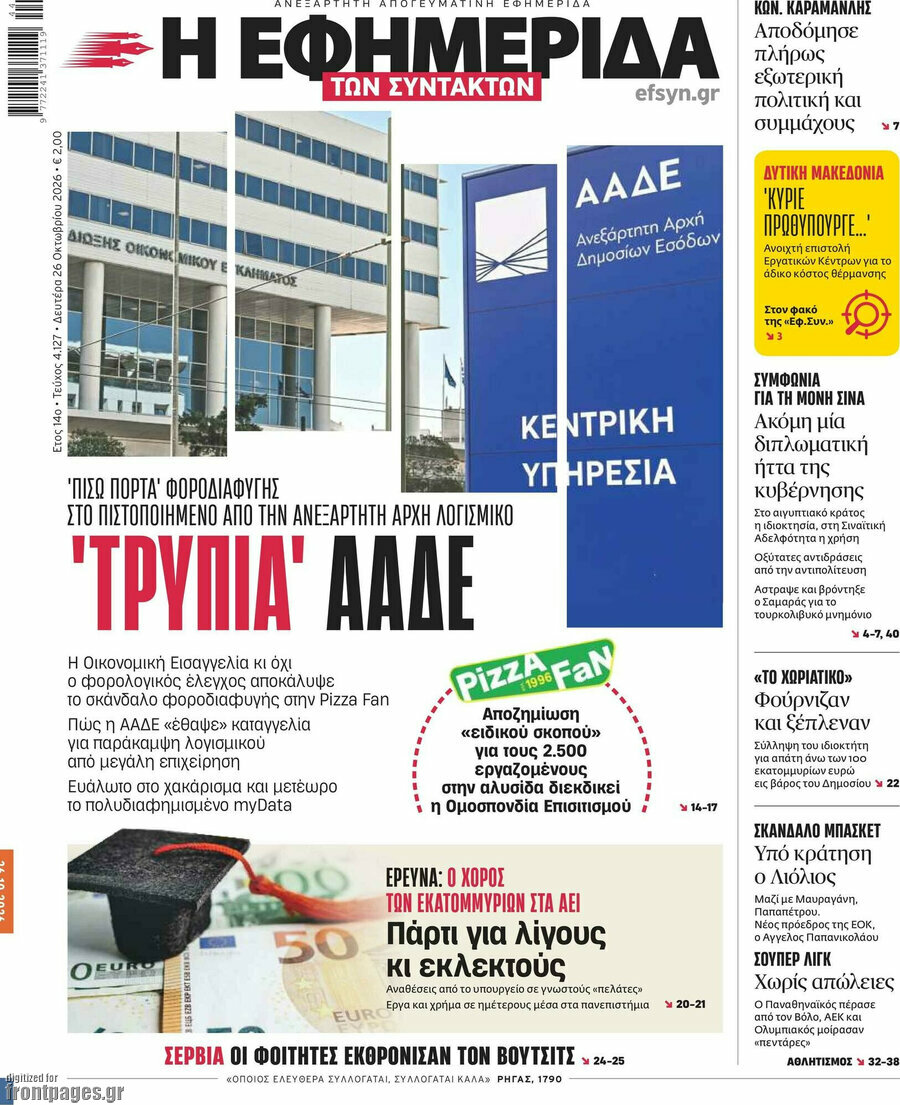
EFIMERIDA TON SYNTAKTON: Independent Revenue Authority (AADE) has a software with a tax-evasion “back-door”
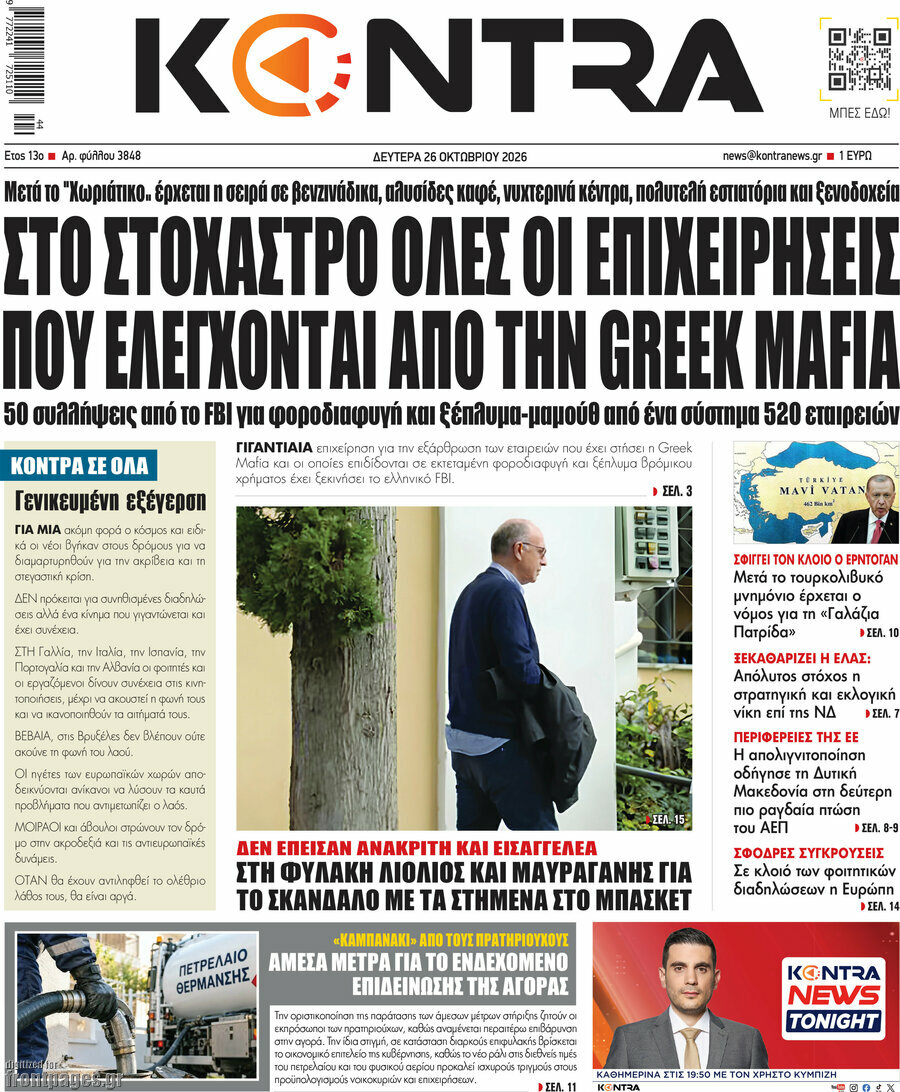
KONTRA NEWS: All businesses controlled by the Greek Mafia are being targeted
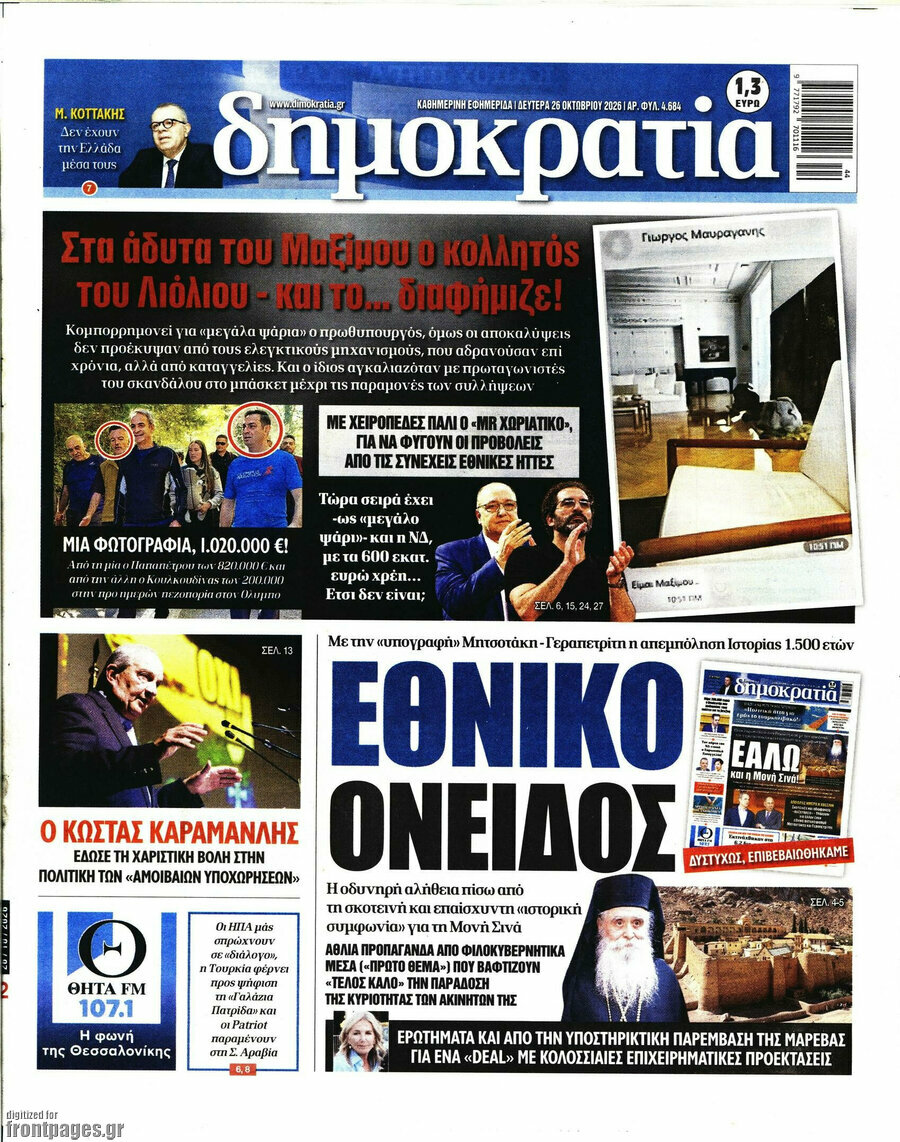
DIMOKRATIA: National shame regarding Mount Sinai monastery
NAFTEMPORIKI: “Stress test” for Euronext Athens

DRIVING THE DAY
UKRAINE COLLIDES WITH THE BUDGET TALKS: EU leaders are preparing to seek a deal on a roughly €45 billion support package for Ukraine by the end of this year, according to five EU diplomats and officials who spoke to me and Bjarke Smith-Meyer.
The potential loan, which would be guaranteed by the current EU budget, has emerged in recent weeks as the most likely scenario for Europe to meet Ukraine’s financial needs in 2027. The EU has also been trying to garner more contributions from other allies such as Canada and the United Kingdom, while Belgium continues to oppose the use of immobilized Russian assets to help Ukraine.
But the push for the support package — which would amount to about two-thirds of the €70 billion requested by Ukrainian President Volodymyr Zelenskyy — coincides with difficult talks about the EU’s next long-term budget. And it will likely aggravate tensions between countries that provide the bulk of support for Ukraine and those that contribute comparatively little.
Not for us, thanks: Countries that previously opted out of the EU’s last major loan for Ukraine — a €90 billion package agreed last December — are signaling they plan to do so again. The leaders of Czechia and Slovakia indicated at this month’s European Council that they wouldn’t take part in the loan, and Hungary is also likely to opt out, two of the diplomats said. The diplomats were granted anonymity to discuss the sensitive plans.
 |
The cost of opting out: Ukraine’s biggest backers in the bloc warn that they might be less inclined to support demands from the so-called “Friends of Cohesion” group pressing for a larger EU budget if some of those countries don’t show solidarity with Kyiv.
“How can anyone seriously believe that our taxpayers would be willing to send even one more euro in cohesion funds to those who refuse to take part in defending against the greatest threat to the security of us all?” a German diplomat told my colleague Hans von der Burchard.
But another EU diplomat argued that the EU needs to find a way to fund Ukraine and to ensure the cohesion funds that many countries in the bloc depend on. “Politically, it would not be easy to explain that we have found money for Ukraine but we had to proceed with massive cuts in EU policies for Europeans,” that diplomat said. “It would be better to fund both.”
When to watch: The question of how exactly to structure the potential new loan for Ukraine will be on the table when leaders gather on Nov. 26, with the European Commission expected to lay out the different options in a paper. The size of any support package is likely to fluctuate depending on how much help Ukraine gets from NATO allies, how much can be mobilized from existing EU funds and how much military aid (particularly missile interceptors) Kyiv can secure.
BIG AND BREAKING
THE SICKEST MAN OF EUROPE: After two weekends of mass protests marred by episodes of violence, France is being dragged into a vicious cycle of fiscal and social crises. The EU’s second-biggest economy is “on the brink of a financial crisis,” former Prime Minister Michel Barnier tells my colleagues Giorgio Leali and Clea Caulcutt in Paris.
Philippe slips: Centrist former PM Edouard Philippe is losing ground to far-left challenger Jean-Luc Mélenchon in the French presidential race, according to polling conducted exclusively for POLITICO. Marine Le Pen remains comfortably in the lead.
SEATS AT THE TABLE: The EU will be represented at the next Ukraine talks by the Commission and Council, per Commission spokesperson Arianna Podestà and another EU official. Diplomats raised eyebrows when only von der Leyen’s chief of staff Björn Seibert was present in Miami and Oslo, leaving António Costa’s top aide Pedro Lourtie out in the cold.
FUNDING FLOWS AGAIN: Norway will resume funding Hungary via the EEA and “Norway grants,” to the tune of €254.1 million for the 2021-2028 period, after payments were suspended for a decade amid disagreements over human rights with the government of former PM Viktor Orbán. “In reality, we can have payments all the way until 2031 because this has been delayed,” Norwegian Foreign Minister Espen Barth Eide told Playbook.
Don’t tell Donald Trump: The U.S. president slammed Norway as a “shithouse country” at a campaign rally in Michigan last night. He’s fuming that he hasn’t yet been awarded the Nobel Peace Prize.
THE MYSTERY OF THE MISSING REPORT
LACKING FORESIGHT: A report intended to help the EU prepare for a more dangerous future appears to have an uncertain future of its own, with four officials telling Sebastian Starcevic it has been delayed with no publication date in sight.
Geopolitical laundry list: European Commission President Ursula von der Leyen launched the Strategic Foresight Report in 2020 at the height of the Covid-19 pandemic to take stock of the various challenges facing the EU. The document, published annually, tracks the long-term forces shaping the bloc — from climate and technological change to geopolitical upheaval — and shapes policy priorities.
But the 2026 edition has yet to be seen.The report, helmed by Youth Commissioner Glenn Micallef,was last on the College agenda in July and has not surfaced since. It was supposed to be published around the time of von der Leyen’s State of the Union speech in September, one of the officials said.
Open question: The report will be published “in the following months,” a Commission spokesperson told Playbook. They didn’t specify a date or confirm whether the report is still set to be officially adopted by the College or whether it has been downgraded in importance.
More open questions: EU officials who spoke to Playbook offered varying explanations for the holdup, ranging from delays within the cabinet to more important files taking precedence. The Commission spokesperson didn’t give a reason for the delay.
20-SECOND PLAYBOOK PRIMER
Christine Lagarde is expected to leave her role as president of the European Central Bank ahead of time. She also sits on the ECB’s six-person executive board … but who else is on it and what does it do? The board sets the agenda for Governing Council meetings (which define monetary policy for the euro area and set key interest rates) and manages the day-to-day running of the ECB. It currently consists of Lagarde, Vice President Boris Vujčić and four other ECB members.
PARLIAMENT DEBATES IMMUNITY RULES
OUT OF PUBLIC VIEW: The European Parliament is weighing whether to anonymize immunity proceedings to shield lawmakers under investigation from public scrutiny, three people familiar with the discussions told Max Griera. The proposal is part of an overhaul of how the Parliament handles requests from prosecutors seeking to investigate MEPs.
Under existing rules, once the Parliament receives an immunity waiver request from law enforcement, President Roberta Metsola announces it — including the name of the lawmaker under question — at the next plenary session. Some MEPs want the announcement to take place only after the legal affairs committee has decided to lift the immunity, while deleting any names from the agendas and minimizing internal documents to avoid leaks.
Past controversy: In 2025, Belgian authorities submitted and then withdrew a request to waive the immunity of MEP Giusi Princi in the space of 24 hours. In 2026, the prosecutor wrongly accused MEP Daniel Attard of receiving payments from Chinese bank accounts after mixing him up with a businessman of the same name.
But there could be a cost to shielding MEPs. Anonymizing lawmakers under investigation risks leaving the public “completely in the dark,” said one of the people familiar with the plans, granted anonymity to speak about the proposal.
The push comes amid broader anger around perceived politicization of immunity proceedings, after years of political groups horse-trading over the protection of MEPs. EPP lawmakers voiced frustration at a group meeting in September about the lifting of MEP Matej Tonin’s immunity. The ongoing reforms are intended to “better protect MEPs,” a senior lawmaker said at that meeting, according to internal minutes obtained by Playbook.
3 MORE THINGS GETTING US TALKING
COMPETING VISIONS: Canada wants to create an alliance of so-called middle powers with the European Union … but the EU doesn’t see itself as a middle power at all, Zi-Ann Lum, Sebastian Starcevic and Camille Gijs write.
GREEN GOALS UNDER THREAT: The ECB’s commitment to green finance is likely to be tested if Christine Lagarde leaves Frankfurt early, Johanna Treeck reports.
SATELLITE DILEMMA: A proposed space merger hailed as a potential European “champion” could drive up costs as the bloc builds its own secure satellite communications, Francesca Micheletti and Jacopo Barigazzi report.