
Polls show shifting battle for second place
Former prime minister Alexis Tsipras is poised to establish a new political party, creating strategic challenges for the country’s center-left opposition ahead of upcoming elections, according to recent political assessments. Estimates place Tsipras’ core support at between 8% and 10%, with a potential ceiling of 17-18%, according to sources at both the Prime Minister’s Office and opposition headquarters. The measurements reaching Tsipras’ team show slightly more favorable numbers than those known to the current government.
https://www.ekathimerini.com/politics/1288298/polls-show-shifting-battle-for-second-place
Farmers extend highway blockades
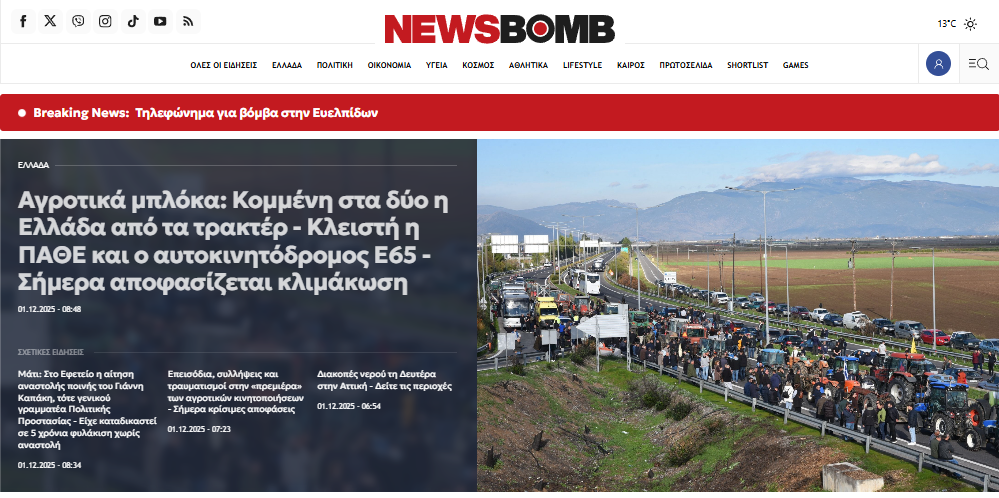
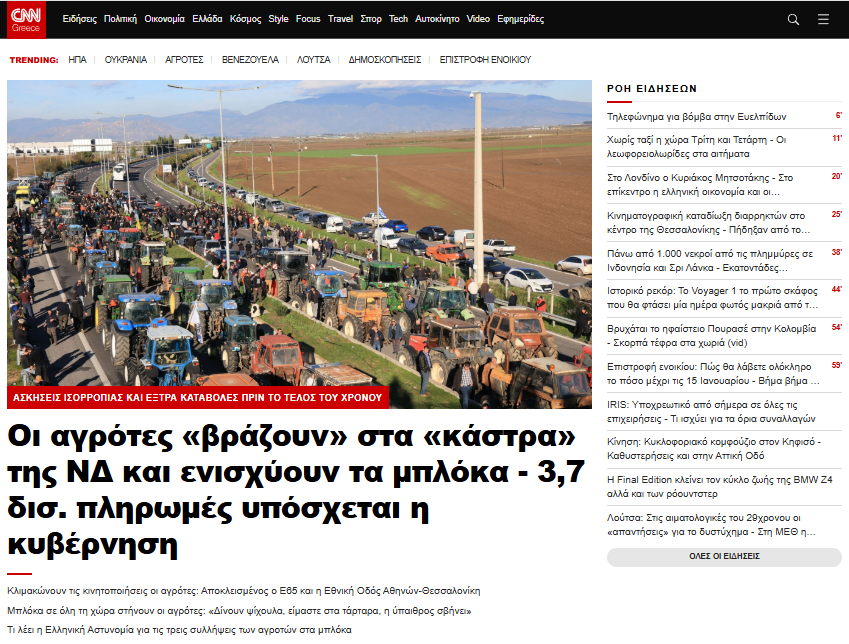
Greece remained effectively cut in two for a second day on Monday as protesting farmers kept the Athens-Thessaloniki national highway blocked near the central city of Larissa. Farmers from Karditsa in western Thessaly also shut the E65 motorway with tractors as part of the same mobilization. Protesters cite severe delays in payments owed by the agricultural payments agency OPEKEPE (the backlog comes amid investigations into an alleged scandal involving falsified land and livestock declarations to obtain EU farm subsidies), along with soaring production costs and persistently low market prices. Farmers say they will maintain their blockades until the government offers concrete solutions.
https://www.ekathimerini.com/economy/1288380/farmers-extend-highway-blockades
Mitsotakis to participate in Morgan Stanley and ASE investment conference in London
Prime Minister Kyriakos Mitsotakis will participate οn Monday, December 1, in the Greek Investment Conference, co-organised by Morgan Stanley and the Athens Stock Exchange in London. At 10:15 local time, the prime minister will join a discussion at the conference with Clare Woodman, Head of Morgan Stanley for Europe, the Middle East and Africa (EMEA), Latin America, and Canada, and CEO of Morgan Stanley & Co. International.
Greece’s Finance Min Pierrakakis announces candidacy for Eurogroup President
Minister of Economy and Finance of Greece Kyriakos Pierrakakis, along with Deputy Prime Minister and Minister of Budget, responsible for Administrative Simplification of Belgium, Vincent Van Peteghem, have put forward their candidatures to become president of the Eurogroup. According to the Council’s announcement, the election of the new president will take place at the next meeting of the Eurogroup on 11 December.
ATHEX: Bourse ends November 4.4% higher
The Greek stock market ended the month of November with whopping growth of 4.41%, despite the losses the benchmark incurred on Friday. The rising course of Athinon Avenue continues as the year is drawing to a close and the final result for 2025 is all but certain to be positive, too. Toward the end of Friday’s session sellers obtained a clear advantage, although mid-caps and a few blue chips resisted the pressure and posted gains.
https://www.ekathimerini.com/economy/1288274/athex-bourse-ends-november-4-4-higher


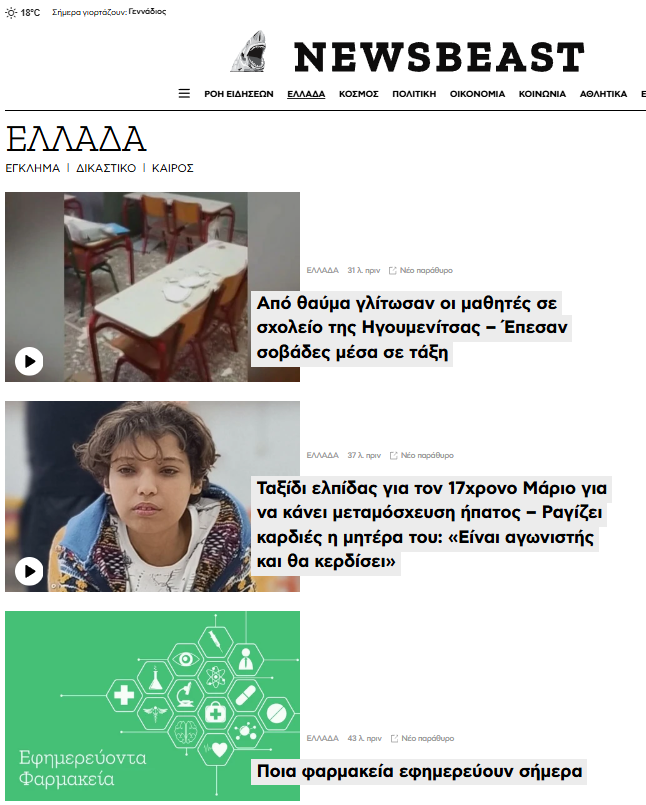

SUNDAY PAPERS
KATHIMERINI: Polls and the battle for second place
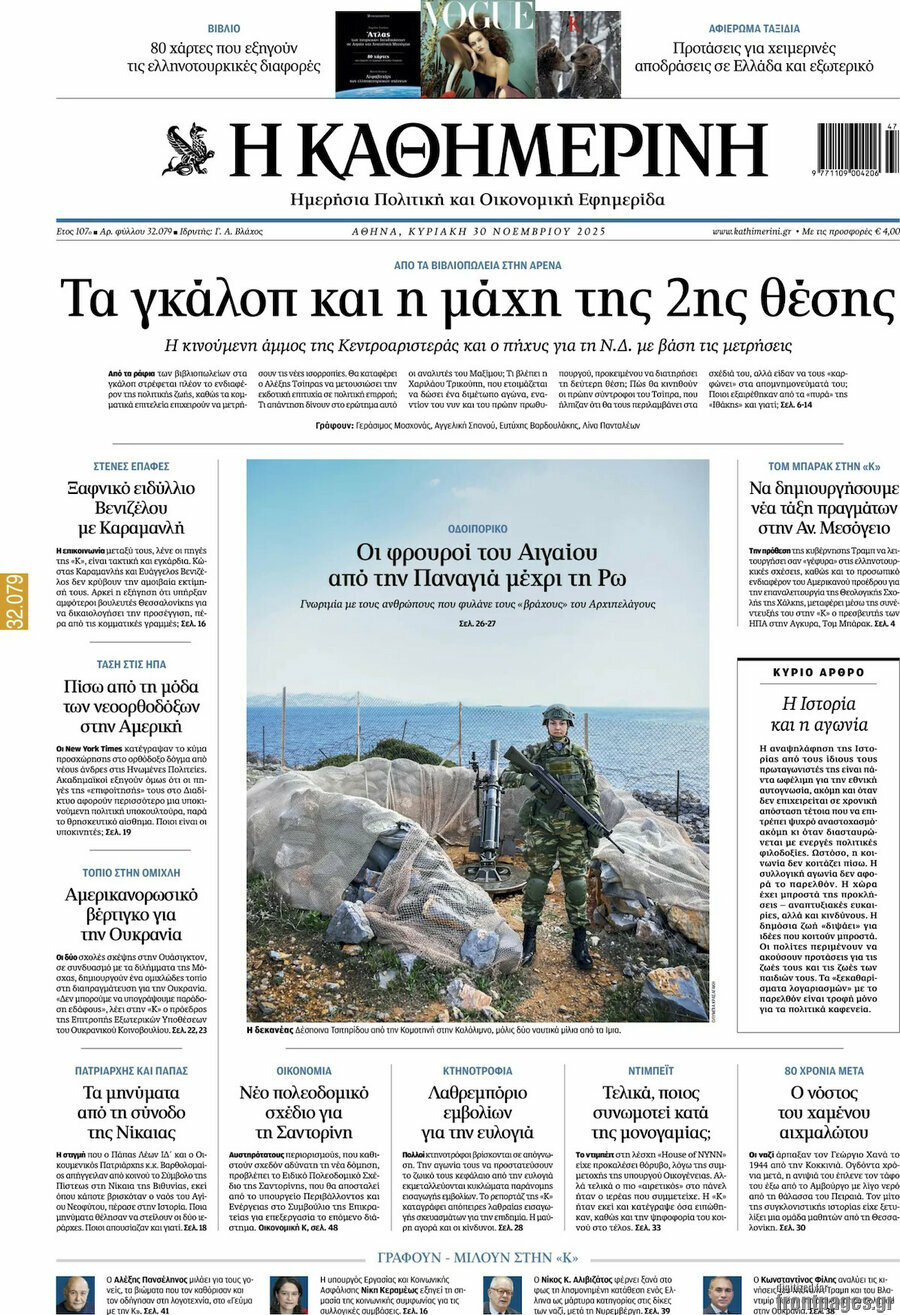
TO VIMA: Athens-Kyiv-Ankara: The “recognition of territory” scares Greece

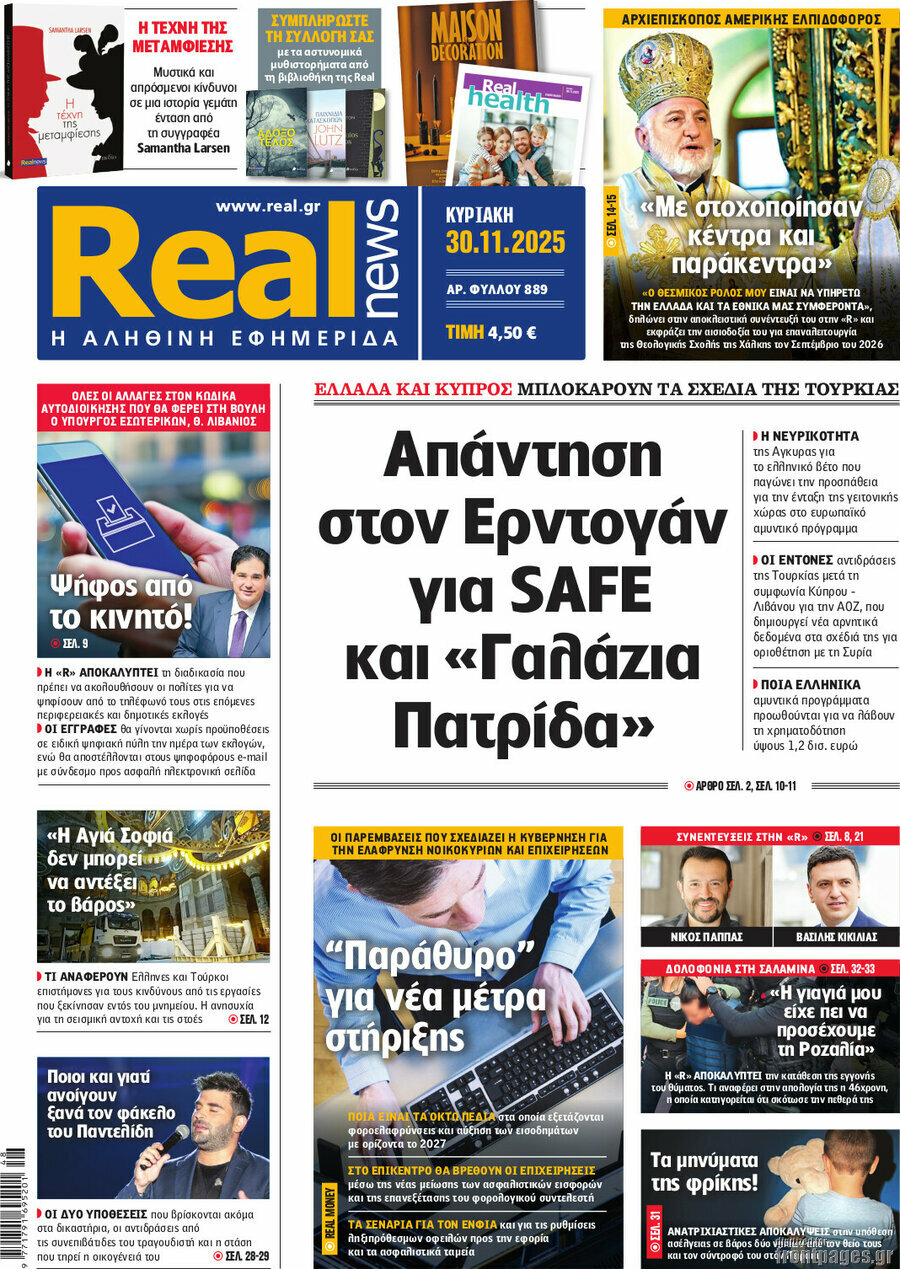
REAL NEWS: Response to Erdogan regarding SAFE program and “Blue Homeland”
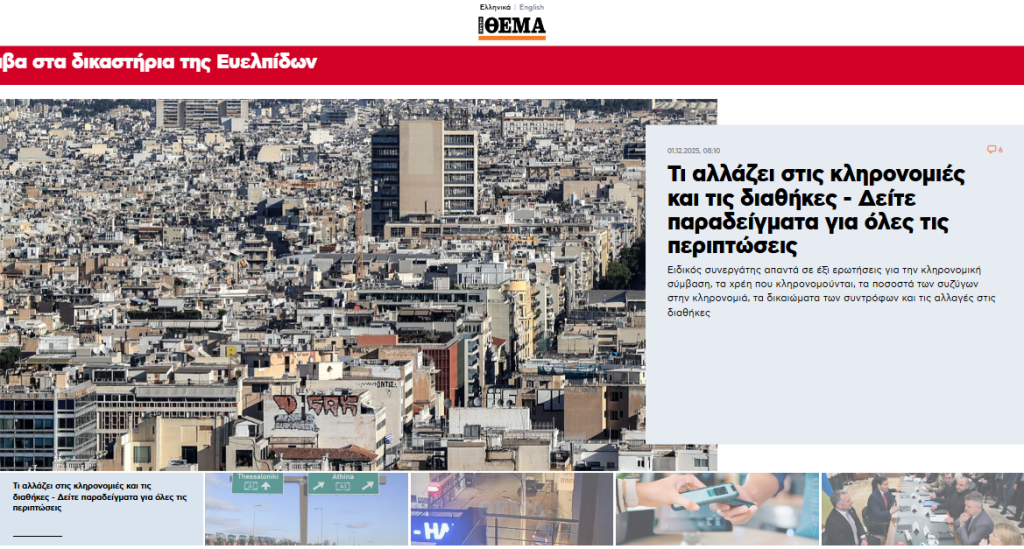
PROTO THEMA: “Energized” government polls at 31%

MONDAY PAPERS:
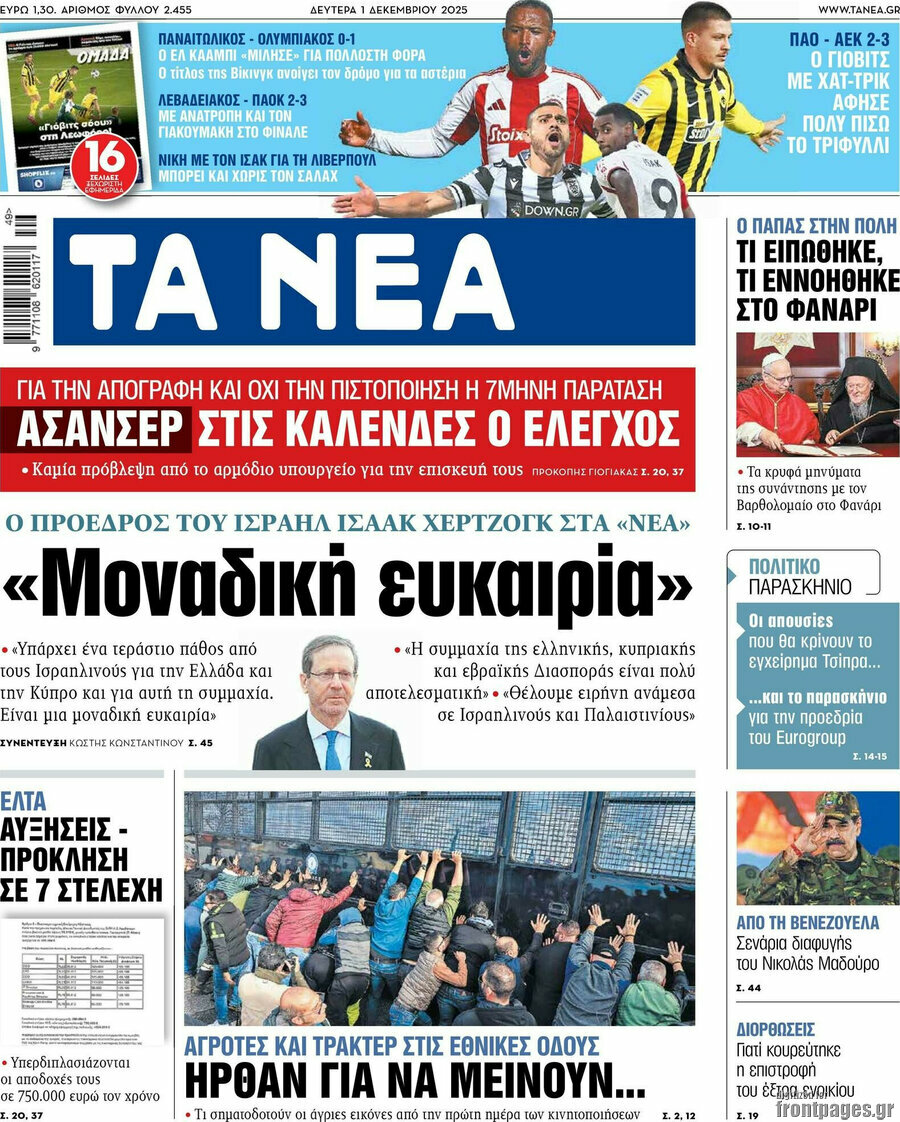
TA NEA: Israel president Isaac Herzog: “Unique opportunity”
EFIMERIDA TON SYNTAKTON: The government “paid” farmers with violence and teargas

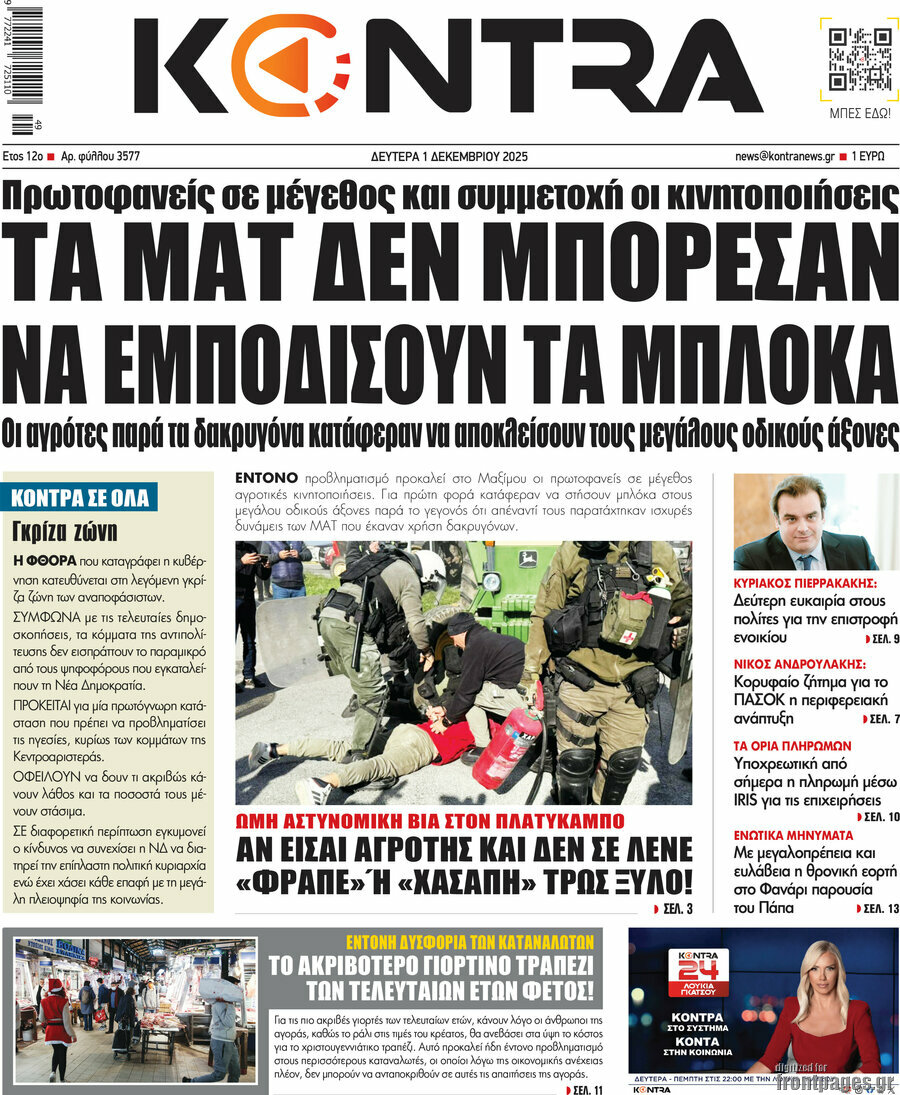
KONTRA NEWS: Riot police failed to stop farmers’ highway blockades
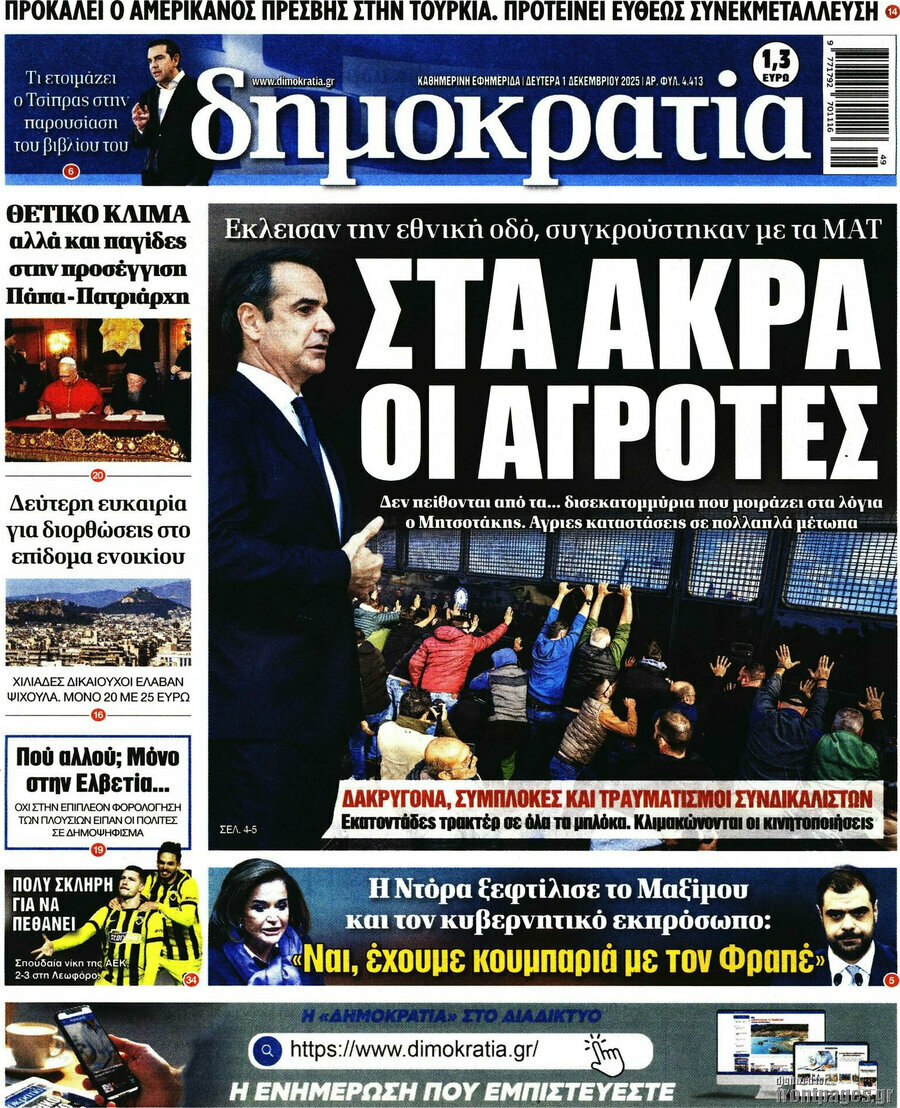
DIMOKRATIA: Farmers go to extremes
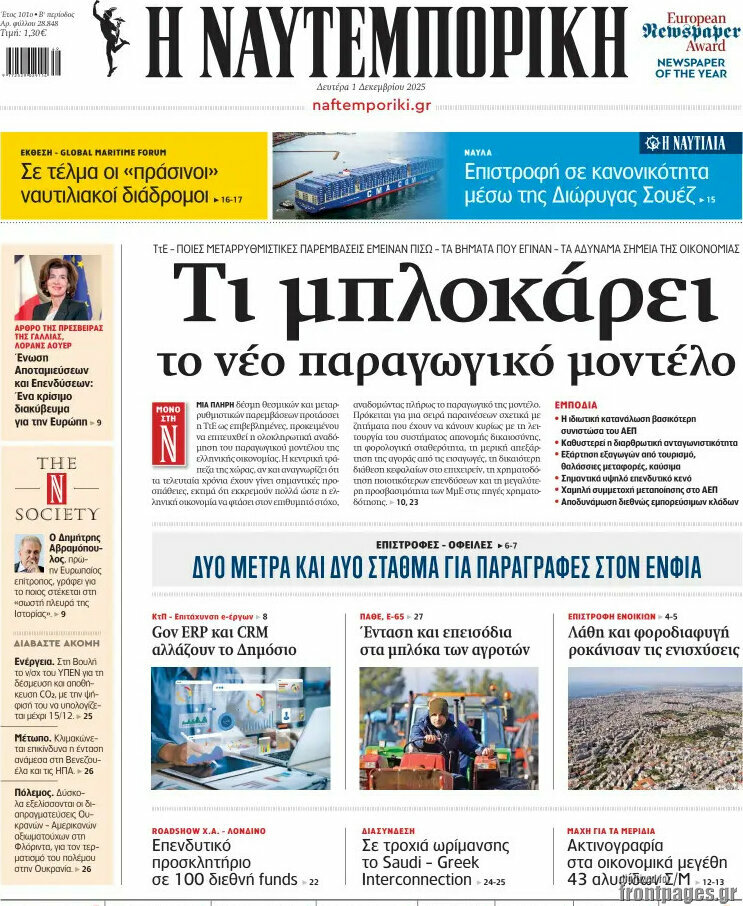
NAFTEMPORIKI: What is blocking the country’s new production model

DRIVING THE WEEK: GRAPPLING WITH BELGIUM’S ‘NO’
EUROPE GETS BOGGED DOWN ON UKRAINE FINANCING: EU leaders are getting ready to review legal proposals on how to keep Ukraine financially afloat by midweek. However, the path ahead is looking more fraught than ever as the depth of Belgium’s objections to using Russia’s frozen assets sinks in.
Pointing the finger: In comments to Playbook, Belgian Foreign Minister Maxime Prévot doubled down on the objections of his boss, Prime Minister Bart De Wever, to the so-called reparation loan, taking aim at leaders and officials who insist that using Russia’s assets is the only credible path forward.
It’s not me, it’s you: Prévot said the EU’s failure to find a clear way to financially support Ukraine by now is not Belgium’s fault but a product of the bloc’s “obstinacy” in insisting on using the Russian assets “without knowing how to do it nor understanding the risks that come with it.”
The Trumpian line: Prévot went on to describe the reparation loan as a problem for ongoing peace talks aimed at ending the war in Ukraine: “It is now clear that the assets can play an important role in a peace plan … Our action must not create obstacles to a peace plan.”
Staying the course: Asked whether the Commission was still working on the reparation loan, despite Belgium’s objections, a spokesperson said: “Yes — as one of the options put forward in [the] options paper shared by President Ursula von der Leyen.” Brussels was continuing to consult on the loan with member states including Belgium, the spokesperson added.
Merz stays firm: That chimes with comments from German Chancellor Friedrich Merz, who told a press conference on Friday that he “understand[s] the concerns [from Belgium] … but we also have good arguments to achieve a common goal of exerting as much pressure as possible on Russia to end this war.”
Fear and loathing: Yet diplomats and EU officials who spoke to Playbook over the weekend voiced concern about the tone, timing and public nature of De Wever’s letter — as well as his insistence that the reparation loan could be an obstacle to peace. “It definitely had a note of finality,” said one diplomat.
Trump at the wheel? That last argument is particularly concerning, the diplomats said, given that it flies in the face of the EU strategy of increasing pressure on Russia — and seems to align with U.S. President Donald Trump’s more Moscow-friendly stance. “There are members of the [U.S.] administration who want to do business with Russia,” said an EU official. “The assets thing doesn’t work for them.” Asked if Belgium had been in touch with the Trump White House regarding the loan, a foreign ministry spokesperson said they had “no information about such contacts.”
Suspicious vibes: Yet tensions are only due to get worse. A POLITICO story citing five diplomats who questioned how Belgium was using tax proceeds from the assets was the talk of the town in recent days. “Every diplomat other than the Belgian ones are talking about the money they are making from them,” said the same EU official.
FAC defense: Such mutterings are due to hang over a gathering of defense ministers that kicks off in Brussels at 9 a.m. Top EU diplomat Kaja Kallas will preside over the Foreign Affairs Council meeting and give a press conference at 2 p.m.
Mission improbable: EU leaders are now preparing for an uphill slog in coming weeks as they pore over the Commission’s legal proposal and race to come up with a solution in time for the next European Council gathering on Dec. 18-19. All options on the table — raising debt for Ukraine; using the EU budget; and tapping Russia’s assets — have their weaknesses. But failure is not an option. “It will be extremely difficult,” said one of the diplomats. “There is no easy way out.”
EUCO headlock: It will ultimately rest with European Council President António Costa to ensure that a solution is found in December, the same diplomat added. “It will be up to Costa to put the ball in the net at EUCO. You lock the doors and say: ‘You don’t leave until you have a solution.’”
UKRAINE LATEST: U.S. Secretary of State Marco Rubio said there was “more work to be done” to achieve a peace deal between Ukraine and Russia, despite productive talks with Kyiv’s new chief negotiator Rustem Umerov in Florida on Sunday. Trump’s special envoy Steve Witkoff is traveling to Moscow for talks with the Kremlin, while Ukrainian President Volodymyr Zelenskyy (who spoke to von der Leyen over the weekend, per her spokesperson) is heading to Ireland for his first official visit, according to Sky News.
PLAYBOOK INTERVIEW
JUSTICE COMMISSIONER WARNS ON RUSSIAN IMPUNITY: Trump’s rush for a peace deal at almost any price contains one risk that has been underreported so far: that Vladimir Putin and other senior Russian figures currently wanted over alleged war crimes will evade justice. That, at least, is the take of EU Justice Commissioner Michael McGrath, in an interview with POLITICO’s Tim Ross.
Welcome back, Vlad: Let’s not forget that the original 28-point blueprint for a deal put forward by the Trump administration included the promise of a “full amnesty for actions committed during the war” and set out plans to reintegrate Russia into the world economy, including with long-term deal with the U.S.
Not so fast: McGrath told POLITICO that “we must avoid” the risk that Russia will dodge prosecution for war crimes, effectively setting a new red line for a deal. “I don’t think history will judge kindly any effort to wipe the slate clean for Russian crimes in Ukraine.”
The next Ukraine: “They must be held accountable for those crimes and that will be the approach of the European Union in all of these discussions,” McGrath said. “Were we to … allow for impunity for those crimes, we would be sowing the seeds of the next round of aggression and the next invasion. And I believe that that would be a historic mistake of huge proportions.”
MONNET’S GHOST
WHAT WOULD JEAN DO? How can Europe pull itself out of its current predicament of being sidelined on Ukraine peace talks while staring down the barrel of economic decline? Playbook caught up with the grandson of Jean Monnet for some insight on how the European Union’s founding father would have approached today’s challenges.
First movers: Jean-Marc Lieberherr, head of the Jean Monnet Institute, says the top priority should be learning to move quickly. Monnet’s philosophy, he says, was “to be the earliest one … with your proposals if you want a chance to get the result that you want.” On Ukraine: “We are lagging behind. Even if you question the US approach, they came first and anchored the discussion.”
Selfless outsiders: The EU needs to empower behind-the-scenes operators who have the freedom to move quickly and boldly. “[Monnet] came from outside the system; he had this idea that true change must be driven from the outside. He saw politicians as short-termist by nature, egotistical by nature. You need someone from outside.”
External pressure: Donald Trump has embraced political outsiders, for better or worse, by tasking special envoy Steve Witkoff and his son-in-law Jared Kushner to lead thorny negotiations on Ukraine and the Middle East. Monnet, Lieberherr says, was cut from a similar cloth. “Today, we don’t have people like this, that politicians are ready to listen to.”
Think small; be practical: Europe needs to learn how to think small and practically. Mario Draghi’s tome of recommendations to fix the EU and avoid a “slow agony” in economic terms is all well and good, Lieberherr says, but its lengthy list of tips offers no hint of how to get results. “The Draghi report is 500 priorities. It is impossible to move on all of them. What you need is one — and a method to get there.”
Monnet’s superpower, per his grandson, was that he could identify practical, achievable aims that wouldn’t alienate politicians, like unifying Germany and France’s Coal and Steel sectors. Today, Europe’s urgent need is on defense; Monnet would most likely have focused on a high visibility project — like the Franco-German plans to develop a fighter jet — to get the ball rolling, says Lieberherr.
Sell it: The EU’s current focus on “competitiveness” as its priority may describe a real need, but it’s a PR disaster. Leaders should come up with better arguments for why people need to back European approaches that are not couched in bureaucratic, off-putting language.
The price of timidity: Leaders need to reconcile with a sense of sacrifice. Currently, EU leaders are so terrified of the populist right that they shy away from any moves toward integration for fear it will blow up in their faces. “Monnet came up with the method. Schuman had the courage. Where is it today? Who, at EU level and member state level, has the courage?”
IN OTHER NEWS
SERAFIN IN THE LION’S DEN: You could hardly think of a more unwelcome guest in Viktor Orbán’s Hungary than Piotr Serafin. Nevertheless, the EU budget commissioner — who is keeping billions of EU funds for Hungary frozen because of the country’s democratic backsliding — will be touring Budapest today. The Polish commissioner will give a speech at the Hungarian Integrity Authority, a body that polices how EU funds are spent, and meet its president Ferenc Pál Biró, along with Hungary’s European Union Affairs Minister János Bóka.
Yes, that authority: Earlier this year Pál Biró was placed under investigation over minor graft allegations that he claimed were politically motivated. In his speech, Serafin is expected to convey the EU’s support for the public body and defend its independence.
RIGHT GEARS UP FOR BRUSSELS BATTLE: A high-profile summit of leading “proud patriots and national conservatives” is back in Brussels this week, after last year’s event sparked protests, political opposition from local mayors and a move by police to shut the meeting down altogether. The two-day conference, billed as a “Battle for the Soul of Europe,” kicks off on Wednesday just outside the EU quarter at The Claridge, the organizers told Gabriel Gavin — the same venue that was forced to shutter the summit in 2024.
Attendee list: Hosted by MCC Brussels, the favorite think tank of Hungarian Prime Minister Orbán, attendees will hear from controversial former Czech President Václav Klaus, French far-right activist Alice Cordier and British commentator Matthew Goodwin. Orbán’s chief of staff, Balázs Orbán, will speak alongside Hungarian MEP and Patriots for Europe Foundation President András László. In a preview out this morning, organizers say they will fight “the Brussels establishment” to ensure the summit can go ahead, this time around, in the name of free speech.
ALTERNATIVE ELECTION STRATEGY: The far-right Alternative for Germany has tried moderating its image by promoting media-friendly figures and downplaying open extremism to boost the likelihood of victory next time round. Nonetheless, my POLITICO colleagues Pauline von Pezold and Gordon Repinski found the slicker style to be more a matter of optics than substance.