
Recycling scandal deepens with arrests
Four people were arrested Thursday in an investigation into the purchase of more than 240 recycling centers by waste management agencies in Attica, the Peloponnese and Crete. The centers, supplied by TEXAN, cost nearly €80 million and were financed with European Union funds. Those arrested include the company’s owners, Apostolos and Panagiotis Mourgos, the head of the Recycling for Rewards system, Pavlos Ravanis, and the publisher of the newspaper Parapolitika, Giannis Kourtakis. The arrests followed orders from European prosecutors Eleni Siskou and Evgenia Kyvelou. The four are suspected of forming a criminal organization, instigating breach of trust and money laundering. They are expected to appear before the European prosecutors on Saturday and then be taken to the prosecutor’s office.
https://www.ekathimerini.com/economy/1322637/recycling-scandal-deepens-with-arrests
Turkey rejects EU Parliament resolution against maritime deal with Libya
Turkey’s Foreign Ministry has rejected Thursday’s European Parliament resolution against the disputed maritime rights deal between Turkey and Libya that has angered Greece and other Mediterranean countries. A ministry statement said the resolution contains “biased and unfounded allegations.” The agreement that partitions Mediterranean Sea offshore rights between Turkey and the north African country, ignoring the presence of intervening Greek islands, was signed in 2019 between Ankara and the administration that controls the western section of strife-divided Libya. Last month it was ratified by the rival administration in eastern Libya.
Tsipras’ party faces questions over finances
A political dispute over transparency and corruption has escalated, with New Democracy, PASOK and ELAS trading accusations over the business activities of the latter’s party secretary Miltos Hatzigiannakis. The controversy centers on municipal contracts awarded by the Stylida municipality to companies in which he is a shareholder, and his company’s provision of office space for party activities. Hatzigiannakis said he makes the premises available because the party relies on its members, adding that ELAS leader Alexis Tsipras knew about the arrangements. New Democracy urged Tsipras to explain, while PASOK alleged that companies linked to Hatzigiannakis received €752,000 in one year and questioned ELAS’ financing.
https://www.ekathimerini.com/politics/1322490/tsipras-party-faces-questions-over-finances
Civil Protection urges public to take precautions ahead of worsening weather conditions
The General Secretariat for Civil Protection has urged the public to exercise particular caution and take self-protection measures against risks arising from severe weather conditions. More specifically, the General Secretariat for Civil Protection, which operates under the Ministry of Climate Crisis and Civil Protection, has informed all relevant state agencies, as well as regional and municipal authorities across the country, urging them to remain on heightened civil protection alert in order to respond promptly to the impact of the severe weather.
ATHEX: Benchmark claws back part of losses
The Euronext Athens (ATHEX) general index closed Thursday at 2,479.94 points, adding 1.02% to Wednesday’s 2,454.94 points. The large-cap FTSE-25 index expanded 1.21% to end at 6,361.25 points.
https://www.ekathimerini.com/economy/1322638/athex-benchmark-claws-back-part-of-losses


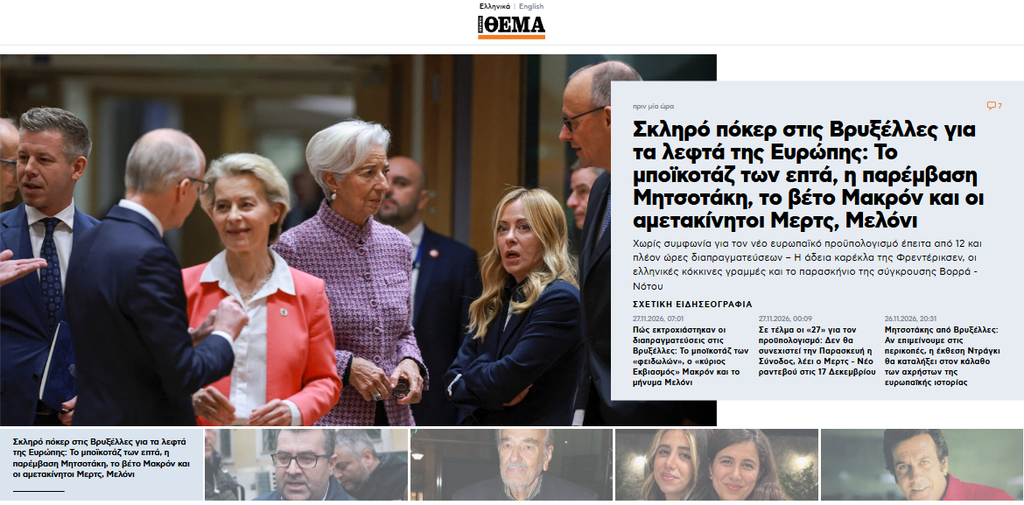
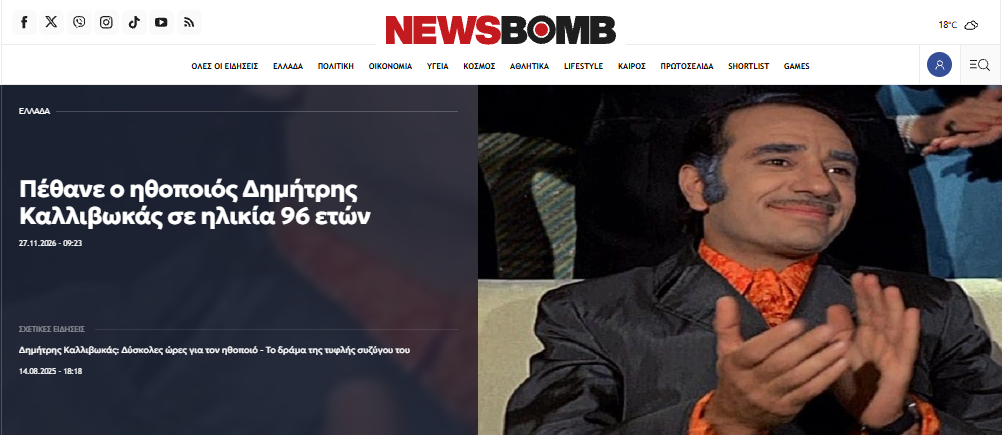
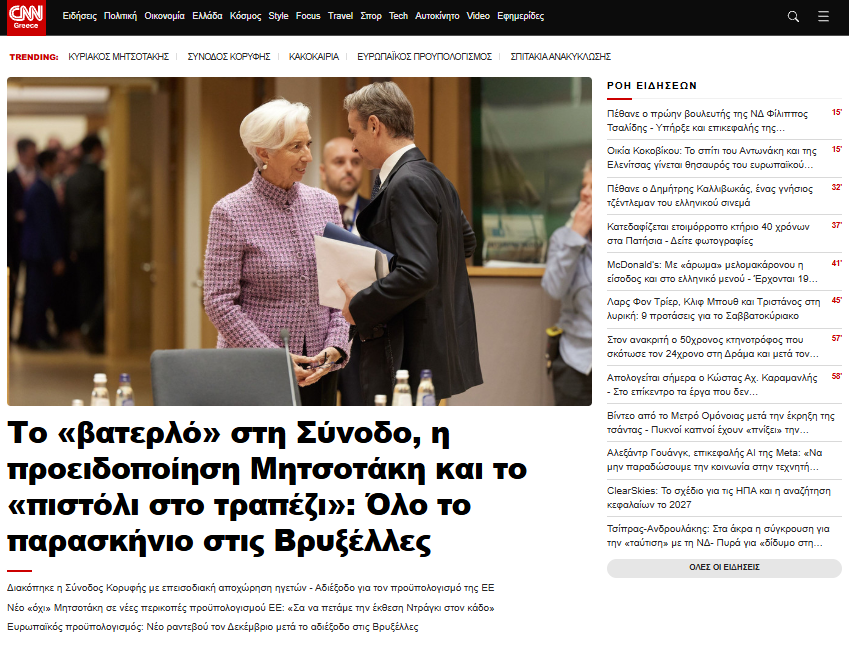

KATHIMERINI: Avalance due to recycling houses
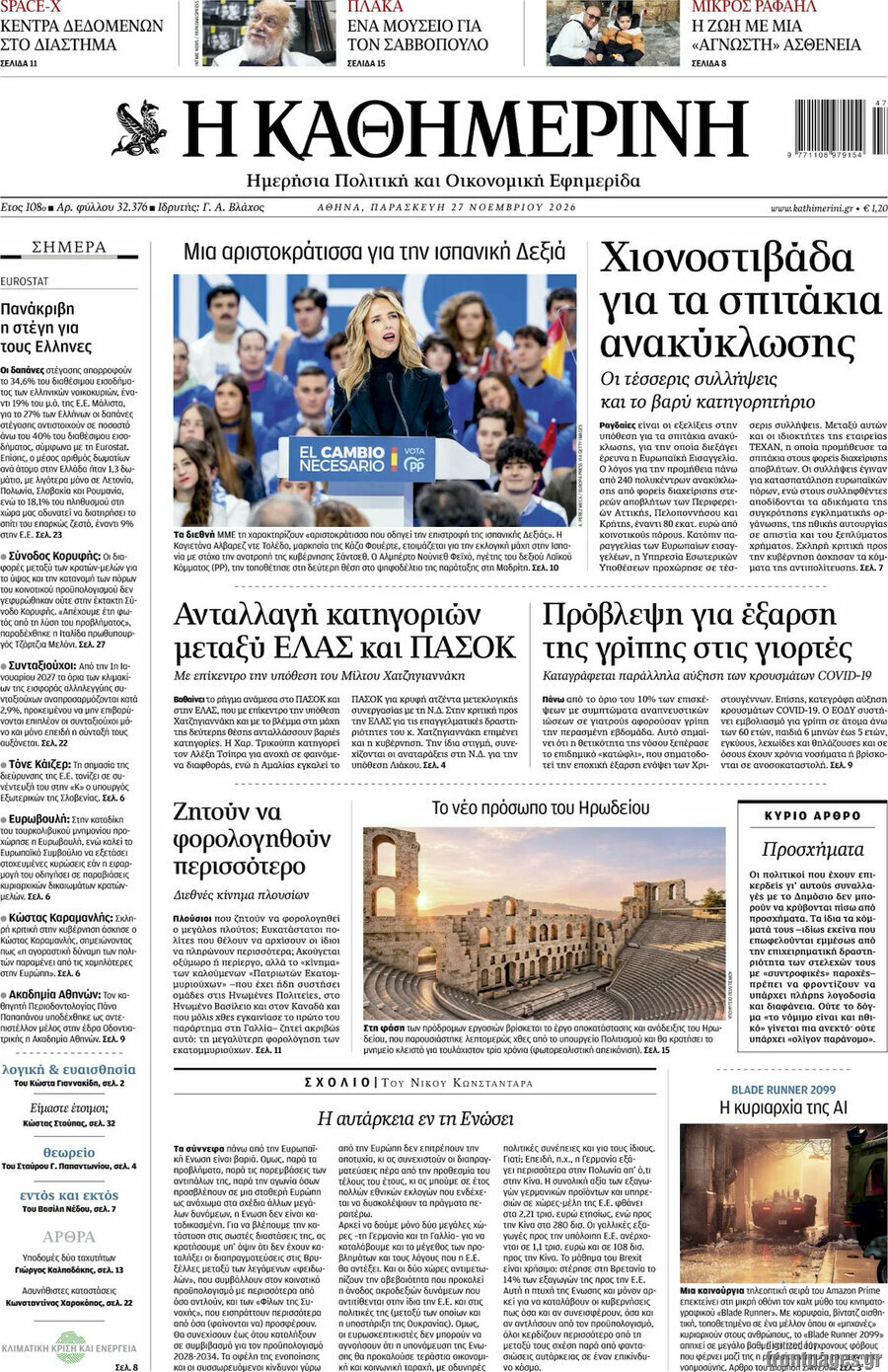
TA NEA: Landmark decision regarding referenda in the EU
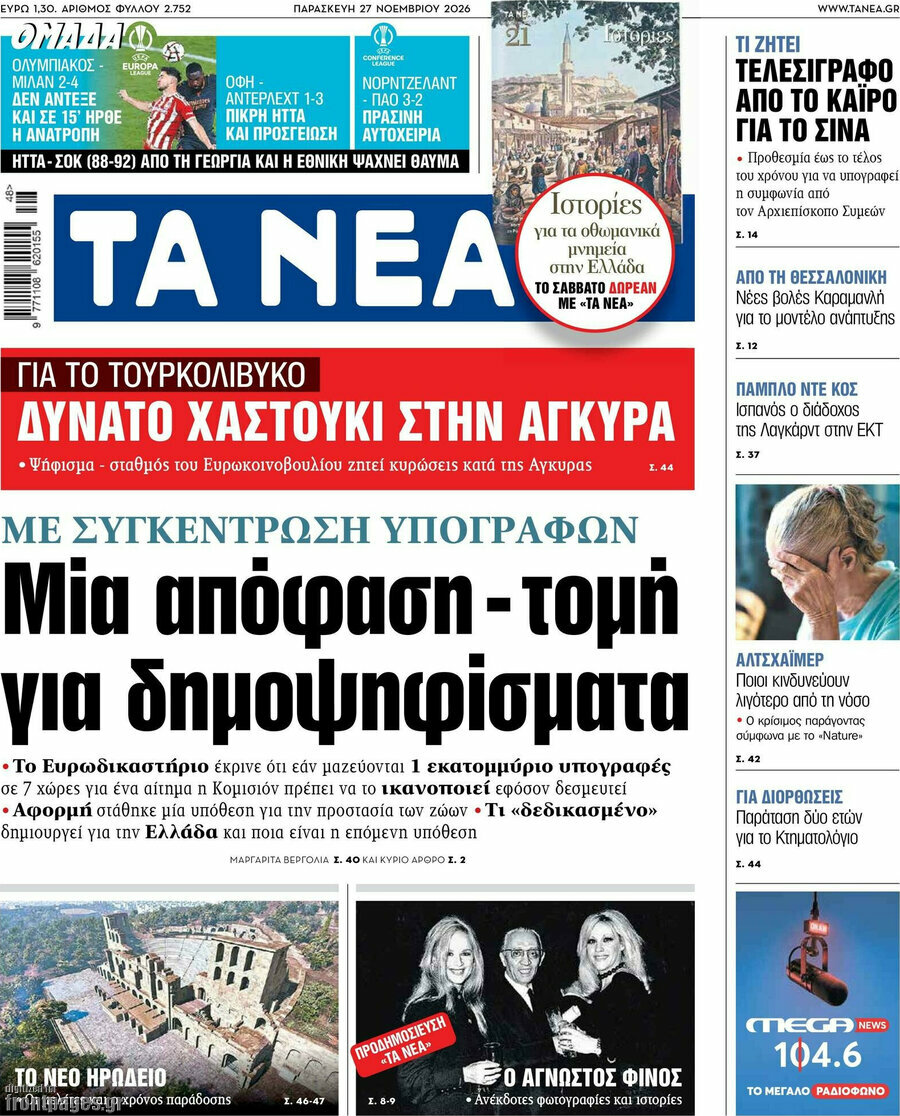
EFIMERIDA TON SYNTAKTON: Recycling houses: Heavy accusations for well-known individuals
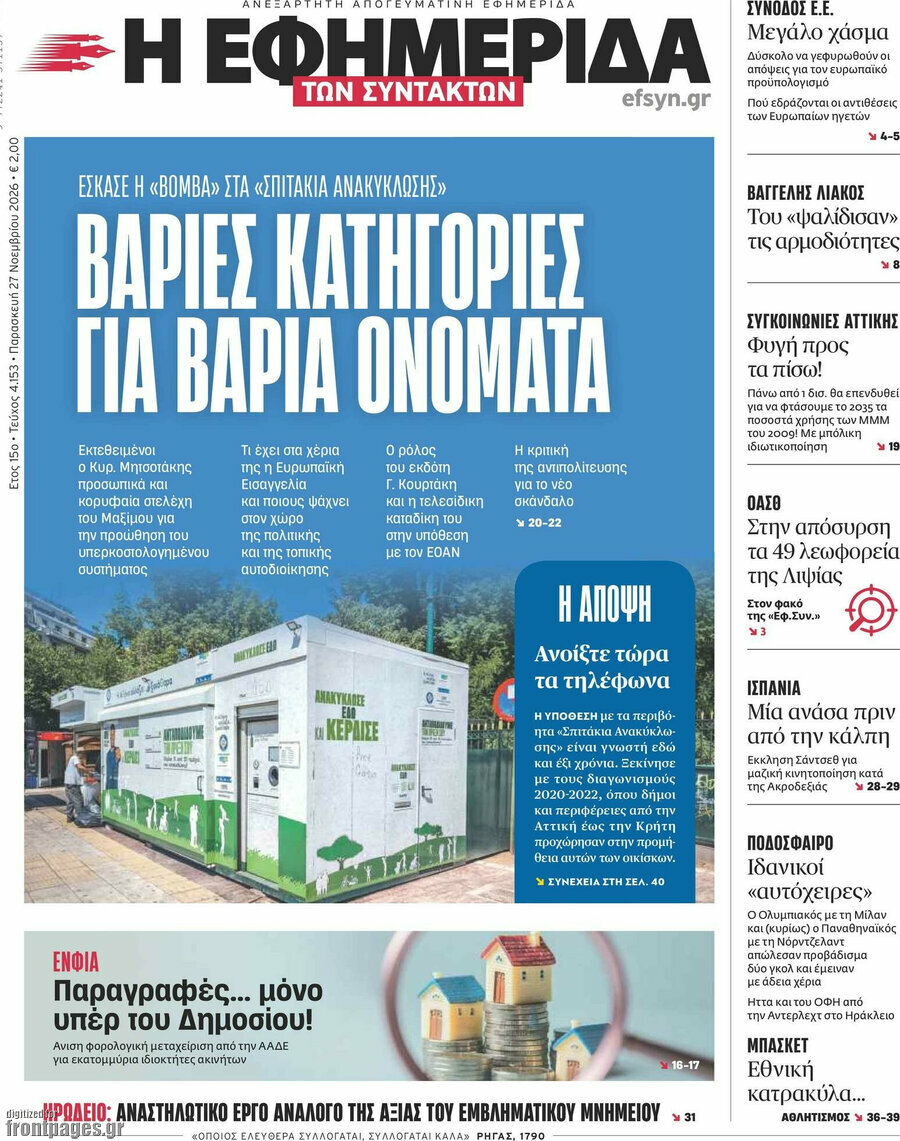
RIZOSPASTIS: The support of corporate profits and the war are “executing” the people
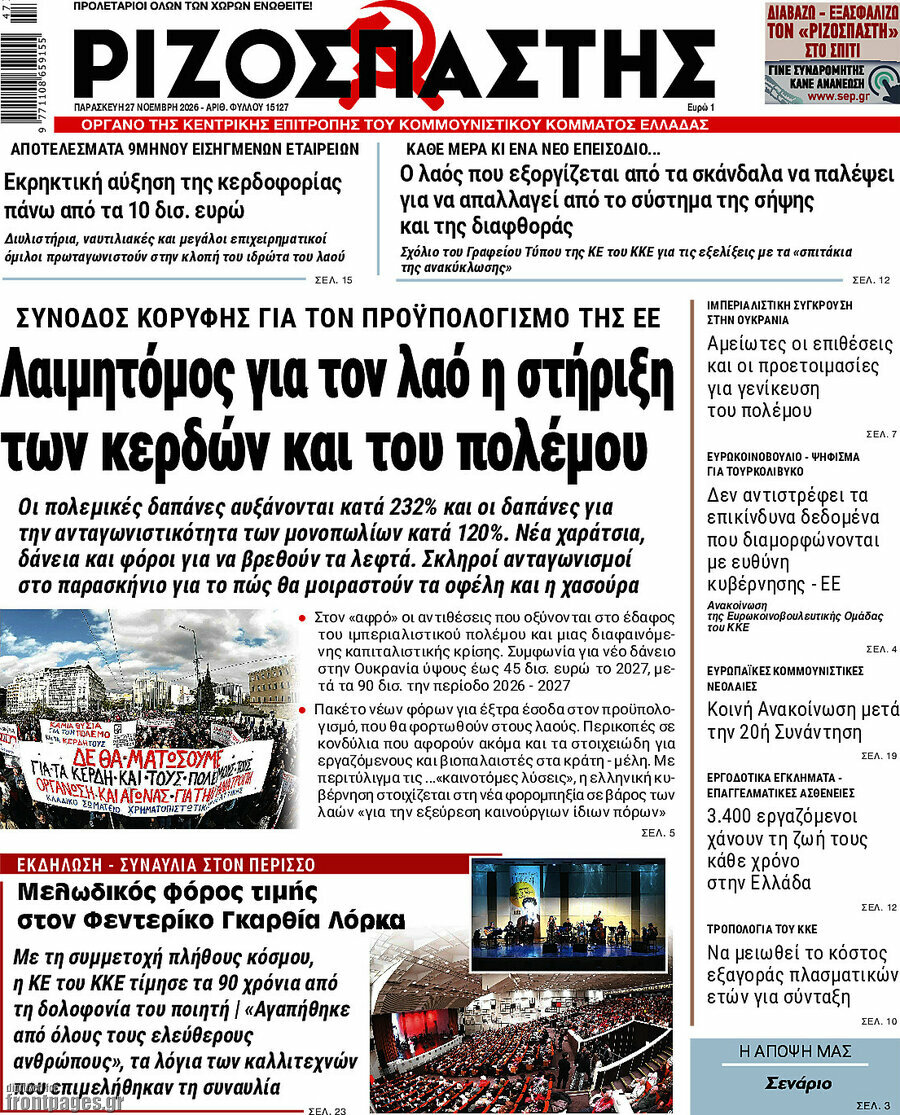
KONTRA NEWS: False flag operation by New Democracy and PASOK against Tsipras
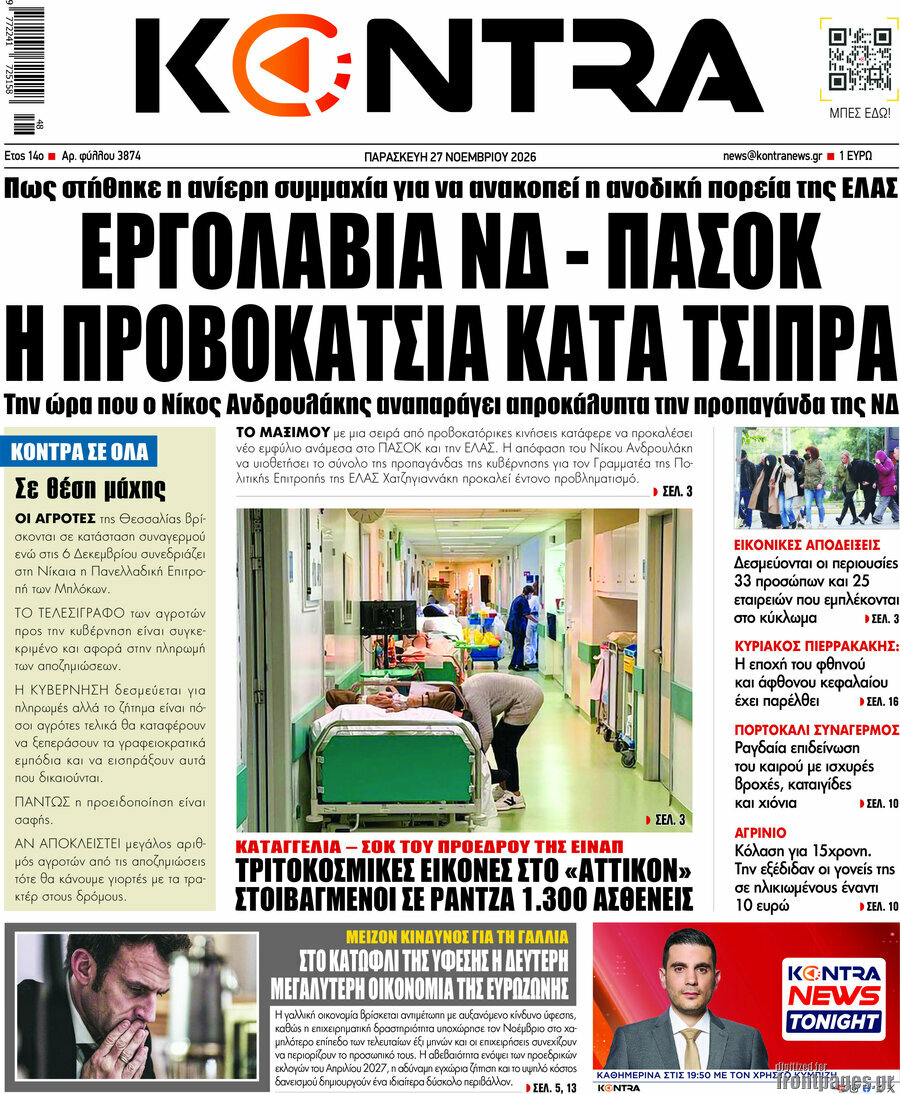
DIMOKRATIA: The bomb regarding the recycling houses has exploded
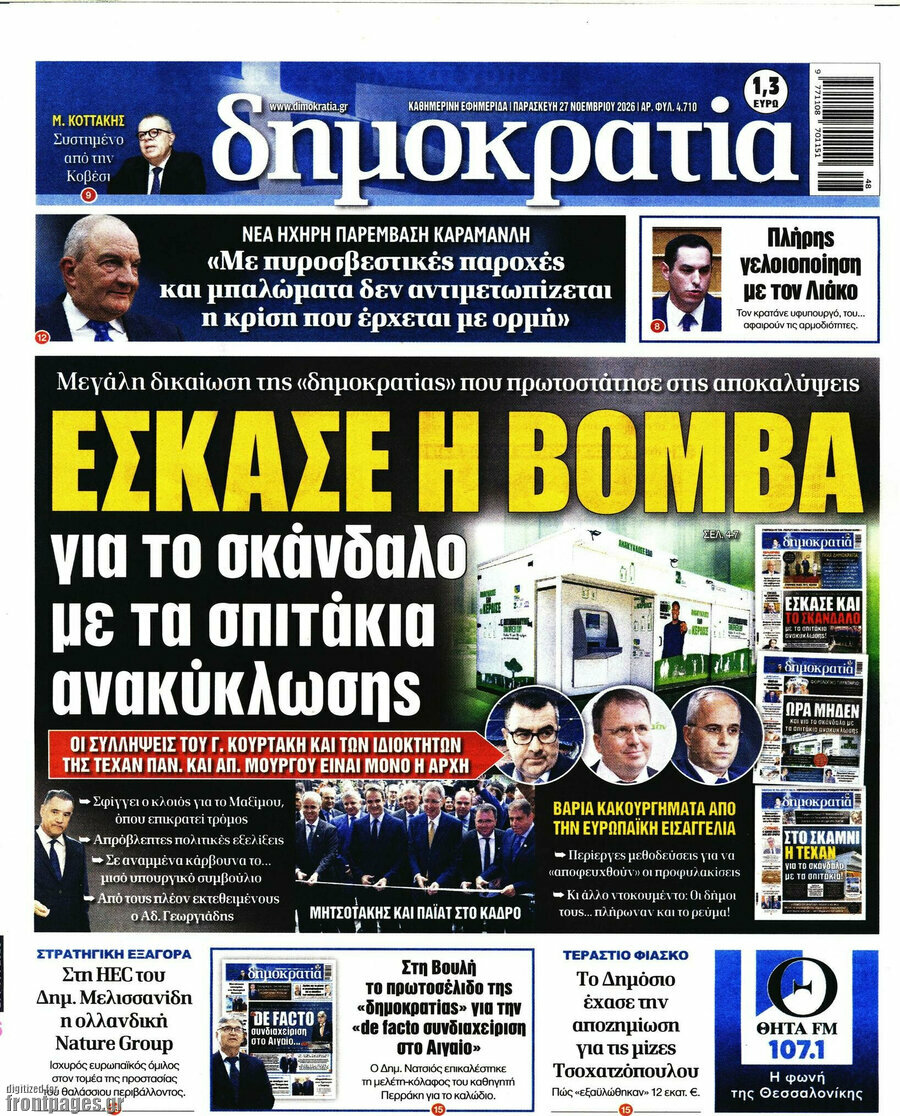
NAFTEMPORIKI: 4-bln-euro “reserve” linked to the storage of CO2

DRIVING THE DAY
IT’S A BOYCOTT: Last night’s summit failed to get a deal, but that wasn’t a surprise. What was a surprise: seven countries walking out of the talks in protest.
The summit wrapped up after midnight, with leaders at such loggerheads that they were sent home to their capitals rather than being kept for the planned second day of talks. The so-called frugals, seven countries that want to shrink the budget, even boycotted European Council President António Costa’sdiscussion format of small breakaway groups.
Costa and Commission President Ursula von der Leyen looked exhausted, even peeved, at the concluding press conference around 1 a.m. After delivering terse remarks, they took only three questions and wound up after just 11 minutes.
How it happened: Throughout the day, leaders split off into the groups, with the two main camps — the seven frugals and the 17 that want a bigger budget — each appointing a leader to speak to Costa. Denmark’s Mette Frederiksen spoke for the former and Italy’s Giorgia Meloni and Romania’s Nicușor Dan for the latter.
But the somewhat novel format got no closer to an agreement.“Nobody explained why we were meeting in these groups or how they would work,” a diplomat told Playbook. A second diplomat told me it was “weird,” with Costa not presenting any alternative options. A third, from one of the seven countries, accused Costa of a ploy to “divide” them, telling me they refused to go on principle. And a fourth diplomat told my colleague Nick Vinocur that Costa had lost their country’s confidence entirely with the scheme.
It’s cosmic: Latvian Prime Minister Andris Kulbergs told me when I grabbed him on the Council’s red carpet last night that leaders are each on a different “planet.” Malta’s Prime Minister Robert Abela agreed, telling my colleagues Jacopo Barigazzi and Camille Gijs that the talks were “difficult.”
There was no “bloodbath,” as one diplomat predicted. Instead, leaders simply restated their positions, according to an EU official, before some stopped going to the groups. “Nothing has really happened today,” Swedish Prime Minister Ulf Kristersson said, while a visibly angry French President Emmanuel Macron told reporters Europe was “making a strategic mistake” with a less ambitious budget (and lashed out at French presidential front-runner Marine Le Pen for criticizing the talks).
My colleagues have a full rundown on last night’s action here and here.
One last chance: That leaves a final summit, starting Dec. 17, to agree a deal before the new year. After that, consensus might become impossible, multiple leaders said last night, given elections and the potential for political disarray across the bloc in 2027.
Fingers crossed: Both Kulbergs and Abela were optimistic about the odds of a deal in December. “There has to be,” Kulbergs said, adding that leaders all understand 2027 will be too difficult. “I am positive about it,” Abela said. A diplomat told Playbook their delegation was already booking extra nights in a hotel next month.
Twenty days to go: The real work starts now. Costa will spend the next few weeks reaching out to capitals to get talks back on track ahead of the all-important December summit, a diplomat said.
BIG AND BREAKING
EMBOLDENED: European leaders are steeling themselves for clashes with Donald Trump on digital taxes, defense procurement and financing for Ukraine, Nick Vinocur and Camille Gijs report.
EUROPE’S UKRAINE DILEMMA: Voters across the continent are growing weary of the war, raising the political risks for centrist EU leaders pushing to boost support for Kyiv.
RIGHT TURN: After eight years of Socialist rule, polls point to a right-wing government in Spain — but exactly what it’ll do in office will depend on the balance of power between the conservative People’s Party and far-right Vox, Nacho Alarcón writes.
Climate pivot: Flood-hit Valencia offers a glimpse of how a right-wing government could shake up Spain’s climate policy.
FALLING SHORT: The European Union is on track to miss its pandemic-era target of spending more than €200 billion on green projects before the end of 2026, according to new figures shared with POLITICO.
EUROPE’S SOCIALISTS IN DECLINE
THE LEFT’S CRASH: Europe’s Social Democrats are bracing for a brutal week.
With Spanish Prime Minister Pedro Sánchez forecast to lose Sunday’s election and Sweden’s Magdalena Andersson failing to secure a governing majority — leaving center-right incumbent Ulf Kristersson poised to clinch another term on Monday — the political family risks hitting an all-time low in European Council representation, Max Griera and Jacopo Barigazzi report.
Problem for later: “Next week we can take further stock of social democracy in Europe,” Party of European Socialists Secretary-General Giacomo Filibeck told Max. He pointed out that the Swedish center-left party achieved most votes in the country’s election, and still wasn’t discounting a Sánchez victory. “We are still the second largest political force in Europe.”
The Socialists may now be left without a standard-bearer, with only Malta’s Robert Abela (from the EU’s smallest country) and Denmark’s Mette Frederiksen (whose hard line on migration has angered counterparts and is the subject of formal discussion) remaining among the bloc’s 27 national leaders.
Lost bridge: Sweden’s Andersson was seen as a potential bridge between southern European and Nordic Socialists. “She can work as a kind of liaison,” said an EU diplomat who was granted anonymity. Although Andersson takes a tough stance on migration, she is seen by officials as easier to work with than Frederiksen.
To the right: Another problem is that it will be more difficult for the center left to influence EU laws, according to Parliament Vice President Victor Negrescu. “We will therefore have to work harder, particularly from the Parliament’s side, to ensure our ideas are reflected,” he said. By contrast, Socialists are still in government as junior partners in some countries, such as Austria, Germany and Romania, he said.
That will pile pressure on a party feeling increasingly isolated in Brussels as the center-right EPP and far right gain ground, with some saying they believe it will make it less easy to make compromises in the Parliament. The developments “will push us towards opposition,” said a Socialists and Democrats MEP.
For all that, there’s still (some) hope for the Socialists as they look toward the elections next year in Finland and Italy.
20-SECOND PLAYBOOK PRIMER
EU countries are seeking to block ENISA from joining an EU-wide cyber defense network, in part because the network deals with national security issues. But what’s ENISA? It’s the European Union Agency for Cybersecurity, set up in 2004 and based in Greece. Its job is to advise EU institutions and member countries on cybersecurity policy and implementation, as well as to coordinate cross-border cyber threat responses. As Playbook reported, the European Commission was recently hit by a cyberattack.
WHY INTERPRETERS ARE FEELING ‘THREATENED’
FEARING FOR THE FUTURE: For decades, interpreters in the EU had jobs to be coveted: secure, fulfilling and relatively lucrative. After all, with 24 official languages, there should always be work. Nowadays, things look decidedly less comfortable, as ever-improving technology risks eating away at the value humans provide.
Doom and gloom: The words interpreters chose to describe their career at the European Commission’s Interpreting Europe Conference, taking place in Brussels yesterday and today, highlight the disquiet, Mari Eccles reports. Among the terms at the top of the list: “threatened,” “challenging,” “confusing” and “evolving.”
One of the biggest fears is over artificial intelligence. Management sees AI as something that needs to be worked with and harnessed — as long as it’s used properly. “I don’t think we should be naive about [AI], or defensive,” said Genoveva Ruiz Calavera, who heads up a 500-strong team of interpreters in the Commission’s interpretation department. While “it will be incorporated into our work,” it will be with “solid human supervision.”
But technology can cause divisions. There’s a risk of “two-speed multilingualism,” said Ruiz Calavera, in which more common languages benefit the most from technological developments — which, again, might be a double-edged sword for interpreters.
Then there’s the non-technological crosswinds. A major headache for interpreters in the European Parliament is the prospect of additional countries joining the EU — while there may be less money to spend, according to Director-General Juan Carlos Jiménez Marín. “In this current climate, we don’t actually know what the budget is going to look like,” he said. “We’re going to have to expand language coverage but with not many funds.”
DASHBOARD
THE COST OF CUTTING TECH TIES: The EU is negotiating a bill that would force public administrations to rethink how much they rely on American technology in sensitive sectors. But a patchwork of different national choices is complicating the bloc’s efforts to reduce that dependence, Mathieu Pollet and Hanne Cokelaere report for subscribers.
A study by researchers at Finland’s Aalto University revealed major disparities in the extent to which countries’ digital services for citizens depend on Amazon, Microsoft or Google. Those differences tend to be linked to countries’ size and labor costs, with smaller countries more likely to use U.S. cloud providers — and the cost of such a new policy could mainly fall on small member countries, the researchers warned.
 |
4 MORE THINGS GETTING US TALKING
YOU’RE NEXT: Enlargement Commissioner Marta Kos is in Albania today encouraging the country to follow in Montenegro’s footsteps. “2027 can be the year of Albania,” she’s expected to say. Kos will stress that protesters demanding action against corruption and better environmental protections can help to advance the country’s accession bid: “EU membership is a national project, not the project of a single party or the government alone.”
PLAYING DEFENSE: Kyiv is stepping up its bid to keep Russian athletes out of global sports tournaments, Martina Sapio reports.
PUBLIC SERVICE ANNOUNCEMENT: Before you blow your salary on supposedly unmissable Black Friday bargains, Consumer Protection Commissioner Michael McGrath has some advice for Playbook readers: Check those discounts carefully and don’t let countdown timers or claims of limited availability rush you into buying something. “A genuine deal should never depend on misleading the consumer,” he told Playbook.
DECLASSIFIED: British PM Andy Burnham was stung after trying to get too close to the TikTok generation. Paul Dallison explains the perils of politicians trying to be down with the kids.