
EU reaffirms support for delayed Great Sea Interconnector project
The European Commission has reiterated its strong backing for the Great Sea Interconnector (GSI), a major electricity link planned to connect the power grids of Greece, Cyprus, and potentially Israel.
ND leads by 16.6 points; one in five voters undecided, poll shows
Ruling New Democracy maintains a strong 16.6-point lead over second-placed PASOK, while one in five voters remains undecided, according to a new Opinion Poll survey released Thursday for Action24 TV.
Thessaly’s sheep pox outbreak defies containment
A preliminary investigation has been launched into the continued spread of goat and sheep pox in Thessaly, despite strict biosecurity measures. Larissa’s appellate prosecutor ordered the inquiry, which will involve police and veterinarians inspecting livestock facilities, particularly in Magnesia.
https://www.ekathimerini.com/economy/1286564/thessalys-sheep-pox-outbreak-defies-containment
Pierrakakis at ECOFIN: Greece requests extension of tax exemption in shipping, aviation, agriculture fuel
Greece requests a ten-year extension of the tax exemption in fuels for shipping, aviation and agriculture, three sectors of strategic importance to Greece, National Economy & Finance Minister Kyriakos Pierrakakis told the ECOFIN ministers meeting in Brussels on Thursday.
ATHEX: When the Greek bourse rises, it does it decisively
Athinon Avenue enjoyed a fourth consecutive session of stock gains on Thursday, again revealing a trend that has been something of a main theme over the last few months: when it decides to head higher it does so decisively. The day’s gains for the benchmark exceeded 1%, adding to the growth recorded since the start of the week and more than compensating for the losses of previous weeks. A coalition of banks and other blue chips led the price climb, though mid-caps struggled to keep up.
https://www.ekathimerini.com/economy/1286754/athex-when-the-greek-bourse-rises-it-does-it-decisively



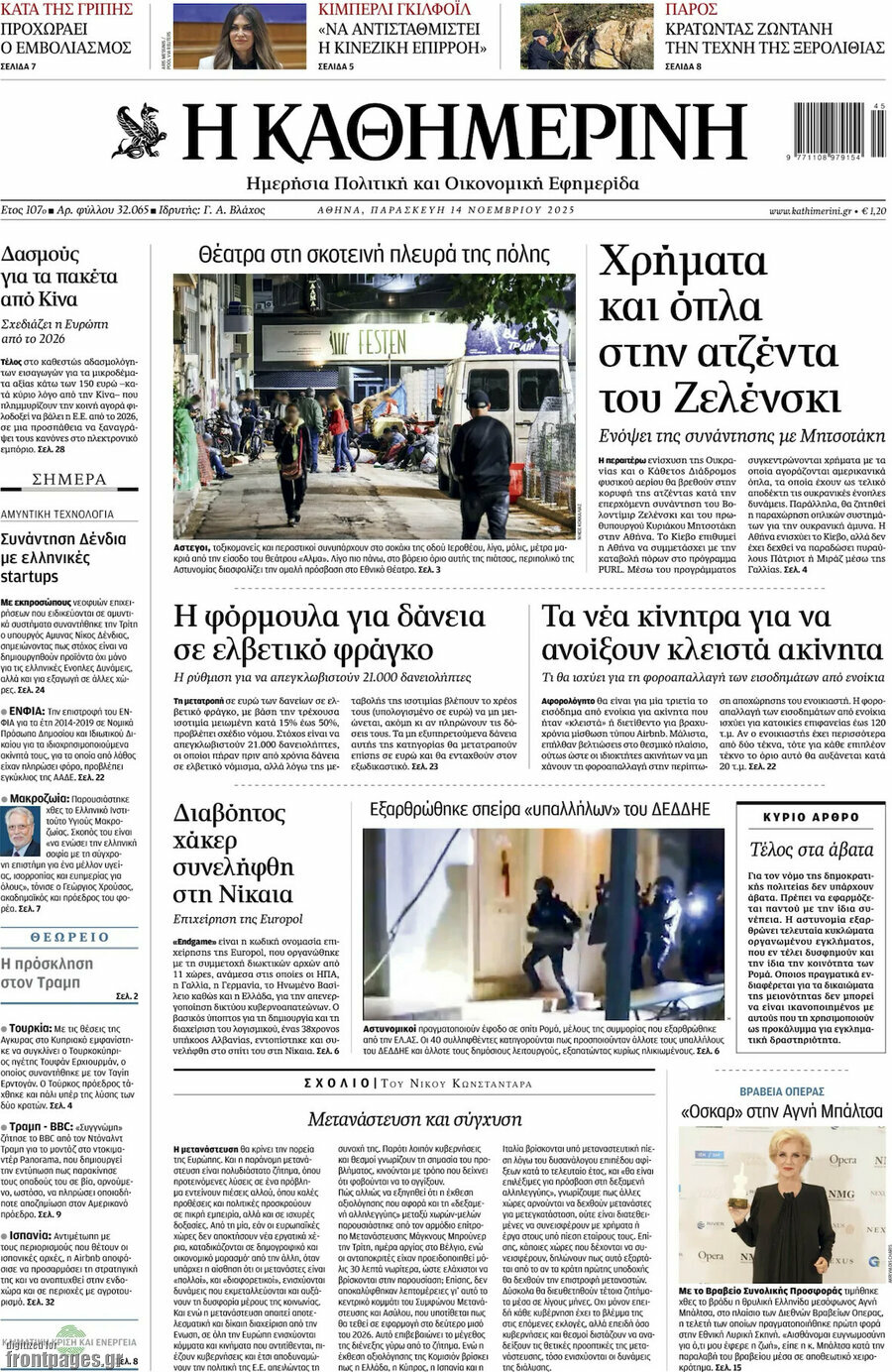
KATHIMERINI: Funds and weapons on Zelenskyy’s agenda
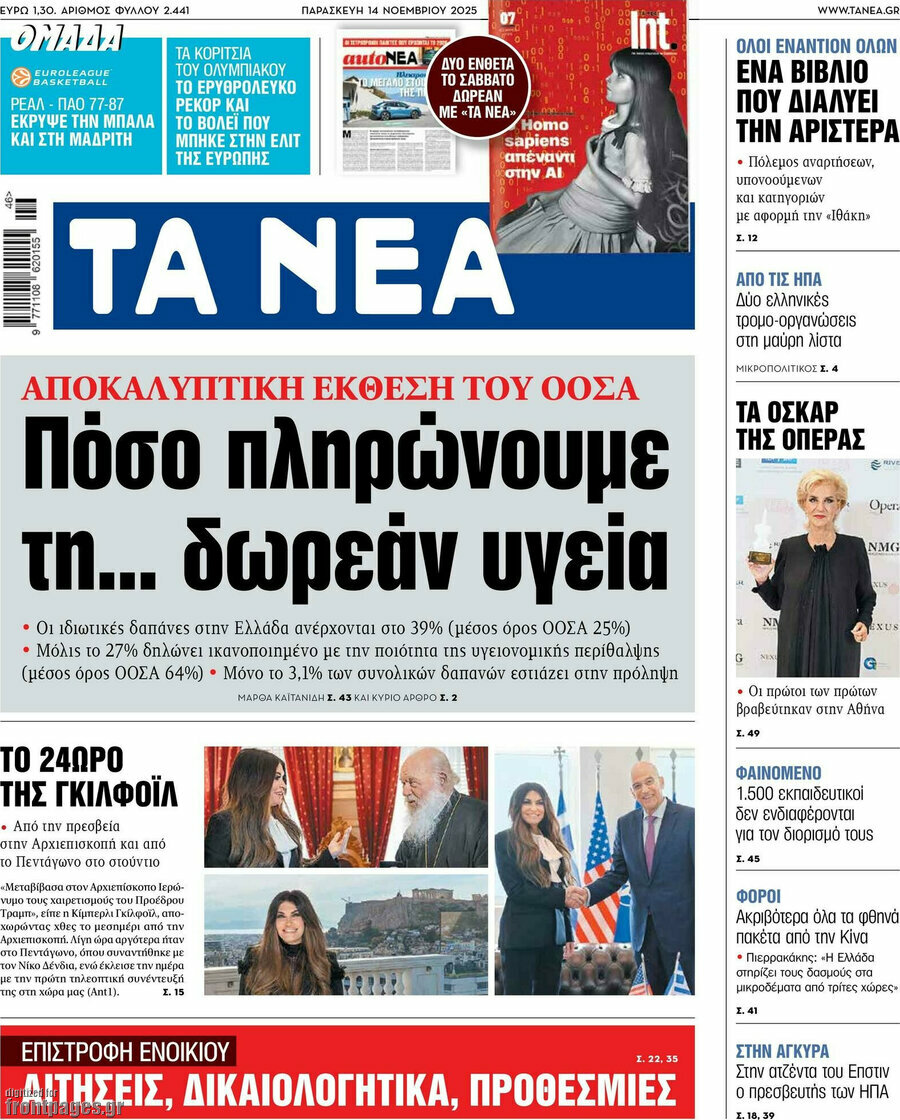
TA NEA: How much we are paying for… public health
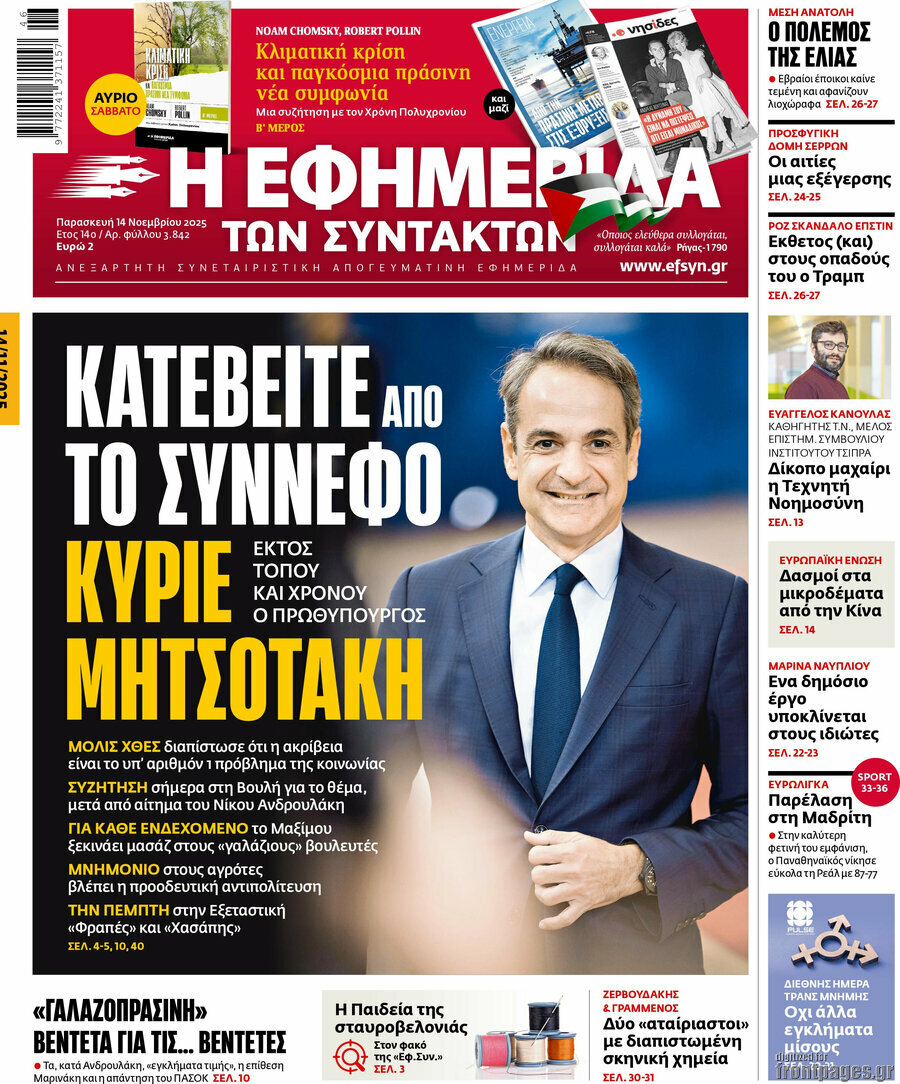
EFIMERIDA TON SYNTAKTON: “Mr. Mitsotakis get down from your cloud”
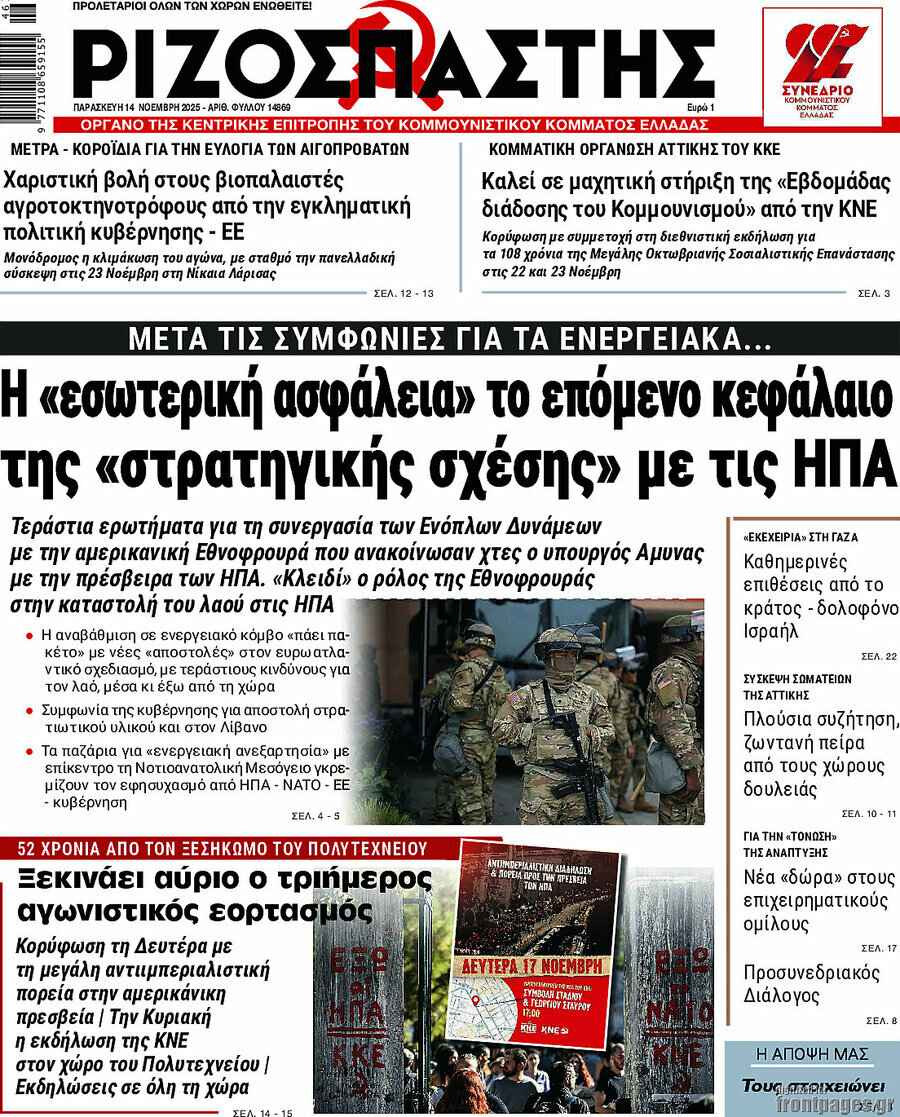
RIZOSPASTIS: “Internal security” will be the next chapter of Greece’s “strategic relationship” with the USA
KONTRA NEWS: Farmers’ ultimatum to the government

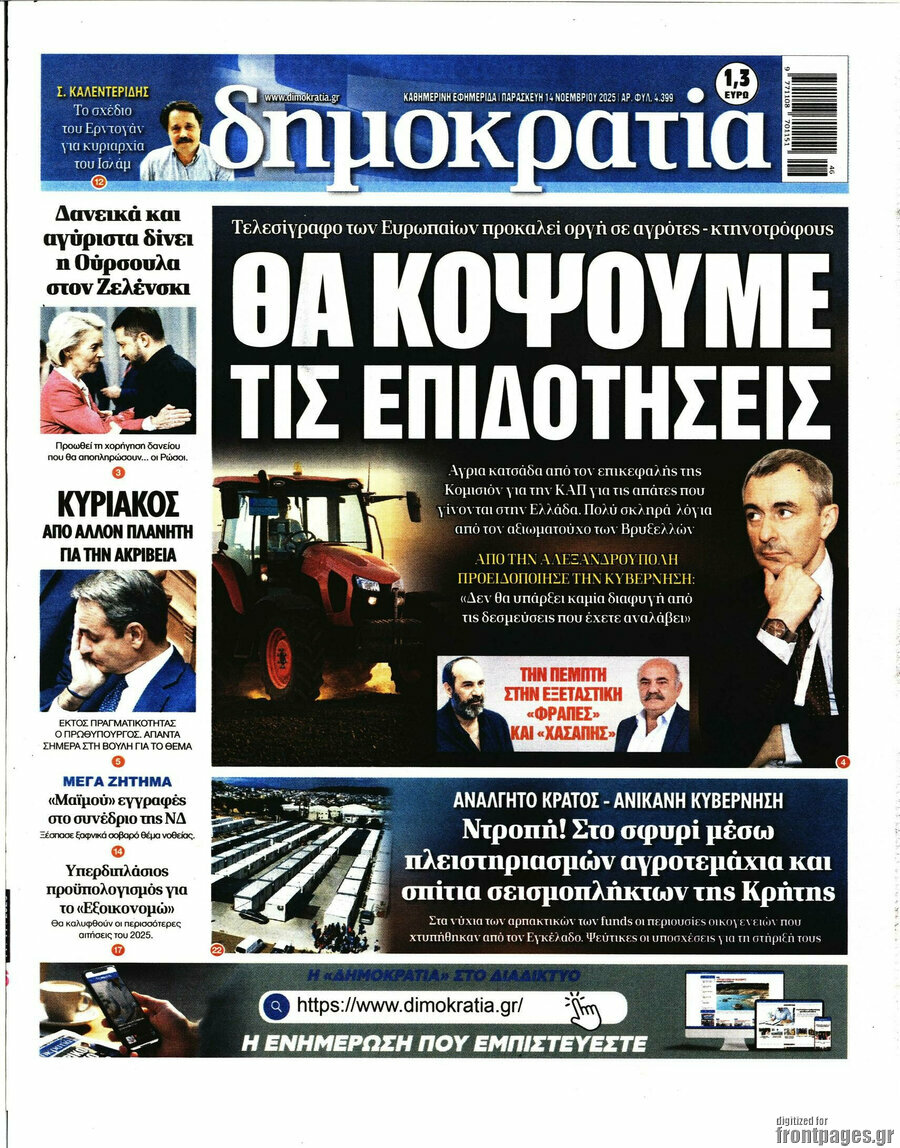
DIMOKRATIA: EU ultimatum: We will ax farm subsidies
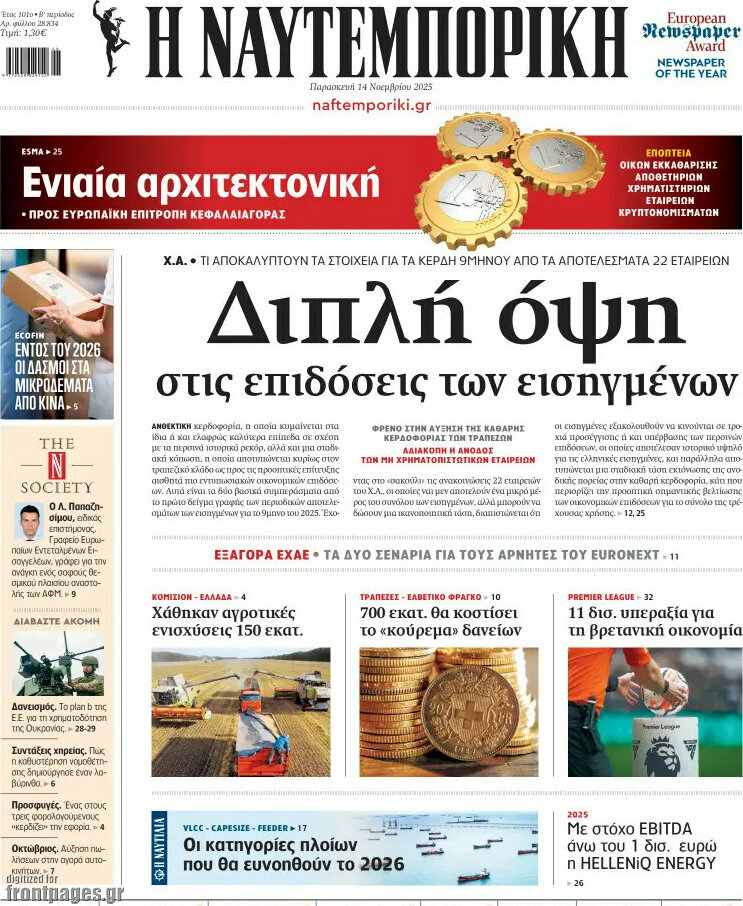
NAFTEMPORIKI: Double aspect regarding listed companies’ performance

DRIVING THE DAY: YERMAK DEFENDS ZELENSKYY
TOP ZELENSKYY AIDE PUSHES BACK ON CORRUPTION CRITICISM: Ukrainian President Volodymyr Zelenskyy is a “very principled person” and “not corrupt” despite a major corruption probe that has led to Ukraine’s energy and justice ministers stepping down this week, presidential adviser Andriy Yermak said in an interview with the Axel Springer Global Reporters Network, to which POLITICO belongs.
Wasn’t Z: Yermak said Zelenskyy himself should be above suspicion because it was he who “declared a fight” against corruption and allowed “absolutely free investigations” to go forward, which proved that anti-corruption agencies were “independent and working.”
Hints of manipulation: At the same time Yermak, who is a fixture at Zelenskyy’s side, suggested “some political forces were using” the corruption probes to discredit Ukraine’s leadership, and that baseless accusations that destroy a reputation could “happen to anyone.” He added: “Before you judge people, it’s necessary to have courts and investigations.”
How we got here: The pushback from Kyiv comes days after Ukraine was rocked by the biggest corruption probe of Zelenskyy’s presidency, after anti-corruption agencies revealed on Monday that some of his associates were allegedly involved in a plot to skim around $100 million from Ukraine’s energy sector.
Why it’s so painful: The scandal struck as Ukrainians are suffering blackouts caused by Russian bombing, with the state saying it has spent tens of millions of euros to protect energy infrastructure from drones and missiles. (ICYMI: Catch up on all the ins and outs of “Operation Midas” in this explainer by Veronika Melkozerova and Jamie Dettmer).
Brussels grits teeth: It prompted EU officials to seek reassurances from Kyiv over its efforts to combat corruption, Victor Jack reports in this piece out today — though so far no one is suggesting cutting financial aid over the scandal.
Calling on Kyiv: Zelenskyy “needs to comfort everyone, most likely with a plan on how to fix corruption,” said an EU official a week after the European Commission flagged “limited progress” in Ukraine’s anti-corruption efforts over the past year.
German Chancellor Friedrich Merz chimed in on Thursday after a call with Zelenskyy, saying Berlin expects “Ukraine to press ahead with anti-corruption measures and reforms.” Write-up here.
From scandal to cash crunch: The timing couldn’t be more delicate for Kyiv, which faces a €41 billion budget crunch next year. Brussels is doubling down on the use of frozen Russian assets as a “reparation loan” to help Ukraine over the hump — but Belgium is holding out due to fear of retaliation from Russia.
How it falls apart: In this must-read piece out today, Bjarke Smith-Meyer spells out how Ukraine will have to start belt-tightening from April if new funds don’t materialize, with painful measures — from pulling money from municipalities to postponing civil servant salaries — likely following within months.
The bottom line: A perfect storm of scandal, resistance to using Russian assets and drone attacks (including a massive one overnight) is dogging Ukraine. Kyiv has prevailed against worse odds before — but it needs some good news, fast.
PARLIAMENT’S NEW NORMAL
FAR RIGHT CLAIMS VICTORY: Speaking to POLITICO’s Max Griera, far-right group leader Jordan Bardella claimed victory after the center-right European People’s Party joined forces with his Patriots for Europe group to pass cuts to a major green regulation package.
Bardella, the EU parliamentarian: “The overall interest has won, but it is also the fruit of our ever-increasing presence … here concretely in the hemicycle,” Bardella, head of France’s National Rally and president of the Patriots for Europe group in the European Parliament, said after the vote.
More gloating: The Patriots’ lead negotiator on the file, Pascale Piera, called it a “historic victory” as they have managed to “bruise the von der Leyen majority.”
The center didn’t hold: The move signed the death warrant of the so-called cordon sanitaire, the informal pact between Europe’s centrist forces — the EPP, the Socialists and Democrats, the liberals of Renew, and the Greens — to keep the far right out of decision-making, Max writes in this definitive take.
Loading, new era: It also ushers in a new era defined by the largest group, the EPP — which also happens to be Ursula von der Leyen’s political family — joining forces with whatever political forces it needs to achieve its aims, tradition be damned.
BERLIN HACKS AT FOREST LAW
TIMBER! Berlin is taking a hatchet to the EU’s troubled bill against deforestation, proposing to delay its implementation by a year and asking the Commission to simplify the law by April 2026, according to a German draft paper seen by Playbook and circulated to perm reps on Thursday.
Context: The anti-deforestation bill has been stuck in Coreper I. Various envoys have proposed ways of breaking the impasse. But Berlin is Berlin, and the push for simplification is in line with a call by Chancellor Merz and 18 other leaders to radically revise EU regulation.
Dominoes: The push against deforestation is also the latest shoe to drop following the Commission’s two omnibus simplification bills, with the EPP hunting for further ways to slash red tape. Stay tuned.
SPEAKING OF DELAYS: Pieter Haeck and Gabriel Gavin scooped that the Commission is expected to propose delaying a key part of its landmark artificial intelligence rules, according to two Commission officials. Read their story here.
FRANCE CALLS FOR WAR ON DRUGS
PARIS NODS TO TRUMP’S DRUG WAR WITH CALL FOR SANCTIONS: France is no fan of Donald Trump’s campaign of strikes against suspected drug smugglers (see this criticism from Foreign Minister Jean-Noël Barrot), but agrees with Washington on the bigger picture — it’s time to get tough with organized crime and cartels.
Coming right up: Paris is pushing the EU to impose sanctions against anyone who participates in organized crime as well as their facilitators. A proposal is likely to be put forward as an AOB at the next Foreign Affairs Council on Nov. 20, per an EU diplomat and France’s foreign affairs spokesperson Pascal Confavreux, Clea Caulcutt and Playbook report.
Tough talk: “The government is mobilized to hit the evil at its root,” said Confavreux, adding that Paris would discuss the push with partners and bring it up with the European Commission.
Step back: Leaders’ rhetoric on the danger of organized crime, and its infiltration into all levels of EU society, have grown much more strident in recent months. A top judge in Antwerp recently said Belgium was turning into a “narco-state,” while French Interior Minister Bruno Retailleau called drug trafficking an “existential threat” for institutions.
Allies, anyone? Playbook reached out to a few likely partners in France’s push against organized crime. So far none have said they discussed this with France.
SPY VS. SPY
BRUSSELS INTEL TURF WAR: The European Commission is being accused of duplicating the intelligence capabilities of the bloc’s diplomatic arm, after this week’s revelation it was planning to set up a new intelligence unit in the executive’s secretariat, Antoaneta Roussi writes in to report.
Early days: The plan — a “very early, conceptual stage” — reflects wider efforts to bolster the EU executive’s security and intelligence functions, Commission spokespeople Balazs Ujvari and Paula Pinho said this week. It would live in the Commission’s Secretariat-General, under Ursula von der Leyen’s direct control, and would host seconded officials from national intelligence agencies.
Seeing double? That might sound familiar because it’s already the job of the Single Intelligence Analysis Capacity (SIAC), which brings together the EU Intelligence and Situation Centre (INTCEN) and its military counterpart — the EU Military Staff’s Intelligence Directorate — under the European External Action Service (EEAS).
Never enough: The unit the Commission is proposing would brief commissioners on security and intelligence matters, yet INTCEN has briefed three Foreign Affairs Councils this year — including one focused on defense — as well as a security College.
Duplicate it: “It would seem like an exact duplicate of INTCEN, wouldn’t it?” one EU official told POLITICO, speaking on the condition of anonymity to discuss the matter.
ITALY HEARTS ALBANIA
RAMALONI STILL GOIN’ STRONG: Giorgia Meloni gave a ringing endorsement of Albania’s plans to join the EU during the first-ever Italy-Albania summit held in Rome’s Villa Doria Pamphili, Jakob Weizman writes in to report.
Project 2028: The Italian leader announced she would set a target to start political negotiations for Albania to join the bloc in the first six months of 2028, which coincides with the dates of Italy’s EU presidency.
Full steam ahead on migration: Meloni also doubled down on her plan to send asylum-seekers to Italian-run detention centers in Albania. Italian judges, backed by a key ruling from the EU’s top court in August, repeatedly blocked transfers after rejecting Rome’s designation of several “safe countries.” But with the EU’s Migration and Asylum Pact due to be applied in 2026, “the centers will operate exactly as they should have from the beginning,” said Meloni.
NOW HEAR THIS: The EU Confidential podcast grapples with EU enlargement and its discontents this week. Host Sarah Wheaton talks to Sneška Quaedvlieg-Mihailović, head of Europa Nostra, about why Europe won’t feel complete until its whole cultural family is reunited, and with Icelandic politics professor Eirikur Bergmann on why his country may be revisiting its European path. Plus, Berlin Playbook’s Gordon Repinski Kosovo’s president, Vjosa Osmani. Listen and subscribe here.
HR FILES
FEAR AND LOATHING AT BARCELONA-BASED EU AGENCY: EU unions are sounding the alarm again about a staff survey at Fusion for Energy (F4E), a Barcelona-based EU agency. Carried out earlier this year, the Pulse survey shows high response rates for staffers experiencing interpersonal conflicts (77 percent), psychological violence (9.9 percent), sexual harassment (7.3 percent) and physical violence (4.4 percent).
From bad to worse: POLITICO reported on workplace conditions at F4E, which manages the EU’s contribution to the ITER nuclear fusion project, way back in 2022. At the time, staff reps warned that ITER would “most likely fail” unless conditions were addressed.
Three years later, the culture problems haven’t been fully addressed, per staff union Renouveau & Démocratie rep Cristiano Sebastiani. “The crisis that F4E has been experiencing for too long is primarily the failure of a governance model that has proven its inadequacy. It must be finally recognized that F4E and DG ENER cannot solve the problems on their own,” he told Playbook.
What gives? Sebastiani said the problems were down to weak management, pressure to perform and the competitive nature of scientific work carried out at F4E. He praised Commissioner Piotr Serafin for addressing the issue, but said more needed to be done.
F4E responds: Reached for comment, an F4E spokesperson said they had discussed the Pulse survey results with staff and outlined measures, including boosting training, launching an independent review of the agency’s anti-harassment policy and inviting the Commission’s Chief Confidential Counsellor Lene Naesager to the site.
IN OTHER NEWS
WEBER OFF THE EPPO HOOK: The European Public Prosecutor’s Office has closed its investigation into top EPP officials, including leader Manfred Weber. Details here.
TRUMP TO MAKE DAVOS RETURN: Donald Trump is expected to attend the World Economic Forum’s annual meeting in Davos in January, Bloomberg reported last night. The White House subsequently confirmed the report, per Reuters.
FRIDAY FEATURE: Who’d want to run the BBC? Paul Dallison has five fantasy candidates for the job in this week’s Declassified humor column.