
Athens nears restart of cable surveys
Greece expects to issue a Navtex notice by Monday, clearing the way for a French-flagged vessel to resume seabed surveys for the Greece-Cyprus electricity interconnector, the Great Sea Interconnector (GSI). Technical discussions have been completed, leaving the navigation warning as the main outstanding step. The Abeille Marengo is expected to begin operations over the weekend, initially within territorial waters. Turkey is expected to react but is not anticipated to obstruct the work, partly because it will host the COP31 climate summit in Antalya from November 9-20. Greece’s Foreign Ministry has extended the French authorization to cover all of 2027. A further recommendation from the committee responsible for marine research permits remains pending, although approval is expected. Foreign Minister George Gerapetritis is expected to authorize the measure before the Navy’s Hydrographic Service issues the Navtex.
https://www.ekathimerini.com/politics/foreign-policy/1320420/athens-nears-restart-of-cable-surveys
PM Mitsotakis: Greece to secure around €50bln from next EU financial tool
Prime Minister Kyriakos Mitsotakis, while speaking earlier on Thursday at the inauguration ceremony of the Solar Sludge Drying Unit at the Kalamata Wastewater Treatment Plant, described the project as a very important investment. He added that the experience gained from the Recovery and Resilience Facility will prove very useful in managing future European funds, referring to negotiations for the upcoming EU budget. “Greece will secure an amount of around € 50 billion from the next financial tool, the National and Regional Partnership Fund (EPES), and the question is how we will utilise it in the best possible way,” Mitsotakis said, pointing out that this new challenge must be approached under new terms since the EPES increasingly resembles the Recovery Fund.
PASOK leader Androulakis outlines 5 commitments for strong local government at KEDE conference
Local government currently faces severe consequences due to current government policy, which has led municipalities into a dual institutional and financial crisis, that threatens their ability to respond to even the basic needs of local communities, PASOK-Movement for Change (KINAL) leader Nikos Androulakis said in his address to the annual conference of the Central Union of Municipalities of Greece (KEDE) in Kalamata on Thursday.
Noting that PASOK claims the responsibility of governing the country, Androulakis stressed that municipalities hold a central role in its plan, laying out five specific commitments:
-Creating a genuine Regional Resilience Fund to finance flood prevention works, fire protection, and natural disaster prevention actions.
-Implementing a major institutional reform for local government by establishing a new framework guaranteeing administrative and financial autonomy.
-Restoring local government competencies.
-Ensuring local government participation in the country’s development planning.
-Substantially reinforcing municipal social structures.
Inflation rises to 5.6% in October
Inflation in Greece remained above 5% for the second consecutive month, closing at 5.6% in October, according to Eurostat estimates. It closed at 5.1% in September. This is the third highest change in the EU-Harmonized Consumer Price Index in the eurozone, after 6.1% in Lithuania and 6% in Bulgaria. Eurozone-wide, the corresponding change was 4%. Fuel prices and overall energy products continue to be the main drivers for inflation, which according to all indications will continue in the coming months. In October, energy prices increased on an annual basis in Greece by 26.5%, against a 20.8% rise in the eurozone.
https://www.ekathimerini.com/economy/1320304/inflation-rises-to-5-6-in-october
ATHEX: From Russia with loss for local stocks
The Euronext Athens (ATHEX) general index closed Thursday at 2,611.41 points, shedding 1.92% from Wednesday’s 2,662.45 points. The large-cap FTSE-25 index contracted 1.94% to end at 6,694.89 points.
https://www.ekathimerini.com/economy/1320423/athex-from-russia-with-loss-for-local-stocks




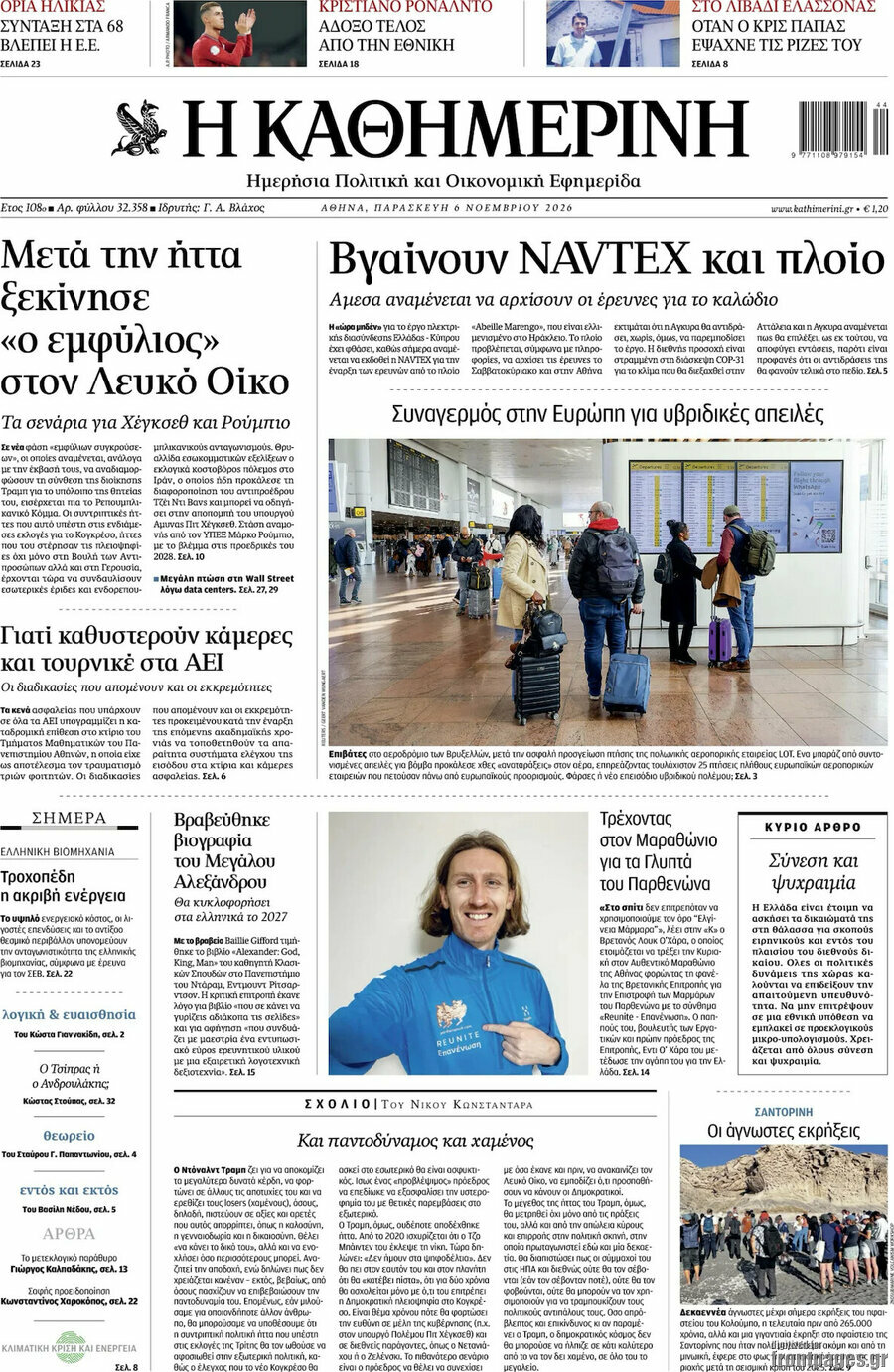
KATHIMERINI: NAVTEX and the cable vessel are being activated
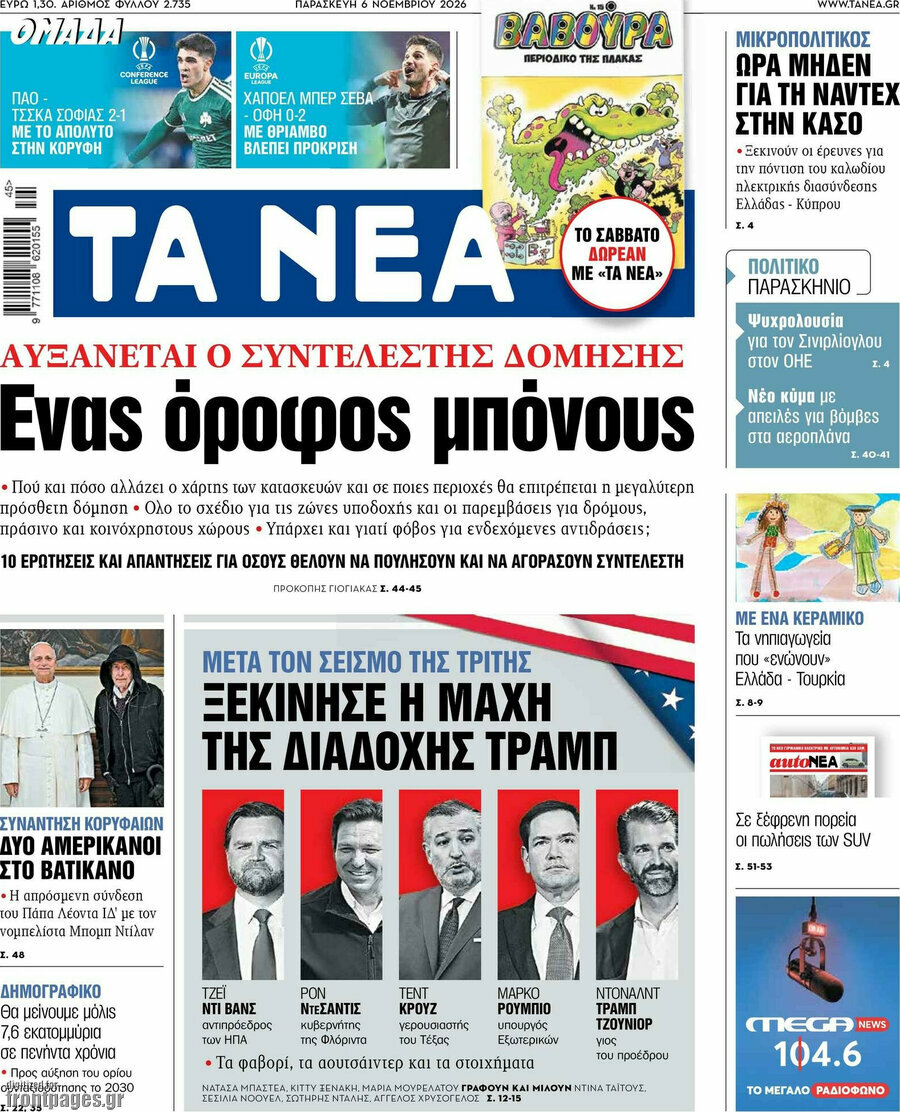
TA NEA: Construction heights: one floor bonus
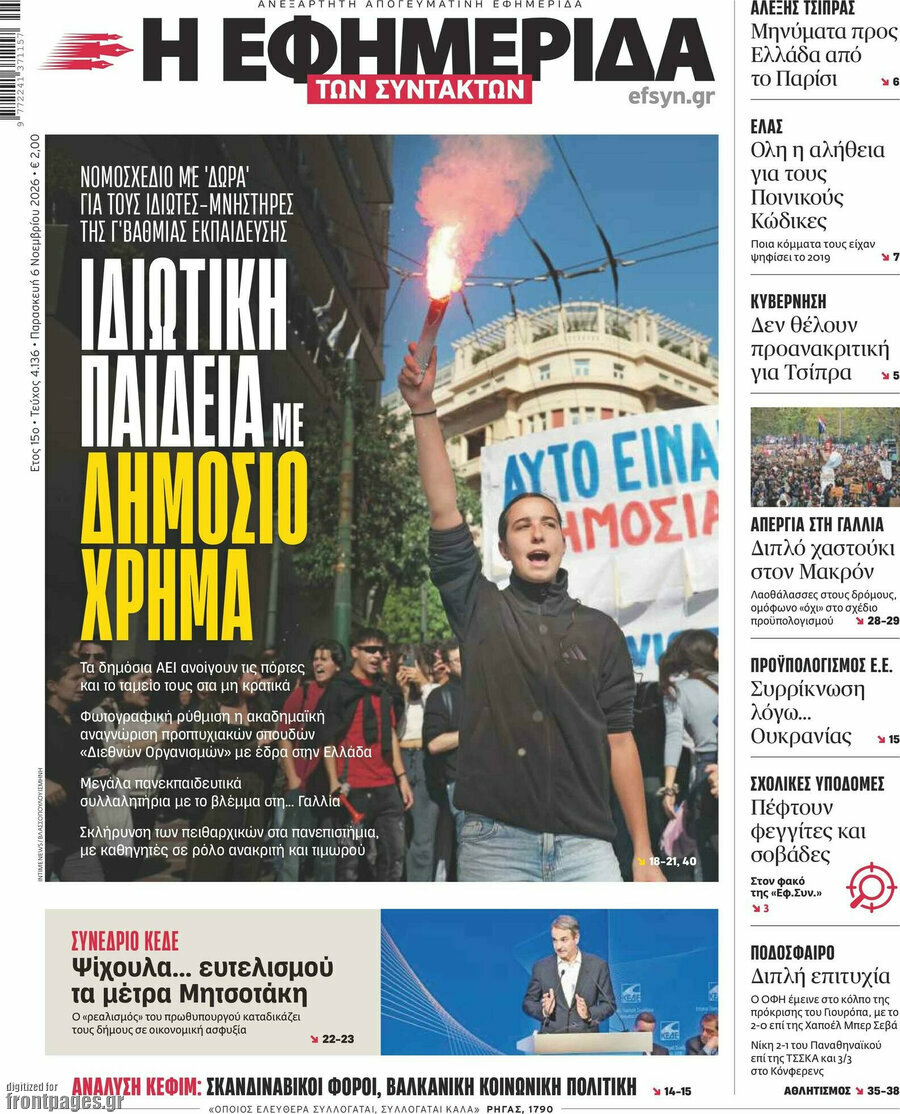
EFIMERIDA TON SYNTAKTON: Private education with public funding
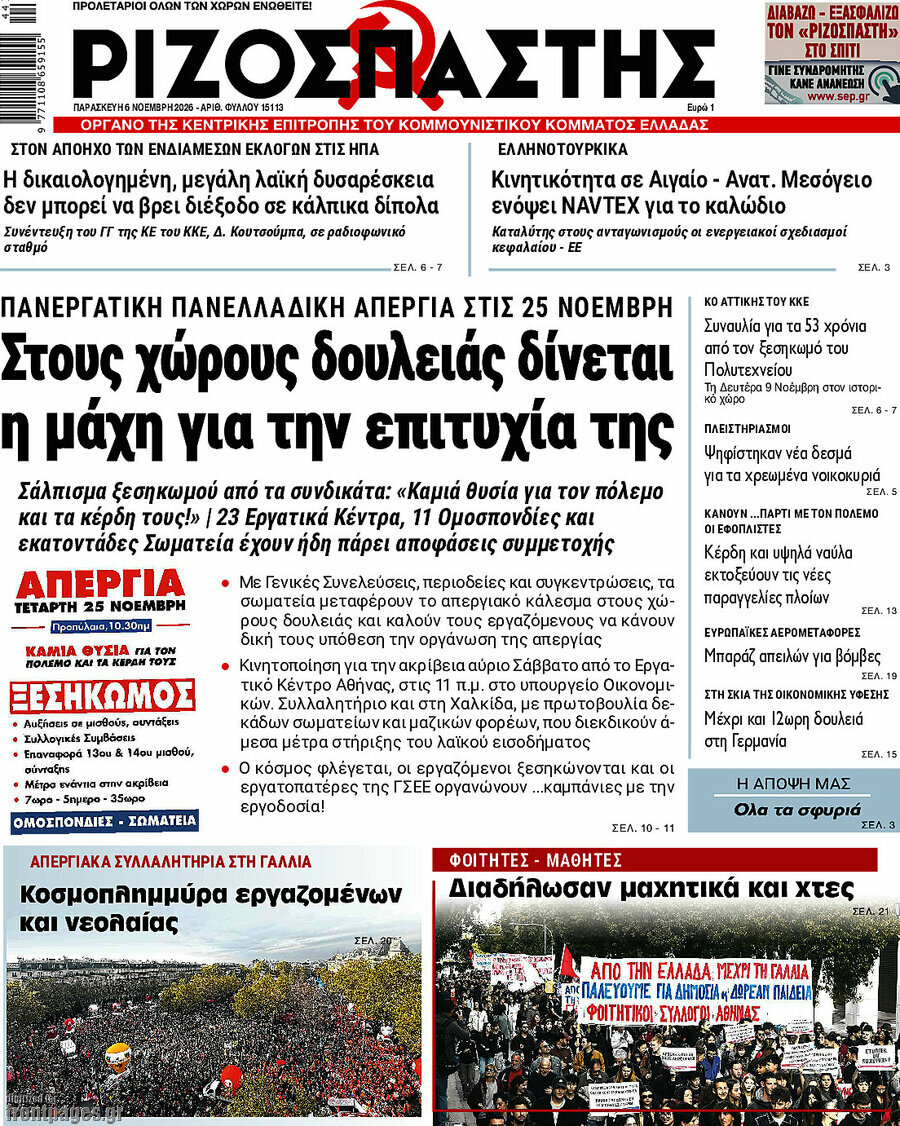
RIZOSPASTIS: The battle for the success of the November 25 strike takes place in working spaces
KONTRA NEWS: The calculation of the solidarity contribution is illegal

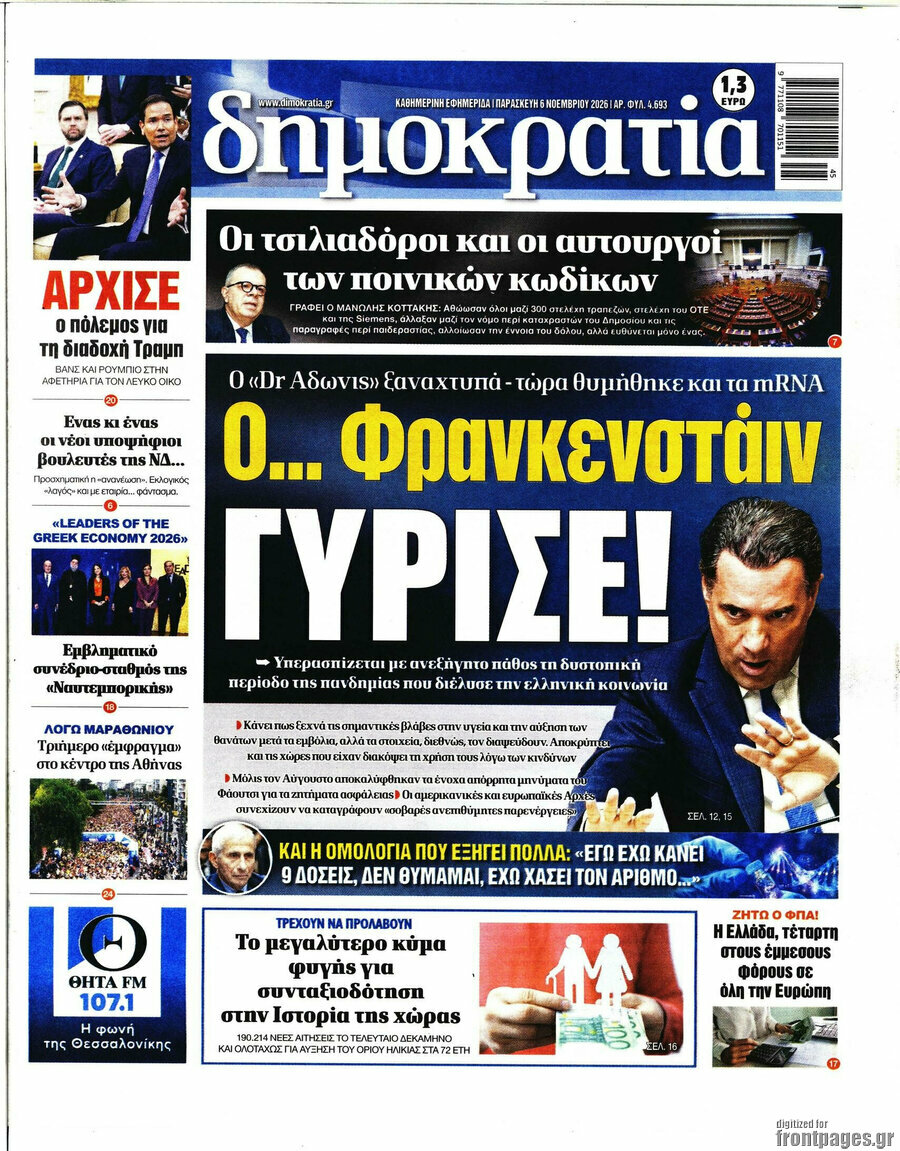
DIMOKRATIA: Frankenstein… is back
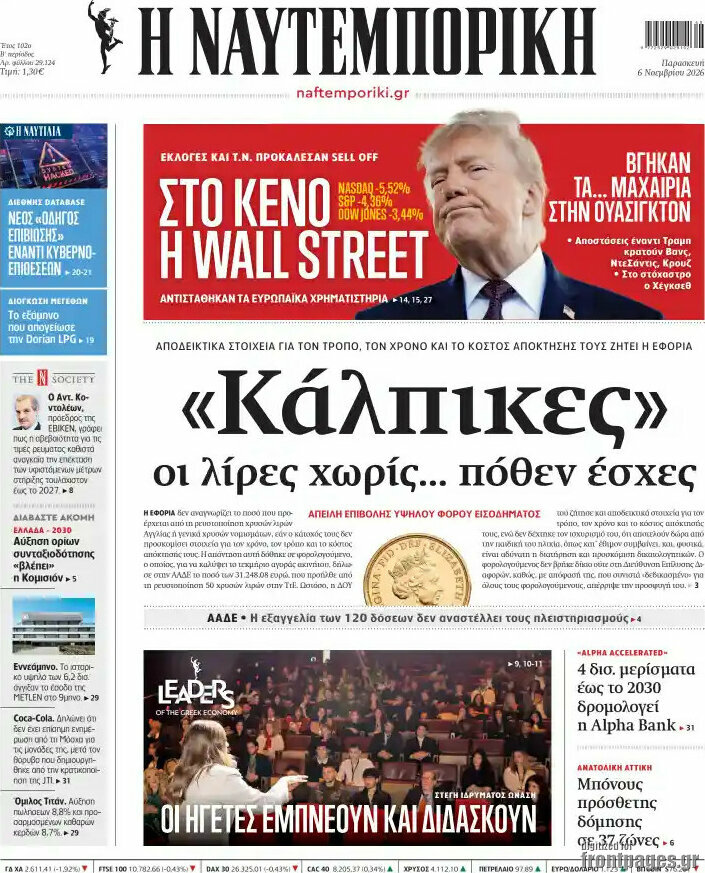
NAFTEMPORIKI: “Fake” liras without… wealth origin declarations

DRIVING THE DAY
A TALE OF TWO HOUSES: EU lawmakers and officials in Brussels are hoping to turn the Democrats’ midterm wins into a diplomatic opening with Washington, laying the groundwork for cooperation on everything from Russian sanctions to artificial intelligence and a transatlantic forum.
A fresh start: The “blue tsunami” earlier this week gave Democrats control of Congress, bringing a wave of new faces to Washington. Due to retirements, deaths and campaigns for other offices, at least 99 incoming members of Congress are newcomers — a record, according to NPR.
Out of the freezer: The chair of the European Parliament’s U.S. delegation, Brando Benifei said there’s “a lot of space with this new Congress to upgrade our level of cooperation,” telling me EU lawmakers could “push through projects that were frozen before.”
Top of the wish list: The implementation of Russian sanctions, U.S. intel sharing and PURL weapons is how a European diplomat posted to Washington listed the priorities to my colleague Daniella Cheslow. The EU’s top diplomat Kaja Kallas urged the new Congress to put “more pressure” on Moscow. “Let’s see what happens now,” she mused.
Another big target is …the Transatlantic Legislators’ Dialogue, an inter-parliamentary exchange between MEPs and members of Congress. Benifei said “institutionalizing” the group is now back on the table, while a senior EU official said Brussels was planning to gauge interest on Capitol Hill for a beefed-up version of the forum. The official was granted anonymity, like others, to discuss the internal plans.
Planting seeds: “The fact that we have now such a new Congress provides some diplomatic opportunities for the EU delegation in Washington and the European embassies there,” a second EU diplomat said. Laying the diplomatic groundwork now will bear fruit in six months, a year — or longer, the diplomat argued.
There is cautious optimism in Brussels that a Democratic-controlled Congress could prove a more receptive partner. “The relationship with Congress under Speaker Mike Johnson was not bad, but there were tensions,” the official said, adding the EU would wait to see how much things change once Hakeem Jeffries is sworn in as speaker in January.
Other targets: There will be “new opportunities” to work together on AI legislation, Benifei predicted, singling out the House Committee on Ways and Means, which has trade jurisdiction, as an important partner to help blunt Trump’s tariff threats. (A Democrat will take the reins of the committee from a Republican in 2027.)
Quick reality check: European officials are under no illusion that a Democratic Congress will automatically mean a return to the Joe Biden-era transatlantic relationship. A second senior EU official said they expect the Democrats to have their hands full with domestic politics.
But the midterms could open channels for cooperation in specific areas that have been closed off for years. And for Brussels, even an incremental thaw in relations is welcome after two years in Trump’s freezer.
BIG AND BREAKING
TRUMP MEETS RUSSIAN ENVOY: Donald Trump met Vladimir Putin’s envoy Kirill Dmitriev privately in Washington yesterday, the U.S. president told reporters last night, adding that Russia’s war with Ukraine is close to being settled in a deal that “might involve all of Europe.” Reuters has a write-up.
EXCLUSIVE — BUDGET SWEETENER: European Council President António Costa suggested limiting a controversial business tax to companies with a turnover exceeding an annual €750 million, two EU diplomats briefed on the discussions told Gregorio Sorgi.
MADRID GOES MAGA: With Hungary’s Viktor Orbán gone, Spain’s nationalist Vox party is set to play an increasingly central role in the far-right global ecosystem.
WTF MFF: Europe’s key policy files, including its push to accelerate AI chip production and strengthen its Arctic presence, are caught in the logjam of Brussels’ seven-year budget standoff.
DIPLOMATIC HOMEWORK: Ambassadors from countries bordering France had lunch with far-right presidential candidate Marine Le Pen at the German ambassador’s Paris residence on Wednesday, three officials told Giorgio Leali and Sarah Paillou, with the EU dominating the discussion.
EPP’S BALKAN SCHISM
THE EPP’S TWO BLACK SHEEP: Since parting ways with Viktor Orbán, the European People’s Party has tolerated two of its more troublesome national figures. Now, the EPP is weighing up whether to kick out the party of Serbia’s Aleksandar Vučić, while appearing to turn a blind eye to the friendly fire of Slovenia’s Janez Janša.
Vučić in the balance: The EPP is set to decide at its Dec. 7–8 Political Assembly whether to take a tougher line on Vučić’s Serbian Progressive Party (SNS), after launching a scrutiny process in September 2025 into whether the party still respects the political family’s fundamental values, Max Griera and Nektaria Stamouli report.
“Things are not looking good for SNS,” said a senior EPP official. “They had promised to fix certain things and there was a timeline for actions and commitments, but they were not met.” The official was granted anonymity to discuss internal group deliberations.
The choice ahead: Some EPP members argue Serbia shouldn’t be isolated and SNS should remain in the fold, albeit under closer scrutiny. Another senior EPP insider said there were now two options: impose conditions under which the SNS can remain in the EPP, or kick the party out. An EPP spokesperson said the process is “ongoing.”
Looking the other way: Recent barbs from the Slovenian prime minister have been met with a more muted response. On Saturday, Janša took to social media to accuse fellow EPP national leaders Donald Tusk and Péter Magyar of rule-of-law abuses, drawing praise from senior figures in the far-right Patriots for Europe.
Little reaction: “No one has noticed much,” said one lawmaker. Polish EPP Vice-Chair Andrzej Halicki told POLITICO he found Janša’s comments “strange,” saying they showed a “lack of information.” EPP chief Manfred Weber declined to comment.
Words and deeds: The EPP has shown a high tolerance for outbursts, so long as members vote in line with the party and avoid causing problems in the European Council, with ongoing support of Ursula von der Leyen’s Commission part of the deal. It took the EPP years to part ways with Orbán.
A reliable ally: Janša “is tough in words, but in the end, he does cooperate,” said a senior EPP insider. A Slovenian EPP vice-chair, MEP Romana Tomc, is also widely liked in Brussels. “She’s fun,” said another EPP lawmaker.
20-SECOND PLAYBOOK PRIMER
Next week is the latest United Nations Climate Change Conference in Antalya, Turkey. COP31 (it stands for Conference of the Parties) runs from Nov. 9-20. But what will the negotiators be trying to achieve? Among the issues up for discussion are the transition to cleaner economies, climate finance and cutting emissions. That all comes after a summer in which Europe suffered from savage heatwaves and droughts.
THE COST OF (NOT) LEAVING SCHUMAN
COMMISSION TO PAY €300 MILLION TO STAY PUT: The Commission is set to pay over €300 million in fees for not moving out of seven buildings that it sold in 2024. Part of that money gets added to the bloc’s annual budget, worth almost €200 billion, which is expected to be signed off on Tuesday by the European Parliament and national governments.
The Commission sold 23 buildings in the affluent Schuman neighborhood for €900 million in 2024, to cut costs and reduce office space, as more staff worked from home. This coincided with a controversial plan to relocate hundreds of Eurocrats to the cheaper Northern Quarter.
But some of these savings have been offset by €255 million in fees the Commission paid to extend its stay in seven of the sold buildings, including the Madou Plaza Tower, which hosts DG COMP. The EU executive is also on the hook to pay the rest of the money — €24.6 million in 2027 and €25.6 million in 2028 — to prolong its stay, according to a Commission spokesperson.
On the attack: The head of the Renouveau & Démocratie trade union representing EU staffers, Cristiano Sebastiani, slammed the Commission’s strategy and asked for clarification as to whether “these payments would enable the purchaser to recover the purchase price within only a few years.”
But the EU executive pushed back. A Commission spokesperson told Gregorio Sorgi that prolonging its stay in some buildings allowed “margin to negotiate new rental contracts” and to “pursue its long-term building policy adequately and on cost-effective grounds.”
DASHBOARD
Germany is under pressure from the U.S. to pay more for new medicines, with talks expected in Berlin in coming days, trade colleagues Camille Gijs and Caroline Hug report. Berlin has been mulling proposals to avoid tariffs as it awaits the results of an investigation by the Trump administration, which argues that U.S. citizens are subsidizing medical research for countries in Europe through higher drug prices.
The results of a POLITICO Poll suggest respondents would be open to paying more, in return for faster access to new medicines. When asked to choose between price and access, a majority of respondents in Spain, Germany and France, as well as the U.K. and Canada, favored higher prices.
 |
4 MORE THINGS GETTING US TALKING
ESTONIA’S WARNING: Europe shouldn’t open up a diplomatic channel to “dictator” Vladimir Putin, Estonia’s Prime Minister Kristen Michal said.
ACCESS DENIED: Washington has scuttled a French push for the G7 to coordinate on advanced AI safety, with a White House official calling it “unnecessary bureaucracy.”
DAS IST NICHT SO GUT: Germany’s defense ministry has privately warned that moving too quickly to reduce the country’s dependence on American weapons could jeopardize relations with Washington, according to internal briefing materials obtained by POLITICO.
BLAME LIZ: The Republican Party’s midterm disaster, the cost-of-living crisis, the war in Iran, Trump’s election strategy of complimenting people’s buttocks … The Declassified column wonders whether former U.K. Prime Minister Liz Truss is the common thread.
 |