
Karystianou rolls out new party, attacks political establishment
Maria Karystianou formally entered Greek politics Thursday, rolling out a new party named “Hope for Democracy” with a platform strong on anti-establishment rhetoric and support for policies ranging from animal welfare to fighting price-gouging and corruption. The 53-year-old pediatrician’s 19-year-old daughter was among the 57 victims of the 2023 Tempe rail accident – a head-on smash between a passenger train and a freight train that had been allowed onto the same track, speeding in opposite directions.
Public consultation opens for new Local Government Code abolishing two-round elections
Changes to the system for electing municipal and regional authorities – including the abolition of the second round of elections, the introduction of electronic voting, clarification of responsibilities, and the resolution of issues concerning financial management, oversight, and administration of local government organizations – are included in the Local Government Code presented for public consultation by Interior Minister Theodoris Livanios.
Leader of 17 November terrorist group released from jail on conditional terms
Alexandros Giotopoulos, who was jailed as leader of the terrorist organization 17 November, was released from Korydallos jail 24 years after his sentencing to extremely severe penalties, including multiple life sentences.
First non-political persons involved in OPEKEPE investigation to testify before European Prosecutors on June 5
The first individuals who are not involved in politics were summoned by European Prosecutors to testify on the OPEKEPE irregular distribution of EU farm subsidies on June 5. They will be asked to explain subsidies received from OPEKEPE for the year 2021. A group of some 50 defendants began testifying on Thursday (May 21) before the European Prosecutors in Athens, and the rest will continue on Friday. The group includes people involved in politics, such as high-ranking officials and staff of the OPEKEPE agency, farmers and others, who have been recorded in conversations where they directly or indirectly asked to circumvent regulations so they can collect suspect subsidies. The charges include both misdemeanors and crimes.
ATHEX: PPC rules the bourse roost after increase
Public Power Corporation stole the show yet again at the Greek stock market on Thursday, accounting for more than half of the day’s turnover after closing its book for its share capital increase. Its issue was more than 4.5 times oversubscribed and its share price soared 7.23% on the day. That drew the rest of the market higher, too, with Eurobank, which has just opened an office in Mumbai, India, standing out. Overall turnover grew considerably, with the benchmark covering most of its recent losses.
https://www.ekathimerini.com/economy/1304484/athex-ppc-rules-the-bourse-roost-after-increase



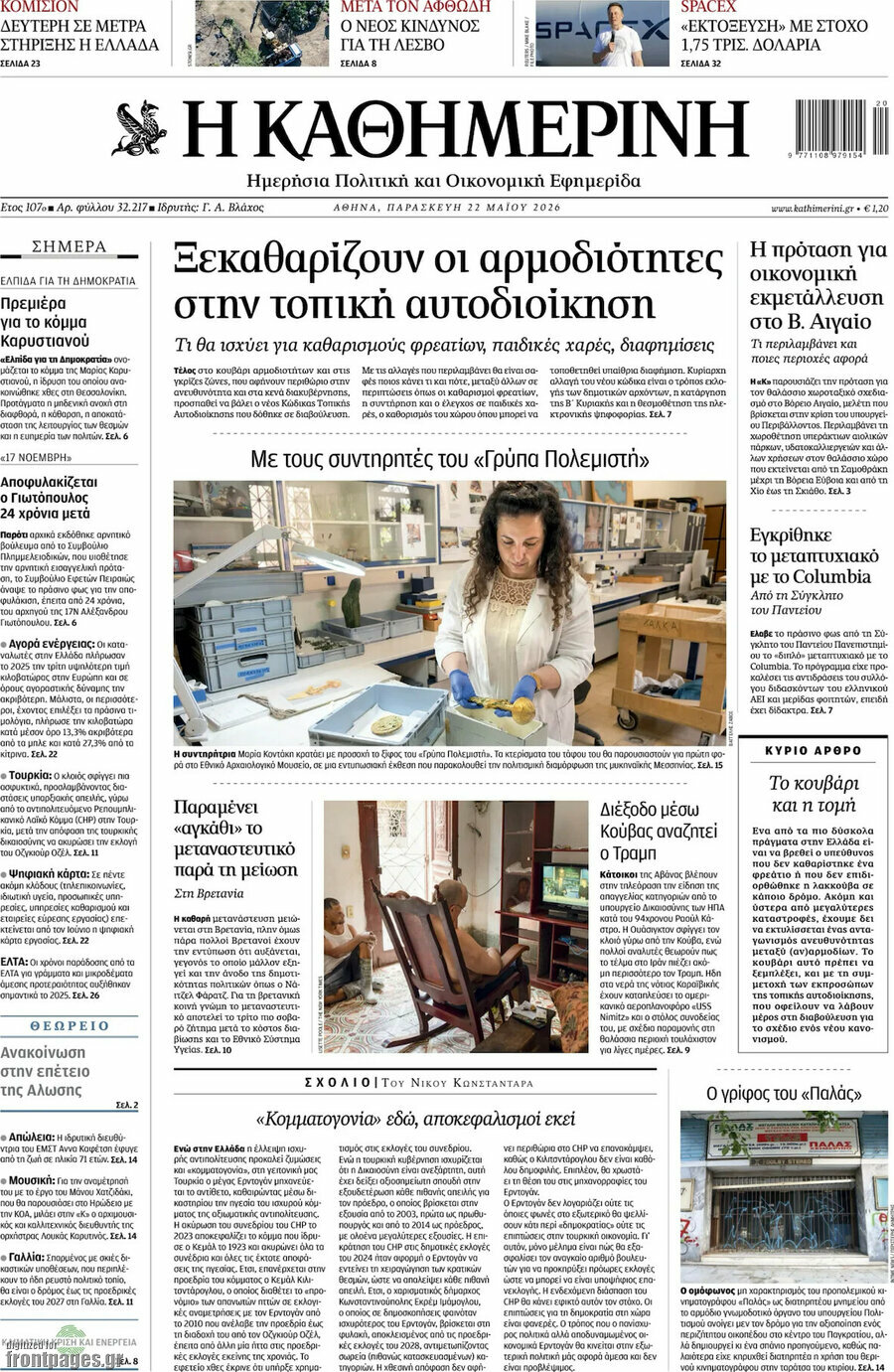
KATHIMERINI: Local government competence clarified
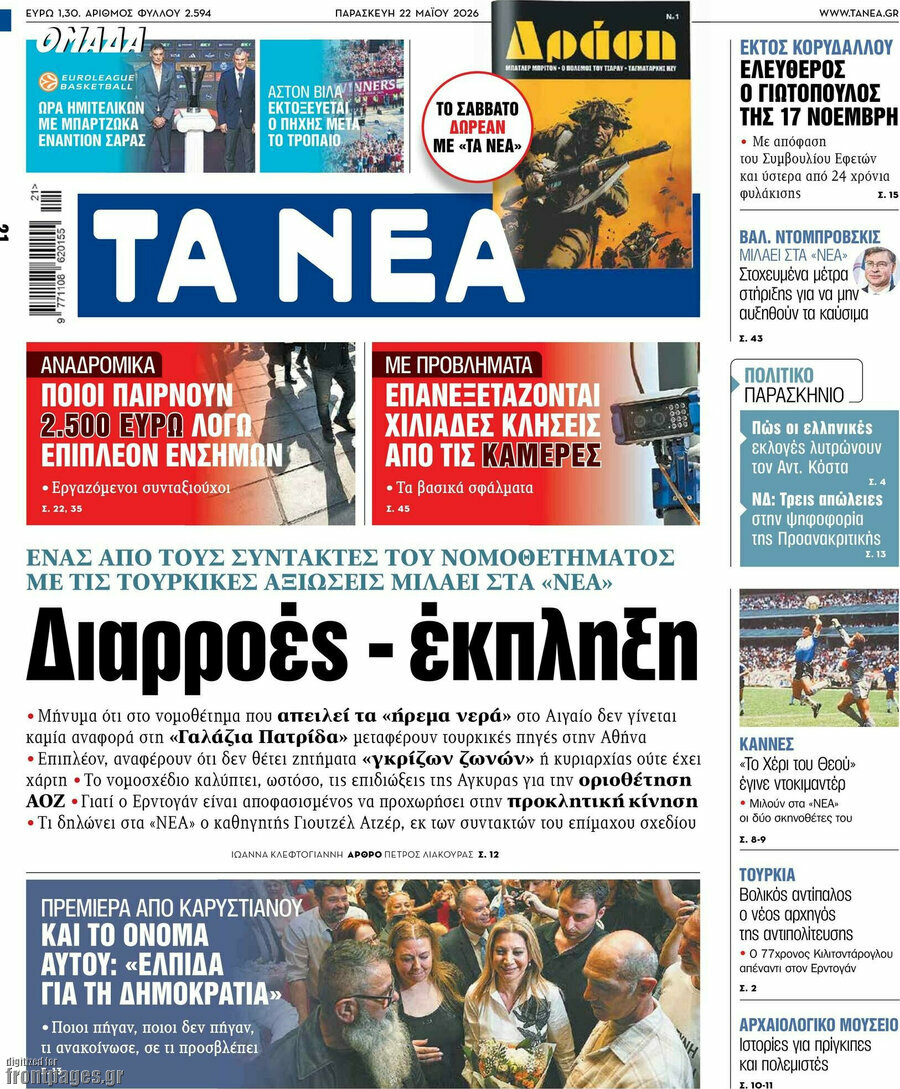
TA NEA: Turkey: Surprising leaks
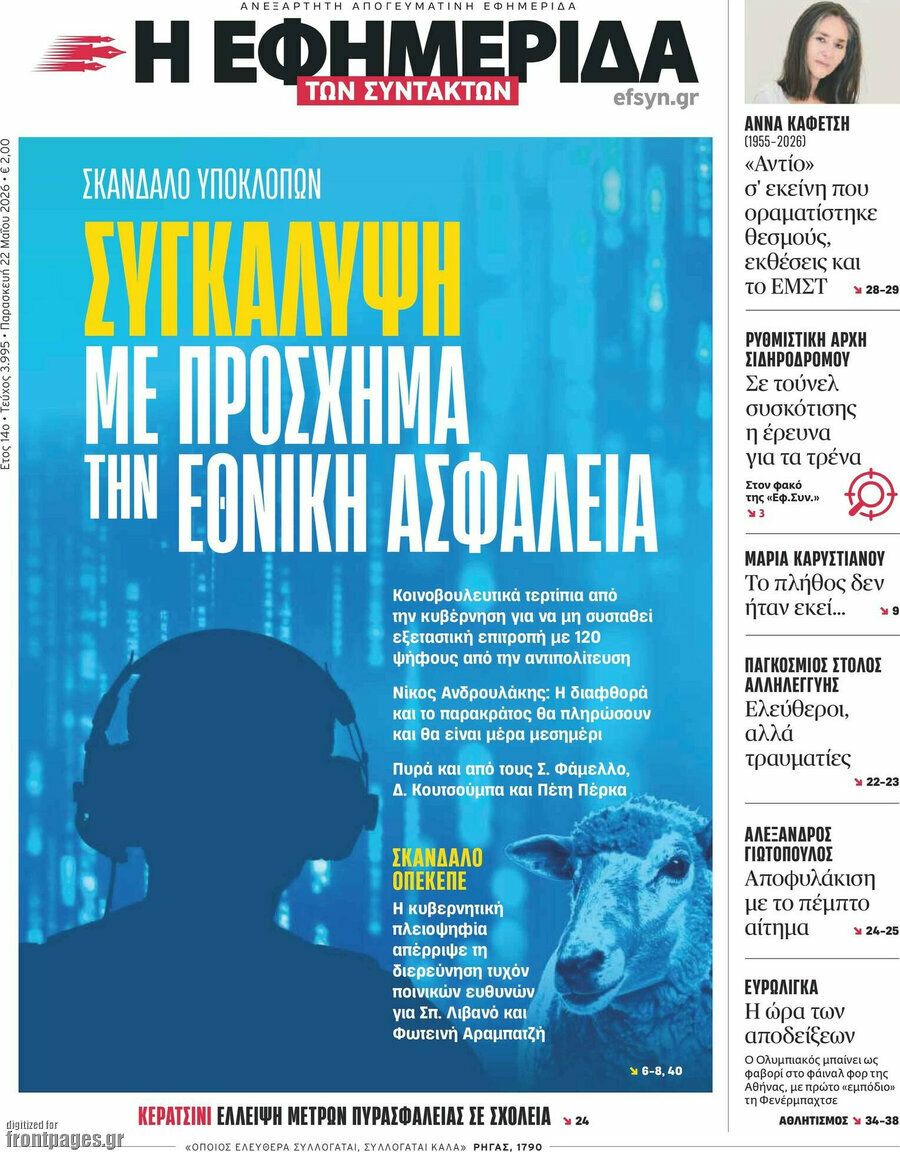
EFIMERIDA TON SYNTAKTON: Wiretappings scandal: cover-up with national security as a pretense
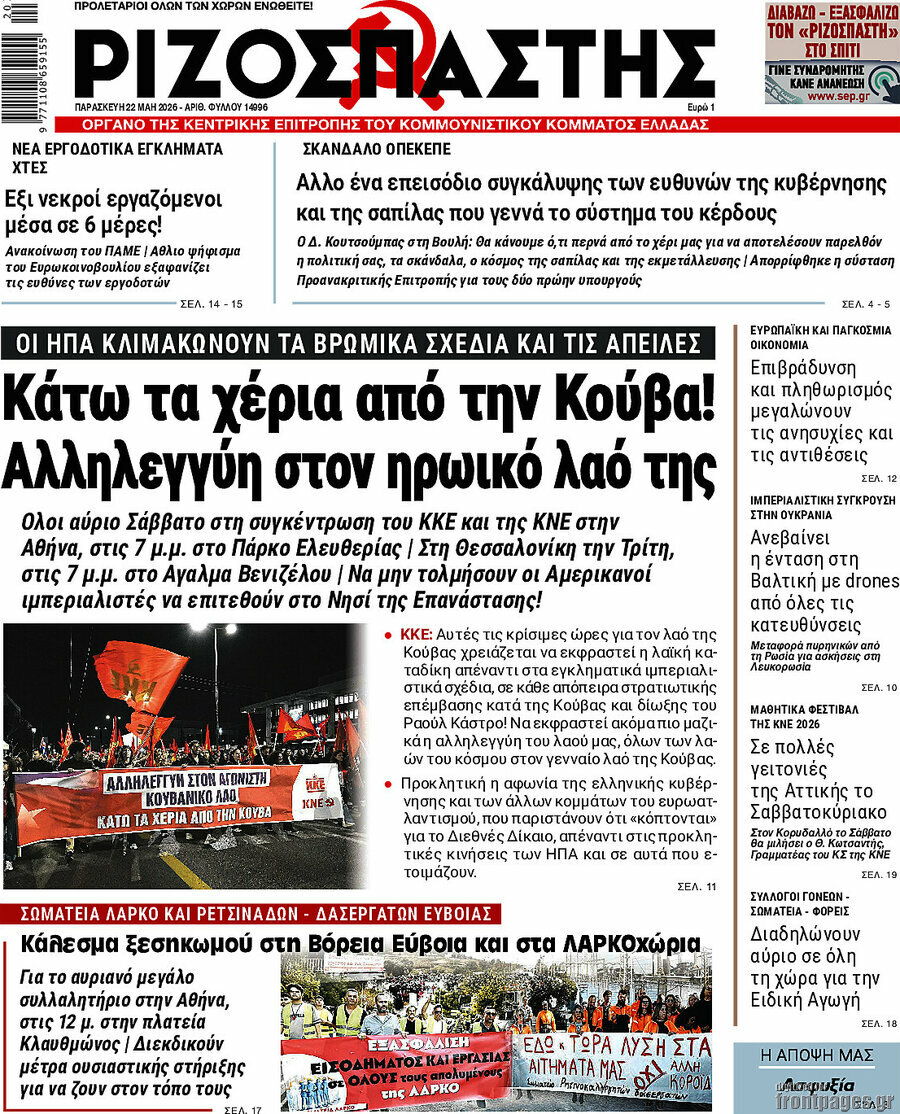
RIZOSPASTIS: Hands off from Cuba!
KONTRA NEWS: Bold measures for the housing crisis
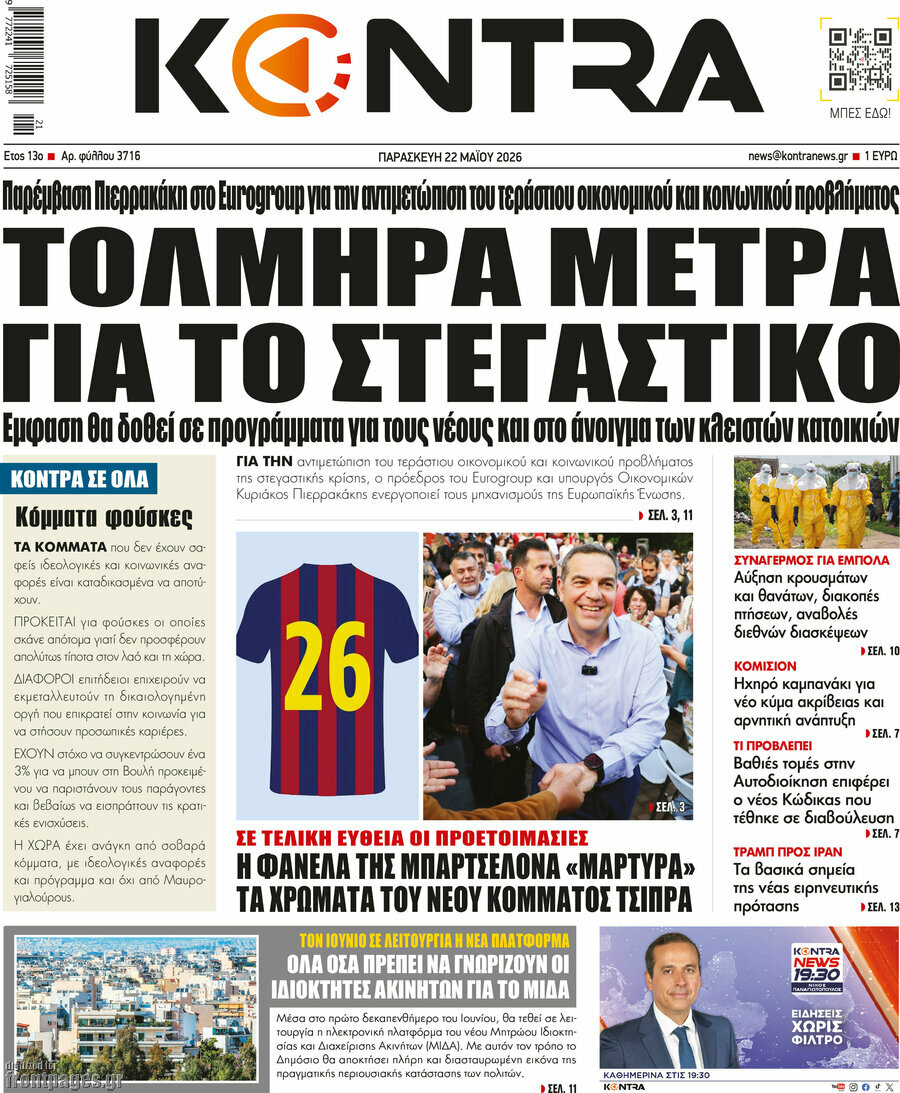
DIMOKRATIA: Karystianou: “With clean hands we will bring back light and hope”
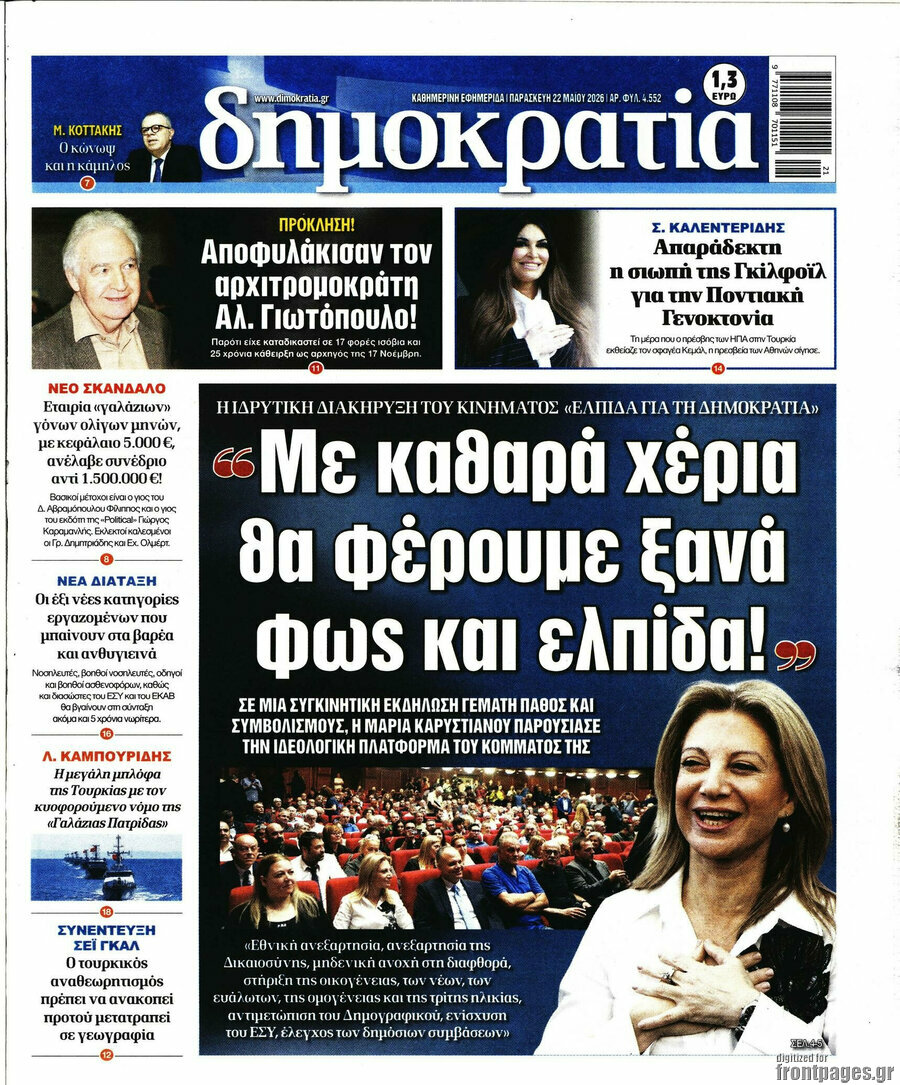
NAFTEMPORIKI: Multiple “gains” from PPC’s capital increase

DRIVING THE DAY
WHO’S AFRAID OF THE BIG TECH ACT? The EU’s long-awaited tech-sovereignty package is missing — again — from the Commission agenda, despite expectations it would dominate the discussion next week. It’s the third delay for a file Brussels says is about the EU standing on its own two feet in tech. So — why the holdup?
Behind the scenes: Some think the draft isn’t ready, while others fear it could antagonize Washington. That’s according to six officials familiar with the talks, who spoke to POLITICO’s Mathieu Pollet, Nicholas Vinocur and me, and were granted anonymity to discuss the internal deliberations.
The official line: “The Commission is currently finalizing details to present a solid and mature initiative,” spokesperson Thomas Regnier said.
Tech what? The package is meant to reduce Europe’s reliance on foreign technology as the bloc is squeezed between U.S. dominance in cloud computing and China’s strategic push into AI, chips and digital infrastructure. Its most controversial component, the EU Cloud and AI Development Act, could push governments and companies to buy more European tech — effectively pushing major U.S. cloud providers out of parts of the European market.
Delicate timing: The roughly 400-page package was sent around for internal Commission review on Monday night, barely 24 hours before eleventh-hour EU talks on the bloc’s beleaguered trade deal with Washington. For officials trying to keep that transatlantic track steady, a proposal that could hit U.S. tech giants set off alarms.
Brake slam: Several Commission departments pushed for a last-minute pause, officials familiar with the talks said. The presentation, initially penciled in for next Wednesday, has now slipped to June 3.
Blame Washington? Green lawmaker Alexandra Geese called the latest postponement “almost ironic.” “That’s not what sovereignty looks like,” she told Mathieu, arguing that trade talks have become “a weapon” against Europe’s digital industry.
Or blame Brussels? Three EU officials rejected the idea that Commission President Ursula von der Leyen pulled the handbrake to protect relations with Washington. Two instead pointed to DG CONNECT — the Commission department steering the file — for circulating a draft they said was nowhere near ready for sign-off, including by the president’s own team.
What happens next: Officials expect more fights over the legality of “buy European” procurement clauses and the risk of alienating strategic partners. The next big moment for the package’s political fate is the heads of cabinet meeting, scheduled for next week.
Sovereignty is spreading: The same mood is already shaping other decisions: Brussels this week picked Swedish private equity firm EQT over British VC firm Atomico to manage the EU’s €5 billion startup scale-up fund.
Is being British a problem? Asked whether choosing a non-EU manager might have been politically awkward, one senior EU official told me with admirable Brussels honesty: “It’s not totally wrong that it’s easier for us that [the winning bid] is a pure EU country.”
Takeaway: Before Europe’s tech sovereignty push can test relations with Washington, it first has to survive Brussels.
BIG AND BREAKING
SPEAKING OF AI: ASML CEO Christophe Fouquet warned POLITICO’s Pieter Haeck that Brussels is drifting away from Europe’s industrial champions — and risks pushing AI companies out of Europe altogether.
MY JOB IS SAFE: Influencers invited by the Council to high-level EU meetings won’t replace journalists, one content creator told my colleague Mari Eccles after last week’s scoop. Brussels’ press corps can breathe easy.
ALL ABOUT THAT BAS: Green lawmakers walked into a routine Parliament meeting on Wednesday — and got blindsided. One of Brussels’ best-known MEPs, Bas Eickhout, announced he would quit. Our Parliament correspondent Max Griera brings you the chronicle of Eickhout’s rise and fall.
HOW TO KEEP TRUMP HAPPY: Mark Rutte has a strategy to stop U.S. President Donald Trump blowing up NATO: promise defense deals that also benefit Washington. Victor Jack and Jacopo Barigazzi explain the logic.
SURPRISE DEPLOYMENT: Trump announced on Truth Social last night that the U.S. will send another 5,000 troops to Poland — an apparent reversal of his moves to reduce the presence of American forces in Europe. NATO foreign ministers meeting in Sweden today had been braced for U.S. Secretary of State Marco Rubio to signal more cuts, Victor reports.
SANCTIONS SPLITS
PUSH FOR ISRAEL SANCTIONS HITS TURBULENCE: A growing campaign for new sanctions against Israel over its harsh treatment of Gaza flotilla protesters is running into two obstacles: the Czech government and concerns that such measures could bolster hardliners in Israel’s upcoming election.
Never simple: The pushback shows that although EU countries have recently approved sanctions targeting violent West Bank settlers, the bloc’s stance is far from unified, Nicholas Vinocur reports. It means that further punitive steps against Prime Minister Benjamin Netanyahu’s government can’t be taken as a given.
Rewind: EU governments including Germany and France reacted with outrage to a video showing Israeli National Security Minister Itamar Ben-Gvir taunting detained Gaza flotilla protesters, whom he calls terrorists as they are led around in stress positions.
Action, now: Swedish Foreign Minister Maria Malmer Stenergard told POLITICO’s Victor Jack the EU should urgently impose sanctions against Ben-Gvir, while Poland said it would bar the minister from entering Polish territory. Italian Foreign Minister Antonio Tajani joined the call for sanctions, as did Belgium.
But the push is running into Czechia, whose Foreign Minister Petr Macinka said this week that Prague would oppose any further sanctions against Israel. (An EU diplomat confirmed that stance to Gabriel Gavin, saying the position was unchanged following the flotilla video.)
What’s more, two EU officials told Playbook that new sanctions against Israel could be politicized by hardliners in Ben-Gvir’s Otzma Yehudit camp ahead of Israeli elections coming up in October. “This is what he wants. The video was a disgraceful stunt, but it’s an election stunt,” said one of the two diplomats, who were both granted anonymity to discuss Europe’s potential response.
Then there’s Germany. While Foreign Minister Johann Wadephul described the video as “unacceptable,” Berlin so far has stopped short of publicly calling for new sanctions.
The bottom line: Hungary is no longer Israel’s indefectible defender on the European stage. But other countries remain strongly supportive — and faith in Israeli voters to punish extremist ministers at the polls is emerging as a common talking point behind the scenes in Brussels.
20-SECOND PLAYBOOK PRIMER
The next national election in the EU is in Cyprus on Sunday. Cyprus — which holds the rotating presidency of the Council of the EU for another month-and-a-bit — has a presidential system of government, so there’s no prime minister: Nikos Christodoulides is the president. Voters will elect the 56-seat parliament, with the three parties backing Christodoulides set to lose seats and the far-right ELAM expected to gain ground.
COMMISSION RESTRUCTURING
PARLIAMENTARY ALARM BELLS: The Commission’s restructuring plans are sparking pushback in the Parliament, after Playbook reported Wednesday that the EU executive is considering an internal overhaul that could merge — or cut entirely — several departments.
Gathering support: According to an internal email seen by Playbook, Green MEP Cristina Guarda is collecting signatures for a letter to Ursula von der Leyen expressing “serious concern” about the plans.
The warning: “Weakening or dismantling these services would send a deeply contradictory political signal,” the draft letter says, arguing the changes could hollow out departments with strong expertise and long-established partnerships.
Government by Excel: The letter remains open for signatures until midday today. Guarda told Playbook that “centralization at the EU level does not mean more Europe, it means less,” adding: “You cannot run a diverse continent via a single, detached spreadsheet in Brussels.”
Meanwhile in the Berlaymont: All Commission staff are expected to join an “engaging online session on the large-scale review” on Wednesday, aimed at providing “the latest updates” and “a closer look at what each work stream is working on,” according to a Commission official.
Still opaque: The official said the exercise is part of an “ongoing effort to shed some light” on the process.
DASHBOARD
 |
HOW THE EU IS SHAPING BRUSSELS: Almost one in four Brussels residents has a non-Belgian EU passport, with France, Romania, Italy and Spain by far the most common nationalities. Population fluctuations in the Belgian capital echo recent developments in the bloc, from an uptick in the number of Romanians after the country joined the EU to an increase in the number of Ukrainians in the aftermath of Russia’s full-scale invasion. Over the same period, the number of Bruxellois with Moroccan nationality has dropped — although that’s partly because many have taken Belgian nationality.
6 MORE THINGS GETTING US TALKING
IRISH BY-ELECTIONS: Ireland votes today in two wildly different battlegrounds: Dublin Central and Galway West. Sinn Féin’s fortunes in the capital may hinge on votes cast for Dublin’s most famous crime boss Gerry Hutch. Polls stay open until 10 p.m. and we’ll get results Saturday.
MELONI’S MUNICIPAL TEST: There are also elections in many Italian cities this weekend, including Venice, in what’s shaping up to be the first real electoral stress test for PM Giorgia Meloni since her bruising defeat in a referendum on justice reform.
CHINA CLASH: Supporters of top EU diplomat Kaja Kallas and the journalist who conducted an interview with her over the weekend have hit back at suggestions she insulted China, insisting nobody in the room came away with that impression.
SANCTIONS REVERSAL: Brussels is set to temporarily lift sanctions on a major Chinese semiconductor supplier after automakers warned the ban could create supply-chain chaos, Bloomberg reports.
E3 ON LINE ONE: Ukrainian President Volodymyr Zelenskyy confirmed he will be on a call of the E3 (bringing together France, Germany and the U.K.) today, hosted by London.
GREENLAND PROTESTS: Hundreds of Greenlanders demonstrated outside the new U.S. consulate in Nuuk, vowing to resist Washington’s attempts to control the territory.