
PM opens debate over Constitution
Prime Minister Kyriakos Mitsotakis on Thursday presented the governing New Democracy party’s proposed framework for constitutional revision, outlining amendments to 30 articles that would reshape judicial appointments, electoral procedures, public administration and environmental protections.
https://www.ekathimerini.com/politics/1303120/pm-opens-debate-over-constitution
Slight losses for ND, PASOK stalls
A new Pulse poll for Skai shows small losses for the ruling New Democracy party and stagnation for PASOK, as voters express growing concern about the economic effects of the war in the Middle East and political disputes over demands for parliamentary investigations into the OPEKEPE farm subsidy case and surveillance allegations.
https://www.ekathimerini.com/politics/1303118/slight-losses-for-nd-pasok-stalls
SYRIZA’s Christos Spirtzis seeks recusal of Supreme Court prosecutor in wiretapping probe
A former minister with the SYRIZA opposition, Christos Spirtzis on Thursday filed a request with the Supreme Court seeking the recusal of a senior prosecutor overseeing aspects of the country’s Predator spyware scandal investigation. In his filing, Spirtzis requested the exclusion of Supreme Court prosecutor Konstantinos Tzavellas, citing what he described as a “clear lack of objectivity and impartiality.” Spirtzis, a former infrastructure and transport minister and a high-ranking member of leftist SYRIZA, also submitted a request to reopen parts of the investigation, arguing that new evidence points to operational links between the National Intelligence Service (EYP) and the illegal Predator spyware.
Fitch praises Greece for its targeted support measures for households and businesses amid rising energy costs
European governments’ measures to protect households and businesses from escalating energy prices could significantly impact their public finances if extended, warned Federico Barriga-Salazar, a senior analyst at Fitch Ratings and head of Western Europe, on Thursday. “The only one that has really put in place targeted measures is Greece,” said Barriga-Salazar.
ATHEX: Mild advance after recent buying spree
After the rally of the previous days in the stock market, prices edged slightly higher on Thursday, as traders showed less enthusiasm and more caution in their purchases, while maintaining an optimistic take on the geopolitical developments, with the prospect of permanent peace in the Middle East and a decline in oil rates. The first quarter results season is well underway, affecting prices depending on performance as many blue chips issue their reports, like Coca-Cola HBC, Metlen, Eurobank and Titan Cement did on Thursday.
https://www.ekathimerini.com/economy/1303132/athex-mild-advance-after-recent-buying-spree



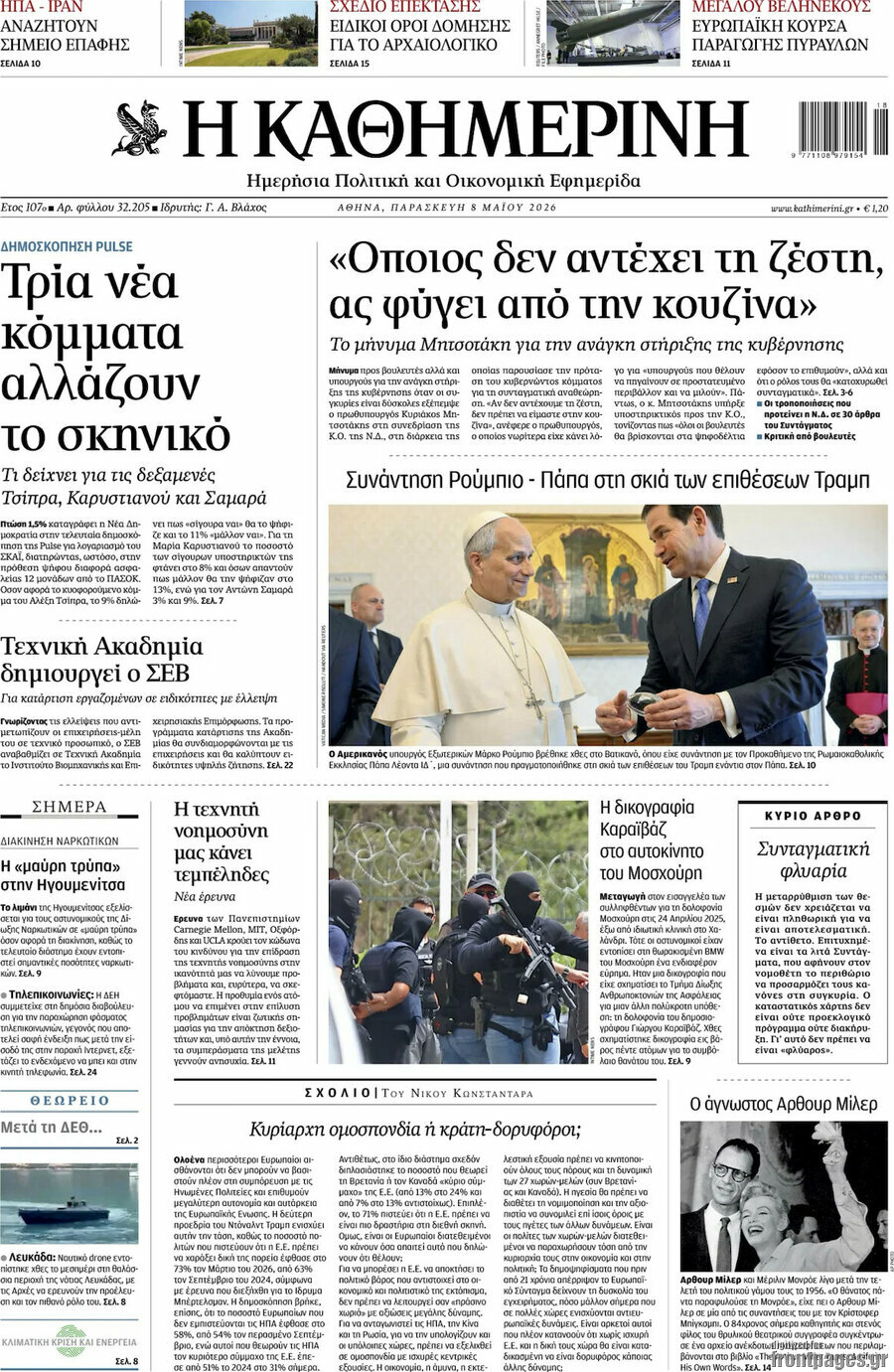
KATHIMERINI: Pulse poll: Three new parties are changing the scenery
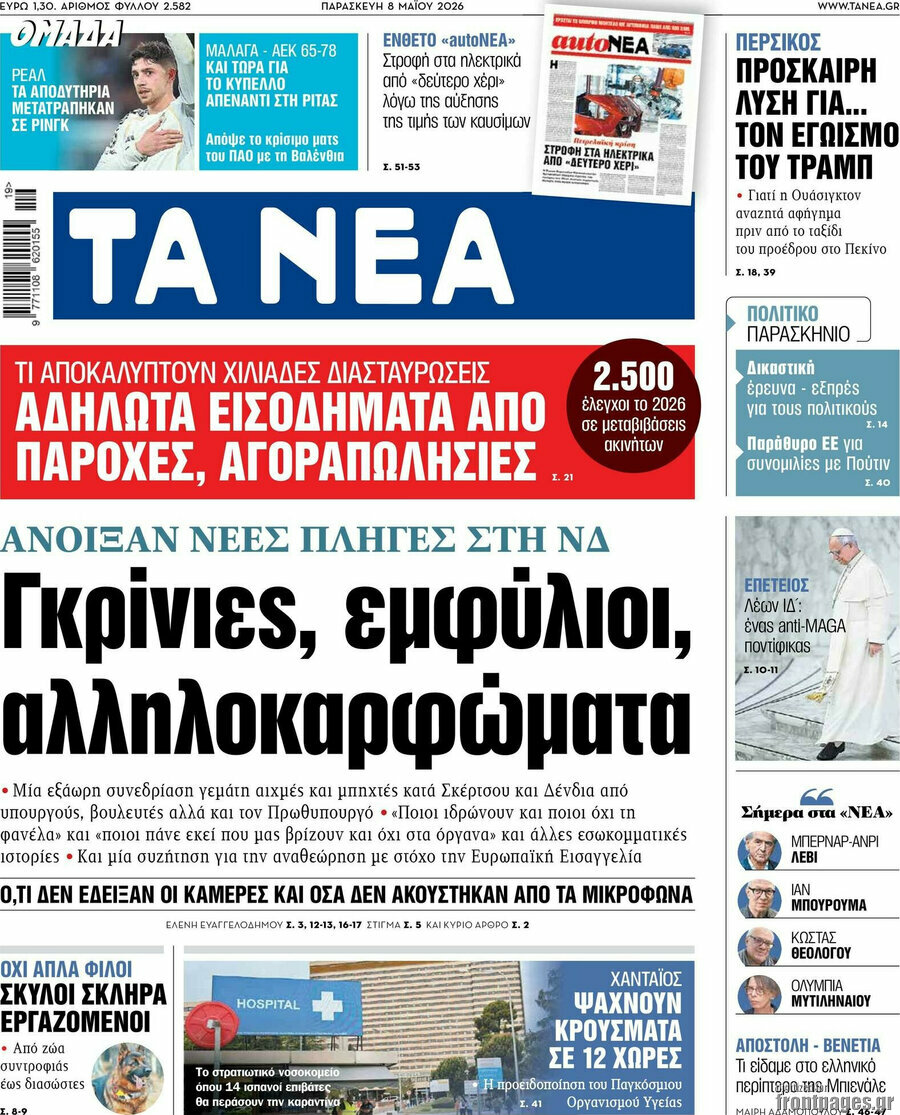
TA NEA: Turbulence in New Democracy: Complaints, civil wars and backstabbing
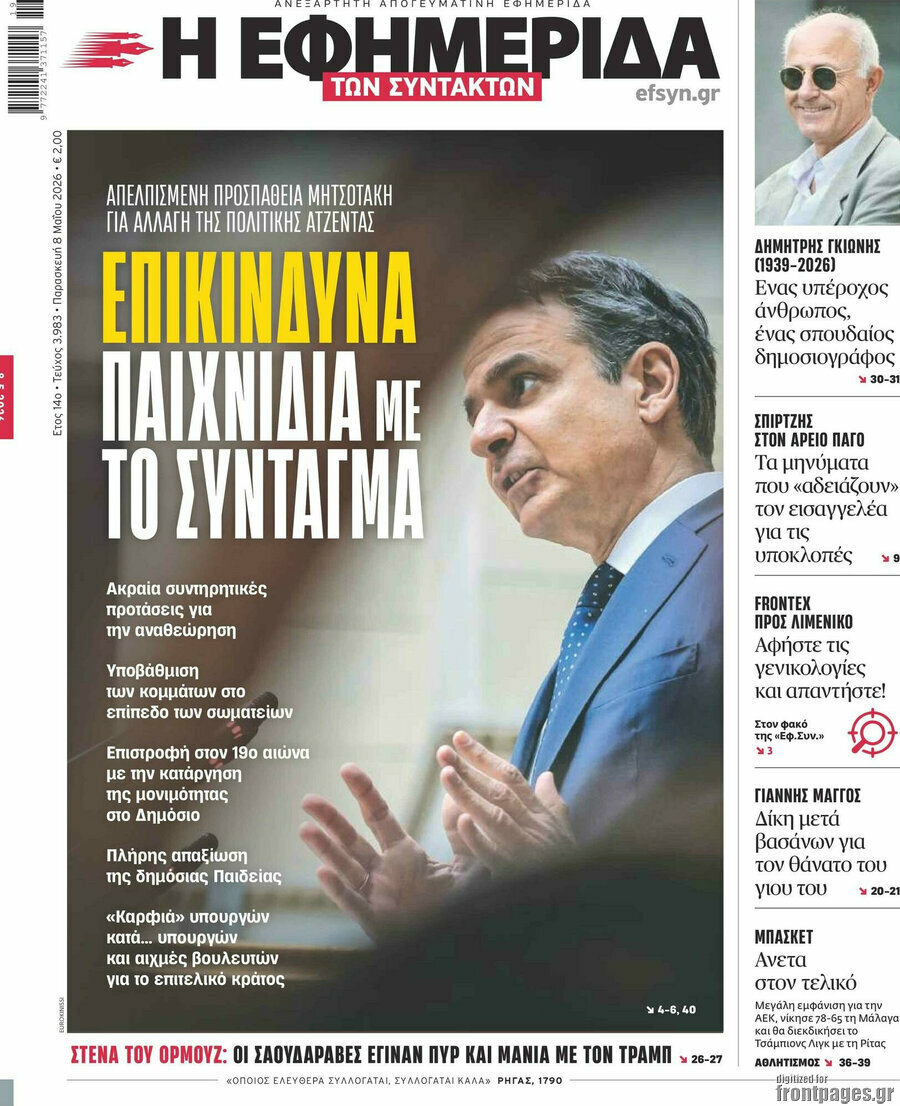
EFIMERIDA TON SYNTAKTON: Dangerous games with the Constitution
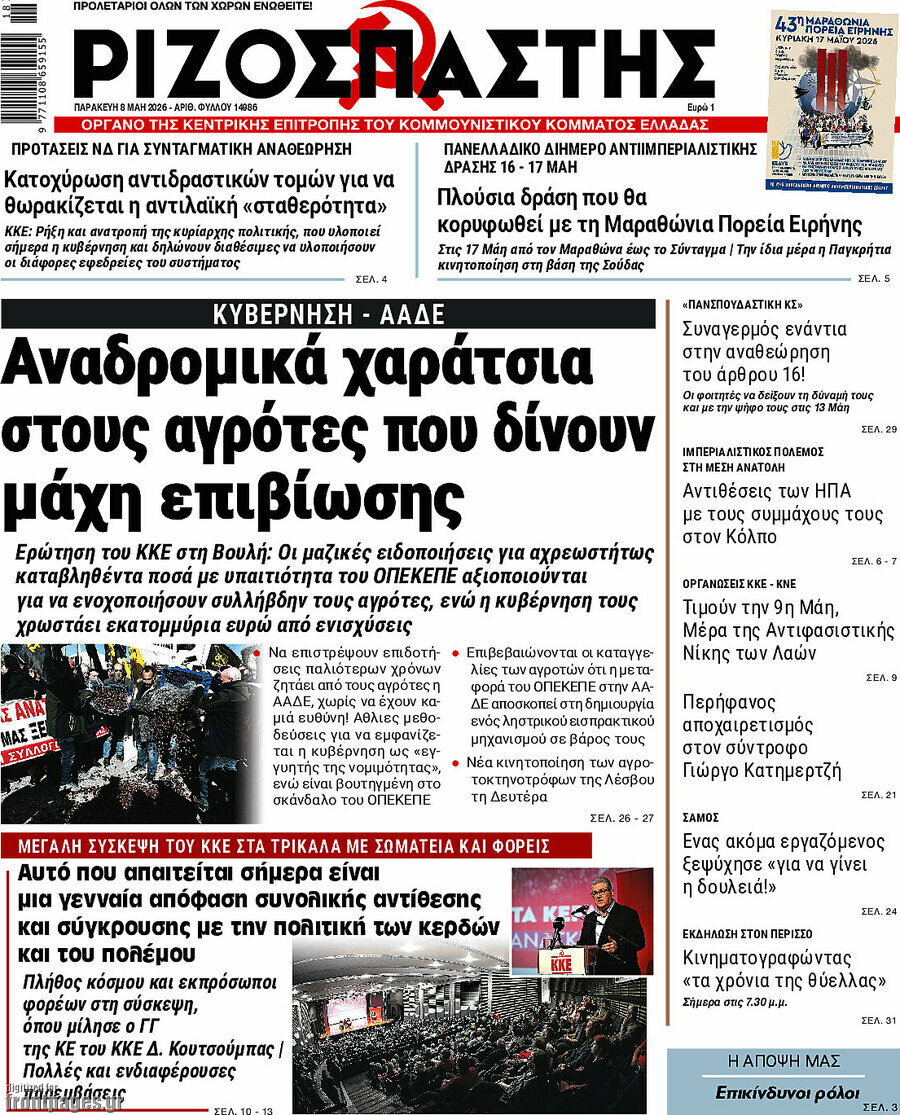
RIZOSPASTIS: Retroactive fiscal burden for farmers fighting for survival
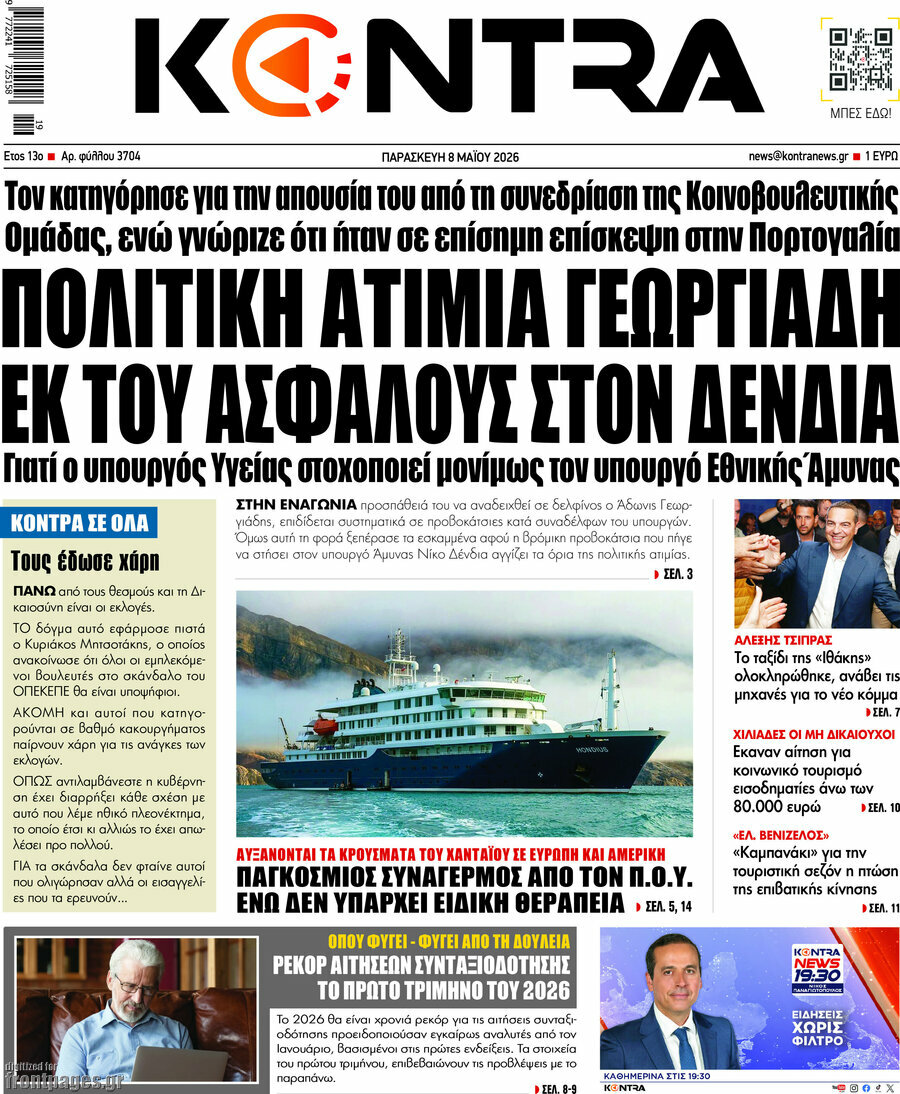
KONTRA NEWS: Vile and bullyish political behavior by Health Minister Georgiadis against Foreign Minister Dendias
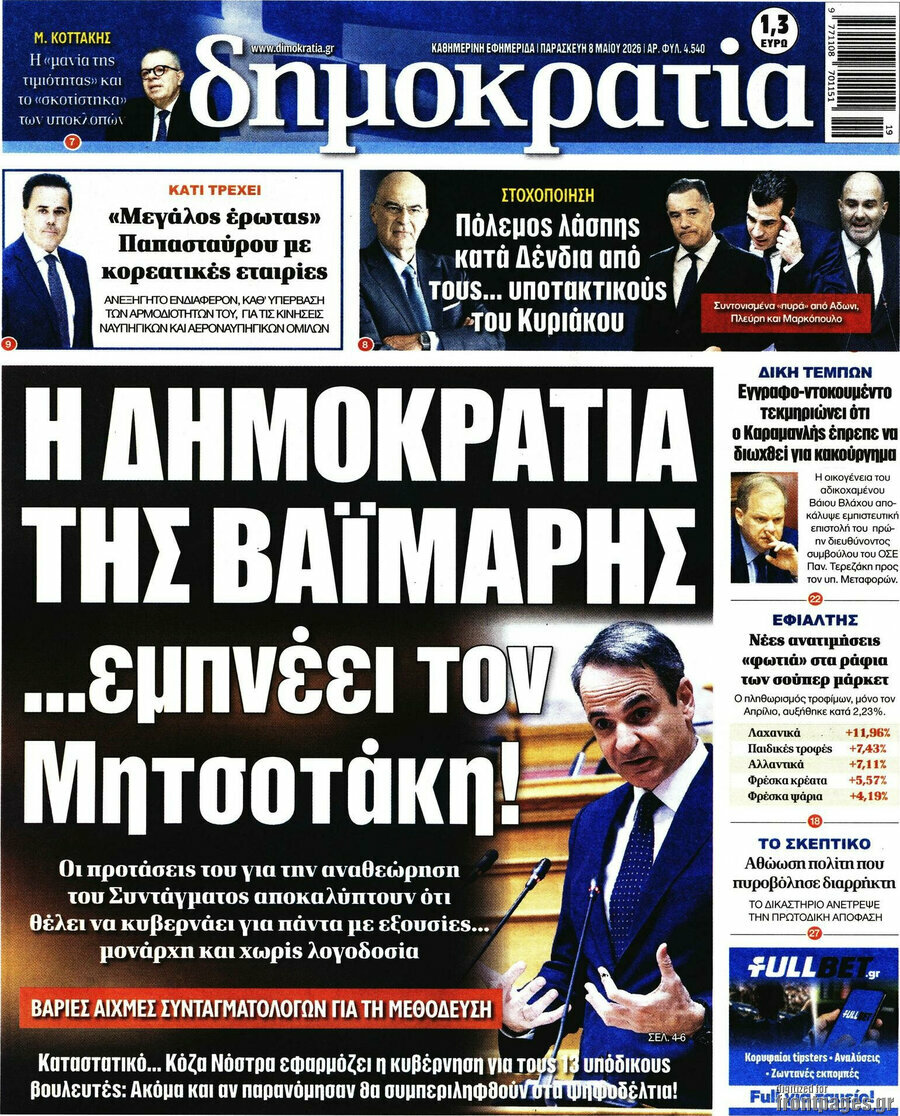
DIMOKRATIA: The Weimar Republic inspires… PM MItsotakis
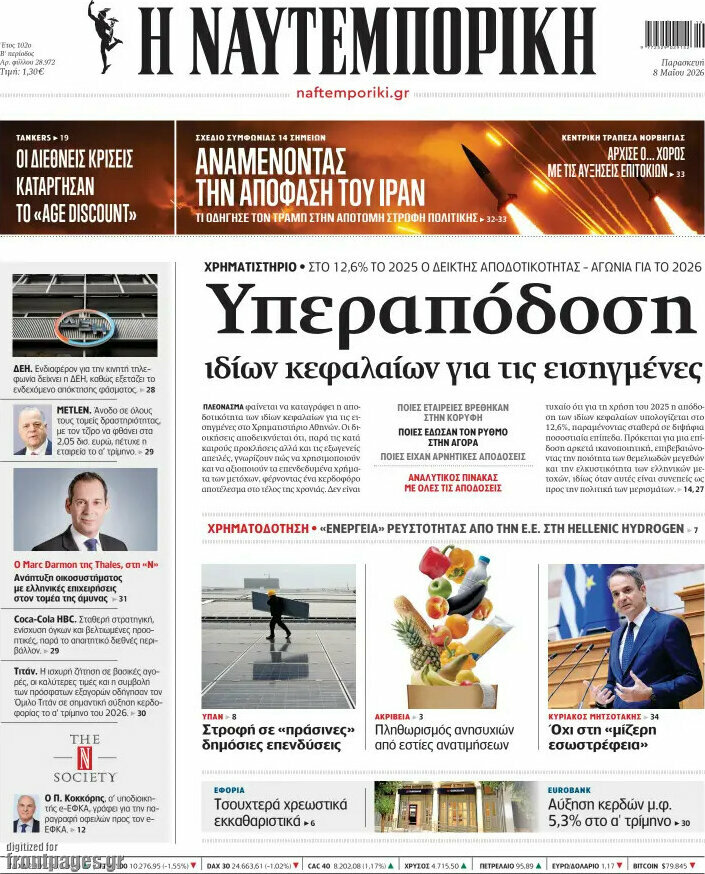
NAFTEMPORIKI: Listed companies’ own capitals over-perform

DRIVING THE DAY
PUTTING EU-RSELF FIRST: The EU is inching toward a major shift in how it spends public money — one that could shut American companies out of billions of euros in taxpayer-funded goods and services contracts. And European Industry Commissioner Stéphane Séjourné is coming down on one side of the debate.
Evolving landscape: A series of EU decisions over whether to include the U.S. in public procurement has largely been deadlocked, with some governments fearing retribution if America is shut out. But now, the impasse may be coming to an end.
What’s changed … is an increasingly unreliable Washington, along with China’s industrial muscle-flexing and the unease about Europe’s sluggish growth. The result is a developing head of steam behind what had initially been a French push to stop EU money going to non-European businesses.
Quid pro quo: “Countries wanting access to those European public procurement markets will have to open their own markets in return,” Séjourné told Playbook. The commissioner is one of the chief advocates of the policy and his intervention is a nod to the U.S., which has imposed hefty tariffs on EU exports. But it also recognizes China, which tightly controls access to its own industries and resources.
No overnight change: “Every major shift in doctrine takes time, persuasion and consensus-building,” Séjourné said. “The more the world is changing and the more we explain, the more support is growing.”
According to Séjourné, enshrining the principle of Europe-first in procurement rules “changes the balance in global trade negotiations.”
The battleground: The fight is already playing out over the Ukraine Facility, the EU’s reparation fund — with €3 billion up for grabs for companies supporting reconstruction of the country in the coming year. The Commission has put forward proposals to allow U.S. firms to access the money, even as Washington slashes its financial support for Kyiv.
That has riled some capitals, with France leading the charge for the exclusion of American companies. A vote on the issue Tuesday was postponed after a political argument between national envoys and is expected later this month, two diplomats on either side of the debate told Playbook. “With the tension with the U.S., it has become more and more political,” said one senior EU diplomat.
Some worry the move would spark retaliation. “Are we going to stick our finger in [Washington’s] eye when we know there’s a question mark over their support for Ukraine?” asked one diplomat.
Sea change? Germany has been leading a more cautious faction, which includes the Netherlands and Italy, wanting to avoid rigid rules that could hurt supply chains. But according to a classified letter seen by my Berlin colleagues, the government is now pushing for the EU’s flagship industrial policy to establish a requirement for the use of European steel in public projects.
It’s not just America: China is also giving cause for concern. Belgium’s Foreign Minister Maxime Prévot has joined calls on the EU executive to tackle oversupply from Beijing. “Hungary was a big problem for protecting Chinese investments,” said one EU official, referencing Budapest’s support for China. “But now [that Viktor] Orbán is leaving, we can start to have the conversation seriously.”
Takeaway: That series of decisions could define where billions of EU taxpayers’ money goes, and potentially drive another wedge between the U.S. and the EU.
BIG AND BREAKING
EXCLUSIVE — TOP ENVOY: The EU is set to appoint Finnish diplomat Jukka Salovaara as its next ambassador to the U.K., three officials confirmed to POLITICO.
MAGA GOES GREEK: While European countries are increasingly distancing themselves from Donald Trump, that’s not the case in Athens — where Prime Minister Kyriakos Mitsotakis is leaning into closer ties with the Republican Party core.
HANDLING MONEY TO HANDLE THE PRESS: The European Public Prosecutor’s office has launched an investigation into potential misuse of EU funds linked to French presidential hopeful Jordan Bardella’s media training sessions.
ASSETS DÉJÀ VU: The Netherlands is resurrecting the contentious idea of using up to €210 billion in frozen Russian assets to help fund Ukraine.
FINGER ON THE PULSE: The EU’s Eurobarometer survey is published today and Playbook got a sneak peek: 73 percent of Europeans now see the bloc as a stabilizing force in the world, up 6 percent, and 81 percent back a common defense and security policy — an all-time high.
VOTE WATCH: Results are being declared in British elections expected to have seismic consequences for Keir Starmer — and the early signs don’t look good for the PM. Our London colleagues will keep you updated through the day in our live blog.
MOSCOW’S INTIMIDATION PLAYBOOK
BLACKLIST OR HIT LIST? Russia’s list of European officials, activists and academics who are banned from entering the country is actually a list of targets for the Kremlin’s agents, according to a leading EU lawmaker.
Finnish center-right MEP Mika Aaltola argues in a memo seen by POLITICO’s Zoya Sheftalovich that the Kremlin’s objective is to make officials censor themselves by softening speeches and avoiding anti-Russian positions and sensitive dossiers, out of fear of being targeted. “You never know which list you might be on,” Aaltola told Zoya. “They leave these things hanging in the air.”
Gig economy for sabotage: Aaltola said there had been “strange incidents” targeting EU lawmakers. “A car window is smashed, certain books that are Russian propaganda are mailed to your home address or left at your front door,” he said. The lawmaker points to Russia-linked actors hiring operatives on gig economy sites to target critics — something POLITICO has previously covered.
MEPs face pressure: Several lawmakers have been placed under police protection due to Russia-linked attacks. Pina Picierno became a target after successfully pressuring Italian state broadcaster RAI to cancel a planned appearance by Kremlin propagandist Vladimir Solovyov.
Ondřej Kolář, an MEP who oversaw the removal of a statue of Soviet Marshal Ivan Konev from Prague in 2020 when he was the mayor of a district in the Czech capital, told Zoya the campaign against him, which forced him into a police safe house for 20 days, was incredibly intense. “I was getting threats via email, social media, letters, phone calls, people were yelling on the phone that they were coming for me, I was getting letters with bullets, with white powder.” The Kremlin is “trying to raise fear,” he said.
Tomáš Zdechovský, a vocal backer of Ukraine, told Zoya that Russia-linked accounts online had run “psychological campaigns” targeting him and his family. “I proposed ban for Russian soldiers who were in Ukraine … And I receive hundreds and hundreds of threats that they will come and they will kill me.” The MEP added that his home address and phone number had been leaked online “many times.”
Make it clear: Aaltola said European authorities need better intel about Russia’s blacklists. “Better understanding of how these lists operate and who is on which lists, lowers ambiguity. Because that’s the key battle — ambiguity leads to self-censorship.”
20-SECOND PLAYBOOK PRIMER
The Industrial Accelerator Act, a plan to make Europe more competitive by favoring local manufacturers of green technologies such as windmills, solar panels and electric vehicle batteries, is in large part meant to counter China’s dominance. Yet German exporters aren’t happy — they fear retaliation that could close off their access to foreign markets. Industrial output in Germany is down nearly 10 percent since the start of the pandemic, with about 10,000 jobs lost each month over the past year.
GERMAN WOES HIT BRUSSELS
COALITION OF THE CHILLING: German Chancellor Friedrich Merz’s falling poll numbers and tension inside his ruling coalition are hampering Berlin’s ability to shape policy in Brussels, three EU diplomats told Playbook.
Instructions not included: A lack of guidance from Berlin has left German officials with no position on files discussed at working group (or technical) level, said the diplomats, who were granted anonymity to discuss sensitive closed-door talks. This has slowed progress on tobacco legislation and an AI simplification drive, among other files, they argue. “The delegation will have nothing to say because there are no instructions from Berlin,” said one of the diplomats.
Inside job: In the European Parliament, rifts between Merz’s Christian Democrats and their Social Democrat coalition partners have delayed the adoption of the EU-U.S. trade deal. “Berlin will complain about something in Parliament and it may be their own MEPs causing the issue,” said the same diplomat.
NB: This hasn’t stopped Berlin from staking out bold EU positions, such as seeking an end to veto rights on foreign policy. Diplomats also note that, however dire the situation may seem, things were worse under former Chancellor Olaf Scholz.
But expectations for a stronger Merz era are fading. “They have an issue-defining policy and when you add Merz’s poll numbers, honestly it’s not good,” said a third diplomat. A German spokesperson in Brussels declined to comment.
5 MORE THINGS GETTING US TALKING
BE AFRAID — SUPERMARKET EDITION: Worried the Iran war will drive up your grocery bill? You should be. Our reporters Bartosz Brzeziński and Ketrin Jochecová have the story.
HOT AIR: The EU is set to give in to American lobbying and relax enforcement of its methane rules to ensure energy security in the future.
TRUMP IN CHINA: The U.S. president will head to Beijing next week to meet Xi Jinping in a dealmaking mood — but American business leaders say his administration is sending mixed signals about the trip.
MIDDLE EAST LATEST: The U.S. and Iran exchanged fire last night, but Donald Trump downplayed the latest hostilities and said the tenuous ceasefire remains in place.
DECLASSIFIED: Meet the musical act comprised entirely of world leaders.
DASHBOARD
The reputation of the U.S. continues to take a hit, according to the Democracy Perception Index (DPI), out today. “The fast decline of the United States’ perception around the world is saddening but not shocking,” said former NATO chief Anders Fogh Rasmussen, who founded the Alliance of Democracies Foundation, which was behind the study.
 |
BRUSSELS CORNER
WEATHER: High 16C, overcast.
PATIO CULTURE: The final terrace review of the week takes us to the Lithuanian embassy. The Rue Belliard building has a spacious courtyard, where Ambassador Nerijus Aleksiejūnas and spokesperson Viktorija Urbonavičiūtė host visitors. Fortunate invitees have access to an ample library of Lithuanian literature and, more often than not, homemade salads and soups to rival any local restaurant. With Lithuania set to take over the presidency of the Council of the EU in the second half of next year, now’s the time to get on the invitation list.
BEHIND THE SCENES: Brussels institutions are throwing their doors open Saturday to celebrate Europe Day, inviting the public to see the (admittedly drab) corridors of power. The European Commission is offering exclusive tours of its Berlaymont headquarters and the Council is giving free access to its Justus Lipsius campus, with member countries running stands to talk to the public about diplomacy. The European External Action Service is also getting in on the act with music, tango performances and workshops on how to make Myanmar’s traditional Thanak cosmetic paste. A must for EU nerds.
GOOD BOYS UNITE: Brussels’ Dogolympics is bounding back to Bois de la Cambre on Sunday after last year’s paw-pular debut. Four-legged friends will compete for trophies in puppy pétanque, musical chairs and a 5K race, under the watchful supervision of the city’s police dog unit. Woof!
SPOTTED … at Day 3 of POLITICO’s AI & Tech Week: EU Startups, Research and Innovation Commissioner Ekaterina Zaharieva; Björn Juretzki, head of unit for data policy and innovation at the European Commission; MEPs Bart Groothuis, Eva Maydell and Diego Solier; Kilian Gross, director for enabling and emerging technologies at the European Commission; Marietje Schaake, former MEP and non-resident fellow at Stanford University.
And more … Cláudio Teixeira, head of digital policy at the European Consumer Organization BEUC; Prismos Co-Founder and CEO Pepijn Mores; France Digitale CEO Maya Noël; NaroIQ Co-Founder and CEO Chris Puellen; Uli Grabenwarter, deputy chief investment officer at the European Investment Fund.
ALSO SPOTTED … at last night’s showing of “The Devil Wears Prada 2” at Bozar: U.S. Ambassador to Belgium Bill White; Motion Picture Association’s Emilie Anthonis; the European Commission’s Alexandra Henman; Covington’s Atli Stannard; the Financial Times’ Paola Tamma; lobbyist Victoria Main; POLITICO’s Gavin Sundwall.