
UN Security Council: Greece calls for increased humanitarian aid to Gaza and backs two-state solution
The UN Security Council held an open briefing on “The situation in the Middle East, including the Palestinian question”, following a request by ten Council members to discuss the humanitarian situation in Gaza. Speaking during the session, Greece’s Permanent Representative to the United Nations, Ambassador Aglaia Balta, stressed the importance of scaling up humanitarian assistance to Gaza and advancing the implementation of early recovery projects. She also reiterated Greece’s support for the two-state solution as the only path towards the peaceful coexistence of Israelis and Palestinians.
Androulakis: PM should aim for condemnation of Türkiye in European Council conclusions
PASOK leader Nikos Androulakis, speaking from Brussels where he is attending the summit of the Progressive Alliance of Socialists and Democrats in the European Parliament (S&D), called on Prime Minister Kyriakos Mitsotakis to request that the European Council conclusions include a condemnation of Türkiye, similar to that contained in the European Parliament’s resolution approved on Wednesday.
Parthenon unbound after two centuries
For the first time in roughly 220 years, the western facade of the Parthenon has been returned to what the Culture Ministry described as its fullest possible form, free of external scaffolding. The milestone marks the completion of a painstaking restoration effort that combined contemporary scientific expertise with respect for the techniques of the monument’s original builders.
https://www.ekathimerini.com/culture/1307082/parthenon-unbound-after-two-centuries
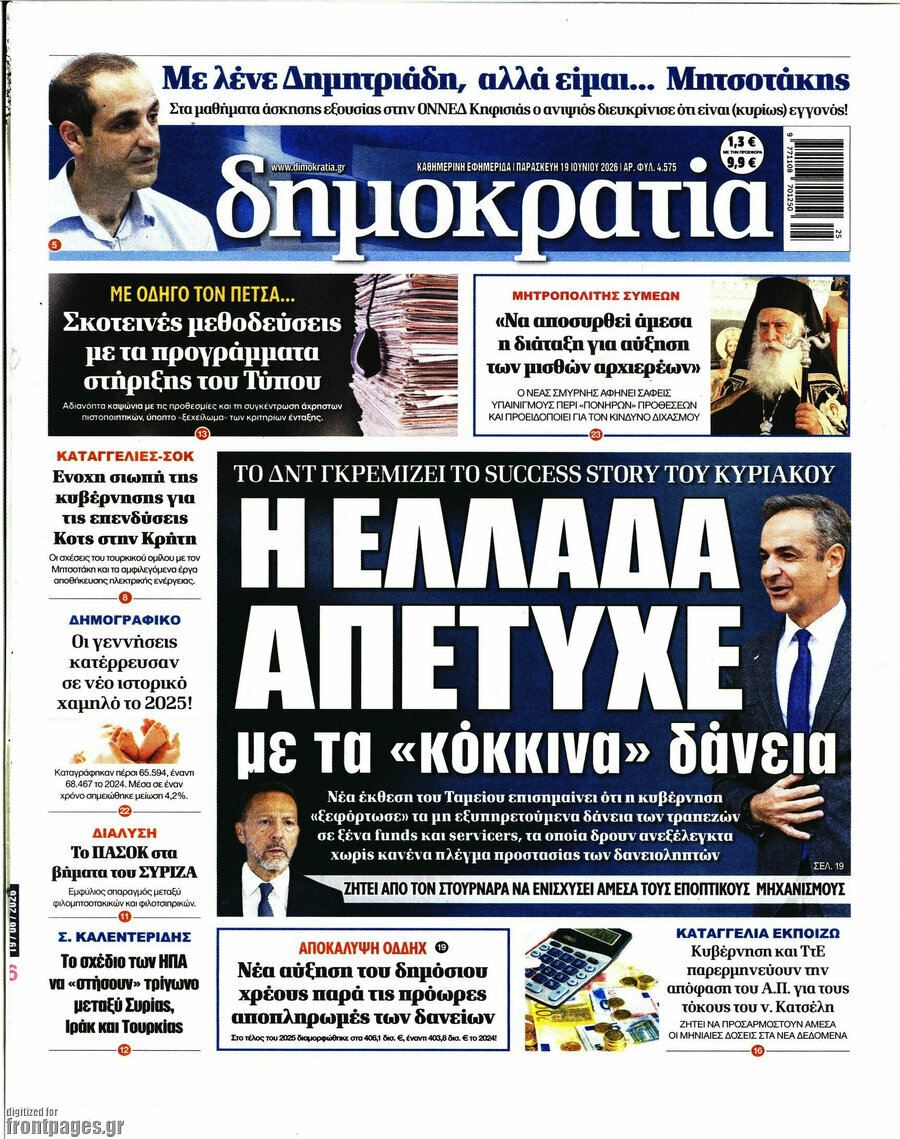
Greece’s public debt reached 406.1 billion euros in 2025, PDMA announces
According to the Annual Public Debt Report published by the Public Debt Management Agency (PDMA), Greece’s public debt increased to 406.1 billion euros in 2025, from 403.8 billion euros at the end of 2024. At the same time, General Government debt declined to 362.9 billion euros, compared with 364.9 billion euros in the previous year. On a cumulative basis, the debt-to-GDP ratio fell by approximately 63 percentage points between 2020 and 2025, reaching 146% of GDP in 2025, down from 209% in 2020.
ATHEX: Minor decline does not alter general trend
The Greek bourse benchmark ended Thursday off the 16-year record high posted on Wednesday, as after five straight days of rise there was an appetite among traders for some profit taking. That does not change the overall picture of a summer of growth ahead, given that the conflict in the Middle East appears to have subsided, the local stock market is about to join its developed peers, and the current political stability offers short-term opportunities that 2027 – an election year – may not.
https://www.ekathimerini.com/economy/1307099/athex-minor-decline-does-not-alter-general-trend


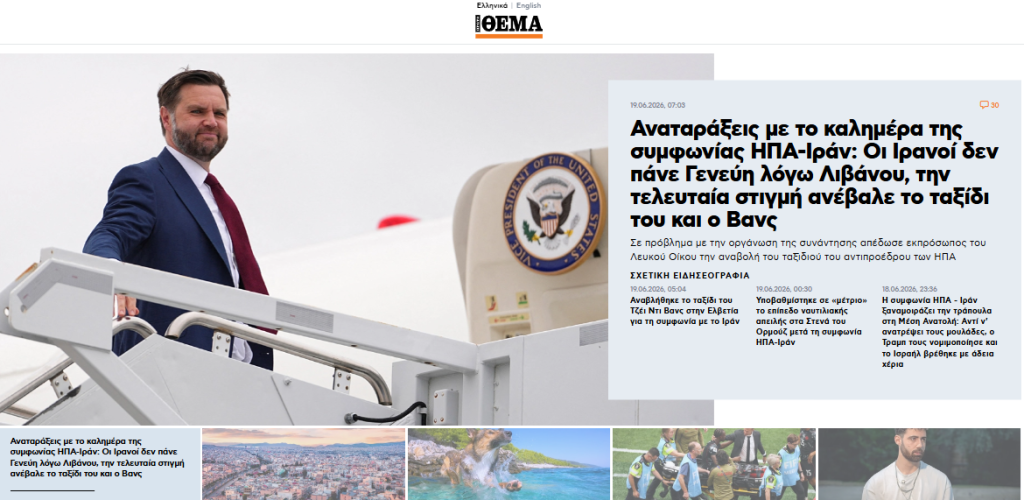
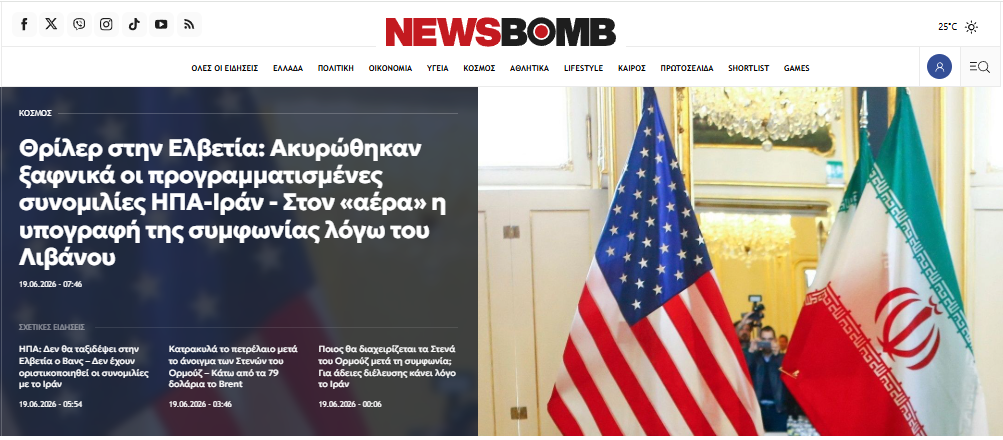
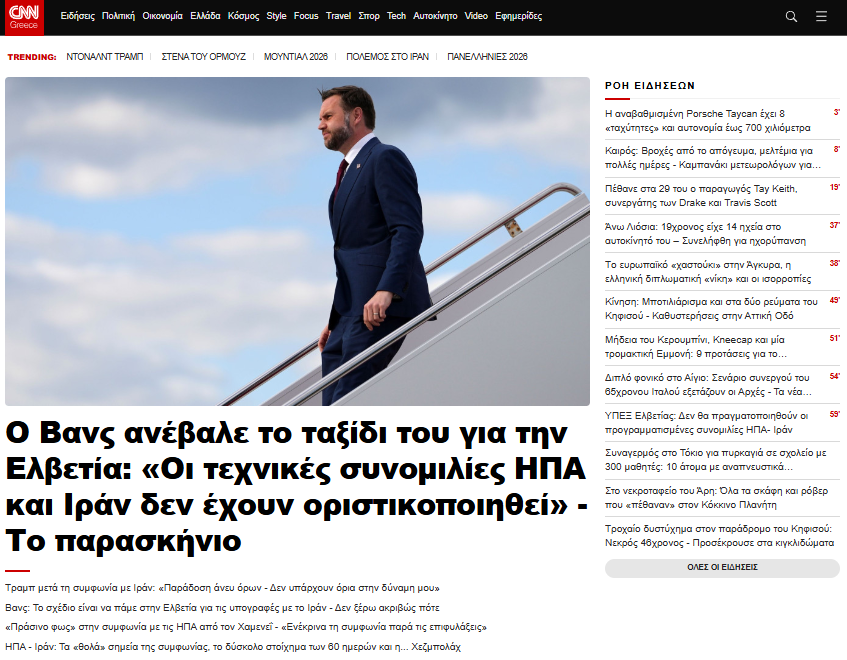

KATHIMERINI: 19,060 drivers caught by the traffic police without a driver’s license
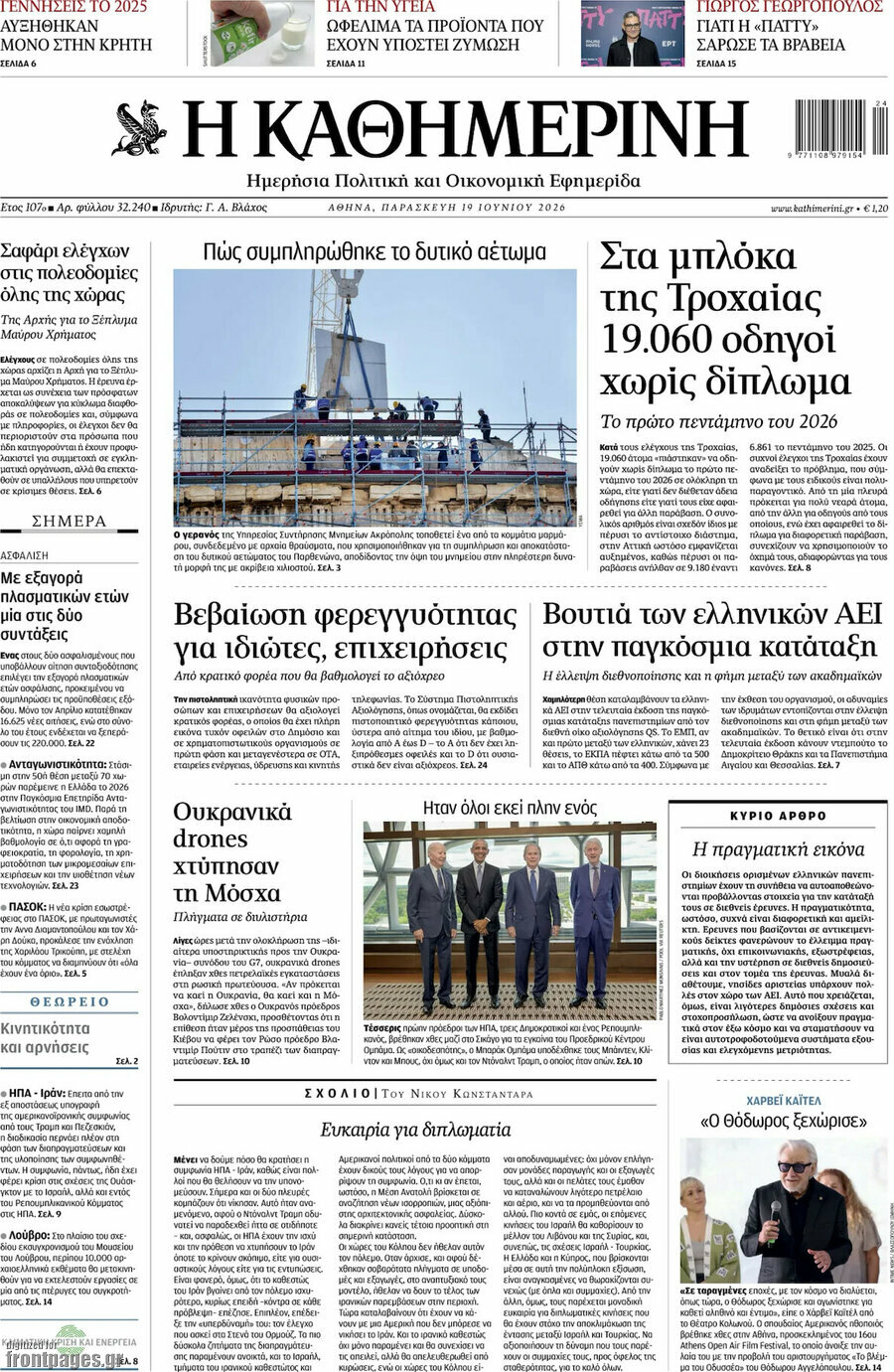
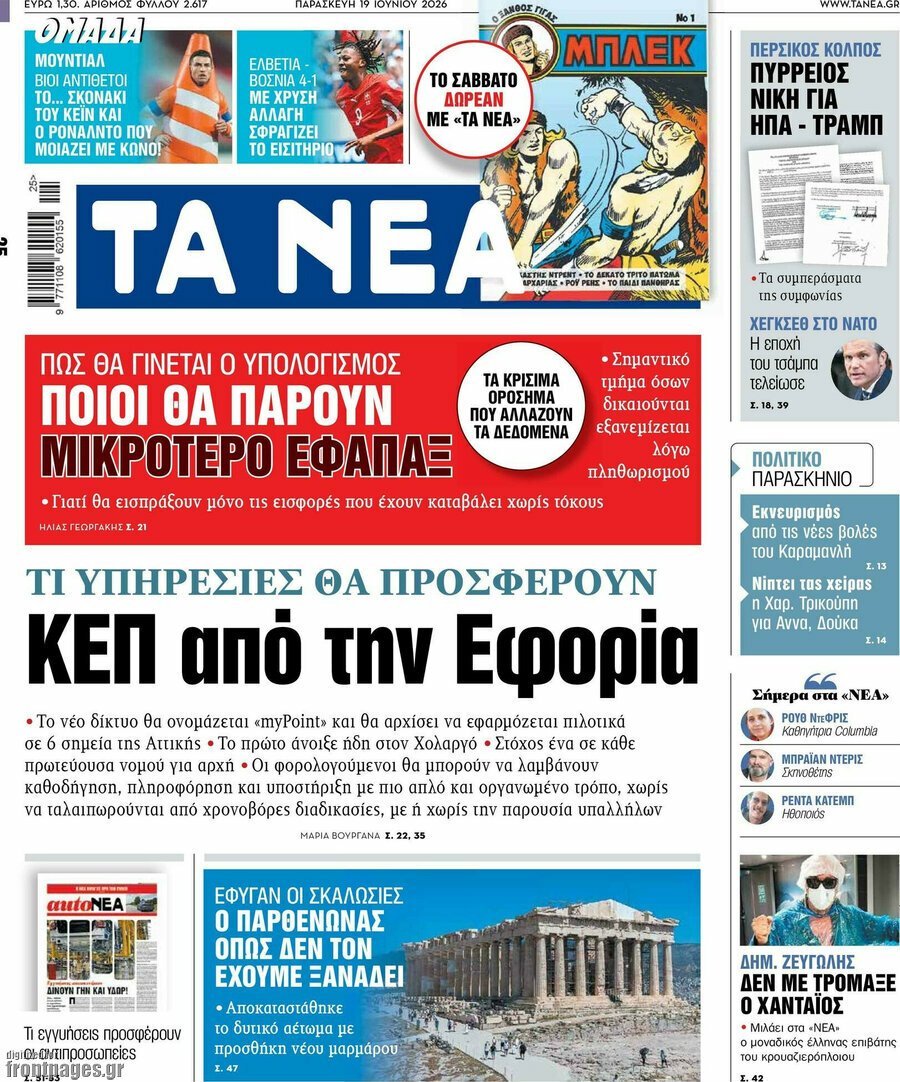
TA NEA: Tax office is setting up “myPoint” spots to service citizens
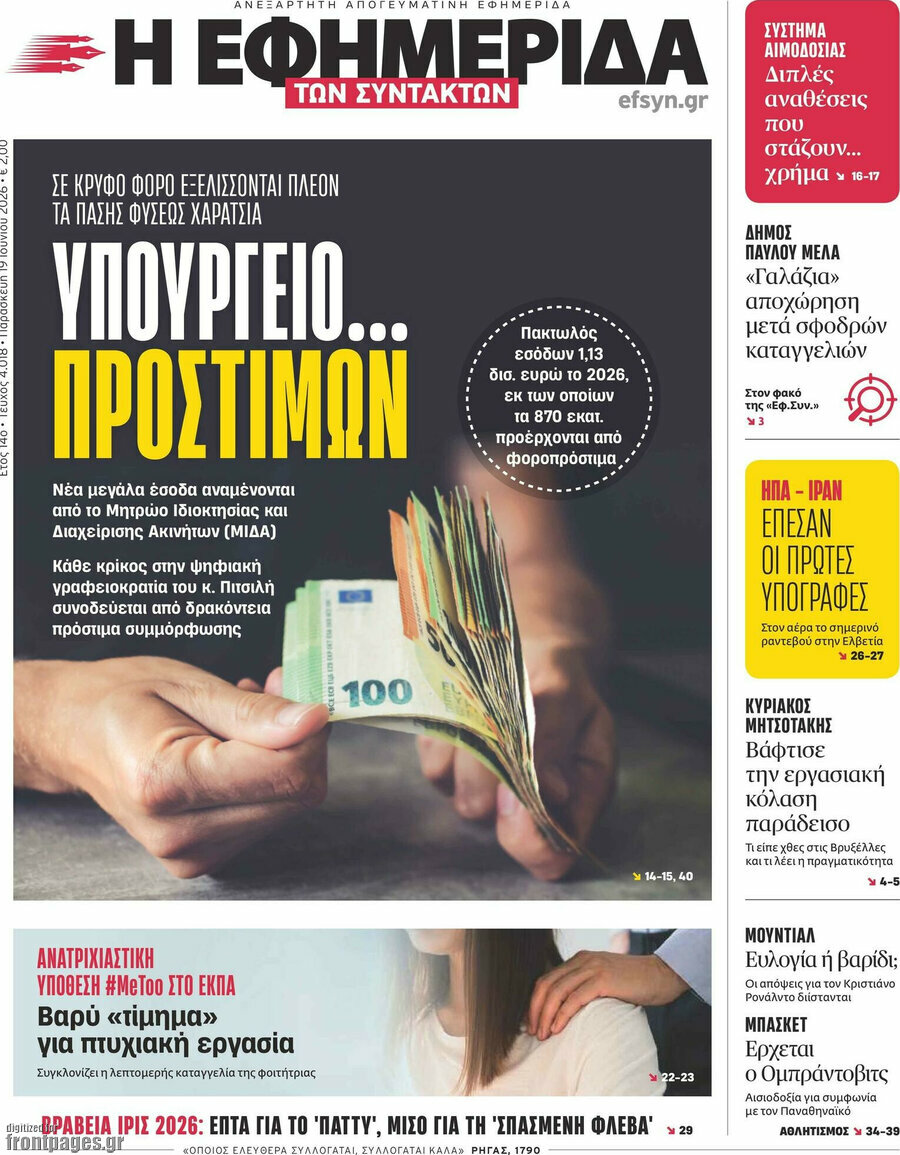
EFIMERIDA TON SYNTAKTON: Ministry of… fines
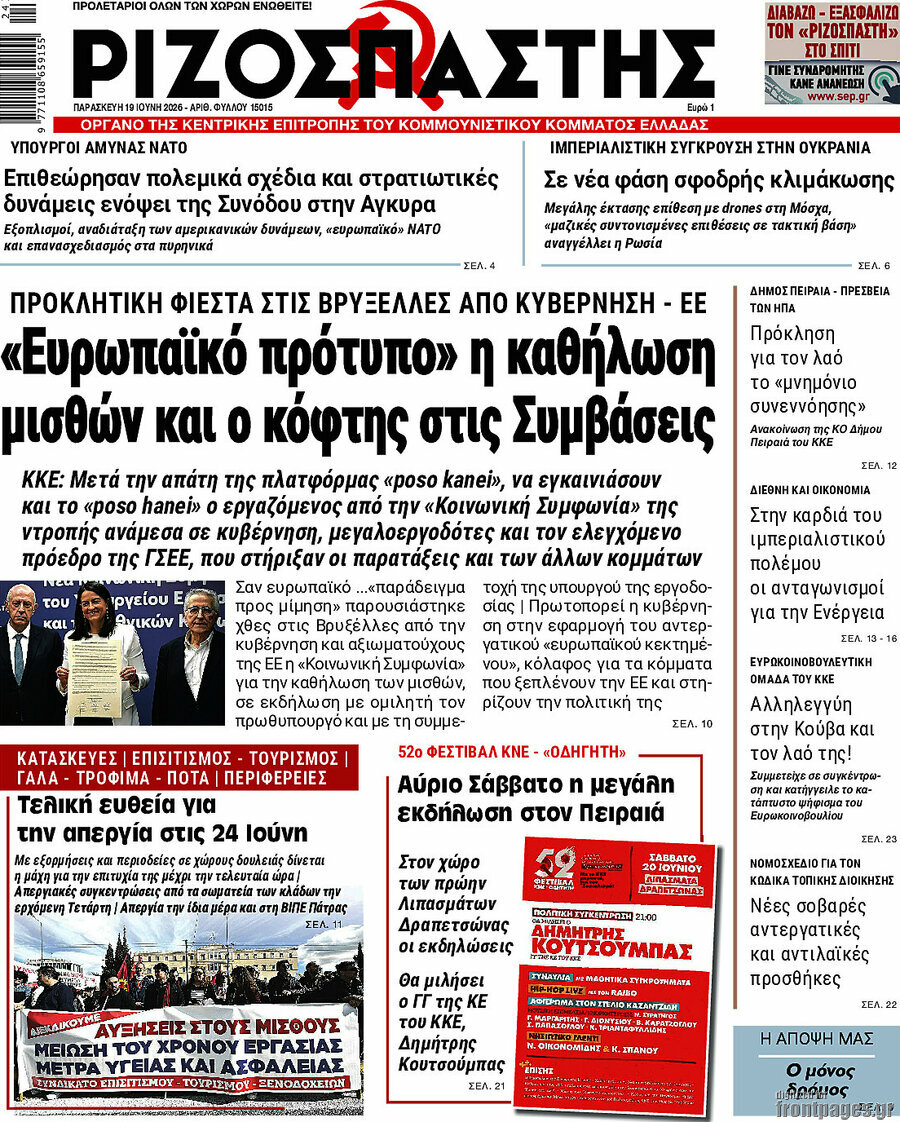
RIZOSPASTIS: The freezing of salaries and the cap on collective labor agreements is the “European model”
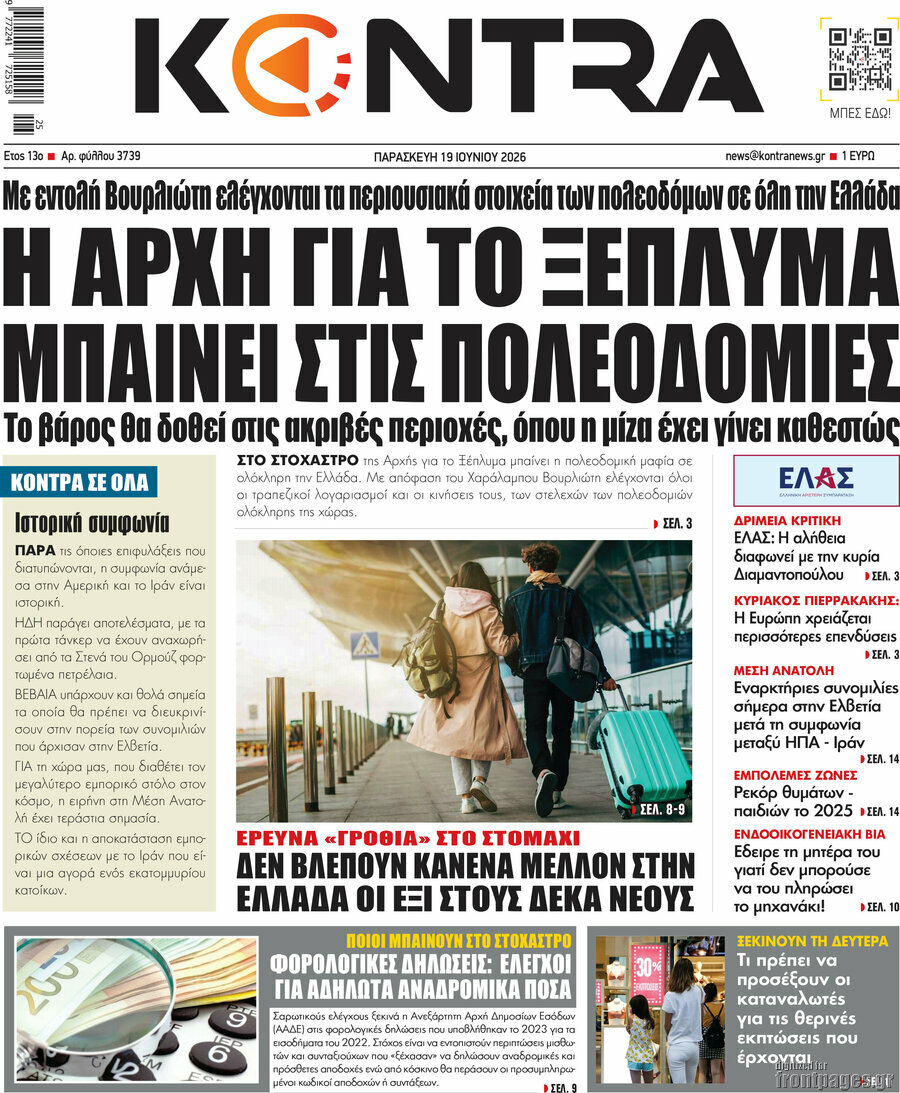
KONTRA NEWS: The Authority against Money Laundering is entering urban planning offices
DIMOKRATIA: IMF: Greece failed in the handling of red loans
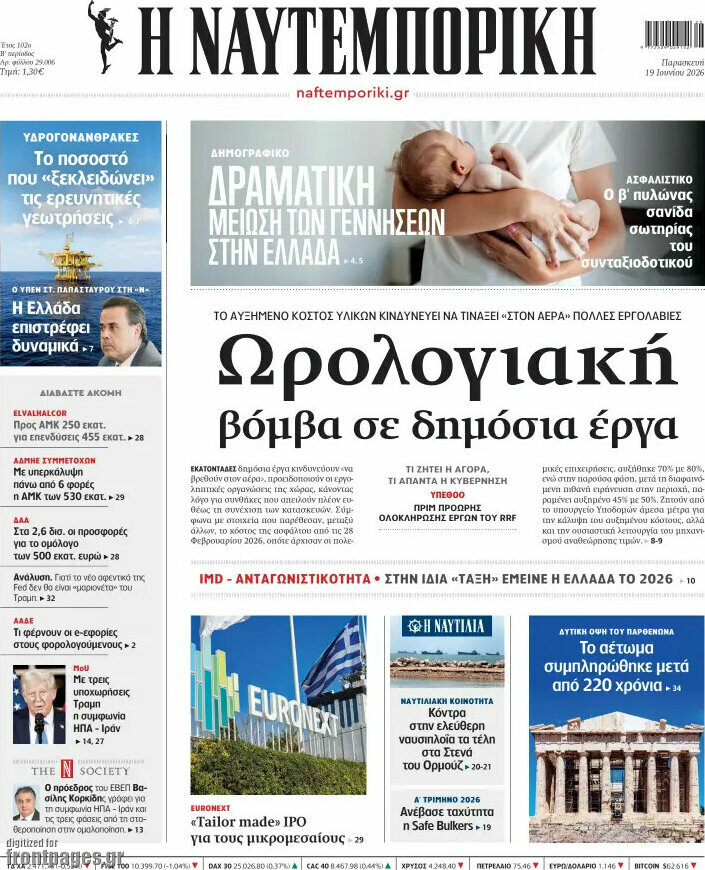
NAFTEMPORIKI: Time-bomb for public construction projects

DRIVING THE DAY
MASSIVE FUNDING FIGHT: A group of EU leaders will use today’s summit in Brussels to launch an all-out revolt against the bloc’s planned €2 trillion budget, known as the MFF — as looming national elections threaten to upend delicate negotiations.
Leaders will resume this morning after late-night talks turned unexpectedly spiky — with Emmanuel Macron and Friedrich Merz lashing out at European Council President António Costa’s efforts to reach out to the Kremlin, as we detail in our scoop this morning.
Coming up: Today’s debate will consider a compromise drafted by Cyprus, in response to calls from net contributors, that would shave just 2 percent off the 2028-2034 budget. Wealthy northern countries were left fuming.
Less is more: Swedish Prime Minister Ulf Kristersson,who is among those leading the charge against the Cyprus compromise, told Playbook his message at the summit is clear: “We need a better, not bigger budget.”
“The proposal on the table is simply unacceptable on volume,” Kristersson said. It’s not a credible starting point — we need significant cuts to be able to move forward. For us, the result is more important than making a deal by the end of 2026.”
Ticking time bomb scenario: The reference to the tight timeframe is deliberate. “The longer this drags on, the worse it becomes,”said one diplomat working on the issue, pointing out that Sweden, Latvia, Finland, Italy, Spain and France all have elections this year or next that could scuttle any progress. “It’s at risk of becoming an electoral issue where people campaign on getting — or blocking — EU money and that will make the negotiations far harder,” the diplomat said.
The Bardella effect: A far-right victory in the French presidential election could leave everyone worse off, if frontrunner Jordan Bardella’s threats to slash France’s EU budget contributions are anything to go by. That would force other EU countries to fill the gap.
What now? Costa and Merz are keen to strike a deal in December, Gregorio Sorgi writes in. The Brussels machine is working towards that deadline, but few countries are openly committing themselves to the timeline, fearing it could undermine their leverage in the negotiations.
Quality over speed: Both the frugals and the “friends of cohesion” say they’re under no pressure to seal a deal by 2027. “We’re not in a hurry,” said a senior EU diplomat, adding that the frugals won’t sign up to an agreement unless the budget is cut and it includes a discount for wealthier members.
Club Med: Italian Prime Minister Giorgia Meloni insisted during a parliamentary debate in Rome that “we do not intend to endorse, or bind ourselves to, predetermined and artificial negotiation timelines.” French Europe Minister Benjamin Haddad made the same point last month. “The less we talk about deadlines, the better it is,” quipped a senior EU diplomat.
Tough talk: The discussion is slated to last just two hours. But if last night’s talks on Ukraine and diplomatic backchannels are anything to go by, the schedule could fall by the wayside. Leaders ended up finishing discussions and moving on to a debate on how to handle China at 11 p.m., with the planned working dinner becoming more of a midnight snack.
Capitals were also bitterly divided over the outreach to Russia by Costa’s chief of staff Pedro Lourtie. Leaders from some of the most staunchly anti-Russia countries rallied behind Macron and Merz, who don’t think it’s the right time to talk to Vladimir Putin and want the E3 (France, Germany and the U.K.) to take the lead. Several leaders were angry they only learned about Lourtie’s calls to Moscow through the media. But others took Costa’s side.
“The European Union cannot assume the role of mediator in these negotiations,” Estonia’s PM Kristen Michal told us, adding that “misguided” diplomacy would lead to bad outcomes. But Belgian PM Bart De Wever said: “The first question is whether Putin wants to negotiate. Until then … no one other than Costa can represent the European Union.”
BIG AND BREAKING
TAKING ON CHINA: Leaders have given Ursula von der Leyen a political mandate to sharpen the bloc’s tools to deal with unfair Chinese trade practices — a major win for the Commission president on an issue where capitals have historically struggled to find consensus.
BRITAIN’S NEXT PRIME MINISTER? Andy Burnham cleared a major hurdle in his bid to replace Keir Starmer by winning the Makerfield by-election by more than 9,000 votes. My U.K. colleagues will have more through the day on what it means for Starmer, Labour and British politics.
THE OTHER WOULD-BE LEADER: Jordan Bardella is touring Poland to court nationalist and conservative allies for his push to reshape the EU.
GETTING TOUGH ON MIGRATION
EXCLUSIVE — PLAN FOR DEPORTATION PUSH: More than half of the EU’s 27 members have signed a letter calling for swift action to establish return hubs in third countries to receive failed migrants. The missive, seen by POLITICO, was organized by the Danish and Italian governments and signed by at least 15 capitals.
“Together, we have redefined the European conversation about migration,” the letter reads. “Now we need to show concrete results that make a real difference for our citizens with solutions based in third countries as soon as possible.”
Bloc with a vision: “Countries are now working … to implement the new possibilities, including hubs in third countries. We will personally lead the way to make sure our visions are brought to life,” the letter reads.
It’s the law: The move comes after a deal to give EU national governments powers to set up facilities abroad. Following a vote in the European Parliament, in which MEPs backed the move by 418 votes to 218, right-wing lawmakers chanted “send them back” while those opposing the measures shouted `”shame on you.”
New mainstream consensus: While questions lingered over whether capitals would actually take advantage of the rule change, governments of all stripes are now indicating they will. A group of the most active countries on the issue will meet for a working breakfast this morning to coordinate their plans.
20-SECOND PLAYBOOK PRIMER
Most EU legislation is adopted using qualified majority voting. But what does that mean? Two conditions need to be met: At least 55 percent of member countries must vote in favor (that’s 15 out of 27); and those countries must represent at least 65 percent of the total EU population (Germany, France and Italy collectively account for about half of the EU’s population). If fewer than four countries vote against a piece of legislation, the qualified majority is deemed attained. An abstention under these rules counts as a vote against.
TALK TO PLAYBOOK: WhatsApp us on +32 491 050629 and listen from 7 a.m. to hear if we give you a shoutout.
MIDTERM MANEUVERS
THE HEAT IS ON: European Parliament President Roberta Metsola signaled she’ll reject the two preconditions set by Renew Europe Chair Valérie Hayer for any candidate seeking the presidency of the Parliament, Max Griera writes.
Quick reminder: Hayer said last month that a candidate wanting the support of the liberals in the January 2027 election would need to bar far-right groups from positions of power — namely, Parliament vice-presidencies. The candidate would also need to be open to the European People’s Party forming majorities with centrist parties.
Not personal: Hayer’s comments didn’t name-check Metsola, but were presented as a warning for anyone thinking of running.
Metsola’s answer? “I am the president of all members of the European Parliament … I am fair, and I really want to be the president of every single member,” she said, responding to a question by POLITICO at the European Council about Renew’s checklist.
It’s up to political groups to make decisions among themselves “as [has] always been done,” Metsola said, adding she has “always worked for majorities to be built from the center outwards” and that is where parliament needs to be on “many files” including the MFF.
4 MORE THINGS GETTING US TALKING
BIGGEST LEAK OF THE NIGHT: The European Council’s hopes of securing €1 billion in funds to renovate its Brussels headquarters got a boost on Thursday evening, when a sudden summer storm saw water pouring through the glass roof and onto the desks of journalists below.
EXCLUSIVE — GREENS CALL EARLY LEADERSHIP RACE: The Greens group in Parliament will elect its new two co-presidents on Oct. 7, followed by the election of its six vice -chairs on Oct. 14, the leadership decided on Wednesday evening, according to two people familiar with the matter. It follows Bas Eickhout’s resignation at the end of May.
EXPORTING ESPIONAGE? Bulgaria gave out export licenses for sensitive spyware to be shipped to authoritarian states with records of human rights abuses, leaked documents seen by POLITICO show.
FOR THE BIRDS: Our weekly humor column takes aim at the birds of Brussels politics, from liberal hummingbirds to monarchist flamingos.
RAISING THE DOUGH
BACK TO THE BUDGET: If they’re to get a deal done by December, leaders will have to achieve rapid progress on new EU-wide taxes — known as “own resources” — to finance the next budget.
Deal-maker: The Commission’s original proposal is facing resistance from governments. To break the deadlock, the EU executive produced revenue estimates for new levies on crypto, digital giants and online gambling that were first pitched by the European Parliament. Out of the three, the crypto tax has garnered the most support in Council, said three EU diplomats, while cautioning that data remains scant.
What to look out for: France, Italy and Spain are leading the push in favor of own resources. Madrid has led an unsuccessful attempt to mention the levies in the Council conclusions, while Rome wants the Commission to speed up the technical work on new proposals.
In Ireland we trust: Supporters are counting on the Irish government, taking over the presidency of the Council of the EU next month, to approach a landing on own resources in their budget compromise that is expected in October.
WHAT DO THE FARMERS THINK: Billions of euros in agricultural subsidies will be a thorny issue for the Irish presidency expected to broker the MFF, and “rogue tractors” could start rolling again.