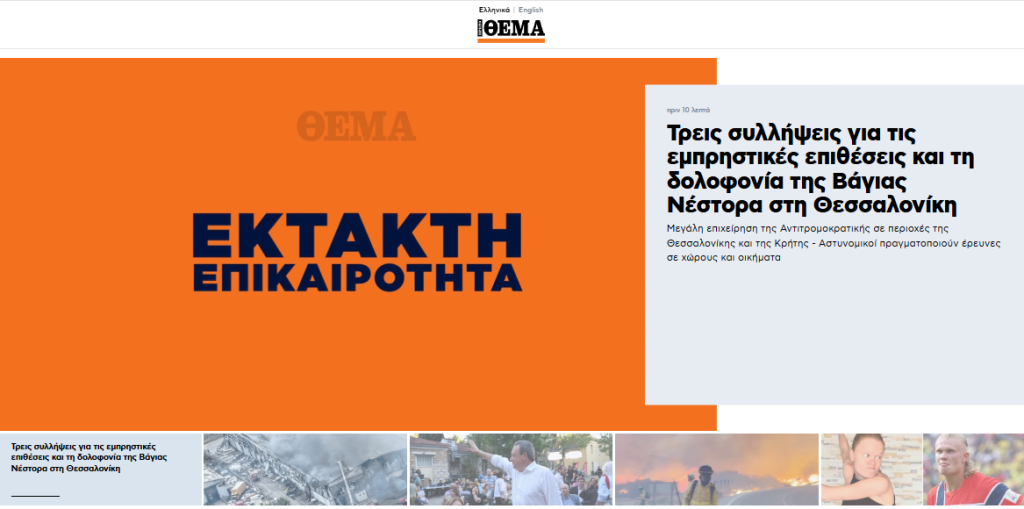
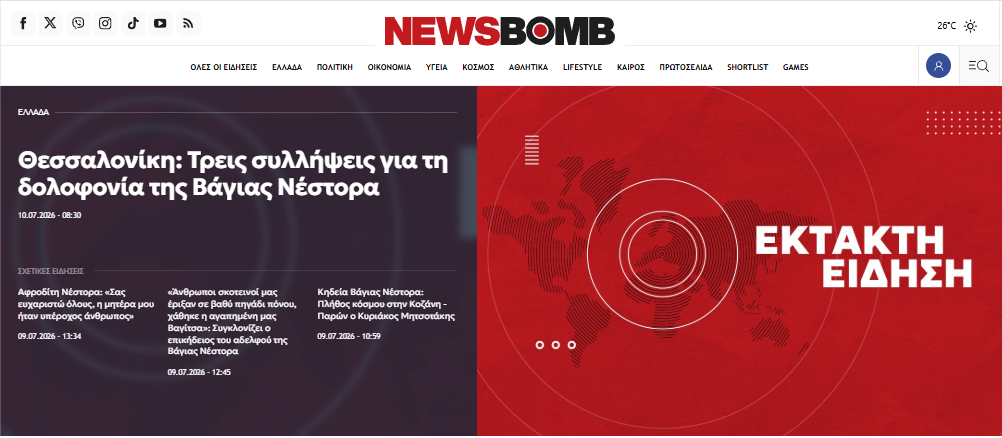
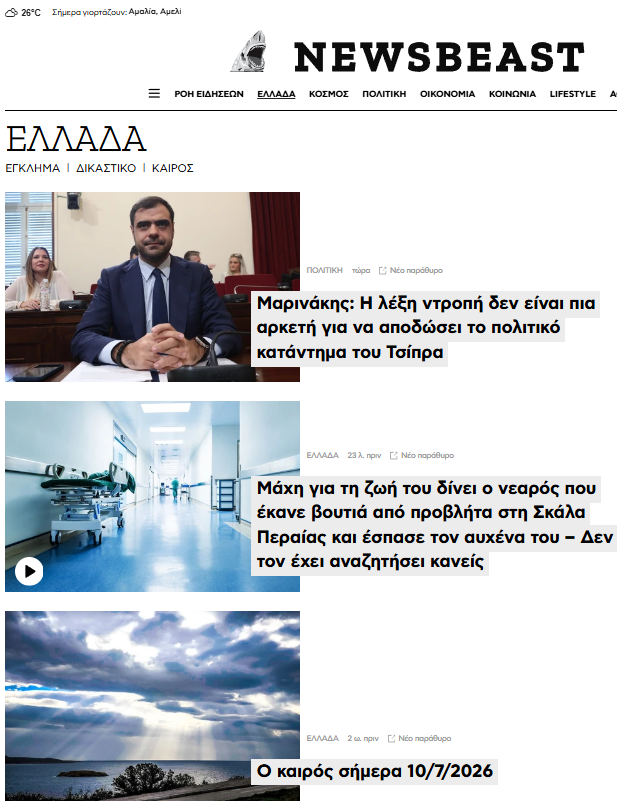
3 arrested over deadly firebomb attacks on ruling party lawmakers’ homes
Three suspects have been arrested in connection with the deadly firebomb attacks that targeted the homes of members of Greece’s ruling New Democracy party in the northern city of Thessaloniki on July 1, police said Friday. The arrests followed counterterrorism operations in Thessaloniki and on the southern island of Crete, police said, adding that the investigation is ongoing.
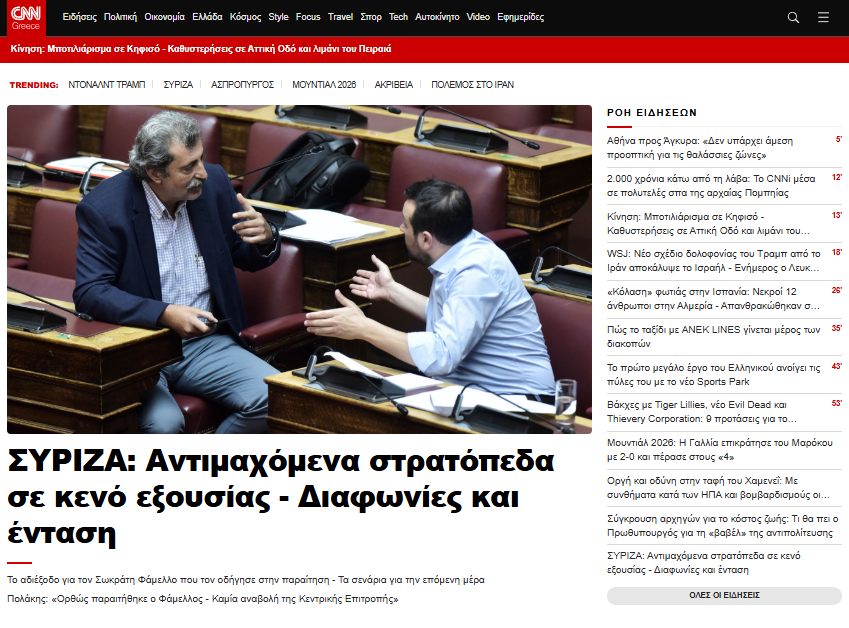
SYRIZA leader Famellos steps down amid party divisions
Sokratis Famellos resigned Thursday as leader of Greece’s left-wing SYRIZA party, opening the way for a leadership contest as the party faces internal divisions and questions over its future. Famellos criticized divisions within the left and said he could not support a different political direction. He said he would remain a SYRIZA lawmaker and member.
https://www.ekathimerini.com/politics/1309141/syriza-leader-famellos-steps-down-amid-party-divisions
Androulakis: A fair green transition will strengthen Western Macedonia’s resilience
A region-wide protest rally took place in Kozani on Thursday evening, with residents from across Western Macedonia demonstrating against the area’s transition away from lignite mining.
PASOK leader Nikos Androulakis posted a video on social media, saying that residents of Western Macedonia have every reason to oppose a government plan which, he argued, has led to a contraction of the region’s GDP and the loss of thousands of jobs, forcing younger generations either to move abroad or relocate elsewhere in Greece.
Inflation slows to 4.4% in June as food price pressures ease
Greece’s annual inflation rate slowed significantly to 4.4% in June from 5.2% in May, although it remained above the 2.8% recorded in June last year, as food price increases moderated despite higher energy costs, the Hellenic Statistical Authority (ELSTAT) said on Thursday.
https://www.amna.gr/en/article/1007576/Inflation-slows-to-44-in-June-as-food-price-pressures-ease
ATHEX: Weak reaction from benchmark
Thursday’s bourse session was a mixed one, after the decline of the two previous days, with the benchmark being unable to stage a decent rebound and the majority of stocks ending up on the losing side. This serves to explain the reduction in the daily turnover, too. Banks showed a more notable reaction, while Motor Oil continues to benefit from the rise in global oil rates.
https://www.ekathimerini.com/economy/1309168/athex-weak-reaction-from-benchmark

KATHIMERINI: Israel Deputy Foreign Minister: “We will always have the upper hand against Turkey”
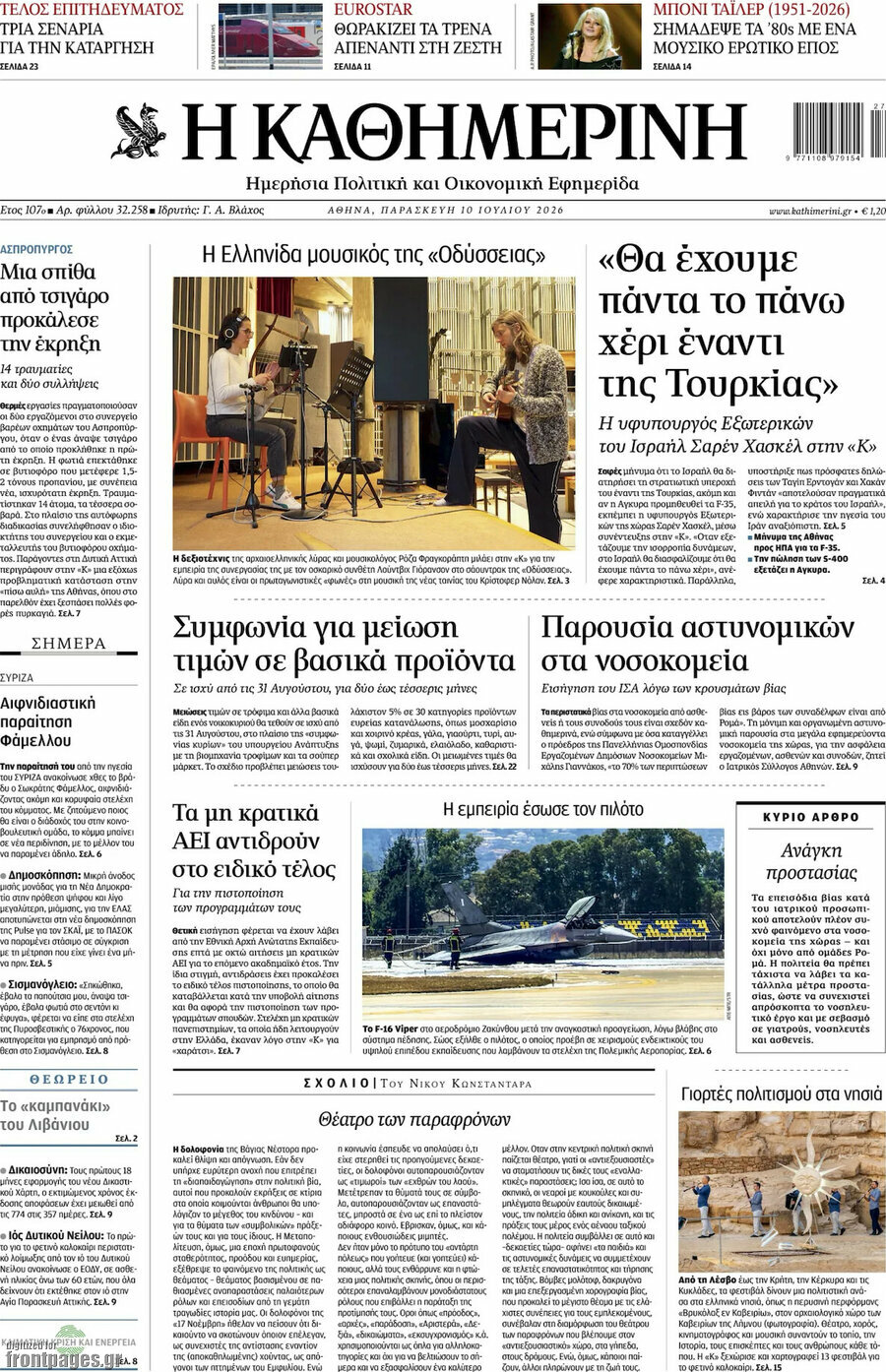
TA NEA: Civil Employees: Green light for positions of deputy mayors
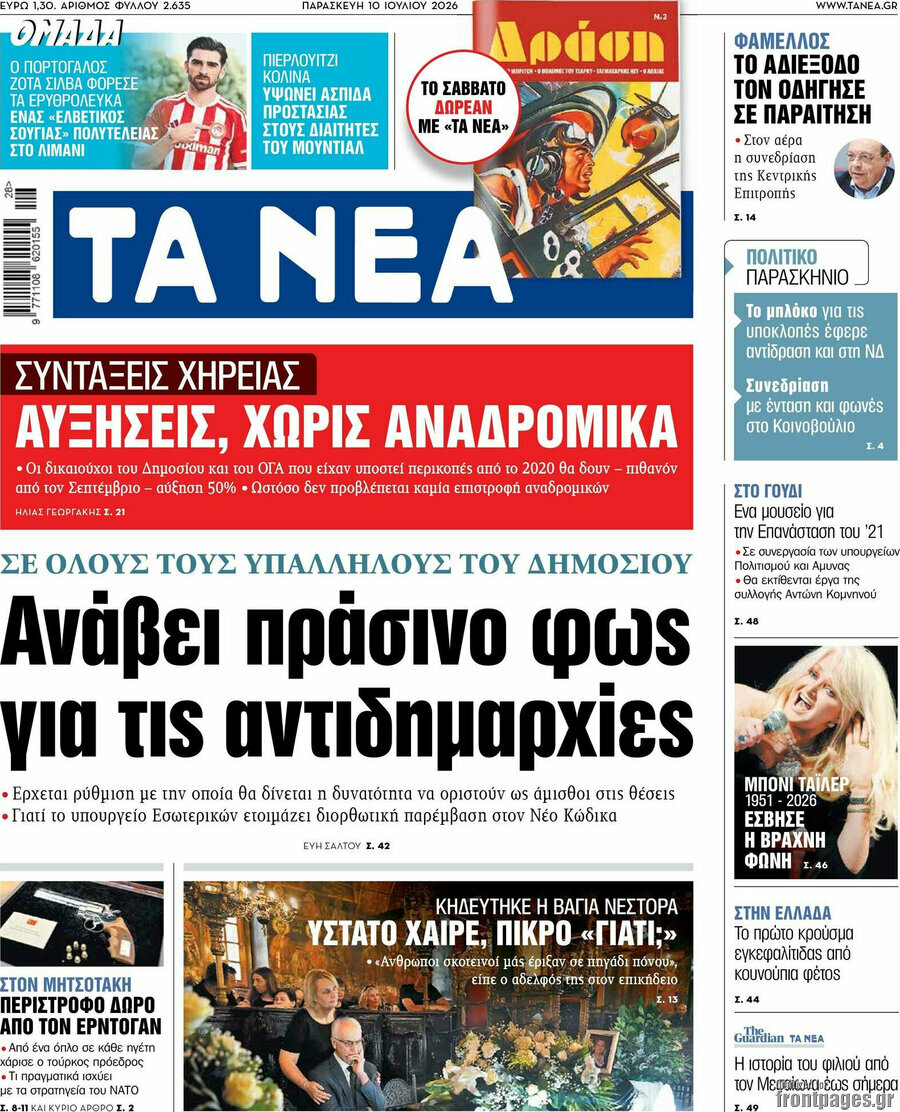
EFIMERIDA TON SYNTAKTON: SYRIZA: A party that resigned
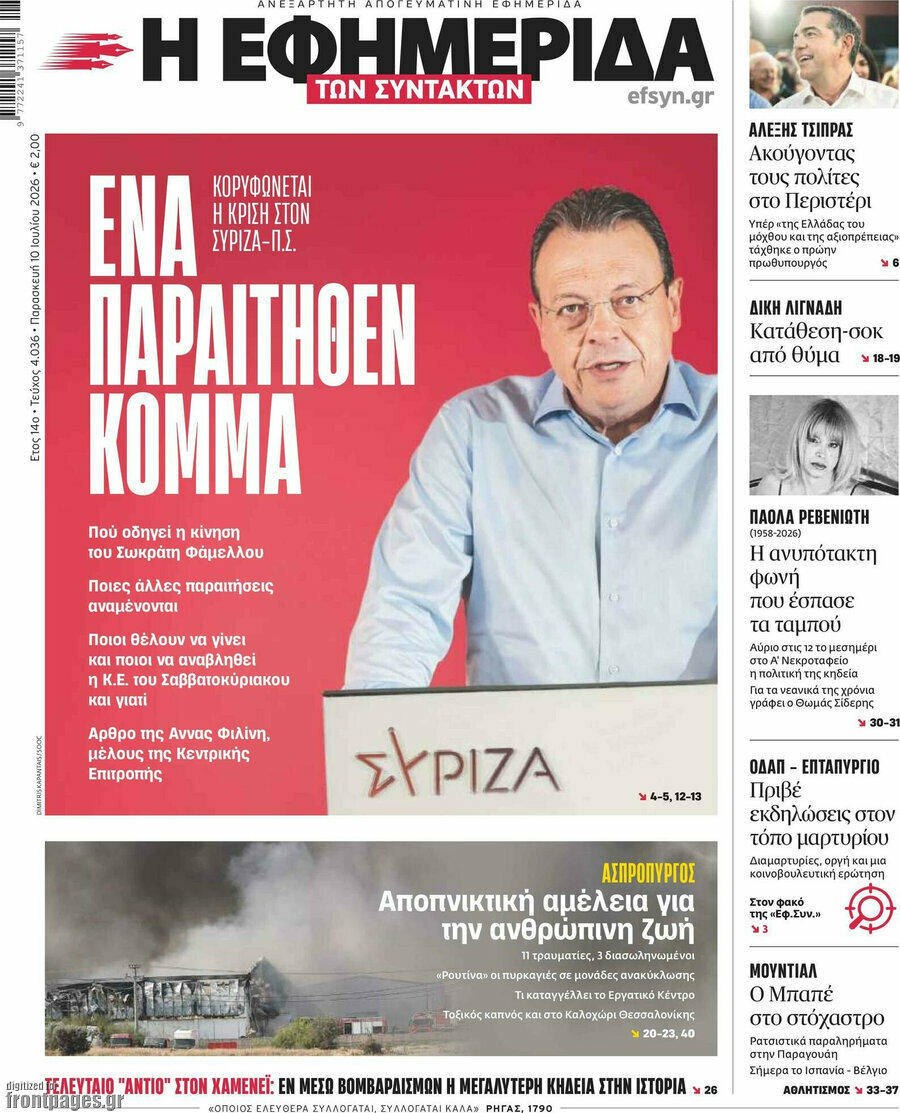
RIZOSPASTIS: Industrial accent in Aspropyrgos: No more crimes for profits!
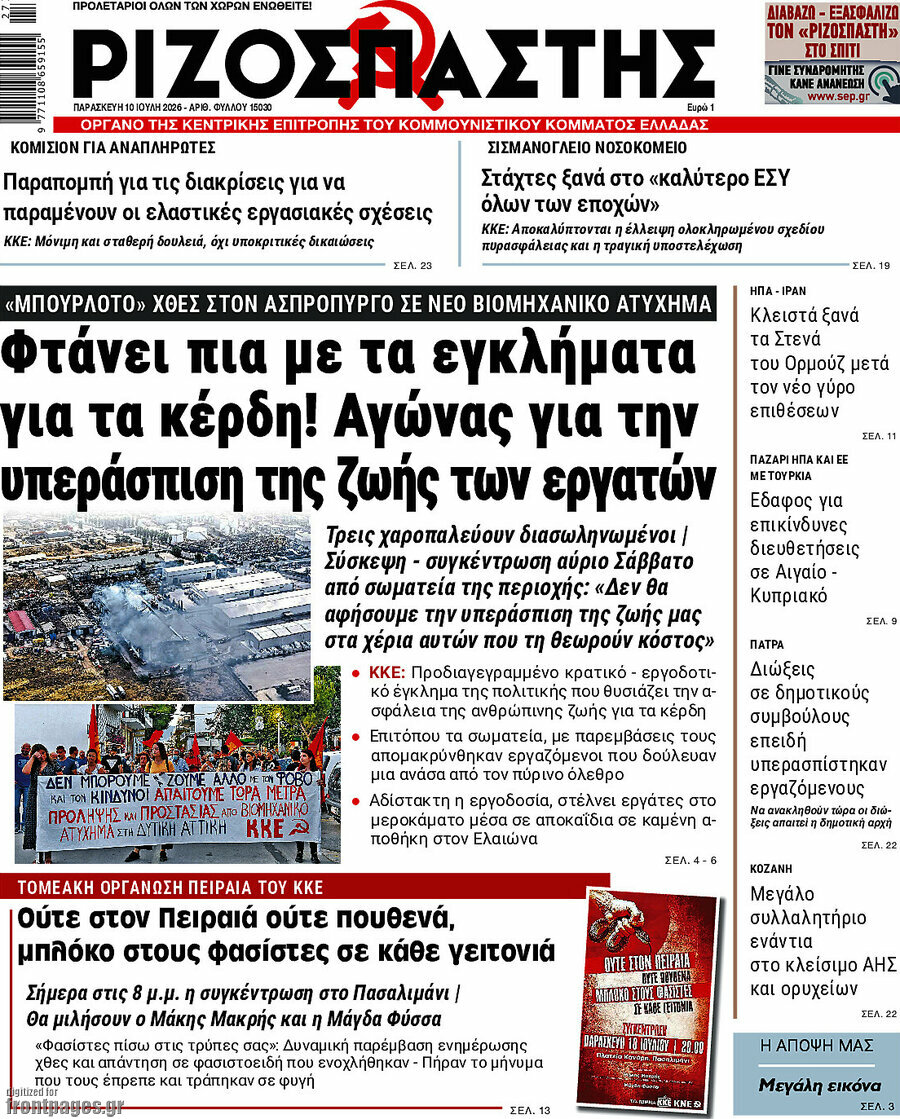
KONTRA NEWS: Tsipras’ dynamics with 17,6% remains unshakeable
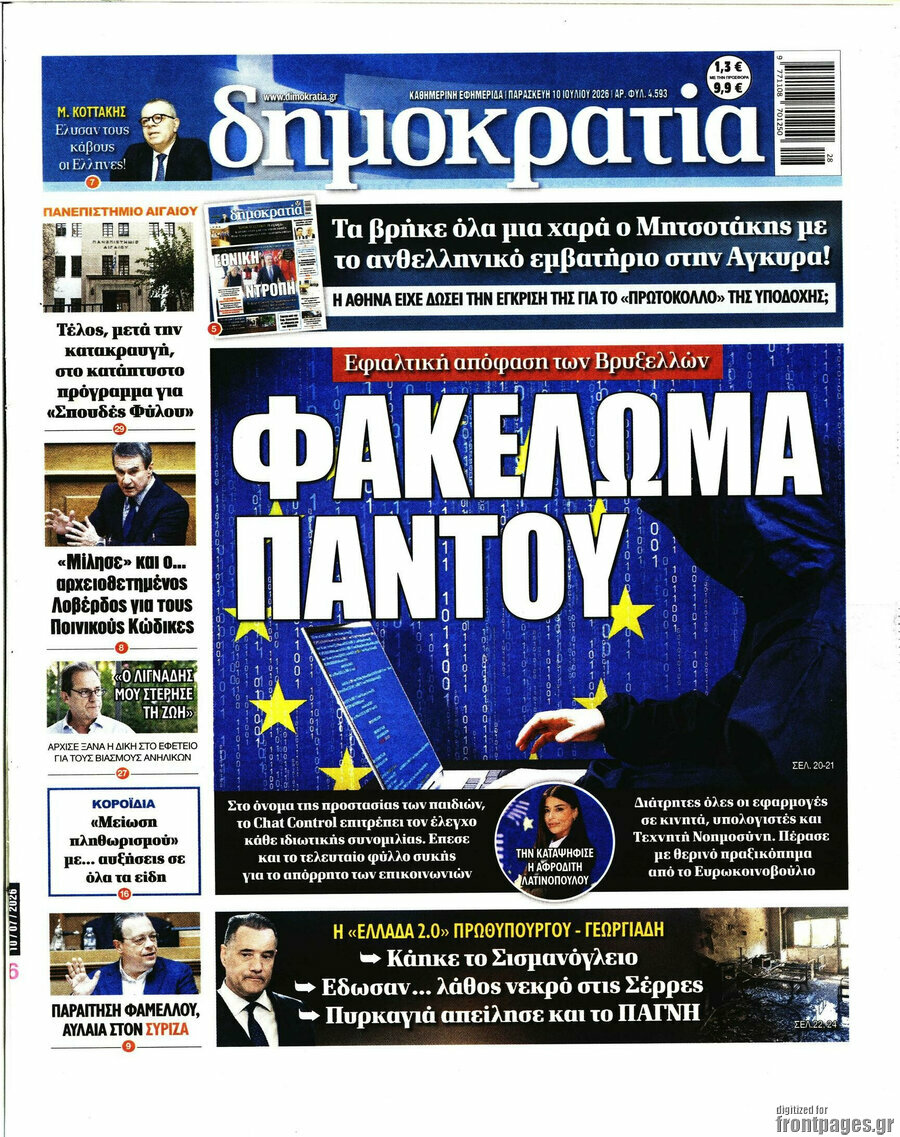
DIMOKRATIA: Nightmarish decision by Brussels: Everyone under surveillance
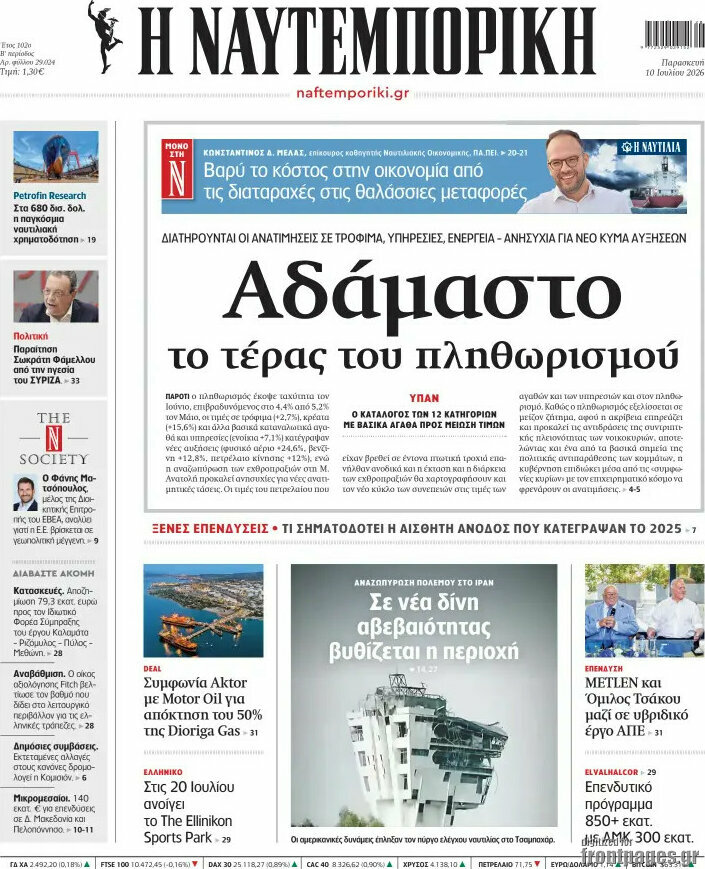
NAFTEMPORIKI: The inflation monster remains untamed

DRIVING THE DAY
TIME TO LOG OUT: Children and teenagers across the EU could be banned from using social media sites within the next few years under plans being drawn up in Brussels, and European Commission President Ursula von der Leyen is kicking off the push next week.
Starting gun: Von der Leyen will make a short statement about the proposals on Monday. She’ll also publicly accept the findings of an expert report she commissioned into the harmful effects of digital platforms on young people, as Eliza Gkritsi and I report this morning.
What will it say? The proposals will contain concrete recommendations about how to limit the harm done by social media, those working on it say, but won’t be specific about what should be banned. Yet one of the authors has already contributed to a German analysis published last month that recommended barring under-13s from the likes of Instagram, Facebook and X.
True believer: The report isn’t designed to convince von der Leyen, who, as a parent and a medical doctor, is said to be already deeply concerned about the issue. Instead, one EU official said, it’s a way to encourage any skeptical national governments to get on board by providing “an evidence base” for the proposed ban. Von der Leyen first hinted at the plan in last year’s State of the European Union address.
She’s got support: “We’ve seen that already 14 member states are on board,” Poland’s Digital Affairs Minister Dariusz Standerski told Playbook. “I believe that we have now a strong majority in favor of those solutions. We’ve heard from a couple of countries which are not really happy about those proposals — however, I do not see any possible blocking minority right now.”
Stark warning: “Children about 6, 7 years — those kids are seeing harmful content: child pornography, bullying and other crimes on the internet,” Standerski said, adding that “more than 70 percent of people [in Poland are] supporting a social media ban for children and age verification.”
Parental panic: “If you have already said that we are going for a ban and we are looking for a way how to do it, then this [report] is a little bit biased,” Estonia’s Justice and Digital Affairs Minister Liisa-Ly Pakosta said. It’s “perfectly clear that the Commission is interested in a social media ban” and “there is a kind of parental panic behind that,” she said.
Living in harmony: But EU countries including France and Poland are already at an advanced stage in drafting their own social media bans for under-16s. The bloc wants to avoid different rules in different countries and will introduce a blanket age limit to “harmonize” the approaches, officials said.
The bottom line: Several key aspects of the EU proposal remain unclear, such as whether Brussels will set an EU-wide age or let countries set their own. But with officials working on it over the summer ahead of von der Leyen’s State of the European Union speech in September, it could soon be time-out for kids on social media.
BIG AND BREAKING
ISRAEL SANCTIONS: EU foreign ministers will on Monday discuss the options for restricting trade with illegal Israeli settlements in the West Bank. “For once, things are moving in the right direction, and we welcome that,” Belgium’s Foreign Minister Maxime Prévot told POLITICO. “We now encourage the Commission to take the next step: to turn the ideas discussed into concrete proposals.”
Leaky boat: Commission Chief Spokesperson Paula Pinho expressed outrage over the fact the options paper on Israel leaked to the media. “It’s unacceptable. We have launched an internal investigation. We expect Council will do the same,” she told Playbook.
GREEN SHOWDOWN: The EU’s flagship decarbonization program is at the heart of a battle between capitals next week — with Sweden’s Europe Minister Jessica Rosencrantz telling POLITICO she will fight tooth and claw to keep the rules from being watered down.
RED TAPE FURY: European businesses are unhappy with Brussels’ plans to cut bureaucracy and make it easier for companies to operate, warning the bloc is taking too long and doing too little to simplify its laws.
MONEY MATTERS
NO-DEAL WARNING ON MFF: Europe’s wealthier countries would have little to lose by simply walking away from difficult negotiations on the EU’s long-term budget, a senior government official from a net contributor nation told Nicholas Vinocur.
Walking away? EU countries are locked in tense talks over the union’s nearly €2 trillion seven-year budget, the Multiannual Financial Framework, which would last from 2028-2034. The warning of a possible no-deal scenario raises the stakes further, hinting that net payers may be willing to significantly harden their stance to keep the overall amount down.
Just saying: “Everybody would lose in a no-deal scenario,” said the senior official from a significant net payer nation, who was granted anonymity to speak frankly about closed-door negotiations. “But one of the oddities of these negotiations, that the net recipients haven’t realized yet, is that for the net contributors, a world without an MFF is by far the least costly option.”
“In a no-agreement scenario, net contributors would pay between €500 and €600 billion less than compared to the Commission’s proposal,” the official added.
Come again? If net contributor and net recipient countries fail to agree on a deal, the ceiling, or maximum amount for the final year of the current MFF, would be carried over in 2028. Without adjustment for inflation, this would come to about €1.4 trillion.
Cohesion in crosshairs: Payments for agricultural subsidies, administrative costs, humanitarian aid, security and foreign policy are all legally protected. But other programs, such as the cohesion policies that many net recipients rely on, would expire. An extension needs a qualified majority in the Council and the net contributors have a blocking minority.
The bottom line: MFF negotiations are quickly moving to a more combative phase, with one telling the other: just dare us. Stay tuned for more.
HAPPENING TODAY: EU ministers in charge of competitiveness are in Ireland, where they’ll sit down for talks today on how to support financing of small businesses and industrial decarbonization. My colleague Jacob Parry is on the ground.
Protectionism alert: Irish Enterprise Minister Peter Burke told POLITICO that the Irish presidency is “trying to find strands of commonality” on a Buy European framework. But warns: “I’ve learned that the very hard way as an open economy… [what] protectionism got us.” Competitiveness ministers, he said, are “restless” for solutions to protect their industry.
20-SECOND PLAYBOOK PRIMER
The International Olympic Committee’s decision to provisionally lift the ban on Russian athletes, which could pave the way for them to compete in the 2028 Games in Los Angeles, has led to outrage and even calls for the EU to stop funding the IOC. But does the EU fund the Olympics? Not directly — most of the cash for the games comes from broadcasting rights and sponsorship. But the IOC and other Olympic bodies can receive grants for specific projects from EU programs such as Erasmus+.
TALK TO PLAYBOOK: WhatsApp us on +32 491 050629 and listen from 7 a.m. to hear if we give you a shoutout.
FAILING THE TEST
PSYCHOMETRIC, QU’EST-CE QUE C’EST? Officials hoping to secure a senior AD7-level post with the European Commission were required to sit a psychometric test. Now, furious staff think the whole thing was botched.
Lost in translation: The test was provided by British-based company SHL and was designed to screen officials’ reasoning and other skills. But a Commission official said it wasn’t properly translated into French and German, or appeared to be have been translated with AI. “Many people are upset,” the official said, adding that practice tests were only available in English, something that may have harmed the chances of non-native English speakers to familiarize themselves with the test.
A second official said that “many candidates” complained about the exam.
Above board: Commission spokesperson Balazs Ujvari told Playbook that SHL confirmed it had used professional translators for all tests, with native-speaking experts reviewing them. The English-only practice test was simply there to familiarize candidates with the platform and “had no bearing” on the results. Some candidates sought clarification after the test, the spokesperson acknowledged, but were told exactly that.
SHL didn’t respond to POLITICO’s request for comment.
Non-EU outsourcing: The first official slammed the optics of the Commission outsourcing the exam to the U.K. “You cannot just outsource your competition to be an EU official to a British private company,” the exasperated official said.
Simply the best: Ujvari said the EU executive surveyed the market in late 2024 and early 2025, before selecting SHL. The Commission concluded the company offered, among the other testing platform providers, the best combination of quality, flexibility and value for money.
Psychometric expansion: The AD7 competition marked the first time the Commission has used psychometric screening in an internal competition, as part of what the executive describes as a pilot to modernize recruitment and promotion procedures. EU officials told Playbook at the time that if the experiment proved successful, the approach could be expanded to other competitions — including future AD5 selection procedures for candidates seeking to join the EU public service.
5 MORE THINGS GETTING US TALKING
MEET THE NEW MERZ: Dressed in a sharp suit and dark sunglasses, black leather briefcase in hand, Chancellor Friedrich Merz is presenting himself as a hard-charging Reformkanzler — a “chancellor of reforms” — who can see off the far right.
FOOTBALL UNITY: There’s nothing like a World Cup match to bring together feuding French politicians. Les Bleus’ 2-0 win over Morocco led to a rare moment of détente.
WRAP IT UP: The EU has kicked off its squeeze on allegedly unfair Chinese trade practices by opening an investigation into cheap imports of Pekin duck, after other sellers said they couldn’t compete on price. But what will be the size of the bill … ? Read about it in Morning Trade.
RUE DU MUR? MAUERSTRASSE? VIA DEL MURO? European stock exchanges are battling Wall Street banks to be at the center of global financial trading.
SUMMER BLOCKBUSTER: In this week’s Declassified, Paul Dallison looks at the movie hit of the year, based on the travails of Marine Le Pen and Nigel Farage.