
Mitsotakis: Euro-Atlantic relations should be maintained at functional level
The need to maintain Euro-Atlantic relations at a functional level was underlined by Greek Prime Minister Kyriakos Mitsotakis in his statements shortly after the conclusion of the extraordinary European Council in Brussels. The Euro-Atlantic relations have gone through periods of turbulence over the last year, he said and added: Despite this, we all recognize that we must, in good faith, seek to maintain these relations at a functional level, without any behaviours that could lead to developments that cannot be corrected later.
Mitsotakis cites ‘legal concerns’ over Trump’s Board of Peace
Prime Minister Kyriakos Mitsotakis has raised “legal concerns” over US President Donald Trump’s new Board of Peace, citing objections shared by most EU member states. Speaking as he arrived at an extraordinary EU summit in Brussels, Mitsotakis said that Greece, along with “almost all EU countries, with two exceptions,” has expressed reservations about the initiative, arguing that its scope “far exceeds United Nations Resolution 2803” passed in November to give effect to the Gaza peace plan.
Congress green-lights bill on the role of the Eastern Mediterranean in the IMEC corridor
The House Foreign Affairs Committee has approved legislation that aims to establish the Eastern Mediterranean as a key strategic hub within the India–Middle East–Europe Economic Corridor (IMEC). This major trade and infrastructure initiative is backed by the United States and its allies. The bill emphasizes expanding U.S. cooperation with key regional partners, including India, Greece, Cyprus, Israel, and Egypt. Energy security and defense coordination are identified as central priorities.
Passenger traffic in Greek airports increased 4.9 pct in 2025
Passenger traffic recorded an increase of 4.9%, in 2025 at all Greek airports. According to the Hellenic Civil Aviation Authority, passenger traffic at all airports nationwide during the period January-December 2025 reached 83,333,571 passengers, compared with 79,424,082 passengers in the corresponding period of 2024.
https://www.amna.gr/en/article/964695/Passenger-traffic-in-Greek-airports-increased-49-pct-in-2025
ATHEX: Session of emphatic rise on bourse
Free from geopolitical concerns regarding transatlantic tensions about Greenland, Greek stocks enjoyed a day of considerable growth on Thursday, with blue chips raising their prices and the benchmark climbing once again to highs unseen in over 16 years. This time it was mostly energy stocks that ran the show, while turnover was also on the rise. Three weeks in, the stock year shows it may well prove to be the sixth in a row with net gains for the main index at Athinon Avenue.
https://www.ekathimerini.com/economy/1293148/athex-session-of-emphatic-rise-on-bourse


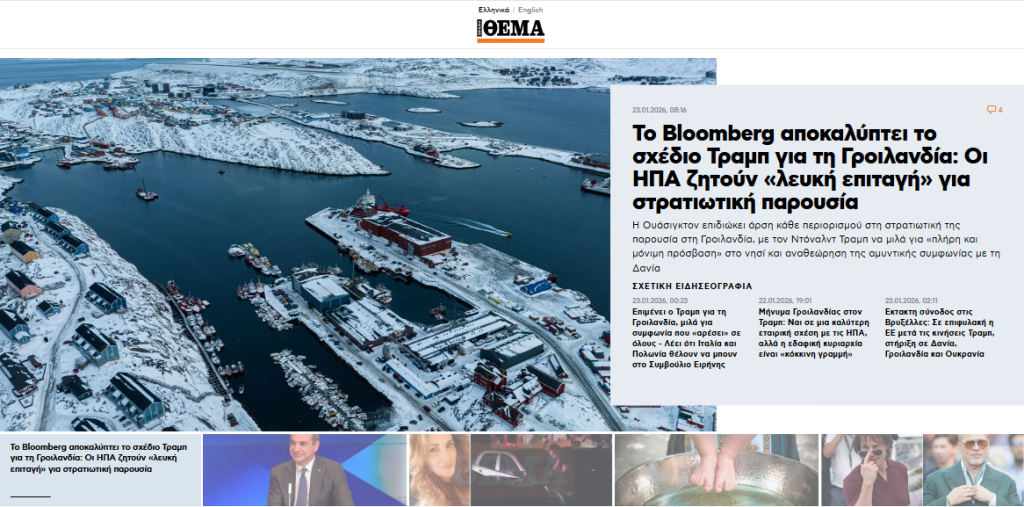
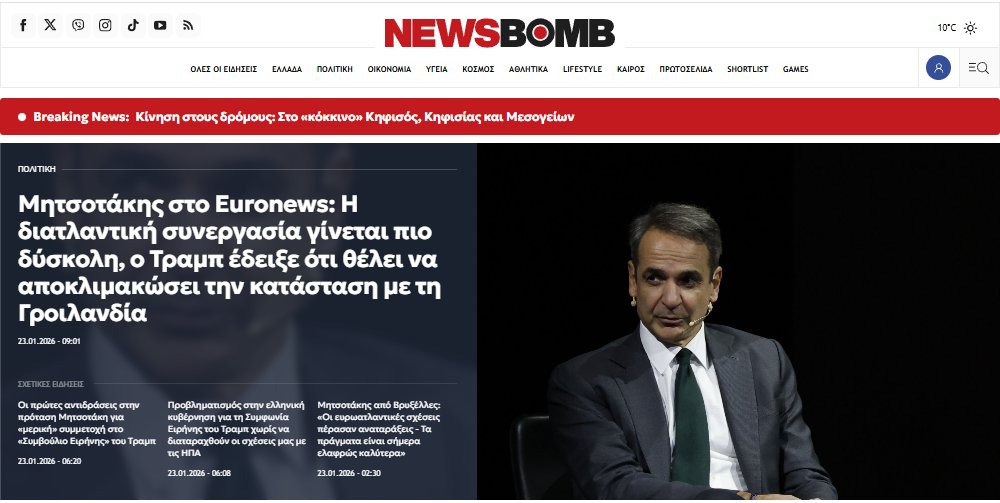
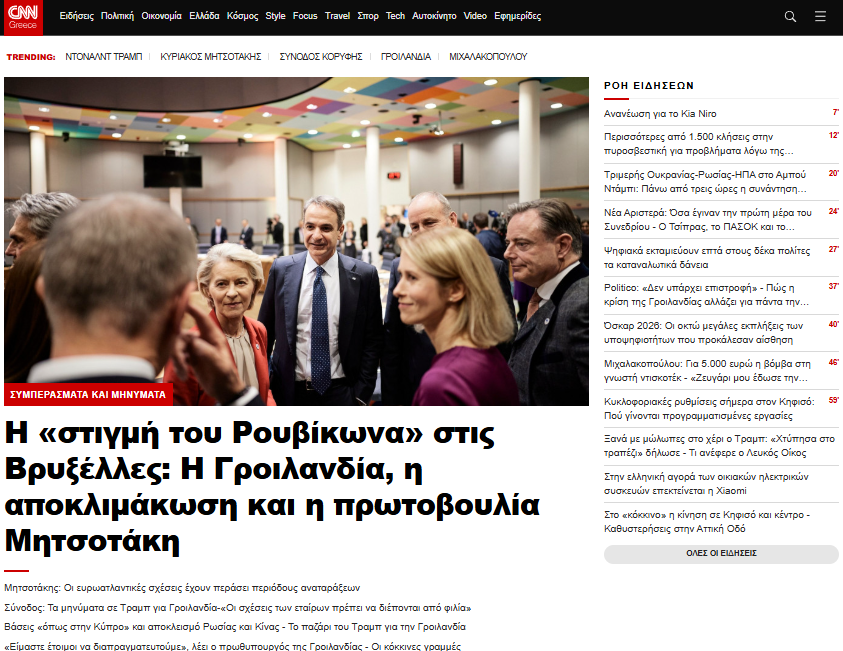
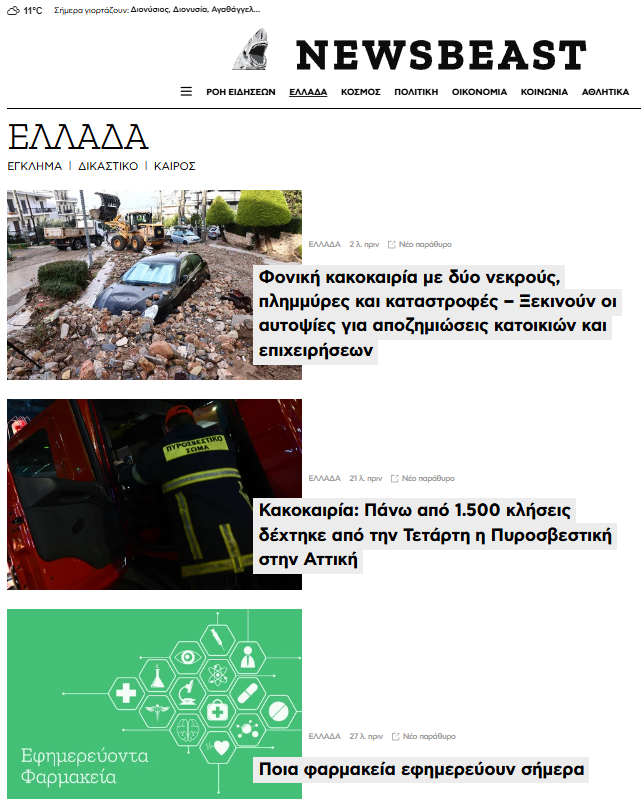

KATHIMERINI: Hazards map regarding natural disasters was kept away from the public eye
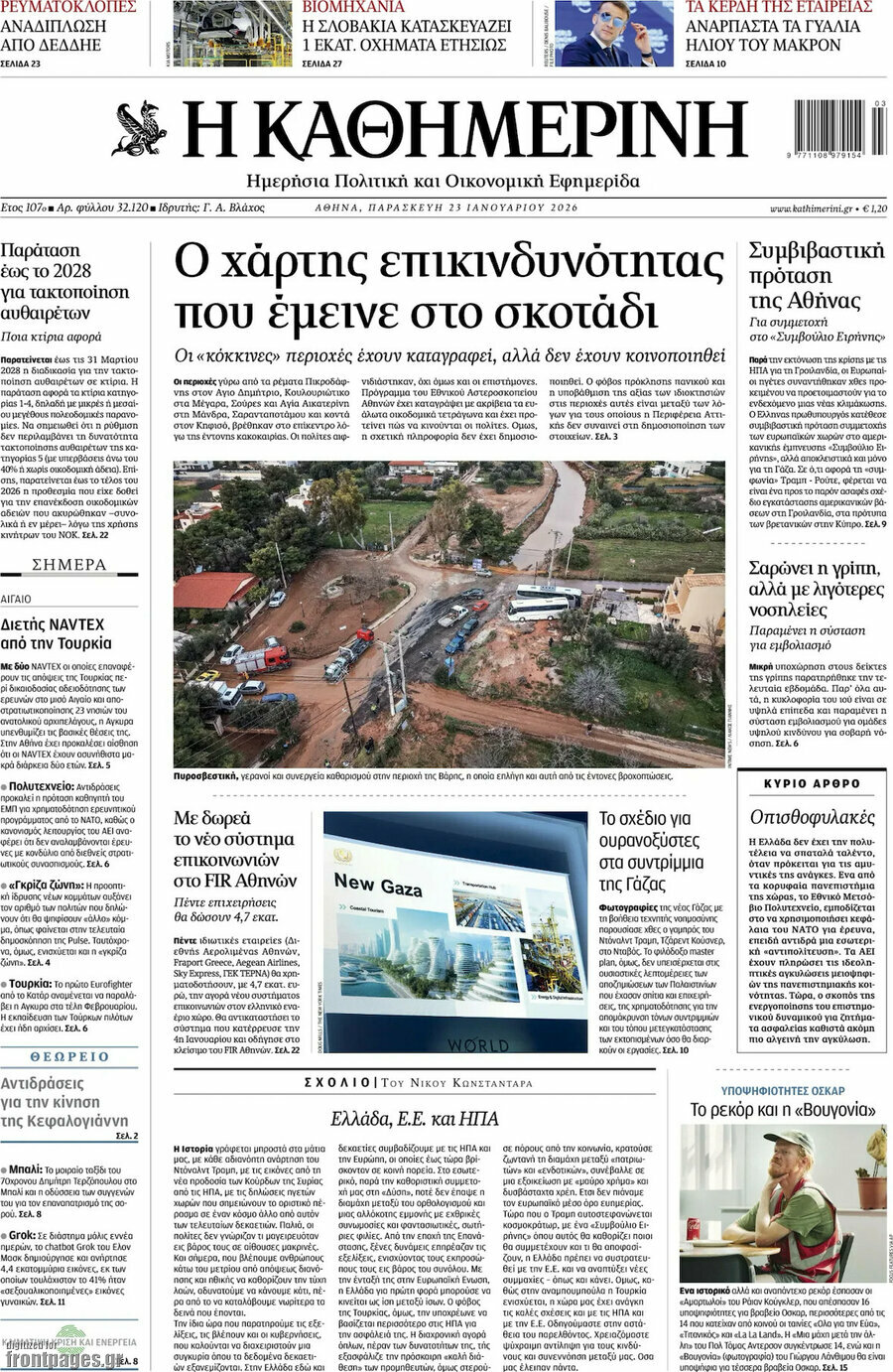
TA NEA: Private donations in order for new air-traffic control system to be acquired
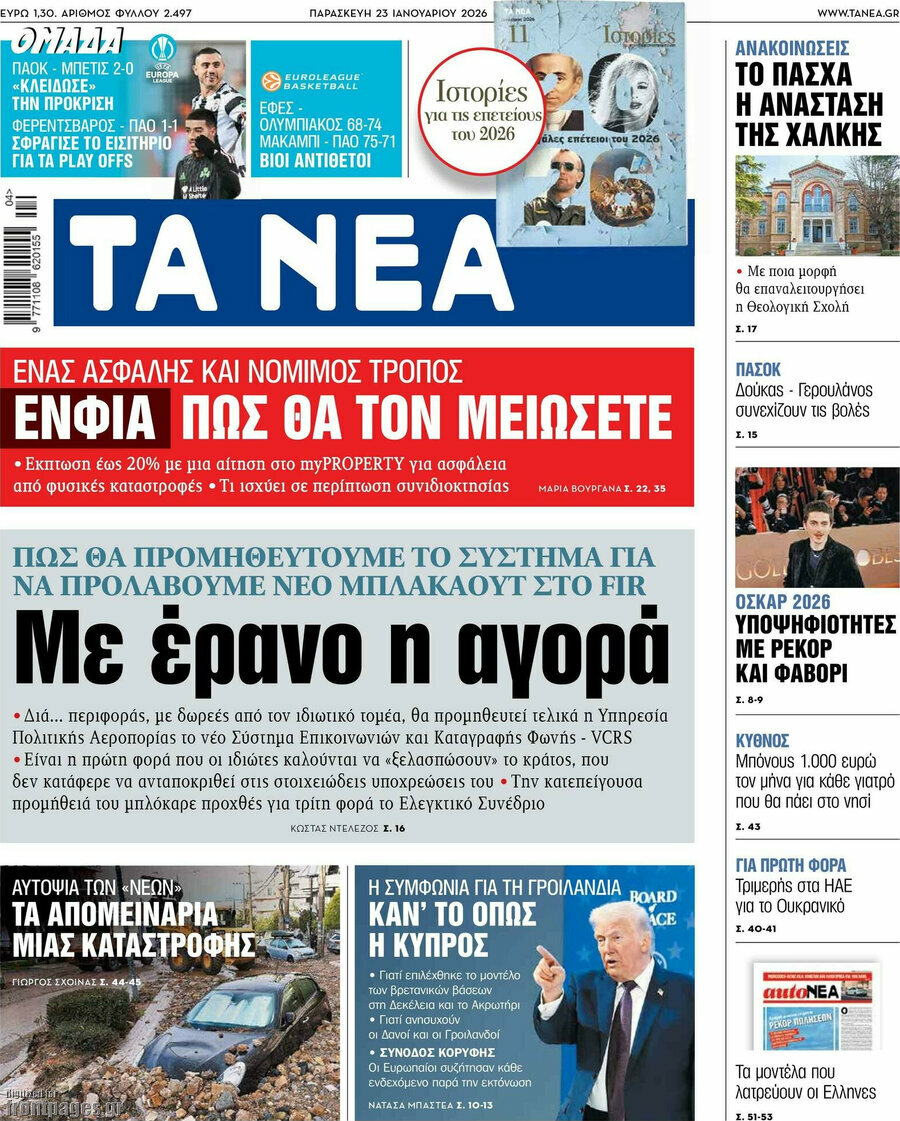
EFIMERIDA TON SYNTAKTON: Truce until further notice
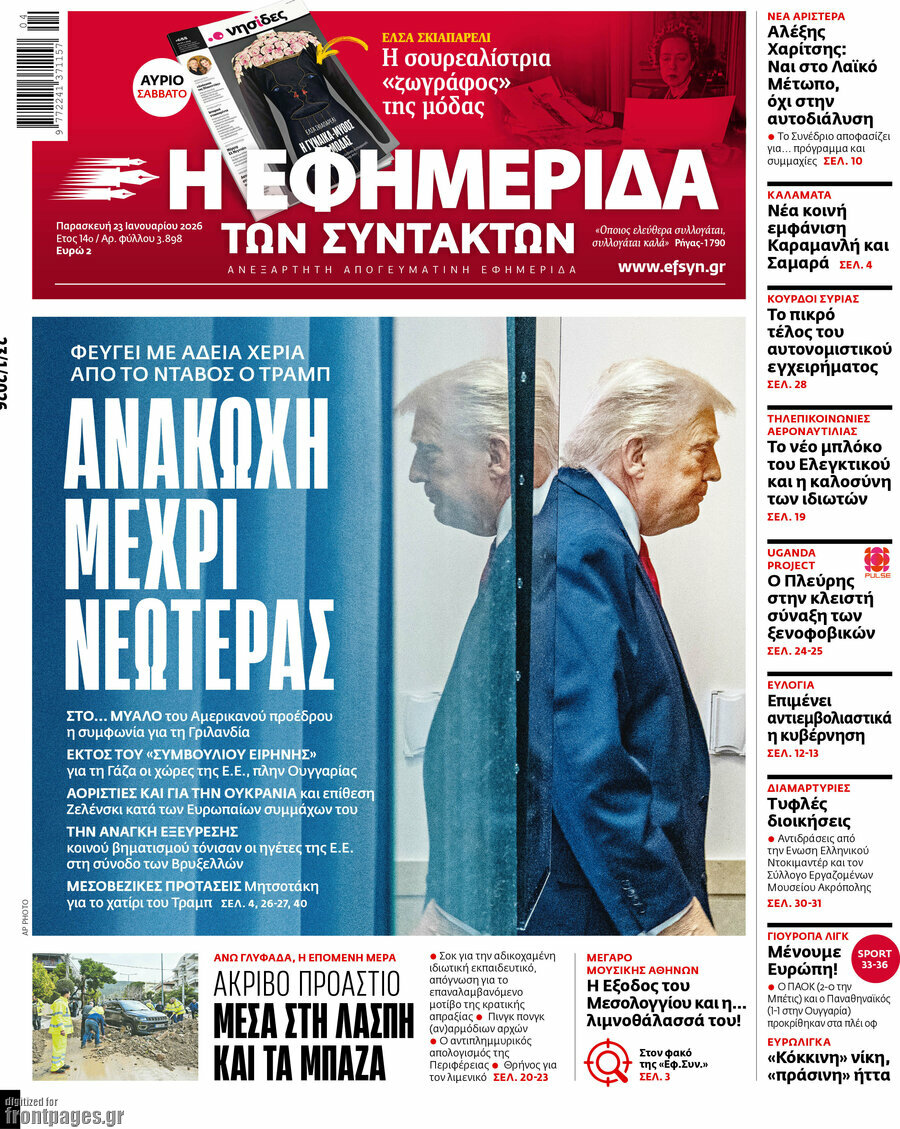
RIZOSPASTIS: The people are left unprotected again by the government and the state
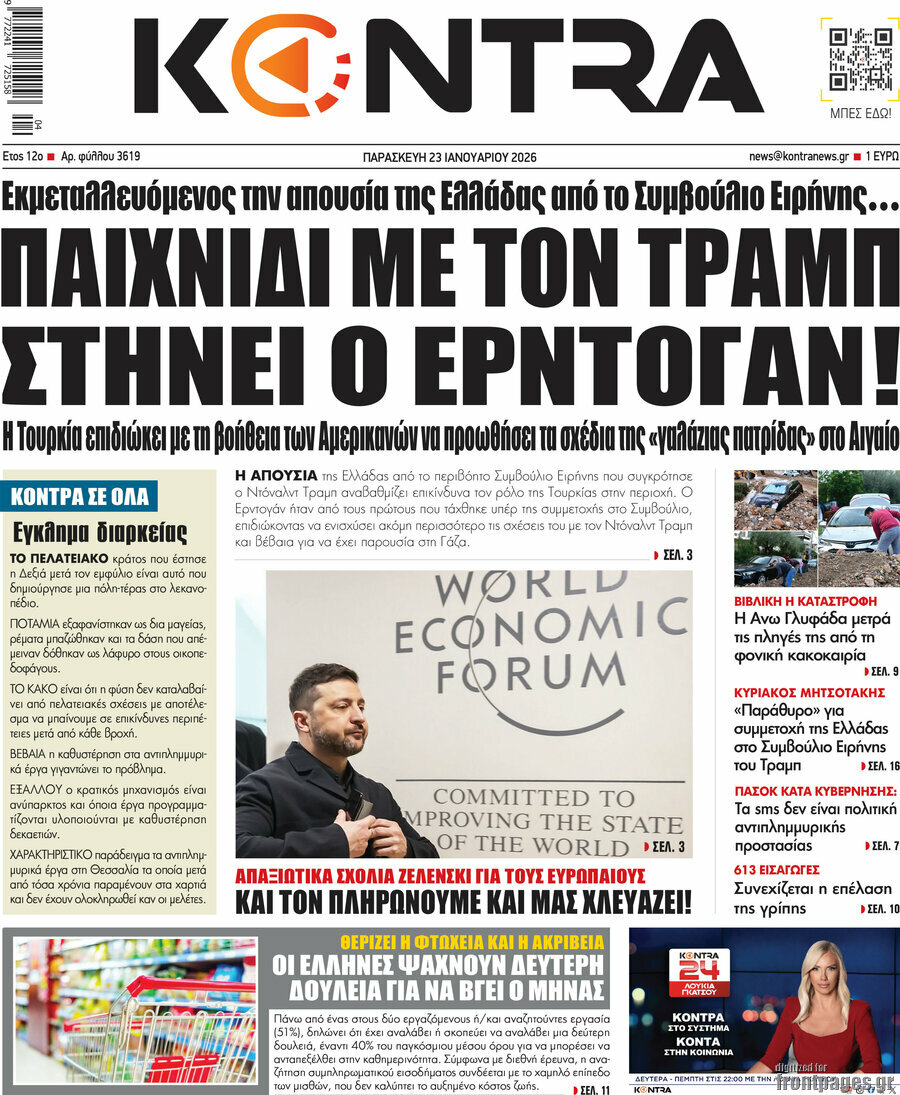
KONTRA NEWS: Erdogan is setting up a game in the Aegean Sea alongside US President Trump
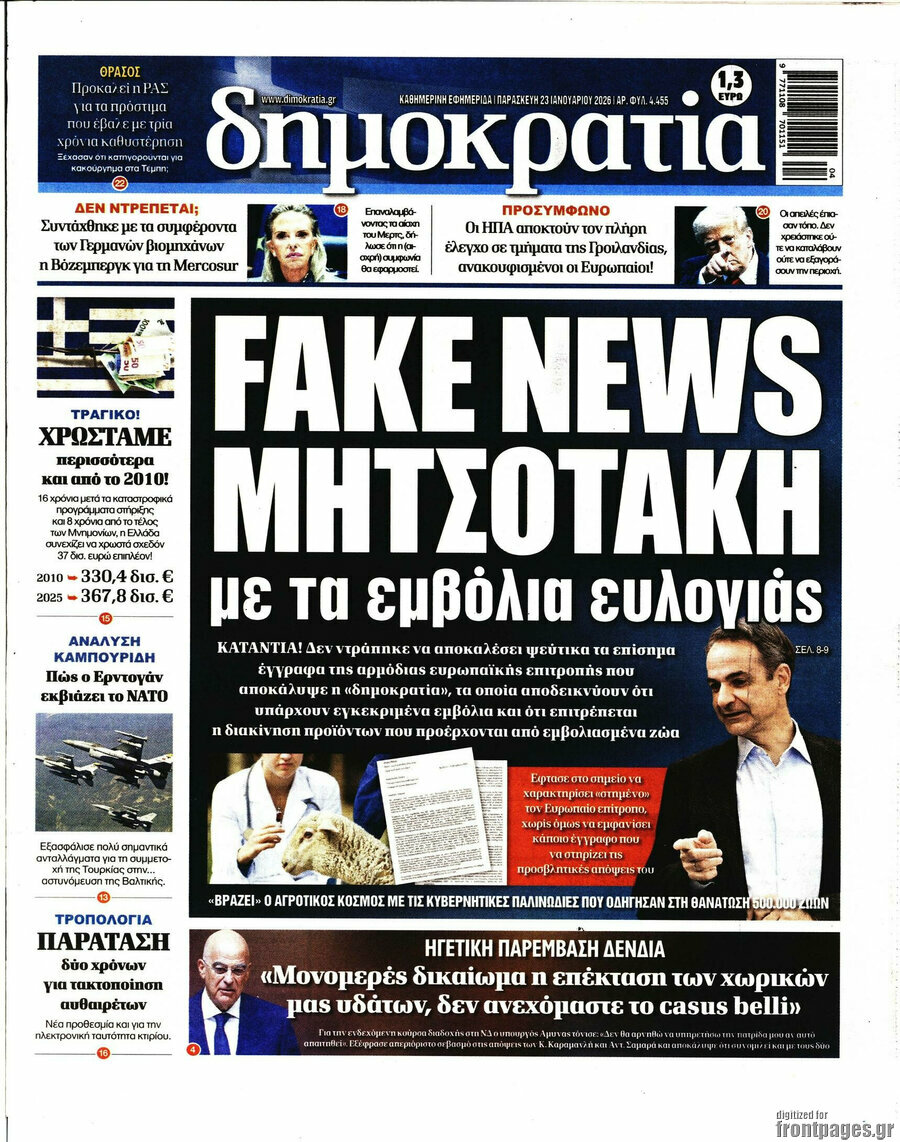
DIMOKRATIA: Fake News by Mitsotakis regarding sheep-pox vaccines
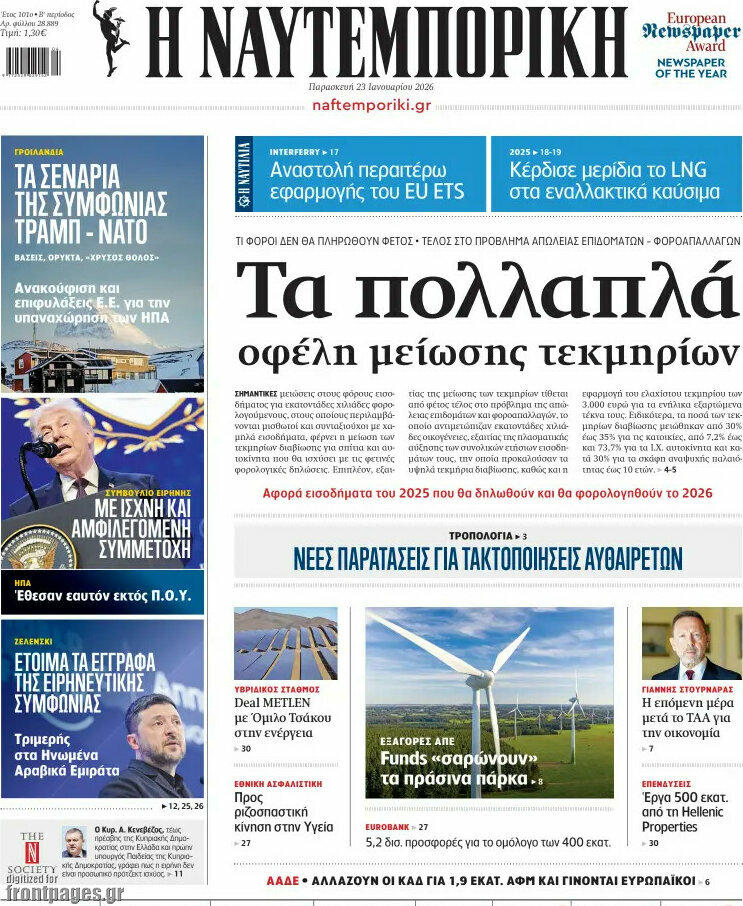
NAFTEMPORIKI: Multiple benefits from the reduction of tax criteria

DRIVING THE DAY:
THE TRUMP PLAYBOOK: The European Union may have averted one transatlantic crisis this week but has already started thinking about the next. That was the message from diplomats, officials and politicians in the early hours of this morning, after leaders held a five-hour working dinner in the European Council building on how to handle an increasingly volatile U.S. President Donald Trump.
EU countries want to avoid a repeat of the Greenland crisis but they’re split on how to do it. Some — like France, Belgium and Spain — credit the EU’s joint position, pledge of retaliation and market-sinking trade-war fears with fending off Trump. Others, like the Baltics and Poland, say NATO Secretary-General Mark Rutte’s strategy of flattering the U.S. president was what averted disaster.
Die is cast: The one thing they can all agree on is that there can be no going back. As Zoya Sheftalovich and Nicholas Vinocur report this morning, Trump’s fighting words on Greenland have had a profound impact on the EU and the bloc’s view of its U.S. frenemy. “This is the Rubicon moment,” said an EU diplomat from an eastern flank country. “It’s shock therapy. Europe cannot go back to the way it was before.”
Illusory TACO: The consensus is that if Trump has threatened his NATO allies once, he can do it again. “The fact there are no tariffs from February is a positive development but we have to be prepared for Donald changing his mind,” said one diplomat after the preparatory meeting of ambassadors earlier in the day. “Nobody said TACO. Nobody thinks this is him chickening out. It’s de-escalation, but we have to be prepared for him changing his mind.”
Standing firm: It was Commission President Ursula von der Leyen who best articulated the mood. “We followed four key principles: firmness, outreach, preparedness and unity. And it was effective so going forward we should maintain this very approach,” she said.
New vibe: Another EU official familiar with the discussion agreed: “There was a clear change of mood in the room. The discussion among the leaders made clear that when a situation like the one that occurred a few days ago happens, a calm but quick and firm response is needed and it works.”
Thursday’s summit was initially convened to work out a retaliatory response to the threat of new U.S. tariffs, which were to have been imposed from Feb. 1. With the tariffs no longer on the table, the meeting was quickly overshadowed by the need to understand what deal, if any, had been struck between Trump and Rutte over Greenland.
What we know: Two officials told my colleagues Nette Nöstlinger and Jacopo Barigazzi that the proposed four points sketched out by Rutte centered on the renegotiation of a 1951 U.S. defense agreement and a broad promise by European governments to step up Arctic security. This could include adapting the original agreement for a “golden dome” — Trump’s proposed future missile-defense system. It could also include a provision for what would happen if Greenland obtained full independence from Denmark.
U.S. access: The proposals could also include extended U.S. military access to the island, along with a broad promise by European governments to increase their contribution to security in the region, including a potential NATO mission.
Aspirational goals: Some diplomats suggested the third and fourth points of the proposal may be, for now at least, more wishful thinking than firm commitments. Those points are: An understanding that the U.S. and EU won’t place further tariffs on each other; and the establishment of a supervisory body to monitor exploration rights, to prevent another major power, such as China or Russia, from winning the race for Greenland’s resources.
Danish Prime Minister Mette Frederiksen, who had complained of being cut out of the conversation, will meet Rutte at NATO headquarters for a working breakfast this morning to discuss the situation, a national official told POLITICO.
Hush hush: Two diplomats, who were granted anonymity to speak freely about the sensitive talks, said those who — like Council President António Costa — have had personal readouts from Rutte about the details of what Trump was offered are cautious about sharing information too widely. They are keen to avoid leaks and speculation.
No hostility: “I still treat United States as our closest friend,” said Lithuanian President Gitanas Nausėda on arrival at the meeting, adding that it was a mistake for Brussels to even contemplate using the so-called trade bazooka against an ally. A diplomat from a more cautious country said EU members broadly agreed on how to handle the crisis. “The question is one of tactics. Do you walk in wielding a big stick now, or do you do it later?” the diplomat said.
“Hysteria”: In Davos, U.S. Treasury Secretary Scott Bessent told POLITICO’s Dasha Burns that the Europeans had been wrong to stand up to Washington (he would say that, of course). “The hysteria level that hit here was just out of control — driven by the media, driven by this European hand-wringing,” Bessent said in the interview. “It was completely out of control.”
The EU’s plans to diversify away from America and reduce the bloc’s exposure to Trump’s whims will face another critical moment next month when leaders gather at a castle in rural Belgium to discuss strategic autonomy — though with this president, it’s entirely possible they’ll be tested again before then.
NOW HEAR THIS: On the EU Confidential podcast, we recap the summit — and the week that was. Host Sarah Wheaton is joined by Zoya, Nick and Tim Ross.
PLAYING POLITICS
RUNNING OUT OF STEAM? Ursula Von der Leyen has survived her fourth motion of censure in seven months by a wide margin.
On paper, the Commission president’s support is growing — drawing more and more votes in her favor each of the four times a no confidence motion has come up. A total of 390 lawmakers backed her Thursday, suggesting MEPs are growing weary of the far right repeatedly tabling censure motions. Or perhaps they are unwilling to destabilize the EU at a time when Europe is engulfed in multiple crises.
What helped: The fact it was a far-right motion means dissatisfied lawmakers from the center and left sides of the hemicycle voted against it. The other factor is that the European People’s Party (EPP) this week introduced tougher punishments for those breaking the party line in such votes, which dissuaded some EPP lawmakers critical of von der Leyen from voting against her.
But but but … even those rules did not prevent five EPP lawmakers from voting against von der Leyen or abstaining. As a result, for the next six months they will likely be banned from speaking in the hemicycle and from leading negotiations in any legislative file or resolution. The MEPs are: the Netherlands’ Jessika van Leeuwen and Sander Smit; Romania’s Loránt Vincze and Iuliu Winkler; and Slovenia’s Milan Zver.
MERCOSUR CONTROVERSY LOOMING: The Commission is now weighing up whether to provisionally apply the Mercosur agreement — despite Parliament voting to freeze its ratification of the trade deal with South American countries and send the text for legal review. If it were to go down this path, it could trigger another backlash if lawmakers see the executive as bypassing Parliament’s decision. This could trigger a fifth motion of censure against the Commission — this one supported by anti-Mercosur MEPs from all political groups.
Inside the Mercosur muddle: For weeks, now, the Commission had been expecting Parliament to send the Mercosur deal for a legal review and it undertook a concerted lobbying campaign to ensure it didn’t happen, Max Griera reports. This included asking heads of government to call lawmakers. The campaign ultimately failed, as domestic political pressures carved deep fault lines in the Parliament’s political groups and triggered massive infighting within Europe’s centrist party ranks.
DID METSOLA JUMP THE GUN? Meanwhile, MEPs from the Socialists and Democrats (S&D) and the liberals of Renew Europe are annoyed that the EPP’s Roberta Metsola, the assembly’s president, didn’t coordinate with them on committing to unfreeze the EU-U.S. trade deal ahead of meeting leaders on Thursday.
Angry allies: An S&D official said Metsola did not consult with the second-largest group after POLITICO reported she was coming under pressure to smooth the passage of her decision. “The EPP is the only one exerting pressure” to unblock the U.S. trade deal, the official added. No Renew official could confirm consultation had taken place.
Pressure is huge. Now that Trump has toned down his tariff threats, it’s highly unlikely that the Parliament will move to freeze the next steps of the deal. Lawmakers from the trade committee are now expected to formalize the decision on Monday.
MIGRATION MOMENT
CALL TO BEEF UP MIGRATION RESPONSE: The role of Frontex and Europol in the EU’s approach to migration has to be strengthened, according to Marie-Pierre Vedrenne, France’s minister delegate to the interior minister. Speaking with Hanne Cokelaere in Cyprus, Vedrenne said she wasn’t calling for the agencies to “completely change their mandate” but simply to reinforce what works well and to engage with countries of migration departure and transit.
Tough talk: While those in Nicosia for Thursday’s Justice and Home Affairs Council were working through a lunch of souvlaki and stuffed vegetables, ministers were discussing how to return people to Syria and Afghanistan. “It’s a delicate subject — a difficult one, but it’s a necessary one,” Belgium’s Migration Minister Anneleen Van Bossuyt told reporters. In a letter to European Migration Commissioner Magnus Brunner last year, Belgium and 19 other countries called for a joint European approach to voluntary and forced returns to Afghanistan.
Sweden wants a shift: Sweden’s deportation policy is focused on people who’ve committed crimes but faces difficulties including missing paperwork, a lack of political cooperation with the Afghan Taliban regime, trouble identifying people and difficult and expensive flights, Sweden’s Migration Minister Johan Forssell told a group of journalists at an impromptu presser. He called for an action plan: “One way or another, there must be a shift.”
Levers to pull: As the EU looks for leverage to get third countries to accept returns, Forssell said his country favors also including development cooperation on an EU level — “but we’re not really there yet … Our experience is quite simple, and that is that money talks.”
UNABLE TO REUNITE: Ukrainians serving prison sentences in Russian-occupied territory, and those forcibly abducted by Russian forces, are being left unable to enter the EU as a result of the bloc’s new Schengen Information System, risking being flagged as potential threats to public order and internal security. It has left some prisoners unable to rejoin loved ones abroad after gaining back their freedom.
Fairness warning: “We should be very careful not to treat Ukrainians from temporarily occupied territories as a security threat by default,” said Thijs Reuten, a Dutch center-left MEP and the European Parliament’s shadow rapporteur on Ukraine. Ekaterina Bodyagina has the full investigation.
IN OTHER NEWS
WHILE YOU WERE SLEEPING: U.S. President Donald Trump said the U.S. has sent an “armada” of warships toward Iran but hoped he would not have to use it, as he renewed warnings to Tehran against killing protesters or restarting its nuclear program. Reuters reports the USS Abraham Lincoln aircraft carrier and several guided-missile destroyers will arrive in the Middle East in the coming days.
FRESH UKRAINE TALKS: Russia has announced it will hold security talks with the U.S. and Ukraine in Abu Dhabi on Friday, Reuters reports. However, the Kremlin has warned that unless territorial issues can be resolved, a durable peace would not be possible.
Zelenskyy clap-back: Ukrainian President Volodymyr Zelenskyy didn’t mince his words when he spoke at Davos Thursday, accusing Europe of dithering in its support against Russia, and of preferring words over action. This prompted a sarcastic English-language post on X from Hungarian Prime Minister Viktor Orbán, who listed the reasons why Hungary “cannot support your war efforts.”
No love lost: “The Ukrainian people, of course — despite your carefully chosen insults — can still count on us to continue supplying your country with electricity and fuel, and we will also continue to support refugees arriving from Ukraine,” Orbán said.
BORED OF PEACE: Trump’s plan to end wars is turning to a group of some of the world’s most warlike leaders — including Vladimir Putin and Aleksandr Lukashenko. In his weekly Declassified humor column, my colleague Paul Dallison asks: What could possibly go wrong?
Non-invitation: On Thursday, we said Denmark had confirmed it wouldn’t participate in Trump’s Board of Peace. Today, it may be worth pointing out that the Danes weren’t actually invited in the first place. Read the details in a statement put out by Foreign Minister Lars Løkke Rasmussen.
Meanwhile, Canada’s invitation to join “what will be, the most prestigious Board of Leaders ever assembled, at any time” was publicly rescinded by Trump himself.
STUDIO SHOWDOWN: A bitter battle over Warner Bros. Discovery, which is pitting Netflix and Paramount against each other in a $82.7 billion buyout bid, is becoming a problem for the EU. After Warner accepted the Netflix bid, Paramount has met with the European Commission Directorate-General for Competition, Francesca Micheletti and Mari Eccles report.
JUST IN TIME: TikTok announced overnight it had closed a deal establishing a U.S. subsidiary of the platform to avoid a ban, with new owners including the U.S. private equity firm Silver Lake, Abu Dhabi-based artificial intelligence company MGX and Oracle, the tech giant co-founded by Larry Ellison, an ally of Trump. The deal allows TikTok’s Beijing-based parent company, ByteDance, to maintain a nearly 20 percent stake. Our U.S. colleagues break down everything you need to know about the deal here.
MOVE OVER FRANCE: The infamous Franco-German engine has competition — from Rome. Italian Prime Minister Giorgia Meloni and German Chancellor Friedrich Merz appear set on sharing control of the EU’s economic agenda together, in what has become the bloc’s newest power couple.
Can’t get enough of each other: Officials from Meloni’s office told Jacopo Barigazzi that the right-wing prime minister met with Merz privately ahead of last night’s summit. And that’s not all — the pair will sit down today in Rome to sign a string of partnership agreements that could see Paris sidelined, according to our top team of reporters.