
Greece welcomes ‘most powerful’ FDI-class frigate
Greece’s leadership welcomed on Thursday the Hellenic Navy’s first FDI-class frigate, Kimon (F-601), marking a new era for Greece’s Armed Forces.
Road blockades ease nationwide
Farmers leading the toughest road blockades began easing their protests and gradually reopening national highways across Greece, meeting a key government condition for talks with those who refused dialogue on Tuesday.
https://www.ekathimerini.com/economy/1292522/road-blockades-ease-nationwide
Greece posts highest employment growth among OECD countries in Q3 2025, says Kerameus
Labor and Social Security Minister Niki Kerameus, said in a post on social media that “Greece recorded the highest increase in employment among all OECD countries in the third quarter of 2025, compared with the third quarter of 2024.”
Budget: Primary surplus of 8 billion euros in 2025
The 2025 central government primary surplus (on a cash basis) amounted to 8.006 billion euros, exceeding the target of 5.327 billion euros by almost 2.7 billion and turning the projected deficit of 2.586 billion into a marginal surplus of 17 million.
https://www.amna.gr/en/article/962985/Budget-Primary-surplus-of-8-billion-euros-in-2025
ATHEX: GEK Terna and banks boost index
The Greek stock market confirmed for one more day the clear upward trend it has decided to follow for the first few months of the year at least, ending Thursday on yet another 16-year-high for its benchmark and a decade-high for the banks index. The closing of the benchmark on the day’s high and the increased turnover to the maximum level of this week bode well for the short term, with GEK Terna once again stealing the show from the banks.
https://www.ekathimerini.com/economy/1292484/athex-gek-terna-and-banks-boost-index


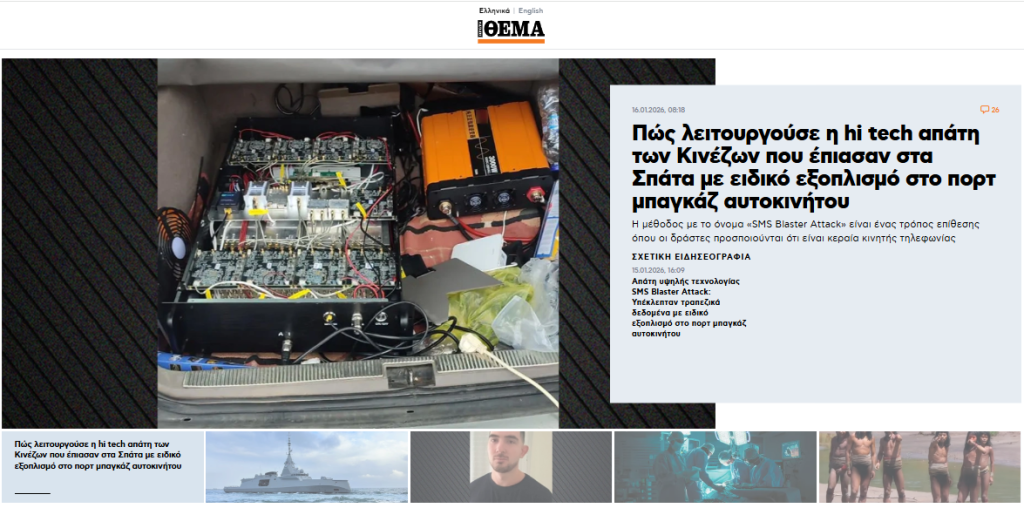
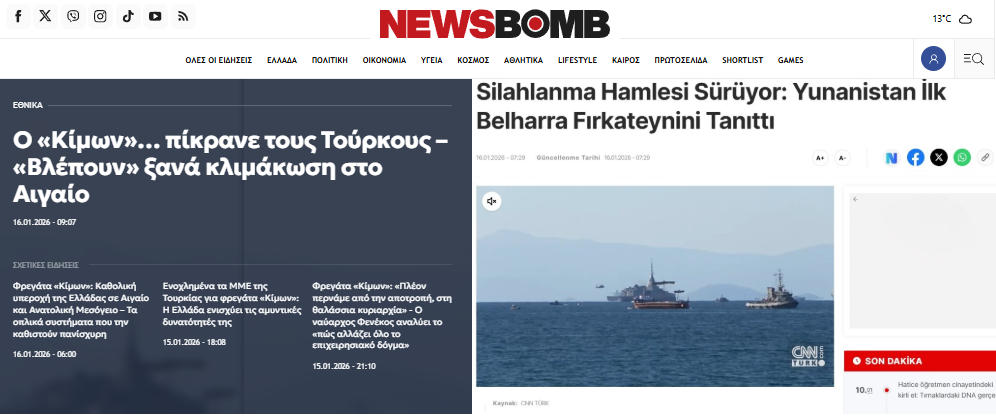
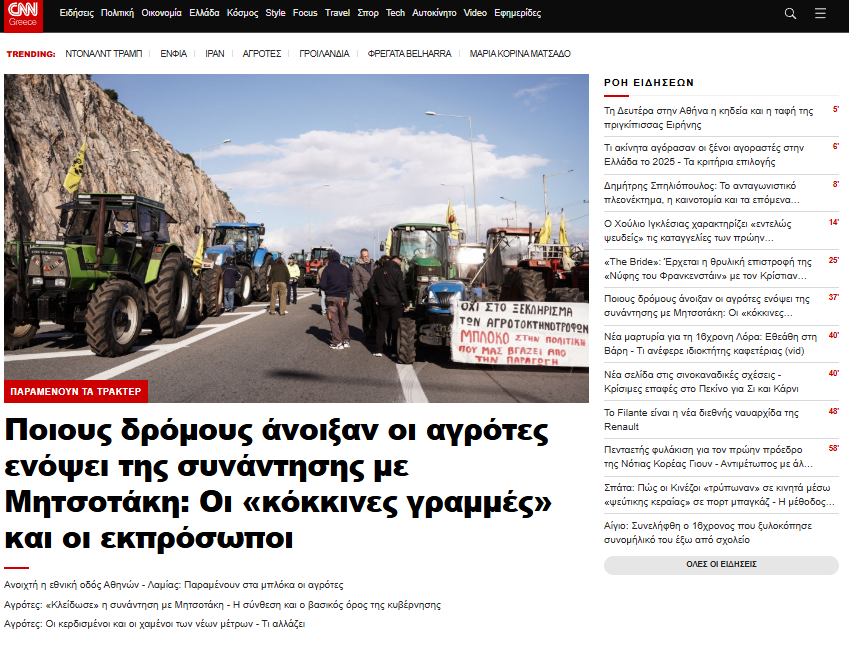
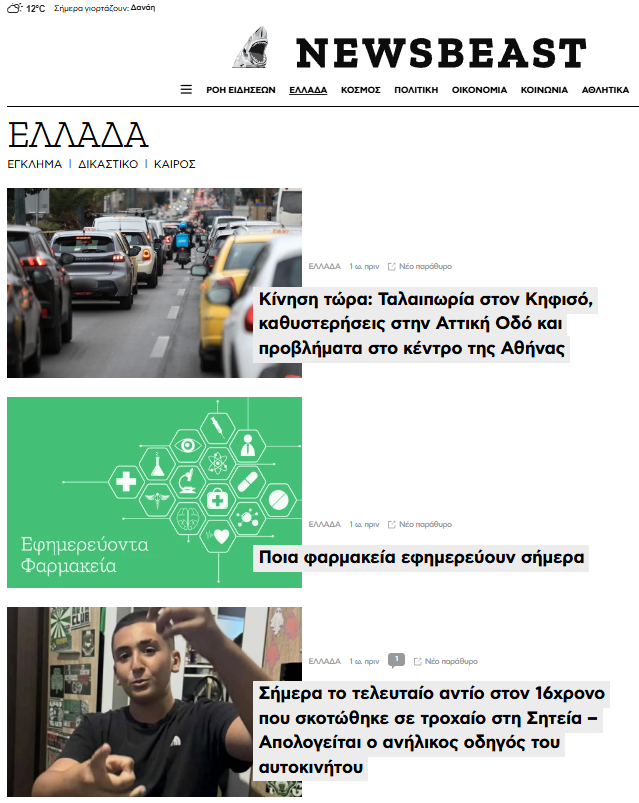

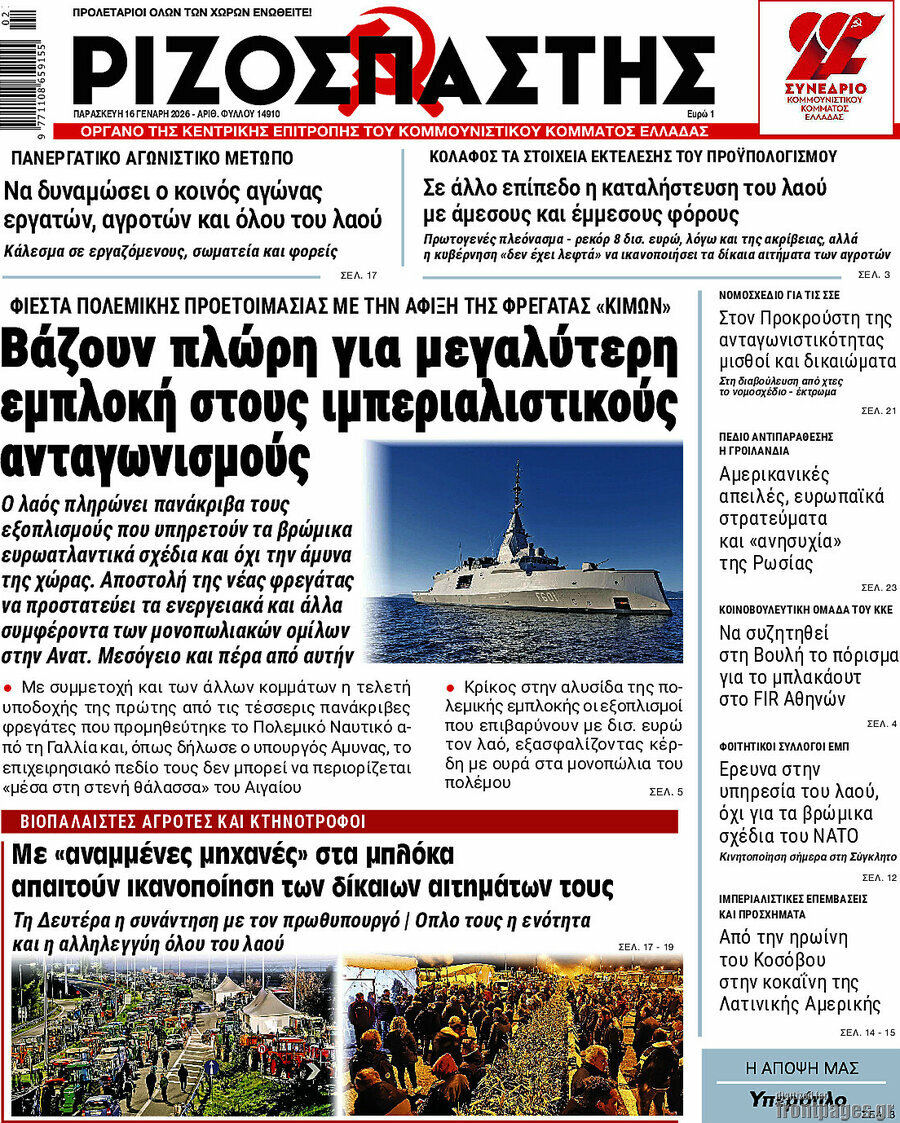
KATHIMERINI: ER congestion due to flu outbreak
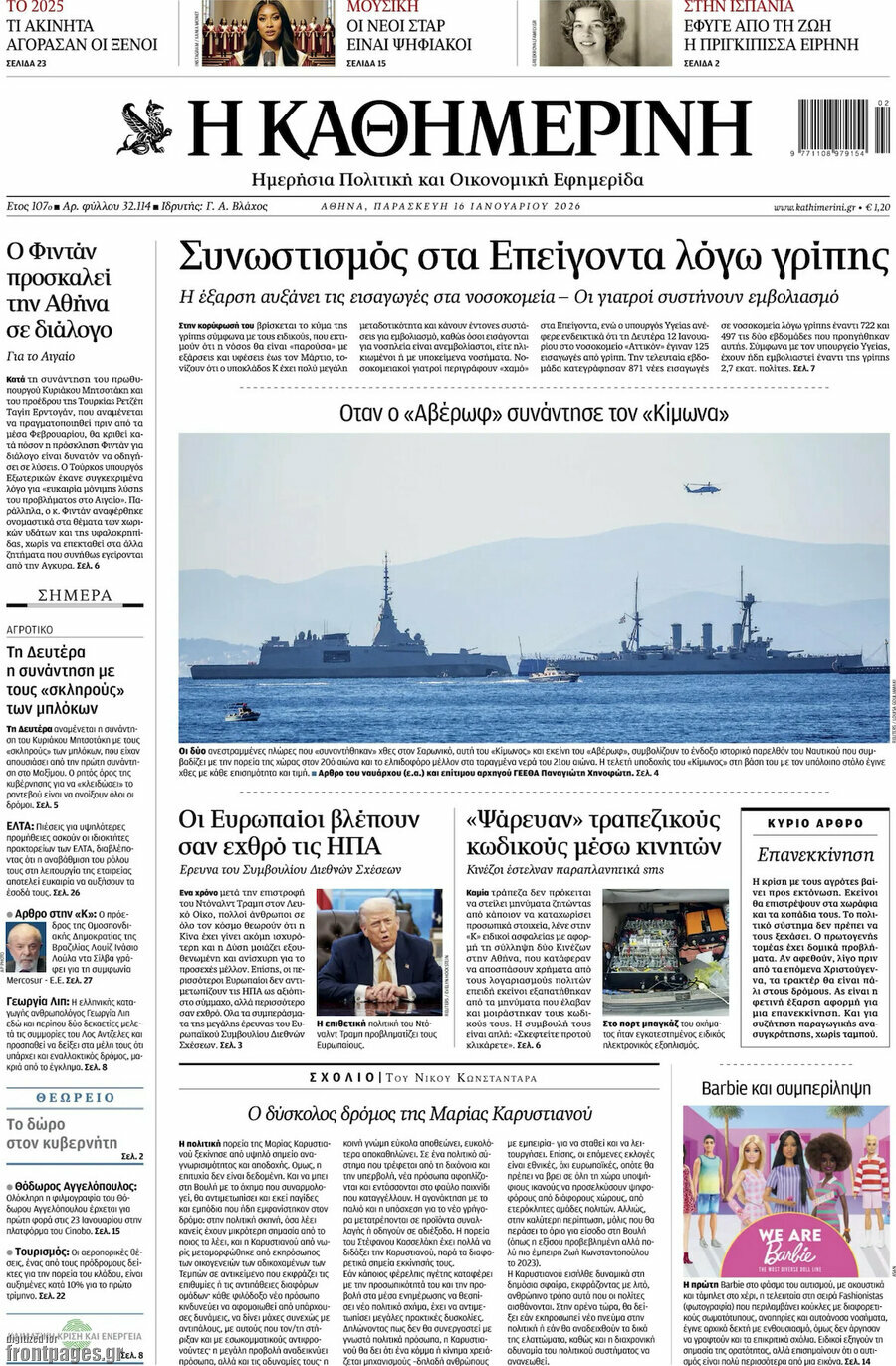
TA NEA: Real estate assets: the big census
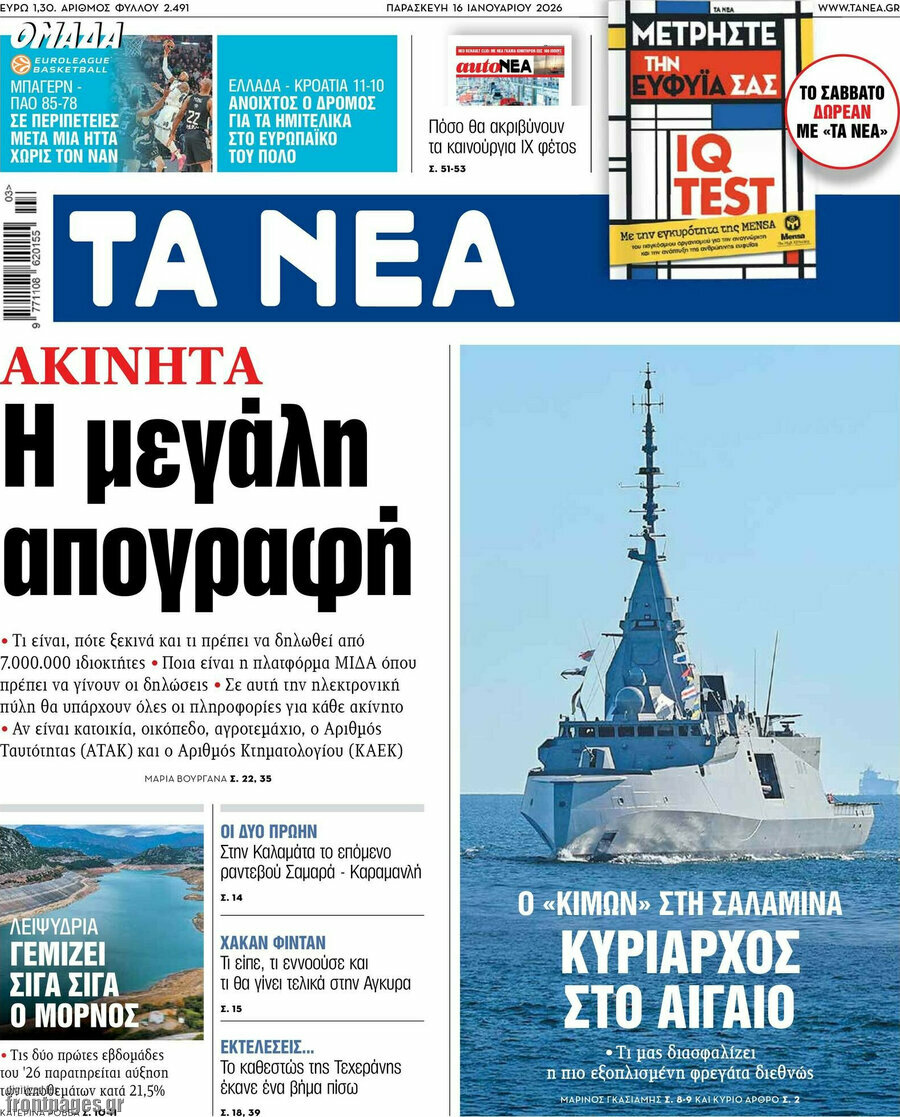
EFIMERIDA TON SYNTAKTON: Surplus of spending cuts
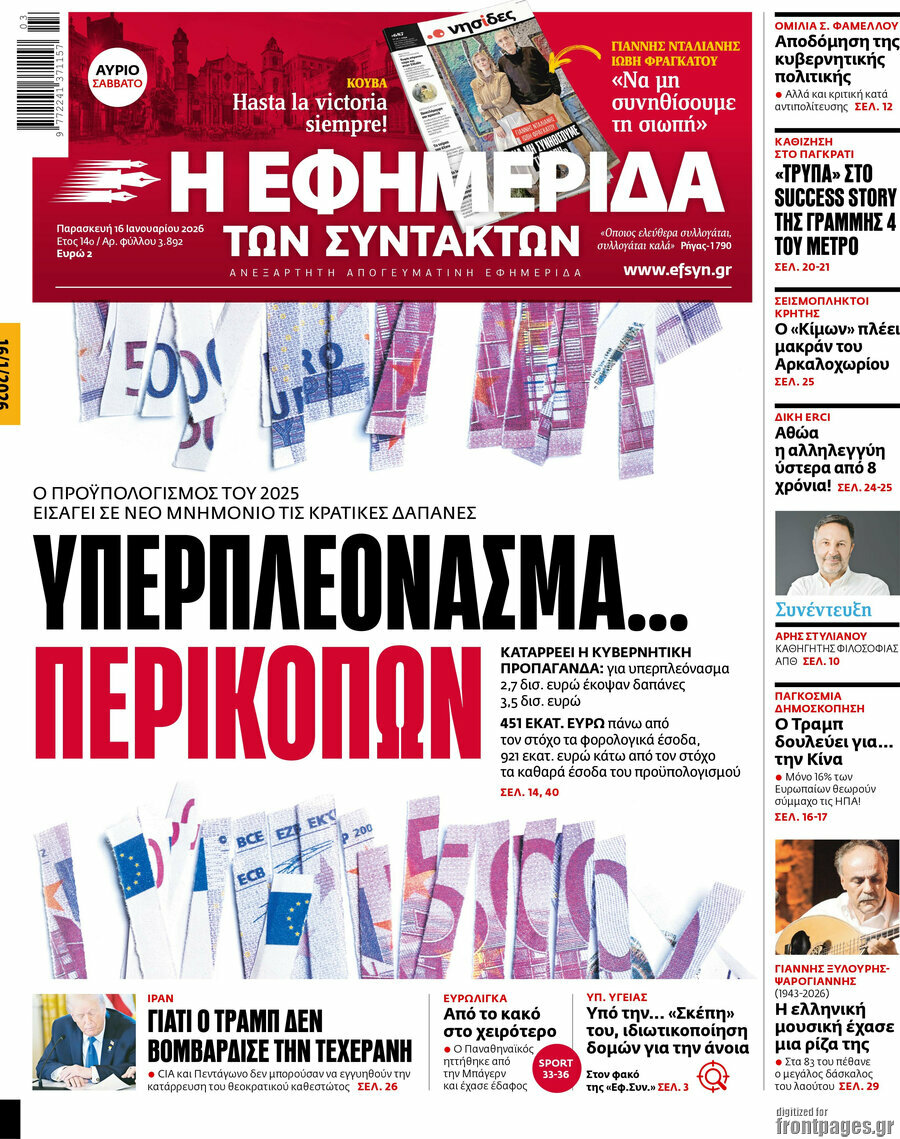
RIZOSPASTIS: The government sets sail for more intensive involvement in imperialistic competitions
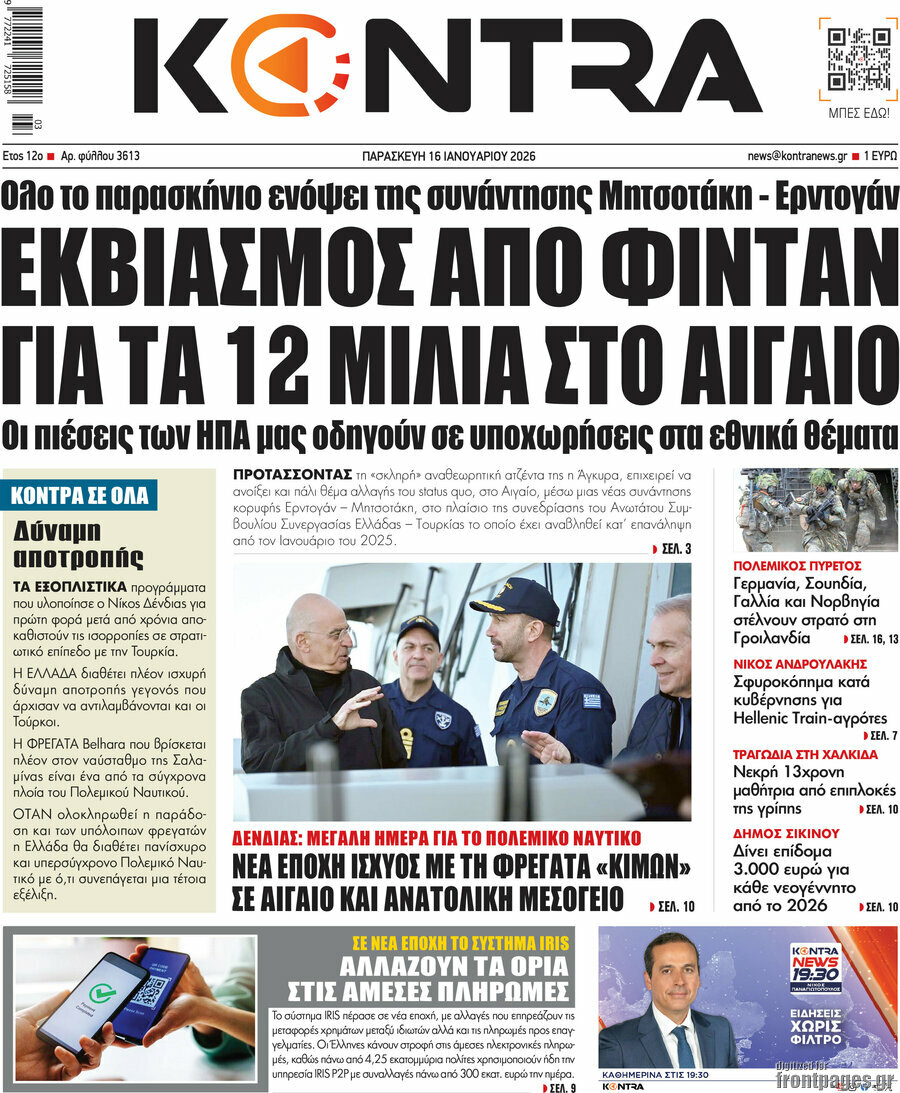
KONTRA NEWS: Blackmail by Fidan regarding the 12 nautical miles in the Aegean Sea
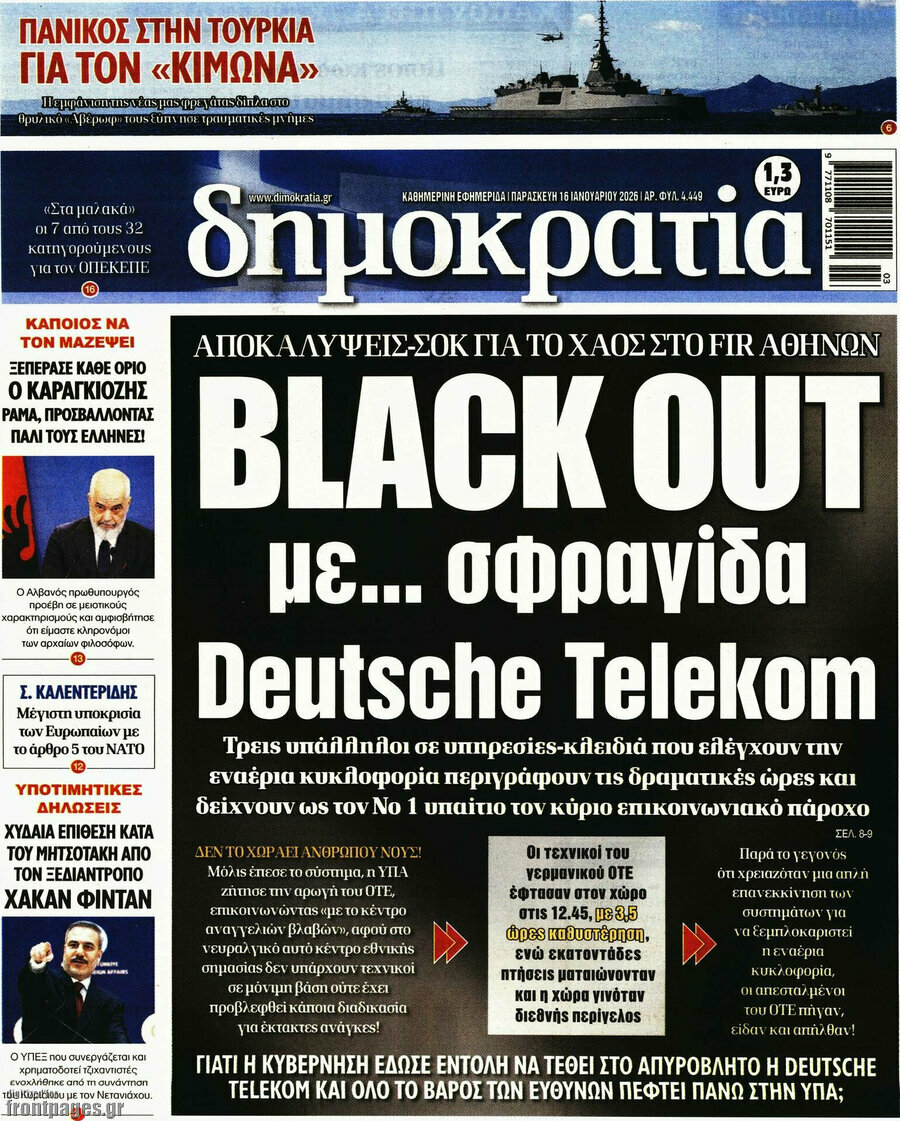
DIMOKRATIA: Black Out… with the signature of Deutsche Telekom
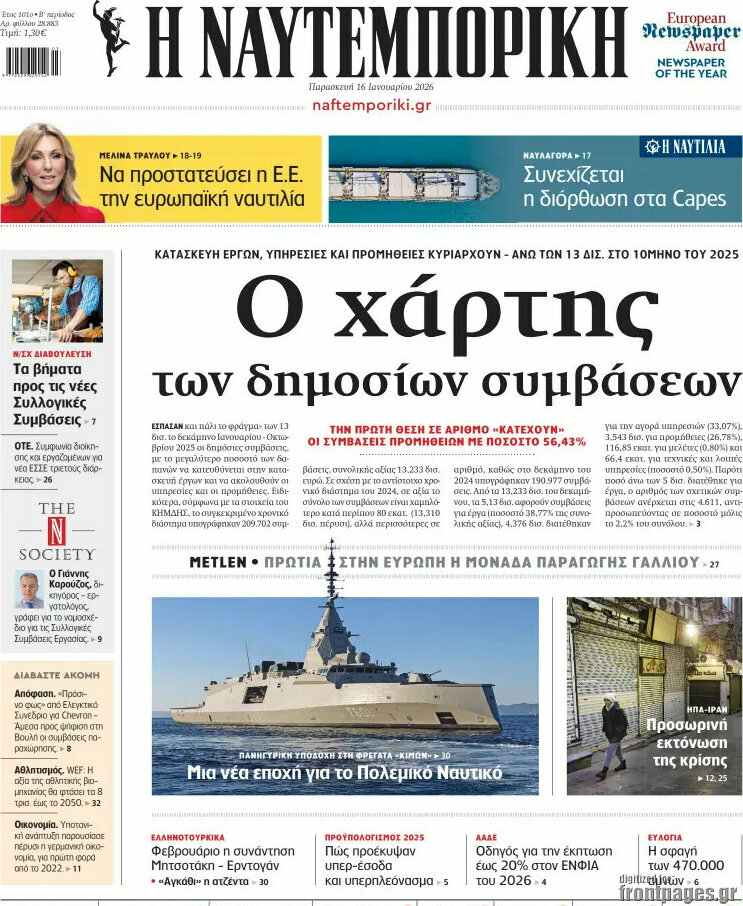
NAFTEMPORIKI: The public contracts map

DRIVING THE DAY: POSTCARD FROM CYPRUS
The first thing commissioners would have seen as they flew in: The massive flags of Turkey and the so-called Turkish Republic of Northern Cyprus, which is only recognized by Turkey, carved into the Kyrenia Mountains overlooking Nicosia. The flags, which are visible both from the south and the occupied north, are an inescapable symbol of the divided island.
An open wound: “It’s a physical manifestation of occupation on European territory,” Cyprus’ Deputy Minister for European Affairs Marilena Raouna told Playbook. The flag carvings were installed by Turkey as “a form of psychological warfare and a constant reminder to Cypriots of occupation” and they have been positioned so they are “the first thing Cypriots and others see when entering the capital,” she added.
Securing Europe: You could hardly come up with a more apt backdrop for the commissioners and presidency as they gather to discuss the challenges facing Europe today. Chief among them: how to ensure security on the continent at a time when Russia is increasing its attacks on Ukraine and an American president threatens to take one of his top European allies’ territories by force.
There’s a strategy for that: European Commission President Ursula von der Leyen last night announced that she’d tasked the Cypriots with shepherding a European security strategy over the line over the next six months. “It is time for a new European approach,” she said. “In the environment that we have right now, the security and defense [environment], we have decided that it is also time, during your presidency, to come with a new European security strategy.”
Any details? Beyond announcing that a strategy would come, von der Leyen offered no further info, saying it was too early to do so. “At the beginning of the work, it’s not wise to limit or to expand explicitly, already the different topics,” she said. “But the purpose is … we need to collect all the knowledge to acknowledge the changes, the geostrategic changes indeed, and also the geopolitical changes in our world, and to give an appropriate answer.”
Speaking of Greenland: Von der Leyen struck a conciliatory tone when asked about Donald Trump’s threats to take the territory of the Kingdom of Denmark, one way or another. The EU has “doubled down on investments and supporting Greenland” because the Arctic and its security “matter enormously for us,” she said, before adding that the EU would “continue our work on Arctic security with our allies, our partners, including the United States.”
With allies like these … The comments came after Trump escalated his rhetoric, declaring that “the United States needs Greenland for the purpose of National Security,” calling it “vital” for his planned “Golden Dome” missile-defense system.
Cyprus gets it: Speaking with reporters who are in Cyprus to cover the Commission trip, presidency officials came out hard in support of both Kyiv and Nuuk. “We’re the only member state of the European Union that is under foreign occupation and we can understand Ukraine much … better than any other member state,” said President Nikos Christodoulides. Foreign Minister Constantinos Kombos said “sovereignty and territorial integrity of member states is of course something we take very seriously.”
Cypriot officials repeatedly insisted that any sort of deal that would force either Ukraine or Denmark to accept ceding territory would be unacceptable because of the precedent that would set, with one warning it would open Pandora’s box, which would not stop at Ukraine.
Dare to dream: Some of the Cypriots expressed hope that their presidency could boost efforts to reunify the island, particularly after moderate Tufan Erhurman’s election as Turkish Cypriot leader last October. Reunification talks broke down in 2017, but there’s some hope they’ll resume.
In the meantime, Cyprus is pushing for entry into the EU’s Schengen free-travel area by the end of this year, with Christodoulides on Wednesday night saying his country is ready. “We look forward to further substantial progress and a successful conclusion in 2026,” the president said. But the main problem is the “Green Line,” the U.N.-controlled buffer zone that splits the country (and which the commissioners got to see for themselves on a tour of Nicosia on Thursday).
IRAN SANCTIONS
EU COUNTRIES TO REVIEW NEW SANCTIONS AGAINST IRAN: EU foreign ministers will be reviewing a slate of new sanctions against Iran when they gather for their next formal meeting in Brussels on Jan. 29, according to two EU diplomats.
Lengthy list: The proposed sanctions include a total of 21 listing under the EU’s human rights sanctions regime, while the European External Action Service has proposed listing 10 entities under a regime that targets Unmanned Aerial Vehicles.
Concerted push: Germany, France and the Netherlands are among the EU countries that have been pushing to ramp up pressure on Tehran, which stands accused of killing thousands of protesters during a brutal crackdown.
GREENLAND TURMOIL
GREENLAND TRUCE — OVER ALREADY: It was a win, of sorts, that the Wednesday meeting between U.S. Vice President JD Vance, Secretary of State Marco Rubio and the foreign ministers of Denmark and Greenland didn’t culminate in a declaration of war. But our POLITICO colleague Tim Ross reports that on Thursday things quickly went off the rails in DC, dampening any optimism in Copenhagen.
White House whitewash: Karoline Leavitt, Trump’s press secretary, described Wednesday’s meeting as “good” and “productive” — so far, so Danish. But then she claimed the working group announced at the end of the talks would meet, every couple of weeks, for the purpose of “technical talks on the acquisition of Greenland.”
Jaws, meet floors: Danish Foreign Minister Lars Løkke Rasmussen fired back immediately to deny the White House’s suggestion that the purchase of the Arctic island was on the table. “We have not agreed that we will have a technical working group to look at how the United States can acquire Greenland,” he told Denmark’s TV 2. Leavitt’s summary suggested the proposed group “will be really, really difficult,” the minister said, adding that it could all be a “very, very short” process if the U.S. doesn’t respect Danish and Greenlandic red lines.
Visiting hours: Denmark is trying all avenues to make the case that Greenland is not up for sale and must not be taken by force. Today a delegation from the U.S. Congress will visit Copenhagen for meetings with Danish representatives. Then, on Monday, Danish Minister of Defense Troels Lund Poulsen and Greenlandic Foreign Minister Vivian Motzfeldt will travel to Brussels for talks at NATO, including with Secretary General Mark Rutte.
Reminder: The Danish PM has warned that a U.S. seizure of Greenland would destroy NATO, though Rutte — for some reason — has not yet endorsed that view.
Is Europe ready to push back? European officials and diplomats have started to quietly articulate what had previously been unmentionable: What would it look like to fight back? There are ways that Greenland’s allies can resist the American president if he refuses to compromise, without resorting to arms, according to this analysis by Tim Ross and Victor Jack.
Meanwhile, French Finance Minister Roland Lescure warned his U.S. counterpart Scott Bessent that any move to seize Greenland by force would amount to a “crossed line” that would imperil Europe’s economic relationship with Washington, the Financial Times reports.
TRUMP ACCEPTS NOBEL PRIZE (FROM MACHADO): The Danes should take a leaf out of María Corina Machado’s book in their dealings with Trump: come bearing gifts. The Venezuelan opposition leader said she presented Trump with her 2025 Nobel Peace Prize. Trump accepted the medal, according to Reuters. “Such a wonderful gesture of mutual respect,” he said in a social media post.
MERCOSUR AND THE SPANISH EPP
SPANISH EPP’S MERCOSUR WOBBLES: The Spanish center-right is quietly pulling back from its once-ironclad support for the Mercosur trade deal between the EU and South America,Camille Gijs, Max Griera and Aitor Hernández-Morales write in to report.
That’s worrying for supporters of the deal. Spain represents the second-largest delegation within the European People’s Party, the largest group in European Parliament — raising the possibility that the deal could run into significant delays.
The whole agreement could now be in serious trouble ahead of a vote next Wednesday on whether to request an opinion on the legality of the treaty. If that motion is approved, the Mercosur trade deal — 25 years in the making — could be put on ice for up to two years.
Righteous farmers: Spanish People’s Party (PP) president, Alberto Núñez Feijóo, telegraphed the position shift at a party rally last weekend, where he said that Spain’s “farmers are right.” While he didn’t reject the deal outright, he did cast doubt on the PP’s support, especially as the party’s lawmakers in Brussels did not reply to POLITICO’s questions about their stance.
In one line: “It seems they have a heated internal debate ongoing,” said one EPP official who was granted anonymity to discuss sensitive party matters. “Members of the group are feeling the heat of farmers and the Spaniards have three elections upcoming.” French, Polish and Austrian center-right lawmakers are opposed to the deal over concerns it will hurt farmers.
What it means: If the Spanish delegation votes in favor of getting a legal opinion on the Mercosur deal, “that would be the end,” said an EPP lawmaker, also granted anonymity. Spain’s backing for the deal is as important as Germany’s, said the MEP. Read the full story here.
All politics are local. The PP’s doubts about the Mercosur deal are driven by electoral considerations at home. Key regional elections are set to be held in Aragón on Feb. 8 and in Andalucía later this spring. The rural vote will be decisive.
Happening today: Before the signing ceremony in Asunción on Saturday, Council President António Costa and von der Leyen are heading to Rio de Janeiro today for a trilateral meeting with Brazilian President Luiz Inácio Lula da Silva. A press statement is scheduled at 5.30 p.m.
CENSURE VOTE
COLD SHOULDER: According to three people aware of her plans, von der Leyen is not expected to be present for the next motion of censure tabled by Patriots for Europe Chairman Jordan Bardella over the Mercosur trade deal, Max Griera writes in to report.
What’s more, von der Leyen’s College of commissioners won’t be coming either. Unlike previous motions of censure when von der Leyen’s commissioners came out in full force to show support, this time the entire college will be snubbing the event.
Who you gonna call? Instead, von der Leyen may be represented by her trade commissioner, Maroš Šefčovič, who is known as the loyalist you call on to handle tricky or unpleasant jobs. A Commission spokesperson did not immediately reply to a request for comment.
Low threshold, low power: It takes just 72 out of 720 lawmakers to call a censure vote. With four motions already called since von der Leyen started her second term in power, lawmakers have figured out how easy it was to launch them. And the Commission is losing interest.
Far-right rage-bait: Some lawmakers are calling to change the threshold. But so far Parliament’s leadership has avoided going down that path, fearing it would be weaponized by far-right groups as they claim censorship.
IN OTHER NEWS
BUBBLY IN THE BUBBLE: Well, Playbook asked and you delivered. Yesterday, after High Representative Kaja Kallas joked that certain world events mean it might be time to hit the bottle, we put out a call to the Brussels bubble for its drink orders if the end of the world was nigh, Seb Starcevic writes in to report.
Wine o’clock: Mediterranean Commissioner Dubravka Šuica said her drink of choice on the eve of a global disaster would be “a glass of very cold Moscato wine,” while Rasmussen CEO Fabrice Pothier replied: “Negroni, obviously.” Obviously.
That’s the spirit: Meanwhile, Iratxe Garcia, chair of the Socialists and Democrats, opted for “Cuban rum,” while Manon Aubry, The Left’s co-chair, told Max Griera: “Probably a Myrte (a liquor made out of myrte berries from Corsica, where I’m from) or a Palestine cola to remember our fight.”
Not the metal band: Greens co-chair Terry Reintke’s liquor pick: “Korn. Klarer, starker Korn. It’s the choice for crisis moments.”
No, thank you: EPP chief Manfred Weber and European Parliament President Roberta Metsola declined to share their preferred tipple.
Overheard in Cyprus: If proof were needed that the EEAS chief’s words have cut through, one official spake thus: “Well, Kallas told me to start drinking, so …”
ICELAND OFF THE HOOK: In an update to yesterday’s Playbook, in which we mentioned the comments of a former U.S. congressman that Iceland could become the “52nd state” (presumably with Canada, or Greenland, being the 51st), there has been a U-turn. Our stateside colleagues say Billy Long has apologized, saying there was “nothing serious” about his comments. Long was recently nominated as U.S. ambassador to Iceland.
VARHELYI’S NEW ADVISER: After many *many* months of unanswered questions to the office of Olivér Várhelyi, journalists across Brussels will be relieved to hear that the Hungarian commission has finally hired a comms adviser, only one year (and a bit) after starting in the job. Karolina Tomaszewska, a former parliamentary assistant for the Polish PiS group, has already started work in the EU health chief’s office, Pieter Haeck is told.
Tomaszewska is already used to the rough and tumble of media life, having found herself featured in the Polish press as part of a story on nepotism in the EU bubble, as the daughter of PiS leader Jan Maria Tomaszewski’s cousin. One EU official rejected this interpretation, telling Mari Eccles that she’s “really hard-working.” Tomaszewska also has a background in animal welfare — one element of Várhelyi’s portfolio he has been accused of neglecting.
INTRODUCING POLITICO FORECAST: A forward-looking global briefing on the forces reshaping politics, policy and power worldwide, Forecastbrings insight from POLITICO’s global newsroom. It includes coverage tied to major international gatherings to help you understand where politics, policy and power are headed. Subscribe here.
NOW LISTEN TO THIS — THE ‘ANTIDOTE’ TO TRUMP’S BITE: In this week’s episode of the EU Confidential podcast, Arancha González-Laya offers her prescription for overcoming the “politics of inevitability” and defeatism on Greenland and Ukraine. The antidote to the bloc’s seeming powerlessness against the U.S. president, the former Spanish foreign minister and ex-EU trade negotiator tells host Sarah Wheaton, means using the leverage the bloc already has. Plus, a mini-portrait of Dan Jørgensen, the EU’s commissioner for energy and housing, and his vision for making homes more affordable. Listen and subscribe to EU Confidential here.