
PASOK leader says spyware trial ruling a ‘defeat’ for PM’s ‘apparatus’
Nikos Andoulakis, leader of center-left PASOK-KINAL, said the conviction on Thursday of four businesspeople involved in the illegal wiretapping of dozens of high-profile Greek figures, including him, is a “major defeat of the state within a state” created by Prime Minister Kyriakos Mitsotakis.
Macron visit to Athens confirmed by Greek government
The Greek government confirmed Thursday that French President Emmanuel Macron will visit Athens to discuss the renewal of the Strategic Partnership Agreement on Defense and Security, which expires this year. An exact date for Macron’s arrival has not yet been set.
Kyranakis reports ‘deliberate sabotage’ of railway safety infrastructure on Athens-Thessaloniki line
There has been a “shocking incident” of deliberate sabotage of the railway remote management system on the Athens-Thessaloniki line, shortly before Platy in Imathia, where unknown individuals have cut the system’s cables, Deputy Infrastructure and Transport Minister Konstantinos Kyranakis asserted on Thursday.
Eurostat: Greek inflation at 2.9% in January
Inflation in Greece came to 2.9% in January, according to the revised data that Eurostat released on Wednesday. Across the EU the inflation rate averaged 2%, down from 2.3% in December.
https://www.ekathimerini.com/economy/1296413/eurostat-greek-inflation-at-2-9-in-january
ATHEX: Stock market stays on its course northward
The Greek stock market continued its recovery on Thursday, with growth for the majority of stocks and the benchmark climbing back above the 2,300-point mark, even if turnover was not up to recent standards. A temporary wipeout of early gains was immediately followed by a new rebound. The corporate results for 2025 dominate traders’ interest and will likely offer a further boost to stock prices in the coming days in most cases.
https://www.ekathimerini.com/economy/1296422/athex-stock-market-stays-on-its-course-northward




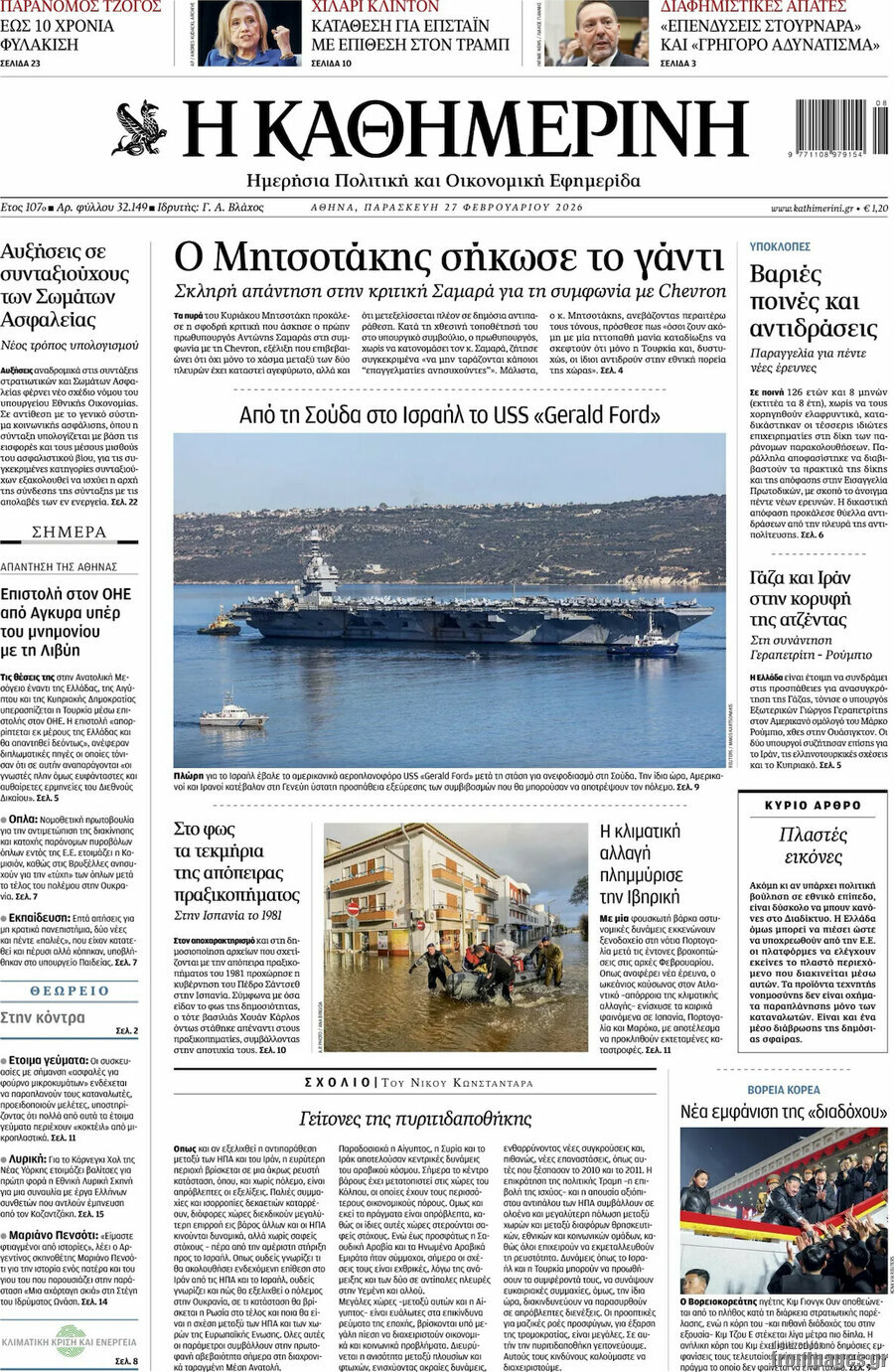
KATHIMERINI: Mitsotakis took up the gauntlet [responding to former PM Samaras who criticized the deal with Chevron ]
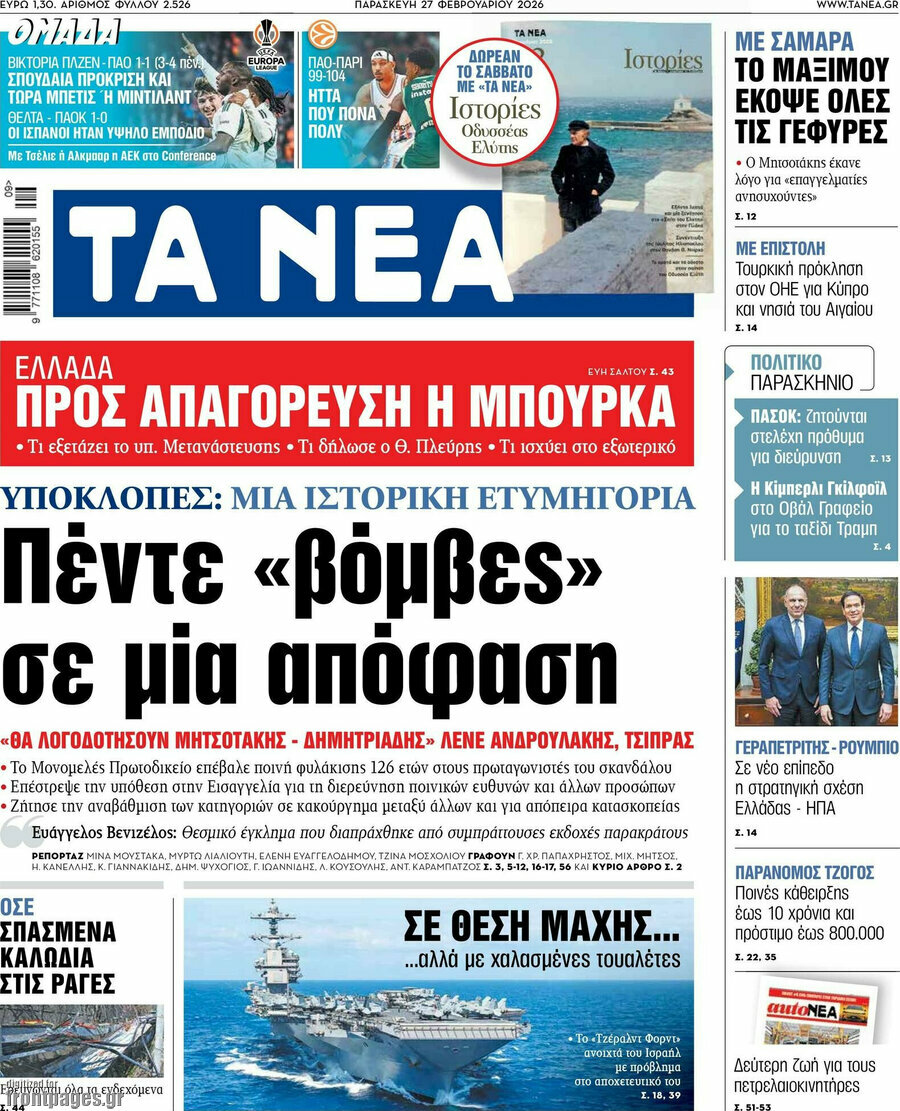
TA NEA: Wiretappings scandal: 5 “bombs” in the court ruling
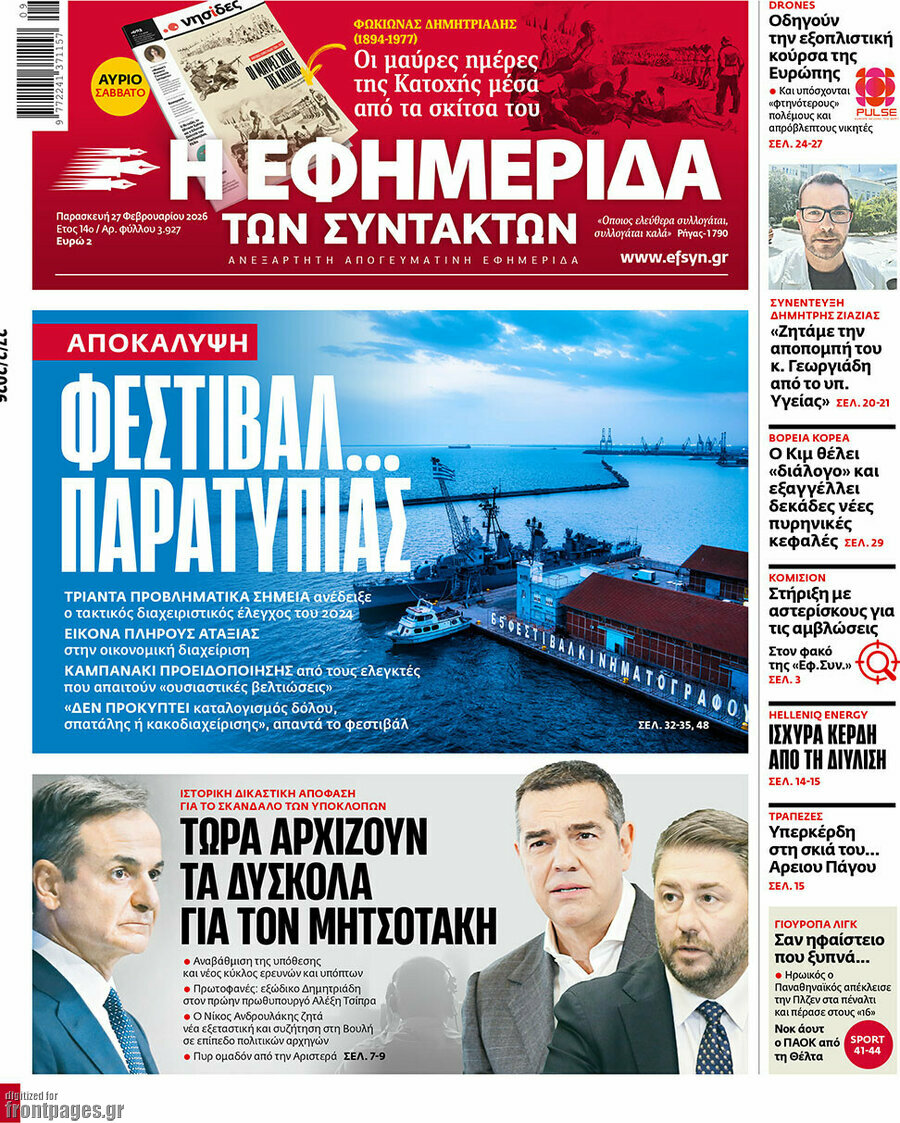
EFIMERIDA TON SYNTAKTON: Revelation: Series of irregularities in the operation of the Thessaloniki Film Festival
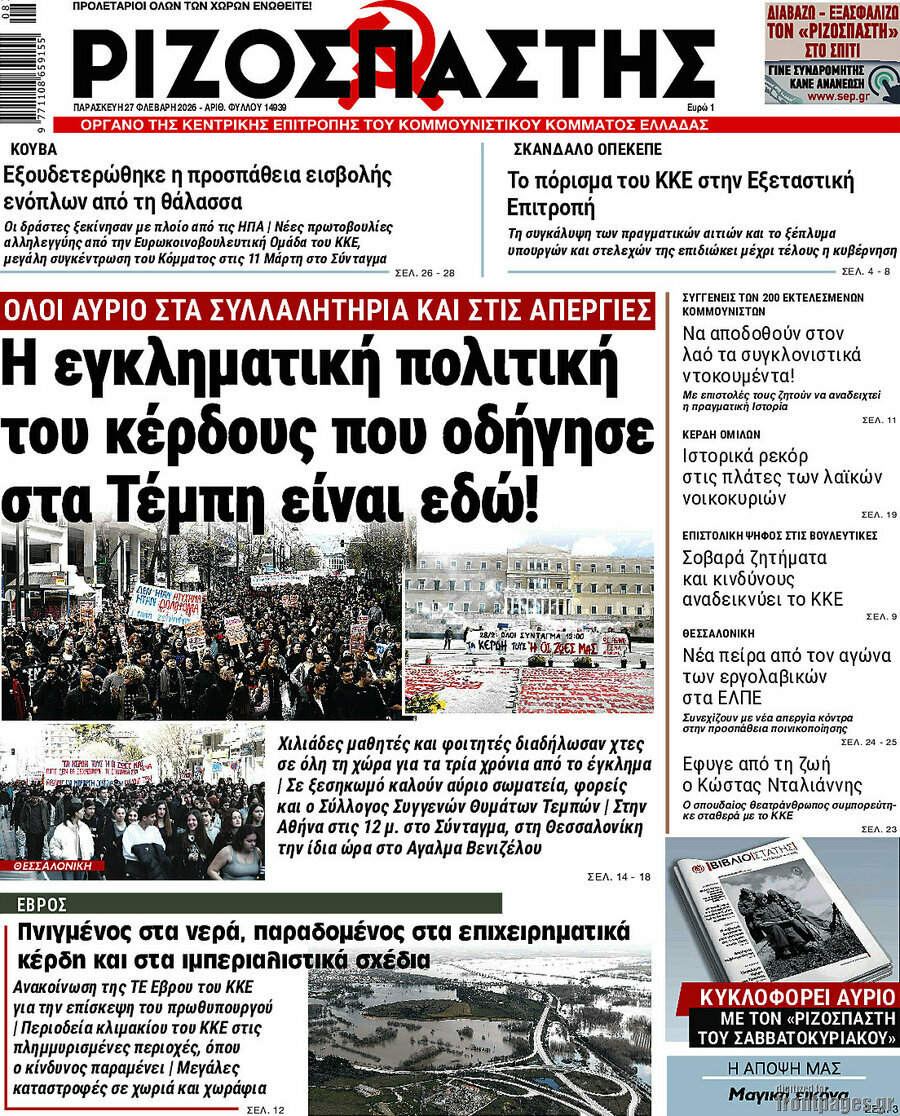
RIZOSPASTIS: The criminal profit policy, which led to the fatal Tempi rail-crash, is still here!
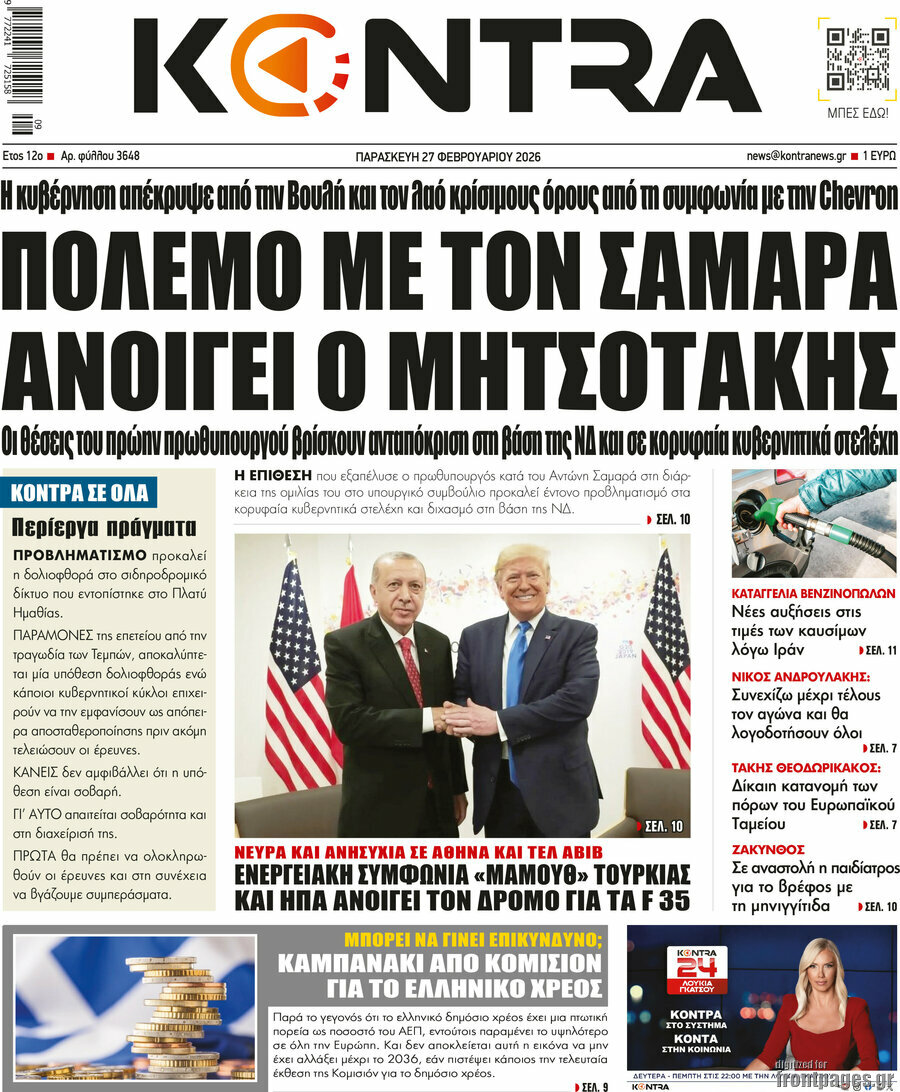
KONTRA NEWS: Mitsotakis initiates war with [former PM] Samaras
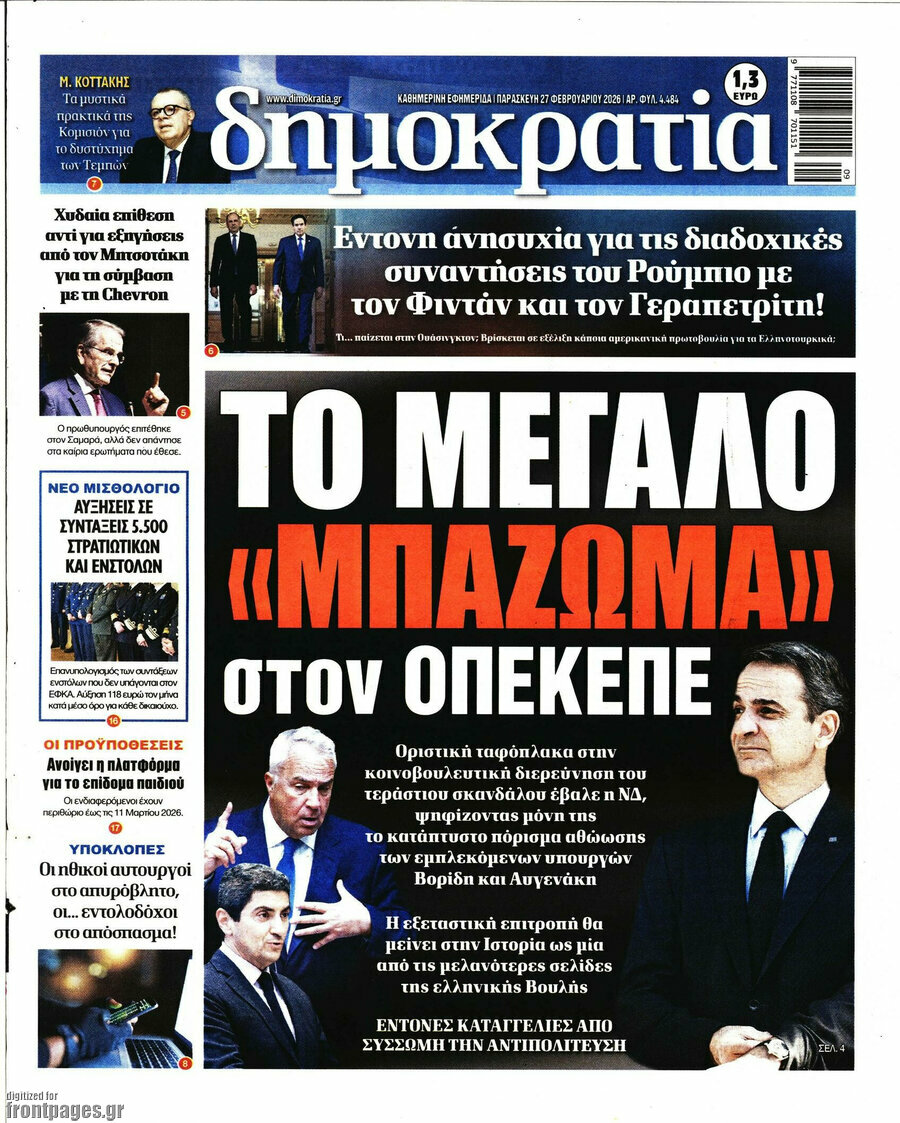
DIMOKRATIA: OPEKEPE scandal: The big cover-up
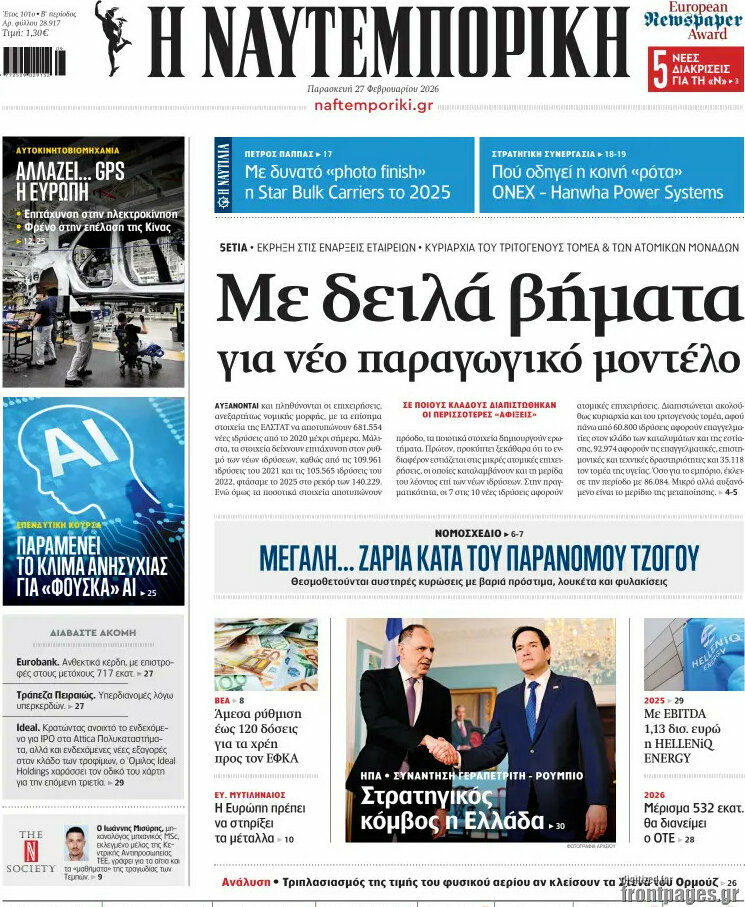
NAFTEMPORIKI: Small steps for a new productive model

DRIVING THE DAY
A PATHWAY TO A SOLUTION: Slowly but surely, EU officials appear to be gleaning some insight into what it might take for Viktor Orbán to lift his veto on the bloc’s €90 billion loan to Ukraine.
What Orbán wants — 1: In a letter to European Council President António Costa Thursday, obtained by POLITICO, the Hungarian prime minister hinted at taking a step back if the EU formally assesses damage to a key oil pipeline in Ukraine. Some EU officials hope a pledge to address the Druzhba pipeline issue could unlock the loan.
What Orbán wants — 2: But two diplomats directly involved in the discussions caution that Budapest’s maneuvering may go further and deeper. Hungary could continue blocking sanctions until its own €16 billion application for a defense loan — under the SAFE instrument — is approved, they say.
Follow the (defense) money: Diplomats speaking to POLITICO’s Nicholas Vinocur say Budapest’s pressure campaign is primarily about accelerating Commission approval of the SAFE request, echoing what Playbook heard yesterday. The suggestion is that the defense loan may get Orbán across the line, despite the PM’s very public insistence that the EU is colluding with Ukraine to deny Hungary cheap oil.
There are a lot of moving parts. Yet there’s also cause for some optimism, based on what one diplomat calls the “conciliatory tone” of Orbán’s letter. “It points to a way forward … it acknowledges there is a political commitment problem.”
That’s where Costa, with whom Orbán exclusively exchanged letters, comes into play. “Costa can play a role the Commission cannot play at this moment: moral suasion on the Ukrainians,” a diplomat said.
Budapest, in this reading, may want a symbolic inspection visit to the pipeline — the optics of the visit could amount to a propaganda win ahead of elections. Whether the combination of a SAFE deal and a pipeline commitment will be enough is another question.
Legal loophole? Even as these pathways appear to solidify, alternatives continue to circulate, including renewed discussions around the use of frozen Russian assets (particularly in the European Parliament). There’s also the “obscure clause” that seems to have been spotted by Council legal services: Article 327 of the Treaties. It states EU members not participating in enhanced cooperation (the legal basis for the loan) “shall not impede its implementation by the participating Member States.”
Another mediator? NATO Secretary-General Mark Rutte was cryptic when asked yesterday whether he had been involved in negotiations. “My role is not to comment but to try to be helpful wherever I can. And what that is, I cannot tell you until it has been successful,” Rutte said, according to my colleague Victor Jack.
Rutte’s relationship with Orbán was forged through years of political sparring when Rutte was Dutch prime minister. And if he was able to iron out tensions in Davos with Donald Trump and fend off a U.S. move on Greenland, some wonder whether the NATO chief might also be the right man to broker a deal with Budapest. Desperate times and all that …
BRUSSELS VS. THE MACHINE
AI IN YOUR OFFICE CUBICLE: European Commission Executive Vice President Roxana Mînzatu is in Rome today (I know — tough gig!) to tackle one of the more anxiety-inducing topics in Brussels (and beyond): artificial intelligence in the workplace.
What she’s expected to say: Mînzatu will reiterate the Commission’s familiar “human-centric” AI line … the need for a pragmatic approach to AI grounded in solid analysis of how it is spreading through the labor market … and a process of digitalization that should make Europe more competitive while strengthening — not weakening — workers’ rights.
Relevant policy: Mînzatu is set to call for deeper exchanges with member countries and other players ahead of the upcoming Quality Jobs Act and for renewed momentum in negotiations on revising social security coordination rules and the e-declaration framework.
Plot twist: It’s not just the workforce of EU member countries facing disruption — the Commission itself may be next in line. Public Administration Commissioner Piotr Serafin has been tasked with steering a “large-scale review” designed to modernize how Commission services operate — a potentially sweeping bureaucratic reset.
Is AI part of it? Officially, yes. The review contains 15 work streams, one focused on innovation and AI. Its aim, Commission spokesperson Isabel Otero Barderas told Playbook, is “to embed innovation and position AI as a key driver for modernizing our work.”
What will that actually mean? Too early to say. “We cannot pre-empt the recommendations of the work streams at this stage,” she said, while adding that the Commission “needs to embrace the opportunities AI can bring,” particularly to boost efficiency.
Meet GPT@EC: By the way, the Commission already has its own in-house chatbot. Originally branded GPT@JRC, it was reintroduced as GPT@EC, with internal communications nudging staff to adopt it.
Playbook stress test: I observed a Commission official taking it for a spin (it was like those Twitch users watching others play). The results were … mixed. A basic search of my name misidentified both POLITICO and my most recent previous employer, landing … two jobs back, when I was still young enough for a parliamentary rave.
More than a toy: To be fair, the platform is broad. It offers translation, speech-to-text transcription, anonymization tools, AI-generated summaries, multilingual short-form translation (curiously, currently compatible only with Elon Musk’s X), email drafting and briefing notes. Impressive on paper. Less so in execution — at least for now.
MEANWHILE IN PARIS: Two contenders for the Paris mayoral seat — centrist candidate Pierre-Yves Bournazel and far-right candidate Sarah Knafo — have launched chatbots to allow voters to query their programs, our Paris colleagues write in to report.
Chatbot sovereignty: The “Bournazel Chatbot” is based on French technology of national champion Mistral AI, while Knafo’s “Parisbot” is based on Google’s Gemini. That choice in itself has become a political statement: Team Bournazel was quick to point out on X that the chatbot of Knafo, who is also the author of the much-discussed report on digital sovereignty, as per this POLITICO Pro article, uses American AI. Knafo’s team argued their chatbot had a lower hallucination rate.
FRIDAY FUNNY: Albania has had an AI minister for public procurement, while an AI bot called Gaitan is on the ballot in Colombia’s upcoming election. So, has the time come for an AI candidate to run in the EU’s 2029 elections? The odds are good, Paul Dallison suggests in this week’s Declassified column.
PLAYBOOK INTERVIEW
UNDERREPRESENTED ROMA: The EU’s only government minister with Romani ancestry told POLITICO’s Seb Starcevic the ethnic minority needs vastly more representation in the bloc’s institutions and in Brussels more broadly, calling the status quo a major failure of democracy.
Numbers game: “There are five or six EU countries which, together, have less population than the Roma minority across Europe,” said Petre-Florin Manole, who was appointed Romania’s labor minister last year, making him the country’s first Roma person to hold such a high post. “If you’re in Brussels now and you look through the window, you see no Roma in important political institutions in Brussels. This is a huge democratic problem for Europe.”
There are an estimated 6 million Roma in the EU, about the same as the population of Denmark. But Manole points out that the current European Parliament does not have a single Roma member, which was not the case in the past.With no voice in Brussels, it is impossible to formulate good policies for Roma people, who face myriad social challenges, including poverty and discrimination, he said.
A Commissioner for Roma? Asked if he felt the European Commission should appoint a commissioner specifically responsible for Roma, Manole said that would be too much to hope for anytime soon and argued the EU should start by allocating more funds to Roma NGOs.
IN OTHER NEWS
ABORTION COMPROMISE: The European Commission said Thursday it won’t create a new fund to support abortion access, suggesting member countries could achieve this outcome by using an existing mechanism: the European Social Fund Plus (ESF+). The “My Voice, My Choice” group had campaigned for a new EU funding mechanism to help women gain access to abortion services but nonetheless described the Commission’s decision as a “victory,” Claudia Chiappa reports.
MANDELSON REFERRED TO OLAF: The European Commission has referred former Trade Commissioner Peter Mandelson to the EU’s anti-fraud watchdog OLAF over his links to the late convicted sex offender Jeffrey Epstein. POLITICO’s Tim Ross and Jon Stone have the details.
HUNGARY IN BREACH OF EU LAW: The EU’s top court sided with the European Commission Thursday, ruling that Hungary had breached EU law by denying an independent radio station a renewal of its frequencies, Mathieu Pollet writes in to report.
Tl;dr: Klubrádió — a commercial media outlet critical of the government and Orbán — was forced off the air in 2021 after Hungary’s media authority refused to renew its spectrum license over what it considered to be repeated procedural infringements. Klubrádió‘s application to a renewed call for tenders was then denied.
The verdict: The Court of Justice of the EU argued that Hungary’s decisions have been disproportionate, infringed the principle of good administration and the right of freedom of expression and information. The Hungarian government didn’t reply to POLITICO’s request for comment in time for publication.
AMBASSADORIAL BREAKFAST: European Parliament President Roberta Metsola is unlikely to have attended last night’s rave in the Parliament, given she’s having breakfast this morning with EU ambassadors (my fellow Playbooker Gabriel Gavin wrote here about how ambassadors have become worthy of this kind of hospitality).
Exchange of courtesies: The European Parliament invited the Danish presidency last September, a Metsola cabinet member explained. Now the Cypriots are returning the favor, with similar exchanges planned with the upcoming Irish presidency, in what could become a regularized circuit of institutional outreach.
Focus on the croissants: The breakfast will also mark the first time Metsola has met Council representatives since EU members floated the idea of legal action against the Commission over what they see as preferential treatment toward the Parliament. On this, Metsola is expected to be unapologetic. Her line: The accusation is unfounded. The contested framework agreement with the Commission doesn’t alter the institutional balance of power, she argues — it’s simply about working methods.
SOCIALIST COMPETITIVENESS: Spanish Prime Minister Pedro Sánchez has sent a letter to European Council President António Costa — obtained by my colleague Zoya Sheftalovich — attaching a non-paper with a 10-point plan to boost European competitiveness. The pitch is to sharpen the EU’s economic edge without the bloc turning its back on citizens, sidelining the Green Deal or reducing the debate to regulatory simplification.