
Prosecutors forward new files on farm scandal, 2 more MPs involved
European prosecutors on Thursday forwarded a third batch of files to Greek authorities from a new investigation into a major farm subsidy scandal, this time involving two more sitting lawmakers from the governing New Democracy party. The new case made public Thursday involves alleged incitement in breach of duty by the two MPs from the ruling New Democracy party- Haralambos Athanassiou and Tassos Hadzivassiliou.
PASOK calls for snap elections amid widening OPEKEPE probe
Main opposition leader Nikos Androulakis called for immediate snap elections on Thursday, accusing the government of undermining democracy to conceal a widening web of scandals, as a European investigation into subsidy fraud widened to include more members of the New Democracy government and MPs.
Alexis Tsipras: New party ready by September, we will be present in the next elections
“We will be present in the next election, whenever it takes place,” Alexis Tsipras said in an interview with ANT1, regarding his new political venture, which he said will be ready in September, but if necessary earlier, as “political developments are catching up with us.”
https://www.ekathimerini.com/politics/1299994/tsipras-eyes-september-launch-for-new-party
Tempe footage trial to restart as judge quits
Τhe court trying officials over missing surveillance footage from the deadly 2023 Tempe train collision has been forced to restart proceedings after the presiding judge declared she was recusing herself, nullifying 19 previous sessions.
https://www.ekathimerini.com/politics/1299983/tempe-footage-trial-to-restart-as-judge-quits
ATHEX: Stocks drop before the long weekend
Markets reacted on Thursday with pessimism to US President Donald Trump’s message about the extension of the war in Iran. Oil rates and bonds rose, while stocks declined, including those at Athinon Avenue. In the absence of any light at the end of the tunnel and given the closure of the bourse both on Friday and on Monday due to holidays in other European markets, investors chose to keep their cards close to their chest and reduced their exposure, as the turnover also reveals.
https://www.ekathimerini.com/economy/1300001/athex-stocks-drop-before-the-long-weekend


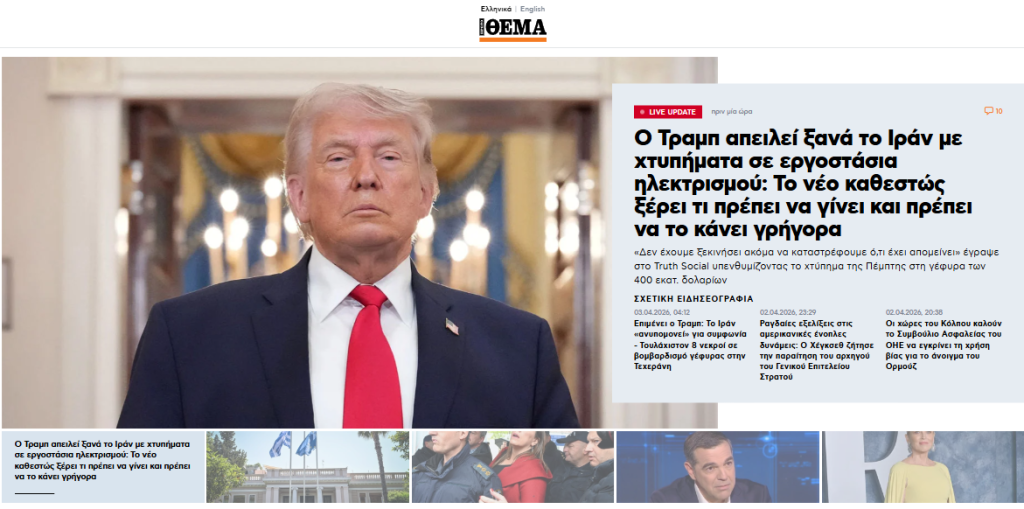
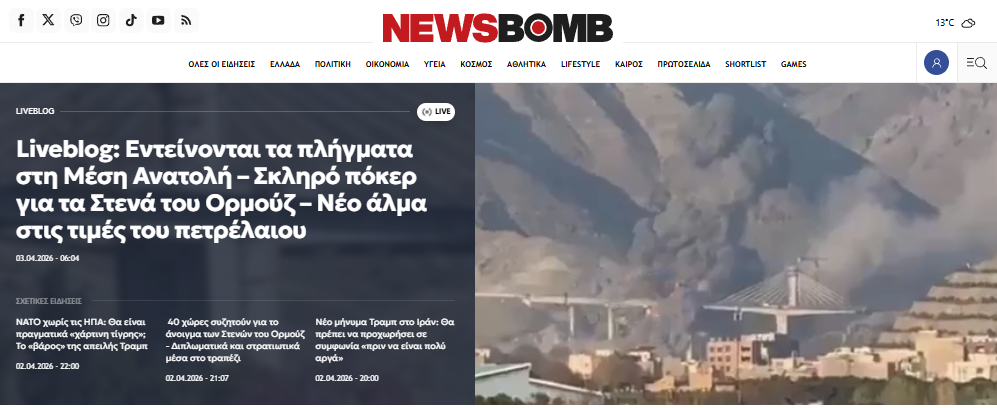
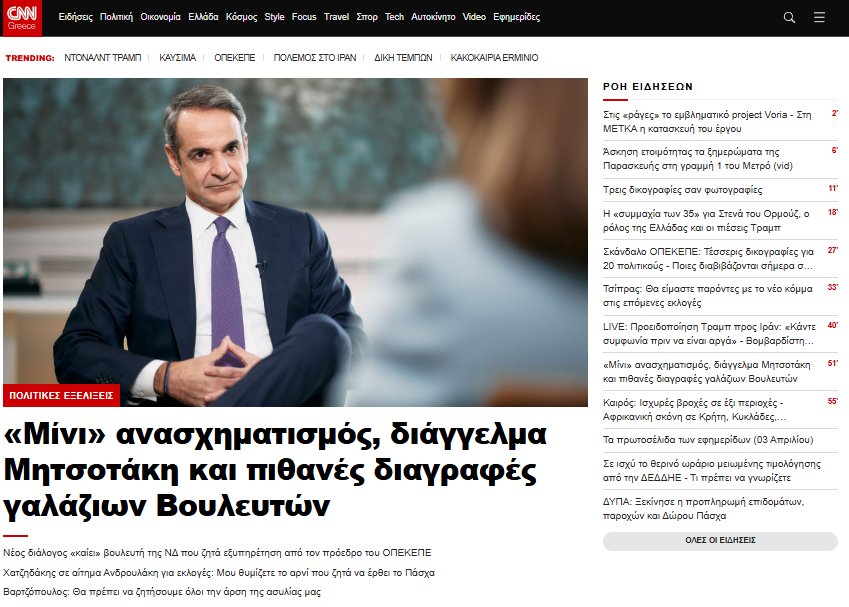
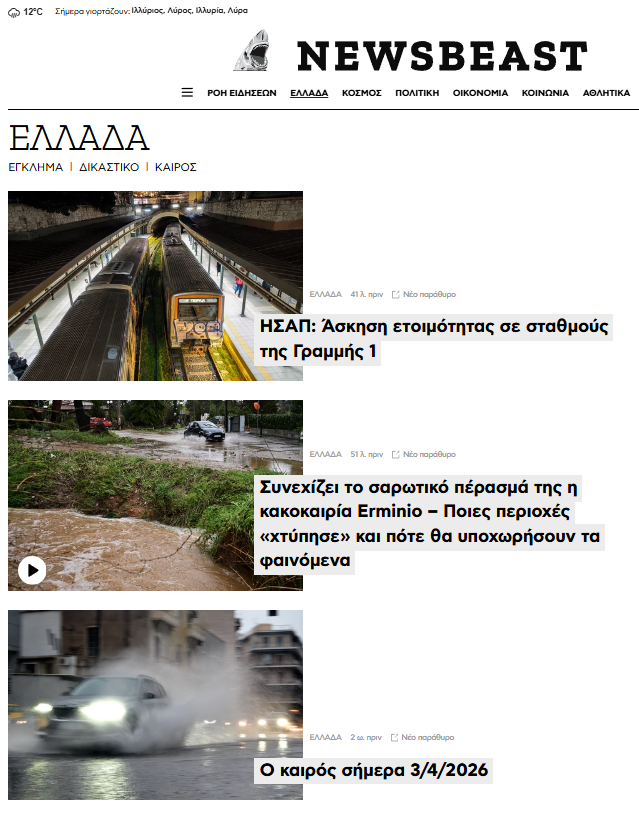

KATHIMERINI: Three new hot cases included in the judicial file regarding OPEKEPE
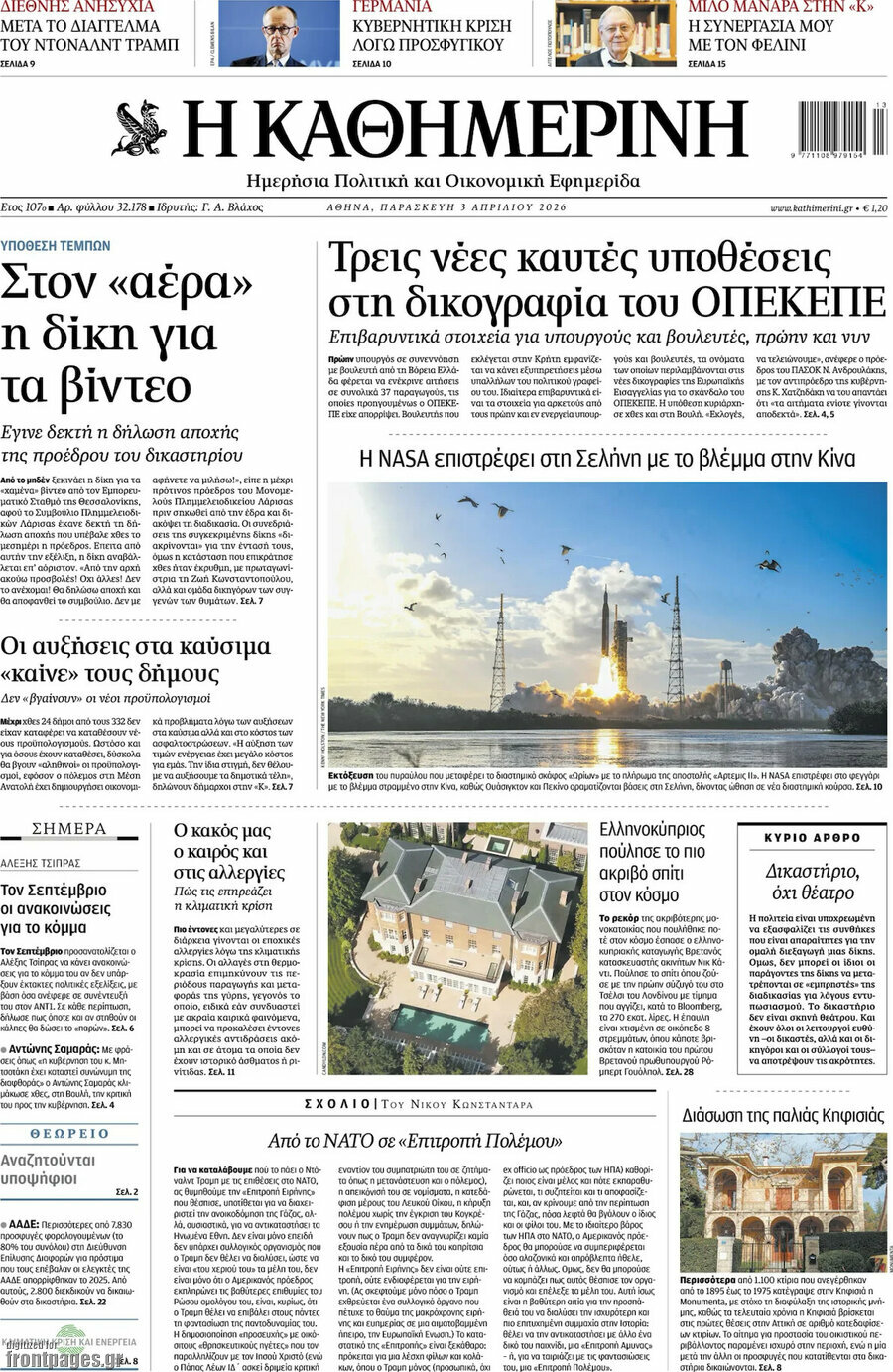
TA NEA: OPEKEPE scandal and new “hot” case files: Decay…
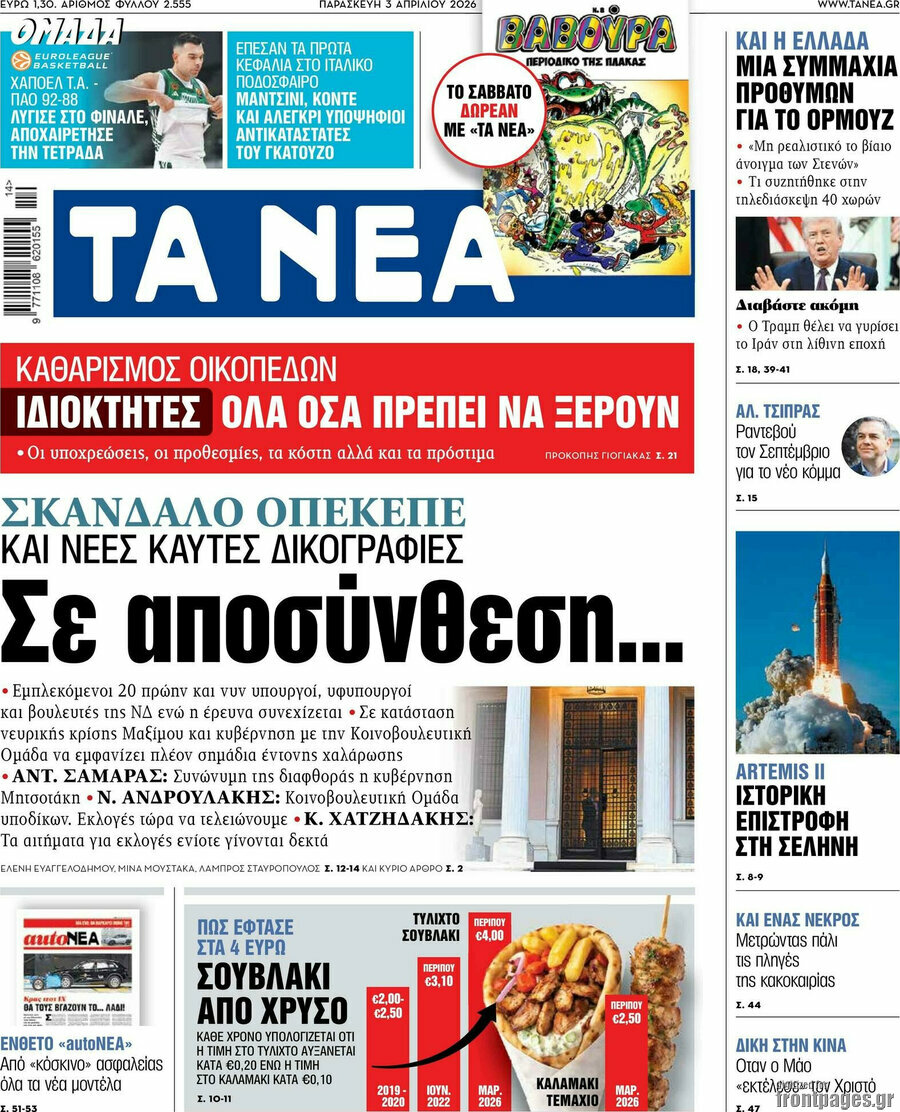
EFIMERIDA TON SYNTAKTON: Government in deep crisi
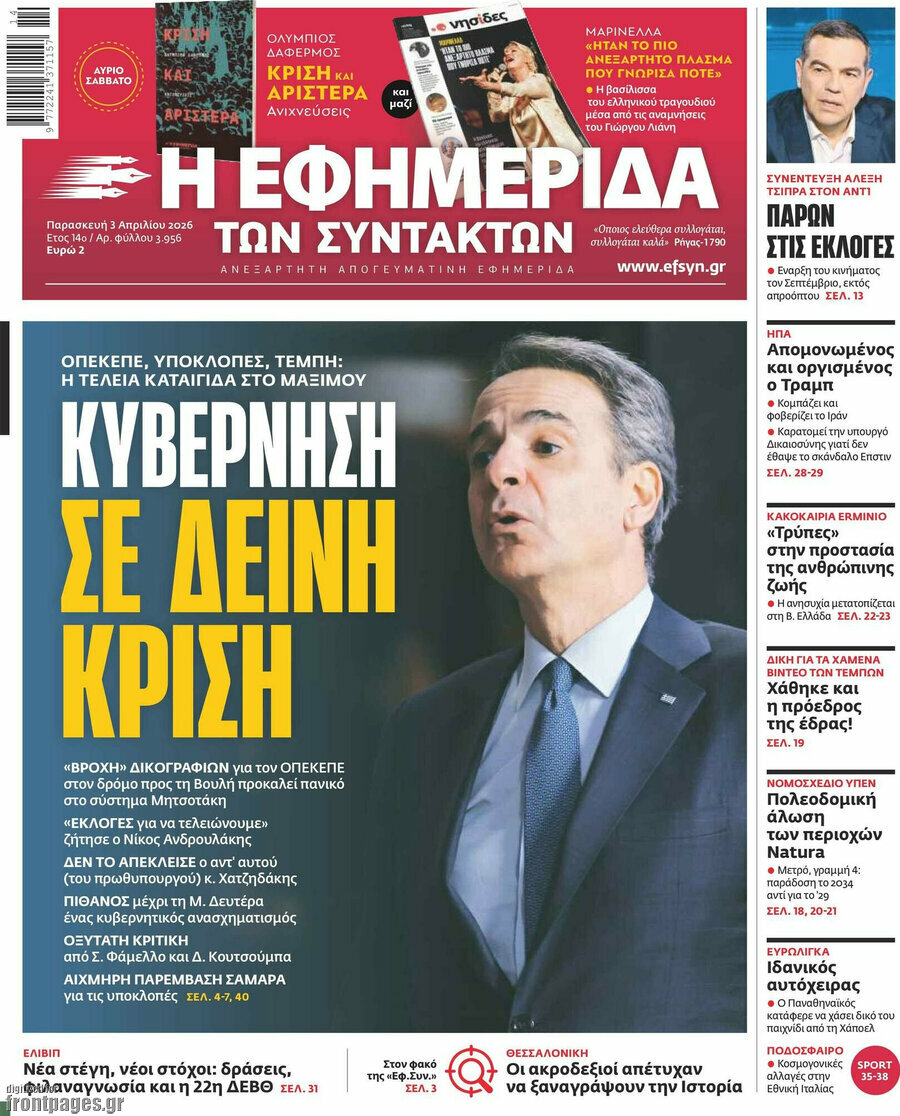
RIZOSPASTIS: Organization, rallying and international solidarity against war barbarity and exploitation
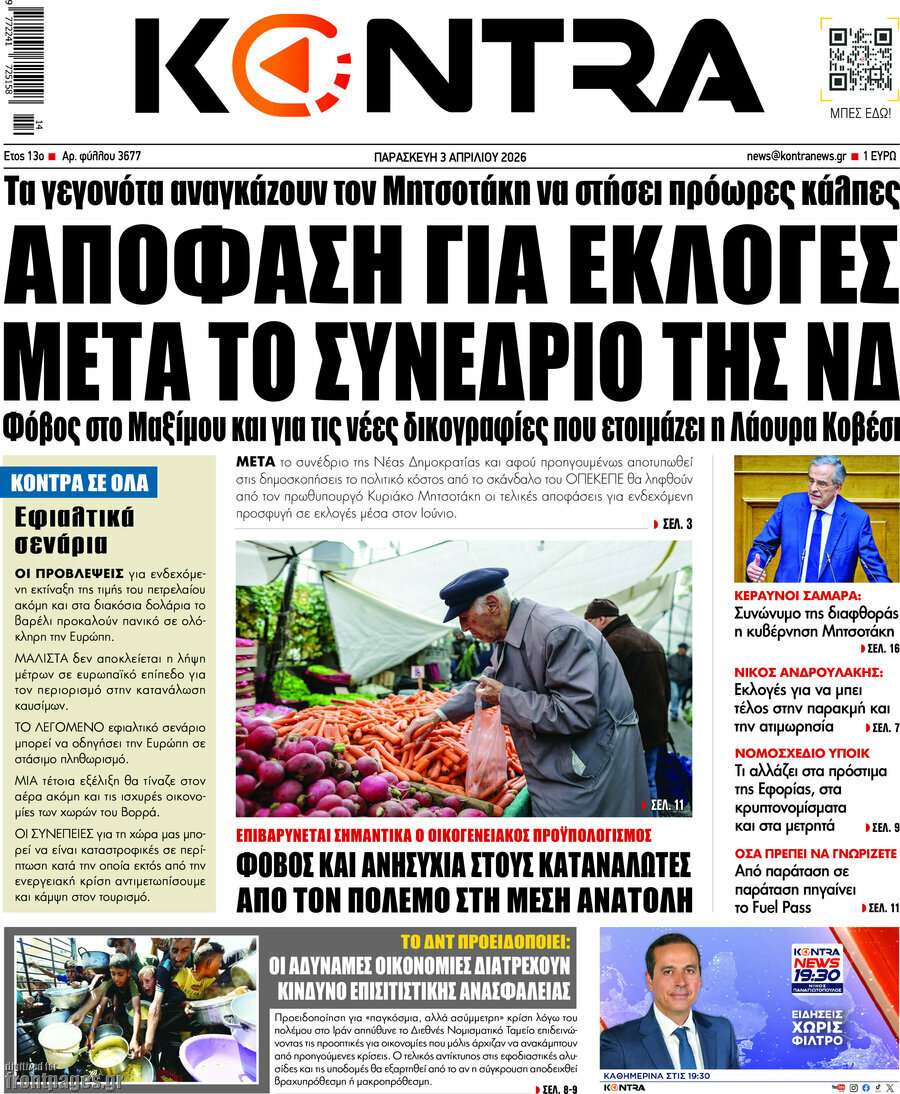
KONTRA NEWS: The decision regarding snap elections will be made after New Democracy’s conference
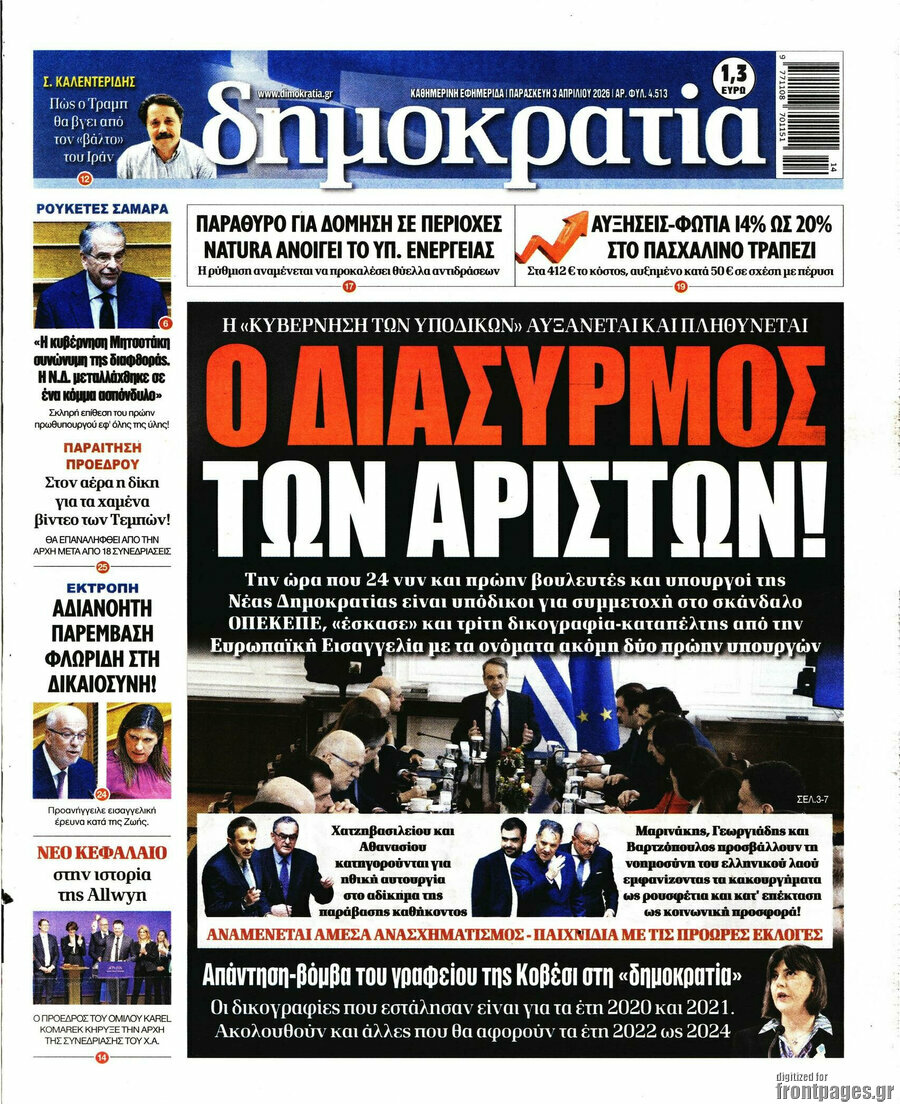
DIMOKRATIA: The humiliation of the excellent ones
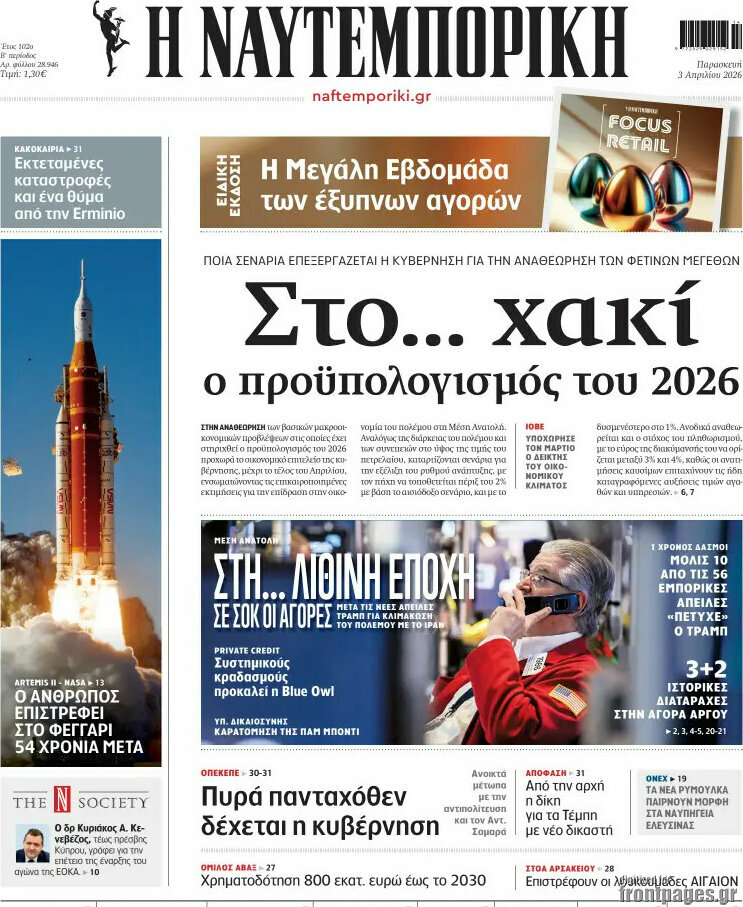
NAFTEMPORIKI: 2026 budget “enlists in the army”

DRIVING THE DAY
GETTING THINGS STRAIT: If there was one takeaway from the U.K.-led call with 41 countries on how to respond to the looming energy crisis, it was this: There’s no appetite to deploy military forces to the Strait of Hormuz for as long as the U.S.-Israel war in Iran continues. That set the tone for what’s to come.
High stakes: Participants were left in no doubt about the seriousness of the situation. They were told traffic through the Strait had plunged from around 150 tankers a day to just 10–20. The online gathering also unfolded in the shadow of U.S. President Donald Trump’s recent suggestion that allies should “take the lead” and send warships to help address the global energy shock caused by Iran’s retaliatory attacks.
Keep it real: Leaders were having none of that, concluding that all military options were off the table until a ceasefire had been enacted. The 90-minute call ended with agreement to keep coordinating, with a first meeting on post-conflict planning set for Tuesday. “Common action is important,” one senior European official told my colleague Victor Jack. “But we also need to be realistic about what we can contribute.”
Only the beginning: “It was a good meeting, but it’s early days,” POLITICO’s Chief Correspondent Tim Ross was told by another senior official from an EU government who was on the call. The official also praised the U.K. for its convening role.
Pressure, not force: A U.K. readout said countries agreed to increase pressure — including via the U.N. — to ensure free passage through Hormuz and reject any Iranian attempt to impose tolls on vessels. But there was no discussion on emulating things like the U.N.-brokered Black Sea Grain Initiative, although here may well be “lessons to learn” from that, according to the official
Fun in the sun: Trump has a simpler take. “They gotta get guts and go in,” he told POLITICO’s Diana Nerozzi. “Just send your ships up there and enjoy it.” French President Emmanuel Macron pushed back, calling military action “unrealistic” and warning it would take too long and expose tankers to missile attacks.
Trump uses d-word: Trump also took aim at NATO. “I don’t have any thoughts on NATO. I’m disappointed in them,” he told Diana. “I have no frustration. I couldn’t care less.” Not ideal timing, with NATO Secretary-General and Trump whisperer Mark Rutte heading to Washington next week.
Something’s cooking: Advised by France, Bahrain is drafting a U.N. resolution — scooped by Playbook’s Nicholas Vinocur — intended to authorize the use of force to reopen the strait. But reports overnight suggest the resolution has been watered down amid opposition from China and Russia. The Security Council vote on the resolution is now expected Saturday.
The bigger risk: The alliance’s future remains uncertain — and Trump is the central variable in each of the five collapse scenarios mapped out by my colleagues Victor Jack and Jack Detsch in this must-read piece.
MÎNZATU AND THE WINTER OLYMPICS
WHO GETS TO FLY THE FLAG? The Milan-Cortina Winter Games are over — widely considered a success and a moment of pride for Italy (more so than its football team, sadly). Yet in the corridors of the Berlaymont, one question has been doing the rounds for weeks: Who was supposed to represent the Commission at the ceremony?
What the FOI told us: Playbook obtained email exchanges on the Commission’s attendance, which ultimately featured Executive Vice President Roxana Mînzatu and Sport Commissioner Glenn Micallef. The documents released as part of a freedom-of-information request suggest Mînzatu hadn’t originally been invited, sparking a concerted effort to secure her a spot. This included asking a senior EU official to step in, and deploying the argument that, as Micallef’s superior, Mînzatu should be the one in the box seat.
How it started: IOC President Kirsty Coventry initially invited Commission President Ursula von der Leyen and Micallef to attend both the opening and closing ceremonies on behalf of the Commission, in a letter dated Sept. 18. Von der Leyen declined on Oct. 29, citing “prior commitments on the days of the Opening.” Her letter didn’t suggest a replacement from within the College.
So, who invited Mînzatu? By January, a push to secure Mînzatu a spot was underway within the Commission. At the center of the move was Mario Nava, director-general of DG EMPL, which is a Commission service under Mînzatu. Nava isn’t part of her cabinet — his role is administrative, not political.
The Italian fixer: In a Jan. 20 email (in Italian), Nava — cc-ing Mînzatu’s cabinet member Alina-Stefania Ujupan — asked for an invitation to be sent to Mînzatu, presenting her as “available” to attend events originally intended for the president and noting her responsibility — inter alia — for sport. The recipient is redacted, but the message appeared to be directed at Italian authorities.
All emails lead to Rome: A Feb. 2 email from another EU official later hinted at a direct connection with Italian authorities, rather than the IOC, saying: “EVP [Mînzatu] and Commissioner [Micallef] have been invited differently — EVP via Italian authorities and Commissioner via IOC directly.”
Pulling rank: In a Jan. 26 email to the IOC, Nava argued that, following von der Leyen’s absence, Mînzatu would replace her at several events — highlighting that she oversees multiple policy areas and coordinates the work of several commissioners, including Micallef.
Not everyone got the memo: An official from Micallef’s cabinet noted in an internal email that “apparently, the Italian organising committee as well as the IOC were directly contacted” by Nava regarding Mînzatu’s participation — and asked for clarification about what to do.
Cracks between cabs: Problems followed. Mînzatu’s team needed accreditation for an accompanying person but couldn’t access the relevant portal, as she hadn’t been formally invited via the normal process. Her cabinet asked Micallef’s team to liaise with the IOC to sort this out. This prompted a curt email reply: “We cannot ask the IOC since we were not the one inviting her.”
Open questions: Playbook asked the Commission spokesperson service and Nava himself for more information on the events, including whether von der Leyen had formally designated Mînzatu as her replacement and whether it falls within a director-general’s remit to intervene in such exchanges.
A way of life: In her reply, Commission spokesperson Siobhan McGarry didn’t enter into specifics, but said the presence of the two commissioners was announced on Feb. 6. McGarry added that, in her mission letter, “Mînzatu has been asked to focus on the things that define and make up our European way of life,” which include the strengthening of the European Sport Model.
JAPAN VISIT
THE ONLY ITEM ON THE EU AGENDA: The EU bubble is quiet today — buildings closed, officials away (except those who aren’t — sorry, Siobhan!). Check the institutional agendas and you’ll find just one item: Commissioner Hadja Lahbib wrapping up her Japan trip in the Noto Peninsula, visiting earthquake- and flood-hit Wajima and holding a call with Mayor Shigeru Sakaguchi.
No walk in the cherry-blossom park: It’s not a bad time to be in Japan — peak hanami season, with cherry blossoms in full bloom (more about that later). But Lahbib’s team told Playbook this is about crisis management and preparedness, not sightseeing. She’s the first commissioner covering disaster readiness to visit Japan since 2015. The trip included meetings with ministers and businesses, as well as a stop in Fukushima, site of the 2011 nuclear accident.
MEPs too: Lahbib, a Belgian, even found a touch of home in Tokyo — a stuffed Milou (Snowy), Tintin’s fox terrier. Meanwhile, a European Parliament delegation was also in Japan (and South Korea), winding down the trip in Tokyo yesterday — lawmakers’ first visit since 2023.
Same values: “Japan is a strategic like-minded partner,” chair of the European Parliament’s foreign affairs committee and member of the delegation David McAllister told Playbook from Tokyo. The MEP cited shared commitments to democracy, rule of law and multilateralism, as well as the common goal of tackling threats posed by authoritarian regimes.
Dragon Ball incident: Macron was also in town this week, meeting Prime Minister Sanae Takaichi and dining with Emperor Naruhito and Empress Masako. But it was the president’s social media team that stole the show, botching a Dragon Ball reference by confusing the Kamehameha energy blast (the power move of the main character Goku) with the “Fusion” move, before hastily correcting it. For someone of my generation, it was an unforgivable faux pas.
Japan rush: It’s all reminiscent of last year’s Brussels-to-Japan airlift. Between May and October, 11 commissioners — including von der Leyen and High Representative Kaja Kallas — made the trip. No grand strategy, officials insisted at the time: just a follow-up to the EU-Japan summit and a forward glance at the Osaka Expo.
NERVOUS KYIV
WINTER WORRIES: Ukraine is desperately planning for ways to prevent a repeat of this year’s nightmare winter, in which thousands of Ukrainians were repeatedly left without heating, electricity and even water for days on end, due to Russia’s relentless hammering of the country’s infrastructure.
Time is slipping: But approval delays from donors like the EU are costing Ukrainians precious time, with the next winter heating season only six months away. “Without sufficient generation capacity, the impact goes well beyond blackouts to essential services and humanitarian consequences,” Maksym Timchenko, the CEO of Ukraine’s largest private energy company DTEK, told my colleague Zoya Sheftalovich.
Iran impact: Tehran has attacked Gulf countries’ energy infrastructure, as part of the U.S.-Israeli war. As a result, those countries have been seeking the same parts and equipment that Ukraine needs, blowing out procurement and manufacturing timeframes and raising costs.
Not a moment to waste: “Ukraine is already in a race against time to avoid another energy crisis next winter,” Timchenko said. “We have seen a positive response from international donors … we are now working with them to accelerate approvals so we can begin procurement and get equipment into Ukraine in time.”
Hungary’s veto bites: Ukrainian President Volodymyr Zelenskyy earlier this week said Budapest’s decision to veto the €90 billion loan for Ukraine has already hurt preparations for next winter, because €5 billion of that money was earmarked to help restore and protect energy infrastructure. “This is about people’s lives,” he told reporters including POLITICO’s Veronika Melkozerova. “We lost already one month — March.”
You scratch my back … : With Europe staring down the barrel of an energy-price spike and a supply crunch as a result of the war in Iran, Ukraine has taken the opportunity to offer a helping hand. Naftogaz, which owns Ukraine’s natural gas storage facilities, has in previous winters offered Europe its spare gas storage capacity in facilities located in the west of the country. That offer is still on the table, and Bulgaria took up the offer this week.
EPPO VS. GREECE
GREECE’S FARM SCANDAL WIDENS: Greece’s spiraling farm-fraud scandal is enveloping a growing list of MPs from the ruling New Democracy party, my colleague Nektaria Stamouli writes in to report. The European Public Prosecutor’s Office (EPPO) sent another file to national authorities Thursday (the alleged offense is outside EPPO’s remit) involving two ruling-party MPs accused of incitement and breach of duty.
Big names, big allegations: The move comes a day after EPPO asked the Greek parliament to lift the immunity of Agriculture Minister Kostas Tsiaras, Civil Protection Minister Ioannis Kefalogiannis and nine more MPs over alleged crimes affecting the EU’s financial interests. The cases focuses on alleged offenses dating back to 2021.
The backstory: European prosecutors are probing allegations of a multi-million-euro fraud in which individuals claimed EU farm subsidies for land they didn’t own or use, or for work never carried out — diverting funds from legitimate farmers. The alleged scheme was detailed in a February 2025 investigation by POLITICO.
Pressure mounts: Opposition leader Nikos Androulakis is calling for snap elections, describing the situation as a “dystopia.” Syriza chief Sokratis Famellos is pushing for a coordinated no-confidence vote, as the scandal continues to widen.
IN OTHER NEWS
ANATOMY OF A WIN: Lille’s clinching victory in the race to host the new EU Customs Authority last week marked the culmination of behind-the-scenes diplomacy. My colleagues Giorgio Leali and Koen Verhelst have pieced it all together in an exclusive story — from the early lobbying to the decisive moment when Macron and Italian Prime Minister Giorgia Meloni (Rome was the runner-up) started hitting the phones to contact EU delegates.
MORE CHANGES POSSIBLE AFTER BONDI FIRING: Trump is considering additional changes to his cabinet, following the firing of Attorney General Pam Bondi. POLITICO’s Dasha Burns reports Commerce Secretary Howard Lutnick and Labor Secretary Lori Chavez-DeRemer may be next on the chopping block.
LEGAL TROUBLE: French MEP Rima Hassan was placed in police custody in Paris on Thursday, her office told POLITICO. She is being questioned over an alleged “apology for terrorism” linked to a social media post. Her team argues the move breaches her parliamentary immunity.
ORBÁN’S AFTERMATH: Even if opposition frontrunner Péter Magyar wins Hungary’s election this month, governing won’t be easy. He would inherit a dense legal and political minefield built by Prime Minister Viktor Orbán, as Max Griera and Jamie Dettmer explain.