Cable surveys begin without incident
A French-flagged vessel began surveying south of the island of Kasos on Thursday without obstruction, as tensions with Turkey remained limited to a radio transmission repeating Ankara’s claims over the area. The radio transmission was considered mild harassment and had been expected. Turkish forces had not escalated to repeated demands that the vessel identify itself and state its purpose, a practice known as “hailing.” Greek officials in Athens assessed that the surveys were likely to continue smoothly in the coming days, while remaining cautious because earlier phases of the project, dating to 2024, had raised the prospect of sudden disruption.
https://www.ekathimerini.com/economy/energy/1321153/cable-surveys-begin-without-incident
PM: Europe must be involved in Ukraine peace negotiations
Prime Minister Kyriakos Mitsotakis has stressed that Europe must be directly involved in negotiations to end the war in Ukraine, warning that no lasting peace agreement or future European security framework can be shaped without its participation. Speaking on Thursday upon his arrival at the 9th Summit of the European Political Community (EPC) in Dublin, Mitsotakis expressed cautious optimism over recent diplomatic efforts but insisted that Europe must have a voice in the negotiations.
Androulakis accuses government of corruption, warns of electoral defeat
Main opposition PASOK leader Nikos Androulakis strongly criticised the government’s economic policy during a parliamentary debate on Thursday, on a bill containing income support measures announced by Prime Minister Kyriakos Mitsotakis at the Thessaloniki International Fair (TIF). Androulakis contrasted key proposals in PASOK’s programme with the government’s measures, arguing that they highlight the differences between PASOK and ruling New Democracy. Referring to the resignation of former Deputy Development Minister Lazaros Tsavdaridis amid allegations of irregularities involving his daughter’s university admission, Androulakis accused the government of fostering a culture of corruption and impunity.
Greek Prime Minister faces widespread disapproval despite lead in polls
Nearly two-thirds of Greek voters disapprove of Prime Minister Kyriakos Mitsotakis’s performance, according to a new opinion poll, highlighting mounting public dissatisfaction even as his center-right New Democracy party maintains a substantial lead over its political rivals. The survey, conducted by polling firm Marc for Greek television broadcaster ANT1 and released Thursday, showed 63.5% of respondents evaluating Mitsotakis’s tenure negatively or somewhat negatively, compared with 36% expressing a positive assessment. Despite those ratings, New Democracy remained the country’s leading political force, attracting 27.2% support in voting intentions, slightly higher than in the previous survey. The party held a 13.2-percentage-point advantage over ELAS, which ranked second with 14%.
ATHEX: Local bourse contracts the Nvidia virus
The Euronext Athens (ATHEX) general index closed at 2,640.52 points, shedding 0.59% from Wednesday’s 2,656.13 points. The large-cap FTSE-25 index contracted 0.61% to end at 6,781.98 points.
https://www.ekathimerini.com/economy/1321166/athex-local-bourse-contracts-the-nvidia-virus

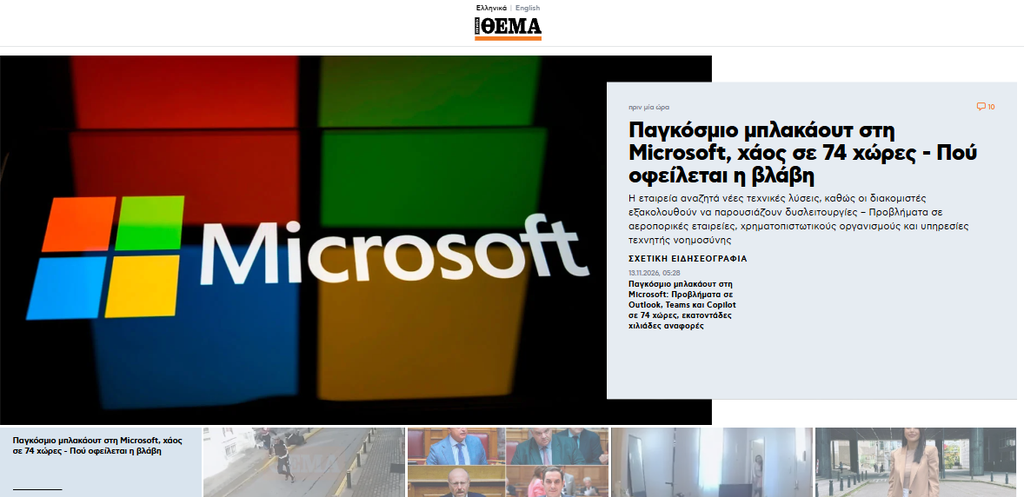
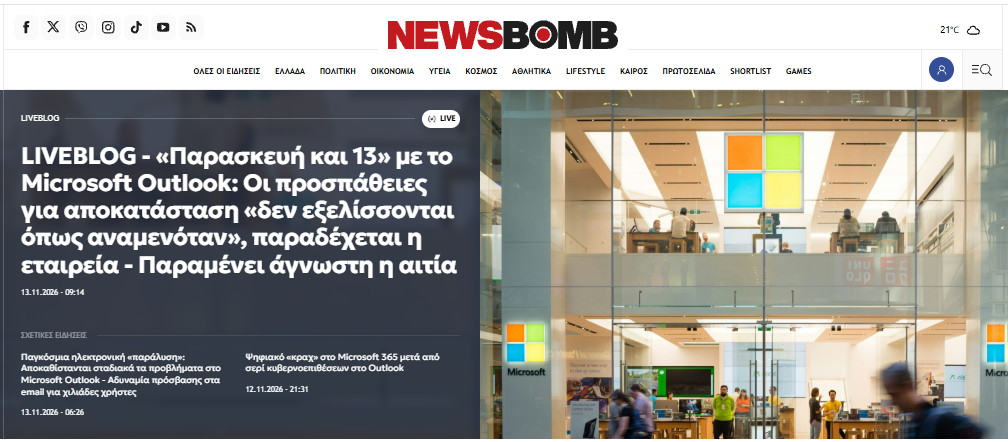

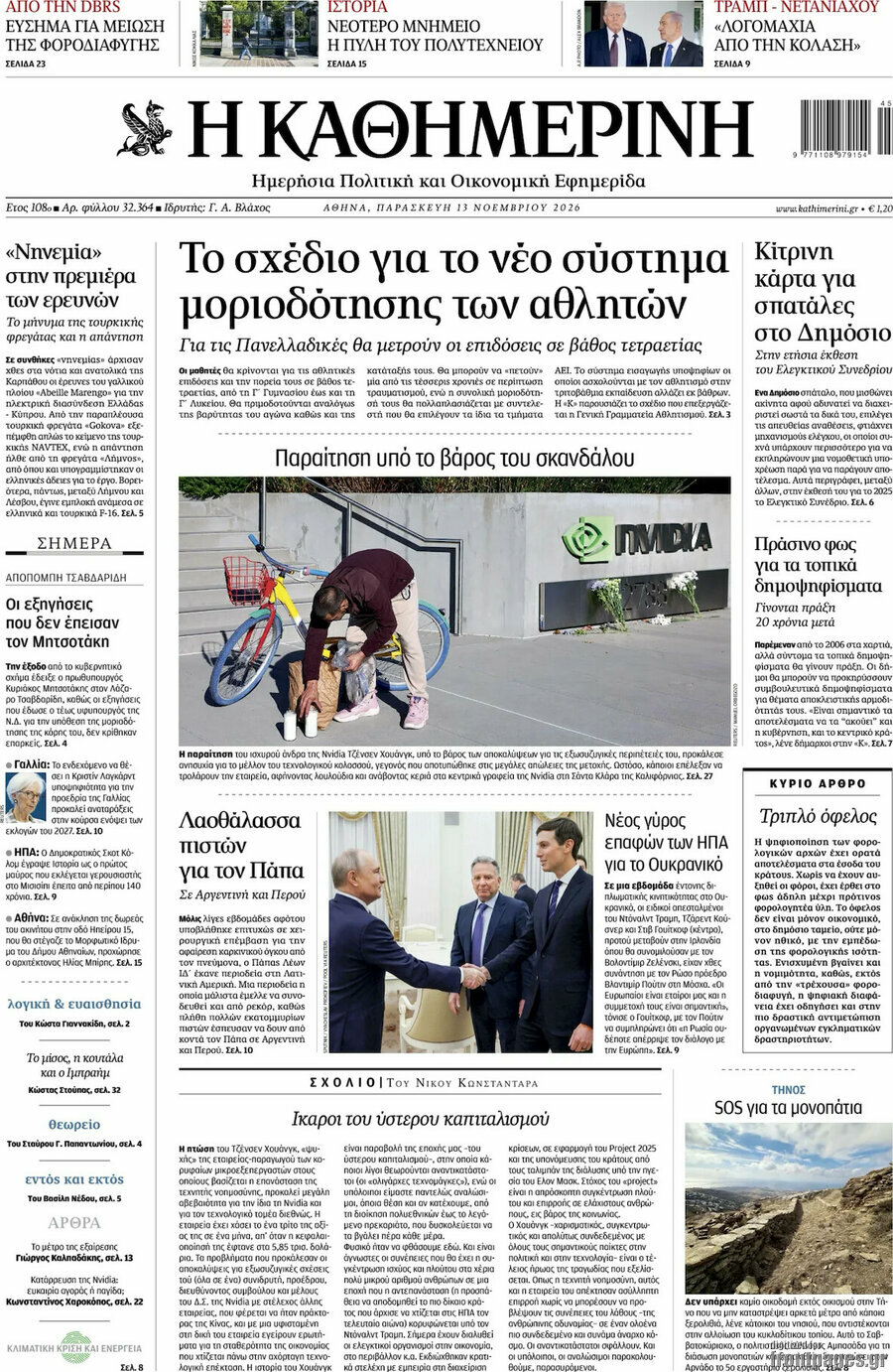
KATHIMERINI: The plan for the bonus points system for distinguished student-athletes
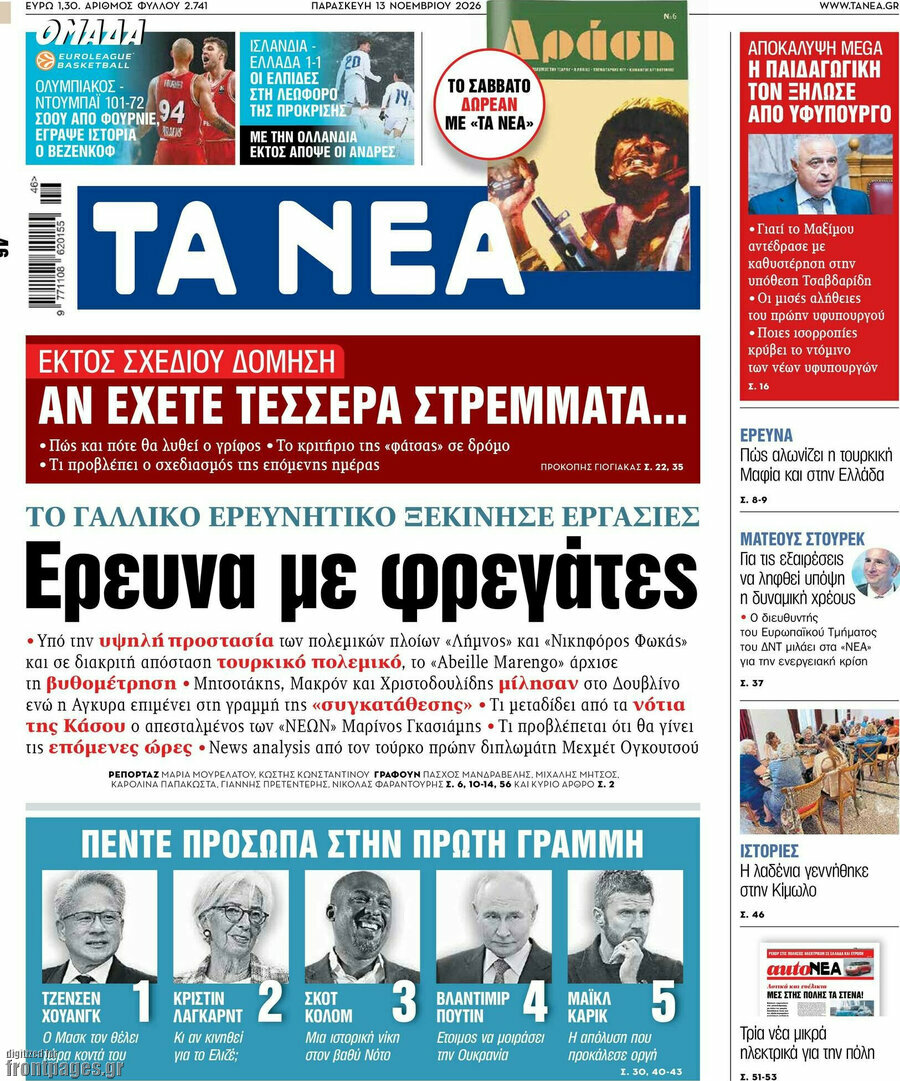
TA NEA: The French vessel began work: exploration in the presence of frigates
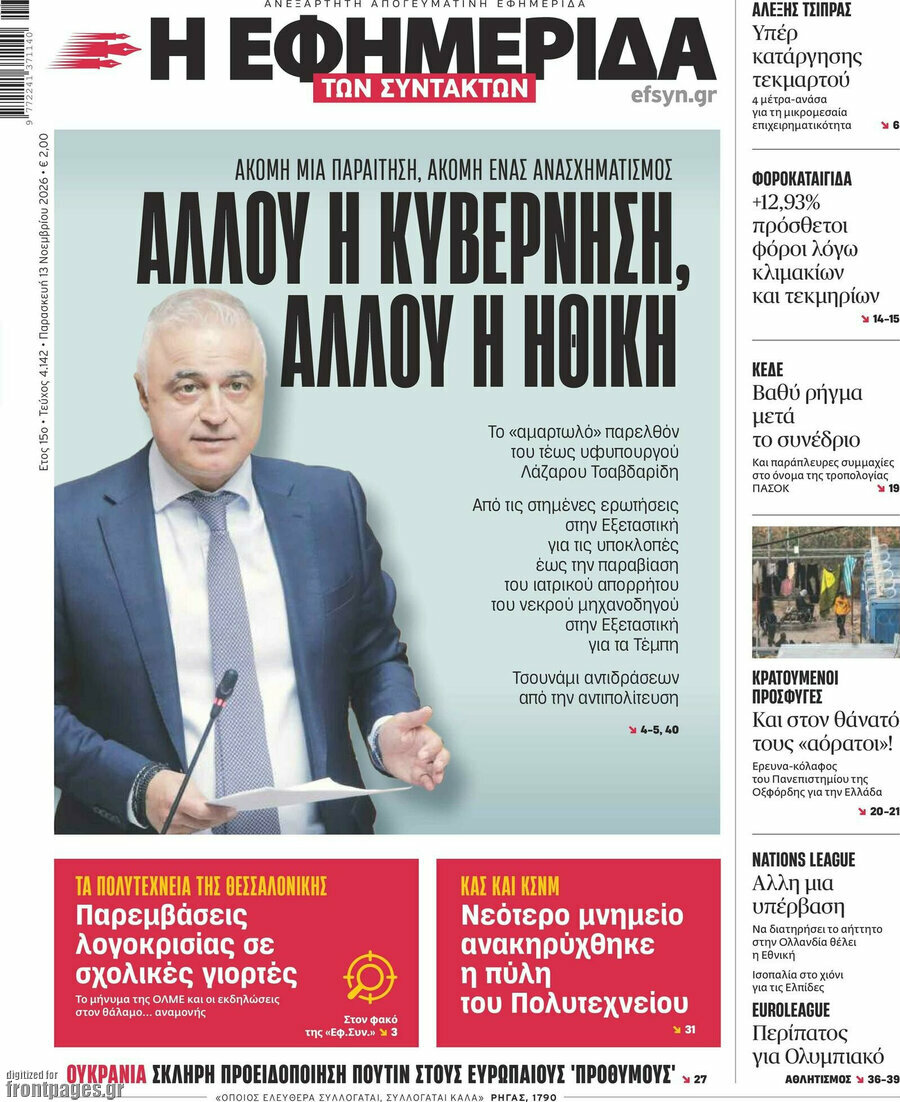
EFIMERIDA TON SYNTAKTON: Yet another resignation; another cabinet reshuffle: The government and morality are two separate worlds
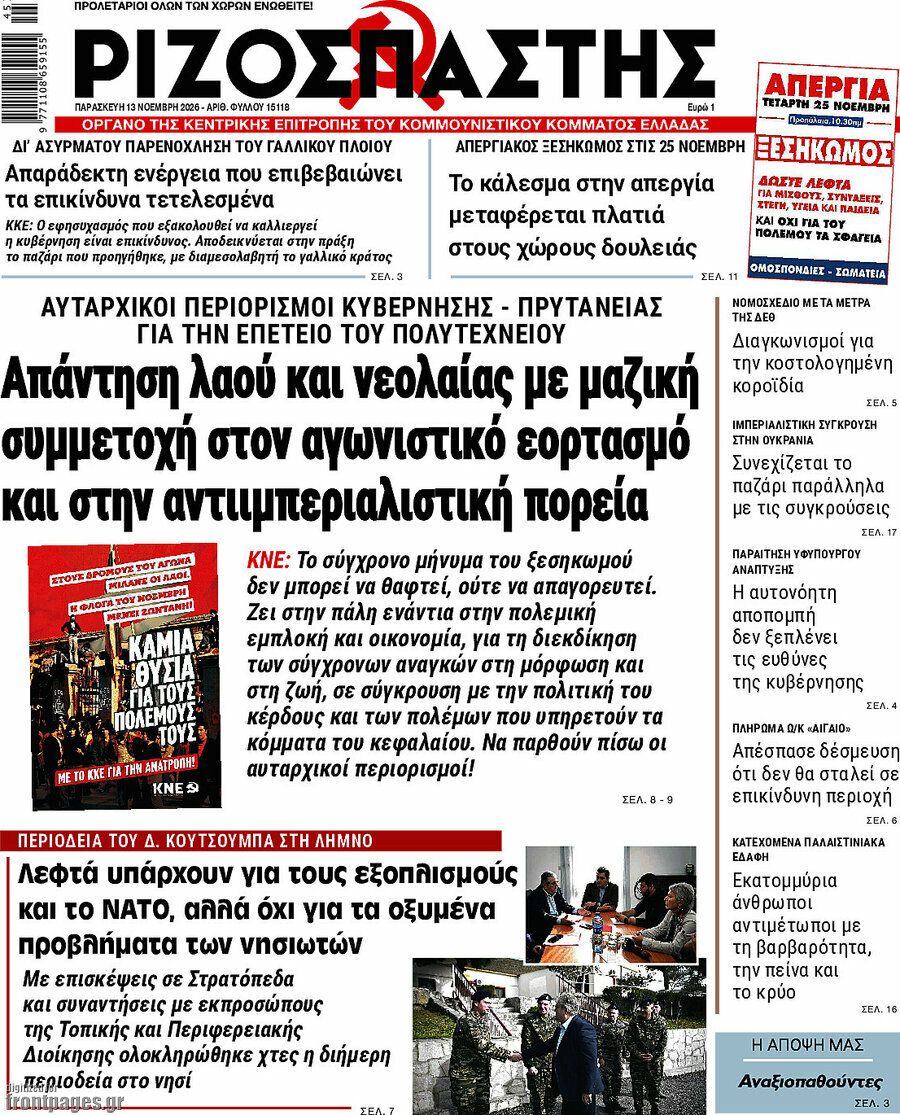
RIZOSPASTIS: The people and the youth will respond with massive participation in the upcoming November 17 rallies
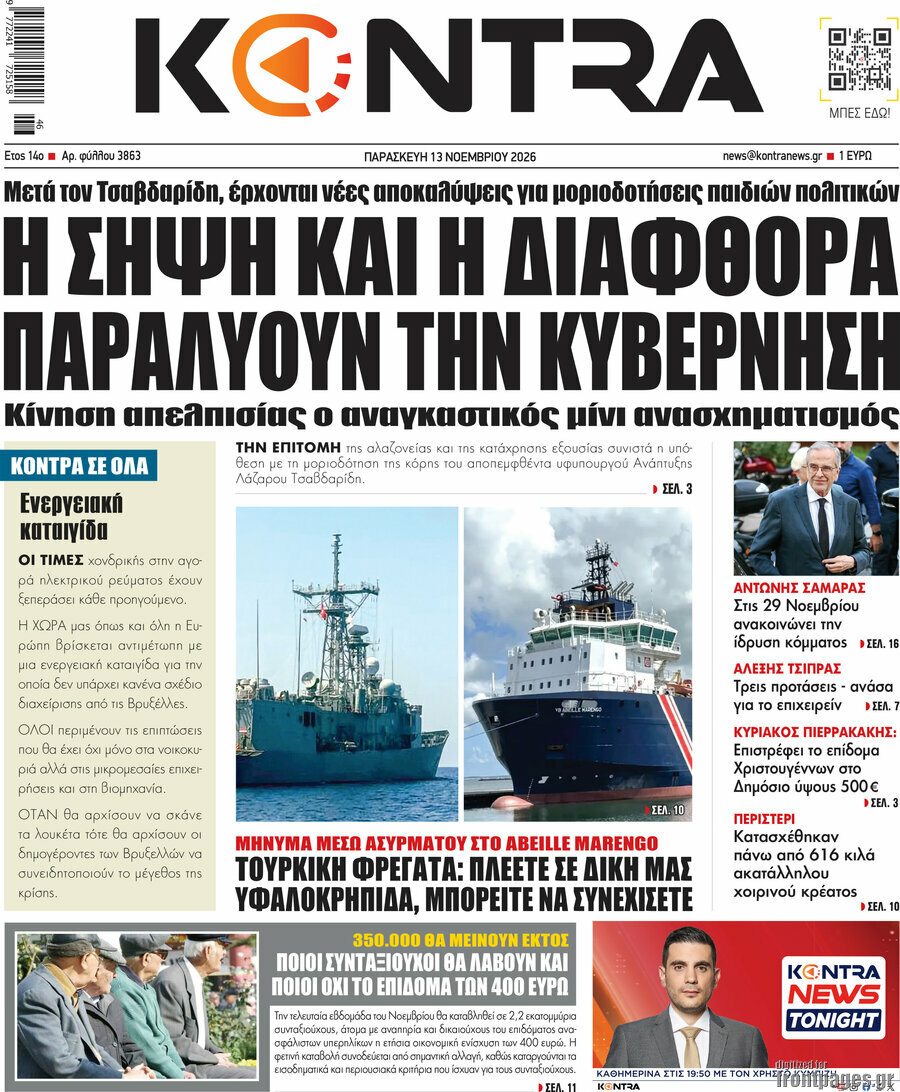
KONTRA NEWS: Decay and corruption paralyze the government
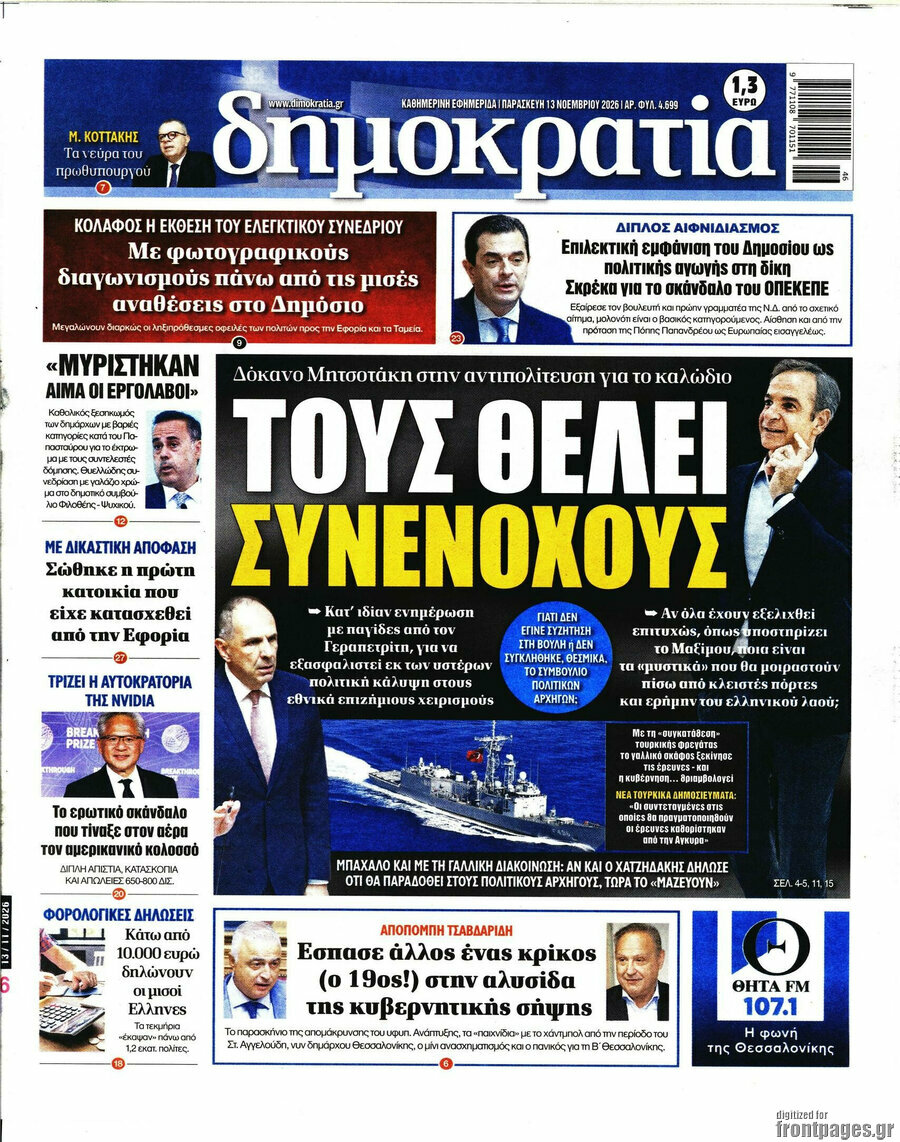
DIMOKRATIA: Mitsotakis wants to make the opposition complicit to the crime regarding the power cable
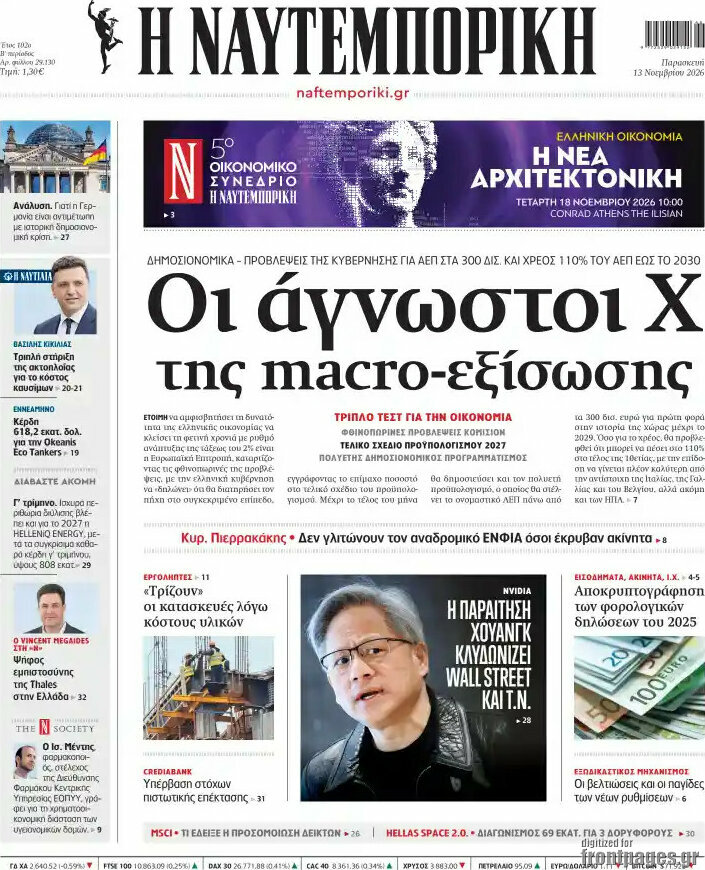
NAFTEMPORIKI: The unknown factors of the macro-equation

DRIVING THE DAY
WHO SPEAKS FOR EUROPE? European Council President António Costa is emerging as the front-runner to represent the EU in eventual Russia-Ukraine peace talks. But resistance from Europe’s biggest powers and deep divisions over the role of top diplomat Kaja Kallas threaten to derail the efforts to secure the bloc a seat at the negotiating table.
As EU leaders gather in Dublin today to thrash out who should speak for Europe, Playbook’s conversations with leaders, diplomats and officials reveal a growing consensus around Costa — though the bloc’s most powerful capitals might not accept being represented by Brussels at all.
Look no further: If you ask Estonian Prime Minister Kristen Michal, the answer is obvious: it should be Costa and Kallas. “Putin does not have to like them,” he told me in an interview in Dublin. What’s important is they are “accountable” to the EU and will presumably hold their positions until 2029.
The pair makes sense on paper: Costa’s role means he represents the EU on the world stage, while Kallas handles matters of foreign policy. The Baltics, Luxembourg, Poland, Italy and others support Costa taking the lead, diplomats and officials told Playbook.
But while most diplomats we spoke to are on board with Costa, some are far less keen on Kallas, who is seen as too hawkish on Russia. “That’s a joke, right?” a European diplomat (granted anonymity for obvious reasons) said, adding that Kallas is “probably the worst person you could pick.”
Then again: Her hawkishness is precisely what makes her the right pick, a second senior European diplomat argued. “It would make much more sense,” they told my colleague Zoya Sheftalovich. “That’s what Putin would do. He would pick whoever you don’t want to talk to.”
Both Kallas and Costa have signaled they’re up for the job. Kallas told reporters in Dublin yesterday that she and Costa were chosen for their roles in 2024, two years after the invasion of Ukraine, on the understanding that they would be the ones talking to Russia someday. And Costa stressed in his letter to Italy’s Giorgia Meloni on this topic that the EU is represented by its institutions.
Non and nein: That might not fly with France and Germany, my colleagues Jacopo Barigazzi, Giorgio Leali and Hans von der Burchard report. The EU’s two biggest countries will oppose any format that means giving up their seat at the table, a diplomat and an EU official said.
Wild card: Another name that has come up is that of Jonathan Powell, the U.K.’s national security adviser (and chief of staff to Tony Blair when he was PM), a European diplomat in Britain told my colleague Esther Webber.
Lower your expectations: The summit today is unlikely to result in an envoy being formally selected but will result in an “understanding” around the leaders’ table, a senior EU official said. “The individual or the structure itself, I think, is something that we need to tease through a little bit more,” Irish Foreign Minister Helen McEntee told me.
Whatever happens, you’ll want to tune in today: “It has endless possibilities. You could even have a TV show about it,” Michal joked, adding that the topic had already come up briefly among leaders on Thursday. “But we are saving the best part for tomorrow.”
We’ll bring you the best of the action in our live blog.
BIG AND BREAKING 


HOW THE MACRON CONSPIRACY THEORY BLEW UP: My colleague Marion Solletty has a must-click piece out this morning tracing how the false claims about Brigitte Macron went from a fringe theory to a global story — and became a cautionary tale on the limits of political influence in the digital age.
SHAKE-UP MEETUP: The Commission’s HR chief Piotr Serafin will meet this afternoon with union leaders to talk through the biggest administrative overhaul of the institution in two decades, which has already got the thumbs-up from the Renouveau et Démocratie staff union.
PARLIAMENT PLAYS FOR TIME: The European Parliament might postpone a key vote on the EU’s next seven-year budget to January to gain leverage over governments pushing to cut farmers’ subsidies and regional payouts, EPP negotiator Siegfried Mureșan told Playbook. (More here for Morning Agriculture & Food subscribers.)
FUEL FOR CONCERN: NATO forces could face jet fuel shortages in a future war as Europe’s transition away from fossil fuels and shrinking oil refining capacity create dangerous vulnerabilities, a new study has warned.
YOUR SUMMIT CHEAT SHEET
WHAT TO WATCH TODAY: Artificial intelligence may be the official focus in Dublin, but leaders have a packed side agenda — from Ukraine’s place in peace talks to the race for the top job at the European Central Bank, Gerardo Fortuna reports. Here are five things on our radar:
1 — AI frontier: Jensen Huang’s fall has been a reminder that Europe has largely been a spectator in the global AI race, Pieter Haeck writes. Leaders will debate whether Europe should build frontier models to rival U.S. and Chinese developers or focus on applications. António Costa wants Europe to become “a leading and sovereign player” across the AI value chain — the obstacle is funding computing power and infrastructure. Mistral CEO Arthur Mensch and AI pioneer Geoffrey Hinton will address leaders.
2 — The Ukraine envoy question: Costa agreed to put the issue formally on the agenda after Giorgia Meloni called the EU’s approach “all over the place.” The bloc remains deeply divided over who it should choose as its representative — yet the task of choosing has become increasingly urgent after U.S. envoy Steve Witkoff said Europeans would be invited to the next round of Ukraine negotiations.
3 — Ukraine’s €70 billion gap: While peace talks gather pace, Kyiv is also facing a massive funding shortfall next year. German Chancellor Friedrich Merz wants Ukraine financing linked to talks on the EU’s budget, which is being resisted by governments wary of tying the two together.
4 — The MFF: The EU’s next long-term budget is another issue not formally on the agenda, but with the clock ticking, each meeting is a potential arena to narrow the gulf between the warring camps’ positions ahead of a new negotiating document expected around Nov. 21. Merz is set to discuss the budget with Macron, though no breakthrough is expected.
5 — ECB jobs bargain: Macron and Merz are also expected to discuss the race to succeed Christine Lagarde. Spain’s Pablo Hernández de Cos and former Dutch central banker Klaas Knot are leading contenders. The contest also covers two other senior ECB posts, with Paris and Berlin both coveting the chief economist job, according to two officials.
20-SECOND PLAYBOOK PRIMER
Much of the prep work for today’s informal leaders’ meeting will have been done by sherpas … but what are they? Sherpas are personal representatives (or chief negotiators) who carry out behind-the-scenes work for ministers, heads of state and government ahead of international summits. Named after the Himalayan mountain guides who lead climbers up peaks, political sherpas are meant to guide leaders through difficult diplomatic terrain.
CANBERRA INSISTS THE TRADE DEAL WILL HOLD
EXCLUSIVE — IGNORE THE NOISE: Canberra is “absolutely confident” the EU-Australia free trade agreement will get through Australia’s parliamentary processes, despite the opposition coalition threatening to bring it down, Australia’s Industry Minister Tim Ayres told Zoya Sheftalovich.
The trade deal is “unambiguously” in the interests of Australian businesses and workers, he said. “You’d have to have rocks in your head to oppose it.”
Damage control: The bullish comments come after Australia’s opposition’s trade spokesperson Matt Canavan, who previously called the country’s agreement with the EU the “worst trade deal ever,” again took aim at the agreement, criticizing its terms for farmers and climate commitments. In response, the European Parliament’s Australia delegation Chair Seán Kelly warned that if Australia reneges on the deal, it could be “buried” for decades, with Brussels having already shut the door to reopening negotiations.
The worrying math: Canavan’s opposition coalition cannot kill the deal on its own, but it could help block the laws needed to put it into effect in Australia’s Senate.
History lesson: Negotiated over eight years, the deal will cut tariffs and open market opportunities, while deepening the EU’s access to Australian critical minerals. Talks collapsed in 2023 over farm access and product names, but Donald Trump’s tariffs and concerns about reliance on China’s critical minerals gave the deal fresh geopolitical urgency earlier this year. The two sides reached an agreement in March.
On the Horizon: Ayres was in Brussels to formally sign up to Horizon Europe, which will give Australian researchers access to the EU’s €95 billion research program.
DASHBOARD
LAGARDE FOR PRESIDENT? Christine Lagarde’s early departure as European Central Bank chief fuels speculation that she could join the race to become French president next year — something she’s rejected in the past but not since announcing her early ECB exit. If she does enter the fray, new polling by Cluster17 for POLITICO suggests she’d fare as well as centrist candidate Edouard Philippe, as Pauline de Saint-Rémy reported yesterday. Here’s what that looks like.
 |
5 MORE THINGS GETTING US TALKING
CALLING OUT DUBLIN: Academics and digital rights advocates Shoshana Zuboff and Johnny Ryan want the European Parliament to launch an inquiry into Ireland and the European Commission over Dublin’s track record on GDPR enforcement, according to a paper seen by Morning Cyber’s Ellen O’Regan (for subscribers).
DON’T IGNORE US: Exiled Belarusian opposition leader Sviatlana Tsikhanouskaya is urging the EU not to overlook Belarus in negotiations over Ukraine and Europe’s future security, Anne McElvoy reports.
TROUBLE IN THE HEARTLAND: Pedro Sánchez officially launched his reelection campaign yesterday in Andalusia, but the center-left is on the ropes even in a region that has been a political stronghold for decades.
BORDER CROSSINGS KEEP FALLING: Irregular crossings into the EU dropped 29% in the first 10 months of 2026, according to new Frontex figures out today and seen in advance by Playbook. The central Mediterranean route saw a 55% decline, while the western Mediterranean bucked the trend with a 21% rise.
DECLASSIFIED: In his weekly humor column, Paul Dallison asks whether the person most likely to get through to Vladimir Putin is judo star Teddy Riner, if he becomes president of France.