
Greece anticipates next test at sea
Greece has taken its case against the Turkish-Libyan memorandum to the United Nations Security Council, but the next test may come at sea, where a French survey vessel is waiting in Iraklio, Crete. Prime Minister Kyriakos Mitsotakis told the council last Thursday that the memorandum was incompatible with international law and condemned Turkish expansionism. Athens could do little more publicly over an arrangement long in motion. The dispute complicates the GSI electricity link between Greece and Cyprus. Whether a Navtex is issued for surveys by the Abeille Marengo, docked in Iraklio, will indicate whether contacts between Paris and Ankara have produced results. France faces competing pressures: advancing a project involving its companies while respecting Greece’s positions. Turkey has said it will submit a “Blue Homeland” bill to parliament before year’s end, while a recent article by Turkish naval chief Ercument Tatlioglu presents naval power as central to turning surrounding seas into zones of prosperity, production and security. Meanwhile, Greek officials fear US midterm elections could weaken Republicans in Congress if the economic effects of the Iran war hurt President Donald Trump, potentially prompting decisions that destabilize the region. In eastern Libya, the Haftar faction secured approval of the memorandum in Benghazi, leaving Greece, Egypt and Israel on the losing side.
https://www.ekathimerini.com/politics/foreign-policy/1319898/greece-anticipates-next-test-at-sea
Israel condemns Turkiye-Libya memorandum as having ‘no validity and no legitimacy,’ Israeli Ambassador says
Israeli Ambassador in Athens Pninat Yanay stressed in a post on social media that Israel condemns the maritime agreement beween Libya and Turkiye and considers that it has no validity. “Israel firmly respects Greece’s sovereignty and sovereign rights, as well as the principles of international law. No agreement between two countries can undermine the legitimate rights of a third country,” she added, while also posting a video with an excerpt of the speech given by Greek Prime Minister Kyriakos Mitsotakis, discussing this issue, during the recent open debate on maritime security organised at the UN Security Council.
Problems with flooding on Rhodes, Samos, Kalymnos and coastal town of Volos
The Fire Service on Monday received several calls reporting problems due to flooding on the islands of Rhodes, Samos and Kalymnos, as well as the coastal town of Volos, due to the heavy rain falling since early in the morning. More specifically, there were 28 calls for assistance on the island of Samos, including 10 where floodwater had to be pumped out. A total of 18 calls were made in the Dodecanese island group. On the island of Rhodes there were three calls to pump out water, one to cut down a tree and two for the transfer of individuals to a safe location. On Kalymnos, there was one call to pump out water and one to cut down a tree. In the town of Volos, the fire service received a total of 12 calls, seven to pump out floodwater and two to cut down trees.
Fuel subsidy extended to November 15
The subsidies of 40 cents per liter on heating oil, 20 cents on diesel and 10 cents on unleaded gasoline (95-octane) have been extended to November 15, the government announced. With fuel prices still high and fiscal margins narrowing, the government is conservatively pursuing income support efforts, reviewing the potential for new interventions every fortnight. According to the latest data from the Liquid Fuel Price Observatory from Thursday, October 29, the price of heating oil after the subsidy averaged at €1.566/lt nationwide, while the prices of diesel and gasoline rose to €2.136/lt. Refining companies contribute half of the heating oil subsidy, ie with a discount of 20 cents per liter. Also, since mid-October, refiners’ participation in the diesel subsidy is limited to a 5-cent discount. Therefore, the fiscal cost of the extension of fuel interventions for the first fortnight of November is estimated for the state at €35 million.
https://www.ekathimerini.com/economy/1319939/fuel-subsidy-extended-to-november-15
ATHEX: October ends monthly rise sequence
The Euronext Athens (ATHEX) general index closed Friday at 2,619.08 points, shedding 0.15% from Thursday’s 2,623.03 points. On a weekly basis it advanced 3.50%.
https://www.ekathimerini.com/economy/1319844/athex-october-ends-monthly-rise-sequence

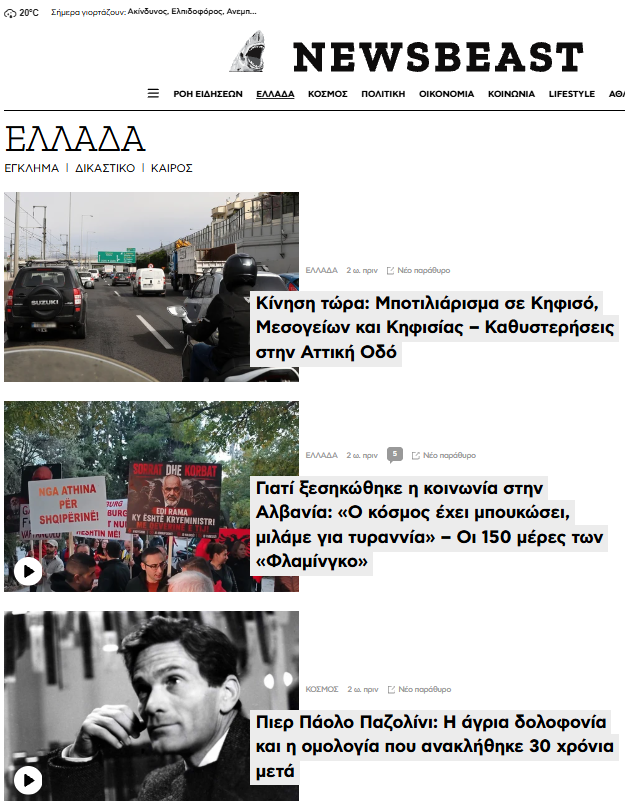

SUNDAY PAPERS
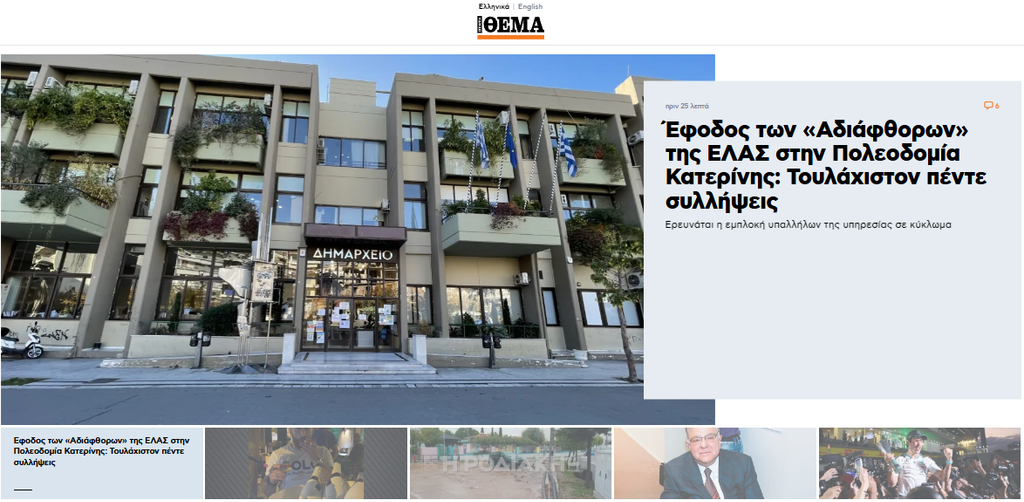
KATHIMERINI: File: “dirty bread”
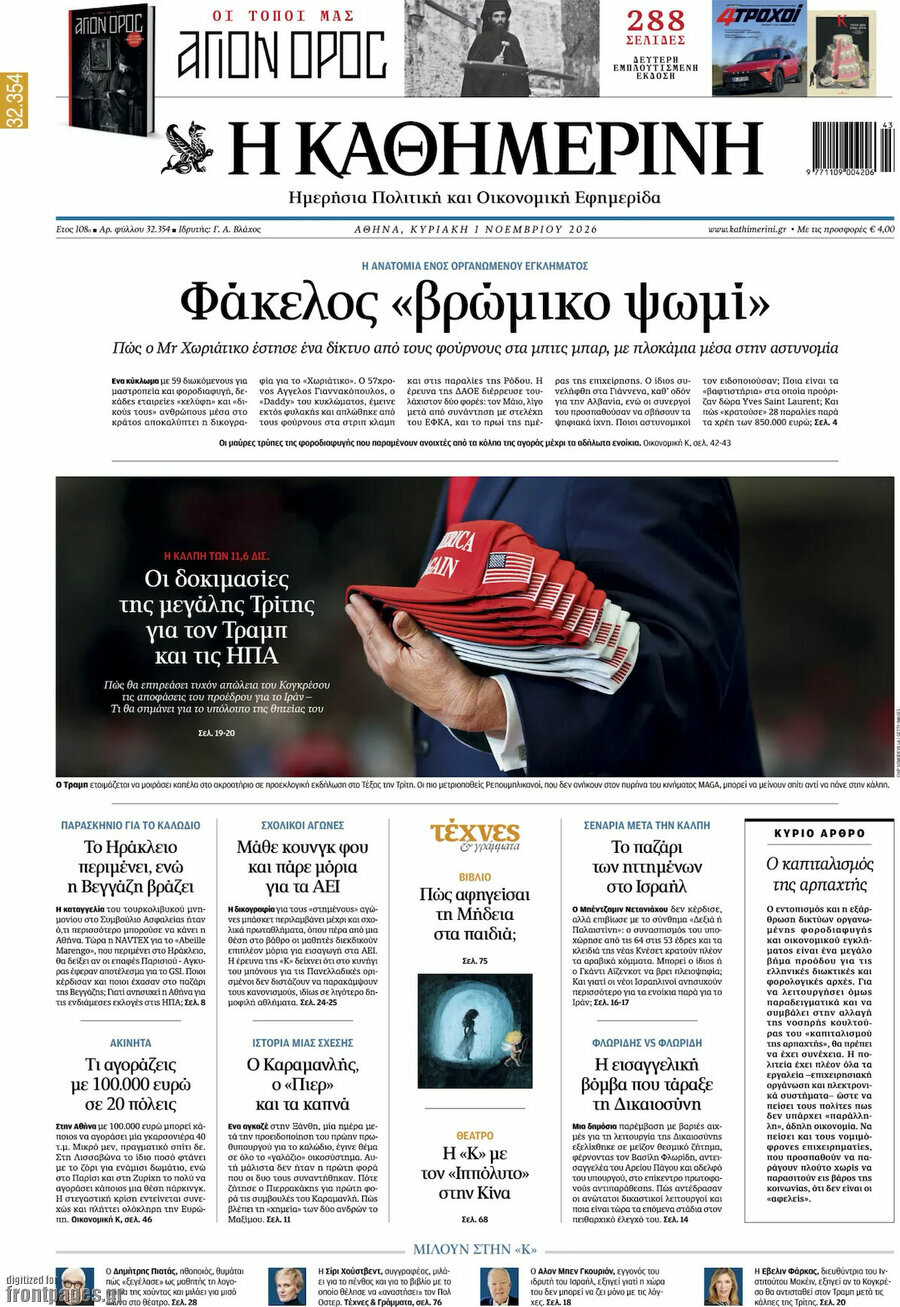
TO VIMA: Athens and other countries’ ballots
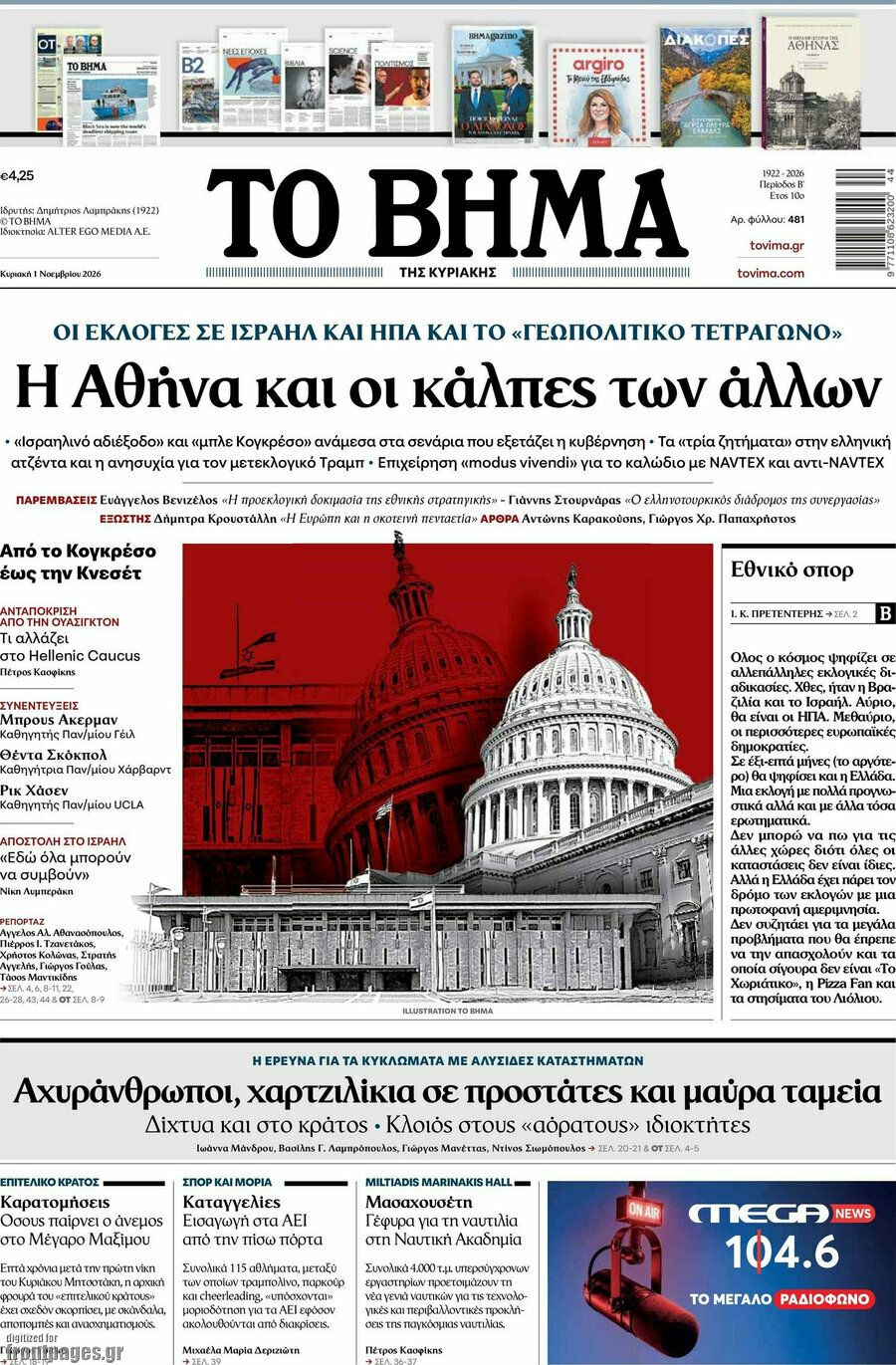
REAL NEWS: Authorities are investigating 10 large cases
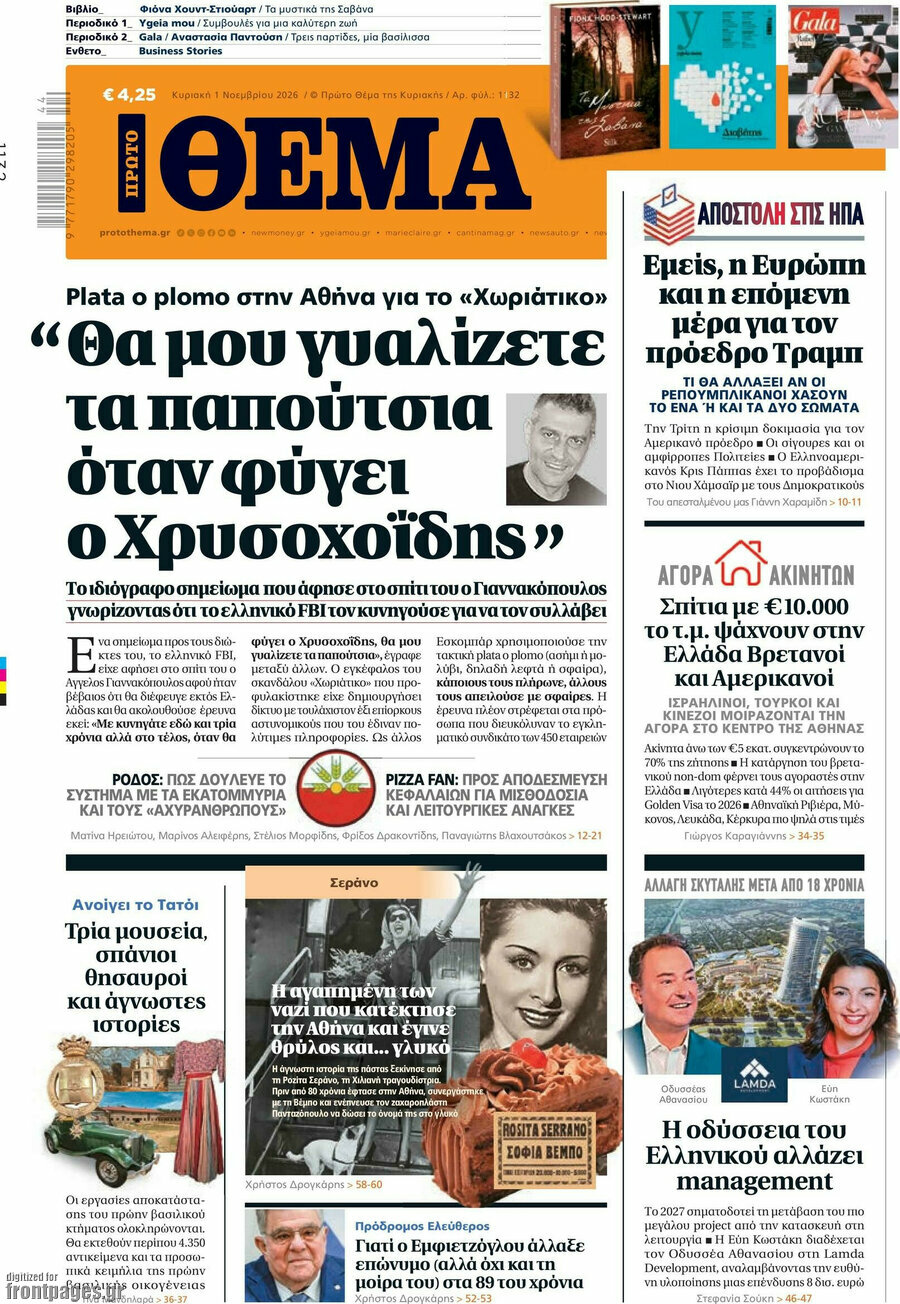
PROTO THEMA: Horiatiko owner’s message to the Greek FBI: “You will be shining my shoes when Hrysohoidis leaves the ministry”
MONDAY PAPERS:
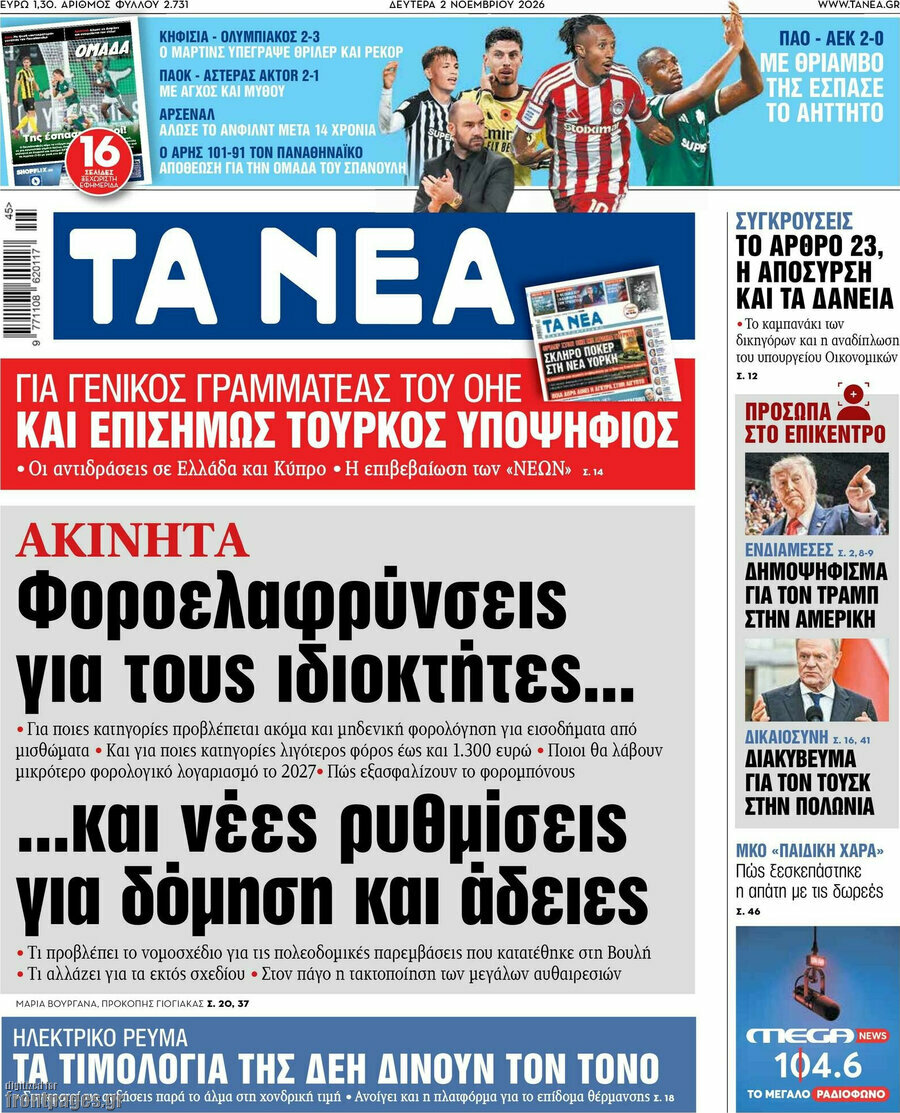
TA NEA: Real estate assets: tax alleviations for owners and new regulations for constructions and building permits
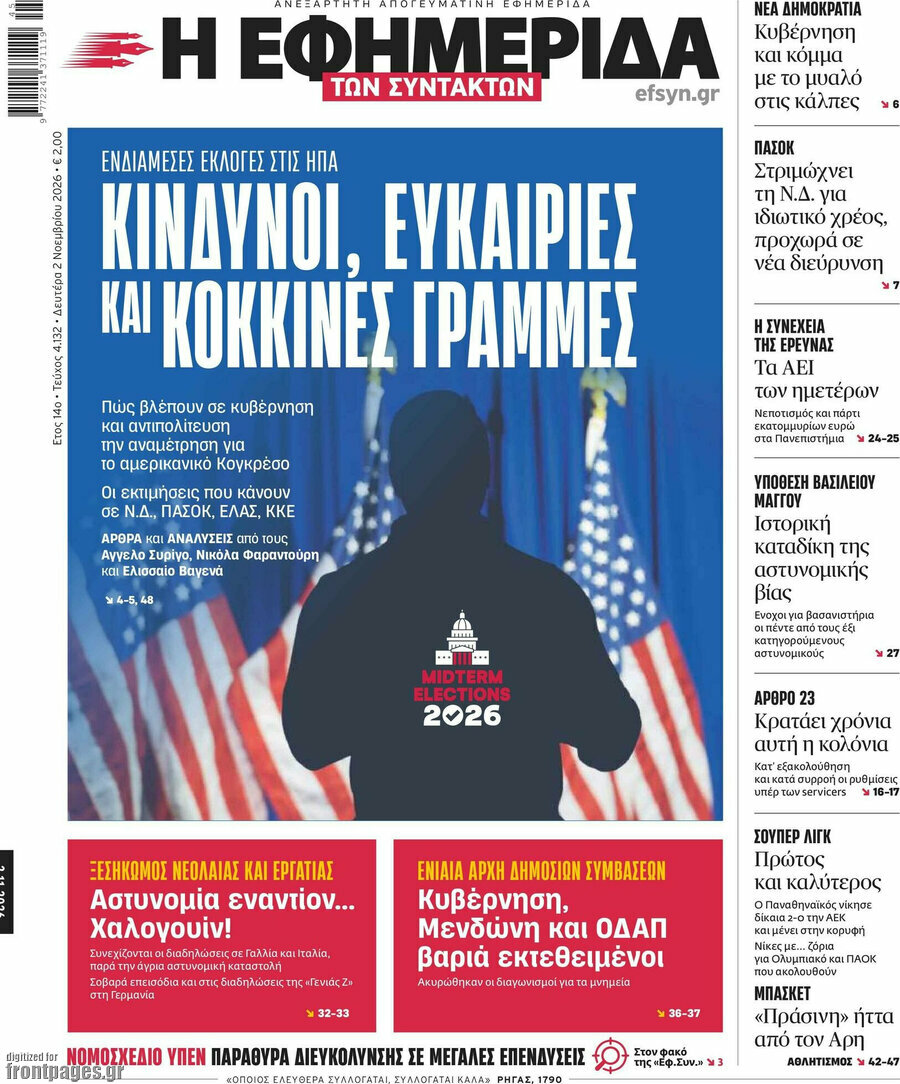
EFIMERIDA TON SYNTAKTON: US mid-terms: dangers, opportunities and red lines
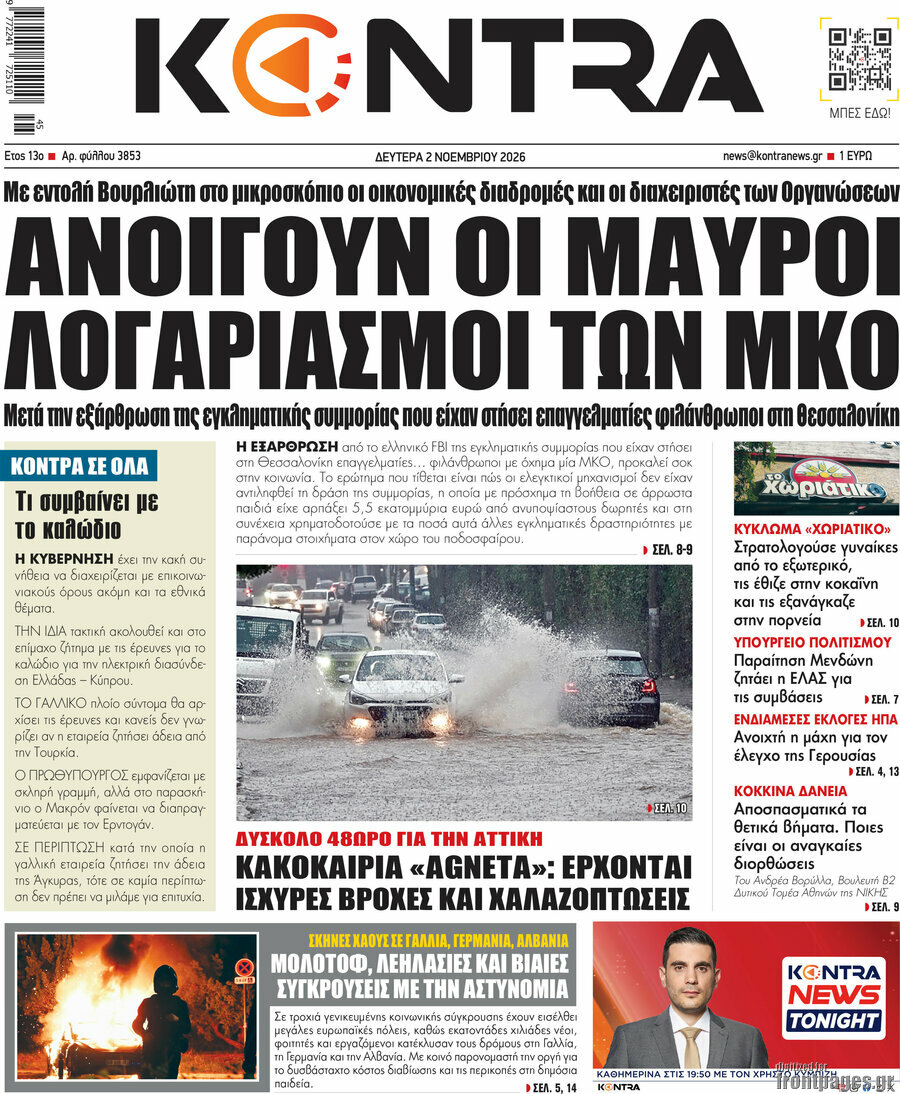
KONTRA NEWS: Black accounts of NGOs are being opened
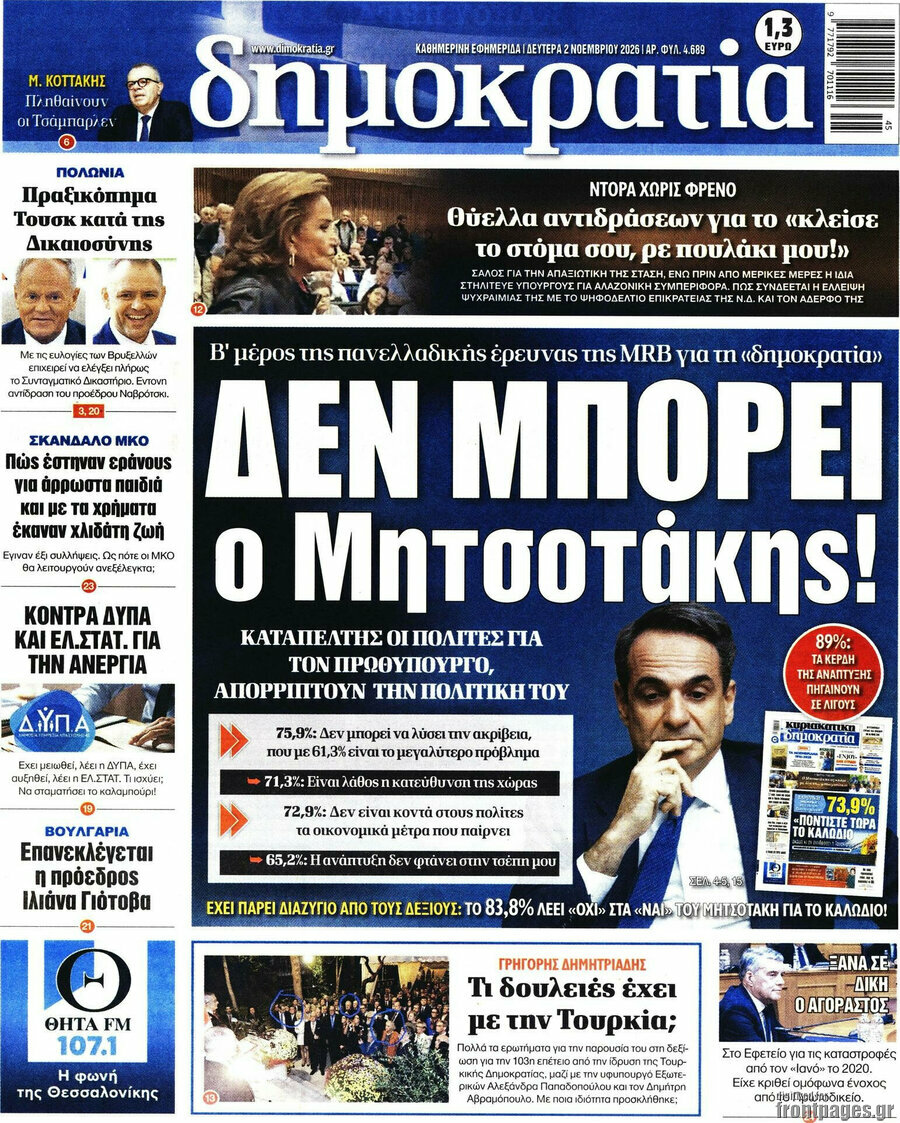
DIMOKRATIA: New poll by MRB: Mitsotakis is being rejected by the people
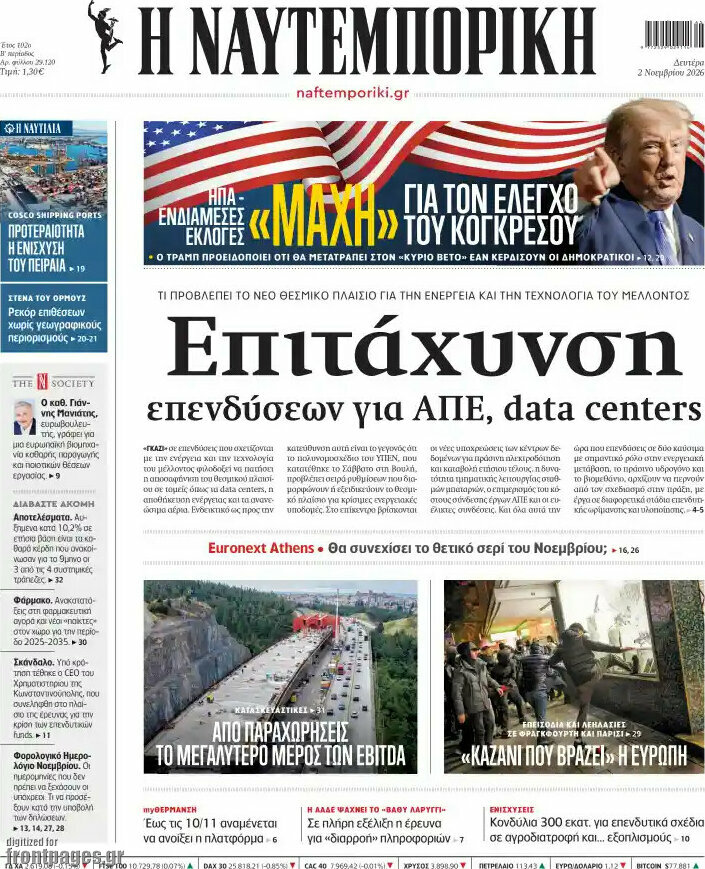
NAFTEMPORIKI: Acceleration of investments for RES and data centers

DRIVING THE DAY
COSTA GRABS THE WHEEL ON BUDGET NEGOTIATIONS: European Council President António Costa kicks off a crucial behind-the-scenes push this week to bring countries closer to a deal on the EU’s long-term budget, EU officials told me and Gregorio Sorgi.
The real deal: This week’s meetings are a test of Costa’s ability to strike deals, after he faced criticism from some governments for hosting an unwieldy EU summit last month. Several leaders say the time is now right to strike a deal before looming elections in France, Italy and Poland threaten to derail talks.
Taking over the reins from Ireland, which holds the EU’s rotating presidency, Costa’s chief of staff Pedro Lourtie will use closed-door meetings in Brussels’s Europa building, dubbed “confessionals,” to sound out the 27 capitals on possible budget cuts and compromises. “The purpose … is to indicate the direction of travel and hear the feedback of member states,” an EU official close to Costa told Gregorio.
Padre Pedro: Lourtie will come equipped with “different scenarios” — i.e., simulations of how various nips, tucks and taxes could affect the overall package — to test countries’ responses, an EU diplomat said. Costa invited leaders’ sherpas alongside their EU ambassadors to add political heft to the discussions, according to two EU diplomats. This will help Costa’s team work toward an official negotiating document to be presented before a gathering of leaders in Brussels on Nov. 26 — a meeting that will be devoted to the 2028-2034 budget.
Pick your tax: Costa’s budget brains and the Commission are testing the waters on potential new EU-wide taxes, or own resources. One of the new ideas on the table is to funnel revenue from a global tax on multinational corporations to fund the EU budget.
Pleasing Paris: Generating money from own resources is notably a key ask from France, whose Europe Minister Benjamin Haddad told Playbook: “The key to this [EU budget] equation is own resources. They are a sine qua non condition for us.”
Indeed, after President Emmanuel Macron said he would have to sign off on a deal after year-end, Costa’s mission is partly to give the French president a win to pave the way for a broader deal by December, according to two other EU diplomats.
Brace: Summit season starts next week with an informal meeting in Ireland where, despite a primary focus on AI, leaders are expected to discuss the budget on the sidelines.
To lay the foundation for a deal, two diplomats floated the possibility of a three-way meeting between Macron, German Chancellor Friedrich Merz and Italian Prime Minister Giorgia Meloni.
The bottom line: This push to find a “landing zone” for the next budget may be the biggest test yet of Costa’s dealmaking skills — or what one diplomat called “the real thing.”
BIG AND BREAKING
NATO FEARS GROW AHEAD OF U.S. MIDTERMS: European allies fear a Republican Party defeat could spur President Donald Trump to dramatically step up his attacks on the alliance, according to NATO diplomats.
ENDORSEMENT FALLOUT: The decision by Democrat lawmaker Haley Stevens to endorse Republican Mike Rogers in the Michigan Senate race has sparked calls within her party to have the congresswoman ejected from the Democratic caucus. Meanwhile, Tump has held the last of his in-person midterm rallies.
EU FLEXIBLE ON TERMS IF U.K. REJOINS: Brussels would be flexible on letting Britain stay out of the euro and the Schengen Area if London applied to rejoin the European Union, two EU officials familiar with the bloc’s approach have told POLITICO.
EU-CANADA’S SIX-MONTH TEST: Brussels and Ottawa have agreed to build the closest possible relationship, but over the next six months they’ll need to define what that means, Zoya Sheftalovich reports.
HOW RFK IS SHAPING EU FOOD POLICY: U.S. Health Secretary Robert F. Kennedy Jr has alarmed Brussels with his anti-vaccine broadside, but his crusade against mass-produced munchies has found an ally in the European Commission.
YOTOVA WINS BULGARIAN POLL: Incumbent President and former MEP Iliana Yotova has won Bulgaria’s presidential election with 57% of the runoff vote, in an outcome that will strengthen Prime Minister Rumen Radev’s grip on power, Bloomberg reports.
POLISH COURT CRISIS: Polish Foreign Minister Radosław Sikorski has told French far-right leader Marine Le Pen to stop intervening in Polish politics after she voiced concern about the government’s clash with the constitutional court. The European Commission has thrown its support behind the government of Prime Minister Donald Tusk.
GEARING UP FOR DUBLIN AI SUMMIT
HOMEWORK FOR EU LEADERS PREPPING AI SUMMIT: As EU leaders gear up for their first top-level huddle on AI in Dublin next week, Norway’s Deputy Foreign Minister Andreas Motzfeldt Kravik has some advice: Either focus on deliverables, like a shared system for reporting AI incidents, or risk discussions getting bogged down.
Why him? Kravik, who spoke to Playbook en route to New York for international AI talks, is on the front line of shaping global AI guidelines. He’s traveled the world in an attempt to forge a broad consensus on the matter.
It’s the security, stupid: “I think the question we have is: Will there have to be a major incident before countries understand that there needs to be some sort of discourse at the international level, some kind of rule-setting at the international level?” asked Kravik.
What he means: Incidents of AI models “breaking out” of their testing environments, in some cases hacking rival companies, could be just a prelude to bigger, far more damaging incidents. At the very least, he argued, countries need a system where such incidents can be reported quickly and transparently — not unlike how states alert disease outbreaks to the World Health Organization.
Tough, but still needed: Some 30 countries including Norway, Canada, South Africa and several EU states have signed a “call to action” on AI safety. But agreements on international principles are in their infancy. “It’s like trying to set aviation standards in the 1920s,” said Kravik, referring to a time when aviation was still emerging as a viable technology and thus difficult to regulate.
An added obstacle: Fierce competition between the U.S. and China and … critics who argue AI needs no special rules. “Some colleagues, also in the U.S., will say: ‘Well, we have liability rules,’ ” he said. But suing a company post-harm isn’t enough, Kravik argued, pointing to extensive regulation in pharmaceuticals.
Focus on convergence: Talks among dozens of countries have already identified some key areas of convergence, namely around incident-reporting and testing of AI models. EU leaders may want to take that experience into account when they gather in Dublin.
20-SECOND PLAYBOOK PRIMER
The U.S. is pressing Lithuania to open a port to allow potash to be exported from Belarus, despite European sanctions. But what is potash and why does the U.S. want it? It’s a potassium-rich mineral that’s a primary element in fertilizer (it can also be used in glass manufacturing and to make soaps and detergents). American farmers have reported higher fuel and fertilizer costs, squeezing already tight profit margins, which is a problem for Trump ahead of the midterms.
ETHICS BODY TUSSLE
EU ETHICS BODY SAGA CONTINUES: In the wake of the Qatargate scandal, the European Parliament pushed other institutions to create a common EU ethics body. Two years on, the Parliament is undecided on whether to kill the entire thing.
Recap: The right-wing majority in the Parliament is blocking the creation of the ethics body, but the legislature’s legal service says the institution is bound by a 2024 agreement to set it up. So it’s up to President Roberta Metsola and political group leaders to break the deadlock.
Frozen: Metsola has yet to put the issue on the agenda, even as Parliament approved the body’s budget and appointment of experts to staff it. A Parliament official said group leaders won’t discuss the issue until the Council sends an invitation to the body’s inaugural meeting.
“The president has always consistently moved the process forward,” a spokesperson for Metsola said. “The Council presidency is now in the chair and the Parliament will of course attend any meeting they call.”
Catch-22: Yet the Council wants reassurances from Parliament before it calls a meeting, which “is by its nature political and requires a commitment from the governance tier of all of the institutions,” said an EU diplomat. “This is what Parliament committed itself to and what its partners expect.”
A second frustrated diplomat said the Parliament “certainly needs” a body, pointing to the numerous scandals it has faced.
Midterms reshuffle: Three officials said the Parliament is keen to push the issue until after the midterm reshuffle to avoid inflaming tensions between the European People’s Party and the Socialists and Democrats.
6 MORE THINGS GETTING US TALKING
FRANCE EYES CHUNK OF U.K. NUCLEAR: Four industry figures familiar with nuclear planning in Whitehall say EDF Group-owned company Framatome is bidding to purchase land at Oldbury, in southwest England.
U.K.-GERMANY DEFENSE HEADWINDS: British Defence Secretary Wes Streeting is in Berlin today to discuss closer military cooperation with Germany, as internal German briefings point to a tough choice ahead on how the two sides can work together.
BRUSSELS EYES QUANTUM LEAP: A perennial also-ran in the global AI race, Europe now sees an opportunity to win what promises to be another technological revolution by learning from its mistakes, Pieter Haeck reports.
RUSSIA AND UKRAINE CLAIM APP HACK: Ukraine’s public air raid alert app was hacked on Sunday, with Kyiv and other areas issued nuclear and chemical alerts, the Ukrainian Air Force said. Russia also claimed its emergency app had been hacked.
ABOUT A TRUMP PHARMA RESET: Some Europeans hope that midterm elections in the U.S. may ease Trump’s push to lower EU drug prices — but the president is just as likely to intensify his demands.
FORMER IRISH MEP DIES: Former Fianna Fáil minister and MEP Gerry Collins has died at the age of 88, the Irish Times reports. Collins was a member of the European Parliament between 1994 and 2004.