
EU summit: PM Mitsotakis to call for lower energy prices and support for households and businesses
Prime Minister Kyriakos Mitsotakis will attend the European Council summit in Brussels on Thursday and Friday. The European Council meeting is taking place at a critical juncture, as Europe faces multiple challenges, including a new energy crisis, increasing the competitiveness of the European economy, the negotiations on the new Multiannual Financial Framework and the latest developments in Ukraine. On rising energy prices driven by international uncertainty and disruption in the Strait of Hormuz, the Greek prime minister is expected to stress, according to reports, that the priority must be to bring prices down and explore ways of providing targeted, temporary support to households and businesses, particularly small and medium-sized enterprises (SMEs), ahead of a difficult winter. This must be done while maintaining fiscal stability and sustainability, as markets remain nervous.
Countdown begins for Crete-Cyprus cable
The French contractor for the planned Crete-Cyprus electricity link has applied for an exceptional permit to resume seabed surveys, a step that could bring work back within weeks. Nexans SA submitted its request on October 8 to the Greek Foreign Ministry’s D1 directorate, seeking authorization for the research vessel VB Abeille Marengo to conduct surveys for the Great Sea Interconnector, or GSI.
https://www.ekathimerini.com/politics/foreign-policy/1318230/countdown-begins-for-crete-cyprus-cable
Parthenon Sculptures on London-Athens ‘rotation’
British Museum Chairman George Osborne is optimistic that an agreement on the Parthenon Sculptures is still possible, proposing an arrangement under which the 5th century BC works would be displayed alternately in Greece and Britain. In an interview with Kathimerini, Osborne outlined his vision for cooperation between the two sides. “My conception and what the museum’s board would like to see is that these very valuable and historically significant marbles would spend some of their time in Athens and some of their time in London,” he says, adding that he also believes the issue could be resolved within the next three years, before the end of his tenure.
https://www.ekathimerini.com/culture/1318232/parthenon-sculptures-on-london-athens-rotation
IMF sees rapid drop in Greek public debt
Greece’s public debt is expected to fall to 136% of GDP in 2026, from 146.6% last year, and continue to decline to 128.7% in 2027 and 111.1% in 2031, according to the International Monetary Fund’s World Economic Outlook. It was released on Wednesday, at its annual meetings in Bangkok. The projected decline in Greece’s debt is expected to be slightly faster this year and in 2027 than the IMF forecast in April, when it was estimated at 136.9% and 130.3%, respectively. By 2031, Greece’s debt is also expected to fall below that of France, which is projected to rise gradually to 123.6%, and Belgium, at 122.1%. By 2031, Greece’s debt is also expected to be lower than the aggregate public debt of advanced economies, which is forecast to reach 115.2% of GDP.
https://www.ekathimerini.com/economy/1318217/imf-sees-rapid-drop-in-greek-public-debt
ATHEX: Index has cleared the 2,600-pt bar
The Euronext Athens (ATHEX) general index closed Wednesday at 2,603.70 points, adding 0.19% to Tuesday’s 2,598.72 points. The large-cap FTSE-25 index expanded 0.17% to end at 6,667.57 points, though mid-caps contracted 0.55%.
https://www.ekathimerini.com/economy/1318235/athex-index-has-cleared-the-2600-pt-bar



KATHIMERINI: Last stretch for the power cable
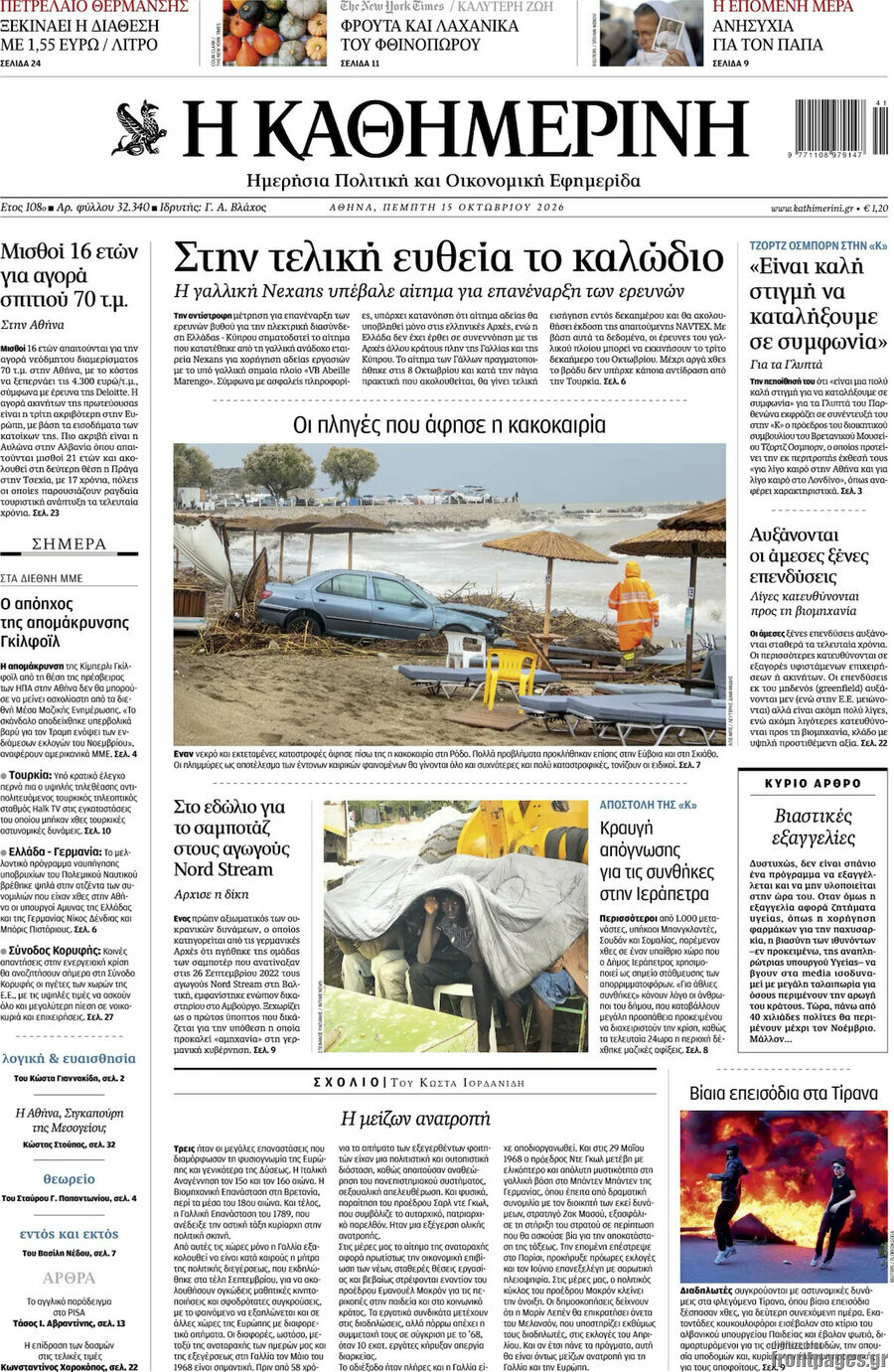
TA NEA: Motor fuel-heating: how much they will cost

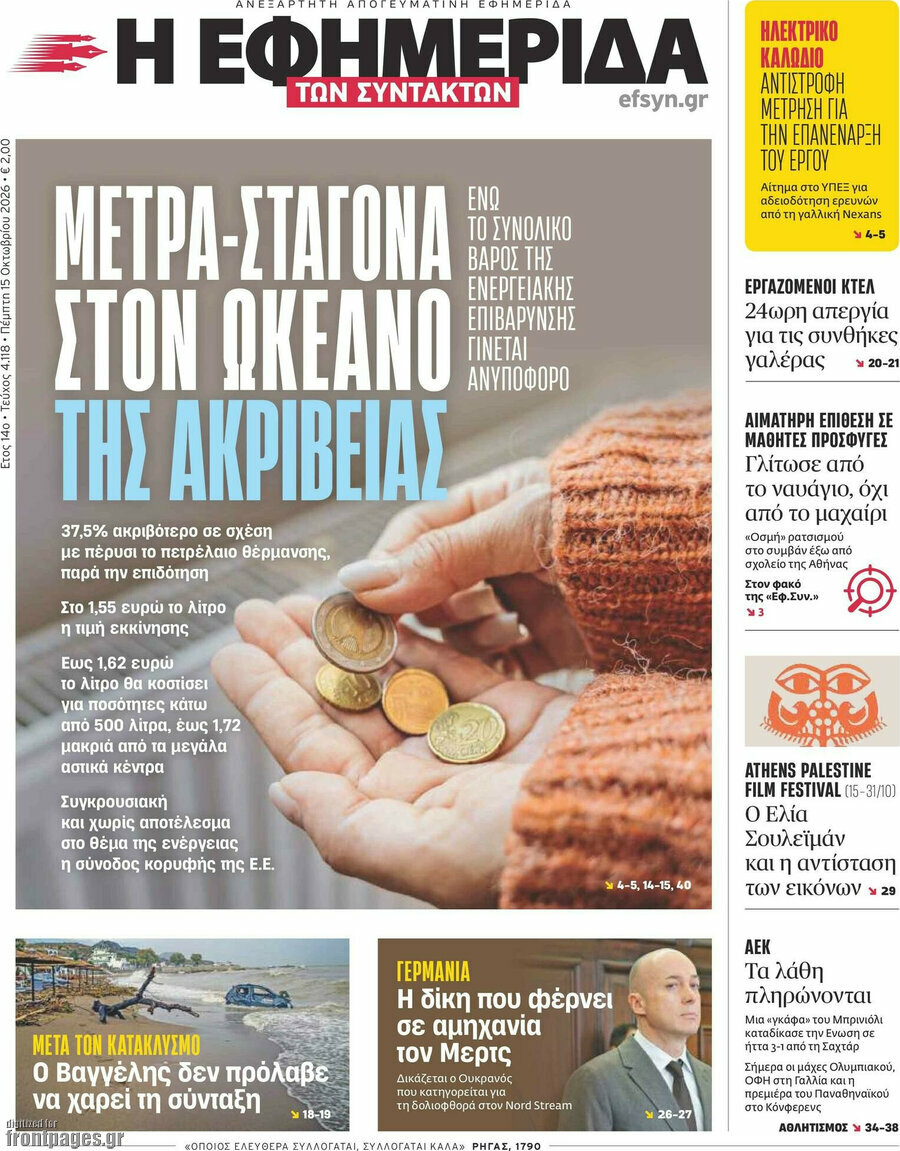
EFIMERIDA TON SYNTAKTON: The measures against price hikes are a drop in the ocean
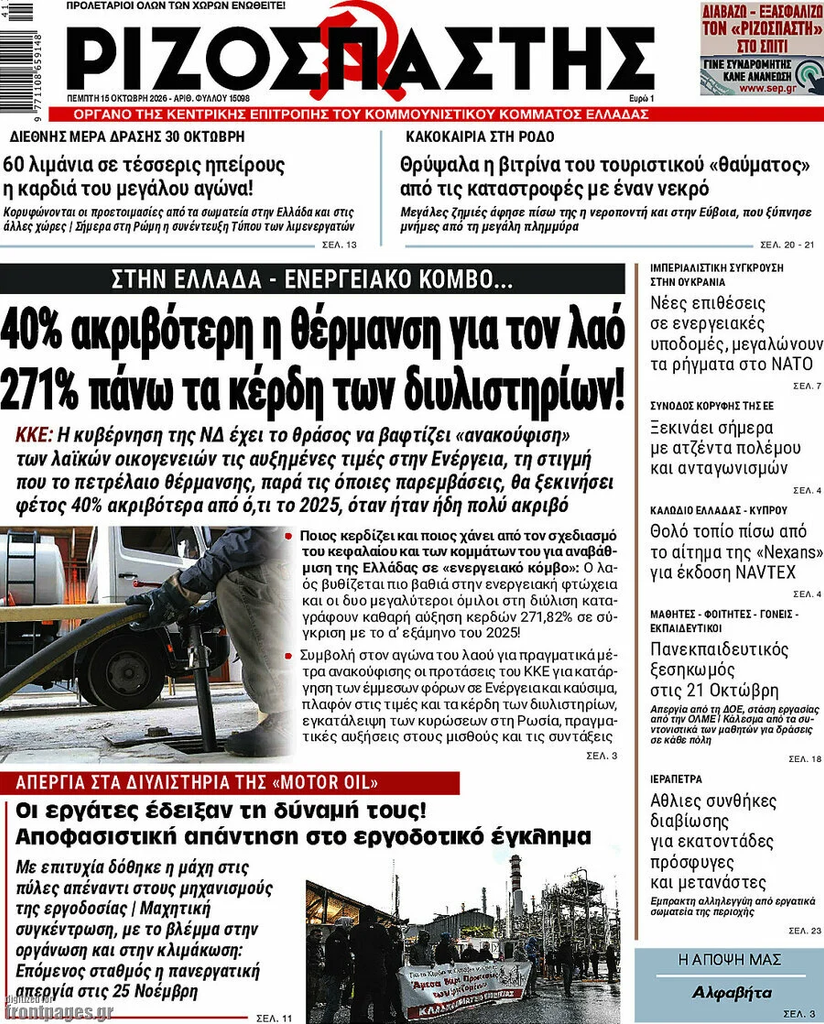
RIZOSPASTIS: Heating for simple folks spikes 40% – Refineries’ profits spike 271%
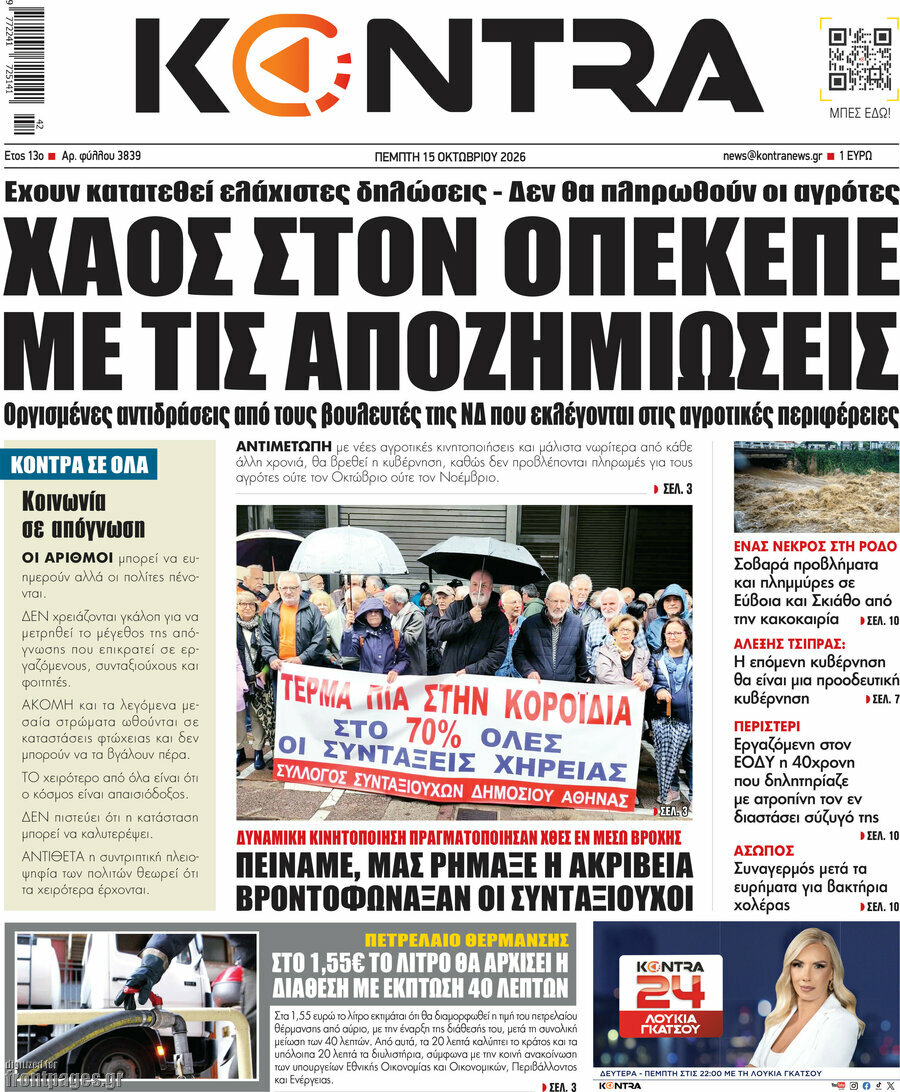
KONTRA NEWS: Chaos in OPEKEPE regarding farmers’ compensations
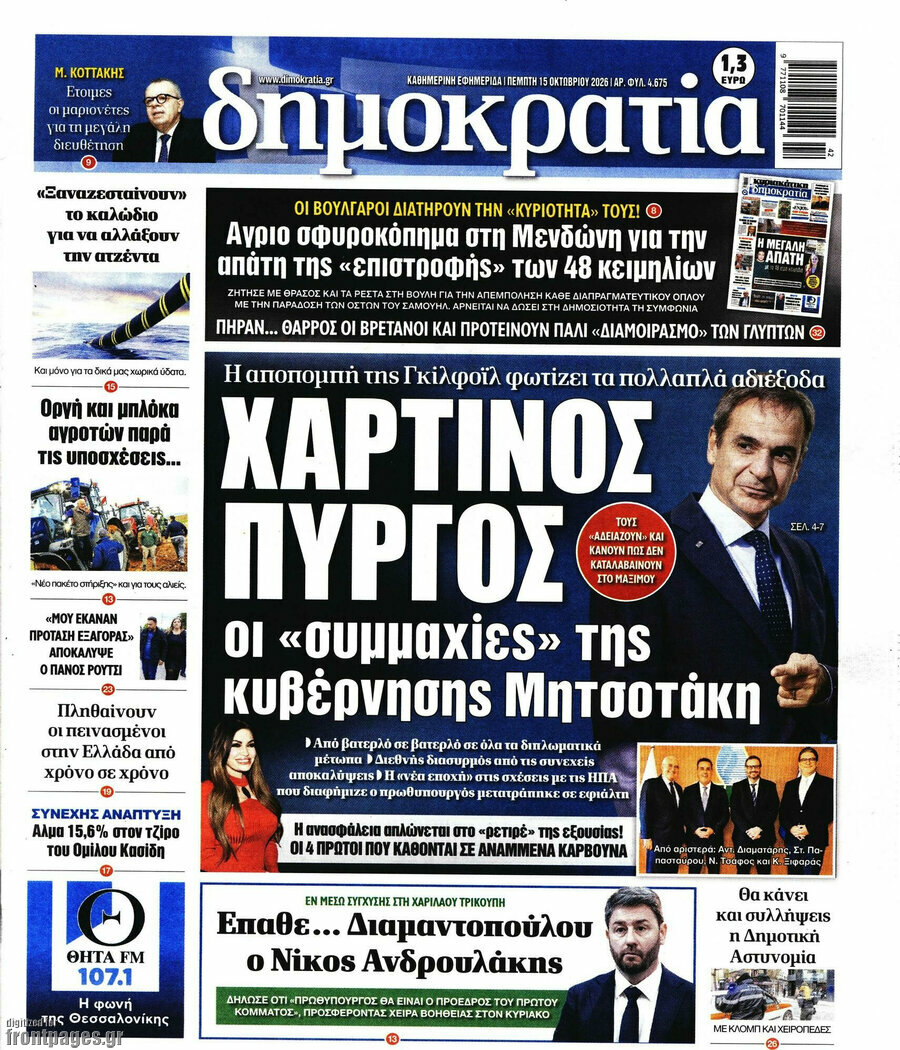
DIMOKRATIA: The alliances of the Mitsotakis government is a “house of cards”
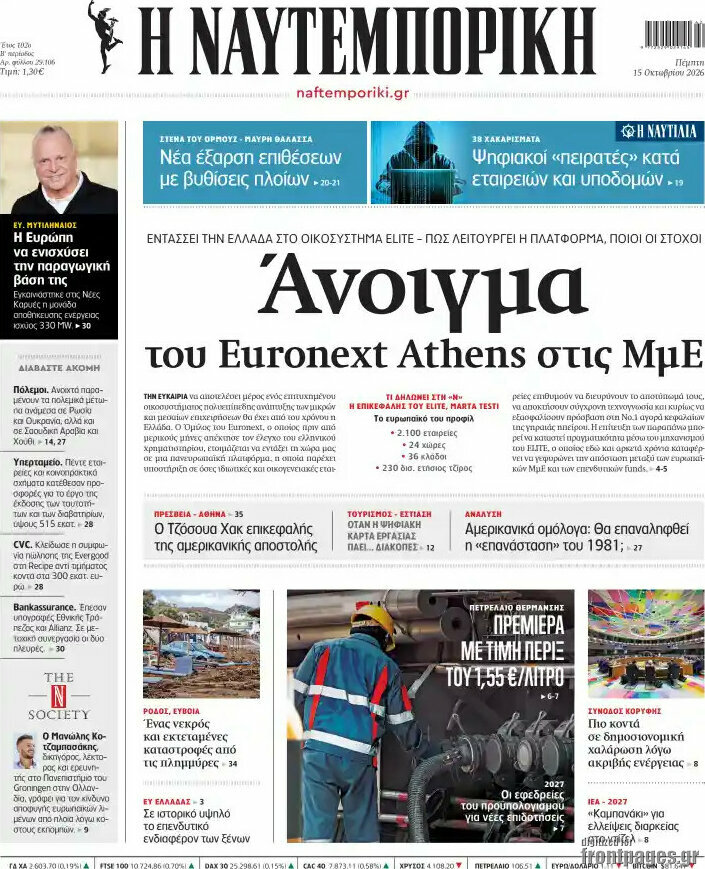
NAFTEMPORIKI: Euronext Athens makes opening to SMEs

DRIVING THE DAY
COSTA’S BIG TEST: Nearly two years into the job, European Council chief António Costa will today face the biggest test of his presidency yet, Gregorio Sorgi reports.
Taking over negotiations between squabbling governments on the EU’s next seven-year budget at today’s leaders’ summit in Brussels, Costa is determined to secure a deal by the end of the year. That would not only avoid the messiness of all the high-profile national elections next year — it would also enable him to show off a clear victory before potentially securing a second term.
“It’s impossible to have a new budget [from] Jan. 1, 2028, if you don’t approve this budget by the end of this year,” Costa told reporters yesterday. Failure to reach a deal would lead to an investment shortfall and stymie Europe’s capacity to defend itself, he said.
If only it were that easy … At a private meeting recently, officials could barely conceal their laughter when told that an end-of-year budget deal was possible, according to a senior EU diplomat who was granted anonymity to speak frankly about the fraught conversations.
Messy domestic politics is getting in the way of Costa’s plan. Italian Prime Minister Giorgia Meloni, who is running for re-election and under pressure from angry regions and farmers, told MPs on Wednesday that “we will sign an agreement only when it is right for Italy.”
Ominously for Costa’s ambitions — and for today’s summit — Italy, France and others have already watered down a commitment to secure a deal by the end of the year, according to draft conclusions for the meeting seen by Playbook.
Berlin and Paris are key to resolving the deadlock, but Friedrich Merz and Emmanuel Macron are hamstrung by weak political positions at home, as my colleagues Nick Vinocur, Giorgio Leali and Clea Caulcutt report. (The front-runner to succeed Macron, far-right leader Marine Le Pen, piled on the pressure in Brussels last night, telling reporters that the attempt to speed up the budget talks is a “democratic scandal.”)
Costa’s timeline is also imperiled by an election in Spain on Nov. 29, which polls suggest Prime Minister Pedro Sánchez is on track to lose. The Spanish vote adds uncertainty to a special EU summit on the budget that is provisionally scheduled for Nov. 26. “It will probably take place,” a senior EU official said. “We will have to then see what will be on the table.”
So what could delays mean? From today, leaders will start knocking on Costa’s door to save their pet projects. “The more time passes, the more it plays into the hands of those pushing for cuts,” said a senior EU diplomat.
Today’s discussion will signal how far leaders are from a landing zone — especially on the tricky issue of EU-wide taxes, known as own resources, to finance the budget.
The toughest fight will be over the figures presented by Ireland, which has steered the talks over the past four months under its rotating presidency of the Council of the EU. Dublin has floated major reductions to the European Commission’s budget proposal.
FOLLOW THE ACTION TODAY: Our team at the summit will keep you updated through the day in our live blog.
BIG AND BREAKING
FICO OPENS THE DOOR: Slovakia is reviving a dormant cooperation forum with Moscow after five years, with Russian oil, gas, nuclear fuel and even the treatment of athletes on the agenda. Zoya Sheftalovich and Max Griera have the exclusive.
A NEW RUSSIA TWIST: Donald Trump’s special envoys proposed that European countries unfreeze Russian assets and transfer them to a vehicle overseen by Washington in an attempt to revive peace talks with Moscow, the FT reports. European delegates shot down the idea.
SATELLITE SQUEEZE: Ukrainian officers say the reported restrictions to Elon Musk’s Starlink service are “comparable to a nuclear strike against us,” with severe consequences for Kyiv’s military operations, my colleagues report.
CASH CRUNCH AT FRONTEX: The EU border agency has suspended applications for its program to help deported migrants reintegrate after burning through its budget, Eliza Gkritsi and Hanne Cokelaere scooped.
ESN FIGHTS FOR SURVIVAL
EXCLUSIVE — AfD’S PARTY PLEDGES REFORMS TO DODGE A BAN: The far-right Europe of Sovereign Nations, the EU party whose members include Alternative for Germany, rejected claims by the EU’s party watchdog that it breached the bloc’s values — but promised new internal rules to keep its national parties in line, according to a 160-page defense obtained by POLITICO.
ESN argued that many of the breaches alleged by the Authority for European Political Parties and Foundations predate the party and can’t be attributed to it, and that investigators rely too heavily on subjective interpretations of what constitutes a breach of EU values, Max Griera reports. The defense said deregistration would be disproportionate and proposed lesser sanctions, including a “reprimand” or “temporary suspension of funding.”
The party said it amended its statutes this summer after the allegations surfaced, creating an ethics committee to monitor compliance with EU values, investigate internal breaches, recommend corrective measures and produce an annual report. It also drafted a code of conduct to guide its member parties on respecting EU values.
Russia defense: The watchdog’s case cited Dutch Forum for Democracy leader Thierry Baudet’s praise of Vladimir Putin and Bulgarian party Revival’s pact with United Russia as examples of breaches of EU values. ESN said Baudet was criticizing NATO and Western foreign policy, not directly endorsing Russia’s war.
“One may reject that view, but it should not be regarded as a violation of EU values,” the defense said. It called Revival’s pact “merely a symbolic declaration intended to promote dialogue and normalization,” and argued that without financial or material support, it breached no EU sanctions.
Historically, the watchdog has favored fixes over punishment. Between 2022 and 2025, the APPF identified 30 breaches of spending, donation and other rules but imposed sanctions only twice, after parties failed to take corrective action.
20-SECOND PLAYBOOK PRIMER
The end of the year is packed with European Council summits. There’s the one that starts today (and continues on Friday), plus an informal summit in Dublin on Nov. 13 and then the leaders are back in Brussels on Dec. 17 and 18. On top of that, we hear there will be an extra summit in late November. But 2026 won’t top 2020, when leaders met a whopping 13 times (many of which were via video conference because of Covid-19, which is also the reason they met so often).
YOUR EUROPEAN COUNCIL CHEAT SHEET
ON YOUR MARKS: António Costa wanted to focus on the next seven-year budget at this EU leaders’ summit. Instead, leaders are going to talk about … pretty much everything. “It’s the largest agenda ever since Costa took over,” one senior diplomat said. Here’s your handy guide to the first day of the marathon diplomatic session.
Blaming each other … Leaders will kick off with talks on energy, with capitals and the Commission expected to point fingers at each other over high prices. Climate rules could take a beating, too.
… then blaming Beijing: Lunch is devoted to “macroeconomic imbalance” — Brussels-speak for China. Ursula von der Leyen will brief leaders on trade talks with Beijing. Expect renewed demands for the Commission to “urgently” sharpen its trade defenses and protect more European industries from Chinese competition, according to POLITICO’s Camille Gijs, who’s been following the prep.
Show me the money: After China, they’ll turn to the elephant in the room — the bloc’s next long-term budget, on which the warring camps are still miles away from an agreement. Spoiler: Don’t expect a breakthrough. “I don’t think we are there yet, nor will we be in the next two days,” one senior EU diplomat said. It’s not looking great for that December deadline.
More mouths to feed: After arguing over how to divide the EU’s money, leaders will discuss letting more countries into the club. Internal reforms to make enlargement possible are on the menu, with Montenegro hoping for a pat on the back and Ukraine hoping its path is not decoupled from that of Moldova.
WATCH LIKE A PRO: There’s plenty more in my guide to the two-day summit here.
DASHBOARD
EU leaders are expected to broach the topic of Europe’s major trade imbalance with China over lunch today, after the bloc’s trade chief brokered a deal last week to cap the imports of Chinese hybrid cars from 2027. Import numbers have increased sharply — a senior EU official even said the 2026 tally could land above 800,000 cars.
 |
3 MORE THINGS GETTING US TALKING
RUSSIA’S APPS TAKE A HIT: Ukrainian strikes on Russian data centers haven’t just disrupted Moscow’s military communications — food deliveries, online payments and ride-hailing services have been affected, too.
DON’T TOUCH DEFENSE: As EU capitals prepare to take the ax to the Commission’s €2 trillion budget proposal, Defense Commissioner Andrius Kubilius is warning that cutting military funding would delay Europe’s rearmament.
BABIŠ’ BRUSSELS HEADACHE: The Commission still considers Czech PM Andrej Babiš’ ties to agribusiness giant Agrofert a conflict of interest, even though he put the company in a trust fund, according to a letter obtained by Transparency International Czechia.