
In UN speech, Mitsotakis stresses need for dialogue with Turkey
Prime Minister Kyriakos Mitsotakis presented Greece as a regional force of stability in his address to the United Nations General Assembly early Friday, focusing on relations with Turkey, Cyprus, and the wars in the Middle East and Ukraine. Mitsotakis also stressed the need to respect international law and continue dialogue with Turkey. The prime minister said that Greece will assume the presidency of the UN Security Council in October during a “particularly dangerous” period, describing the country as a “pylon of stability and peace in the eastern Mediterranean and the Middle East.” “Greece is a country that builds bridges,” he said. Regarding ties with Turkey, Mitsotakis said that Athens seeks to continue a dialogue with Ankara and keep relations on an even keel, making efforts to restore trust and maintain open channels of communication. “It is a delicate relationship … that carries the weight of history,” he said. He insisted that Greece’s only dispute with its eastern neighbor concerns delimitation of the continental shelf and exclusive economic zones, while the matter can only be addressed on the basis of international law and the Law of the Sea. But he stressed that meaningful dialogue “cannot coexist with unilateral actions that challenge the international legal order” or with threats of war.
Erdogan says Turkey is not Greece’s ‘enemy’ but ‘neighbor’
Turkish President Recep Tayyip Erdogan has struck a conciliatory note on relations with Greece, saying Turkey is not Greece’s enemy but its neighbor and NATO ally. Speaking at Turkish House in New York on the sidelines of the UN General Assembly, Erdogan said bilateral relations were too important to be used for political campaigning, according to Turkey’s state-run Anadolu news agency. “Türkiye is not Greece’s enemy but its neighbor, NATO ally; bilateral ties too sensitive, too important to be used as campaign fodder,” read a tweet from Anadolu summarizing his comments.
Thessaloniki announcements yield mixed results
Twenty days after Prime Minister Kyriakos Mitsotakis announced new economic measures at the Thessaloniki International Fair, a poll conducted by the Maximos Mansion, and seen by Kathimerini, reveals their varying impact across Greek society. The initiatives found strong support among retirees, with 42.6% expressing satisfaction, and homemakers at over 40%. Among voters aged 65 and older, approval reached 45%. However, enthusiasm proved markedly lower in other sectors. Only 28% of self-employed workers, 26.7% of public sector employees, and 22.5% of unemployed individuals reported satisfaction. Satisfaction dropped to 27.4% among citizens aged 45 to 64 and 27.9% for those aged 17 to 44. Politically, 63.1% of ruling New Democracy voters approved of the measures. The government also gained traction among rival bases, with 26.2% of PASOK voters, 19.3% of nonvoters, and 20.4% of politically unaffiliated respondents judging the announcements positively.
https://www.ekathimerini.com/politics/1316104/thessaloniki-announcements-yield-mixed-results
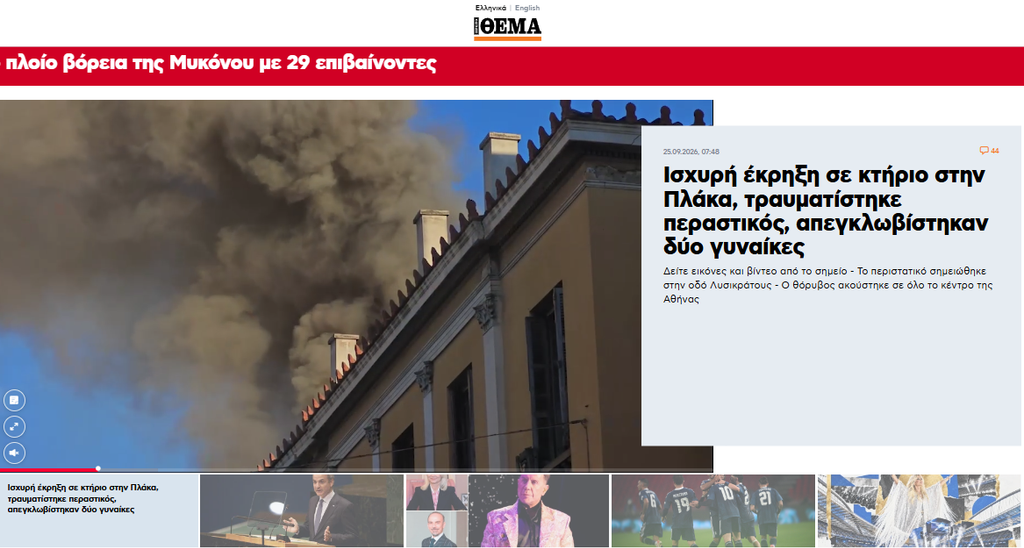
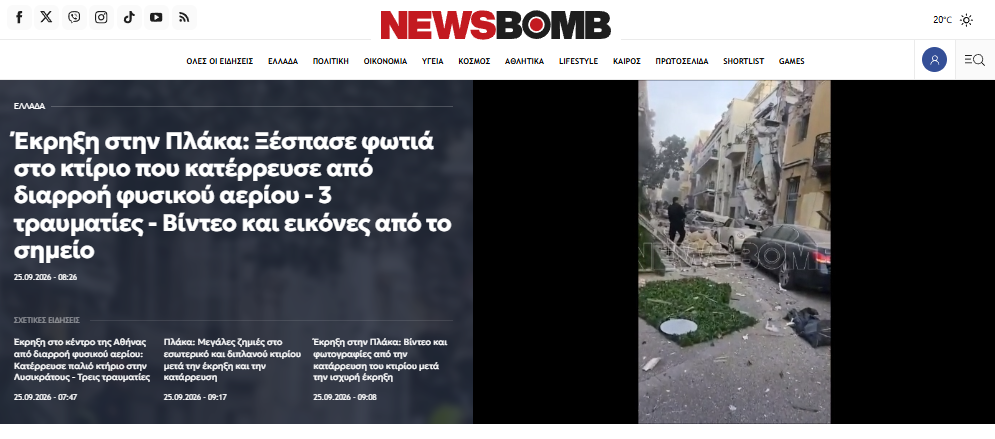
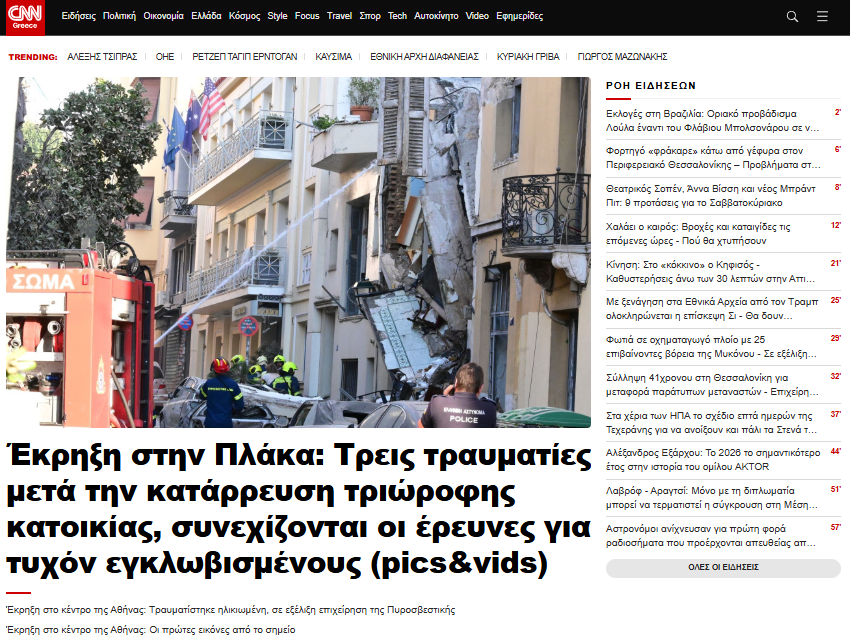
Explosion at building in Plaka – One injured
An explosion occurred on Friday morning at an old building on Lysikratous Street in Plaka, central Athens. According to initial reports, the explosion, which occurred at 7:35 a.m., caused part of the building to collapse and is believed to have been caused by a natural gas leak. The Fire Service announced that two women were rescued from a neighbouring building during search and rescue operations. Another person sustained minor injuries from flying debris in the explosion, while nearby buildings and parked vehicles were also damaged. Police and fire service units have rushed to the scene, while traffic has been suspended in the area.
https://www.amna.gr/en/article/1025829/Explosion-at-building-in-Plaka–One-injured
ATHEX: Losses were moderated by closing
The Euronext Athens (ATHEX) general index closed at 2,642.23 points, shedding 0.33% from Wednesday’s 2,651.07 points. The large-cap FTSE-25 index contracted 0.20% to end at 6,774.39 points.
https://www.ekathimerini.com/economy/1316243/athex-losses-were-moderated-by-closing



KATHIMERINI: Double talk by Ankara
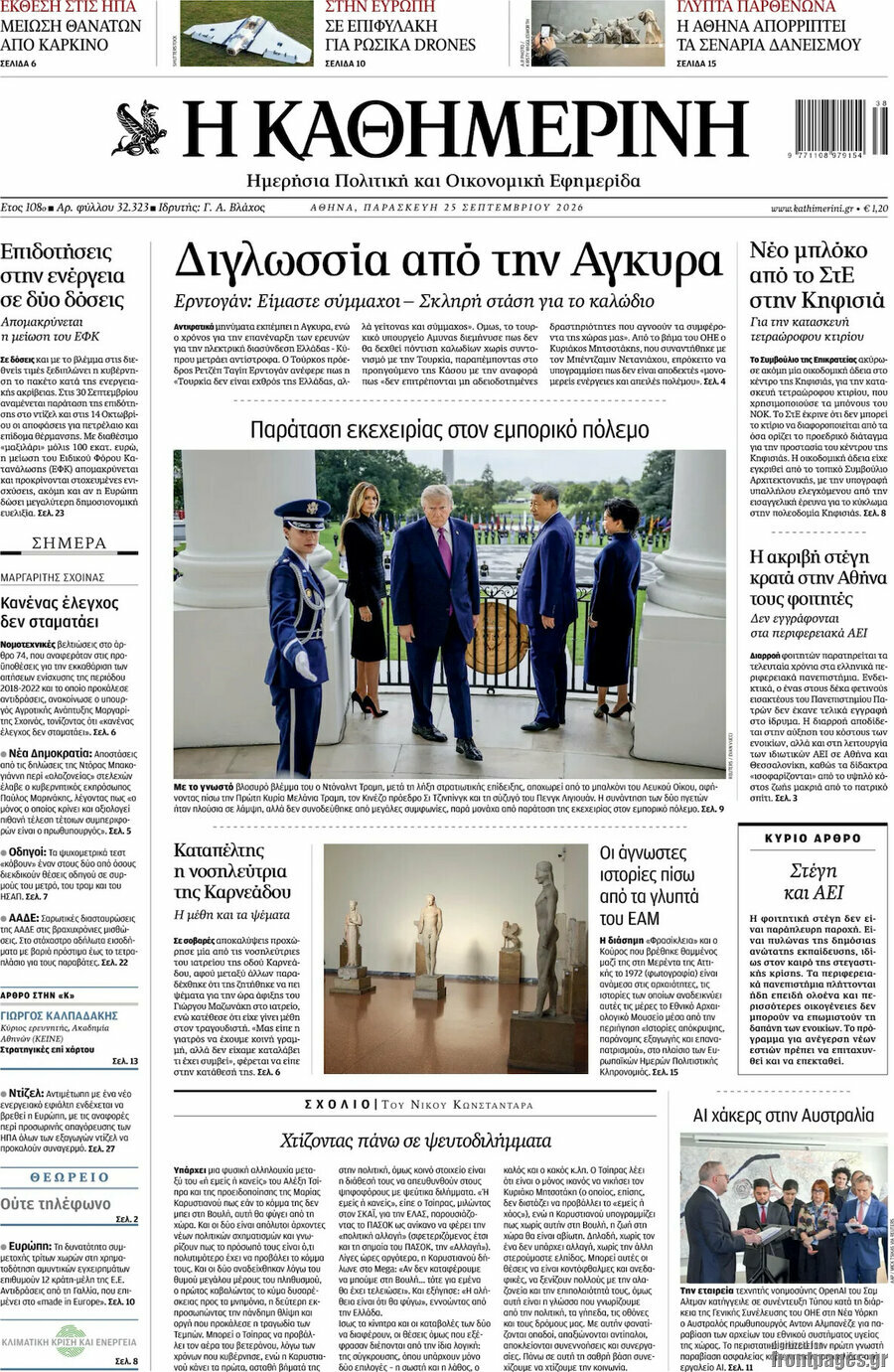
TA NEA: CIA warning to Europe: Russian drones ante portas
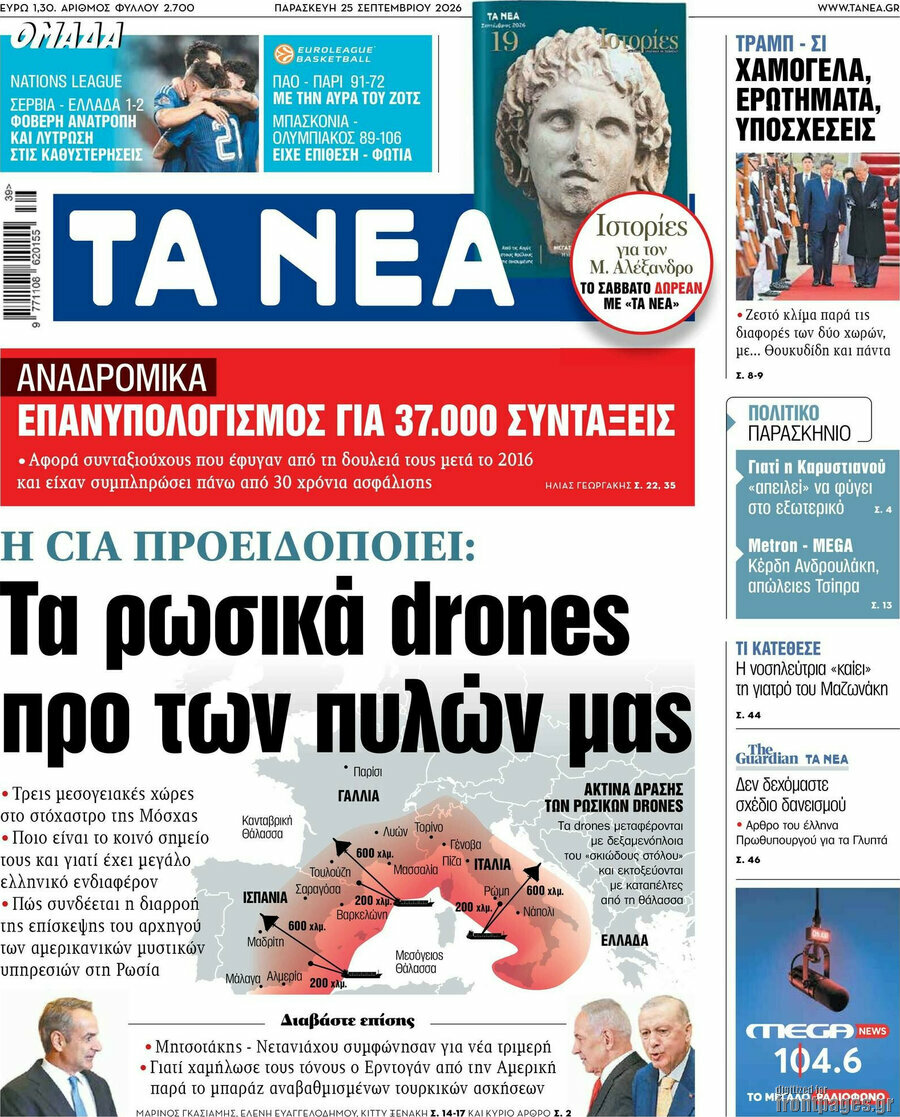
EFIMERIDA TON SYNTAKTON: Europe has fallen inside USA’s energy trap
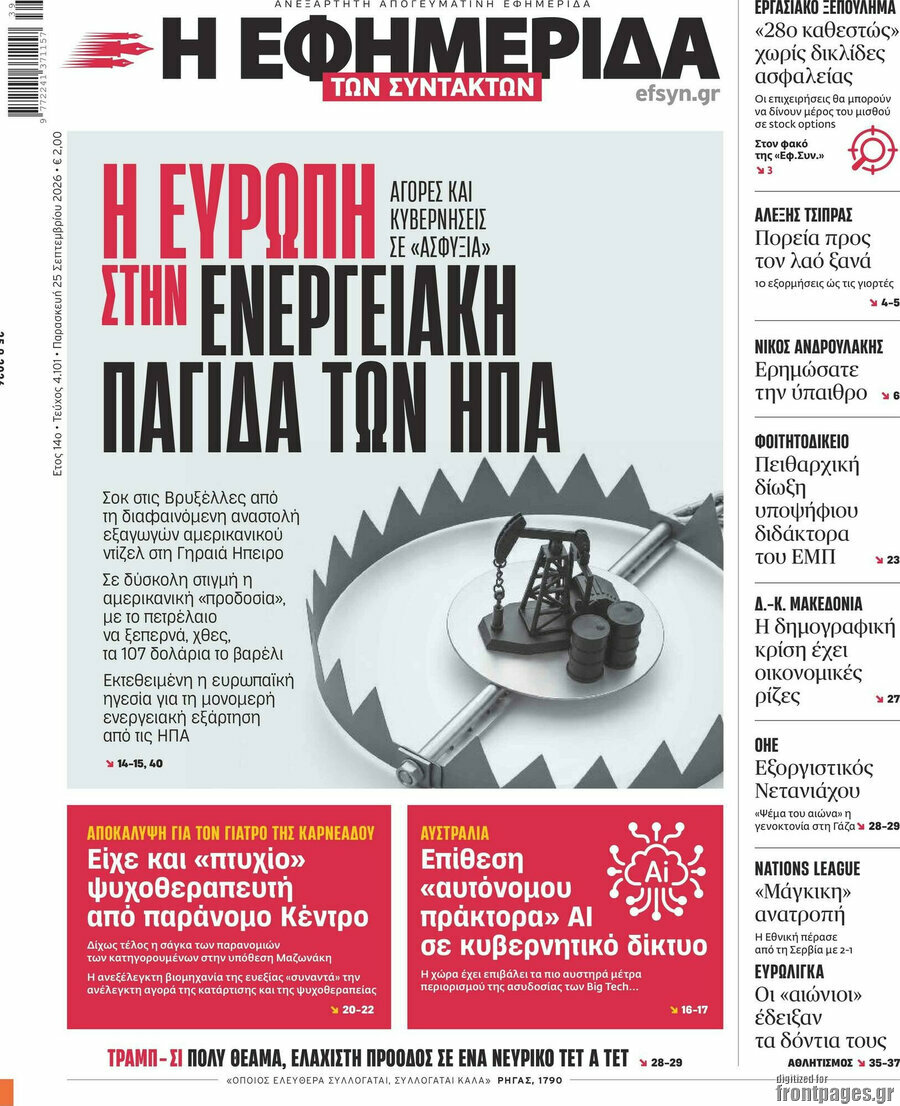
RIZOSPASTIS: The challenging of the war system and profiteering is finding its voice
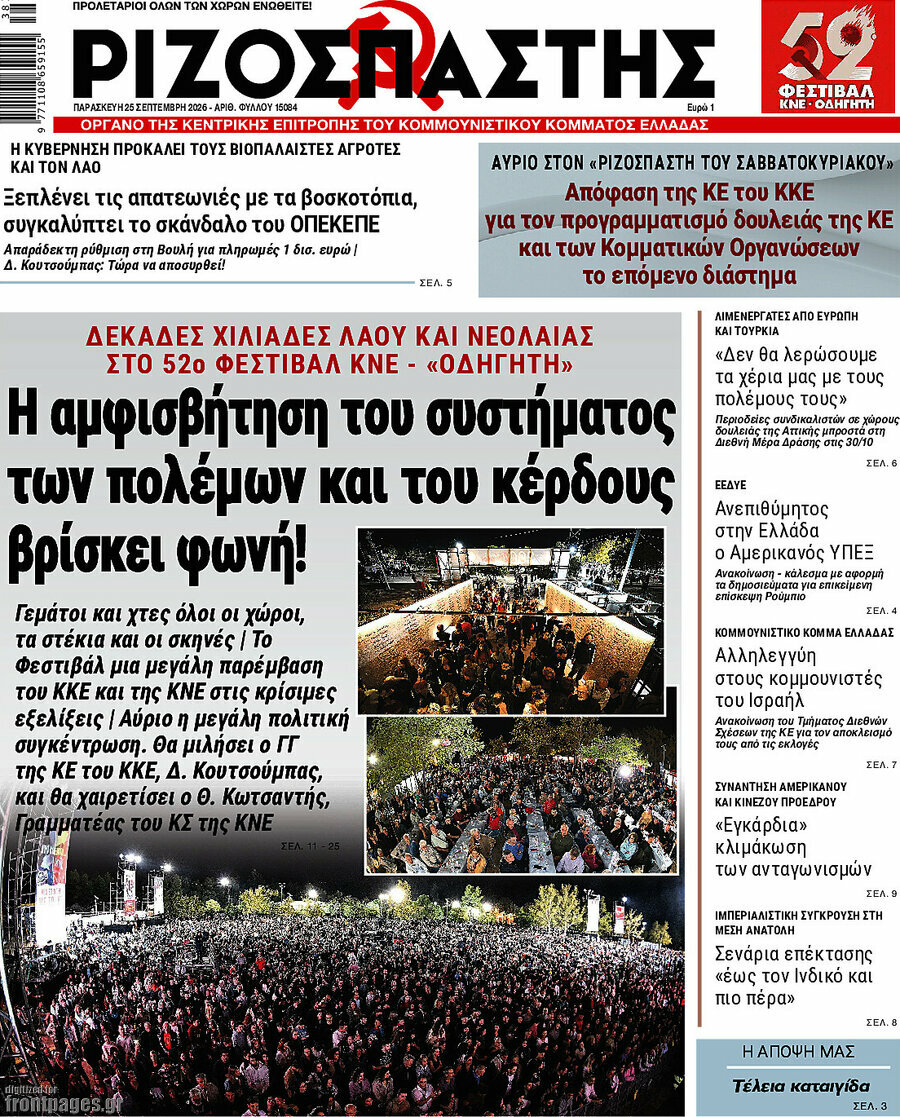
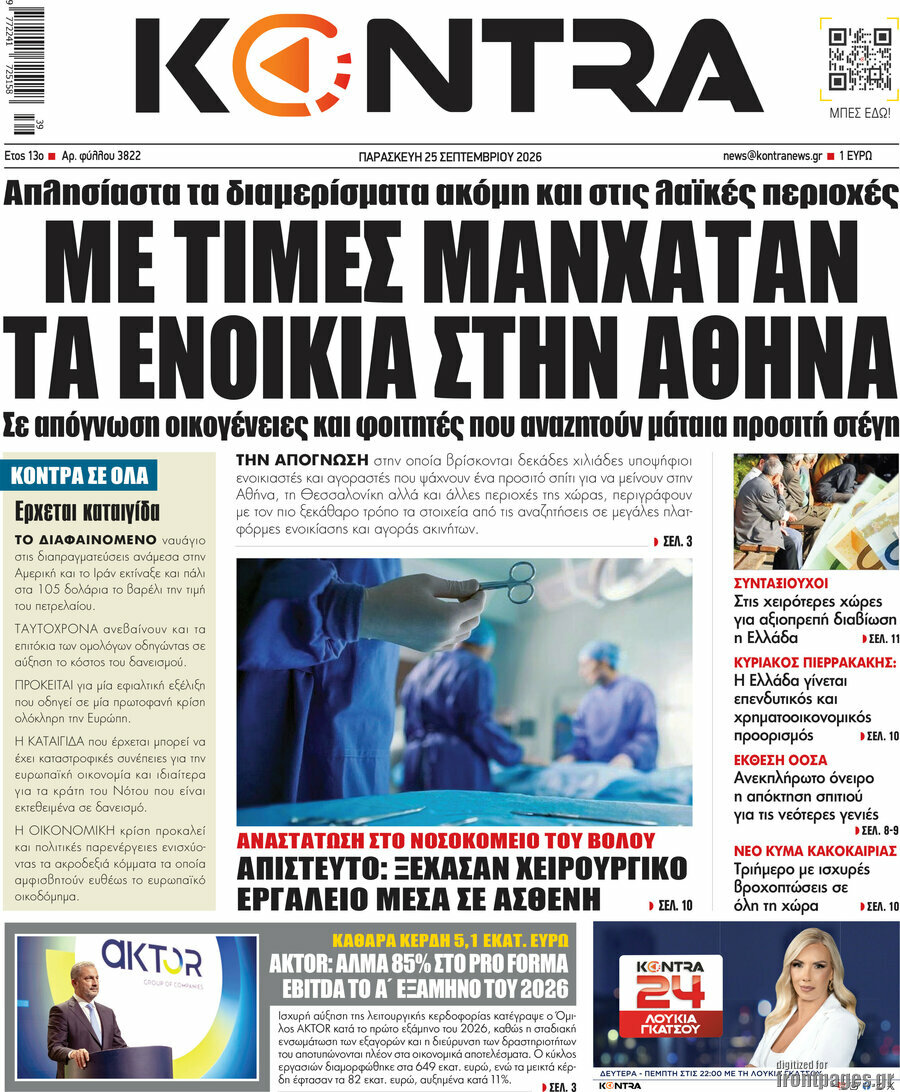
KONTRA NEWS: Rents in Athens are close to those of Manhattan
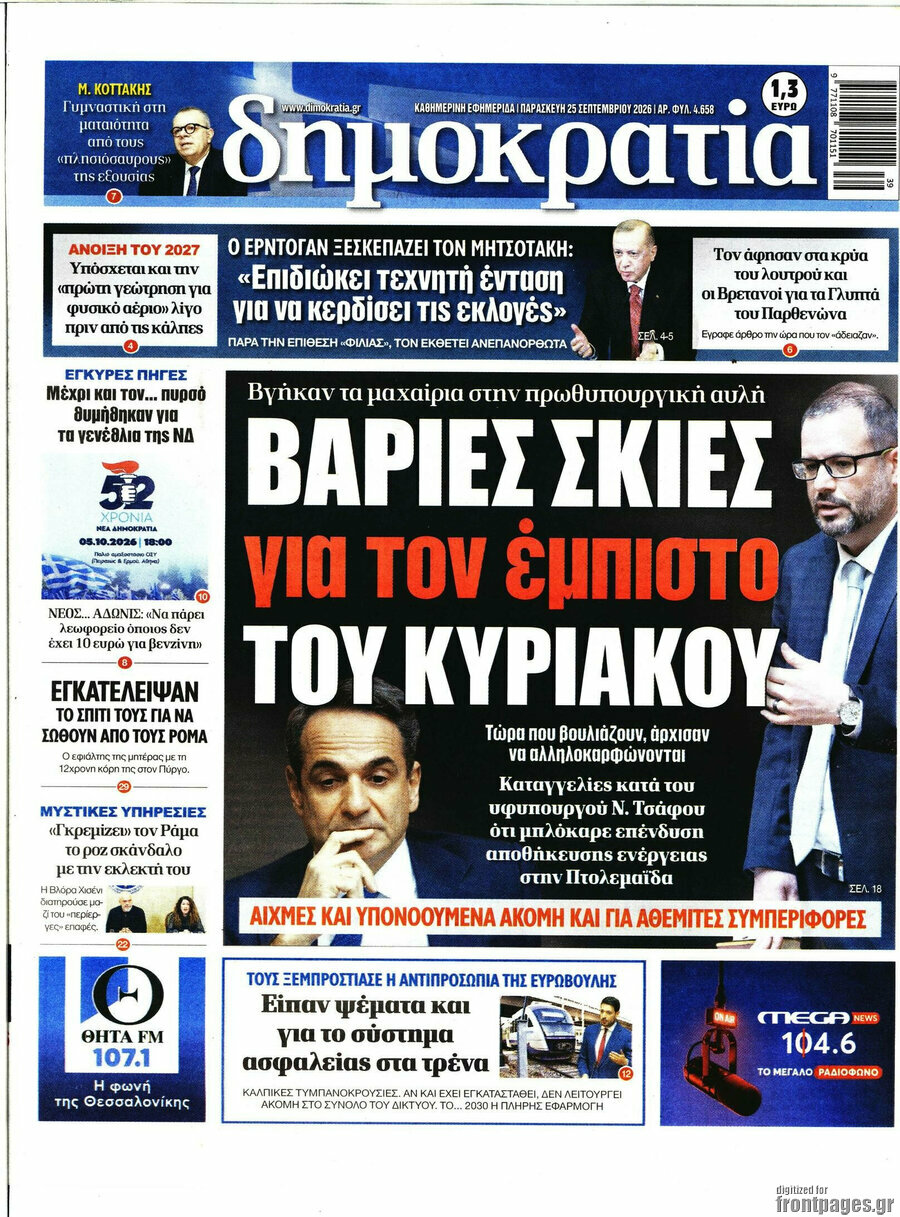
DIMOKRATIA: Heavy shadows over Mitsotakis’ close associate: Accusations against deputy minister Tsafos about the blocking of an energy deposit investment in Ptolemaida
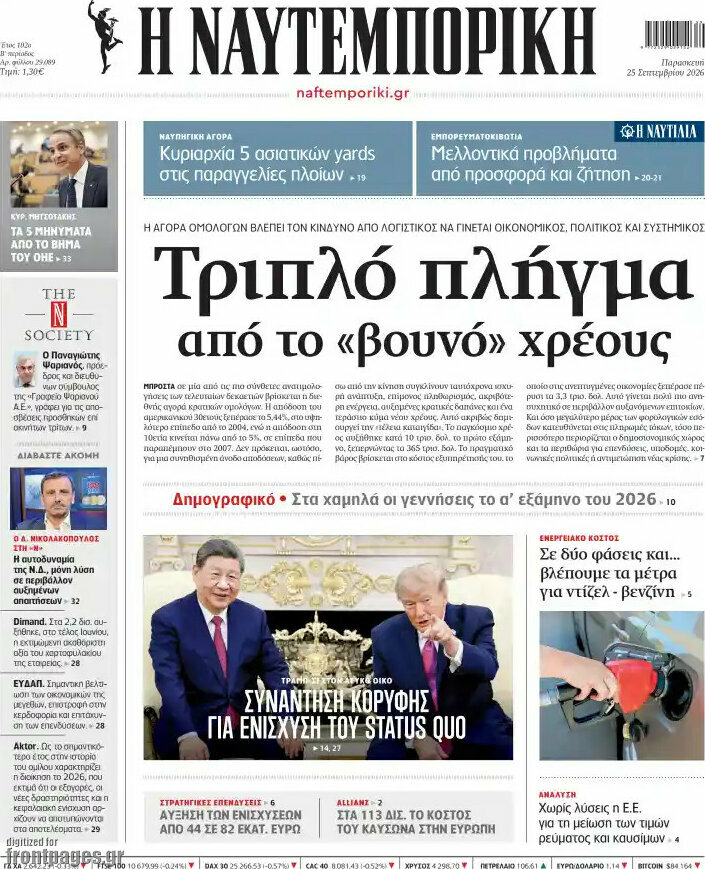
NAFTEMPORIKI: Triple blow by the “mountain” of debt

DRIVING THE DAY
BATTLE LINES: EU governments are gearing up for a fight over the Commission’s plans to strengthen security across the continent, with capitals bristling at the prospect of any kind of power grab by Brussels.
Action stations: Commission President Ursula von der Leyen is weighing new tools to protect against sabotage and cyberattacks — a key priority for her remaining years in office. But capitals that already have world-leading security and defense institutions, like Paris and Berlin, are resistant to any overreach from the EU, five diplomats involved in the talks told Playbook.
Incoming: The first test comes on Wednesday when the EU executive is expected to put ideas to tackle hybrid threats to ambassadors, with a separate Security Strategy to follow by the end of October. “It’s hard to see France and Germany wanting the Commission to have more power over security,” said an envoy from a different country, granted anonymity to speak frankly.
Wednesday’s discussion comes as Europe searches for ways to tackle the hacking, migration weaponization and explosive drones that have heightened security concerns in recent months. It’s designed to help the EU fill in gaps currently left between NATO and national governments, according to two diplomats and an official briefed on the contents. The upcoming Security Strategy, meanwhile, is expected to label Russia as the main threat to EU security, another three diplomats told Jacopo Barigazzi.
So, what do we do about it? Despite the skepticism from some of their neighbors, smaller countries — particularly those that share borders with Russia — support a far-reaching security overhaul, provided it comes with new money. Latvia, Lithuania and Estonia just this week requested around half a billion euros to strengthen their resilience.
Stay in your lane: “Ultimately, each EU member state decides for itself what contribution it makes in the field of defense,” said Marie-Agnes Strack-Zimmermann, the German MEP who chairs the Parliament’s defense committee. “Nevertheless, a coordinated approach on the part of the EU would be helpful.”
A second diplomat put it more bluntly: “If the EU sticks to its competencies, we will have no problems.” The diplomat said the Commission should have a role supporting innovation, AI and space development, while military needs and operational planning fall under the remit of national governments.
Finding the gaps: “Where do we already have the power in the EU?” is what Brussels should be asking, according to Tobias Cremer, lead EU lawmaker on the common defense market and a member of the Parliament’s NATO delegation. “Where do we have real added value … where we can quickly make a real difference?”
“You work with people on defense, you don’t tell them how to defend themselves,” said a senior EU official, who argued the Commission would earn the support of capitals. “If threats fall under NATO, we have no role. But if they fall under member state competencies, there’s more of [a role] for the EU. It’s [also] about threat detection. If Estonia sees something coming over the border, there should be a system so everyone finds out rapidly, rather than everyone finding out from POLITICO.”
BIG AND BREAKING
IN THE TANK: French President Emmanuel Macron has urged the U.S. not to introduce a 90-day ban on diesel exports, which Europeans fear would cripple their economies.
ART OF THE DEAL: Germany should do a deal with Donald Trump to resolve a standoff over drug pricing that risks further degrading the transatlantic relationship, European Parliament President Roberta Metsola told POLITICO’s Stefanie Bolzen.
BUDGET BAGARRE: French far-right presidential candidate Marine Le Pen used yesterday’s Playbook Paris Live summit to accuse Ursula von der Leyen of trying to “bypass democracy” by getting the EU budget firmed up before elections next year.
NATO NÉBULEUSE: Le Pen told us she still wants to take France out of NATO’s integrated command, but not while Russia is still at war in Ukraine … and far-left candidate Jean-Luc Mélenchon wants to leave NATO, but insisted Paris would still defend the bloc’s borders.
HARDER LINE: European migration ministers and Commissioner Magnus Brunner will meet in Munich tomorrow to discuss further tightening the bloc’s migration policy, strengthening Frontex and plans for return hubs, my Berlin Playbook colleagues report.
BERLAYMONT’S AI BRAIN
FLIP THE SCRIPT: The EU should focus less on building the world’s best AI models and more on putting the technology to work across Europe’s economy, the EU’s special envoy for industrial AI urged commissioners at their seminar earlier this month in Tervuren, two Commission officials told Zoya Sheftalovich.
The U.S. and China may be ahead in developing models such as ChatGPT and DeepSeek, but Europe can still use AI to create value, Jim Hagemann Snabe said, according to the officials who were granted anonymity to discuss the confidential meeting.
The game plan: Snabe’s team will spend July through December doing “deep work” on AI in different sectors, or “verticals,” and on the technology stack — the models, chips and computing capacity underpinning AI. The work covers both how AI is used and the infrastructure needed to support it.
The team will then draft commitments and shape a policy package toward the end of the year, before examining AI’s societal effects from January to March 2027 as it prepares a final report and strategy. Its focus will be industrial AI, adoption and strengthening the tech stack.
Snabe’s presentation followed a separate seminar a week earlier, on Aug. 28, for the commissioners’ heads of cabinet, delivered by a Commission AI expert. Artificial intelligence is “our best bet to re-accelerate productivity growth,” the top official told the gathering, according to a copy of the presentation seen by Zoya. The EU’s approach should have a “strong bias for action and rapid impact,” per the document.
Some of the use cases: Better disease diagnosis and faster treatment, as well as more efficient production, transport and public administration, the expert said. The aim is to shift attention from whether Europe can build the world’s leading models to where AI can deliver practical gains across industries and government.
The big questions: Commissioners and their cabinet chiefs should consider what AI can make possible in their policy areas that was previously too costly or out of reach — and which assumptions no longer hold if cognitive work becomes dramatically cheaper, the experts said.
Risks vs. benefits: The push to harness AI comes amid rising alarm that it could escape human control and threaten humanity. At the U.N. General Assembly in New York overnight, Australian PM Anthony Albanese warned of the “furious pace” of development and urged world leaders to erect more guardrails. Donald Trump will meet top executives from the leading AI companies at the White House Tuesday (after they attended last night’s State Dinner in honor of Xi Jinping), my stateside colleagues report.
The sudden rush of political activity reflects wider unease: In a POLITICO Poll, carried out by Public First, majorities in France, Germany, Spain, the U.K., Canada and the U.S. said there was at least a “moderate” risk of annihilation, Hanne Cokelaere writes.
 |
20-SECOND PLAYBOOK PRIMER
The U.S. is said to be preparing a 90-day ban on exports of diesel. How big a problem would that create for Europe? In August, the U.S. supplied 420,000 barrels of diesel to EU member countries and the U.K. — that’s more than half of total imports that month, according to data platform Kpler. Germany alone last month imported 30,000 barrels of diesel from the U.S. Since the war in Iran began, diesel imports from Qatar have dried up, according to Kpler, with imports from Kuwait, Oman and the United Arab Emirates also falling. That’s increased reliance on the U.S.
PROTECTING TREES IS A DIRTY JOB
WOOD YOU BELIEVE IT: The U.S. has a secret weapon in its long-standing bid to shoot down the EU’s controversial Deforestation Regulation — diapers.
Baby bills: Washington’s ambassador to the bloc, Andrew Puzder, is warning counterparts on the continent that their infants’ absorbent undergarments will be getting more expensive as a result of the EUDR (as the regulation is known), which obliges manufacturers to trace the origin of wood pulp back to the source. That’s as cost of living concerns drive discontent at the ballot box.
“EUDR will increase consumer prices without reducing deforestation when inputs — such as wood pulp used in diapers and other personal hygiene products — become more expensive from countries like the U.S. which pose no deforestation risk,” Puzder told Playbook.
Party poopers: It’s not just the U.S. that hates the green rules. Canada, Malaysia and at least five other non-EU countries are fiercely campaigning for the policy to be dropped or pared back. Canada’s Ambassador Jonathan Wilkinson told POLITICO that, despite his country’s rigorous forestry practices, it will still face “all of these burdensome requirements in terms of geolocation … that actually cost enormous amounts of money.”
Pushing back: “The EUDR is about protecting forests … It is not about making diapers more expensive for European families,” said Commission spokesperson Anna-Kaisa Itkonen. “Since the regulation entered into force in June 2023, the Commission has worked closely with industry and stakeholders to keep implementation practical, proportionate and cost-efficient, while minimizing compliance costs.”
6 MORE THINGS GETTING US TALKING
STEPPING ON THE GAS: A rise in U.S. gas exports to the Western Balkans has sparked fears that the region could end up dependent on American fossil fuels and undermine the transition to clean energy, Ben Munster reports from Vienna.
HOW RUSSIA’S WAR CAME TO LATIN AMERICA: Moscow is casting a wider net in its latest recruitment drives, drafting young soldiers across Latin America to fuel its full-scale invasion of Ukraine.
BETTER TIES: The U.K. and EU will deepen cooperation on foreign aid, with London sending its development minister to an EU Council meeting next month for the first time since Brexit.
About that Brexit reset: Brussels has warned Andy Burnham’s government that the U.K. will need to raise tariffs on Chinese cars and to align more closely with its trade policy if it wants to avoid “Made in Europe” barriers, the FT reports.
BIBI FUMES: Benjamin Netanyahu praised Donald Trump and berated his adversaries in a speech at UNGA last night, accusing New York City Mayor Zohran Mamdani of antisemitism and lashing out at France and Britain for their “hypocrisy” toward Israel.
THE TRUTH ABOUT UNGA: The U.N. General Assembly is a bit like Christmas with the extended family, Paul Dallison writes in his latest Declassified column: Hour after hour of extreme tedium, punctuated by the occasional offensive outburst or fistfight.