
Athens signals 12-mile option to Ankara
Athens has linked its response to Turkey’s declaration of unlawful marine parks with a reference to Greece’s right to extend its territorial waters to 12 nautical miles, a point included in a diplomatic demarche delivered to the Turkish Foreign Ministry. The note states “in a formal and explicit manner” that Greece’s right to extend the territorial sea of its islands to 12 nautical miles, as provided by the Law of the Sea, remains unaffected. Beyond sending a message to Ankara, Athens aims to place its arguments on record in case Greek-Turkish disputes are ever brought before the International Court of Justice. Greek officials are preparing for three potential flashpoints in coming weeks: the publication of presidential decrees implementing maritime spatial planning; a possible Turkish “Blue Homeland” bill that could seek restrictions on activities beyond Turkish territorial waters; and the restart of the Greece-Cyprus electricity interconnection project.
https://www.ekathimerini.com/politics/foreign-policy/1314438/athens-signals-12-mile-option-to-ankara
Officials detail economic measures announced by PM at TIF
Greece’s government on Monday detailed a broad package of tax cuts, wage increases and housing and investment measures announced by Prime Minister Kyriakos Mitsotakis over the weekend, saying the measures would boost household incomes while preserving fiscal stability.
Opposition parties slam Mitsotakis’ economic measures
Opposition parties have reacted to the economic measures announced by Prime Minister Kyriakos Mitsotakis at the Thessaloniki International Fair (TIF) over the weekend, accusing him of offering insufficient relief to households while failing to address high prices, taxation and market competition.
https://www.ekathimerini.com/politics/1314543/opposition-parties-slam-mitsotakis-economic-measures
Greece’s GDP up 1.9% in Q2, ELSTAT says
Greece’s GDP rose by 1.9% in the second quarter of this year compared with the corresponding quarter of 2025. According to quarterly national accounts data released by the Hellenic Statistical Authority (ELSTAT), GDP also increased by 0.3% compared with the first quarter of this year.
https://www.amna.gr/en/article/1020915/Greeces-GDP-up-19-in-Q2–ELSTAT-says
ATHEX: Marginal rise after session of optimism
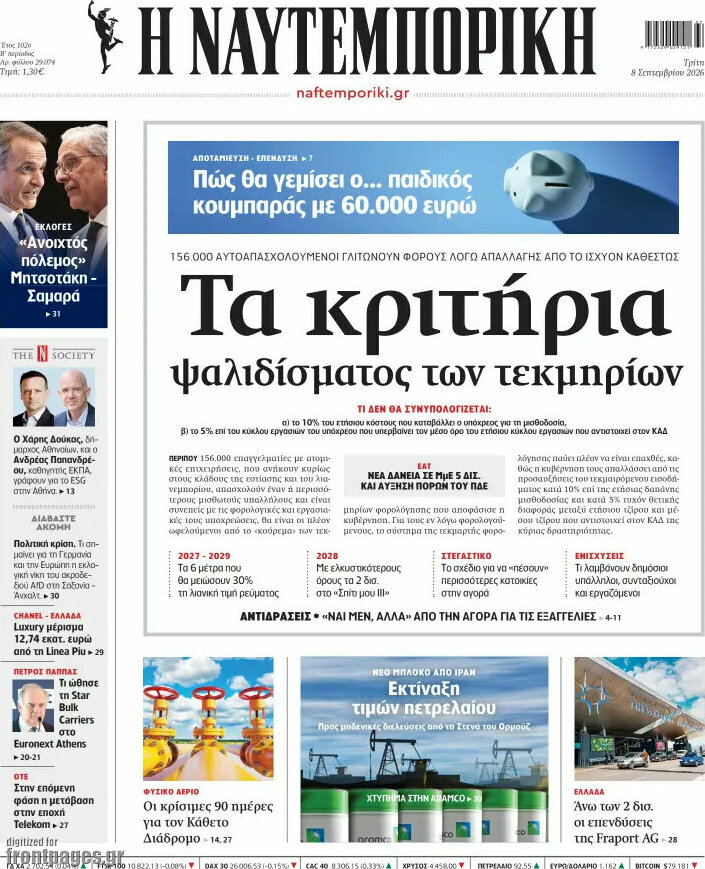
The Euronext Athens (ATHEX) general index closed at 2,702.54 points, adding 0.04% to Friday’s 2,701.38 points. The large-cap FTSE-25 index expanded 0.07%, ending at 6,919.41 points.

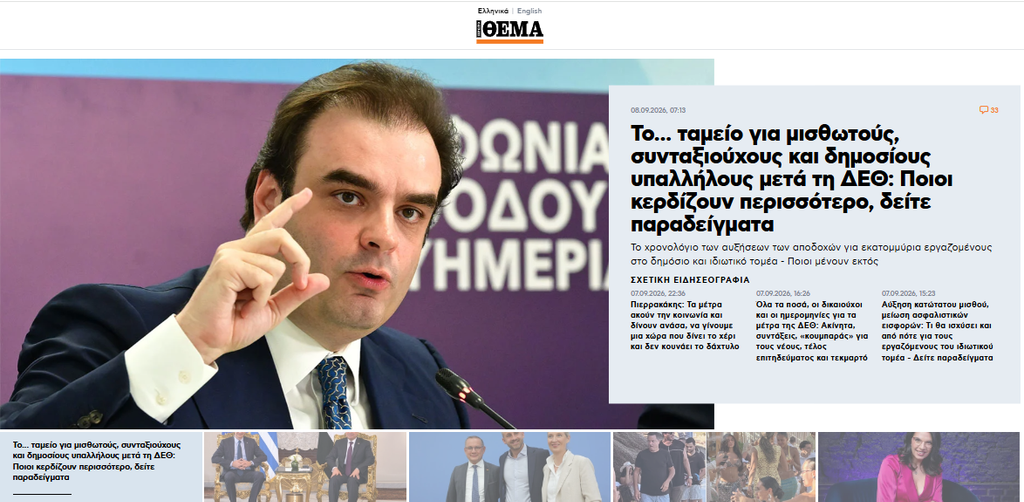
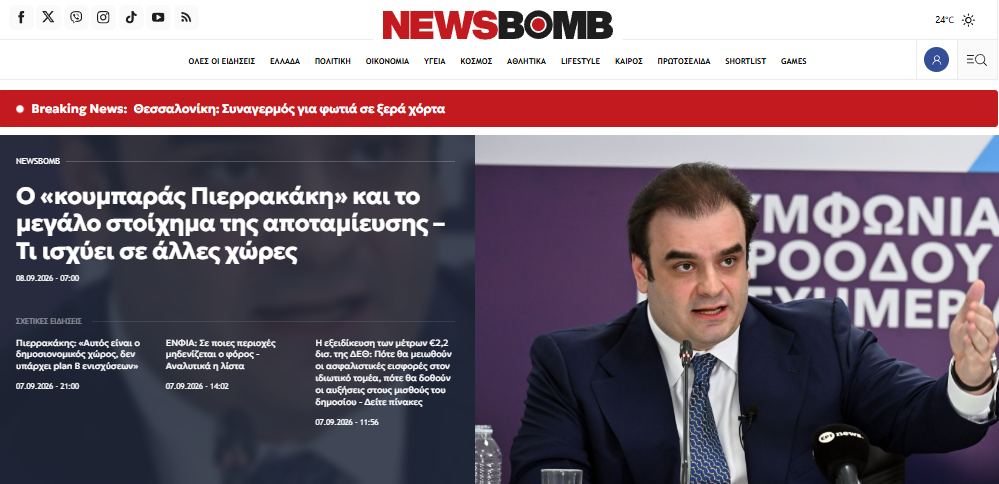
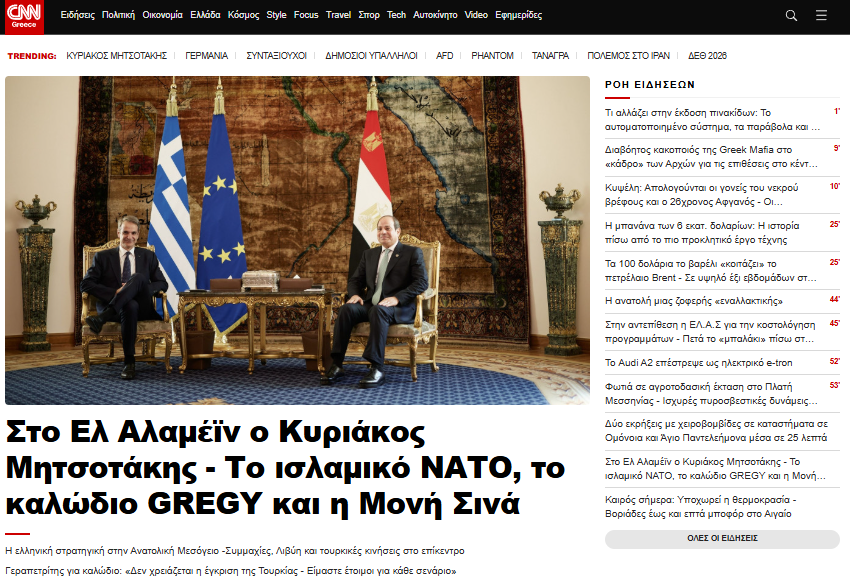
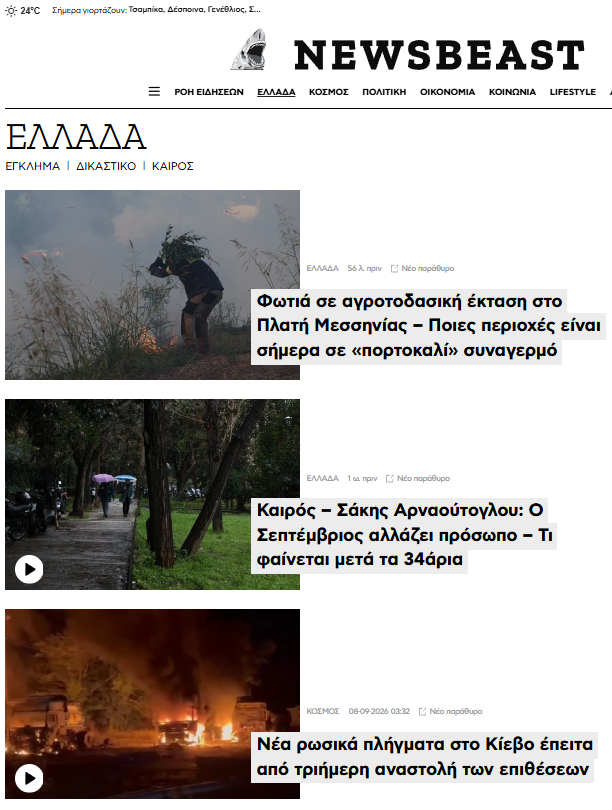

KATHIMERINI: Why Mitsotakis chooses to clash with former PMs Samaras and Tsipras
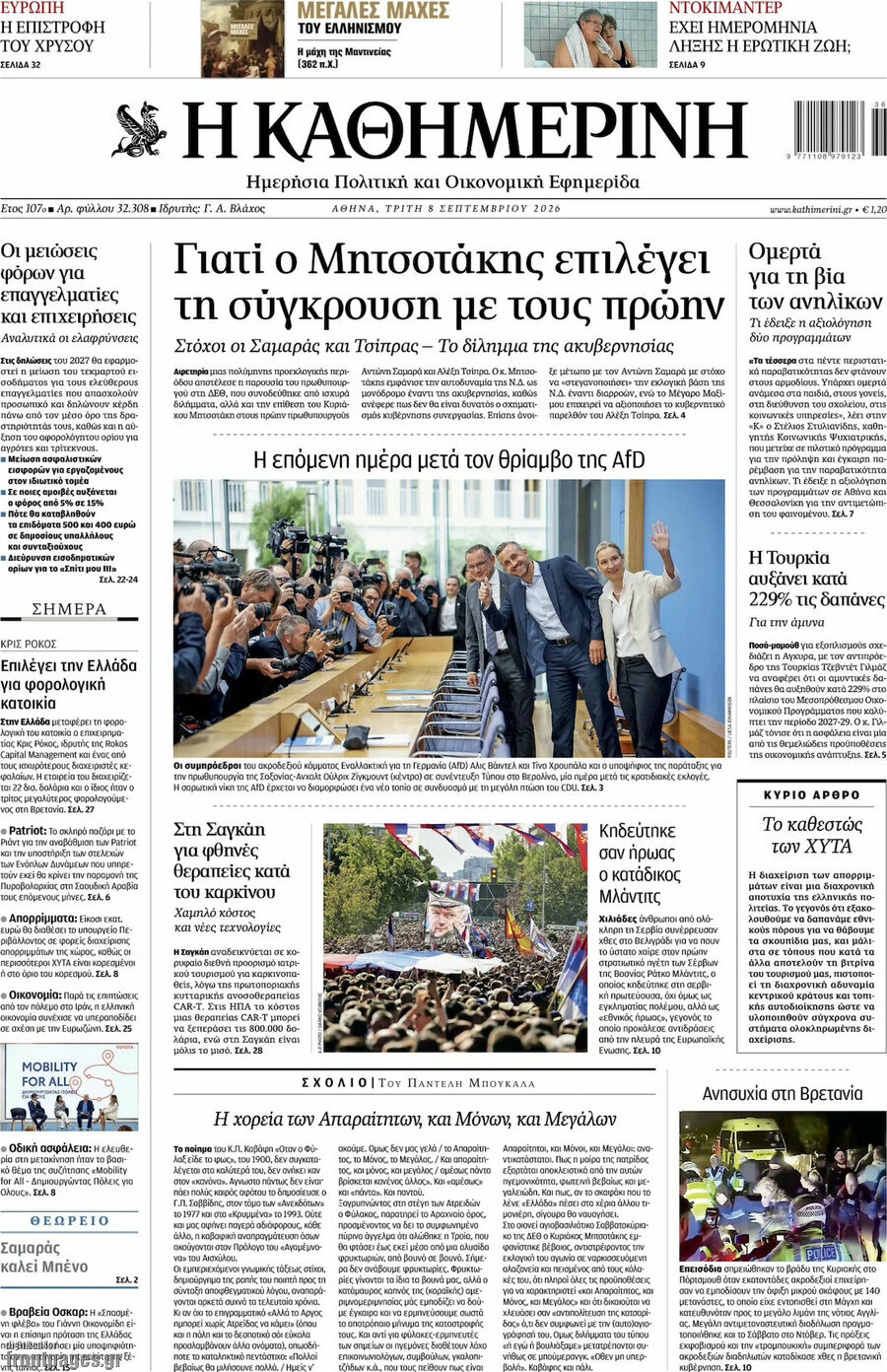
TA NEA: Alerts via sms for frauds
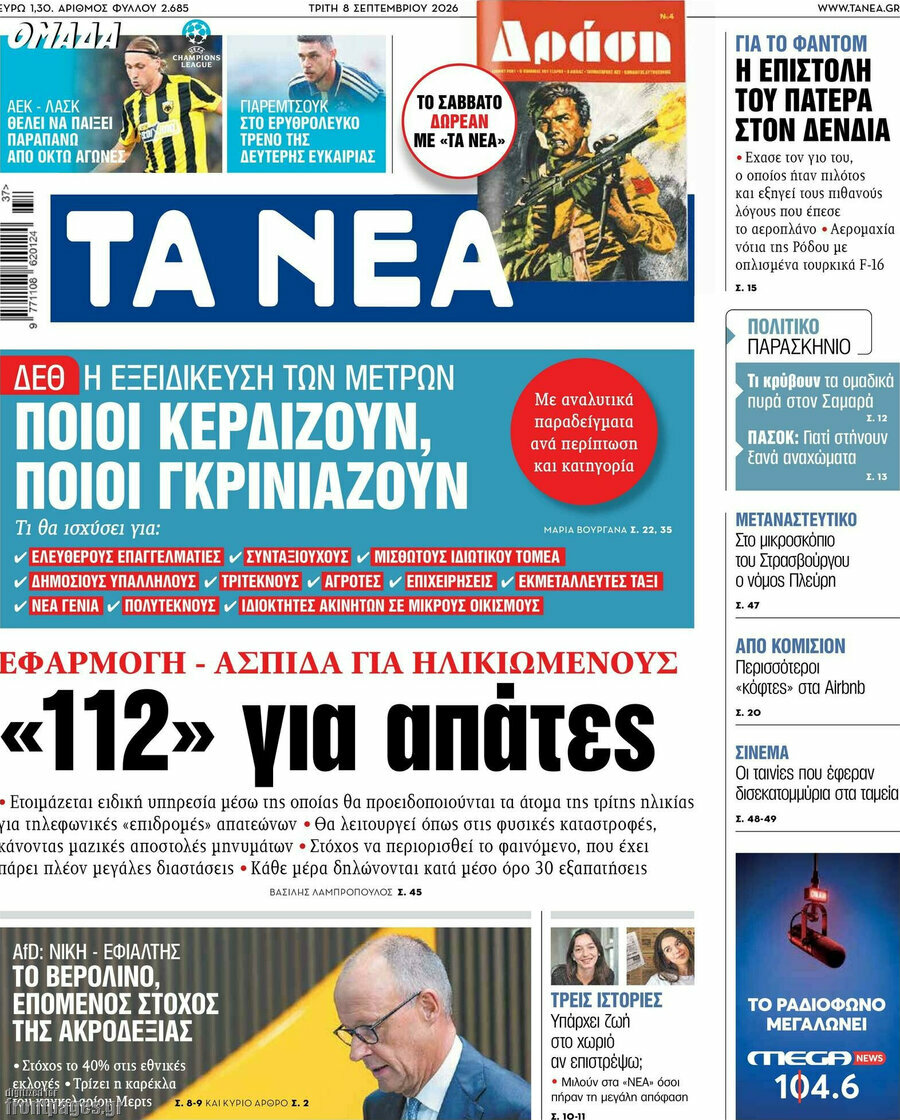
EFIMERIDA TON SYNTAKTON: Far right chills for Europe
RIZOSPASTIS: The massive rallies at TIF are only the beginning
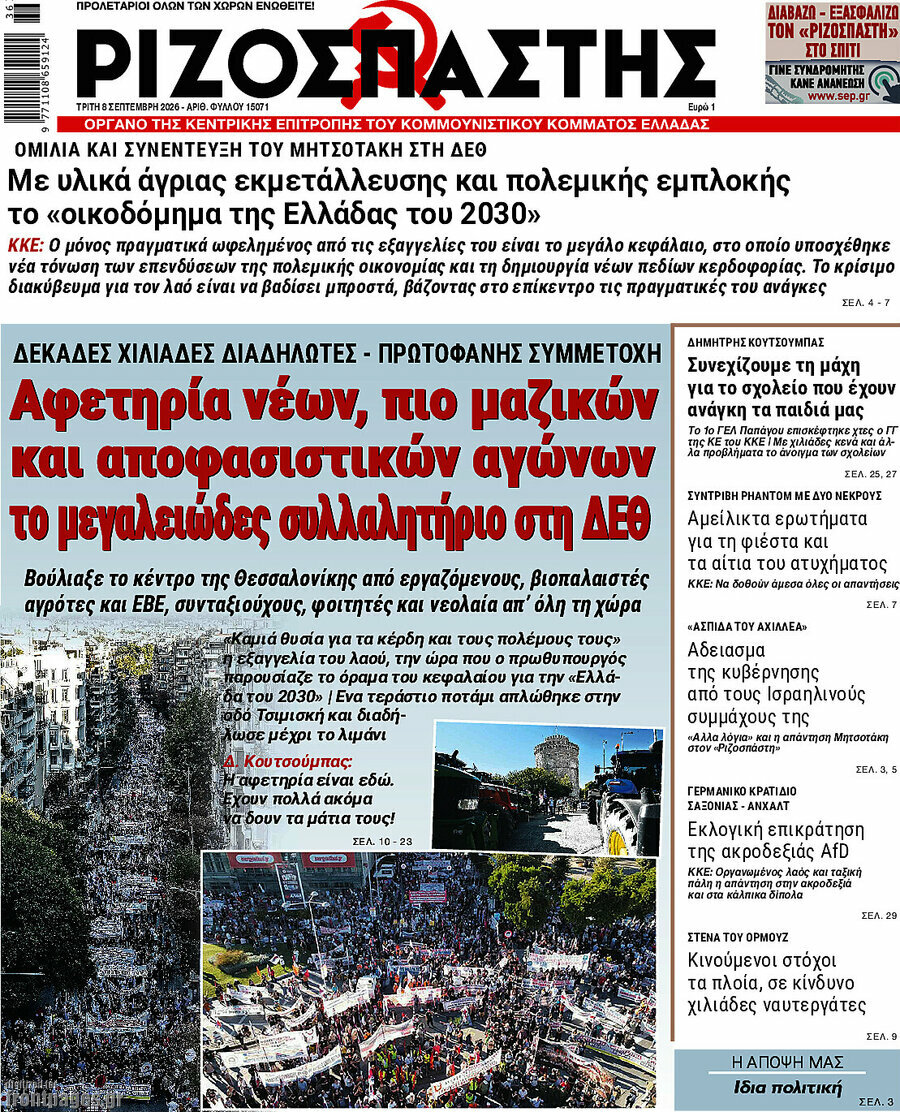
KONTRA NEWS: Specifications regarding objective tax criteria, taxation and benefits
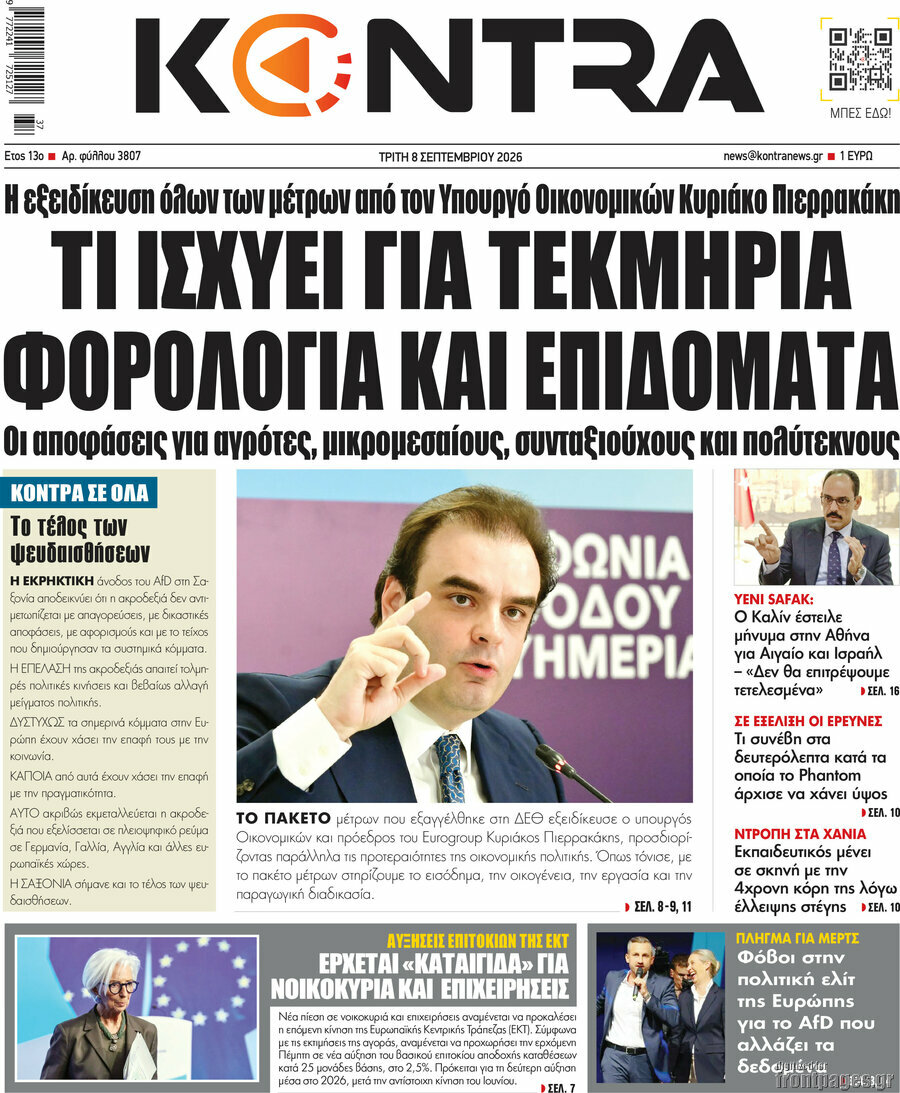
DIMOKRATIA: Kalin demanded from Mitsotakis to hand over Greece
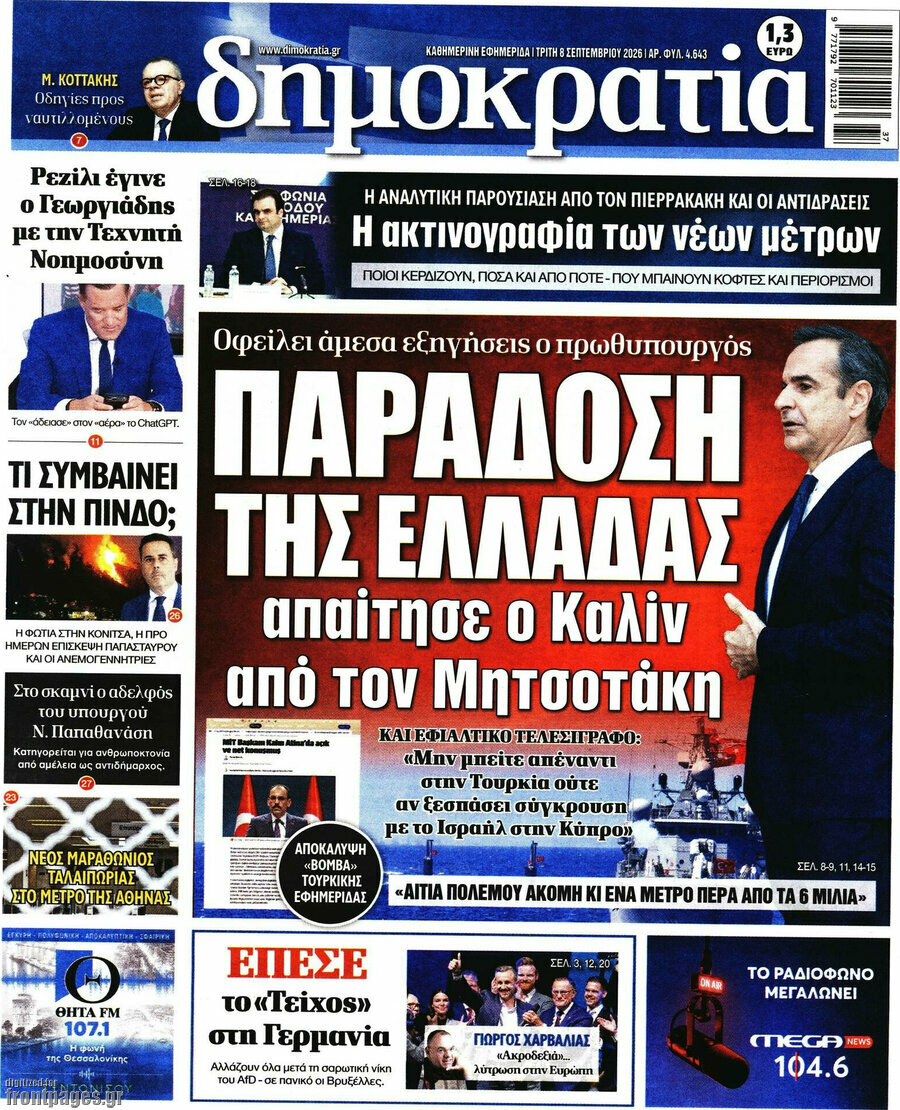
NAFTEMPORIKI: The criteria for the “trimming” of objective tax estimations

DRIVING THE DAY
WHY KALLAS’ DEFENSE GROUP FELL APART: Kaja Kallas’ plans to launch an expert EU defense group collapsed after Rome and other capitals accused her team of failing to consult governments and warned it risked clashing with NATO, according to four EU diplomats who spoke to Playbook and Jacopo Barigazzi.
The cancellation — announced less than 48 hours before the group’s planned launch — is a fresh setback for the bloc’s top diplomat, who is already locked in a turf war with Ursula von der Leyen’s European Commission over EU foreign policy as the bloc confronts a rising Russian threat and American pullback. It also puts Kallas at odds with the capitals that are supposed to be her main constituency.
Look closer: The launch had been billed as a high-profile event, with invites sent out weeks earlier. But several countries, particularly Italy, said they hadn’t been given enough information about the group or its mandate, the diplomats said. The diplomats were granted anonymity to discuss confidential talks.
Not enough: Kallas briefed EU defense ministers on the plan during opening remarks at a meeting in Ireland last week. But that wasn’t considered sufficient — partly because some countries had sent lower-ranking officials to the gathering. “There was no proper discussion of this” at either the defense or foreign affairs ministers’ meetings, said one diplomat. “Hence, surprise and a bit of annoyance.”
Furious: Italian Defense Minister Guido Crosetto “led the charge” against the initiative and was “really upset” that Roberta Pinotti, a former Italian defense minister, had been selected for the group without his knowledge, another diplomat said.
The objection: An Italian official said in a statement shared with Jacopo that several ministers raised “strong concerns” about the initiative directly with Kallas, on the grounds of “both method and substance.” Over the weekend, several countries prepared a letter urging the high representative to cancel the launch and submit it for consideration at an upcoming gathering, but the letter was dropped when the event was called off.
99 problems: Other issues with the group included the lack of representation for several countries as well as the Commission, according to the diplomats. Officials also said it risked overlapping with existing policy work, including that of NATO, and the EU security strategy being co-drafted by the Commission and Kallas’ European External Action Service.
No way out: A flurry of exchanges between national diplomats over the weekend led to the conclusion that there was “no soft landing zone” for the initiative, said another diplomat.
It’s over: The group won’t be resurrected, one senior EU official told Jacopo. A report on the future of EU defense policy by former NATO chief Anders Fogh Rasmussen, who was set to lead the group, has also been shelved.
Disappointed: “The Ukrainian government was celebrating the creation of this group,” a senior Ukrainian government official told POLITICO’s Veronika Melkozerova.
The bottom line: The episode lays bare the deepening splits around who gets to call the shots on the EU’s foreign policy — and marks a rough start for new EEAS Secretary-General Kajsa Ollongren, who began her role last week.
BIG AND BREAKING
MERZ ON THE ROPES: Germany’s far right is cranking up the pressure on Friedrich Merz after its breakthrough in Saxony-Anhalt — but the stunned chancellor doesn’t seem to have a clear plan to save himself or his government, my colleagues in Berlin report.
TRADE SCOOP: Trade Commissioner Maroš Šefčovič will meet European CEOs on Sept. 18 to discuss the EU executive’s push to diversify critical supply chains away from China.
CRACKDOWN ON SHORT-TERM RENTALS: Brussels is preparing to give cities and regions new powers to rein in short-term rentals as part of its upcoming Affordable Housing Act, due to be approved Wednesday, Aitor Hernández-Morales reports.
GROUP CHAIR ELECTIONS: The EPP, Socialists and Democrats and Renew are considering bringing forward their chair and vice chair elections to October to match the Greens and give them a stronger hand in January’s top jobs reshuffle, four officials told Max Griera.
MONEY, MONEY, MONEY
IRELAND’S TAX QUESTIONNAIRE: The Irish Council presidency asked the 27 EU ambassadors to make clear how much money they want to generate for the seven-year budget through EU-wide taxes. “What is a realistic acceptable volume for the Own Resources package to generate?” it asked in the note, seen by Playbook.
France vs. the rest: Ireland wants to achieve progress on the issue during a meeting of EU ambassadors today. France insists that new levies are key to generating more revenue and reducing national contributions to Brussels. But most governments have misgivings about the specific ideas on the table.
Pick your tax: Ireland also asked EU envoys to suggest changes to the Commission’s proposed new taxes. It welcomed “consensus” among governments to introduce new levies on foreign polluters and electronic waste. They could generate €1.64 billion and €17.9 billion per year on average from 2028-2034. But that’s unlikely to be enough for France.
COSTA’S TAX TOUR: EU taxes will be at the heart of discussions as European Council President António Costa’s “Tour des Capitales” takes him to Berlin, Warsaw and Madrid in the coming days, my colleagues Zoya Sheftalovich and Gregorio Sorgi write. The most politically fraught stop will be Berlin on Wednesday, where Friedrich Merz will be under pressure to take an even harder line on the bloc’s long-term budget after the AfD’s election victory on Sunday.
UKRAINE MONEY WORRIES: The EU doesn’t just have to worry about paying its own bills — it’s also got to think about Ukraine. Today, the IMF may provide some help.
Mind the gap: Kyiv recently put its defense-budget shortfall at $27 billion. But Brussels is working with Volodymyr Zelenskyy’s government on financing for 2026 and 2027, including access to a €90 billion EU loan.
First things first: “What you need to do first is to get a clear picture of what the budgetary or financial situation is,” Commission spokesperson Balázs Ujvári said. Only then can Brussels look at “ways of addressing it.”
Valdis on the case: Economy Commissioner Valdis Dombrovskis spoke Monday with Ukrainian Prime Minister Serhii Koretskyi about Kyiv’s financing needs. Dombrovskis will today meet IMF chief Kristalina Georgieva, with Ukraine on the agenda.
Why it matters: The IMF’s forecasts are crucial for Brussels’ calculations. But the IMF’s overview of Ukraine’s needs is based on the assumption that the war ends this year — a prospect few expect to materialize.
Enlargement pays: The IMF will also today unveil a report, seen by POLITICO, on the economic gains from enlargement for candidates and existing members, focusing on the Western Balkans and Moldova.
20-SECOND PLAYBOOK PRIMER
There are two meetings of thePolitical and Security Committee in Brussels this week (and most weeks) … but what does that committee do? Its job is to discuss how world events affect the EU’s Common Foreign and Security Policy and recommend strategies to the Council. The PSC’s members are ambassador-level officials, one from each member state, based in Brussels, and it is chaired by a representative of Kaja Kallas, the EU foreign policy chief.
EU’S PISA FAIL
BAD REPORT CARD: European countries generally scored poorly on the OECD’s PISA test, which is held every three years worldwide and judges 15-year-olds’ math, reading and science skills, a European official with knowledge of the results coming out today told Playbook.
Best and worst in class: Estonian and Irish pupils scored highly across all three categories in the last test in 2022, while those from Bulgaria, Romania, Cyprus and Greece fared the worst.
Good timing? European Commission Vice President Roxana Mînzatu will unveil the EU’s education package in November, in a bid to address declining performance levels in schools.
4 MORE THINGS GETTING US TALKING
MIGRATION RETHINK: Images of migrants flooding the beaches of Ceuta — and the ensuing political crisis — are forcing migration-rights organizations to reconsider how they make their cases.
THE CORN GAP: Europe is suddenly short of corn … Ukraine desperately wants to get its grain to market … but American farmers thousands of kilometers away may be best-placed to cash in, Bartosz Brzeziński reports.
RUNNING OUT OF TIME: The Commission plans to rework public procurement to favor clean-tech producers from the bloc, but solar bosses say they need help now — before more factories disappear.
THE LEAST FREE PLACE ON EARTH: Residents of Russia-occupied Ukraine have no political rights, freedom of expression or protection from secret detention, Lily Hyde writes.