
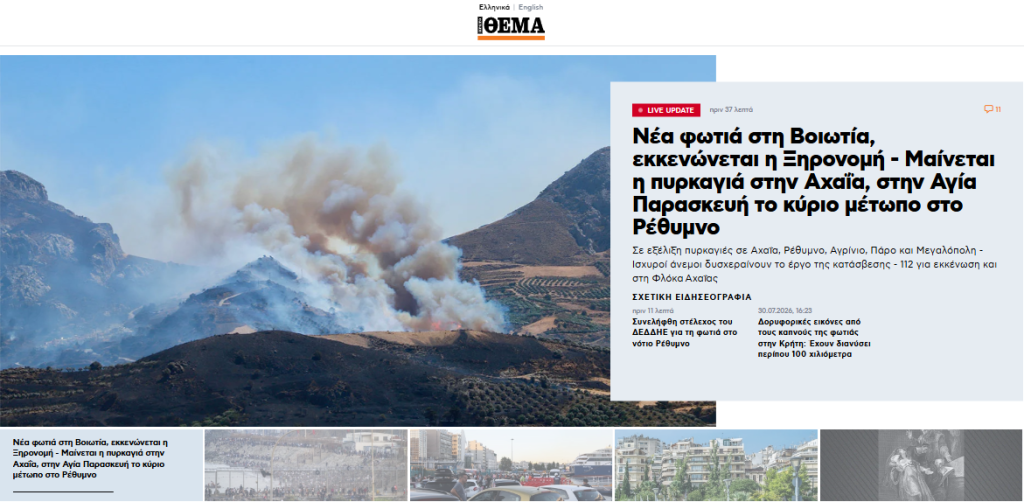
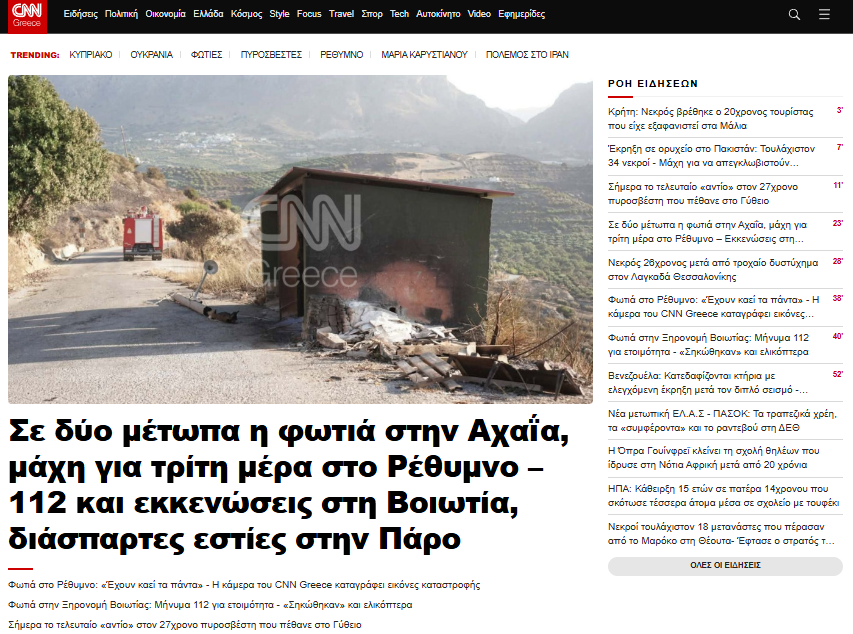
Major wildfire continues to rage in Rethymno; Sitia blazes ease
A major wildfire continued to burn in southern Rethymno on Friday, with more than 270 firefighters battling multiple fronts across Crete as strong winds hampered containment efforts. The largest operation remained focused on the municipality of Agios Vasileios in southern Rethymno, where firefighters were deployed around Krya Vrysi, Agia Paraskevi and the Preveli area. Reinforcements from across Crete and mainland Greece, including specialised forest firefighting units, joined the effort.
Minister defends comments on changing family structures after backlash
Family and Social Cohesion Minister Domna Michailidou on Thursday defended her remarks about the changing nature of the Greek family after facing criticism over comments that the traditional nuclear family model was no longer the norm. Speaking to state broadcaster ERT, Michailidou said she valued the principles of the nuclear family, which she said had played a significant role in Greece’s progress as a nation. However, she stressed that, as minister, she represented all families, regardless of their structure.
INSETE: Greek tourism records positive performance
Greek tourism recorded a positive performance, according to the statistical bulletin of the Institute of Greek Tourism Confederation (INSETE) Intelligence. During the January-June 2026 period, Greece recorded 10.7 million international air arrivals, an increase of 396,000 or 3.8% compared with the corresponding period in 2025. In June alone, international air arrivals reached 4.1 million, up by 80,000 or 2% compared with June 2025.
https://www.amna.gr/en/article/1012786/INSETE-Greek-tourism-records-positive-performance
Jobless rate dropped to 8% in June
The seasonally adjusted unemployment rate stood at 8% in June, according to data from the Hellenic Statistical Authority (ELSTAT), recording a significant improvement compared to June 2025, when unemployment stood at 9.2%. This is the lowest unemployment rate recorded for June since 2012, confirming the gradual de-escalation recorded by the Greek labor market in recent years. The improvement in the picture is reflected both in the reduction in the number of unemployed and in the continued increase in employment. The number of employed people in June stood at 4,389,230, an increase of 53,413 compared to the corresponding month of 2025, recording an annual increase of 1.2%.
https://www.ekathimerini.com/economy/1311002/jobless-rate-dropped-to-8-in-june
ATHEX: Historic high for bourse benchmark
The positive corporate results and the favorable rates decision by central banks gave the Greek stock market one more push on Thursday to take the benchmark to levels not seen since November 2009. This new 200-month record came after five consecutive sessions of growth for the main index as well as the banks index, with July set to offer considerable gains come the end of Friday’s session at Athinon Avenue, while trading volume persistently remains at springtime levels.
https://www.ekathimerini.com/economy/1311117/athex-historic-high-for-bourse-benchmark



KATHIMERINI: The landfill of Paros is a “time bomb”
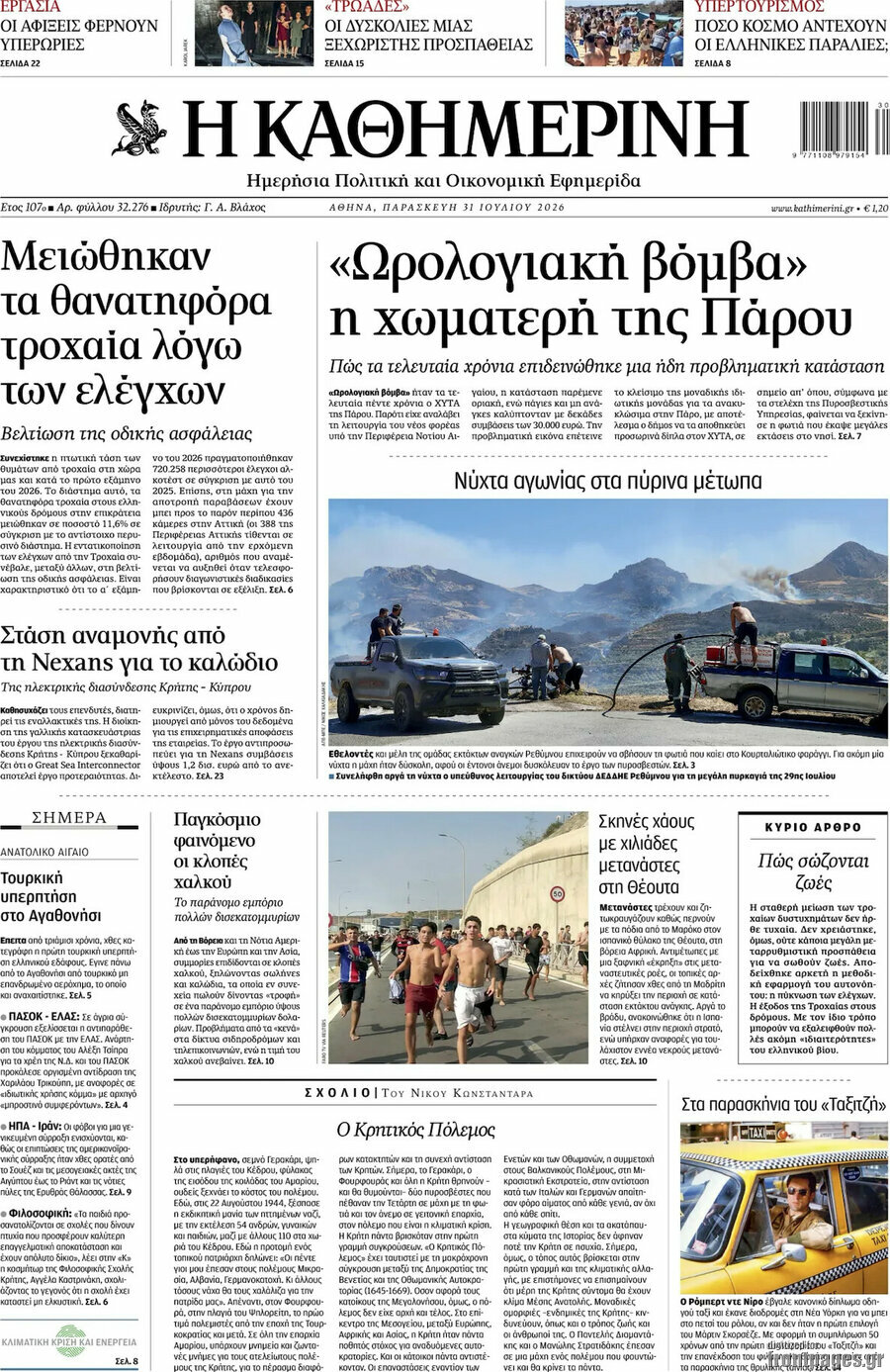
TA NEA: Electricity bills : The punctual are burdened with the unpaid bills
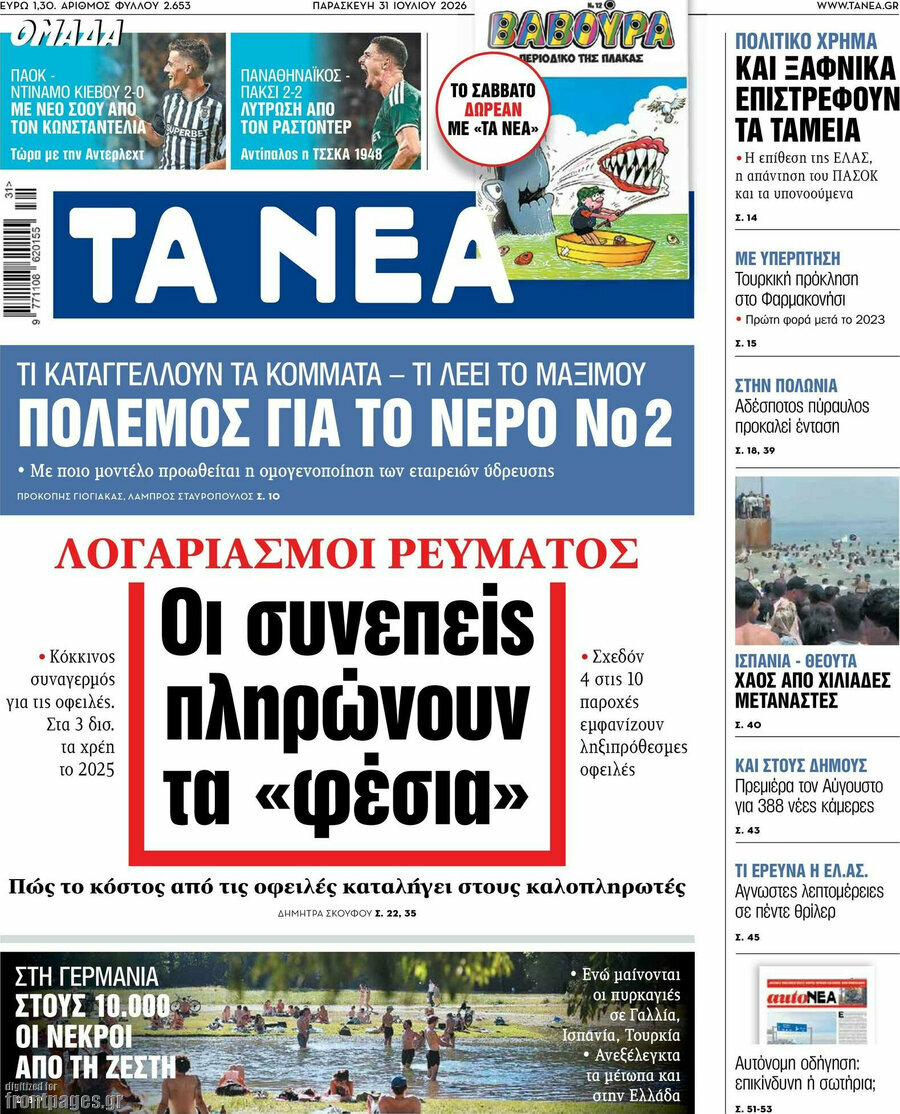
EFIMERIDA TON SYNTAKTON: Grief, rage, catastrophe
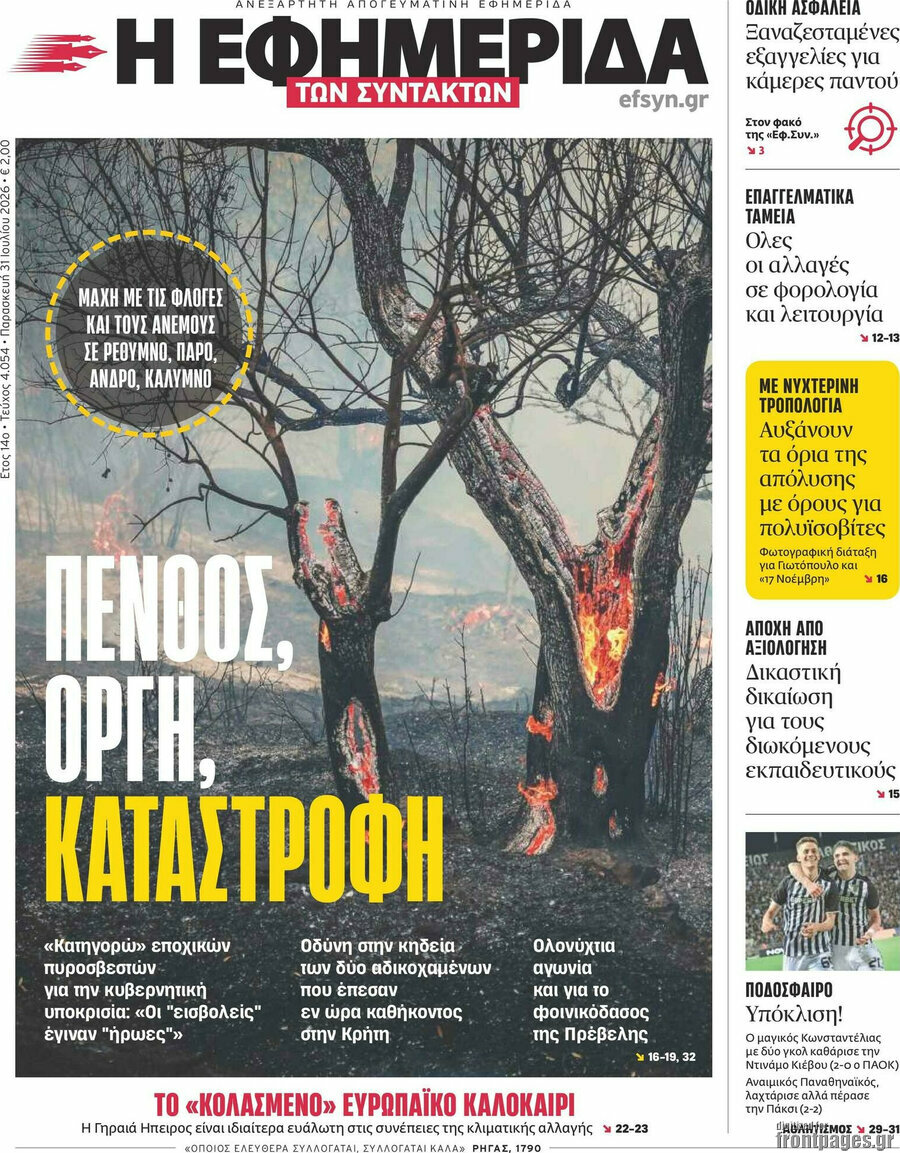
RIZOSPASTIS: Privatization of water is a source of profits for business groups while simple folks pay the bill
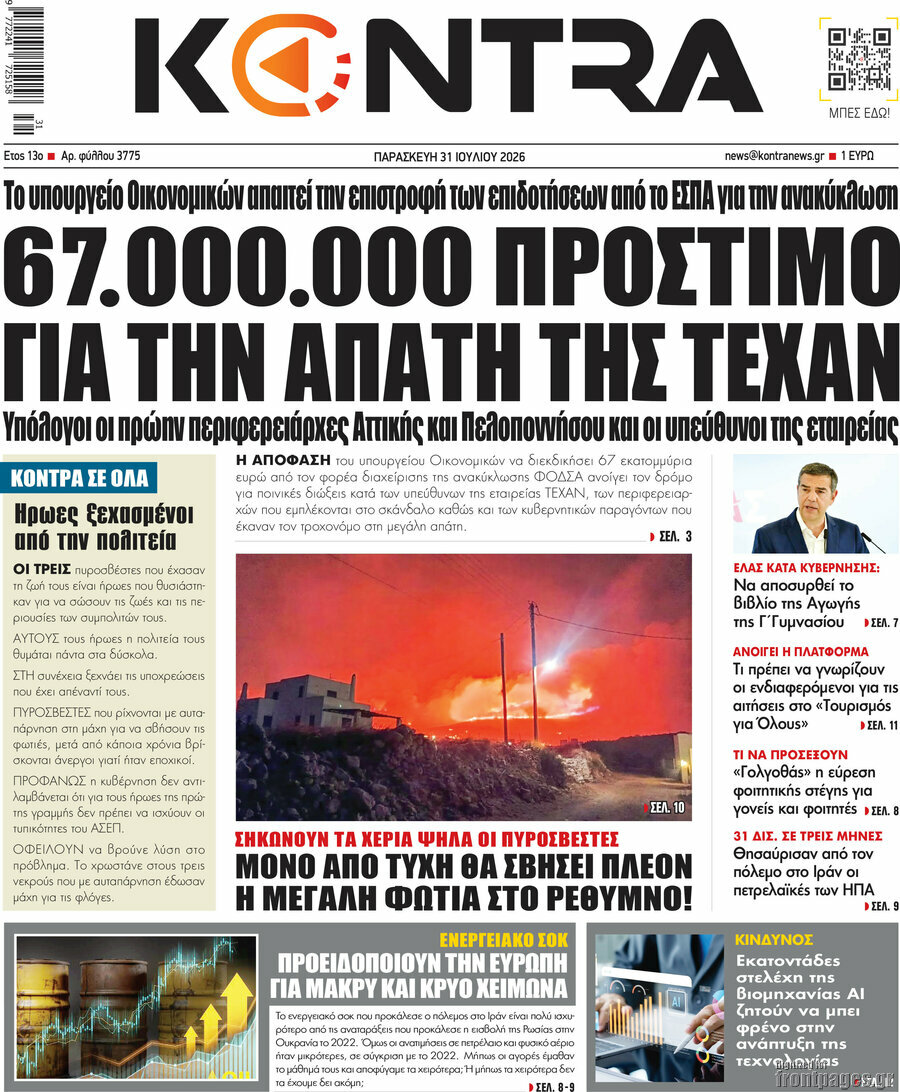
KONTRA NEWS: 67 million euro fine for the TEXAN fraud
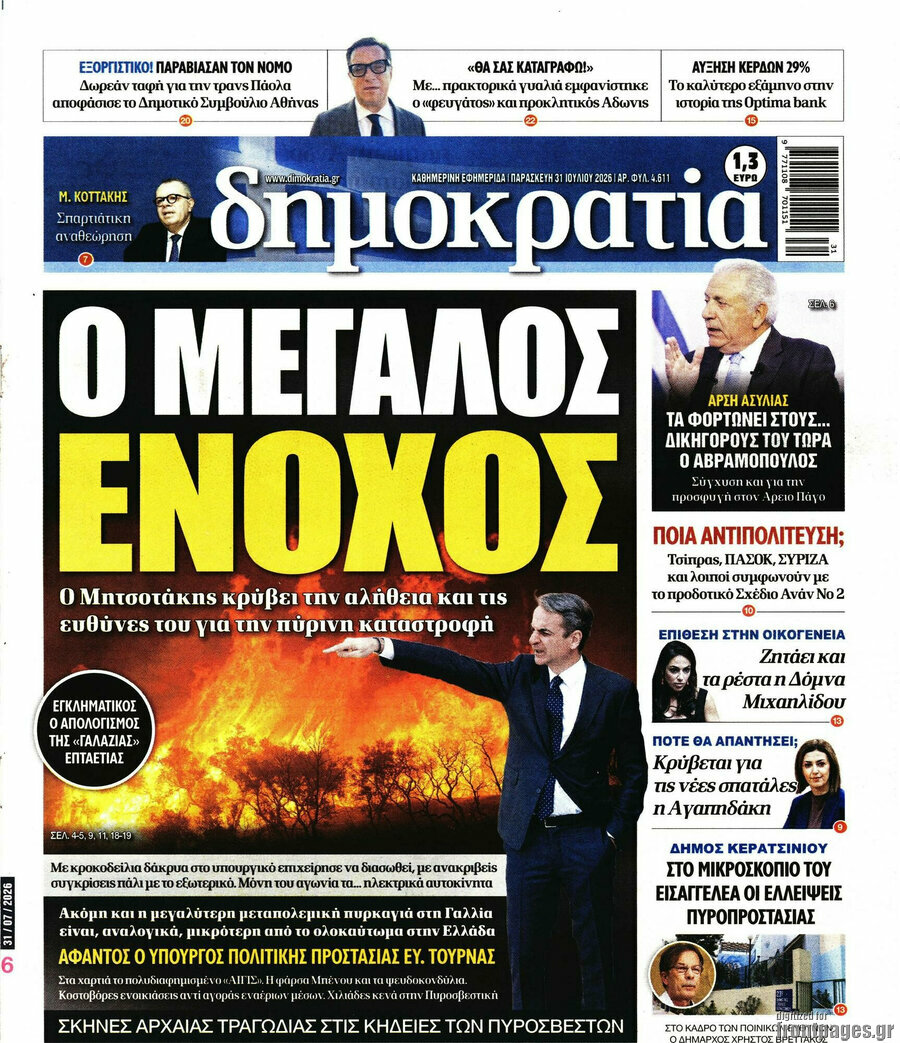
DIMOKRATIA: Mitsotakis is the biggest culprit for the wildfire catastrophes
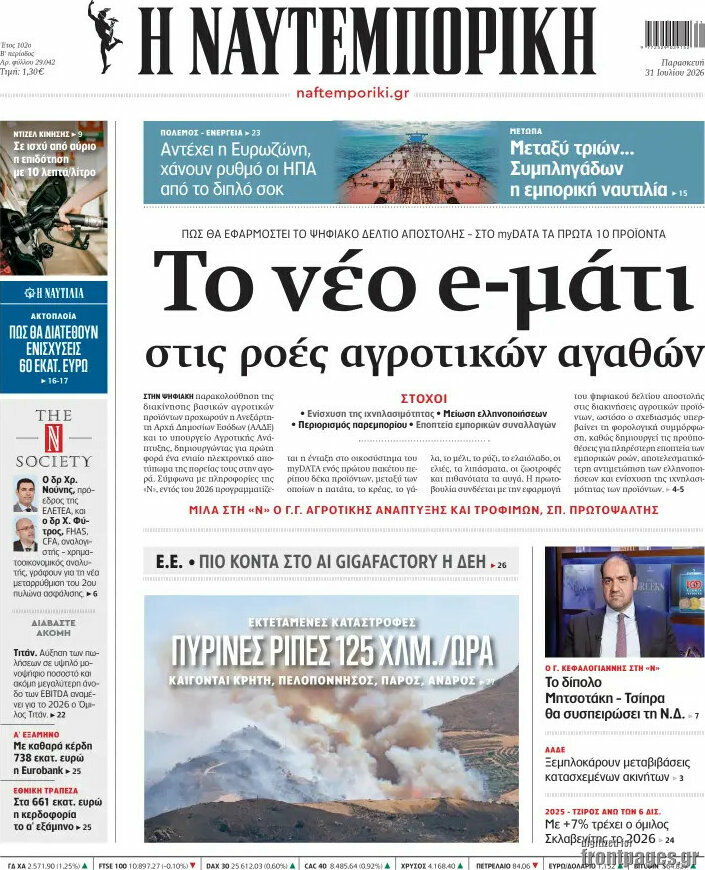
NAFTEMPORIKI: The new electronic “eye” for the flow of agricultural products

DRIVING THE DAY
WELCOME TO THE BUNKER: As wildfires tear across southern Europe, officials in a control room filled with screens and computers are matching requests for planes, crews and equipment with whatever help is available. The system runs on speed, coordination and a fair bit of improvisation — but can it keep pace as crisis becomes the norm?
The Commission’s Emergency Response Coordination Center, hidden a few minutes’ walk from POLITICO HQ, looks the part: walls of screens, rows of desks, ringing phones and duty officers watching disasters unfold in real time. When Playbook visited, one official was flicking between X, Greek news sites and fire maps as the latest blazes spread.
What it actually does: The center is not an EU fire brigade and does not replace national emergency services. Countries remain in command on their own territory. When one is overwhelmed, it can ask Brussels for help; the center then circulates the request, matches it with offers from other governments, coordinates transport and deployments, and can draw on the EU-funded rescEU reserve of planes and equipment.
The promise: “No request goes unanswered,” deputy head of unit Borja Miguelez told Playbook. But that doesn’t always mean the requested item is sitting ready in a Brussels warehouse — often, the job is finding another way.
Casting the net wider: Ukraine’s civil protection authority recently asked for protective netting to shield firefighting vehicles from drone attacks. DG ECHO — the Commission department responsible for civil protection, which houses the crisis unit — had none. The Commission’s fisheries department, however, had illegal fishing nets confiscated from France and Italy. They were sent to Ukraine instead.
Running lean: The center relies on 24 duty officers working 12-hour rotations, with a minimum of three present during the day and two overnight, ensuring a “continuous presence,” unit head Maria Zuber said. During major emergencies, colleagues are pulled in from elsewhere in the roughly 60-person unit.
Brussels quietly beefed up: DG ECHO secured extra civil-protection posts in an internal Commission staffing reshuffle first revealed by Playbook earlier this year. But experience can’t be added overnight. “It takes about two years to really train someone so that, if there’s an earthquake in Turkey in the middle of the night, they know exactly what to do,” Zuber said.
Built for the new normal? The mechanism has handled more than 860 requests since its creation in 2001, expanding from earthquakes and storms to pandemics, war, evacuations and increasingly frequent wildfires. Its staff are skilled at stretching resources and improvising — but creativity can only go so far when a system built for occasional emergencies is operating in permanent crisis mode.
BIG AND BREAKING
WHILE YOU WERE SLEEPING: Donald Trump announced on Truth Social that his Board of Peace has struck a deal to disarm Hamas and other armed groups in Gaza, calling it a “monumental step toward lasting PEACE and SECURITY.” My U.S. colleagues have more details.
MEET BRUSSELS’ NEW AI WATCHDOGS: Beginning Sunday, a 37-person Commission team will get sweeping new powers to police the world’s biggest AI companies.
THE €30 BILLION AI BET: The EU has launched plans to build seven massive AI data centers, with backing from Germany, Italy, Spain, Portugal and Greece.
CLIMATE DEBATE HEATS UP: With flames raging across southern Europe, Britain, France and Spain are using the moment to make the case for stronger climate action, per POLITICO’s Zia Weise. Zia also reports that researchers estimate that climate change made the extreme weather behind Spain’s devastating wildfires around 20 times more likely.
THE CHINA DILEMMA: Three years on, the EU’s Foreign Subsidies Regulation is changing how Chinese companies do business in Europe — but whether Europe is better off is another question.
FIFA’S EUROPE PROBLEM
EUROPE TAKES ON FIFA: European football authorities’ decision to boycott the World Cup if FIFA pushes ahead with its plan to sell a stake in its commercial operations to investors “is not a football story,” Council of Europe Secretary-General Alain Berset told Playbook. “It is a story about rules. Who writes them. Whether they are applied. And who may change them.”
Breaking ranks: The Council of Europe has historically worked closely with world football’s governing body, even signing a cooperation agreement in 2018. Berset insists the institution remains committed to the partnership, but says the 2026 tournament exposed governance problems that can’t be ignored, from Folarin Balogun’s overturned suspension to racist abuse of players.
“Football does not need a shareholder. It needs rules,” Berset said. Europe has repeatedly responded to sporting scandals by writing new rules — from the Heysel stadium disaster, which led to a Council of Europe convention on spectator safety, to anti-doping rules that now bind more than 50 countries — and he argues stronger laws can protect the World Cup.
Next up: Berset wants to launch talks on an integrity framework for the 2030 World Cup when European sports ministers meet in Monaco on Nov. 3-4.
JUST AS PLAYBOOK WAS GOING TO PIXEL … FIFA issued a press release saying it “respects” the critics of its privatization plan but will push ahead with a consultation. “Our planned consultation process was disrupted by incorrect media reports. We will proceed with this consultation process to ensure that each [member association] has the ability to express its vote based on facts,” it said.
SEPP BLATTER HAS VIEWS: Yes, that Sepp Blatter. Gianni Infantino’s predecessor told POLITICO’s Jonas Loesel he “completely supports the initiative of UEFA” in threatening to boycott the next World Cup if FIFA proceeds with the commercial rights sale. Blatter, whose own presidency ended in scandal, is emerging as the George W. Bush to Infantino’s Donald Trump, as Paul Dallison writes in this week’s Declassified column.
MEANWHILE, IN BRUSSELS … Sports Commissioner Glenn Micallef suggested this week that FIFA’s plans could even raise questions under EU competition laws — but there’s no sign yet the Commission is looking into it. “The Commission is constantly monitoring the functioning of markets,” spokesperson Siobhan McGarry said.
Competition lawyers told POLITICO’s Francesca Micheletti they don’t see an obvious abuse-of-dominance or cartel theory based on what’s publicly known.
CYPRUS MISSION
FITTO’S ROCKY START IN CYPRUS: Turkish Cypriot authorities rejected Raffaele Fitto’s role as the European Commission’s special representative for Cyprus, saying in a statement Thursday that they won’t recognize the Commission executive vice president as an interlocutor or accept any official activities he seeks to conduct in the north.
Fitto arrived in Cyprus last night following U.N. chief António Guterres’ visit to the divided island. According to his calendar, Fitto is scheduled to meet President Nikos Christodoulides and Turkish Cypriot leader Tufan Erhürman today, though it’s unclear whether the latter will go ahead given the tenor of the statement. Contacted by Playbook last night, the Commission said there were no changes to Fitto’s plans.
The foreign ministry for the breakaway Turkish-Cypriot north of Cyprus said Fitto’s appointment was made at the request of the Greek Cypriot side without its consent and therefore “carries no legitimacy.”
Fitto’s mission: Before the Turkish side posted the statement to social media, the Commission on Thursday said the EU remains “firmly committed” to reunifying Cyprus in line with U.N. and EU principles and laws. Commission spokesperson Maciej Berestecki said Fitto would work with Guterres, his Cyprus envoy María Ángela Holguín and other stakeholders to “prepare the ground for the resumption of negotiations.”
Why now: The U.N. is trying to restart peace talks that have been stalled since 2017, beginning with confidence-building measures and preparations for a possible meeting of all sides later this year. Fitto’s visit follows Guterres’ two-day trip, during which the U.N. secretary-general said regional turmoil and shifting geopolitics made resolving the Cyprus conflict more urgent.
6 MORE THINGS GETTING US TALKING
PHARMA D-DAY: Donald Trump’s 100 percent tariffs on pharmaceutical imports kick in today. (Morning Health breaks down for subscribers who’s in the firing line.)
TUSK’S WARNING: Poland says “everything indicates” that a Russian cruise missile struck its territory, leaving a 10-meter crater near the Ukrainian border.
THE COST OF STRATEGIC AUTONOMY: Europe will need to invest €14 trillion by 2035 to stand on its own economically, technologically and militarily, Bloomberg Intelligence estimates.
PUTIN’S OLYMPIC PRIZE: Russia is back in the Olympic movement — but the Kremlin’s victory comes with strings attached, Daria Zakharova reports.
EUROPE’S SPIES, RANKED: L’Express asked 60 intelligence insiders to rank Europe’s spy agencies — Britain’s MI6 takes gold, France silver and the Netherlands bronze.
FRUIT OF THE OMNIBUS: Honduran melons, American cranberries and South African grapes could all get pricier under the Commission’s pesticide omnibus, per my colleague Ketrin Jochecová. (More in Morning Agri for subscribers).